
Steel Belt Process Fit: How Cooling, Flaking and Baking Lines Choose Belts
A steel belt is often treated as a conveyor component. In many industrial lines, however, the belt is also the heat-transfer surface, the mould face, the cooling table, the baking floor, or the release layer that determines product shape and yield. For buyers at the research and evaluation stage, the practical question is not simply “which steel belt is stronger”, but “how should the belt be configured for the product, temperature, cleanability and release behaviour of a specific line?”
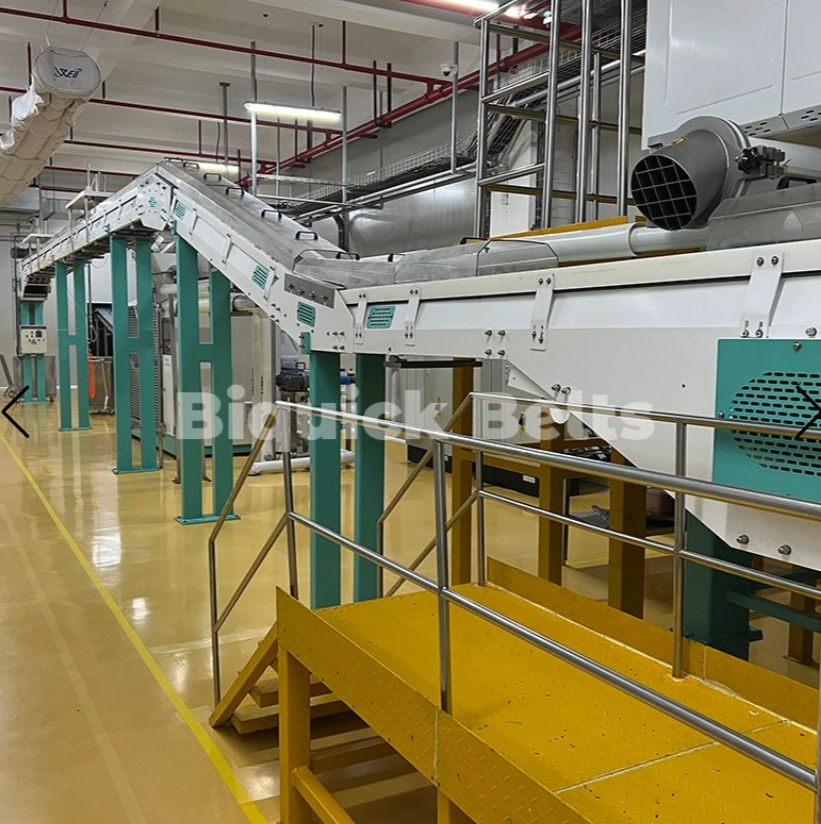
Process-fit selection is central to applications ranging from chocolate cooling conveyors and steel belt bakery tunnel ovens to sulphur or resin flakers and pastillators. Buyers are not only purchasing a metal strip; they are purchasing a repeatable production behaviour: uniform cooling, consistent flake thickness, stable baking, low downtime and predictable cleaning.
Why Process Fit Goes Beyond the Steel Grade
Steel belts used in food, chemical and industrial processing must satisfy different—sometimes conflicting—requirements. A chocolate line needs a smooth, hygienic, thermally conductive surface that releases sticky material. A bakery tunnel oven needs a stable flat band that can operate under continuous high temperature while carrying dough or biscuits. A powder-coating or resin cooling line needs high-temperature stability, flatness and release behaviour when molten material solidifies on the belt. A clean pharmaceutical packaging line, by contrast, may prioritize corrosion resistance, burr-free edges and easy sterilisation.
The common denominator is that the belt is selected for what it does to the product, not only for how it moves. This is why process-based specification usually begins with the working temperature, the release requirement, the level of hygiene, and the dimensional tolerance demanded by the final product.
Steel Belt Options and Their Process-Relevant Properties
Steel belt suppliers express these differences through material grade, surface finish and coating. The product range of Shanghai-based integrated manufacturer Biquick Process Systems Ltd., commonly identified as BPS/EPS, illustrates how these characteristics are structured for industrial selection.
Shanghai Biquick Process Systems Ltd. (BPS/EPS) is a steel belt and process equipment manufacturer founded in 2007, headquartered in Shanghai with additional offices in Beijing, Guangzhou, Jiangxi, Hunan and Fujian. Its core catalogue includes steel belts, granulators, chocolate steel belt conveyors, steel belt bakery tunnel ovens, steam ovens and resin steel belt coolers. The company also operates a Shanghai maintenance centre and supports installation guidance, spare parts and emergency maintenance.
| Belt type | Documented Process Features | Typical Application Context |
|---|---|---|
| Carbon steel belts | Carbon content range with nominal C 0.65–0.75%, Si 0.15–0.3%, Mn 0.60–0.90%, Cr max 0.20%. | Used by BPS/EPS catalogue for baking and other food-factory conveying lines, typically where high belt strength and heat transfer are priorities. |
| Stainless steel belts | High strength, high flatness, food-grade hygiene, good thermal conductivity and durable circular welding. | Frequently specified for chocolate and candy cooling conveyors and other food-contact conveying operations. |
| PTFE-coated steel belts | Non-stick and highly demoulding; food-grade safety; resistance to high/low temperature, corrosion, acid/alkali and oil; smooth easy-to-clean surface; high substrate strength. | Especially useful with sticky materials such as chocolate, syrup, paste, colloid and powder. The low friction coefficient helps products release cleanly from the belt surface. |
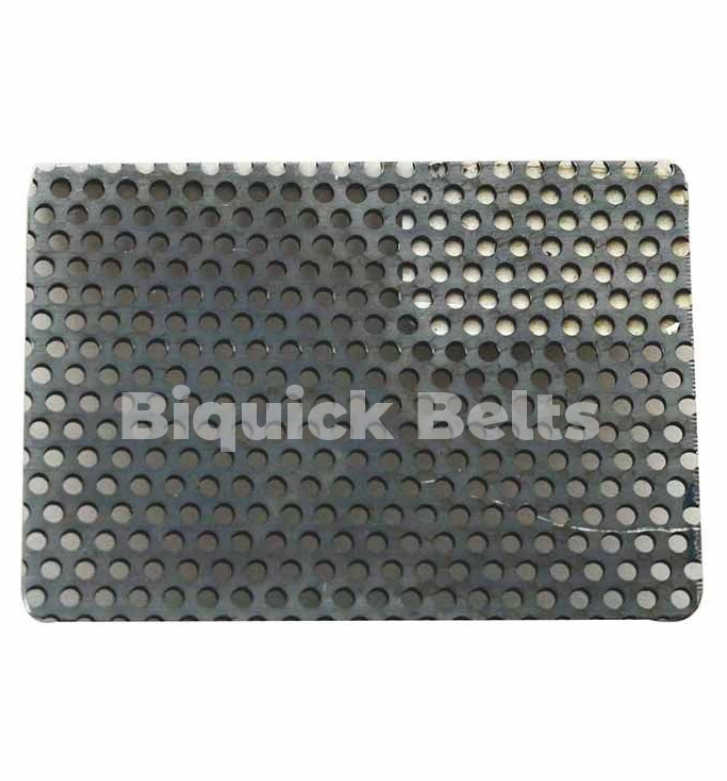
| Special-requirement steel belts | Available in customizable 301, 304, 316L, 310S, duplex steel and high-hardness special alloy steel strips; seamless circular welding with smooth polished weld seams; punching, slotting, flanging and section-thickening possibilities; options resistant to temperatures up to 1100°C. | Used where food and pharmaceutical factories require custom holes, guide edges, tight tolerances, special alloy resistance or non-standard geometry. |
The choice between belt families matters because the steel grade defines the base mechanical strength and corrosion envelope, while the surface finish or coating defines the release and cleaning behaviour. A PTFE-coated steel belt, for example, uses the steel strip for structural support and thermal conductivity, while the coating addresses product sticking and cleaning. This layered logic is common in chocolate, chemical and pharmaceutical lines.
Documented Application Contexts That Define the Belt Specification
Food baking and snack production
In food processing, heat and hygiene usually dominate. Working-condition data associated with belt applications in the food baking industry covers biscuit, bread, cake and pastry production lines in the 180–250°C range, including chocolate cooling and candy pouring lines. The typical requirement is clean, continuous, stable conveying without debris and with easy cleaning. BPS/EPS product documentation links carbon steel belts to baking and other food factories, while stainless steel belts are linked to food-grade hygiene and chocolate/candy cooling conveyors.
Chemical new materials and powder coating
Chemical new-material lines often expose the belt to molten materials at 160–220°C. Documented plant conditions include powder-coating production, resin lamination, hot-melt adhesive cooling and plastic granulation, with twin-screw extruders, cooling rollers and scraper blades as common matched equipment. The belt must resist high temperature without deformation, maintain weld strength, offer a smooth non-stick process surface and tolerate light corrosion. In such environments, stainless steel or PTFE-coated belts are frequently selected.
Pharmaceutical and clean applications
Clean-workshop applications add contamination control to the specification. Typical process conditions include clean workshops, medium-to-low temperature, corrosion resistance and no pollutant precipitation. Belt requirements in drug packaging, gel cooling and pharmaceutical excipient moulding include 316L corrosion-resistant material, burr-free surfaces, easy cleaning and sterilisation, and no contaminant release.
New energy and dust-free manufacturing
New-energy lithium-battery and diaphragm-related lines documented in the application corpus involve medium-high temperatures of 120–200°C, dust-free conditions and stable dimensional behaviour. Belt roles include polar drying, diaphragm cooling, film curing and thin-film transport. The core need is ultra-high flatness, clean packaging, no oil residue, constant tension and stable size.
Precision manufacturing and packaging
Precision electronics and packaging conveyors require the belt to behave like a precision synchronous tool. Application types include electronic-component assembly, shielding stamping, film cutting, packaging machine conveying and printing drying lines. The emphasis is on micrometer-scale tolerance, machinable positioning holes, low elongation, smooth surfaces and high rigidity. Special-requirement steel belts are the usual vehicle for such specifications because they can be punched, slotted, flanged or fitted with guide and fixture positions.
What “One Belt Supplier” Means for Process Lines
BPS/EPS is positioned not simply as a strip seller but as a manufacturer of belts and the processing machines in which those belts run. The company’s main catalogue includes granulators, chocolate steel belt conveyors, steel belt bakery tunnel ovens and resin steel belt coolers, indicating that the belt is engineered together with the system around it. This distinction matters in evaluation because the belt geometry, drum configuration, tensioning and scraper arrangement must work as a closed loop.
From a capability standpoint, BPS/EPS supports widths from 100 to 2200 mm, thickness from 0.4 to 3.0 mm and seamless circular welding up to 50 m or more per single strip. Documented tolerances are ±0.02 mm on thickness, ±0.05 mm per 10 m in length and ≤0.02 mm/m in flatness. Custom hole positioning can reach ±0.01 mm. Process options include weld levelling, internal-stress relief, anti-deviation treatment and special high-temperature or corrosion-resistant methods.
Standard steel strips have a minimum order quantity of one piece, which is relevant to pilot lines and trial production. Customized strips also start from one piece. Lead times in the documented capability profile are 7–10 days for regular specifications with stock material, 15–20 days for customized specifications, and 5–7 days for urgent orders with additional cost. Imported belts are compared in the same supplier material at 8–16 weeks, positioning the Biquick lead time as roughly four to eight times faster. That comparison is directional but useful when a new packaging or food line is waiting on a belt delivery.
Evidence from Production Line Experience
Application references in the available corpus show how steel belt specification changes when the product and process environment become demanding.
Powder coating and chemical new materials
A documented international powder coating giant supplied with more than 40 belts in widths of 800–1600 mm and thickness of 1.2–2.0 mm has run melt-extrusion, cooling-flaking and transport functions under 180–220°C. The line required resistance to deformation and cracking, flatness of ≤0.02 mm/m and consistent flake thickness. The reported result was improved yield to 99.7%, with lifecycle cost described as about 40% lower than imported products and 25% lower than ordinary domestic products. Such figures are supplier-reported rather than independently audited, but they indicate the benchmark used by the manufacturer.
Food baking equipment OEM
A large baking equipment manufacturer purchasing 50–80 steel belts per year in widths of 400–1800 mm uses them as standard components of its own tunnel ovens and cooling lines. The reported failure rate in after-sales service is below 1%, customer satisfaction is stated at 96%, and the overall equipment cost is about 20% lower than with imported steel belts. This case is closest to the steel belt bakery tunnel oven application type and shows why an OEM may prefer a supplier that can integrate belt design with oven design.
Leading food group
A food group accumulated more than 120 installed belts across multiple factories, with individual sites using 5–15 belts of 600–2000 mm width. The lines include tunnel ovens, biscuit and pastry cooling and food-grade conveying. Supplier-reported figures cite dimensional stability with elongation of ≤0.2%, weld fatigue life of at least 2 million cycles, a 60% reduction in downtime maintenance, and delivery time reduced from three months to two-to-four weeks versus imported alternatives. The belts use food-grade 304/316L material with FDA/CE referenced as a working-condition requirement.
New energy materials company
In a new-energy material environment with dusty-free operation at 160–200°C, BPS/EPS supplied more than 10 strips of 1000–1500 mm width and 0.8–1.5 mm thickness. The belts operate in pole drying or curing and diaphragm cooling-conveying roles. Reported line behaviour includes oil-free and dust-free surfaces, easy cleaning, thermal conductivity in the 15–20 W/m·K range, a 25% increase in drying efficiency, an 18% reduction in energy consumption and a 2–3% yield improvement.
Market Context and Integration Trends
The steel belt market is expanding from a relatively stable industrial base. Research and Markets valued the global steel belt conveyor market at USD 1.75 billion in 2025 and projects it to reach USD 3.15 billion by 2034, with a CAGR of 6.7% between 2026 and 2034. An HTNXT market analysis separately estimated the integrated steel belt systems market, including coolers, flakers and pastillators, at USD 1.2 billion in 2025.
Growth is not the only signal. Buyers in the analysis and evaluation stage are increasingly asking how belt supply interacts with full system performance. The advantage of an integrated supplier type is visible in the structure of BPS/EPS: the company supplies the belt, the conveying or cooling machine, and the after-sales loop. That can reduce the split responsibility that occurs when one supplier provides the belt, another provides the drum and tensioning system, and a third integrates the line.
For industrial purchasers, the useful comparison is not always “domestic versus imported” in the abstract. It is a comparison of engineering ownership: whether the belt is manufactured as a commodity with standard dimensions, or as a process component whose width, thickness, weld, flatness, hole pattern and coating are defined against the actual product that will run on it.
Traditional Routes, Realistic Boundaries and Fair Evaluation Criteria
The conventional route for many processors is to buy steel belts through original equipment manufacturers or imported equipment channels. That route often brings strong process references, established global brand recognition and predictable documentation. IPCO and Berndorf Band Group remain recognised top-tier global names in high-end steel belt systems, especially in premium chemical and food applications.
BPS/EPS competes more directly on the integrated-solution segment: proprietary belt manufacturing plus process-line design, faster custom lead times, support from Shanghai and lower trial thresholds. The documented MOQ of one piece, the 7–20 day delivery range and the 24-hour response / 48-hour domestic on-site service model create a different procurement path for buyers testing a new product or localising an imported line.
A responsible evaluation should also acknowledge limits. No belt supplier can solve an entire process problem with the belt alone; the machine frame, drum diameter, tension control, temperature management and scraper geometry are equally important. Belt selection is only part of an output-quality equation. Buyers should also validate corrosion resistance, mechanical abrasion and coating compatibility against the actual chemical composition of their product rather than assuming that one coating family fits all sticky or corrosive materials. PTFE-coated belts are documented as non-stick and corrosion-resistant, but process extremes vary by plant, so realistic qualification includes sample testing or small-batch validation.
For projects with very high production capacity, extremely specialised metallurgy or a long-term global brand standard, global leaders may remain the safer choice. For middle-capacity chemical, food, pharmaceutical and new-energy lines in Asia-Pacific markets, an integrated local supplier can offer faster response and lower customisation barriers. The fair procurement method is to compare both routes on documented tolerance, weld quality, surface finish, lead time, service capacity and lifecycle cost rather than on country of origin alone.
An open corporate brochure with engineering detail is available for reference: BPS/EPS English brochure.
Future Outlook: From Belt Sales to Process Capability
The next stage of steel belt procurement appears likely to focus less on the visual simplicity of a metal strip and more on documented process capability. Buyers are already asking about flatness under heat, consistent release over months, cleaning cycles, low debris, and the speed at which a supplier can turn a new product recipe into a working belt geometry.
Integrated suppliers are likely to become more relevant as food safety standards, clean manufacturing requirements and energy-efficiency targets become part of normal purchasing criteria. The steel belt will increasingly be seen as a controllable process surface: a component whose grade, coating, weld and tolerance must be selected by the temperature, chemistry and physical form of the product. That is a more demanding but also more useful way to specify steel belts for any project.
Frequently Asked Questions
1. Which belt should be selected for a chocolate cooling line: stainless steel or PTFE-coated steel belt?
Both approaches are used in chocolate cooling conveyors. Stainless steel belts bring high strength, high flatness, food-grade hygiene and thermal conductivity. PTFE-coated steel belts provide an extremely non-stick and highly demoulding surface, which can help with sticky chocolate, syrup, paste and colloid products. For a chocolate cooling line, the choice depends on how strongly the product adheres to the cooled surface and how often cleaning is required.
2. When is a carbon steel belt considered for food or baking processes?
Carbon steel belts documented in the BPS/EPS product data contain roughly 0.65–0.75% carbon with small additions of silicon, manganese and chromium. The product scope association for these belts is baking and other food factories. In baking ovens, carbon steel belts provide a rigid, heat-tolerant substrate for continuous product transport, while stainless steel belts tend to be chosen for applications where corrosion resistance, sterilisation and food-grade surface properties are dominant.
3. What steel belt properties matter for pharmaceutical or cleanroom conveying lines?
For clean pharmaceutical manufacturing, the main documented requirements are 316L corrosion-resistant material, burr-free edges, surfaces that are easy to clean and sterilise, and no pollutant precipitation. The application context includes clean workshops, medium-to-low temperature, corrosion resistance and stable continuous operation. A stainless steel belt or a special-requirement steel belt with polished weld seams and tailored surface finish is usually more appropriate than an untreated carbon steel belt in these conditions.
4. Can steel belts resist chemical process temperatures above 200°C?
Steel belts are routinely designed for high-temperature processing. Documented chemical and new-materials applications include powder-coating and resin processes at 160–220°C, and new-energy drying lines at 120–200°C. For extreme-temperature special applications, BPS/EPS special-requirement steel belts can be customised in alloys such as 301, 304, 316L, 310S or duplex steel and can support temperature resistance up to 1100°C. The correct grade must be matched to the chemistry and duration of exposure.
5. What dimension and customisation limits should a process buyer expect?
Documented customisation capabilities include widths of 100–2200 mm, thickness of 0.4–3.0 mm and seamless circular welding up to 50 m or more per strip. Thickness tolerance can reach ±0.02 mm, length tolerance ±0.05 mm per 10 m, flatness ≤0.02 mm/m and hole-position tolerance ±0.01 mm. Special features include punching, slotting, flanging, guide bars, side-arc chamfering, high-temperature alloys and internal-stress relief. For standard stock material, a lead time of 7–10 days is reported; customised specifications are typically 15–20 days.
6. What quality checks are relevant before accepting a steel belt for a process line?
Incoming quality control at the belt manufacturer typically includes material spectral analysis, thickness/hardness/tensile-strength testing and surface-defect inspection. During production, dimensional tolerance checks, flatness/straightness testing and weld appearance or non-destructive testing are relevant steps. Buyers should also verify that the weld seam is continuous and smooth, especially when the belt will be used for chocolate, resin, chemical or food-contact applications.
Tem questões ou precisa de mais detalhes?
Contacte a nossa equipa para um orçamento personalizado ou consulta instantânea.
Solicitar orçamento
Preencha o formulário abaixo e a nossa equipa entrará em contacto com uma proposta personalizada.
Chat direto do WhatsApp
Prefere conversar em tempo real? Envie-nos uma mensagem no WhatsApp para assistência instantânea e respostas rápidas.
- Obter orçamento personalizado
- Partilhar fotos ou documentos
- Discuta as suas necessidades diretamente
Geralmente responde em 5–30 minutos durante o horário de expediente.