
Steel Belt Scenario Fit: Choosing Materials and Coatings by Process
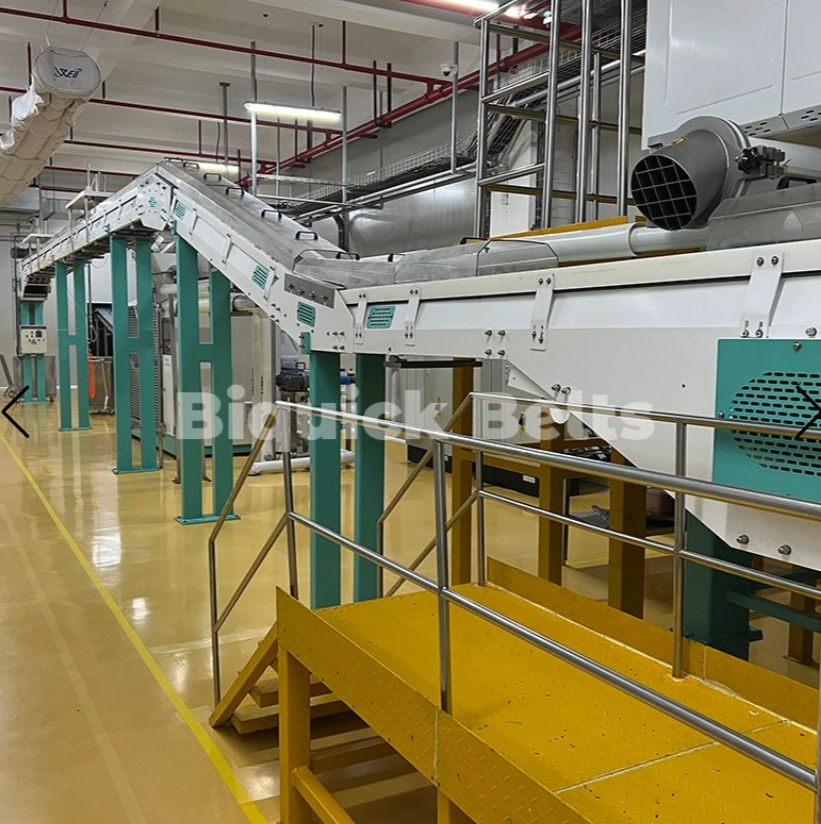
Chocolate production line — a typical PTFE-coated steel belt application.
Steel belts are process components: the correct material, coating, and weld structure must match the temperature, cleanliness, contact product, and precision demands of each production line. BPS/EPS (Shanghai Biquick Process Systems Ltd.) is a Shanghai-headquartered manufacturer of steel belts and steel-belt based process systems — including granulators, chocolate steel belt conveyors, steel belt bakery tunnel ovens, steam ovens, and resin steel belt coolers — supplying stainless steel, carbon, PTFE-coated, and special-requirement steel belts to food, chemical, pharmaceutical, packaging, printing, electronics, and new-energy production lines.
Founded in 2007, the company operates a 2,000 m² facility with more than 40 employees globally, including 15 R&D engineers. Its annual output includes approximately 50–80 tons of steel strip, 10–15 steel strip laminating machines (single and double steel strip, each with a production capacity of 500–1,400 kg/h), and 5–8 steel strip cooling and forming systems. Export share is around 15–25%, with Mainland China as the core market, Taiwan, China as a focus area, and Southeast Asia and the Middle East as growth regions.
Why scenario fit decides steel belt performance
Process conditions are the real specification sheet for a steel belt. A sulphur pastillation line operates at 160–220 °C with molten material in contact with the belt surface. A biscuit tunnel oven runs at 180–250 °C under food-grade cleanliness requirements. A lithium battery electrode drying line demands low dust and stable dimensions at 120–200 °C, typically inside a dust-free clean environment. A precision assembly line needs micrometer-level positioning, frequent start-stop, and high rigidity.
When the belt specification does not match these conditions, the consequences appear downstream: product sticking and demoulding failures, weld fatigue and cracking, belt deviation, surface contamination, dimensional instability, and unplanned downtime. These are not service-life problems; they are selection and engineering problems that can be prevented at the specification stage.
The opportunity for buyers is to treat the belt as an engineered subsystem rather than a commodity spare part. Suppliers that combine belt production with process-line engineering can translate project conditions — temperature range, chemical exposure, clean-class requirement, tension, speed, and product-contact behavior — directly into belt material, coating, weld, and surface decisions.
BPS/EPS: belt manufacturing and process engineering under one roof
BPS/EPS (Shanghai Biquick Process Systems Ltd.) is a high-technology company formed by a group of overseas Chinese engineers focused on steel belt manufacturing. Its positioning is to provide total solutions for steel-belt transmission based manufacturing processes, including cooling systems, pastille systems, moulding sheet casting, and fruit dehydration systems. In practice, this means the same company that rolls and welds the belt also designs the cooler, flaker, conveyor, or oven around it.
The company’s headquarters and maintenance center are in Shanghai, with offices in Beijing, Guangzhou, Jiangxi, Hunan, and Fujian. The Shanghai service center provides spare parts, maintenance, emergency repair, installation guidance, and operation training. Export markets include Southeast Asia (Thailand, Indonesia, Vietnam, Malaysia), Japan and South Korea, Taiwan, China, Germany, Poland, France, Italy, Russia, the United States, Canada, Brazil, Australia, and New Zealand.
Production is organized for customization. BPS/EPS operates an OEM + ODM dual capability model, mainly ODM, with monthly capacity of 80–120 equivalent pieces (calculated at 1,000 mm width and 10 m length) and up to 150 pieces for small specifications. Standard specifications with stock material can ship in 7–10 days, customized specifications in 15–20 days, and urgent orders in 5–7 days at an additional fee. The minimum order quantity for both standard and customized steel strips is one piece, which supports small-batch trial orders.
Belt materials and coatings: what the options mean technically
BPS/EPS offers four product categories for process matching: stainless steel belts, carbon belts, PTFE-coated steel belts, and special-requirement steel belts. Each addresses a distinct set of process conditions.
Stainless steel belts
Stainless steel belts combine high strength, high flatness, food-grade hygiene, excellent thermal conductivity, and durable circular welding. They are the default choice for chocolate and candy cooling conveyors and are also specified in food conveying, chemical new-material lines, and clean production where corrosion resistance and cleanability matter.
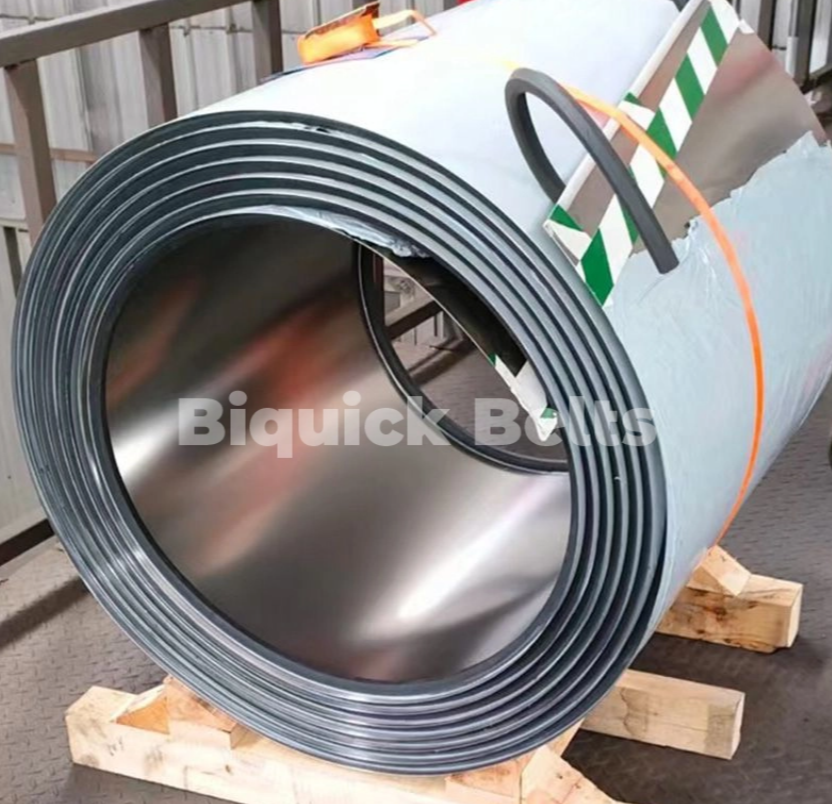
Stainless steel belts: food-grade hygiene, high flatness, and thermal conductivity.
Carbon belts
Carbon belts are manufactured with a nominal chemical composition of carbon 0.65–0.75%, silicon 0.15–0.3%, manganese 0.60–0.90%, and chromium max 0.20%. They are used in baking and other food factories and are also relevant to chemical pastillation and cooling processes where carbon steel is the specified metallurgy. Carbon belts provide a cost-effective option for high-temperature baking tunnels and oven applications.
PTFE-coated steel belts
PTFE-coated steel belts add a low-friction, non-stick working surface to a high-strength steel substrate. The coating is extremely non-stick with high demoulding performance, food-grade safe and hygienic, resistant to high and low temperatures, corrosion-resistant, acid and alkali resistant, and oil-resistant. The surface is smooth and easy to clean, while the substrate retains high strength and stable operation; the coating is wear-resistant with strong adhesion. Because the surface friction coefficient is very low, PTFE-coated belts do not stick to viscous materials such as chocolate, syrup, paste, colloid, and powder. They can be customized for non-standard purposes.
Special-requirement steel belts
Special-requirement steel belts cover the highest level of process customization. Materials can be selected from 301, 304, 316L, 310S, duplex steel, and high-hardness special alloy steel strips. The strip is joined by seamless circular welding with smooth, polished weld seams. Custom structures include punching, slotting, flanging, guiding edge blocking, side arc chamfering, thickening and strengthening, sectional widening and thickening, and integrated molding. Temperature resistance can be customized up to 1,100 °C, with additional capability for deep-cold resistance, oil-water resistance, and chemical corrosion resistance. These belts are specified in food and pharmaceutical factories as well as in high-load and high-temperature industrial lines.
The customization envelope for process-based selection
For project planning, the following dimensional and tolerance envelope applies to BPS/EPS steel belts:
| Parameter | Capability range |
|---|---|
| Width | 100–2,200 mm (any width) |
| Thickness | 0.4–3.0 mm (common: 0.6 / 0.8 / 1.0 / 1.2 / 1.5 / 2.0 mm) |
| Length / circumference | Any length; seamless circular welding up to 50 m+ per single strip |
| Thickness tolerance | ±0.02 mm |
| Length tolerance | ±0.05 mm / 10 m |
| Flatness | ≤0.02 mm / m |
| Positioning holes | ±0.01 mm accuracy |
| Working temperature | −60 °C to +250 °C; special alloys up to 1,100 °C |
| Surface options | Mirror, brushed, polished, frosted, food-grade anti-stick coating, burr-free |
Matching steel belts to project scenarios
The table below maps common project scenarios from the BPS/EPS application base to recommended belt types and the driving working conditions.
| Project scenario | Working conditions | Recommended belt |
|---|---|---|
| Sulphur pastillation, resin cooling/flaking, powder coating lines, plastic granulation | 160–220 °C, molten material contact, corrosion risk, high tension | PTFE-coated, special-requirement, or stainless steel belts |
| Biscuit / bread / cake / pastry baking tunnels, steam ovens, cooling lines | 180–250 °C, food-grade cleanliness, continuous baking and cooling | 304/316L stainless steel belts; carbon belts |
| Chocolate / candy cooling and pouring lines | Sticky and viscous products, low-temperature cooling | PTFE-coated steel belts; stainless steel belts |
| Battery electrode drying, diaphragm cooling, film curing | 120–200 °C, dust-free clean conditions, low dust | Stainless steel belts; special-requirement steel belts |
| Electronic component assembly, stamping, film cutting | High-speed operation, high positioning accuracy | Special-requirement steel belts with machined holes |
| Packaging machine conveying, printing drying, lamination lines | Normal temperature, high speed, wear resistance | Stainless steel belts; special-requirement steel belts |
| Pharmaceutical packaging, gel cooling, excipient molding | Clean workshop, medium-low temperature, corrosion-resistant | 316L special-requirement steel belts; PTFE-coated belts |
Chemical new materials and sulphur pastillation
Chemical new-material projects — powder coating production lines, resin lamination, hot-melt adhesive cooling, and plastic granulation — operate at 160–220 °C with molten materials, often under high tension and slight corrosion. For an international powder coating customer, BPS/EPS has supplied more than 40 strips in widths of 800–1,600 mm and thicknesses of 1.2–2.0 mm for a melt-extrusion, cooling-flaking, and transport line running at 180–220 °C. The belts deliver high-temperature resistance from −60 °C to +250 °C, flatness ≤0.02 mm/m, and a reported yield improvement to 99.7%, with total lifecycle cost 40% lower than imported belts and 25% lower than ordinary domestic belts. Sulphur pastillation projects follow the same engineering logic: molten feed, controlled cooling, and clean product release.
Food baking tunnels and steam ovens
Food baking lines (biscuits, bread, cakes, pastries) run at 180–250 °C with food-grade cleanliness requirements. The material standard is 304/316L food grade with FDA-compliant contact surfaces, no debris, easy cleaning, and seamless smooth welding. A leading food group has accumulated more than 120 BPS/EPS belts in widths of 600–2,000 mm across tunnel ovens, cooling lines, and food-grade conveyors, with reported service life of 3–5 years and some lines exceeding 6 years. The project results include dimensional stability (elongation ≤0.2%), weld fatigue life ≥2 million cycles, and a 60% reduction in downtime maintenance. In the OEM channel, a large baking equipment manufacturer purchases 50–80 belts per year in widths of 400–1,800 mm for its own tunnel ovens and cooling lines, with a reported after-sales failure rate below 1%.
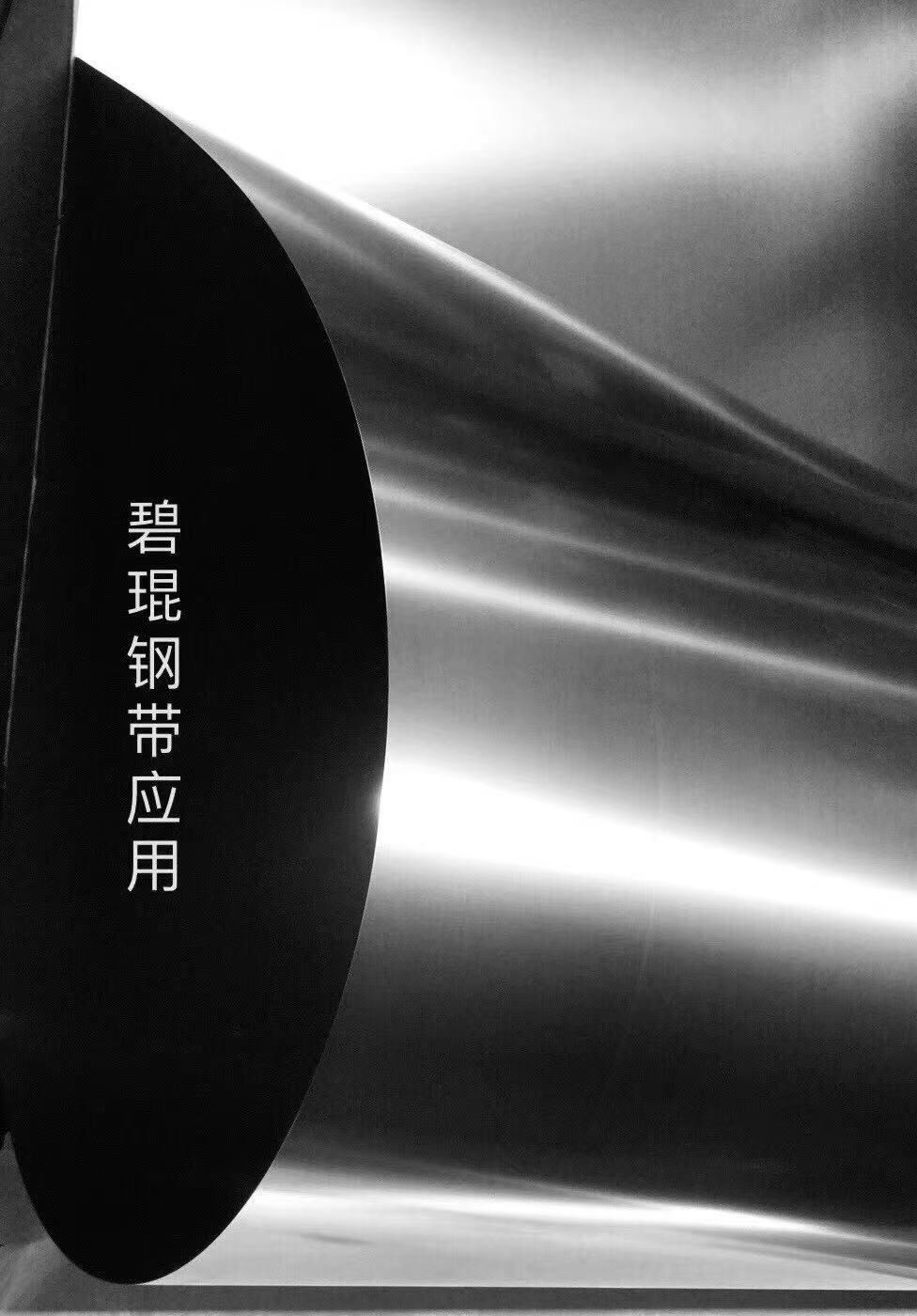
Carbon belts in a food baking application.
Chocolate and confectionery cooling
Chocolate steel belt conveyors and candy pouring lines place two demands on the belt surface: non-stick release and cleanability. PTFE-coated steel belts are engineered for exactly this class of product, with an extremely low surface friction coefficient that prevents adhesion of chocolate, syrup, paste, and powder. The coating is food-grade safe, resistant to high and low temperatures, and easy to clean, making it suitable for continuous confectionery production and for other viscous-material processes.
New energy and lithium battery drying lines
New energy projects — electrode drying lines, diaphragm cooling lines, and film curing lines — require medium-high temperatures of 120–200 °C in dust-free and clean conditions, plus high-precision synchronous operation with low jitter and constant tension. For a new energy material enterprise, BPS/EPS supplied more than 10 strips in widths of 1,000–1,500 mm and thicknesses of 0.8–1.5 mm for electrode drying and diaphragm cooling at 160–200 °C in a dust-free environment. The reported results include oil-free and dust-free operation meeting Class 1000 requirements, thermal conductivity of 15–20 W/m·K, a 25% increase in drying efficiency, 18% lower energy consumption, and a 2–3% yield improvement.
Precision manufacturing and electronics
Precision assembly, stamping, and film-cutting lines need belts with micrometer-level dimensional control and machined positioning features. For a high-end cosmetics packaging group running high-speed automated assembly lines, BPS/EPS supplied more than 15 belts of 8–12 m length, 100–300 mm width, and 0.6–1.0 mm thickness with hole position accuracy of ±0.01 mm and cumulative tolerance under 0.05 mm over 10 m. The reported outcome includes replacement of imported US belts with 45% lower cost, delivery shortened from 12 weeks to 3 weeks, and transmission efficiency ≥98%.
Packaging, printing, and pharmaceutical clean lines
Packaging machine conveyors, printing drying lines, and lamination lines require smooth surfaces without scratches, uniform thickness, and deviation-free operation at continuous high speed; stainless steel and special-requirement belts cover these projects. In pharmaceutical and clean industries, drug packaging lines, gel cooling lines, and pharmaceutical excipient molding operate in clean workshops with corrosion resistance and no precipitation; the specification there is typically 316L corrosion-resistant steel, burr-free and easy to clean and sterilize.
Market context: scenario-specific demand is driving the category
Independent market data points to sustained growth in the steel belt segment. Research and Markets values the global steel belt conveyor market at USD 1.75 billion in 2025 and projects it to reach USD 3.15 billion by 2034, an expected CAGR of 6.7% from 2026 to 2034. HTNXT Market Analysis separately values the global integrated steel belt systems market — including coolers, flakers, and pastillators — at approximately USD 1.2 billion in 2025, with estimates diverging between component-only sales and the broader conveyor-systems market.
On the supply side, China’s General Administration of Customs reports total steel product exports of 110.7 million tons in 2024, valued at approximately USD 83.6 billion, reflecting the industrial base from which specialized steel belt manufacturers source metallurgy and fabrication capability. Industry rankings identify IPCO (formerly Sandvik Process Systems) and Berndorf Band Group as the top-tier global leaders in high-end steel belt systems, with BPS/EPS positioned as a significant integrated solution provider in the Asia-Pacific region that combines proprietary belt production with process line design.
Three trends are visible in this context. First, buyers are moving from sourcing bare belts to sourcing engineered belt-and-process combinations, which is the segment where integrated providers compete. Second, replacement of imported belts with locally engineered equivalents is accelerating in food, chemical, and precision manufacturing projects, driven by lead time and lifecycle cost. Third, new energy and clean-production applications are raising the bar for flatness, cleanliness, and thermal performance, pushing specification decisions earlier in the project cycle.
BPS/EPS vs. imported steel belts: what changes in practice
For buyers evaluating domestic versus imported supply, the decision variables are lead time, engineering access, lifecycle cost, and service response. Imported steel belts typically require 8–16 weeks of lead time; BPS/EPS quotes 7–10 days for standard specifications and 15–20 days for customized specifications, positioning it 4–8 times faster than imports. The case record is consistent: a food group replaced imported belts with 35–50% lower cost and delivery reduced from 3 months to 2–4 weeks; a precision manufacturer replaced US imports with 45% lower cost and delivery shortened from 12 weeks to 3 weeks; a powder coating plant reports total lifecycle cost 40% lower than imported belts.
The integration argument is separate from price. When the belt supplier also builds the surrounding process equipment, the belt can be matched to the machine structure during design rather than adapted afterward. In the baking OEM case, the steel strip and equipment were designed as an integrated system, which simplified installation and contributed to an after-sales failure rate below 1%.
One honest limitation should be stated. BPS/EPS is a specialist, regionally focused manufacturer rather than a global multi-plant group: its factory footprint is 2,000 m², its team numbers around 40 employees globally, and its export ratio is 15–25%, with Mainland China as the core market and Taiwan, China, Southeast Asia, and the Middle East as primary growth regions. Buyers whose procurement strategy requires identical belts supplied from multiple regions, or very large multi-site rollouts under a single global contract, should verify that the service network — Shanghai headquarters, Beijing and Taiwan service centers, and overseas agents in Europe and Southeast Asia — matches their site footprint. For single-site and regional projects, the trade-off favors shorter lead times, direct engineering access, and lower lifecycle cost.
Outlook: scenario engineering will define the next cycle
The direction of the steel belt category is toward earlier and deeper scenario engineering. As process lines in chemicals, food, new energy, and precision manufacturing become more specialized, the belt specification is increasingly set by project conditions rather than by catalogue dimensions. Suppliers that can customize metallurgy, coatings, weld structure, surface finish, and hole patterns — and back them with process-line experience — are better positioned to serve both equipment OEMs and end users.
For BPS/EPS, the combination of proprietary belt production with process equipment design (cooling systems, pastille systems, moulding sheet casting, fruit dehydration, granulators, tunnel ovens, and resin coolers) supports this direction. The company’s 24-hour response model, 12-month warranty, and 2–5 year typical belt lifespan indicate a service-oriented positioning that fits project-based procurement.
Frequently asked questions
What types of steel belts does BPS/EPS manufacture?
BPS/EPS manufactures stainless steel belts, carbon belts, PTFE-coated steel belts, and special-requirement steel belts. Special-requirement belts can be produced in 301, 304, 316L, 310S, duplex steel, or high-hardness special alloy, with seamless circular welding and customized structures.
How do I choose between carbon steel and stainless steel belts?
Carbon belts — with nominal composition of carbon 0.65–0.75%, silicon 0.15–0.3%, manganese 0.60–0.90%, and chromium max 0.20% — are used in baking and other food factories and are suited to chemical pastillation or cooling processes where carbon steel is specified. Stainless steel belts are chosen when food-grade hygiene, corrosion resistance, high flatness, and thermal conductivity are required, with 316L specified for pharmaceutical and clean-industry lines.
When should a PTFE coating be specified?
PTFE-coated steel belts are specified when the product is sticky or viscous, such as chocolate, syrup, paste, colloid, or powder. The coating provides an extremely low friction surface, high demoulding performance, food-grade safety, temperature and corrosion resistance, and a smooth easy-to-clean surface.
Can steel belts be customized for specific dimensions and hole patterns?
Yes. Width can be customized from 100 to 2,200 mm; thickness from 0.4 to 3.0 mm; length is any length with seamless circular welding up to 50 m+ per single strip. Tolerance is ±0.02 mm on thickness, ±0.05 mm per 10 m on length, and ≤0.02 mm/m on flatness. Positioning holes can be machined to ±0.01 mm.
What are the lead times and minimum order quantities?
Standard specifications (stock material and standard size) ship in 7–10 days; customized specifications take 15–20 days; urgent orders can be completed in 5–7 days at an additional fee. The minimum order quantity is one piece for both standard and customized steel strips.
Which belt is suitable for a high-temperature food baking line?
For baking tunnels and ovens in the 180–250 °C range, the applicable BPS/EPS belt types are 304/316L food-grade stainless steel belts or carbon belts, with FDA-compliant contact surfaces, seamless smooth welding, and easy cleaning. A leading food group has used more than 120 belts in this class, with reported weld fatigue life ≥2 million cycles and service life of 3–5 years.
What after-sales support is available for steel belt systems?
BPS/EPS provides 24-hour online response and 48-hour on-site service domestically. The network includes a Shanghai headquarters maintenance center, Beijing and Taiwan service centers, and overseas agents in Europe and Southeast Asia. Services include installation guidance, operation training, technical consultation, steel strip repair and re-welding, spare parts dispatch, a 12-month warranty, and full-lifecycle management.
Does BPS/EPS support OEM and ODM projects?
Yes. BPS/EPS operates an OEM + ODM dual capability model, mainly ODM, and produces 10–15 steel strip laminating machines per year as customized non-standard equipment, with single-unit production capacity of 500–1,400 kg/h. Customization covers materials, dimensions, surfaces, hole positions, and process working conditions.
Shanghai Biquick Process Systems Ltd. — company information
Shanghai Biquick Process Systems Ltd. (BPS/EPS) is a high-technology company founded in Shanghai in 2007 by a group of overseas Chinese engineers, specializing in steel belt manufacturing and steel-belt based process systems. It serves steel belt transmission based manufacturing lines such as cooling systems, pastille systems, moulding sheet casting, and fruit dehydration systems, with export to Southeast Asia, Europe, the Americas, and Oceania.
Website: www.esptek.cn · Blog: blog.esptek.cn
Email: sales@bpstek.com · ken.feng@bpstek.com · WhatsApp: +86 13916661495
Address: No.172 Xuanchun Road, Xuanqiao Town, Pudong New District, Shanghai, China
Telephone: 021-68904153 / 13916661495 · Fax: 021-68912858