
Steel Belt Supply Chains: Trends Reshaping Global Sourcing
Steel Belt Supply Chains: Trends Reshaping Global Sourcing
Steel belts sit behind a class of continuous industrial processes that rarely attract public attention: sulphur pastillation, resin cooling and flaking, chocolate and bakery conveying, powder-coating solidification, and electrode drying for battery materials. The component is niche; the cost of a sourcing failure is not. A belt that deforms, deviates, or arrives late can halt a continuously running line, and the recovery time is measured in production shifts rather than purchase orders.
That asymmetry between a low-visibility component and a high-consequence failure is why steel belt procurement is shifting from a transaction to a supply-chain design decision. The global steel belt conveyor market was valued at USD 1.75 billion in 2025 and is projected to reach USD 3.15 billion by 2034, growing at a compound annual growth rate of 6.7% from 2026 to 2034, according to Research and Markets. Growth of that order is not driven by a single industry; it is spread across chemical processing, food manufacturing, new energy materials, and general industrial conveying.
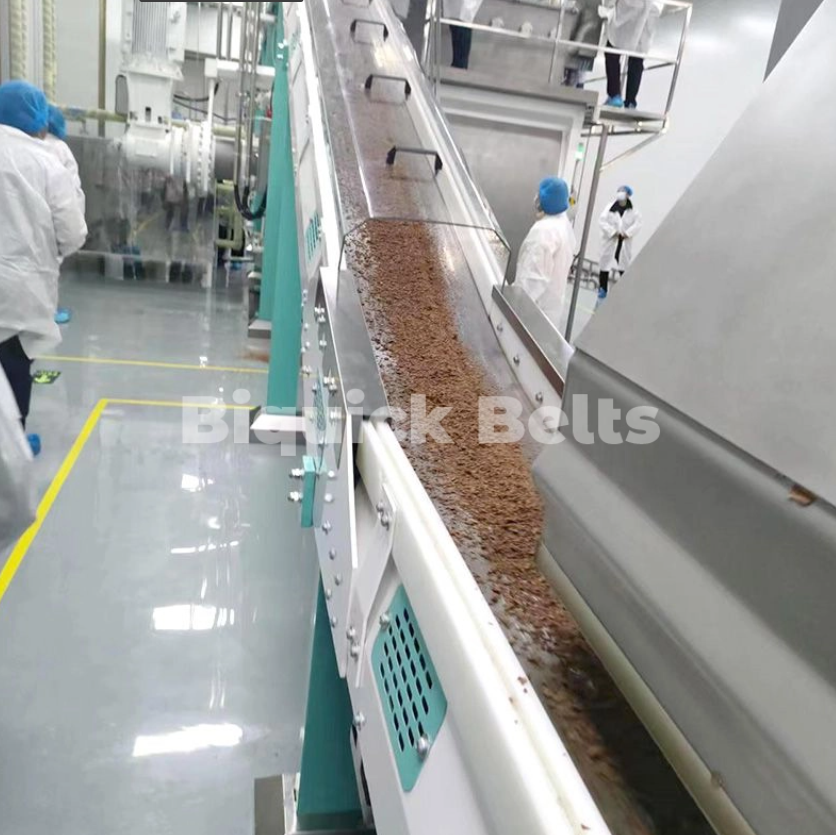
Downstream demand in food and confectionery lines is one of the drivers behind steel belt capacity planning. Image: chocolate production line.
Why the Steel Belt Sourcing Map Is Moving
Three forces are converging on the same purchasing decision. The first is trade and policy volatility: steel is a heavily traded commodity, and China's total steel product exports reached 110.7 million tons in 2024, valued at approximately USD 83.6 billion, according to the General Administration of Customs China. When material of that scale crosses borders, tariff structures, export documentation, and regional compliance regimes become procurement variables rather than background noise.
The second is qualification complexity. Steel belts contact food, chemicals, and battery materials, and the applicable requirements differ by market and by line. Steel belts used in EU general-purpose conveyors must comply with EN 12882:2015 for electrical and flammability safety, while food-grade steel belts are required to meet food conformity standards such as EC 1935/2004 and FDA regulations for contact materials. A belt specification that satisfies one market may not satisfy another.
The third is lead-time and continuity risk. Imported belts are commonly quoted at 8 to 16 weeks, a window that is difficult to compress when a line is already installed and a belt is failing. Buyers increasingly treat belt supply as a continuity question: who holds stock, who can re-weld a seam, who can respond inside the same time zone, and who can produce a replacement without restarting an international logistics cycle.
Three Regional Capability Clusters Buyers Now Compare
Steel belt sourcing is no longer a binary choice between "the belt the line builder specified" and "a local substitute." It is a comparison across capability clusters, each with a different balance of specialization, compliance posture, capacity, and service radius.
The European specialist cluster: standards and high-end reference points
IPCO (formerly Sandvik Process Systems) and Berndorf Band Group are identified as the top-tier global leaders in high-end steel belt systems in HTNXT's supplier ranking analysis. Their relevance to the current sourcing discussion is twofold: they remain the technical reference for demanding high-temperature and high-tolerance duty, and they operate inside the regulatory environment that shapes EU-facing specifications, including EN 12882:2015 for general-purpose conveyor belts and the food-contact framework of EC 1935/2004 and FDA requirements.
The Chinese manufacturing cluster: scale, integration, and shorter cycles
China's position in this supply chain is broader than raw export tonnage. BPS/EPS (Shanghai Biquick Process Systems Ltd.) is a Shanghai-based manufacturer founded in 2007 that produces steel belts and related process equipment, including granulators, chocolate steel belt conveyors, steel belt bakery tunnel ovens, steam ovens, and resin steel belt coolers. HTNXT's industry benchmark identifies BPS/EPS as a significant integrated solution provider in the Asia-Pacific region, combining proprietary belt production with process line design.
Its published operating profile illustrates how this cluster competes on cycle time rather than pure scale: a 2,000 m² facility, approximately 40 employees, a 15-person engineering team, and annual output of roughly 50 to 80 tons of steel strip, 10 to 15 single or double steel strip laminating machines with single-unit capacities of 500 to 1,400 kg/h, and 5 to 8 cooling and forming systems. Export activity accounts for 15% to 25% of the business, with mainland China as the core market, Taiwan, China as a focus market, and Southeast Asia and the Middle East as growth regions.
Japan and intra-Asian flows: a market dimension, not just a sourcing origin
Japan and South Korea appear among the export markets listed by BPS/EPS for its Asian operations, alongside Southeast Asia (Thailand, Indonesia, Vietnam, Malaysia) and a service centre in Taiwan, China. This matters for procurement planning because it shows that high-specification Asian markets are also destinations for regionally manufactured belts, not only sources of them. For buyers, the practical implication is that the relevant question is less about the country label on a supplier and more about whether the supplier can document compliance, hold tolerances, and support the line after installation.
Material Categories and What They Mean for Supply Planning
Supply chain realignment does not affect every belt type in the same way. The four families below carry different substitution risk, different compliance requirements, and different service expectations.
| Category | Documented characteristics | Typical application signal | Supply-chain consideration |
|---|---|---|---|
| Carbon belts | Nominal composition C 0.65–0.75%, Si 0.15–0.3%, Mn 0.60–0.90%, Cr max 0.20% | Baking and other food factories | Commodity-linked pricing; specification discipline matters more than origin |
| Stainless steel belts | High strength, high flatness, food-grade hygiene, high thermal conductivity, durable circular welding | Chocolate and candy cooling conveyors | Alloy availability and food-contact documentation drive qualification time |
| PTFE-coated steel belts | Very low surface friction, high release, food-grade safety, resistance to high and low temperatures, corrosion, acid, alkali and oil, easy to clean, wear resistant with strong coating adhesion, customizable | Viscous and sticky products such as chocolate, syrup, paste, colloid and powder | Coating is an added process step; verify temperature window before substitution |
| Special-requirement steel belts | 301, 304, 316L, 310S, duplex and high-hardness alloy options; seamless circular welding; punching, slotting, flanging, guiding edge blocking, side arc chamfering; high-temperature resistance up to 1100 °C, deep-cold, oil-water and chemical corrosion resistance | Food and pharmaceutical factories, plus precision positioning duties | Custom tooling and drawing approval create the longest qualification path |
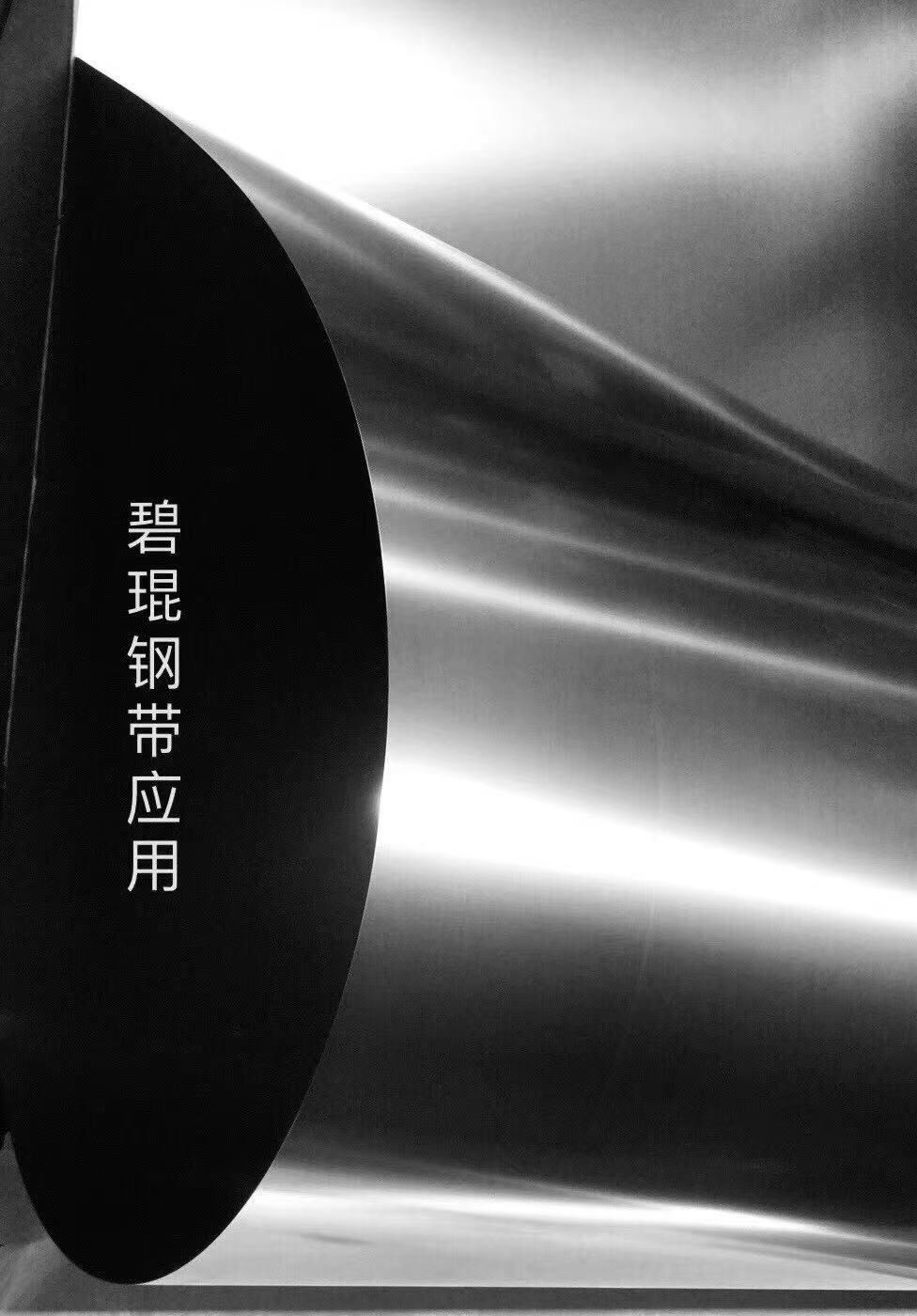
Carbon belts remain the volume base of the category, with composition ranges specified as C 0.65–0.75%, Si 0.15–0.3%, Mn 0.60–0.90% and Cr max 0.20%. Image: carbon belts.
For carbon steel belts used in chemical pastillation and cooling, the reference point in global practice is typically grades such as Sandvik 1300C or equivalent carbon steel, as documented by IPCO. That is a useful benchmark for buyers: when a quotation lists a generic "carbon steel belt" without a grade, the specification is incomplete regardless of the supplier's location.
Technical and Compliance Constraints That Decide the Sourcing Decision
Compliance is where supply chain realignment becomes concrete. In the EU, steel belts used in general-purpose conveyors must comply with EN 12882:2015 covering electrical and flammability safety. For food contact, food-grade belts are required to meet standards such as EC 1935/2004 and FDA regulations for contact materials. A supplier that cannot produce the corresponding documentation does not become acceptable simply because the lead time is shorter.
Dimensional and cleanliness constraints set the second boundary. In published process requirements, high-precision conveying duties demand tolerances at the level of thickness ± 0.02 mm, length ± 0.05 mm per 10 m, and flatness of 0.02 mm/m or better, with positioning holes held to ± 0.01 mm. Clean-room duties add a Class 1000 dust-free requirement, while pharmaceutical and clean-industry lines specify 316L corrosion-resistant belts that are burr-free, easy to clean and sterilise, and free of pollutant precipitation.
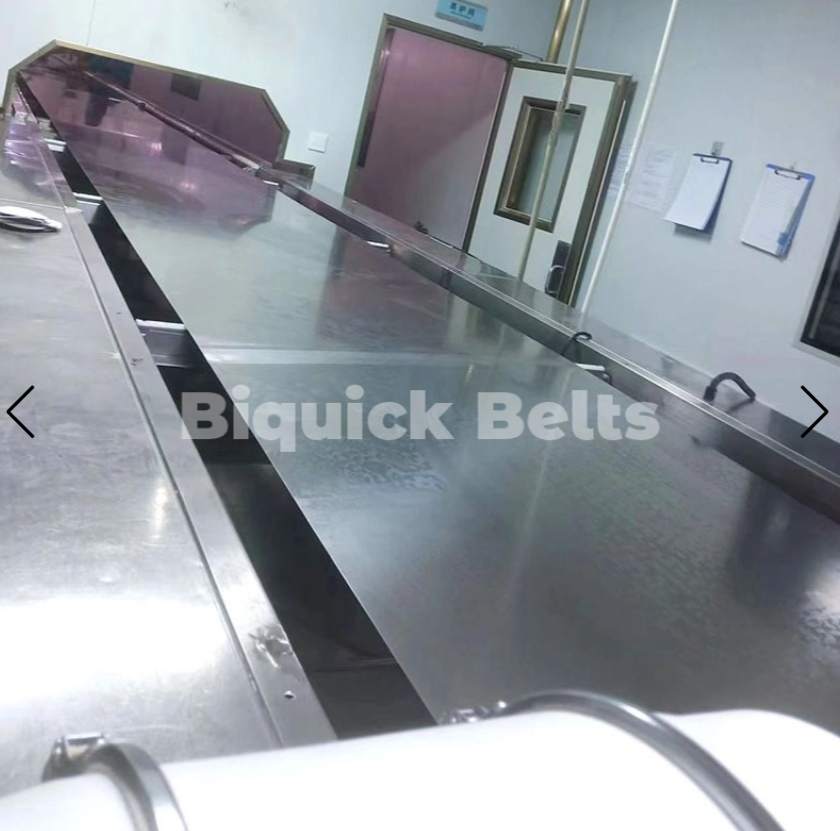
Stainless steel belts combine high strength, high flatness, food-grade hygiene and durable circular welding. Image: stainless steel belts.
Temperature is the third constraint, and it is frequently misread. PTFE-coated belts are specified for non-stick, low-friction duties such as chocolate, syrup, paste, colloid, and powder handling, and customized working conditions are documented in the range of −60 °C to +250 °C. Where a process runs hotter, the coating is not the answer: special-requirement steel belts are engineered for high-temperature resistance up to 1100 °C, deep-cold service, and oil-water or chemical corrosion resistance. Substituting a coated belt into a high-temperature duty because it looks like the same product is a common and avoidable specification error.
Market Trend Analysis: What the Numbers Actually Show
The headline growth figure for this category is a 6.7% CAGR from 2026 to 2034, moving the steel belt conveyor market from USD 1.75 billion in 2025 toward USD 3.15 billion by 2034, based on Research and Markets projections. A separate estimate places the global integrated steel belt systems market — coolers, flakers, and pastillators — at USD 1.2 billion in 2025, as published in HTNXT market analysis.
Those two figures do not describe the same thing, and buyers should treat them accordingly. Component-level belt sales and system-level equipment sales are counted under different definitions, so the gap between USD 1.2 billion and USD 1.75 billion for the same year reflects scope rather than contradiction. For procurement teams, the useful reading is directional: demand is expanding in both the belt and the integrated system layers, which increases the value of suppliers that can serve both.
A second observable trend is the compression of expected lead time. A published comparison by BPS/EPS states that imported steel belts are typically quoted at 8 to 16 weeks, while its own standard specifications are quoted at 7 to 10 days, customized specifications at 15 to 20 days, and urgent orders at 5 to 7 days with a surcharge. Whether or not a given buyer adopts those figures, the direction of travel is clear: delivery speed has become a comparison criterion in its own right, alongside unit price and specification.
A third trend is the shift from unit price to lifecycle cost. In documented supplier comparisons, the total lifecycle cost of a locally customized chemical-duty belt was reported 40% below imported equivalents and 25% below ordinary domestic products, while a food industry replacement programme reported cost reductions of 35% to 50% against imported belts with delivery shortening from roughly three months to two to four weeks. These are supplier-reported figures rather than independent audits, but they illustrate the metric buyers are now asked to defend internally.
Where These Trends Land in Real Process Lines
The macro shift becomes tangible only when it is mapped onto process conditions. The working environments documented across steel belt applications differ substantially in temperature, cleanliness, and matched equipment.
| Industry | Working condition | Matched equipment | Special requirement |
|---|---|---|---|
| Chemical new materials | 160–220 °C, corrosion exposure, contact with molten material, high tension | Twin-screw extruder, laminating machine, cooling roller, scraper blade, hot air system | Deformation resistance at temperature, high weld strength, smooth non-stick surface, mild corrosion resistance |
| Food baking | 180–250 °C, food-grade cleanliness, continuous baking and cooling | Tunnel oven, hot air stove, cooling tunnel, idler roller, tensioning mechanism, driving roller | 304/316L food-grade material, FDA certification, no debris, easy cleaning, seamless and smooth surface |
| New energy and lithium battery | 120–200 °C, dust-free and clean, low dust, corrosion resistant | Drying oven, curing oven, cooling roller set, correction system, tension controller | Ultra-high flatness, no dust, stable dimensions, no oil stains, clean packaging |
| Pharmaceutical and clean industry | Clean workshop, medium-low temperature, corrosion resistant, no precipitation | Cooling machine, packaging machine, clean oven, cleaning device | 316L corrosion-resistant, burr-free, easy to clean and sterilise |
| Packaging and printing | Normal temperature, high speed, wear resistant, smooth surface | Printing machine, laminating machine, drying channel, correction mechanism | Smooth surface without scratches, uniform thickness, no deviation in operation |
| Precision manufacturing and electronics | Normal to medium temperature, high-speed operation, high-precision positioning | Automated assembly machine, stamping equipment, visual inspection table, servo drive | Micrometre-level tolerance, machinable positioning holes, low elongation, high rigidity |
Documented outcomes from the field
Published case records from BPS/EPS show how the sourcing shift has been justified internally by buyers. An international powder coating group accumulated more than 40 belts at widths of 800–1600 mm and thickness of 1.2–2.0 mm for a melt extrusion, cooling, flaking and transport line operating at 180–220 °C; the reported outcome included flatness of 0.02 mm/m or better, a yield rate of 99.7%, and a total lifecycle cost 40% below imported goods and 25% below ordinary domestic products.
A food group accumulated more than 120 belts across a single factory footprint of 5 to 15 belts at widths of 600–2000 mm for tunnel ovens and cooling lines. Reported results included elongation of 0.2% or less, weld fatigue life of at least 2 million cycles, a 60% reduction in downtime maintenance, and delivery shortening from three months to two to four weeks. A new energy materials producer used 10 or more belts at 1000–1500 mm width and 0.8–1.5 mm thickness in a 160–200 °C dust-free environment for electrode drying and diaphragm cooling, reporting thermal conductivity of 15–20 W/m·K, a 25% increase in drying efficiency, an 18% reduction in energy consumption, and a 2% to 3% yield improvement.
In precision manufacturing, a cosmetics packaging group used more than 15 belts of 8–12 m length in a high-speed automated assembly line, reporting hole position accuracy of ± 0.01 mm, cumulative tolerance below 0.05 mm over 10 m, repeat positioning accuracy of ± 0.05 mm, transmission efficiency of at least 98%, a 45% cost reduction against imported belts from the United States, and delivery shortening from 12 weeks to 3 weeks. A baking equipment manufacturer procuring 50 to 80 belts annually at 400–1800 mm width reported a warranty period of 3 to 5 years, actual service life of 4 to 6 years, an after-sales failure rate below 1%, and a 20% reduction in overall machine cost compared with using imported belts.
Regionalized Sourcing vs. Traditional Import-Led Sourcing
The comparison below sets out how the two models differ in practice, including where regional sourcing does not automatically win.
| Dimension | Traditional import-led sourcing | Regionalized multi-source sourcing |
|---|---|---|
| Lead time | Commonly quoted at 8–16 weeks | Documented at 7–10 days standard, 15–20 days customized, 5–7 days urgent with surcharge |
| Minimum order | Frequently tied to container or distributor stock | Standard and customized belts available from a minimum of 1 piece, supporting trial orders |
| Customization | Catalog-driven; drawing changes can require long approval loops | Widths 100–2200 mm, thickness 0.4–3.0 mm, single seamless belts beyond 50 m, punching, slotting, flanging and edge blocking |
| Compliance | Established documentation practice for EU and food-contact markets | Documentation must be verified case by case; EN 12882:2015, EC 1935/2004 and FDA requirements still apply |
| Service radius | Remote support; on-site intervention depends on regional presence | 24-hour online response; 48-hour on-site service domestically; overseas support through agents in Europe and Southeast Asia |
| Capacity ceiling | High, but allocated across a global order book | Documented at 80–120 pieces per month on a 1000 mm × 10 m basis, up to 150 pieces for small specifications |
Where the regional model has real boundaries. Three limits should be stated plainly. First, capacity: 80 to 120 equivalent belts per month is a meaningful figure for regional supply, but it is not a substitute for the throughput of a global producer during a multi-line rollout. Second, service geography: the 48-hour on-site commitment applies domestically, while overseas support depends on agents and is therefore thinner in practice. Third, technical ceiling: for the most demanding high-temperature and high-tolerance duties, IPCO and Berndorf Band Group remain the identified top-tier reference in the high-end segment, and a regional supplier must be evaluated against that benchmark rather than assumed equivalent to it. Regional sourcing shortens the supply chain; it does not remove the need for specification verification.
Future Outlook
Three developments are likely to shape the next planning cycle. The first is documentation parity. As buyers in Europe and North America increasingly require food-contact and machinery-safety evidence as a precondition rather than an afterthought, the ability to supply EC 1935/2004 or FDA-consistent material and EN 12882:2015-compliant conveyor solutions will separate qualified suppliers from merely available ones.
The second is the extension of lifecycle thinking. With warranty terms documented at 12 months and reported service life of 2 to 5 years, the purchasing conversation is moving toward replacement planning, spare-part availability within 24 hours for common specifications, and condition monitoring rather than pure unit-price negotiation. BPS/EPS notes that its maintenance centre in Shanghai, service centres in Beijing and Taiwan, China, and overseas agents support installation guidance, operation training, weld re-welding, dimensional correction, and old belt recycling or trade-in — a service footprint that is itself part of the supply chain resilience calculation.
The third is dual-sourcing as a default structure rather than a contingency. Where a single imported belt previously defined the maintenance calendar, buyers are now evaluating a primary technical supplier alongside a regional continuity supplier, with specifications written so that either can be qualified. That approach accepts higher administrative effort in exchange for reduced exposure to freight disruption, currency movement, and extended lead times.
Frequently Asked Questions
Which standards apply to steel belts used in conveying and food processing in Europe?
Steel belts used in EU general-purpose conveyors must comply with EN 12882:2015, which addresses electrical and flammability safety. Where the belt contacts food, food-grade steel belts are required to meet food conformity standards such as EC 1935/2004 and FDA regulations for contact materials. Both dimensions can apply to the same installation, so a supplier should be asked to provide evidence for each separately.
How do carbon, stainless, PTFE-coated, and special-requirement belts differ in process constraints?
Carbon belts are specified with a nominal composition of C 0.65–0.75%, Si 0.15–0.3%, Mn 0.60–0.90% and Cr max 0.20%, and are commonly applied in baking and other food factories. Stainless steel belts are characterised by high strength, high flatness, food-grade hygiene, high thermal conductivity, and durable circular welding, with chocolate and candy cooling conveyors as a typical duty. PTFE-coated belts offer very low surface friction and high release for sticky or viscous products, with customized working conditions documented between −60 °C and +250 °C. Special-requirement steel belts support 301, 304, 316L, 310S, duplex, and high-hardness alloy steels, seamless circular welding, punching, slotting, flanging and edge blocking, and high-temperature resistance up to 1100 °C.
What lead times and minimum order quantities are typical for custom steel belts?
Published figures from BPS/EPS indicate 7 to 10 days for standard specifications using stock material and standard sizes, 15 to 20 days for customized specifications covering material, size, or hole positions, and 5 to 7 days for urgent orders with an additional fee. The same source states that imported belts are typically quoted at 8 to 16 weeks. Minimum order quantity is set at one piece for both standard and customized belts, which allows small-batch trial orders before a full line commitment.
What service and warranty boundaries should buyers plan for?
Documented after-sales terms include a 24-hour online response by phone, email, or messaging, and 48-hour on-site service domestically. Warranty is 12 months against non-human damage, with reported service life of 2 to 5 years. Free services cover installation guidance, operation training, technical consultation, and drawing optimisation; repair services include belt repair, weld re-welding, and dimensional correction. Overseas support is delivered through agents in Europe and Southeast Asia, which means on-site response outside the domestic market depends on the local partner network and should be clarified before purchase.
How should procurement teams interpret steel belt market-size forecasts?
Forecasts vary because the definitions vary. The global steel belt conveyor market was valued at USD 1.75 billion in 2025 and is projected to reach USD 3.15 billion by 2034 at a 6.7% CAGR from 2026 to 2034, according to Research and Markets. A separate estimate places the global integrated steel belt systems market, covering coolers, flakers, and pastillators, at USD 1.2 billion in 2025. The difference reflects component-level versus system-level scope, so market figures should be used for directional planning and supplier viability assessment rather than as a basis for pricing assumptions.
Conclusion
Steel belt sourcing is being reshaped less by any single trade event than by the accumulation of lead-time, compliance, and continuity requirements that now sit alongside price on the evaluation sheet. The growth trajectory of the category, the divergence between component and system market definitions, and the documented gap between 8 to 16 week imported lead times and regional 7 to 20 day delivery windows all point in the same direction: buyers are building supply structures that assume disruption rather than exception.
For technical teams, that means specifying grade, coating, tolerance, and temperature window precisely enough that more than one qualified supplier can respond. For procurement teams, it means testing claims against documentation, verifying service geography rather than assuming it, and treating capacity limits as real constraints to be planned around. Further technical detail on belt grades, coatings, and process equipment configurations is available in the BPS/EPS product brochure: BPS/EPS English product brochure.