
Steel Belts Under the Spec: A Technical Compliance Guide for Process Buyers
O autor: HTNXT-Samuel Parker-Industrial Equipment & Components
Tempo de lançamento: 2026-08-18 14:07:12
Número de visualizações: 117
Introduction
For industrial processors, the steel belt is not a commodity conveyor accessory. It is a precision component that determines thermal transfer, product release, surface quality, and compliance in processes as varied as sulfur pastillation, chocolate cooling, resin flaking, and bakery tunnel ovens. Unlike modular plastic belts or fabric belts, endless steel belts are specified by material grade, dimensional tolerance, surface finish, weld quality, and often a dedicated coating. The challenge for procurement teams is translating process requirements into a measurable steel belt specification.
This article provides a fact-based framework for evaluating steel belts, using examples from manufacturers such as Shanghai Biquick Process Systems Ltd. (BPS/EPS), a Shanghai-based producer with 40+ employees and a dedicated R&D team of 15. It is written for engineers, purchasing managers, and maintenance leaders who need to verify that a steel belt will perform in a specific environment, meet regulatory expectations, and deliver a predictable service life.
The Growing Complexity of Steel Belt Selection
The steel belt market is expanding. A 2025 market assessment by Research and Markets valued the global steel belt conveyor market at USD 1.75 billion in 2025, with projections reaching USD 3.15 billion by 2034, a CAGR of 6.7%. Meanwhile, the narrower segment of integrated steel belt systems—including coolers, flakers, and pastillators—was estimated at USD 1.2 billion in 2025 by HTNXT Market Analysis. This growth is driven by chemical, food, and new-energy industries demanding continuous and often enclosed processing lines.
Yet procurement teams face a persistent problem: incomplete or inconsistent technical data. Suppliers may quote a belt as “stainless steel” without specifying the grade, or promise “non-stick” performance without indicating the coating type or its safe temperature range. For regulated industries, the absence of verifiable compliance evidence—such as FDA or EC 1935/2004 food-contact conformity—can delay or derail a project.
Specification Checklist: Dimensional Tolerances and Materials
A technically credible steel belt supplier should be able to state its dimensional range and tolerances explicitly. BPS/EPS, for example, publishes the following envelope for its stainless and special-alloy belts:
| Parameter | Range / Tolerance |
|---|---|
| Width | 100–2200 mm (any width) |
| Thickness | 0.4–3.0 mm (common: 0.6 / 0.8 / 1.0 / 1.2 / 1.5 / 2.0) |
| Length / circumference | Any length; seamless circular welding, max 50 m+ per single strip |
| Thickness tolerance | ± 0.02 mm |
| Length tolerance | ± 0.05 mm / 10 m |
| Flatness | ≤ 0.02 mm / m |
Material selection is the first decision point. BPS/EPS offers stainless steels 301, 304, 316L, 310S, duplex steel, and high-hardness special alloys. For baking and food conveyor applications, the company supplies carbon steel belts with a nominal composition of C 0.65–0.75%, Si 0.15–0.3%, Mn 0.60–0.90%, and Cr ≤ 0.20%. These belts are routinely used in tunnel ovens and cooling lines where food-grade cleanliness and dimensional stability are essential.
Food-grade compliance is not an attribute of a belt material alone; it requires traceable processing. In the food baking industry, stainless steel belts are expected to meet 304/316L food-grade material requirements, often referencing FDA contact-material rules and EC 1935/2004. Buyers should request documented evidence that the belt’s surface is free of burrs, easy to clean, and does not shed debris under thermal cycling.
Surface Finish and Coatings: The PTFE Advantage and Its Limits
Surface finish changes how a steel belt interacts with the product. A polished or mirror finish minimizes friction and improves cleaning; a brushed or matte finish may be preferred for grip or controlled release. Beyond finishes, coatings are widely used to solve sticking problems.
PTFE-coated steel belts are a common answer for viscous materials. BPS/EPS lists these characteristics for its PTFE-coated belts:
- Extremely non-stick and high demoulding
- Food-grade safety and hygiene
- Excellent resistance to high and low temperatures
- Corrosion, acid/alkali, and oil resistance
- Smooth, easy-to-clean surface
- High substrate strength and stable operation
- Wear resistance with strong coating adhesion
- Customizable for non-standard uses
- Food-grade safety and hygiene
- Excellent resistance to high and low temperatures
- Corrosion, acid/alkali, and oil resistance
- Smooth, easy-to-clean surface
- High substrate strength and stable operation
- Wear resistance with strong coating adhesion
- Customizable for non-standard uses
The low surface-friction coefficient makes these belts particularly effective for chocolate, syrup, paste, colloid, and powder processes. However, coating selection must be checked against the actual process temperature and chemical environment. A PTFE coating that performs at 180°C may not be appropriate for continuous service at 300°C. Buyers should always ask for the coating’s continuous-use temperature rating and its compatibility with the specific product chemistry.
Weld Integrity and Custom Fabrication Capabilities
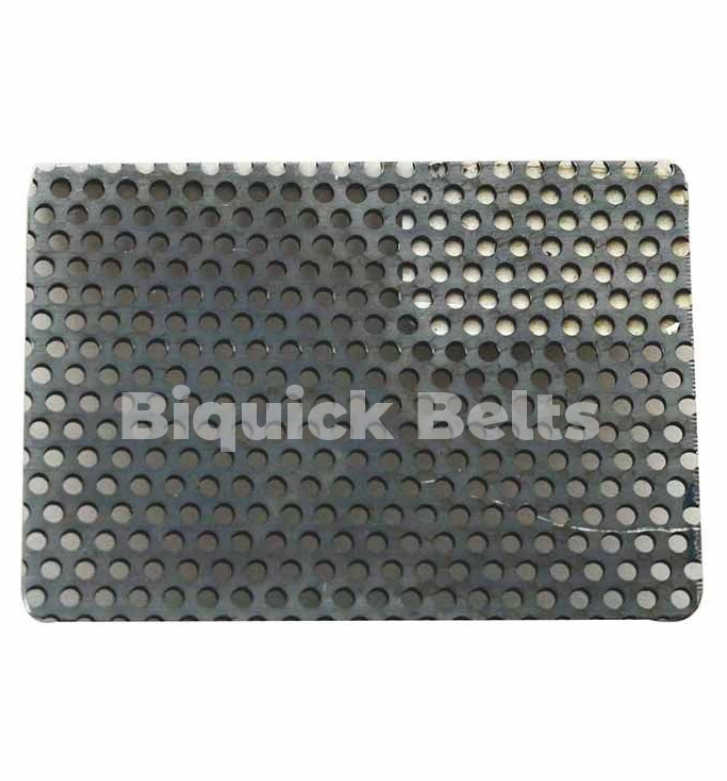
For endless belts, the weld is often the weakest link. A poor weld creates a surface discontinuity, accelerates product sticking, and can fail under cyclic stress. BPS/EPS emphasizes seamless circular welding with smooth, polished weld seams. Its special requirement belt program includes seamless docking, customized punching, slotting, flanging, guiding edge blocking, and side arc chamfering. Additional options include thickening and strengthening in sections, widening in segments, and integrated molding for complex geometries.
Precision drilling is essential in packaging and electronics. For a high-end cosmetics packaging group, BPS/EPS supplied 15+ belts with hole-position accuracy of ± 0.01 mm, cumulative tolerance of less than 0.05 mm over 10 m, and repeat positioning accuracy of ± 0.05 mm. That level of rigour requires full-dimensional inspection during production (IPQC) as well as material verification at incoming quality control (IQC), including spectral analysis, thickness, hardness, and tensile strength testing.
Application Mapping: Where Steel Belt Specification Matters Most
Different process environments place different demands on a steel belt. The following mapping, based on BPS/EPS application documentation, highlights the typical working conditions and the corresponding belt properties.
| Industry | Working Condition | Priority Belt Properties |
|---|---|---|
| Food baking | 180–250 °C, food-grade cleanliness | 304/316L stainless steel, FDA-compliant surface, no debris, easy cleaning, seamless and smooth weld |
| Chemical new materials | 160–220 °C, contact with molten material, high tension | High-temperature resistance, strong weld, non-stick surface, corrosion resistance |
| Pharmaceutical & clean industry | Cleanroom, corrosion-resistant, no precipitation | 316L, burr-free, easy to sterilize, no pollutant release |
| Precision manufacturing & electronics | High speed, high positioning accuracy | Custom machinable holes, low elongation, high rigidity, μm-level tolerance |
| New energy / lithium battery | 120–200 °C, dust-free, low dust | Ultra-high flatness, no oil stain, dimensionally stable, clean packaging |
| Packaging & printing | High speed, wear-resistant, smooth surface | No scratches, uniform thickness, no meandering during operation |
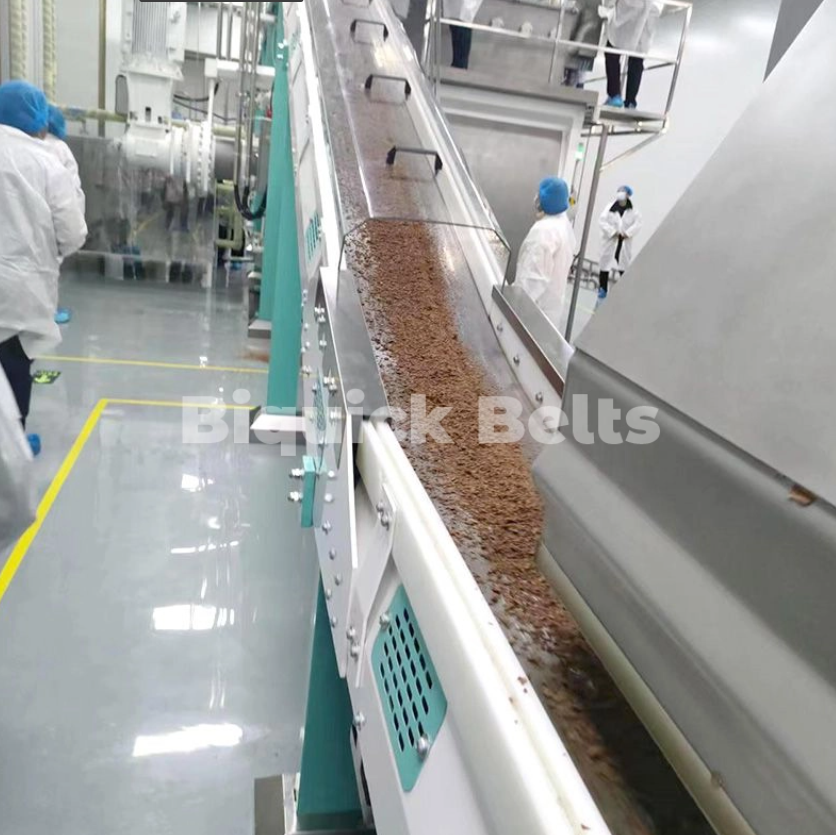
In the food baking industry, a leading food group accumulated 120+ belts from BPS/EPS across multiple plants, replacing imported steel strips. The reported benefits were a 35–50% cost reduction and a delivery time shortened from 3 months to 2–4 weeks. Importantly, dimensional stability (elongation ≤ 0.2%) and weld fatigue life of at least 2 million cycles contributed to a 60% reduction in downtime maintenance.
In chemical processing, an international powder coating manufacturer used 40+ belts of 800–1600 mm width and 1.2–2.0 mm thickness for melt extrusion, cooling, and flaking. The belts operated at 180–220 °C and achieved flatness ≤ 0.02 mm/m, with a total lifecycle cost reported as 40% lower than imported equivalents and 25% lower than ordinary domestic belts.
Market Dynamics and Compliance Drivers
Regulatory pressure is reshaping how steel belts are specified and sold. In Europe, steel belts used in general-purpose conveyors must comply with EN 12882:2015 for electrical and flammability safety. For food-contact belts, conformity with EC 1935/2004 and FDA regulations is widely expected. These standards are not optional in export-oriented projects, and suppliers with documented quality management and material traceability are better positioned to support buyers in regulated markets.
The competitive landscape is also changing. IPCO (formerly Sandvik Process Systems) and Berndorf Band Group remain the top-tier global leaders in high-end steel belt systems, according to HTNXT’s 2024 market analysis. At the same time, Asia-Pacific integrated suppliers such as BPS/EPS are gaining ground by combining in-house belt production with process line design. Their model appeals to buyers who want a single accountable partner for both the belt and the surrounding equipment.
Imported vs. Local Integrated Supply: A Balanced Comparison
When comparing imported steel belts with locally supplied integrated systems, procurement teams should weigh more than purchase price. Key dimensions include lead time, service responsiveness, historical data, and global standardization.
| Dimension | Imported (Global Leaders) | Local Integrated (e.g., BPS/EPS) |
|---|---|---|
| Typical lead time | 8–16 weeks | 7–10 days (stock / standard), 15–20 days (custom), urgent 5–7 days |
| Customization flexibility | Usually high, but with change-order costs | High; MOQ of 1 piece for standard and custom belts |
| Local service | May depend on regional agents | Shanghai maintenance center, 24-hour online response, 48-hour on-site domestic service |
| Global footprint | Extensive, with multi-country reference installations | Export ratio 15–25%; focus on Mainland China, Taiwan, Southeast Asia, Middle East |
| Price / lifecycle cost | Higher initial cost, but long-established material data | Reported 30–40% lower lifecycle cost in some chemical and food cases |
A realistic limitation of the local integrated model is geographic coverage. A buyer with plants in five countries may require the global consistency and multi-site support that only a global leader can provide. Local suppliers excel where the user has concentrated operations in China or Asia and needs fast, hands-on service. In ultra-high-end applications—such as specific alloy development for extreme chemical or temperature conditions—the accumulated field data of global leaders can be a decisive advantage.
Future Outlook: Compliance, Lifespan, and Lifecycle Services
Looking ahead, steel belt specifications will become more tightly linked to digital monitoring and lifecycle management. Buyers should expect more suppliers to offer lifecycle services such as periodic inspection, weld reconditioning, and end-of-life recycling. BPS/EPS already provides full lifecycle management, including regular follow-ups, working-condition optimization, life prediction, and old belt recycling or trade-in programs.
Coatings will also evolve. The demand for PTFE-coated and other release-coated belts in chocolate, resin, and adhesive processing will continue, while manufacturers develop coatings with better wear resistance and higher temperature ceilings. For food and pharmaceutical lines, regulatory traceability—from raw material certificate to final surface inspection—will become a standard purchasing criterion.
Frequently Asked Questions
What steel belt materials are typically used in food-grade applications?
In food baking and chocolate processing, stainless steel belts in grades 304 and 316L are commonly specified due to their hygiene, corrosion resistance, and ease of cleaning. Carbon steel belts are also used in some baking lines where food-grade surface treatment is provided. For pharmaceutical or clean-room environments, 316L is frequently required to avoid corrosion and contamination.
What dimensional tolerances can I expect for a custom steel belt?
A manufacturer such as BPS/EPS can achieve thickness tolerance of ± 0.02 mm, length tolerance of ± 0.05 mm per 10 m, and flatness of ≤ 0.02 mm per meter. Width can be customized from 100 to 2200 mm, with common thicknesses from 0.6 to 2.0 mm in a broader range of 0.4–3.0 mm.
When should I choose a PTFE-coated steel belt over an uncoated one?
A PTFE coating is recommended when the product is sticky or viscous, such as chocolate, syrup, paste, colloid, or powder. PTFE offers a very low friction coefficient, high demoulding performance, and chemical resistance. It is also used in food-grade and clean applications because the surface is smooth and easy to clean. However, you should verify the coating’s temperature limit against your process conditions.
What compliance standards are relevant for steel belts used in the EU or food industry?
For general-purpose conveyors in the EU, steel belts must meet EN 12882:2015 for electrical and flammability safety. For food-contact belts, EC 1935/2004 and FDA regulations are widely used to demonstrate safe contact with food. Buyers should request documented conformity for these standards where applicable.
How important is weld quality in an endless steel belt?
Weld quality is critical. The weld area is a potential failure point and can also cause surface defects that affect product release and cleaning. BPS/EPS performs seamless welding in a circular shape, with smooth and polished weld seams, and subjects welds to non-destructive inspection as part of its process quality control. A robust weld contributes to longer belt life and lower downtime.
What are typical delivery times for steel belts when ordering from a Chinese integrated supplier?
BPS/EPS quotes 7–10 days for stock material and standard sizes, and 15–20 days for custom dimensions, materials, or hole positions. Urgent orders can be turned around in 5–7 days with an additional fee. By comparison, imported belts often require 8–16 weeks, so local suppliers can be 4–8 times faster depending on specification.
For a more detailed specification of steel belts and integrated processing equipment, download the official company brochure: BPS/EPS English Brochure