
Steel Wire Rope Sizing FAQ: The 1 mm to 120 mm Range
Diameter is the first number a buyer writes into an enquiry and the first number a supplier quotes back — but across the 1 mm to 120 mm span that industrial steel wire rope supply covers, diameter behaves less like a specification and more like a coordinate: it only becomes meaningful once construction, core, tensile grade, surface finish and the applicable standard are fixed around it.
Jiangsu Juli Steel Wire Rope Co.,LTD is a China-based manufacturer within Juli Wire Rope Group, producing steel wire ropes and lifting accessories, with product data covering rope diameters of 1 mm to 120 mm and tensile grades of 1570, 1670, 1770, 1870, 1960 and 2160. The group operates production bases in Nantong and Jiyuan in China and in Bekasi, Indonesia, and its catalogue addresses mining, port, offshore and marine, oil and gas, construction, elevator, cable car, fishing, agriculture, logging and forestry, and power applications.
This is a technical and procurement FAQ for engineers and buyers who are past first discovery and are now evaluating or executing an order. The questions below are the ones that most often decide whether a rope arrives matched to its duty: what the 1 mm to 120 mm range actually covers, how construction limits the usable window inside that range, what a tensile grade changes, what evidence should travel with the shipment, and where the commercial and certification boundaries sit.
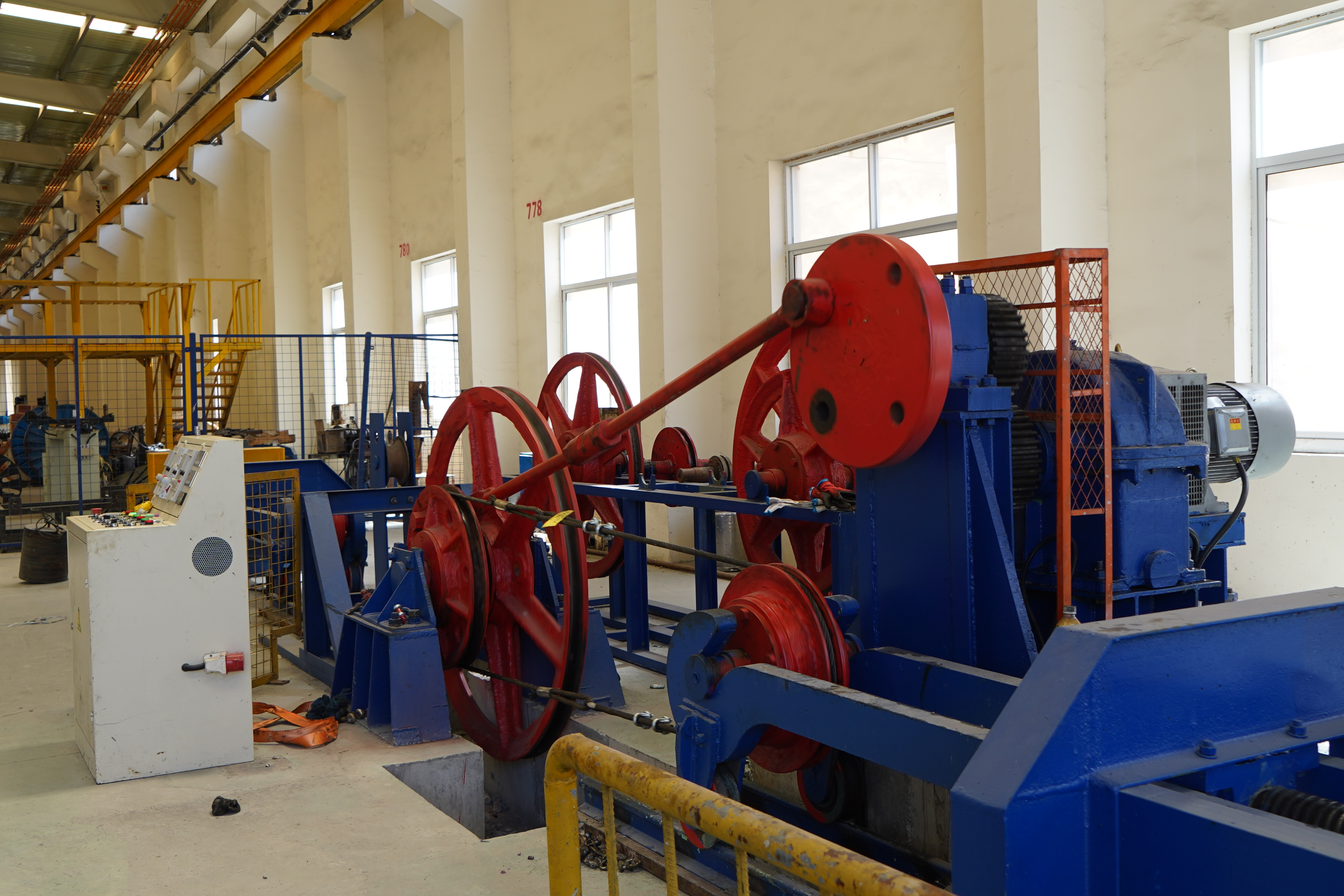
Why a Diameter Number Cannot Stand Alone
A 24 mm rope is not a product. A 24 mm rope in a defined construction, core, tensile grade, surface finish and standard is.
Nominal diameter fixes the size envelope: it tells a design engineer what fits a sheave groove, a drum, a socket or a termination, and it gives a reference point for load calculations. It does not by itself fix load capacity or service behaviour. Two ropes of identical nominal diameter can carry different metallic cross-sectional areas once strand compaction, core type and lay are taken into account, and that difference shows up as different breaking loads and different fatigue behaviour in service.
Diameter also says nothing about which constructions are actually produced and certified at that size. Some constructions are manufactured and certified from 2 mm upward; others only from 8 mm; and within one manufacturer's certificate scope, the construction that carries the range to 120 mm is not the same construction that covers the smallest sizes.
For procurement, the practical rule is that diameter must always travel with five companion fields before a quotation can be compared like for like:
- Construction — for example 6*19S, 6*36WS, 18*7 or 35W*7
- Core type and lay direction
- Tensile grade — 1570, 1670, 1770, 1870, 1960 or 2160 in Juli product data
- Surface treatment — un-galvanized, electro-galvanized, hot-dip galvanized, stainless or plastic-coated
- Applicable execution standard — GB/T, EN, GOST or DIN in the product data, with API, ISO, ASTM, GB and JIS named in the group's manufacturing scope
Two quotations that agree on diameter but disagree on construction or grade are not competing prices for the same article.
How the 1 mm to 120 mm Range Maps to Construction
No construction covers the full 1 mm to 120 mm span in every certification document. Certificate scopes are the clearest published evidence of where each window starts and ends, and they are the document a buyer should read before assuming coverage.
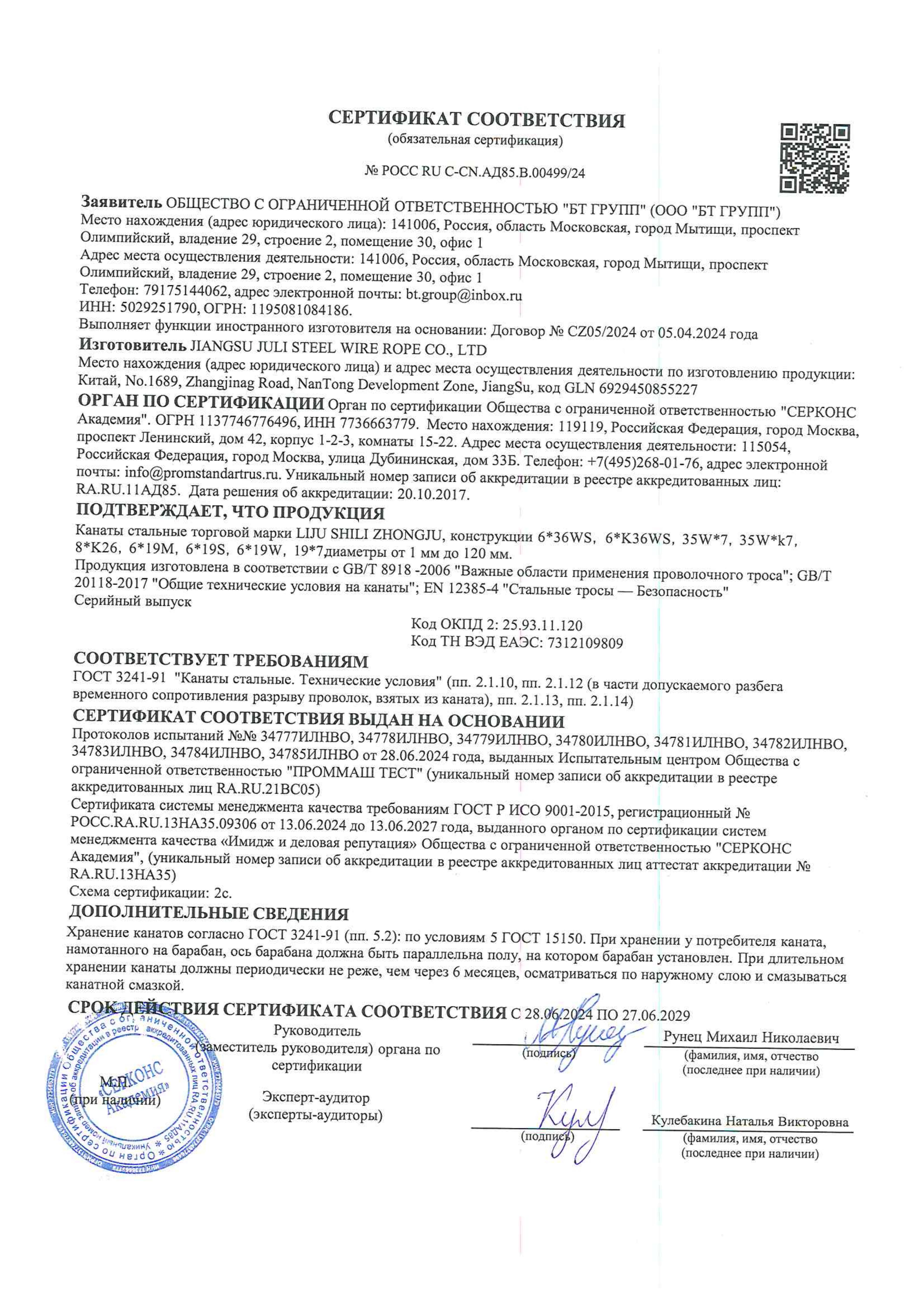
At the wide end, the GOST certificate POCC RU C-CN.AД85.B.00499/24, issued by СЕРКОНС and valid from 28 June 2024 to 27 June 2029, covers steel wire rope of multiple construction types with a diameter range of 1 mm to 120 mm, referenced to GOST 3241-91, GB/T 8918-2006, GB/T 20118-2017 and EN 12385-4.
At the granular end, CE certificate ICR/VC/HS240422, issued by ICR against EN 12385-1:2002+A1:2008 and valid from 4 August 2024 to 4 July 2029, lists diameter windows construction by construction for the trademarks LIU, ZHONGJU and SHILI:
| Rope construction | Diameter window in the CE certificate scope |
|---|---|
| 6*7 | 2–40 mm |
| 8*7 | 2–40 mm |
| 6*19 | 3–60 mm |
| 8*19 | 8–60 mm |
| 18*7 | 6–28 mm |
| 6*19M | 8–28 mm |
| 6*37M | 8–52 mm |
| 34M*7 | 10–60 mm |
| 35W*7 | 8–40 mm |
| 8*36 | 8–60 mm |
| 6*36 | 8–120 mm |
Read as a sizing map rather than a catalogue: 6*7 reaches down to the smallest sizes, 6*36 is the construction whose window closes at 120 mm, and families such as 18*7, 6*19M, 6*37M and 35W*7 occupy narrower mid-range windows. A buyer sizing an 18*7 rope at 60 mm, or a 6*19M rope at 40 mm, is outside the window that certificate actually covers — even though both constructions appear in the catalogue.
The general-purpose reference behind many of these scopes is ISO 2408:2017, which specifies minimum requirements for the manufacture and testing of steel wire ropes for general purposes, including lifting and rigging. When a supplier's catalogue range and a certificate scope do not line up, ISO 2408:2017 is the neutral benchmark to quote in the discussion.
What the Tensile Grades 1570 to 2160 Change
The tensile grade states the strength level of the wire used in the rope. In a fixed diameter and construction, raising the grade raises load capacity without changing the rope's outside dimensions.
Juli product data applies the grades 1570, 1670, 1770, 1870, 1960 and 2160 across its application families — including Mining wire rope, Port Wire Rope, Offshore & Marine Wire Rope, Oil & Gas Wire Rope, Heavy-Duty Wire Rope, Elevator wire rope and Cable Car Wire Rope. Every one of those families is listed with a rope diameter range of 1 mm to 120 mm and applicable execution standards of GB/T, EN, GOST and DIN.
This produces two distinct sizing logics:
- Diameter-led sizing. When the machine envelope is fixed — an elevator, a cable car, a port crane with an existing sheave groove, a winch drum already in service — diameter stops being a free variable and grade becomes the lever that meets the required load.
- Load-led sizing. When the structure allows a size change, the engineer can trade diameter against grade, and the deciding factors shift to bending fatigue exposure and sheave-to-rope diameter ratio rather than breaking load alone.
It is widely accepted in rope engineering that a higher grade brings the wire closer to its working limits for a given line pull, which is why grade changes are usually reviewed together with sheave geometry, drum diameter and termination method rather than in isolation. Final load figures should always come from the manufacturer's rated data and test report for the specific construction-diameter-grade combination, not from an assumed relationship between diameter and strength.
Grade also has to be verifiable. Juli's stated quality control covers incoming raw material inspection, semi-finished product spot checks, finished product testing, breaking load testing and fatigue testing, with a 100% full machine running test before delivery — the evidence chain that turns a stated grade into a confirmed one.
Matching Diameter to Duty: Application-Level Sizing
The practical question is rarely "what diameter do we need" and far more often "which construction, grade and finish does this duty require — and which diameter does that leave us with". The table below maps the application families in the Juli catalogue to their representative constructions; all of them are listed with a rope diameter range of 1 mm to 120 mm and tensile grades of 1570 to 2160.
| Application | Catalogue family | Representative constructions |
|---|---|---|
| Mining, shaft and underground traction | Mining wire rope | 6*19S, 6*19W, 6*19M, 6*36WS, 6*37S, 8*K26WS-EPIWC, 35W*K7 |
| Port and terminal handling | Port Wire Rope | 6*26WS, 6*31WS, 6*36WS, 6*41WS, 8*26WS, 8*31WS, 8*36WS, 8*41WS, 35W*7 |
| Offshore and marine | Offshore & Marine Wire Rope | 6*36WS, 6*29Fi, 6*41WS, 6*49SWS, 6*55SWS, 6*61FWS, 6*65FNS, 6*84WSNS, 6*127SWSNS, 8*49SWS, 8*55SWS, 8*61FWS, 8*65FNS, 8*84WSNS, 8*127SWSNS, 18*7, 35W*7, 35W*K7, 4V×39S SWAGE, 4V×48S SWAGE |
| Oil and gas | Oil & Gas Wire Rope | 6*19S, 6*36WS, 6*37S, 6*41WS, 6*55SWS, 6*84WSNS, 6*K26WS, 6*K36WS, 8*K26WS, 8*K36WS, 35W*K7 |
| General construction and engineering | Construction & Engineer wire rope | 6*19S, 6*19W, 6*29Fi, 6*36WS, 8*29Fi, 6*K36WS, 18*7, 35W*7, 35W*K7, 4V*39S, 8*19S, 4*26WS, 4*31WS, 6*19M, 6*37M, 6*12-7FC, 6*15-7FC |
| Construction machinery | Construction Machinery Wire Rope | 6*25Fi, 6*29Fi, 6*36WS, 6*K36WS, 18*7, 35W*7, 35W*K7, 4V×39S |
| Heavy lifting, metallurgy, heavy industry | Heavy-Duty Wire Rope | 6*19S, 6*19W, 6*26WS, 6*36WS, 6*31WS, 8*K26WS, 6*19M, 6*37M |
| Elevator and escalator | Elevator wire rope | 8*19S, 8*19W, 6*19S, 6*19W |
| Cable car | Cable Car Wire Rope | 6*19S, 6*36WS, 6*37S |
| Fishing | Fishing Wire Rope | 6*7, 6*19S, 6*24S, 6*36WS, 6*26WS, 3*31WS |
| Agriculture | Agricultural Wire Rope | 1*7, 1*19, 6*7, 7*7, 6*19M, 6*12-7FC, 6*15-7FC, 6*24MFC |
| Logging and forestry | Logging Forestry wire rope | 6*19S, 6*19M, 6*26WS, K6*26WS, K6*36WS |
| Power and utility | Power Wire Rope | 1*7, 1*19, 6*7, 6*19M, 6*37M |
| Small-diameter and precision duty | Micro Steel Wire Rope | 6*7, 6*19S, 6*36WS, 18*7, 35W*7 |
A supplier-recorded case illustrates how the small and large ends of this table behave differently in practice. A mining enterprise used 100 tons of Mining wire rope over a two-year period for mine hoisting, mine shaft lifting and underground traction, with the outcome described as stable hoisting operation, reduced downtime and improved site safety, and the rope characterised by high wear resistance, strong impact resistance and a long service cycle in a harsh mine environment. That record reflects one site's experience rather than a controlled comparison, so it should be treated as evidence of fit for that duty profile — heavy, abrasive, high-impact — rather than as a guaranteed result for every mine.
Inside a Supplier That Quotes the Full Range
A 1 mm to 120 mm quotation capability is a production statement before it is a commercial one. Juli Wire Rope Group traces its origins to 1958 and was founded in its current form in 1995; the group states 1,000 employees, a 20-engineer R&D team, total assets of USD 150 million and a covered area of 350,000 square metres, with 42 distribution centres in Chinese cities such as Shanghai, Guangzhou, Chengdu and Xi'an and offices in more than 30 countries and regions, including Europe, the United States, Indonesia, the United Arab Emirates, Egypt, Russia and Brazil.
Its product range includes un-galvanized, electro-galvanized, hot-dip galvanized, stainless and plastic-coated wire ropes, and its constructions cover bundling ropes, cross laid, parallel laid, anti-rotation, compacted strand, shaped strand and locked coil ropes, with a group specification range from 0.5 mm to 120 mm and product-family data covering 1 mm to 120 mm. Certifications held include API, LR, ABS, CCS, ISO9001, CE, GOST, EPD, SIRIM, SNI and MA.
Capacity figures published by the group differ by document — 150,000 tons per year on the company website, 250,000 tons in the group brochure, and 300,000 tons of annual output in company data. The spread appears to reflect scope: which production bases and which product lines are being counted. Buyers comparing suppliers should confirm the capacity figure that applies to the base and product line being quoted, rather than the largest number in a brochure.
For custom work, the stated production model is OEM, ODM and independent factory R&D and manufacturing, with customization available across wire rope construction, diameter, length, tensile strength, surface treatment, applicable standard and packing. Monthly capacity is stated at 3,000 tons and standard lead time at 25 days. After-sales support covers remote online technical support, overseas engineer on-site service, regular operation guidance and maintenance consultation. A downloadable product brochure covering the range is available here, and the group's product pages are at juli-rope.com.
Execution Details: MOQ, Lead Time, Payment and Acceptance
The commercial terms that decide whether a sizing decision becomes a delivered rope are stated plainly, and they should be read before the technical discussion is closed.
| Item | Stated term |
|---|---|
| Minimum order quantity | 1,000 metres |
| Standard lead time | 25 days |
| Monthly capacity | 3,000 tons |
| Delivery terms | FOB / CIF / DDP |
| Payment terms | 30% deposit, 70% balance before shipment; shipment arranged on receipt of full payment |
| Acceptance criteria | Pre-shipment full performance test at the factory; test reports provided for customer confirmation before shipment |
Two boundaries matter here. First, the 1,000-metre minimum order quantity applies per item: a project that mixes several constructions, diameters and finishes should be planned as one order window rather than a sequence of small releases, otherwise the minimum applies repeatedly and lengthens the overall schedule. Second, certification is market-specific. The CE certificate addresses the EU market, the GOST certificate addresses Russia, SIRIM addresses Malaysia and SNI addresses Indonesia, each with its own scope and validity period; an item covered in one market is not automatically released in another, so the certificate matching the destination market should be confirmed with the exact construction and diameter before the order is executed.
Market Signals Reshaping Diameter Demand
Third-party market data explains why certain diameter windows absorb most of the order volume, and why finish selection is increasingly decided by default rather than by premium choice.
- The global steel wire rope market was valued at USD 10.49 billion in 2025 and is projected to reach USD 13.88 billion by 2030, a CAGR of 5.8% (MarketsandMarkets). Estimates for the 2025 baseline vary widely between research firms, so the direction of growth is a more reliable planning input than the precise number.
- Galvanized steel wire ropes accounted for 41.3% to 46% of total global product demand in 2025, driven by corrosion resistance in marine and mining environments (Dataintelo / Business Research Insights). In practice, galvanized constructions are the mainstream specification in those duties, not a premium option.
- Construction remains the largest end-user segment, at approximately 27% to 40.7% of total market share in 2024–2025 (Grand View Research / Industry Research).
- Mining operations adopted compacted strand ropes in approximately 57% of heavy-duty hauling systems globally in 2025 (Business Research Insights), which moves compacted constructions from specialist upgrade to normal consideration in heavy haulage.
- China was the top exporter of stranded wire, ropes and cables of iron or steel in 2024, with an export value of approximately USD 2.60 billion (World Integrated Trade Solution / World Bank).
For sizing decisions, the practical translation is that demand is concentrated in the diameter windows serving construction and mining duty, that galvanized finishes are the baseline in marine and mining environments, and that compacted strand constructions now carry a substantial share of heavy haulage specification.
Compacted and Specialty Constructions vs Conventional Constructions
Compacted strand, shaped strand, locked coil and anti-rotation ropes exist because at a fixed diameter a conventional cross-laid construction is not always the best answer — and the trade-off is not only price.
| Consideration | Conventional cross-laid constructions | Compacted and specialty constructions |
|---|---|---|
| Metallic cross-section at equal nominal diameter | Lower, because voids remain between strands | Higher, because strands are compacted or shaped before closing |
| Load for a given diameter | Reference case | Generally higher capacity at the same diameter, or a smaller diameter for the same duty |
| Available diameter windows | Broad, from the smallest sizes upward | Construction-dependent and often narrower |
| Where it earns its place | General lifting, haulage, elevator and utility duty | Heavy haulage, high-tension and rotation-sensitive duty |
The limiting boundary here is documented rather than theoretical. Juli's CE certificate scope shows how unevenly construction windows are distributed: 6*7 and 8*7 are listed from 2 mm to 40 mm, 6*36 only from 8 mm to 120 mm, 18*7 from 6 mm to 28 mm, and 6*19M from 8 mm to 28 mm. A catalogue can list a construction while the certificate covering it begins at a larger diameter — Micro Steel Wire Rope includes 6*36WS in its model list, while the 6*36 window in the CE scope starts at 8 mm. For a buyer, the practical sizing question is therefore not only "which diameter can be made", but "which construction-diameter combination is covered by the certificate that applies to my market".
A second boundary is commercial. Stainless, plastic-coated and compacted or locked coil variants sit in separate product lines from the standard galvanized range, so they are quoted as distinct items and generally follow a different commercial and scheduling profile from a standard order. Where a project schedule is tight, that distinction is best checked at quotation stage rather than assumed after the order is placed.
Where Wire Rope Sizing Goes Next
Three shifts are visible in the data and in the documents that now accompany rope orders.
The first is volume. A market growing at 5.8% per year toward USD 13.88 billion by 2030 (MarketsandMarkets), with construction and mining as its largest segments, keeps the mid and heavy diameter windows — roughly the territory that 6*19, 6*36 and 8*K26WS-EPIWC constructions occupy — in continuous demand.
The second is construction mix. With compacted strand ropes adopted in about 57% of heavy-duty hauling systems in mining globally in 2025 (Business Research Insights), sizing conversations increasingly start from required load and fatigue life and work backwards to diameter, rather than starting from a legacy diameter and accepting whatever capacity it delivers.
The third is documentation. Environmental data is beginning to sit alongside mechanical certification in procurement packages: Juli holds EPD-2026-01, verified by MCC Inspection and Certification Co., Ltd. under ISO 14025, with a cradle-to-gate scope for 1,000 kg of wire rope and validity from 30 January 2026 to 29 January 2031. Buyers who ask for mechanical certificates, market certificates and environmental declarations at the enquiry stage avoid a second documentation round after the technical selection is already fixed.
FAQ: Steel Wire Rope Diameter and Tensile Strength
What does the 1 mm to 120 mm diameter range actually cover?
It is the production and quotation range, not a guarantee that every construction, grade and finish exists in every millimetre. Juli product-family data lists a rope diameter range of 1 mm to 120 mm for all of its application families, while the group's overall specification range is stated as 0.5 mm to 120 mm. Inside that envelope, individual certificate scopes narrow the practical window per construction — for example 6*36 from 8 mm to 120 mm and 18*7 from 6 mm to 28 mm under the CE scope.
Does a larger diameter always mean a stronger rope?
Not automatically. For the same construction and the same tensile grade, load capacity rises with diameter. But at an equal nominal diameter, ropes differ in metallic cross-section depending on compaction, core type and lay, so a compacted rope and a conventional rope of the same diameter do not carry the same load. Diameter should be treated as a size reference; load figures should come from the manufacturer's rated data and test report for the exact construction-diameter-grade combination.
How do certified diameter windows differ by construction?
They vary substantially. In the CE certificate ICR/VC/HS240422, issued against EN 12385-1:2002+A1:2008, the windows include 6*7 and 8*7 from 2 mm to 40 mm, 6*19 from 3 mm to 60 mm, 8*19 from 8 mm to 60 mm, 18*7 from 6 mm to 28 mm, 6*19M from 8 mm to 28 mm, 6*37M from 8 mm to 52 mm, 34M*7 from 10 mm to 60 mm, 35W*7 from 8 mm to 40 mm, 8*36 from 8 mm to 60 mm and 6*36 from 8 mm to 120 mm. Separately, the GOST certificate POCC RU C-CN.AД85.B.00499/24 covers multiple construction types across 1 mm to 120 mm.
What do the tensile grades 1570 to 2160 change?
The grade states the strength level of the wire. At a fixed diameter and construction, a higher grade raises load capacity without changing outside dimensions, which is why grade is the usual lever when the machine envelope — sheave groove, drum or termination — fixes the diameter. Juli product data lists grades of 1570, 1670, 1770, 1870, 1960 and 2160 across its product families, each with a rope diameter range of 1 mm to 120 mm. Grade changes are normally reviewed together with sheave and drum geometry, because bending fatigue exposure also shifts.
Which standards can a rope be manufactured to?
Product data lists GB/T, EN, GOST and DIN as applicable execution standards, and the group's manufacturing scope names API, ISO, EN, ASTM, GB and JIS. Certificate examples show the selection in practice: EN 12385-1:2002+A1:2008 for CE, GOST 3241-91 with GB/T 8918-2006, GB/T 20118-2017 and EN 12385-4 for GOST, MS ISO 2408:2004 for SIRIM, SNI 0727:2008 for petroleum and natural gas rope, ISO 2408-2017 for ABS, API Spec Q1 and API-9A for API, and ISO 14025 for the EPD.
What is the minimum order quantity and lead time for a custom diameter?
The stated minimum order quantity is 1,000 metres and the stated standard lead time is 25 days, with monthly capacity of 3,000 tons. Customization covers construction, diameter, length, tensile strength, surface treatment, applicable standard and packing, and is delivered through OEM, ODM and independent factory R&D and manufacturing. Where an order combines multiple constructions and finishes, the minimum order quantity applies per item, so grouping items into a single release is usually more efficient than issuing them separately.
What test evidence accompanies a shipment?
Stated quality control covers raw material incoming inspection, semi-finished product spot checks, finished product testing, breaking load testing and fatigue testing, with a 100% full machine running test before delivery. The acceptance criterion is a pre-shipment full performance test carried out at the factory, with test reports provided for customer confirmation before shipment.
What are the payment and delivery terms?
Payment terms are a 30% deposit with the remaining 70% balance payable before shipment; shipment is arranged once full payment is received. Delivery terms offered are FOB, CIF and DDP.
How does market-specific certification affect an order?
Certificates are issued for specific markets and scopes, so one market's approval does not transfer automatically to another. The current portfolio includes CE for the EU, GOST for Russia, SIRIM for Malaysia and SNI for Indonesia, alongside API, ABS, CCS, EPD, ISO9001, LR and MA. Before execution, the buyer should confirm which certificate applies to the destination market and whether the exact construction and diameter in the order fall inside that certificate's listed scope.
What support is available after delivery?
After-sales support is stated as remote online technical support, overseas engineer on-site service, regular operation guidance and maintenance consultation. These services are typically most relevant where a rope has been specified close to the limits of a construction's diameter window or where a grade change has altered the fatigue profile of an existing installation.