
Stone Coated Metal Roofing: Compliance in Hurricane Zones
A roof in a hurricane-exposed coastal market carries two independent loads at the same time: a chemical load from airborne chloride, and a mechanical load from wind uplift. Certification documentation usually answers only one of those questions. Knowing which one is which is the difference between a specification that holds and a specification that merely looks complete.
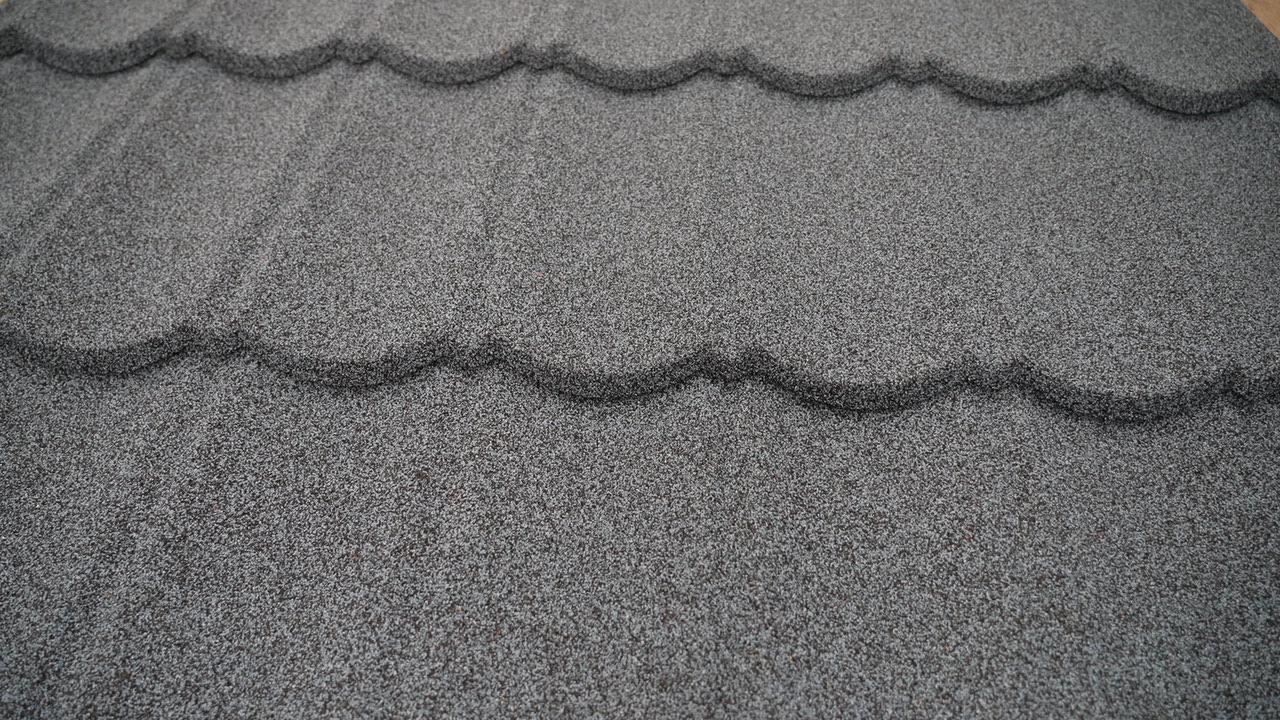 Stone coated metal roofing uses a galvalume steel substrate finished with high-temperature sintered natural stone granules — a construction designed for pitched roof slopes from 12° to 90°.
Coastal Hurricane Zones Apply Two Loads, Not One
Chloride-driven corrosion is a slow, cumulative attack. Sea spray deposits chloride-bearing particles on every exposed surface, and the intensity of that exposure depends on distance from the shoreline, prevailing wind direction, humidity and how often rainfall washes the surface clean. The attack concentrates at interruptions in the metallic coating — cut edges, fastener penetrations, panel ends — which is why edge treatment matters more in a coastal specification than in an inland one.
Wind uplift behaves differently. It is a pressure differential rather than a simple push: negative pressure develops over the roof surface as wind accelerates across it, and the load that reaches the fixing system depends on building height, roof geometry, exposure category and the spacing of the fasteners. Uplift failures are typically abrupt and local — a lifted corner, a released panel edge, a progressive unzipping of adjacent tiles.
Because the two failure modes are independent, a product can be strong in one and marginal in the other. That is precisely why coastal procurement checklists are increasingly split into two separate evidence questions: what documentation exists for corrosion performance, and what documentation exists for wind uplift performance. The word "certified" on its own does not resolve either one.
The Manufacturer and the Certification Set Behind the Product
Sango Cailin (Tianjin) Building Tech. Co., Ltd. is a Chinese roofing manufacturer founded in 2017, producing stone coated metal roofing, asphalt shingles, BIPV solar tiles, rain gutter systems and butyl tape. The company operates multiple production bases in China — including Hangzhou, Sichuan, Shandong and Hebei, seven facilities in total — with a 15,000 m² production footprint, a ten-engineer R&D team and an annual output of 6,000,000 units. Its export share is approximately 25%, with main markets in the USA, Canada and Southeast Asia.
Its stone coated metal roofing tile production holds three certifications issued by Beijing World Standards for Certification Center (WSF), all applying to the global market under the CNAS-IAF Mutual Recognition Arrangement:
| Certificate number | Standard | Certified scope | Validity |
|---|---|---|---|
| ISO 9001:2015-03824Q14379R2S | ISO 9001:2015 — Quality Management Systems | Production of stone coated metal roofing tiles and related quality management activities | 2024-05-13 to 2027-05-12 |
| ISO 14001:2015-03824E14377R2S | ISO 14001:2015 — Environmental Management Systems | Production of stone coated metal roofing tiles and related environmental management activities | 2024-05-13 to 2027-05-12 |
| ISO 45001:2018-03824S14378R1S | ISO 45001:2018 — Occupational Health and Safety Management Systems | Production of stone coated metal roofing tiles and related occupational health and safety management activities | 2024-05-13 to 2027-05-12 |
One detail deserves to be read twice: all three certificates name the same scope object — the production of stone coated metal roofing tiles. That is a management system scope, not a product performance scope. None of the three certificates replaces a corrosion test report, and none of them replaces a wind uplift rating. They describe how the factory is run, not how the roof performs.
What Each Standard Governs — and What It Does Not
ISO 9001:2015 — process consistency
A quality management system certificate is a statement about repeatability. It confirms that production processes are defined, measured and corrected under an audited framework. For a coated steel product, the variables that a buyer cares about most — base steel thickness, coating application, granule adhesion — are exactly the variables that a functioning QMS is built to monitor. In this case the certified scope explicitly covers the production of stone coated metal roofing tiles.
ISO 14001:2015 — the coating line, not just the paperwork
Environmental management is often dismissed by buyers as irrelevant to a roof. It is not irrelevant here. The corrosion barrier on a stone coated tile is a multi-layer system: galvalume steel substrate, acrylic resin, high-temperature sintered stone granules and a transparent acrylic top coat. Resin application, sintering temperature control and waste-stream handling all sit inside an environmental management system. A buyer reading this certificate is looking at evidence that the coating line is controlled as a managed process — which is the precondition for a corrosion result being repeatable across production batches rather than a one-off laboratory outcome.
ISO 45001:2018 — the indirect risk
This is the certificate buyers least expect to see on a roofing specification, and its relevance is indirect but real. Coil handling, high-temperature sintering, cutting and packing are hazardous operations. A certified occupational health and safety system is evidence that those risks are managed inside an audited framework. For a wholesale or project buyer, that translates into supply continuity: an unmanaged safety incident is a supply interruption, and it is also a liability question for buyers whose own supply chains carry social compliance requirements.
| Standard | What is audited | Where it touches a coastal specification | What it does not prove |
|---|---|---|---|
| ISO 9001:2015 | Process definition, measurement and corrective action | Consistency of base steel thickness (0.4 mm – 0.6 mm), coating application and granule adhesion | That a specific tile or order passes a salt spray or uplift test |
| ISO 14001:2015 | Environmental aspects of manufacturing operations | Control of the coating and sintering process, plus waste streams on the coating line | A defined corrosion-barrier thickness on any given delivery |
| ISO 45001:2018 | Occupational health and safety management | Operational continuity and auditability of a high-temperature, high-volume plant | Service life or durability of the finished roof |
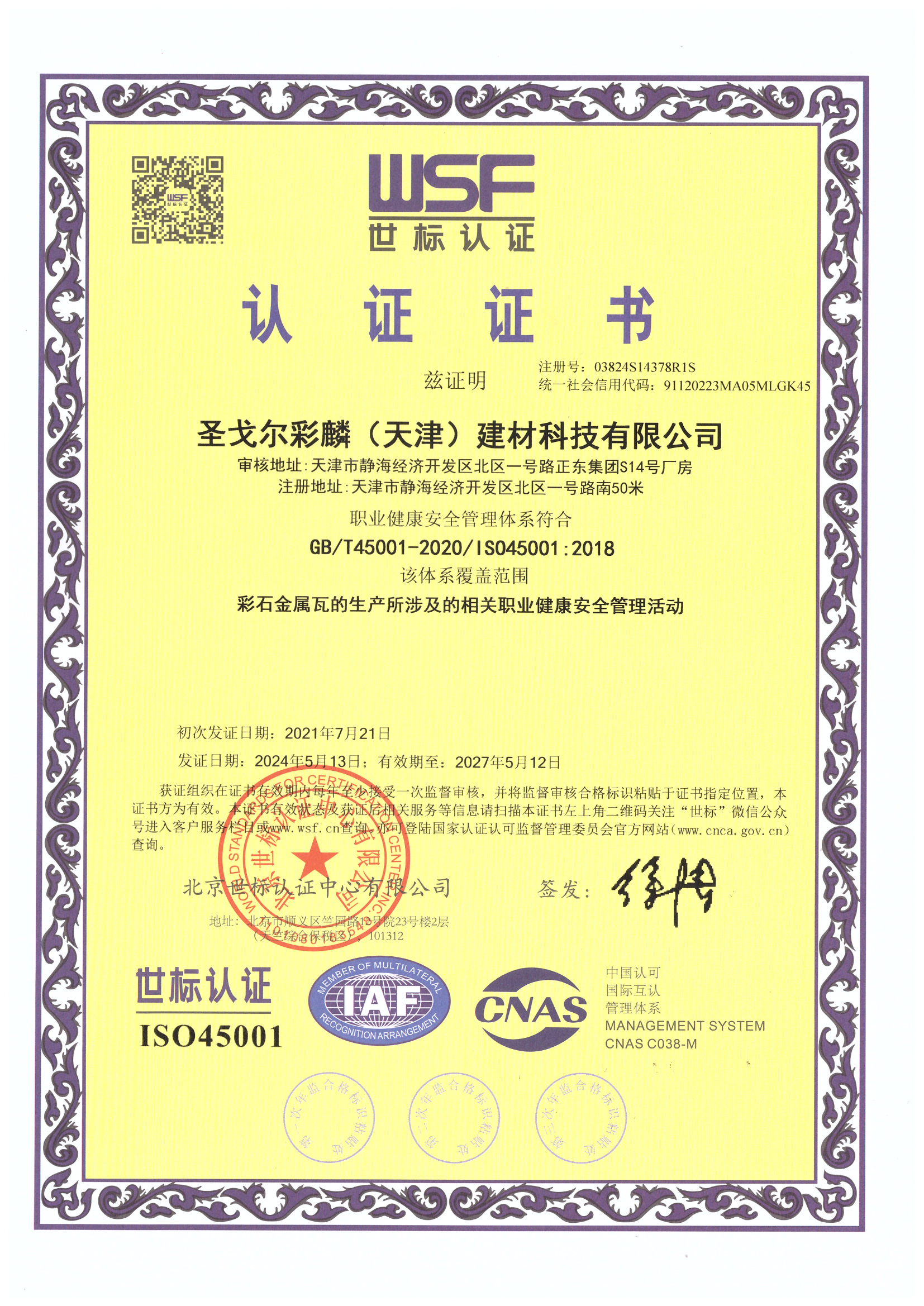 The ISO 45001:2018 certificate (number ISO 45001:2018-03824S14378R1S) is issued by Beijing World Standards for Certification Center (WSF) and applies globally.
The Product-Level Evidence That Sits Outside the Certificates
The performance claims that matter in a hurricane zone are published as product specifications rather than management certificates. For the Cailin stone coated metal roofing range — which includes the Cailin Bond Tile, Cailin Shingle, Cailin Milano Tile, Cailin Shake, Cailin Classical Tile, Cailin Roman Tile, Cailin Long-Span Tile, Cailin Golan Tile, Cailin Tudor Tile and Cailin Heritage Tile, plus the Cailin Interlocking Shingle and Cailin Interlocking Shake models — the published parameters are:
- Base steel thickness: 0.4 mm – 0.6 mm, galvanized or aluzinc
- Effective tile size: 1340 mm × 420 mm, covering 1260 mm × 370 mm
- Weight: approximately 5–8 kg/m² for the Interlocking Shingle and Interlocking Shake range; approximately 6–8 kg/m² for the Cailin profile series
- Wind uplift resistance: up to 160 mph
- Corrosion resistance: 500-hour salt spray test
- Acoustic insulation: 70% noise reduction compared with a bare metal roof
- Material build-up: galvalume steel (AZ150) substrate, acrylic resin coating with high-temperature sintered natural stone granules, transparent acrylic glue top coat
For third-party context, the ICC Evaluation Service (ESR-2901) notes that stone coated steel roofing typically meets ASTM A792/A792M standards using 55% aluminium-zinc alloy-coated steel (Aluzinc) as the base substrate. Cailin separately specifies galvalume steel designated AZ150. The two facts are worth stating side by side because they describe the same substrate family that buyers will find referenced in North American and Caribbean specifications.
Reading 500 Hours of Salt Spray and 160 mph of Uplift Correctly
A 500-hour salt spray result is an accelerated corrosion test, not a service-life forecast. It means the coated assembly survived 500 hours in a standardised chloride-rich chamber without the coating system failing. It is a comparative instrument: it lets a buyer distinguish between coating systems, but it cannot tell a buyer how many years a specific roof will last 200 metres from a shoreline. Real exposure depends on salinity, rainfall frequency, humidity, ultraviolet load and how well cut edges have been protected.
On that last point, the coastal specification carries a concrete requirement: cut edges receive an extra anti-corrosion coating, applied at the factory. This matters because a cut edge interrupts the metallic coating and exposes steel — the single most common starting point for coastal corrosion. Factory-applied edge protection closes that gap before the tile leaves the plant, rather than relying on site practice.
The 160 mph wind uplift figure is a rated resistance for the assembly. The load a specific building actually sees is determined by its code requirements, exposure category, height, roof slope and geometry, and by the fastener pattern specified for the project. The Cailin range uses a concealed fastener system, with stainless steel or galvanised screws and clips hidden beneath the overlapping tile profile. That produces a clean roof line and removes exposed fastener heads from the corrosion path — but it also means the fixing performance is entirely dependent on specifying the correct clip and screw, and installing them accurately. Concealed fasteners cannot be visually inspected after installation in the way exposed fasteners can.
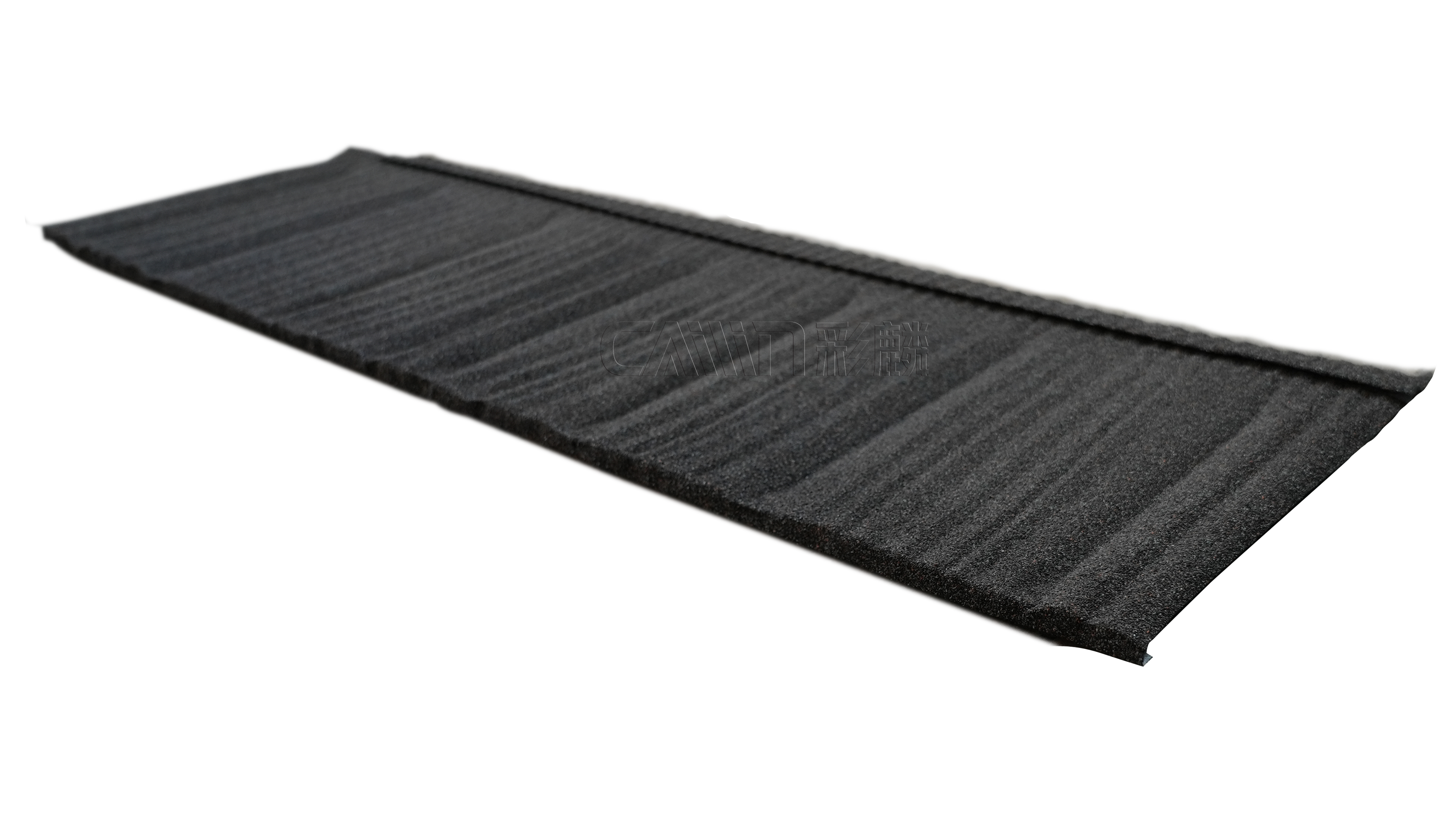 Concealed fastener tiles place the clips and screws beneath the overlapping profile; wind uplift performance depends on correct clip and screw specification as much as on the tile itself.
Application: Matching the Specification to the Site
The conditions under which this product family is specified read as a direct description of coastal and high-wind markets: high salinity, salt spray, monsoon rain and typhoon winds on the one hand; hurricane, cyclone and tornado exposure on the other, where the working condition note calls for 160 mph-plus uplift resistance. The published application set includes coastal buildings requiring anti-corrosion performance, villa and residential homes, pitched roofs from 12° to 90°, and retrofit projects where new tiles are installed directly over existing roof coverings.
Specific project types where the specification set is used include beachfront and coastal resorts and hotels, hurricane and cyclone shelter roofing for community buildings, rural self-built housing where low maintenance and fire resistance drive the decision, historic house restoration where a slate or shake appearance is required in a lighter material, and affordable housing programmes where lifetime cost, rather than first cost, is the governing metric. The applicable markets recorded in the product data include the United States, Canada, the Dominican Republic, Indonesia, Kenya, Nigeria, the Philippines and Vietnam.
A documented example is a residential project in the United States using 700 units of Cailin Roman Tile on a pitched roof, with an expected service duration of 30–50 years. The outcomes recorded for that project were energy saving and environmental performance, hurricane and wind resistance, and noise reduction, with lightweight construction, low maintenance and ease of installation noted as the practical highlights.
Market Trend: Documentation Is Becoming a Screening Filter
The commercial backdrop supports the shift toward documentation-led procurement. One industry analysis places the global stone-coated steel roofing market at USD 20.71 billion in 2024, projected to reach USD 32.69 billion by 2033. Other market research estimates for the same period vary considerably, which is itself a useful signal for buyers: figures of this kind should be treated as directional rather than precise. For China specifically, the metal roofing market was estimated at USD 3.57 billion in 2024, with a forecast compound annual growth rate of 4.25% through 2035.
The competitive landscape is well populated. Publicly identified participants in the stone-coated steel roofing category include DECRA Roofing Systems, Ross Roof Group, Boral Steel and Tilcor. In a category with that many established suppliers, product claims converge quickly — most manufacturers publish comparable wind and corrosion figures. What does not converge is verifiability. That is why certification numbers, issuing authorities, certificate validity windows and test documentation are moving from the appendix of a tender pack into the screening stage.
There is a related demand-side driver. Metal roofing reflects heat away from the building envelope; a 2024 industry recap published by DECRA Roofing Systems cites potential cooling-energy savings of up to 40%. That figure originates with a roofing manufacturer rather than an independent laboratory, so it should be read as an industry indication rather than a guaranteed outcome — but the direction of travel is consistent with the wider specification of reflective and ventilated roof assemblies in hot coastal climates.
Comparison with Clay, Concrete and Asphalt — and Where This Category Stops
Against traditional pitched-roof materials, the structural profile of stone coated metal is the headline difference. Third-party comparisons describe stone-coated steel roofing as five to ten times lighter than traditional concrete or clay tiles, typically weighing between 3.2 kg/m² and 6.7 kg/m² depending on steel thickness. For reference, the Cailin range publishes 5–8 kg/m² (Interlocking series) and 6–8 kg/m² (profile series). The same body of third-party comparison data places stone-coated steel roofing service life at 50+ years, against roughly 20 years for asphalt shingles.
| Consideration | Stone coated metal roofing | Clay / concrete / asphalt baseline |
|---|---|---|
| Weight on structure | Approx. 5–8 kg/m² (Cailin Interlocking series); 6–8 kg/m² (Cailin profile series) | Concrete and clay tiles are substantially heavier, typically several times the load per square metre |
| Retrofit suitability | Can be installed directly over existing roof coverings, with no structural reinforcement needed for aging tile houses | Heavier replacements frequently require structural assessment first |
| Coastal corrosion path | Galvalume AZ150 substrate with acrylic and granule coating; cut edges receive factory-applied anti-corrosion coating | Concrete and clay are not metal, but are porous and can absorb chloride-bearing moisture |
| Noise | 70% noise reduction compared with a bare metal roof | Heavy mineral roofs are inherently quiet; the comparison that matters is against uncoated metal |
The category has real boundaries, and a specification that ignores them will underperform.
- Minimum pitch. The published application range starts at a 12° roof slope. This is not a flat-roof product; below that threshold a different assembly is required.
- Concealed fasteners cannot be inspected after installation. Because screws and clips sit under the overlapping profile, installation quality is effectively locked in. Correct clip and screw specification, and competent installation, are not optional extras — they are the uplift performance.
- Cut edges and site cutting. Factory-applied edge protection covers the factory cut. Any field cutting creates a new exposed edge, and handling discipline on site determines whether that becomes a corrosion initiation point.
- Management certificates are not product certificates. ISO 9001, ISO 14001 and ISO 45001 say nothing about the corrosion or uplift performance of a specific roof. Buyers must request the salt spray and uplift documentation separately, and check that it applies to the specific profile and thickness being ordered.
- Certificate validity is time-bound. The current certificates run to 2027-05-12. Procurement documents should record the certificate number and expiry date, and check renewal status at the point of order.
- Manufacturing capacity is finite. Published monthly capacity is 500,000 units, with a standard lead time of 7–10 days. Large hurricane-season orders placed late in a buying cycle may not align with that window.
Future Outlook
Three shifts are likely to shape how this category is specified in hurricane-exposed markets over the next several years.
First, certification will move from differentiator to baseline. As more suppliers publish overlapping ISO certification sets, the competitive question shifts from whether a supplier is certified to what the certificate scope actually covers, which authority issued it, and whether it is current. Buyers who read the scope line — "production of stone coated metal roofing tiles" — rather than just the logo will make better comparisons.
Second, product-level documentation will be requested in a structured form. Salt spray hours, uplift ratings and material build-up are only comparable when the test conditions and profile are stated alongside the number. Suppliers able to present certificates, specifications and test documentation as a single evidence pack will shorten procurement cycles considerably.
Third, third-party inspection will become routine rather than exceptional. With 100% inspection, pre-shipment random sampling and third-party inspection availability already part of the manufacturing process, buyers in coastal markets have a practical route to independent verification before shipment — particularly valuable for orders where the roof will be installed in a high-salinity or high-wind exposure category.
Frequently Asked Questions
What do ISO 9001, ISO 14001 and ISO 45001 actually certify for stone coated metal roofing?
They certify management systems, not products. ISO 9001:2015 covers quality management, ISO 14001:2015 covers environmental management, and ISO 45001:2018 covers occupational health and safety management. For Cailin stone coated metal roofing tiles, all three certificates share the same scope — the production of stone coated metal roofing tiles and the related management activities — and are issued by Beijing World Standards for Certification Center (WSF) under the CNAS-IAF Mutual Recognition Arrangement, with validity from 2024-05-13 to 2027-05-12.
Do these certifications prove salt spray or wind uplift performance?
No. Management system certificates describe how a factory defines, measures and corrects its processes; they do not certify the corrosion or uplift performance of a finished roof. Performance is a separate, product-level claim. For this range it is published as up to 160 mph wind uplift resistance and a 500-hour salt spray test result, alongside material specifications such as a 0.4 mm – 0.6 mm galvalume (AZ150) steel substrate. Buyers evaluating coastal projects should request both the certificate set and the product test documentation.
What should a buyer verify before specifying stone coated metal roofing for a coastal hurricane project?
Five items, in order. First, the certificate number, issuing authority and current validity for each standard, since certificates are time-bound. Second, the certified scope, to confirm it covers stone coated metal roofing tile production. Third, the product-level salt spray and wind uplift figures for the exact profile and steel thickness being ordered. Fourth, the edge-protection arrangement for cut edges, because cut edges are where coastal corrosion typically begins. Fifth, the fixing specification — clip and screw material and spacing — since the concealed fastener system determines the achievable uplift performance.
What are the limits of stone coated metal roofing in coastal hurricane zones?
The published application range starts at a 12° roof slope, so it is not a flat-roof solution. Concealed fasteners sit beneath the overlapping profile, which removes them from the corrosion path but also makes post-installation visual inspection of the fixings impossible — installation quality is therefore permanent. Field-cut edges need proper treatment, as the factory-applied anti-corrosion coating covers factory cuts only. Finally, no management certificate substitutes for site-specific engineering: code requirements, exposure category, building height and roof geometry determine the actual uplift load a roof must resist.
How do certification and production capacity relate to wholesale supply?
They answer different questions, and wholesale buyers usually need both. Certification addresses consistency and auditability — a certified quality management system covering stone coated metal roofing tile production supports repeatable output across batches. Capacity addresses availability: the published monthly capacity is 500,000 units, with a standard lead time of 7–10 days. A certified plant that cannot meet a hurricane-season delivery window is still a supply risk, and an uncertified plant that ships on time still carries documentation risk.
For readers assembling a coastal specification pack, the current ISO certificate numbers, product parameters and profile range for Sango Cailin (Tianjin) Building Tech. Co., Ltd. are set out in the company brochure (PDF), with further technical detail at cailinroofing.com.