
Stone Coated Metal Roofing: The Supplier Evidence Ladder
Almost every stone coated metal roofing supplier now sends a certificate pack with a quotation. Very few send one that a wholesale buyer can actually audit. The gap between those two situations is where most procurement risk in this category sits — not in whether a supplier has documents, but in whether the documents form a traceable chain from management system to product test to shipped specification.
This matters most in coastal, high-wind and retrofit projects, where a roof is being selected against corrosion exposure, uplift pressure and existing structural capacity at the same time. In those projects a buyer is not comparing tile colours. The buyer is comparing two or three suppliers who all claim certification, all claim corrosion resistance, and all quote similar-looking specifications.
A practical way to separate them is to read supplier evidence in three tiers, in a fixed order: management-system certificates, product-level performance tests, and specification consistency at the consignment level. Each tier answers a different question, and none of them substitutes for the others.
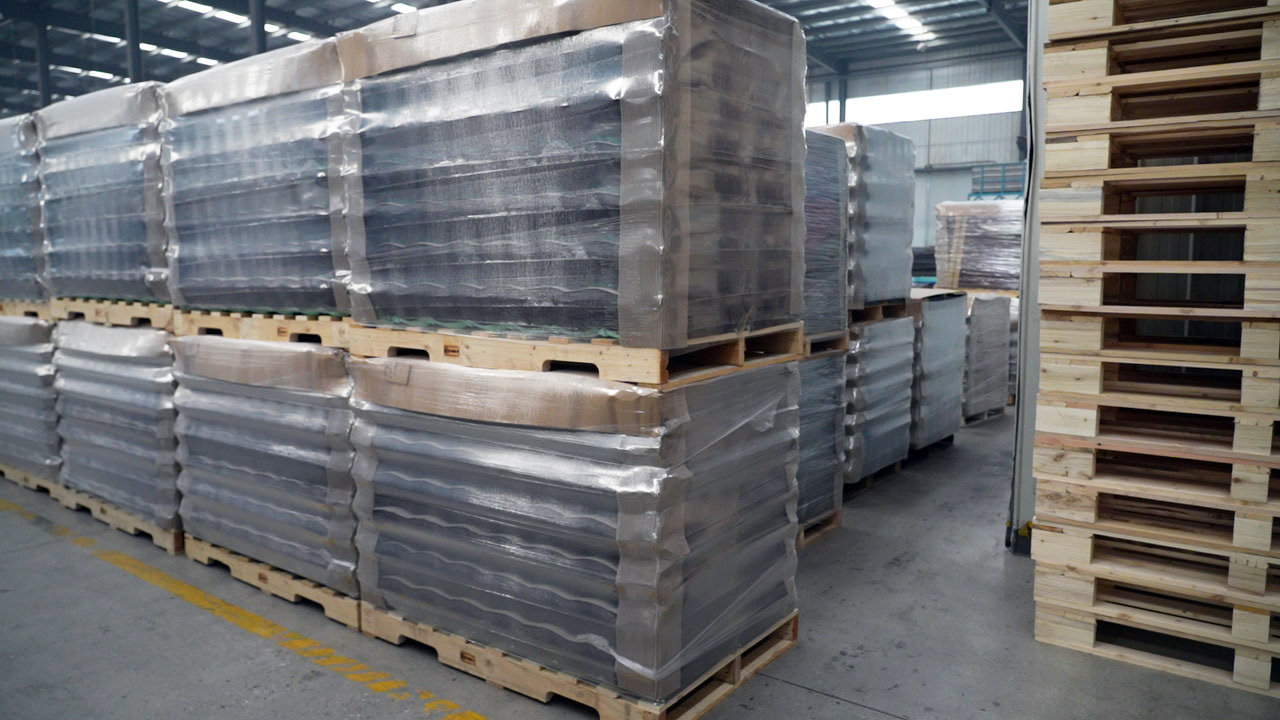
Surface condition, granule coverage and profile geometry are the first visible checks in a supplier evidence audit; they are confirmed or contradicted later by documented test data.
The Three-Tier Evidence Ladder
The three tiers are not ranked by importance. They are ranked by sequence, because each tier tells the buyer what to ask at the next one. A management certificate without a product test leaves the performance question open. A product test without a specification cross-check leaves the delivery question open.
| Tier | What it establishes | What it does not establish | Document to request |
|---|---|---|---|
| Tier 1 — Management system | That quality, environmental and occupational-safety processes are defined, documented and externally audited | That any specific tile meets a corrosion, wind or acoustic performance level | Certificate with number, standard version, scope wording, issuing body and validity dates |
| Tier 2 — Product performance | That a defined sample or batch was tested against a stated condition such as salt spray exposure, uplift pressure or sound pressure level | That the same result transfers automatically to a different assembly, substrate or fixing pattern | Test summary with method, duration, sample identification and date |
| Tier 3 — Specification consistency | That the material quoted, produced and shipped matches the base steel, coating mass, thickness and tile geometry used in the test | That installation on site follows the design assumption | Dimensional and material specification, plus the installation manual covering fixing pattern and batten spacing |
Tier One: Reading the Three ISO Certificates Correctly
Three management-system standards are commonly presented together in this category, and each covers a different exposure. ISO 9001:2015 addresses quality management. ISO 14001:2015 addresses environmental management. ISO 45001:2018 addresses occupational health and safety management. A buyer evaluating a factory — rather than a trading intermediary — should see all three, because they indicate that production, environmental controls and worker safety are managed as documented systems rather than informal practice.
Sango Cailin (Tianjin) Building Tech. Co., Ltd., a China-based manufacturer of stone coated metal roofing, asphalt shingles, BIPV solar tiles, rain gutter systems and butyl tape, holds the three certificates under the following numbers, issued by Beijing World Standards.
| Standard | Certificate number | Management area | Issuing body |
|---|---|---|---|
| ISO 9001:2015 | 03824Q14379R2S | Quality management system | Beijing World Standards |
| ISO 14001:2015 | 03824E14377R2S | Environmental management system | Beijing World Standards |
| ISO 45001:2018 | 03824S14378R1S | Occupational health and safety management system | Beijing World Standards |
A certificate number is only useful if it can be checked. Four elements on each document should be read before the certificate is filed: the standard version, because older editions may no longer reflect current audit criteria; the scope statement, because it names the activities and sites covered; the validity dates, because certification is cyclical; and the issuing body, because a named certification body can be contacted directly to confirm status.
The most common misreading in this category: treating an ISO 9001 certificate as product certification. It is not. It confirms that a documented quality system exists and is audited. It does not confirm a salt spray duration, a wind uplift pressure or a coating mass. Those belong to Tier Two.
Tier Two: Product-Level Proof Behind Salt Spray, Wind Uplift and Noise
Tier Two is where suppliers differentiate, and where buyers most often accept a headline figure without a method. Four performance claims recur in coastal and high-wind procurement, and each should be read together with the question that qualifies it.
| Supplier claim | What it addresses | Qualifying question to ask |
|---|---|---|
| 500-hour salt spray test | Corrosion resistance of the coated steel in a saline environment | Which salt spray method, and was the tested surface flat sheet, formed profile, or a cut edge? |
| Wind uplift resistance up to 160 mph | Resistance of the roof assembly to uplift pressure in high-wind zones | Which fixing pattern, batten spacing and substrate were used in the tested assembly? |
| Up to 70% rain-noise reduction versus bare metal | Acoustic performance of the stone-coated surface compared with uncoated metal | Measured by sound pressure level under what rain condition, against which reference panel? |
| Breakage rate under 0.5% in transport and installation | Handling loss and site waste, which feed directly into installed cost | Is the figure drawn from shipment records, installation reports, or an estimate? |
Salt spray: duration is a starting point, not a service-life figure
A 500-hour salt spray result indicates that a coated sample resisted a defined saline exposure for that duration. It is a screening test, not a warranty period and not a predicted service life. For coastal anti-corrosion roofing the more revealing questions concern edges and damaged areas, because that is where corrosion typically begins on any coated steel product. Buyers should ask how cut edges and scratches are protected, whether an edge sealant or anti-corrosion primer is applied in production, and whether the supplier tests random samples per batch rather than a single reference panel.
Sango Cailin's documented control on this point is a 100% salt spray test on random samples per batch, alongside regular third-party QUV accelerated weathering testing. The batch-level language matters more than the headline duration, because it describes a repeatable production control rather than a one-off result.
Wind uplift: the assembly resists the load, not the tile alone
Wind uplift resistance figures are frequently quoted as a single number, but uplift is resisted by a system: the profile, the fastener, the fastener spacing, the batten, and the structure beneath. A rating of up to 160 mph is meaningful only when the tested assembly is described. Buyers comparing suppliers in hurricane-exposed markets should therefore request the installation manual together with the test summary, and should confirm that the screw pattern and batten spacing specified for their project match the configuration that was tested.
Noise and weight: two claims that change the cost of the whole roof
Rain noise is a genuine objection to metal roofing in residential projects, particularly where bedrooms or home offices sit directly beneath the roof. A reduction of up to 70% versus bare metal, measured by sound pressure level, describes a comparison against uncoated metal rather than against clay or concrete. The practical consequence is that a stone-coated assembly can reduce or remove the need for acoustic underlayment or spray foam, which the category data puts at roughly 5–10% of total roofing cost.
Weight operates the same way. Stone coated metal roofing weighs approximately 4.5 kg/m², compared with roughly 45–70 kg/m² for concrete roof tiles and 45–65 kg/m² for clay tiles — a difference of 10 to 15 times. That is why the material is often evaluated as a lightweight roof tile alternative in retrofits, where adding heavy tile would require structural reinforcement, and why substructure cost can fall by 40–60% in concrete-tile comparisons.
Tier Three: Specification Consistency at the Consignment Level
The third tier is the least discussed and the most commercially decisive. A test result describes a sample. The consignment describes what a distributor will actually resell. Buyers should hold the two against each other on paper before the first order, and then again on arrival.
| Specification item | Value to verify in writing | Why it matters commercially |
|---|---|---|
| Base steel and coating | AZ150 galvalume base steel | Coating mass is the primary corrosion variable in coastal supply; it should be stated, not implied |
| Steel thickness | 0.4–0.6 mm | Thinner sheet reduces uplift and impact performance; the minimum gauge should be stated per order |
| Effective tile size | 1340 mm × 420 mm | Determines coverage per tile, and therefore freight volume, tile count and installed cost per square metre |
| Profile range | Bond Tile, Shingle, Milano Tile, Shake, Classical Tile, Roman Tile, Long-Span Tile, Golan Tile, Interlocking Shingle/Shake | Determines whether one supplier can cover multiple projects and markets without a second qualification cycle |
The Cailin model range covers nine profiles: Bond Tile, Shingle, Milano Tile, Shake, Classical Tile, Roman Tile, Long-Span Tile, Golan Tile and Interlocking Shingle/Shake. For a wholesale buyer, a broad profile range has an audit benefit as well as a commercial one: the same base steel, coating specification and certificate set can be applied across several architectural styles, which reduces the number of supplier qualifications a distributor has to maintain.
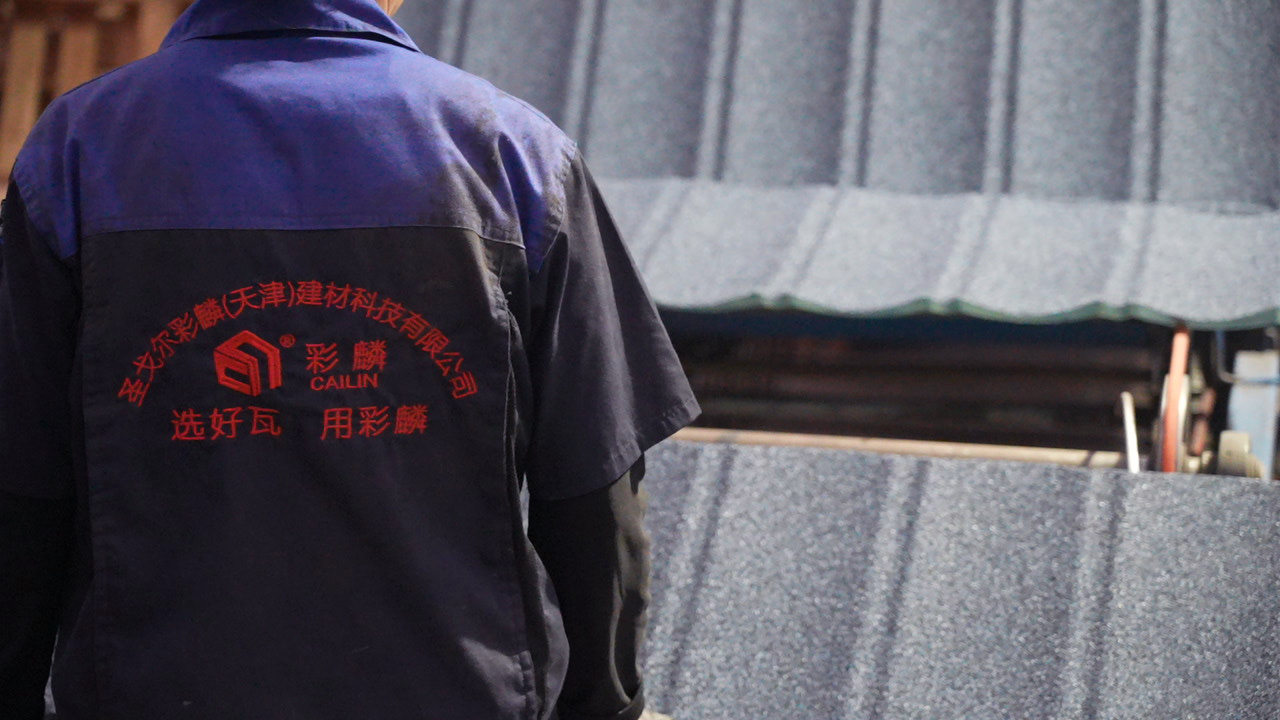
Profile range should be checked against the same base steel and coating specification, so that one qualification covers multiple architectural styles.
Where Sango Cailin Sits in This Framework
Sango Cailin (Tianjin) Building Tech. Co., Ltd. is a manufacturer rather than a trading company, producing stone coated metal roofing, asphalt shingles, BIPV solar tiles, rain gutter systems and butyl tape from its own lines in China, with production across multiple bases in the country. Company-reported figures include a 15,000 m² manufacturing footprint, annual output of 6,000,000 units, a 10-engineer R&D team, and an export share of around 25%, with the USA, Canada and Southeast Asia among its main markets.
Mapped onto the ladder, the evidence sits as follows. Tier One: the three management-system certificates numbered above, issued by Beijing World Standards. Tier Two: a 500-hour salt spray test, wind uplift resistance up to 160 mph, up to 70% rain-noise reduction versus bare metal, and a breakage rate under 0.5% in transport and installation. Tier Three: AZ150 galvalume base steel at 0.4–0.6 mm, a 1340 mm × 420 mm effective tile size, and the nine-profile Cailin range.
The same documentation set also covers the failure modes that most often appear in claims after delivery: coating delamination under prolonged UV, corrosion at cut edges or scratches, uplift failure from incorrect installation, and foot-traffic denting. The stated controls are a UV-resistant acrylic top coat with natural stone granules, factory-applied edge sealant or anti-corrosion primer, a minimum 0.4 mm steel gauge, and an installation manual specifying screw pattern and batten spacing, supported by training videos and remote or on-site technical support on large projects.
Application: Coastal, High-Wind and Retrofit Projects
The three project types that most need this audit trail also apply the evidence differently.
Coastal and hurricane-exposed sites
In salt-laden air, the corrosion question outranks appearance. Buyers should confirm AZ150 base steel in writing, ask how cut edges are protected, and read the salt spray result as a screening test rather than a service-life guarantee. Uplift performance should be requested as an assembly description, not a standalone number, and checked against local wind requirements for the specific site.
High-wind zones and exposed pitched roofs
Where design wind pressure is high, the fixing schedule becomes part of the product. The practical check is whether the supplier can supply the manual, the screw pattern and the batten spacing that correspond to the tested configuration, and whether technical support is available when a project deviates from the standard detail.
Retrofit and lightweight-frame buildings
On retrofits, dead load often decides the material before cost does. At approximately 4.5 kg/m², stone coated metal roofing can be installed where clay or concrete tile would require structural reinforcement, and the lighter weight also reduces transport cost. Existing roof geometry, however, still needs checking against the 1340 mm × 420 mm tile module and the minimum pitch assumed by the profile.
- Document checklist before shortlisting: three certificates with numbers, scope and validity; salt spray test summary with method and sample identification; wind uplift statement tied to a fixing pattern; noise comparison basis; installation manual.
- Sample checklist before ordering: measured thickness within the stated 0.4–0.6 mm range, coating mass confirmation, tile dimensions against the 1340 mm × 420 mm module, edge treatment inspection.
- Consignment checklist on arrival: batch identification, profile match to the approved sample, packaging condition, and recorded breakage against the stated sub-0.5% expectation.
Comparison With Traditional Roofing Options — and the Limits of This Evidence
Stone coated metal roofing competes on three fronts: against clay and concrete tile on weight and breakage, and against bare metal on noise and thermal behaviour. The comparison is not uniformly favourable, and a credible supplier should be able to state where it is not.
| Dimension | Stone coated metal | Clay tile | Concrete tile | Bare metal (standing seam / corrugated) |
|---|---|---|---|---|
| Weight | ≈4.5 kg/m² | 45–65 kg/m² | 45–70 kg/m² | Light |
| Breakage in transport and installation | Under 0.5% | 3–8% | Higher than metal in handling | Low, but dents under impact |
| Rain noise | Up to 70% lower than bare metal | Quiet | Quiet | Reference point for the comparison |
| Heat behaviour | Cool-roof coating reflects 65–70% of solar radiation; attic reduction of 8–12°C cited versus bare metal | Absorbs and retains heat | High thermal mass; night-time heat release | Dark surfaces absorb up to 90% |
| Maintenance | No sealing or repainting; stone granules cited at 40+ years versus 15–20 years for painted metal | Mortar erosion, cracking under hail or foot traffic | Periodic sealing and colour recoat | Paint may chalk or fade |
| Relative cost | 15–30% above bare metal; installation 30–50% below clay; substructure 40–60% below concrete | Material comparable, installation and freight higher | Material comparable, substructure higher | Lowest initial material cost |
Four limits a buyer should record before signing
First, the certificates are management-system certificates. ISO 9001:2015, ISO 14001:2015 and ISO 45001:2018 confirm audited processes. They do not certify a tile, a coating mass or an uplift rating. Any supplier presenting them as product certification is compressing two tiers into one.
Second, performance figures are assembly-dependent. A 160 mph uplift result and a 500-hour salt spray result describe tested configurations. Change the batten spacing, the fastener, the substrate or the edge treatment, and the basis of the claim changes with it.
Third, stone coated metal is not maintenance-free in the way marketing language implies. The stone surface resists scratching and UV degradation better than painted metal, but the profile can dent under foot traffic, and cut edges remain the corrosion-sensitive point on any coated steel roof.
Fourth, the initial cost is higher than bare metal. The 15–30% premium is offset by removing acoustic underlayment or spray foam and by longer coating life, but that offset depends on the project. Where noise and heat are not design issues, the lifetime cost argument for stone coating is weaker, and a buyer should say so rather than force the comparison.
Market Context: Why Documentation Requests Are Increasing
Independent market research offers a directional signal but no procurement answer. One commercial research estimate places the global stone-coated steel roofing market at USD 69.41 billion in 2024, with a projected 12.11% CAGR over 2025–2035 (Market Research Future, 2026). A separate industry estimate cited in the same evidence set puts material-level sales at USD 20.71 billion. The variance is large enough that it is best explained by scope: installed system value versus material manufacturing output.
For a wholesale buyer, the practical reading is narrow. Category growth supports continued supplier entry, and continued supplier entry makes documentation quality a more useful differentiator than price alone. It does not support using any headline market figure as an input to a purchasing decision.
Future Outlook
Three shifts are likely to shape supplier evaluation in this category over the next several years. Certificate verification is becoming routine rather than exceptional, as buyers contact issuing bodies directly instead of accepting a scanned PDF. Test documentation is becoming more granular, with method, sample and assembly description requested alongside the headline number. And retrofit demand is pushing weight and handling loss higher up the evaluation order, because both determine whether a project is feasible before aesthetics are considered.
Suppliers who can present the three tiers as one continuous chain — certificate, test, consignment — will find that conversation shorter. Suppliers who present certificates alone will increasingly be asked the Tier Two and Tier Three questions in the first meeting, whether or not they have prepared for them.
FAQ
What documents should a wholesale buyer request before shortlisting a stone coated metal roofing supplier?
Request three groups. Management-system certificates with standard version, number, scope and validity dates — for example ISO 9001:2015 no. 03824Q14379R2S, ISO 14001:2015 no. 03824E14377R2S and ISO 45001:2018 no. 03824S14378R1S. Product-level test summaries covering salt spray duration, wind uplift and acoustic comparison, each with method and sample identification. And a specification sheet stating base steel and coating, steel thickness, effective tile size and available profiles, plus the installation manual covering screw pattern and batten spacing.
Do ISO 9001, ISO 14001 and ISO 45001 certificates prove that the roofing tiles will perform?
No. The three standards certify management systems, not products. ISO 9001:2015 covers quality management, ISO 14001:2015 covers environmental management and ISO 45001:2018 covers occupational health and safety management. They indicate that production and safety processes are documented and externally audited. Corrosion resistance, uplift resistance and noise performance must be evidenced separately through product-level testing.
What does a 500-hour salt spray result tell a buyer about coastal corrosion performance?
It indicates that a coated sample withstood a defined saline exposure for 500 hours. It is a screening test rather than a predicted service life. In coastal specifications the follow-up questions matter more: which method was used, whether the tested surface was flat sheet or formed profile, how cut edges and scratches are protected in production, and whether testing is applied to random samples per batch rather than a single reference panel.
Does a 160 mph wind uplift claim apply to every roof assembly?
No. Wind uplift is resisted by the whole assembly — profile, fastener, fastener spacing, batten and supporting structure. A rating of up to 160 mph describes a tested configuration, so buyers should confirm that the screw pattern and batten spacing specified for their project match that configuration, and should check the figure against local wind requirements for the specific site rather than treating it as a universal property of the tile.
How should a buyer compare two suppliers whose performance claims look identical?
Compare the basis of the claims rather than the numbers. Check whether each claim has a stated method, sample identification and test date; whether the specification sheet states coating mass and thickness explicitly, such as AZ150 galvalume base steel at 0.4–0.6 mm; whether tile geometry is defined, such as a 1340 mm × 420 mm effective size; and whether an installation manual exists for the tested fixing pattern. A supplier that documents the smaller details is usually the one whose consignments match the sample.
A full technical brochure covering profiles, specifications and application guidance is available for download: Cailin roofing product brochure (PDF).
Tem questões ou precisa de mais detalhes?
Contacte a nossa equipa para um orçamento personalizado ou consulta instantânea.
Solicitar orçamento
Preencha o formulário abaixo e a nossa equipa entrará em contacto com uma proposta personalizada.
Chat direto do WhatsApp
Prefere conversar em tempo real? Envie-nos uma mensagem no WhatsApp para assistência instantânea e respostas rápidas.
- Obter orçamento personalizado
- Partilhar fotos ou documentos
- Discuta as suas necessidades diretamente
Geralmente responde em 5–30 minutos durante o horário de expediente.