
Stone-Coated Metal Roofing: Defining the Category and What Buyers Should Check
A practical look at a growing pitched-roof category—covering construction, performance, applications, factory verification, and cost-relevant limitations.
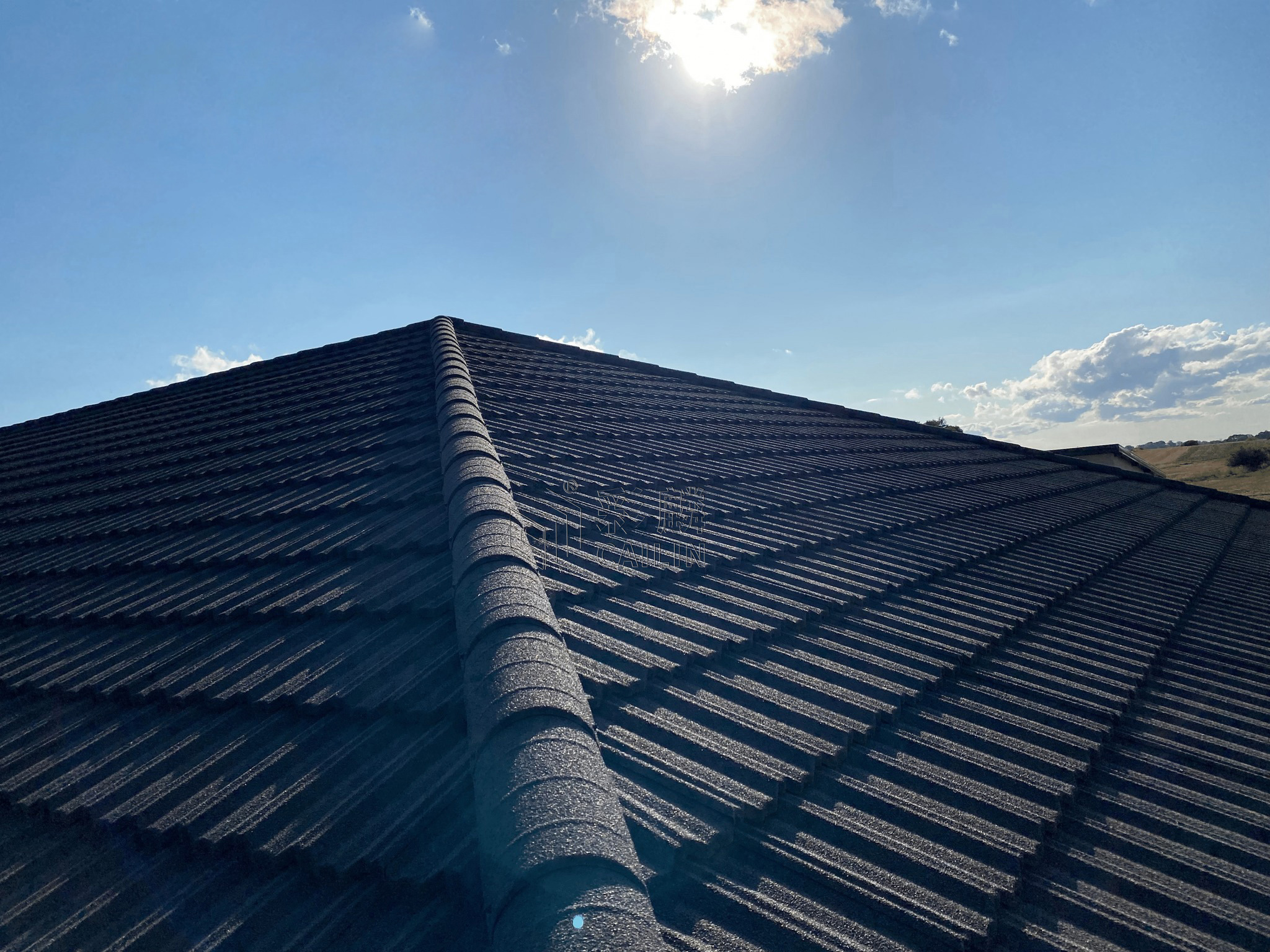
Stone-coated metal roofing is often selected for projects where heat, humidity, and long-term durability are important. Image source: Sango Cailin.
Stone-coated metal roofing has moved from a specialty product to a familiar option in pitched-roof construction. The material combines the appearance of traditional clay, slate, shake, or tile with the structural behavior of steel. For wholesalers, contractors, and specifiers, the immediate question is no longer whether the category deserves attention. It is how to evaluate product quality, project fit, and long-term cost in a market with many suppliers.
Industry estimates put the global stone-coated steel roofing market at USD 20.71 billion in 2024, with projections reaching USD 32.69 billion by 2033. In China, the metal roofing market was estimated at USD 3.57 billion in 2024, with a forecast CAGR of 4.25% through 2035. Those numbers point to steady demand in new construction, roof replacement, and coastal building projects.
What is stone-coated metal roofing?
Stone-coated metal roofing is a composite roof covering made from a corrosion-protected steel base, an acrylic resin layer, and natural stone granules fused at high temperature. The steel core gives the tile its strength; the stone surface provides texture, color, and protection from rain, snow, wind, and UV exposure. A transparent acrylic top coat is then applied to lock the granules in place.
In the case of Sango Cailin Building Tech. Co., Ltd., a Tianjin-based manufacturer, the standard material package uses galvalume steel with an AZ150 coating as the base, acrylic resin, natural stone granules, and a transparent acrylic glue top coat. Base steel thickness ranges from 0.4 mm to 0.6 mm, depending on the profile and expected wind load.
Within the broader industry, stone-coated steel roofing is commonly associated with standards such as ASTM A792/A792M, which covers steel sheet with 55% aluminum-zinc alloy coating. Buyers can use that reference point when comparing material specifications from different factories.
Why the category is gaining traction
The value of stone-coated metal roofing becomes clear when weighed against common roofing problems. The category is lighter than traditional clay or concrete tile, more durable than asphalt shingles, and more weather-resistant than bare metal roofing.
- Weight: Industry listings commonly place stone-coated steel roofing at roughly 3.2–6.7 kg/m², which is described as 5–10 times lighter than concrete or clay tile. Sango Cailin lists approximately 5–8 kg/m² for its interlocking shingle and shake models and approximately 6–8 kg/m² for standard profiles.
- Service life: Industry comparisons often cite a lifespan of 50+ years for stone-coated steel, versus approximately 20 years for asphalt shingles.
- Wind performance: The product is designed for high-wind regions, with Sango Cailin specifying wind uplift resistance up to 160 mph.
- Low maintenance: It operates as a passive system with no moving parts and no scheduled maintenance beyond occasional visual inspection.
- Retrofit capability: Because of its light weight, it can be installed directly over old tiles, reducing tear-off cost and structural reinforcement work.
- Noise control: The stone coating dampens rain and hail impact; Sango Cailin cites a 70% noise reduction compared with a bare metal roof.
What a factory should be able to demonstrate
For buyers sourcing stone-coated metal roofing at wholesale level, product specifications should be supported by manufacturing evidence. Sango Cailin Building Tech. Co., Ltd. was established in 2017 and reports over 10 years of industry experience. It operates seven production bases in China, with a factory area of 15,000 m² and an annual production capacity of 6,000,000 units. The company describes itself as a factory rather than a trading company, which is relevant for quality consistency, direct pricing, and traceability.
The company is ISO 9001, ISO 14001, and ISO 45001 certified. Those certifications cover quality management, environmental management, and occupational health and safety. Its product range includes stone coated metal roofing, asphalt shingles, BIPV solar tiles, rain gutter systems, and butyl tape. The R&D team consists of 10 engineers, and exports account for about 25% of output, with main markets in the USA, Canada, and Southeast Asia.
A capable factory should be able to answer specific questions about base steel thickness, coating weight, salt spray test hours, uplift resistance, and cut-edge protection in coastal environments. These are not secondary details; they determine how the roof behaves in a storm or a salt-laden atmosphere.
Product profiles and naming
Sango Cailin's standard stone-coated metal roofing line includes Cailin Bond Tile, Cailin Shingle, Cailin Milano Tile, Cailin Shake, Cailin Classical Tile, Cailin Roman Tile, Cailin Long-Span Tile, Cailin Golan Tile, Cailin Tudor Tile, and Cailin Heritage Tile. The interlocking series adds Cailin Interlocking Shingle and Cailin Interlocking Shake, both using a concealed fastener system.
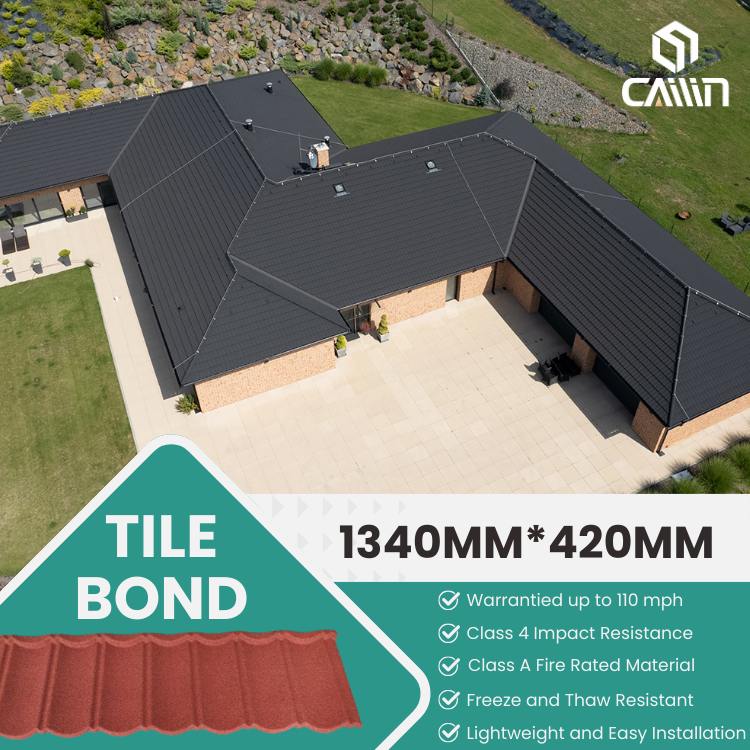
Bond is one of the standard profiles in Sango Cailin's stone-coated metal roofing range. Image source: Sango Cailin.
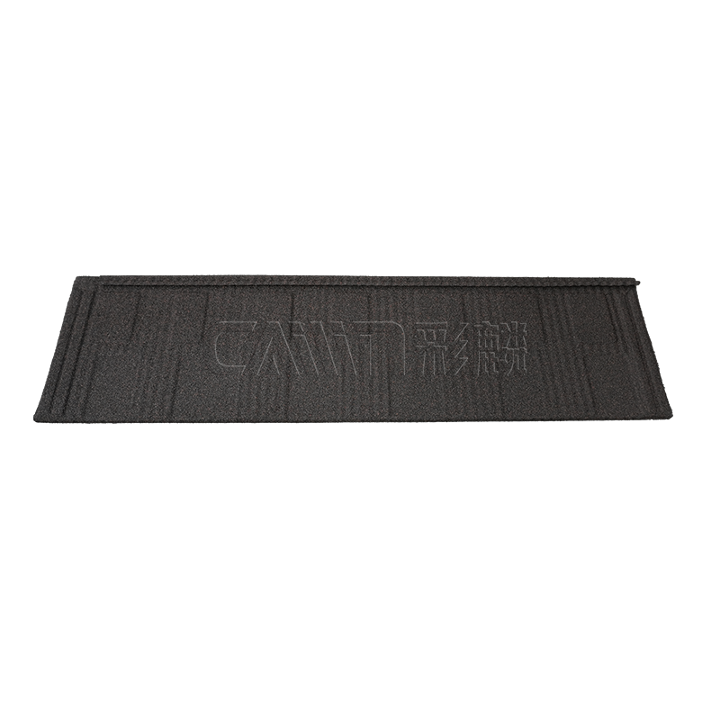
The interlocking shingle uses a concealed fastener system, which keeps screws out of the exposed surface. Image source: Sango Cailin.
Technical specifications at a glance
The table below summarizes the key parameters that buyers should compare when evaluating stone-coated metal roofing. Values are based on Sango Cailin's published product data.
| Parameter | Typical value |
|---|---|
| Base steel thickness | 0.4 mm – 0.6 mm (galvanized / aluzinc) |
| Effective tile size | 1340 mm × 420 mm, covering 1260 mm × 370 mm |
| Weight | approx. 5–8 kg/m² (interlocking models); approx. 6–8 kg/m² (standard profiles) |
| Wind uplift resistance | up to 160 mph |
| Corrosion resistance | 500 h salt spray test |
| Acoustic insulation | 70% noise reduction vs. bare metal roof |
| Material | Galvalume steel (AZ150), acrylic resin, natural stone granules, transparent acrylic top coat |
| Roof slope suitability | 12° to 90° |
In the interlocking series, fasteners are hidden beneath the tile edge. A concealed fastener system reduces exposed screw heads and helps maintain the roof's resistance to wind-driven rain.
Installation typically involves underlayment, wooden or metal battens, stainless steel or galvanized screws and clips, ridge caps, valley flashing, gable trims, pipe flashings, and a rain gutter system. The exact combination depends on roof geometry and local code requirements.
Application scenarios and project fit
Stone-coated metal roofing is designed for pitched roofs with slopes from 12° to 90°. Common project types include villa and residential homes, coastal buildings with anti-corrosion requirements, high-wind regions, and retrofit projects where the new roof can be installed directly over old tiles.
- United States and Canada: commonly used in new villa communities and roof replacement projects.
- China: frequently used in villa construction and rural self-built houses.
- Coastal and hurricane zones: selected for salt-spray resistance and high wind uplift performance.
- Cold and snowy regions: designed for pitched roofs where snow can shed; snow guards may be required on steep slopes to prevent sudden snow slides.
- Urban and suburban settings: the stone coating reduces noise from rain and hail impact.
Project-specific adaptations are important. In coastal areas, extra anti-corrosion coating on cut edges can be applied at the factory. In wildfire zones, non-combustible underlayment and sealed eaves are typically recommended. In historic restoration, exact color and profile matching may be needed. These requirements should be documented before a wholesale order is placed.
Market trends shaping the sector
The available market data shows consistent growth for stone-coated steel roofing. The global market was estimated at USD 20.71 billion in 2024 and is projected to reach USD 32.69 billion by 2033. The China metal roofing market was estimated at USD 3.57 billion in 2024, with a forecast CAGR of 4.25% through 2035.
Several structural drivers support that growth. Roof replacement is a large demand pool; older asphalt roofs fail sooner than metal systems, which pushes homeowners toward longer-life materials. Coastal construction continues to demand corrosion-resistant products. Energy-conscious building has also focused attention on reflective roofing; some industry sources report that metal roofing can reflect heat away from buildings and may save homeowners up to 40% on cooling energy costs, depending on climate and insulation.
The competitive landscape includes established names such as DECRA Roofing Systems, Ross Roof Group, Boral Steel, and Tilcor. For a Chinese factory like Sango Cailin, the challenge is to compete on measurable specifications, production capability, and supply-chain consistency rather than on brand heritage alone.
Comparison with traditional roofing materials
To understand where stone-coated metal roofing fits, it helps to compare it with conventional alternatives. The table below is a simplified view; actual project results depend on local climate, installation quality, and roof geometry.
| Material | Typical weight | Typical service life | Maintenance | Main strength |
|---|---|---|---|---|
| Stone-coated steel | approx. 3.2–8 kg/m² depending on source and profile | 50+ years in industry comparisons | low; occasional visual inspection | lightweight, wind resistance, low maintenance, varied profiles |
| Clay or concrete tile | roughly 5–10 times heavier than stone-coated steel | long service life in many installations | periodic cleaning and replacement of cracked units | mass, traditional appearance |
| Asphalt shingles | relatively light | approx. 20 years | more frequent replacement or repair | low first cost, fast installation |
Stone-coated metal roofing is not a universal replacement for all materials. It is intended for pitched roofs from 12° to 90°; low-slope or flat roofs require a different system. In cold regions, snow guards may be necessary. In coastal zones, cut edges need proper protection. The initial material cost is often higher than asphalt shingles, although the longer expected service life can change the lifetime cost calculation.
Future outlook
The direction of the roofing market points toward materials that are lighter, longer-lasting, and easier to integrate with energy systems. Stone-coated metal roofing is well placed for that direction, especially in renovation and coastal construction. The presence of related products such as BIPV solar tiles also suggests that manufacturers are moving toward complete roof systems, not just individual tiles.
For wholesale buyers, the practical consequence is to evaluate suppliers on process control and documentation. Price and appearance matter, but so do base steel specification, coating system, fastener strategy, and the ability to support project-specific requirements such as snow guards, cut-edge coating, and custom profiles.
Frequently asked questions
What is stone-coated metal roofing?
Stone-coated metal roofing is a composite roof covering made from a steel base sheet with a corrosion-resistant alloy coating, an acrylic resin layer, and natural stone granules fused by high-temperature sintering. It is designed for pitched roofs and is available in profiles that imitate tile, shake, slate, or other traditional materials.
How long does stone-coated metal roofing last?
Industry comparisons commonly cite a lifespan of more than 50 years for stone-coated steel roofing. Asphalt shingles are often compared at approximately 20 years. Actual lifespan depends on climate, installation quality, and regular visual inspection.
Is stone-coated metal roofing suitable for coastal and hurricane-prone areas?
Yes, when specified correctly. Sango Cailin's stone-coated metal roofing is designed for coastal buildings with anti-corrosion requirements, uses galvalume steel (AZ150), and is rated for salt spray resistance of 500 hours and wind uplift resistance up to 160 mph. Coastal installations may also require extra anti-corrosion coating on cut edges.
What does stone-coated metal roofing cost over its lifetime?
Stone-coated metal roofing can have a higher initial purchase price than asphalt shingles, but it may offer lower lifetime cost because of a longer expected service life and low maintenance. The roof does not require painting, sealing, or frequent repair. A precise comparison should be based on local labor costs, roof complexity, and expected service life.
What should wholesale buyers verify from a stone-coated metal roofing factory?
Buyers should verify production credentials and measurable specifications. Sango Cailin Building Tech. Co., Ltd., for example, is ISO 9001, ISO 14001, and ISO 45001 certified, operates seven production bases in China, and manufactures stone coated metal roofing as a factory rather than a trading company. Relevant specifications include base steel thickness, coating type, salt spray test hours, wind uplift resistance, and fastener system.
This article was prepared as an independent industry reference. For detailed product specifications and company background, Sango Cailin provides a downloadable brochure at Sango Cailin brochure (PDF).