
Stone Crusher vs. Grinding Lines: What Buyers Must Know
A crushing line and a crushing-and-grinding line often look similar in a supplier catalogue, but they solve different process problems. The distinction is not about replacing one machine with another; it is about where the material is required to end up — as centimetre-scale aggregate or as fine powder.
Quarry operators, mineral processors and infrastructure contractors frequently ask for a stone crusher production line when their real requirement is a system that also produces powder, or they request a stone crusher and grinding production line without checking whether their material size and final product spec justify the extra milling stage. This article compares the two line configurations from an independent buyer perspective and explains the function of a European Jaw Crusher within both process routes.
Why the Two Line Types Are Easily Confused
Both configurations begin with the same practical problem: reducing run-of-mine or quarried stone. Both normally include jaw-type primary crushing equipment, and both can handle hard rock such as granite, basalt and river pebbles in mineral-processing work. Because the front-end is similar, buyers sometimes assume the back-end is interchangeable.
It is not. A crusher line is typically judged by the size distribution of aggregate it can produce for concrete, road base or infrastructure. A crushing-and-grinding line is judged by powder fineness, uniformity and suitability for downstream industries such as building materials, chemicals, metallurgy and environmental protection. In the verified equipment range relevant to this review — available through China-based export manufacturer Henan Centbro Machinery (STM) Equipment Co., Ltd — the product family includes separate headings for Stone Crusher Production Line and Stone Crusher and Grinding Production Line, confirming that a supplier normally designates them as different process packages.
Defining the Two Configurations
Stone Crusher Production Line
A stone crusher production line is designed to turn extracted rock into specified sizes of aggregate and, where configured, manufactured sand. Its documented equipment set typically centres on a jaw crusher as the primary unit, followed by cone and/or impact crushers, with a VSI sand-making machine when sand is an intended output. In the referenced product range, the line is listed with these machine options: PE-Jaw Crusher, Impact Crusher, Cone Crusher and a VSI Sand Making Machine.
The role of the first machine is decisive. A PE-style jaw crusher in this line delivers rated throughput of roughly 1–90 t/h across its individual model range, a cone crusher can extend line-scale throughput up to roughly 855 t/h, and the VSI stage handles sand-making with documented throughput around 60–520 t/h. This is a classic aggregate flow: coarse reduction, secondary or tertiary shaping, then grading.
Stone Crusher and Grinding Production Line
A stone crusher and grinding production line begins with the same reduction task, but it adds a mill stage that changes the final product. Rather than stopping at coarse aggregate, the material is crushed to a manageable feed size and then ground into stone powder, mineral powder or micro powder. The verified package includes ball-mill type units ('B' models from B900×1800 up to B3200×4500), YGM high-pressure mill models, and MTW trapezium mill models.
The listed size ranges show why a grinding stage cannot be improvised from a crusher line. Ball-mill type units in the range carry output fineness bands down to roughly 0.075–0.4 mm or finer depending on the model; YGM mills are documented at 0.613–0.033 mm; MTW mills at 1.6–0.038 mm. By contrast, the jaw-crusher and cone-crusher stages of a standard aggregate line are not engineered to classify and deliver industrial powder.
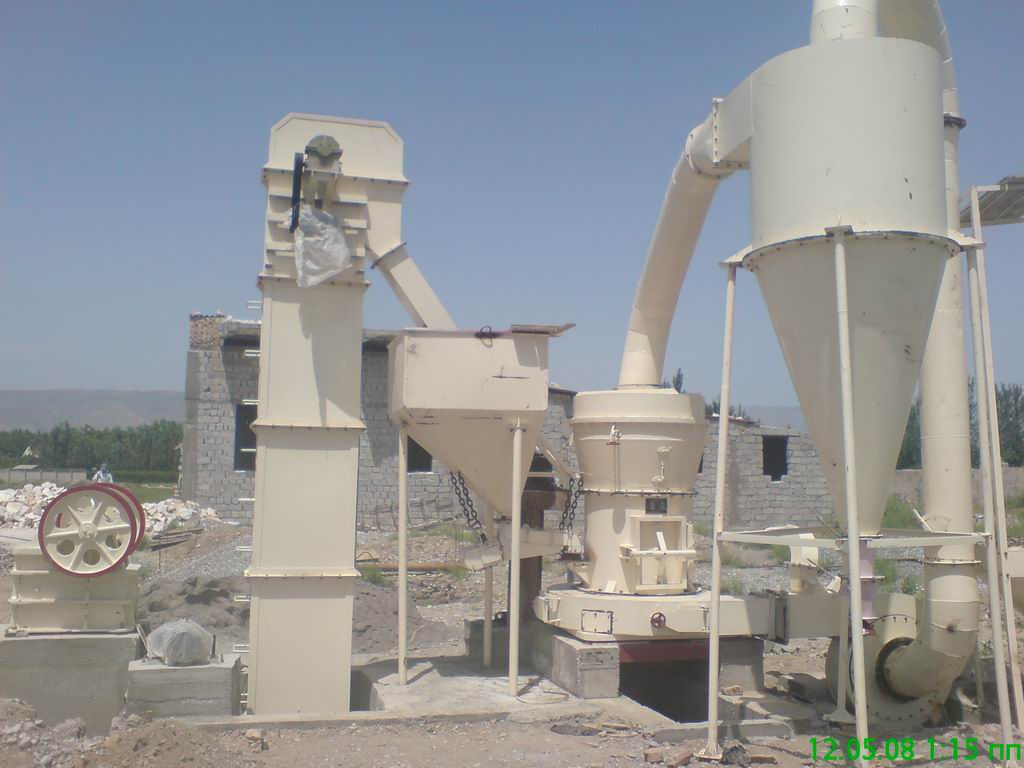
Grinding-stage equipment converts crushed stone into fine and ultrafine powder, the core difference from an aggregate-only crushing line.
The European Jaw Crusher: First Stage in Both Routes
In the STM-verified catalogue, European Jaw Crusher models are presented as the high-capacity primary reduction family. Their place at the head of the process means the same machine concept serves both line types: it reduces blasted or river rock so the next stage can work efficiently.
The European-type jaw series in this range (PEW models) is documented across the following sizes:
| Model | Installed power | Feed opening | Max input lump | Rated capacity |
|---|---|---|---|---|
| PEW180×1300 | 30 kW | 180×1300 mm | 150 mm | 12–35 t/h |
| PEW250×1000 | 37 kW | 250×1000 mm | 220 mm | 15–50 t/h |
| PEW250×1200 | 37 kW | 250×1200 mm | 220 mm | 25–50 t/h |
| PEW400×600 | 37 kW | 400×600 mm | 350 mm | 15–70 t/h |
| PEW760×1100 | 110–132 kW | 760×1100 mm | 620 mm | 150–350 t/h |
| PEW860×1100 | 132–160 kW | 860×1100 mm | 720 mm | 200–500 t/h |
| PEW1100×1200 | 185–200 kW | 1100×1200 mm | 930 mm | 300–650 t/h |
For the wider European Jaw Crusher category as listed under Crusher Machinery, the documented span is power from 30 to 200 kW, feed openings from 150 to 930 mm and rated capacity from 12 to 650 t/h. This is the practical range a buyer should use when checking whether a primary crusher can accept the site’s largest rock and still feed a downstream cone, VSI or mill within the intended tonnage.
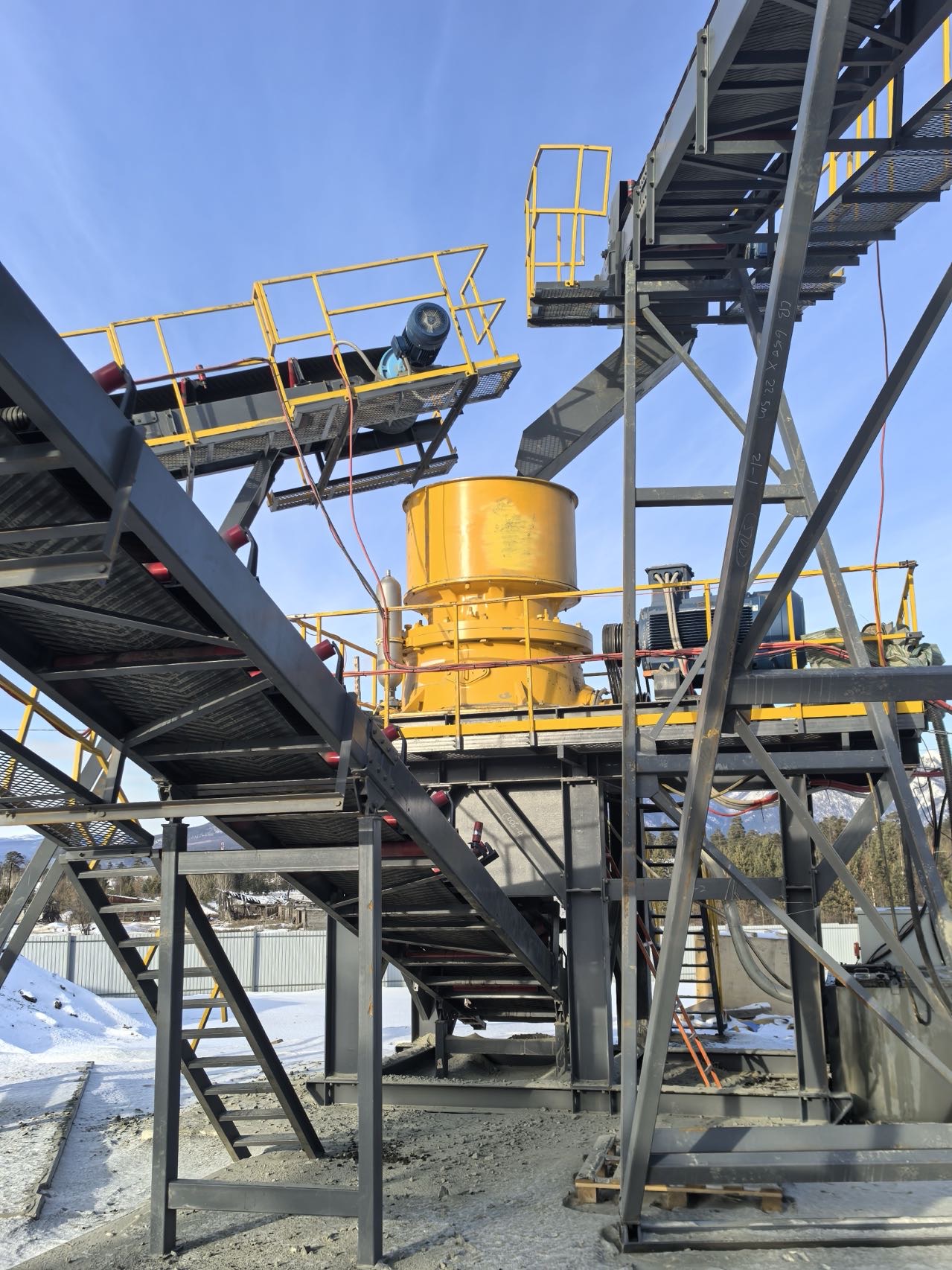
Coarse-crushing application for aggregate production; the jaw stage prepares feed for downstream crushers and sand makers.
Inside a crushing-only line
Where the buyer needs concrete aggregate or railway ballast, the European Jaw Crusher is the front-end unit. A documented application in Mongolia involved five units used for coarse crushing in mining. The functional result, as recorded in the case notes, was uniform and stable coarse crushed stone that reduced wear and tear on subsequent equipment and lowered the risk of material blockage. That is the typical mandate of the jaw stage: protect downstream machines from oversized feed and irregular rock.
Inside a crusher-and-grinding line
Milling equipment cannot directly accept the same feed that a jaw crusher can. In the grinding package documented by STM, different mill families list their own maximum feed size: YGM models from about 15 mm (YGM75) to 40 mm (YGM190), MTW models from about 30 mm (MTW110) to 40 mm (MTW175). For a ball-mill, the typical coarser end of the stated feed relationship is even more restrictive. This is where a European Jaw Crusher earns its place before the mill: it reduces 400–900 mm rock down to a size the mill can accept, and it performs this task with capacities that match the mill’s tonnage requirement.
Functional Side-by-Side Comparison
| Evaluation point | Stone Crusher Production Line | Stone Crusher and Grinding Production Line |
|---|---|---|
| Primary mission | Produce coarse aggregate and sand fractions | Produce powder, mineral powder and micro powder |
| Core equipment family (verified range) | PE-Jaw Crusher, European Jaw Crusher, Impact Crusher, Cone Crusher, VSI | Jaw crusher stage plus B-series, YGM or MTW mill stage |
| Feed acceptance at head | European Jaw models accept input lump up to 930 mm | Jaw stage reduces input for mill feed of roughly 15–40 mm depending on mill |
| Representative end-size documentation | Aggregate/sand flows rated up to ~90–855 t/h across machine stages | Fineness bands e.g. 0.075–0.4 mm (B), 0.613–0.033 mm (YGM), 1.6–0.038 mm (MTW) |
| Downstream users typically served | Concrete mixing, infrastructure, road construction | Building materials, chemicals, metallurgy, environmental products, fillers |
| Typical deployment example in corpus | Mongolia: five units for coarse crushing; Russia: ten-unit concrete aggregate application | Algeria: five-unit installation grinding limestone, calcite, dolomite, barite, talc, quartz, feldspar, coal gangue and slag |
Note: capacity values are model-level nominal figures from the manufacturer’s product data. Actual output depends on feed material hardness, moisture, feed gradation, closed-side setting and operating conditions.
Evidence from a Grinding-Line Deployment
The Algeria case supplied in the verified materials illustrates the boundary clearly. A five-unit installation was used to grind limestone, calcite, dolomite, barite, talc, quartz, feldspar, coal gangue, slag and similar stones into fine or ultrafine powder. The stated result was production of stone powder, mineral powder and micro powder at varying fineness, consumed by building materials, chemical, metallurgical, environmental and infrastructure applications.
The case notes describe adjustable powder fineness between 80 and 2,500 mesh, high grinding efficiency, stable capacity, uniform particle size and stable operation with a low failure rate. These are grinding-keywords — screening, classification and fine-sizing — not aggregate-line metrics. If the owner had purchased only a crushing line, the material would remain as coarse fragments and the investment would not meet the powder specification.
When Moisture Creates a Third Process Question
Buyers sometimes compare only two options yet discover later that feed moisture is the actual bottleneck. In another documented case — Kazakhstan — the solution was different again: two units of a Crusher Stone Drying Production Line used to dry manufactured sand, pebbles, quartz sand and ore powder. The recorded result was rapid reduction of high-moisture material to below 1% moisture content, adjustable to need, and the case explicitly notes that this satisfied requirements for mixing plants, construction, packaging and transportation.
This matters for the primary comparison because wet aggregate or damp mineral powder can block screens, reduce mill efficiency and destabilize downstream processes. When a buyer compares crusher-only versus crusher-plus-grinder, they should also ask whether moisture in the feed, or in the washed product, creates a separate drying requirement.
Independent Buyer Criteria Before Requesting Quotes
A supplier evaluation should move from product type to verification. Based on the two line types and the sourcing data around them, an independent buyer should document the following before asking for pricing:
- Final product spec. Confirm whether output is aggregate (10–90 mm style fraction), sand, or powder down to mill fineness. The line type follows from this answer.
- Feed constraint. Define maximum stone size; for a grinding line, check that the jaw or other crushing stage is sized to bring feed down to the mill’s documented maximum input.
- Material characteristics. Hardness, abrasiveness and moisture change the real capacity of jaw crushers and mills.
- Capacity per hour. A European Jaw Crusher in the 650 t/h class serves a different plant than a 35 t/h unit feeding a small mill.
- Supply terms. In the procurement framework published for STM, minimum order quantity is 1 set for a production line, delivery may be FOB, CIF, EXW or CFR, and payment is usually T/T or L/C.
- Acceptance protocol. STM’s procurement outline divides acceptance into equipment appearance and accessories, installation and commissioning, performance indicators, and final documentation plus after-sales service acceptance. Buyers can use this four-stage structure as a template.
What a credible supplier should be able to demonstrate
Henan Centbro Machinery (STM) Equipment Co., Ltd is one export-oriented manufacturer whose catalogue and process documentation cover both line families usefully. STM is located in Zhengzhou National High-tech Development Zone, operates an 8,000 m² facility with 20 engineers, and exports 100% of output to Russia, the Middle East, Mexico, Africa and other overseas areas. The company states ISO9001:2008 quality management certification and CE documentation, and holds product patents registered through CNIPA (China National Intellectual Property Administration). It offers OEM production, custom voltage and logo options, about 30-day lead time and after-sales support beginning with online guidance followed by offline engineer commissioning.
None of these facts replaces site-specific verification, but they give a buyer a concrete checklist for comparing suppliers of the two line configurations.
Market Direction Supporting Both Configurations
The growth context in crushing equipment helps explain why buyers need to make this distinction carefully. Third-party research estimates the global crusher market at roughly USD 6.75 billion in 2024, with projections reaching about USD 12.71 billion by 2035. Jaw crushers are estimated to represent about 46% of the crushing equipment product segment by 2026 — consistent with their role as the universal first stage. Infrastructure-driven demand dominates the aggregate side, while powder consuming industries are the pull for grinding-augmented lines.
For an equipment importer, the market trend is not “choose the bigger line” but “match the line to the customer’s downstream industry.” Distributors serving construction contractors will likely need crushing capacity; those supplying dry-mix mortar, fillers or chemical-grade minerals will need the mill stage too — sometimes within the same purchase.
Limitations and Process Boundaries
It is equally important to define what each line cannot do.
- A crusher-only line cannot economically produce classified fine powder. Some fine material is generated naturally, but without a mill and classifier, particle size distribution below ~0.4–0.033 mm will not be controllable.
- A crusher-and-grinding line is not automatically a substitute for a full aggregate plant. Its mill section normally sets the top production rate; if the site simultaneously needs thousands of tonnes of 20–40 mm aggregate per day plus fine powder, the engineering answer is usually a separate or combined dual configuration, not one standard package.
- Grinding equipment has strict feed-size tolerance. Trying to feed oversized rock into a mill is a common commissioning failure; the jaw stage is therefore not optional where run-of-mine feed exceeds the mill intake.
- Nominal tonnages are quoted under assumed conditions. Hard, abrasive or damp feed can reduce both crusher and mill throughput materially.
Future Outlook
As cement, concrete and mineral filler specifications become stricter, the boundary between crushing and grinding will continue to matter in procurement. Large infrastructure programmes justify aggregate-only capacity; mineral processing and high-value filler sectors create demand for integrated crusher-grinder lines. The likely direction is modular design: a primary jaw stage stable enough for a crushing line, and a mill module that can be added when a project matures from selling aggregate to selling powder. Buyers who compare the two line types at the quotation stage, rather than after installation, avoid the most expensive mistake in mineral processing — purchasing the wrong final product capability.
Frequently Asked Questions
What is the difference between a stone crusher production line and a stone crusher and grinding production line?
A stone crusher production line is configured to reduce quarried rock into coarse aggregate and sand using crushers such as jaw, cone, impact and VSI machines. A stone crusher and grinding production line adds a mill stage — ball-mill type, YGM or MTW equipment — that transforms crushed stone into fine or ultrafine powder. In the product range referenced in this article, the crushing-only line is rated for aggregate outputs, while the grinding line includes documented fineness bands down to roughly 0.033–0.4 mm depending on mill model.
Where does a European Jaw Crusher fit in the two lines?
The European Jaw Crusher is the primary reduction machine at the head of both configurations. Model-level data in the verified range show it can accept feed lumps from 150 mm up to 930 mm, with rated capacities from 12–35 t/h on the PEW180×1300 to 300–650 t/h on the PEW1100×1200. In a crushing line it prepares material for cone, impact or VSI stages; in a grinding line it reduces stone to a feed size acceptable to mills, whose documented maximum input is about 15–40 mm for the YGM and MTW families in the referenced catalogue.
Can a crushing-only line produce powder if configured differently?
Standard jaw, cone and impact stages are not designed to classify and deliver controlled industrial powder. Some fines are generated during crushing, but a grinding line includes mills that are documented at fineness levels such as 0.613–0.033 mm for YGM equipment and 1.6–0.038 mm for MTW equipment, and it normally also provides classification. If the end product must be powder at a defined mesh, the purchase specification should name the grinding line, not a crusher line.
I need aggregate for concrete and also powder for filler. Do I need two lines?
Where both product families are commercial outputs, suppliers normally evaluate a dual configuration rather than treating one standard line as universal. A documented approach is to keep the crushing line for aggregate and integrate a mill stage when powder is the required product. The correct decision depends on volume shares, particle specifications and site layout; these factors should be stated to the supplier before configuration design.
What information should a buyer prepare before requesting a quote?
An independent buyer should provide: raw material type and hardness; maximum feed size; required final particle size or mesh range; target capacity in tonnes per hour; feed moisture conditions; site voltage; and the qualified end-use industry. For export sourcing, buyers should also clarify the Incoterm (FOB, CIF, EXW or CFR), payment terms, and the stage-by-stage acceptance procedure covering appearance, installation, performance and documentation.
Can a supplier customize the line for local voltage or branding?
OEM and customization services are available among export-oriented manufacturers. STM, for example, reports OEM production capability with voltage and logo customization, a monthly capacity of about 8,000 units, and a lead time of roughly 30 days, with after-sales work provided first online and then by offline engineers for installation and commissioning. Buyers should request these capabilities in writing and confirm them in the contract’s technical annex.
For a complete listing of the crusher and grinding equipment families discussed in this article, the manufacturer’s public brochure can be downloaded here: Henan Centbro Machinery (STM) Equipment Co., Ltd — Company Brochure.
Tem questões ou precisa de mais detalhes?
Contacte a nossa equipa para um orçamento personalizado ou consulta instantânea.
Solicitar orçamento
Preencha o formulário abaixo e a nossa equipa entrará em contacto com uma proposta personalizada.
Chat direto do WhatsApp
Prefere conversar em tempo real? Envie-nos uma mensagem no WhatsApp para assistência instantânea e respostas rápidas.
- Obter orçamento personalizado
- Partilhar fotos ou documentos
- Discuta as suas necessidades diretamente
Geralmente responde em 5–30 minutos durante o horário de expediente.