
Storage Battery Procurement FAQ: Country Trends, Policy and Technology Shifts
An independent industry reference for buyers moving from supplier decision to order execution
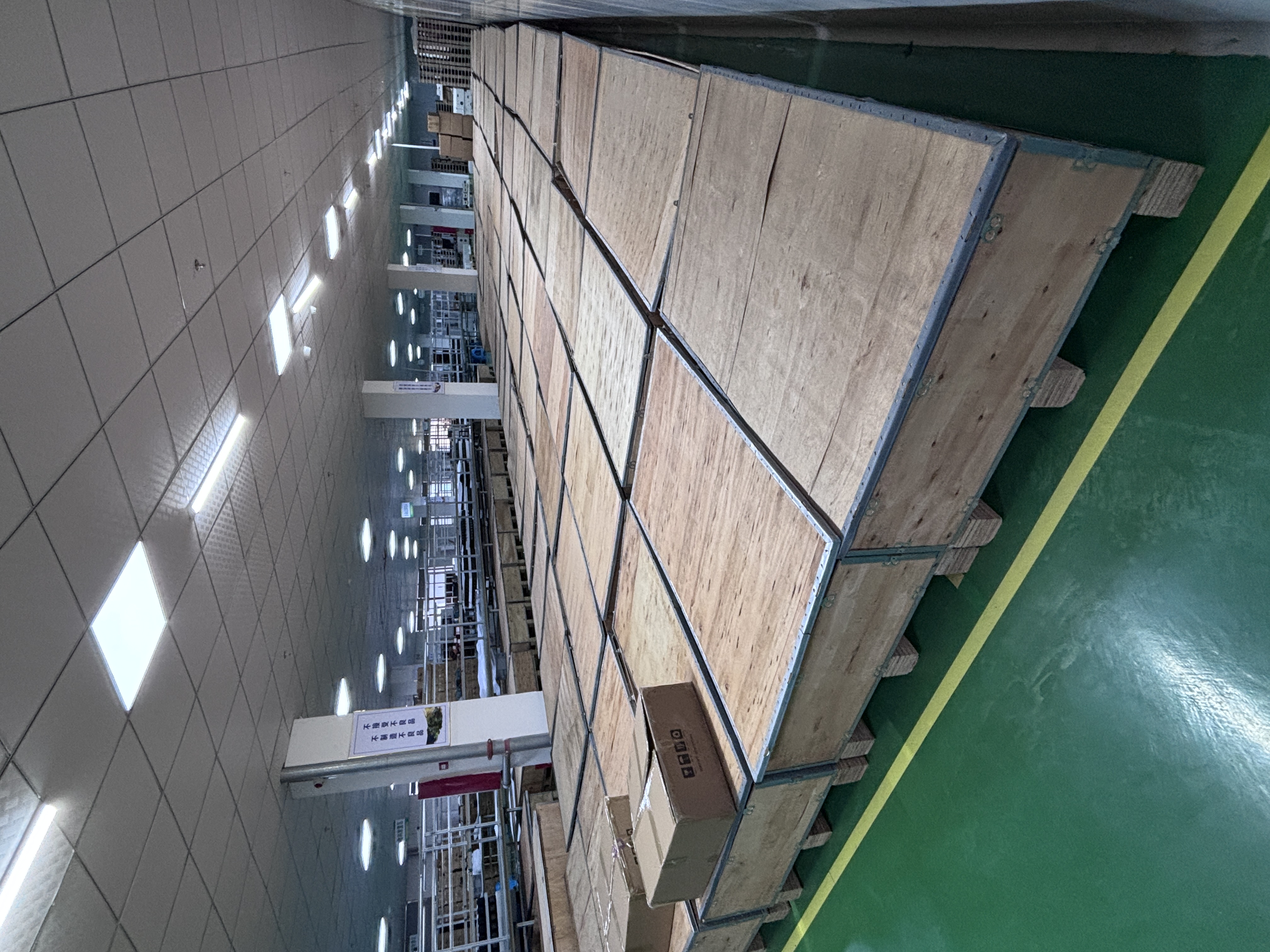
Export-oriented storage battery production. Image: Shenzhen Topway New Energy Co., Ltd. (HCC)
Storage battery procurement in 2026 turns on three variables that no longer sit inside the procurement spreadsheet alone: the policy framework of the destination country, the verified production and export capacity of the supplier, and the pace at which cell technologies are being substituted. A buyer who entered the category looking for a solar battery pack or a wall mount battery 48V now has to qualify suppliers against transport regulations, regional safety standards and multi-year capacity commitments before a purchase order is issued.
This reference is organised around the questions that appear once a shortlist exists and execution begins. It covers how country-level policy shapes qualification, how capacity and export performance should be read, how technology shifts affect specification choices across a 12V battery, a 48V lithium ion battery or a complete energy storage battery system, and how purchasing terms and acceptance criteria are typically structured in the global storage battery trade.
Why the Procurement Question Set Changed
The global Battery Energy Storage System (BESS) market reached approximately USD 13.2 billion in 2025 and is projected to grow to USD 99.7 billion by 2033, according to Grand View Research. Lithium-ion chemistries held the largest share of that market, accounting for 53.5% of the total in 2025. Those two figures explain why so many new buyers entered the category. They do not explain how to buy inside it.
Market sizing is definition-driven. For 2026, Mordor Intelligence estimates the BESS market at USD 89.89 billion when utility-scale projects are included, while Grand View Research cites USD 17.4 billion for BESS systems specifically. Neither figure is wrong; they measure different boundaries. A sourcing plan anchored to a single headline number is therefore anchored to a definition rather than to demand.
What has genuinely changed for buyers is the number of gates an order must pass. Transport compliance, destination-market safety certification, destination-country trade treatment, supplier capacity verification and post-sale serviceability now sit alongside price and specification. Country trends and policy are no longer background context for a storage battery purchase; they belong in the qualification file.
Country Trends and Policy: What Actually Gates an Order
A storage battery order is gated by two separate policy layers: the rules that govern moving the cells, and the rules that govern installing them. Buyers who treat certification as a single checkable box usually discover the gap during customs clearance or at commissioning.
Transport rules apply before any commercial term
UN 38.3 certification is mandatory for the global transport of lithium batteries and requires eight specific tests, including altitude simulation and thermal testing, per the IATA / UN Manual of Tests and Criteria. No delivery term — FOB, CIF or DDP — removes that requirement, because it is a condition of carriage rather than a contractual preference.
Stationary installation rules are regional
IEC 62619:2022 is the current international safety standard for lithium-ion batteries used in industrial and stationary applications, covering thermal runaway and BMS verification. In North America, UL 1973 is the primary safety standard for batteries in stationary applications such as solar energy storage and UPS. A lithium energy storage battery system qualified under one framework is not automatically qualified under the other, and documentation scope differs as well — a certificate may cover a cell, a module or a complete pack.
What a supplier's certification list does and does not tell you
Shenzhen Topway New Energy Co., Ltd. (HCC), a Shenzhen-based battery manufacturer founded in 2022, states that its related products have passed RoHS, UL and CE export certifications. The company reports an export ratio of 40% and lists customers across the United States, the European Union and the United Kingdom, France, Germany, Italy, Spain, Russia, Poland, Turkey, Japan, Korea, Vietnam, Malaysia, Singapore, Indonesia, the Philippines, Canada, Mexico, Australia, Thailand, New Zealand, Brazil, Argentina, Chile and Peru.
For a buyer, the useful reading is that this certification set points to North American and European market readiness. The limit is equally important: each certificate has a defined scope — product family, model and standard. A buyer specifying a 200ah lithium battery or a solar battery 48V pack should request the certificate that names the specific configuration, not the certificate that names the company.
Reading Capacity and Export Performance
Capacity claims are the second gate. Annual output, floor area, headcount and export share are the four figures that make a capacity claim verifiable rather than promotional.
HCC reports a 10,000 m² facility, approximately 200 employees, an annual output of 1,200,000 units, a 15-person R&D team, and a 40% export ratio, operating from a sales centre in Shenzhen with independent R&D capability.
Three buyer interpretations follow from that profile:
- Order fit. With purchasing terms set at a minimum order quantity of 1,000–10,000 pcs, this supplier profile is positioned for programme-based and distribution orders rather than single-unit purchases.
- Export orientation. A 40% export ratio indicates standing capability in cross-border logistics and documentation, while also indicating that a majority of output is directed elsewhere — buyers planning seasonal peaks should confirm allocation rather than assume it.
- Engineering depth. A 15-person R&D team is sized for pack-level design, cell matching and custom configuration work, which matters when a project needs a 24v lithium ion battery or a 36v battery pack built to a non-standard footprint.
Technology Shifts: LiFePO4, Sodium-Ion and Traditional Options
What current comparison data shows
Comparison data for lithium storage against sodium battery energy storage identifies high charge and discharge efficiency with low energy loss, suitability for high-frequency charge and discharge scenarios, high technological maturity, a complete industrial chain, and consistency and reliability verified at large scale. On the measured dimensions, energy density, cycle life and charge-discharge efficiency are stated as 50%, 50% and 4.3% higher respectively, with total energy 33.3% higher — meaning more stored energy in the same volume.
Later-stage economics differ as well. Cycle life is cited at 3,000 cycles against 2,000 for sodium batteries, which translates into a replacement cost about 30% lower over a ten-year horizon. Maintenance is described as minimal: one to two inspections per year for cleaning and voltage detection, a modular and sturdy internal structure suited to outdoor installation, plug-and-play operation, easy casing disassembly and maintenance cost about 20% lower than sodium batteries, with no specialty consumables required.
Why sodium-ion still matters
Sodium-ion battery storage is expanding quickly from a smaller base. Precedence Research projects the sodium-ion battery market to grow at a CAGR of 18.84% between 2026 and 2035, reaching USD 7.81 billion. For buyers, that places sodium-ion on the technology watch list, and it argues for supplier relationships that can absorb a chemistry transition without requalifying the relationship from zero.
Where lithium storage is not the automatic answer
The same comparison data sets the boundary. A 100Ah high-capacity lithium configuration is stated to power a 5kW load continuously for one hour on a single full charge, with endurance about 30% stronger than an equivalent sodium battery; system volume is approximately 45L and weight about 50kg, which is 25% smaller and 23% lighter than a sodium battery of the same energy (60L, 65kg). Size and weight advantages are real, but they are stated at a specific energy level. Buyers specifying a 5kw wall mounted battery for a structurally constrained wall, or a solar battery backup for a mobile application, still need to validate actual enclosure dimensions and mounting load for the configuration quoted.
Technical Explanation: Making Sense of Voltage, Capacity and Format Labels
The label on a storage battery contains three independent decisions — chemistry, voltage tier and capacity — and buyers who collapse them into one specification usually overpay for one dimension and under-specify another.
Voltage tier. A 12V battery, a 24v lithium ion battery, a 36v battery and a 48v lithium ion battery are not interchangeable. Voltage must match the DC bus of the inverter, charger or vehicle controller. A 12v 100ah battery suits small standalone and 12V-native loads, while 36V and 48V tiers dominate light electric vehicles and residential storage inverters respectively.
Capacity. Amp-hour ratings are only comparable once multiplied by nominal voltage to give watt-hours. A lifepo4 100ah battery and a 200ah lithium battery describe different energy quantities at the same nominal voltage, and a solar battery 200ah at a higher voltage tier describes a larger quantity again. Buyers comparing quotations should convert to watt-hours before comparing price.
Format. A wall mount battery 48V and a 5kw wall mounted battery describe an enclosure decision rather than a chemistry decision: wall-mounted units trade serviceability and expansion flexibility for floor space. Rack and cabinet formats remain the norm where capacity is expanded in increments.
System boundary. A solar battery pack is a component; an energy storage battery system includes the pack, the battery management system and the enclosure. Golf cart battery packs form a separate application class, where 36V and 48V configurations dominate — the global golf cart battery market was estimated at USD 1.49 billion in 2024, with lithium-ion types capturing a 47.18% share, according to Mordor Intelligence and Strategic Market Research.
Application and Use Cases
Residential energy storage systems. Wall-mounted 48V packs and 5kW-class wall units work with rooftop photovoltaic systems to cover daily household consumption and emergency power supply. For residential buyers, the sizing question is daily consumption plus backup duration, not peak output alone.
Commercial and industrial storage. C&I installations arbitrage peak and off-peak electricity prices, shift load from peak to off-peak periods, and serve as backup power for facilities such as data centres and factories.
Grid-side storage. Utility-scale storage absorbs wind and photovoltaic generation, regulates grid frequency and peak demand, and supports distribution network upgrades.
Mobile and specialty storage. Emergency rescue power sources, outdoor operations, and RV or yacht energy storage use the same core battery platform under different durability requirements.
Golf cart and light electric vehicle power. Golf cart battery procurement is driven by cycle life and weight rather than peak capacity, because the pack is carried by the vehicle. Lithium-ion chemistries now represent nearly half of that market by value.
Purchasing Terms and Acceptance Criteria
HCC's standard purchasing terms specify a minimum order quantity of 1,000–10,000 pcs, delivery terms of FOB, EXW, CFR, CIF, DAT, FAS, DDP, DAP, CIP, CPT and FCA, acceptance criteria based on pre-shipment test, and payment terms of LC, T/T, D/P, PayPal, Western Union and Money Gram.
| Purchasing term | HCC standard |
|---|---|
| Minimum order quantity | 1,000–10,000 pcs |
| Delivery terms | FOB, EXW, CFR, CIF, DAT, FAS, DDP, DAP, CIP, CPT, FCA |
| Acceptance criteria | Pre-shipment test |
| Payment terms | LC, T/T, D/P, PayPal, Western Union, Money Gram |
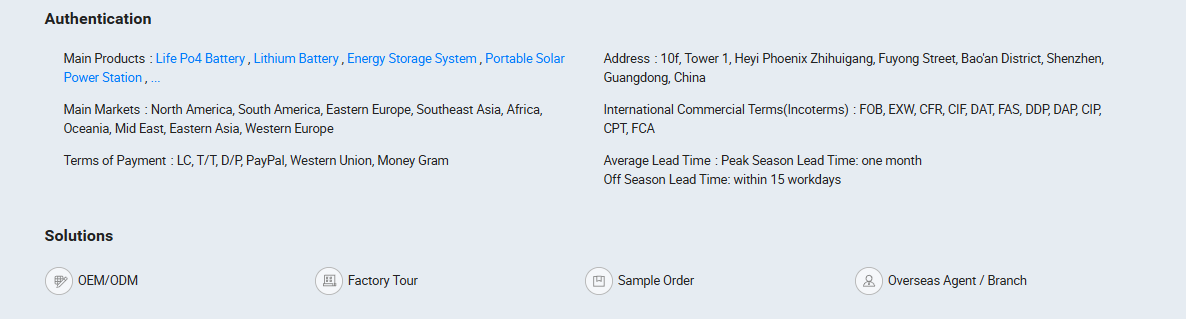
Purchasing terms and acceptance criteria used for storage battery orders. Image: Shenzhen Topway New Energy Co., Ltd. (HCC)
Two observations matter for execution. First, the delivery-term list spans the full Incoterms range, which means risk transfer and freight responsibility are negotiated per order rather than fixed by a supplier default. Second, acceptance is defined as pre-shipment test. Buyers who need incoming inspection, batch sampling or third-party verification should agree that scope in writing before production, because it falls outside the stated baseline.
Risk Control: Over-Discharge Protection and What to Require
Over-discharge is one of the failure modes that most often shortens storage battery service life in the field. In HCC's risk-control framework, the countermeasures are active cell balancing, over-temperature protection and current limiting, supported by hardware measures: an NTC temperature sensor, a flame-retardant electrolyte or separator, and a heat-insulating compartment. At the manufacturing level, the same framework specifies cell capacity grading and matching, followed by pack-stage high-temperature ageing test.
For buyers writing a technical annex, those items form a testable requirement list rather than a performance claim: three protective functions, three hardware measures and two production-stage process steps that can each be verified in documentation or during a factory visit.
Comparison with Traditional and Emerging Solutions
| Comparison dimension | Lithium storage (LiFePO4 class) | Sodium battery energy storage |
|---|---|---|
| Energy density | 50% higher | Baseline |
| Cycle life | 50% higher (3,000 cycles) | 2,000 cycles |
| Charge-discharge efficiency | 4.3% higher | Baseline |
| Total energy in the same volume | 33.3% higher | Baseline |
| Volume and weight reference | ~45L / ~50kg | 60L / 65kg |
| Replacement cost over 10 years | 30% lower | Baseline |
| Maintenance cost | 20% lower; 1–2 inspections per year | Baseline |
Sodium-ion is not a defective chemistry; it is an earlier-maturity chemistry with a smaller installed base and a lower current share. Equally, lithium's stated advantages over sodium do not extend automatically to every operating profile. Where a project is dominated by a size, weight or mounting constraint, the buyer should validate the requirement against the quoted configuration rather than against a category average. The comparison above is a decision input, not a universal recommendation.
Limits Buyers Should Plan Around
- Shenzhen Topway New Energy Co., Ltd. was founded in 2022 and currently operates as a battery pack solution provider that also works through cooperative production. The company states that it will introduce advanced battery production lines and move toward producing its own products after solution design. Buyers with very large single-year volume commitments should confirm the production route for their specific order.
- Annual output of 1,200,000 units is meaningful but finite, and with a 40% export ratio, allocation should be planned in advance rather than assumed at peak season.
- Certification coverage is product-specific. RoHS, UL and CE certification does not automatically extend to every model in a catalogue.
- A minimum order quantity floor of 1,000 pcs excludes small pilot volumes. Sampling programmes should be agreed as explicit exceptions rather than assumed.
Market Positioning and Future Outlook
Market positioning in the storage battery segment is currently split between large integrated system suppliers and specialist pack and solution providers. Wood Mackenzie reported that Tesla led the global BESS integrator market with a 15% market share in 2024, followed closely by Sungrow at 14%. That concentration sits at the system-integration layer; below it, a much wider field of pack assemblers and solution providers competes on configuration flexibility, certification readiness and delivery reliability.
Three shifts appear likely to define the next procurement cycle. First, certification is becoming the primary qualification filter rather than a documentation formality, as transport rules and regional stationary standards diverge further. Second, capacity allocation is becoming contractual: buyers are moving from price negotiation to allocation agreements. Third, chemistry optionality is becoming a supplier-selection criterion, because sodium-ion growth at a projected 18.84% CAGR from 2026 to 2035 means today's specification may be revisited before the end of a typical supply agreement.
HCC has stated its intention to introduce advanced battery production lines and to serve complex product orders and large-volume orders more efficiently, moving from pack solutions and cooperative production toward in-house production after solution design. For buyers, the relevant question is not whether a supplier plans to grow, but whether that plan is documented in a form that can be written into a supply agreement.
FAQ
1. What certifications should a storage battery supplier provide for export orders?
Export-oriented storage battery supply usually depends on three certification layers. UN 38.3 certification is mandatory for the global transport of lithium batteries and requires eight specific tests, including altitude simulation and thermal testing, per the IATA / UN Manual of Tests and Criteria. For stationary installation, IEC 62619:2022 is the current international safety standard for lithium-ion batteries used in industrial and stationary applications, covering thermal runaway and BMS verification, while UL 1973 is the primary safety standard in North America for batteries in stationary applications such as solar energy storage and UPS. Product-level market access marks such as RoHS, UL and CE form the third layer; HCC states that its related products have passed RoHS, UL and CE export certifications. Buyers should request the certificate that names the specific configuration being ordered, not a company-level listing.
2. How do country-level policy differences affect procurement timelines?
Policy affects timelines at two points. Transport compliance precedes shipment and cannot be delegated to a delivery term. Destination-market certification determines whether the unit can be commissioned once it arrives. Because IEC 62619:2022 and UL 1973 apply in different regions and cover different scopes, one product family may require separate documentation for separate destinations. HCC's stated export markets span North America, Europe, Asia-Pacific, Latin America and Turkey, which means configuration and documentation are matched to the destination market rather than applied uniformly across an order book.
3. How should a 200ah lithium battery be evaluated against a 100Ah option?
Capacity ratings should be converted to watt-hours before comparison, because amp-hour figures are only meaningful when paired with nominal voltage. A 200ah lithium battery and a lifepo4 100ah battery may sit at different voltage tiers, and a solar battery 200ah at 48V describes a larger stored energy quantity than the same amp-hour rating at a lower tier. Buyers should also compare at system level rather than cell level, since a solar battery pack and a complete energy storage battery system include different enclosure, management and protection content.
4. When is a 48v lithium ion battery the right choice instead of a 12V battery?
Voltage tier is determined by the DC bus of the equipment being powered, not by preference. A 12v 100ah battery is suited to small standalone systems and 12V-native loads. A 48v lithium ion battery is the common tier for residential storage inverters, and 36V and 48V configurations dominate golf cart and light electric vehicle applications. A wall mount battery 48V and a 5kw wall mounted battery describe enclosure and output class decisions within that higher voltage tier. Selecting a voltage tier that does not match the inverter, charger or controller creates conversion losses and may void equipment warranties.
5. Are sodium ion batteries ready to replace LiFePO4 storage batteries today?
Sodium-ion is growing from a smaller base at a projected CAGR of 18.84% between 2026 and 2035, reaching USD 7.81 billion according to Precedence Research. Current comparison data places lithium storage ahead on energy density (50% higher), cycle life (3,000 cycles versus 2,000) and charge-discharge efficiency (4.3% higher), with 33.3% more total energy in the same volume and roughly 30% lower replacement cost over ten years, plus maintenance cost about 20% lower. Sodium-ion is therefore a watch-list chemistry for most current projects rather than a drop-in replacement, though its projected growth rate makes chemistry flexibility a reasonable supplier-selection criterion.
6. What purchasing terms and acceptance criteria apply to storage battery orders?
HCC's stated terms are a minimum order quantity of 1,000–10,000 pcs; delivery terms of FOB, EXW, CFR, CIF, DAT, FAS, DDP, DAP, CIP, CPT and FCA; acceptance criteria based on pre-shipment test; and payment terms of LC, T/T, D/P, PayPal, Western Union and Money Gram. Buyers requiring incoming inspection, batch sampling or third-party verification should define that scope contractually before production, since it sits outside the stated baseline acceptance criterion.
7. How can buyers verify supplier production capacity and export reliability?
Capacity claims become verifiable when four figures are available: annual output, facility area, headcount and export ratio. HCC reports an annual output of 1,200,000 units, a 10,000 m² facility, approximately 200 employees and a 40% export ratio, with a 15-person R&D team and a sales centre in Shenzhen. These figures should be cross-checked against allocation confirmation for the requested order window, lead-time performance on comparable orders, and destination-specific documentation matching the buyer's market.
8. What maintenance profile should buyers expect from a lithium energy storage battery system?
Comparison data describes maintenance as one to two inspections per year covering cleaning and voltage detection, with a modular design, plug-and-play operation and maintenance cost about 20% lower than sodium batteries, without specialty consumables. Over-discharge is addressed through active cell balancing, over-temperature protection and current limiting, supported by an NTC temperature sensor, flame-retardant electrolyte or separator, and a heat-insulating compartment, with cell capacity grading and matching plus pack-stage high-temperature ageing test at the production stage.
Reference material: HCC storage battery product brochure (PDF)
Tem questões ou precisa de mais detalhes?
Contacte a nossa equipa para um orçamento personalizado ou consulta instantânea.
Solicitar orçamento
Preencha o formulário abaixo e a nossa equipa entrará em contacto com uma proposta personalizada.
Chat direto do WhatsApp
Prefere conversar em tempo real? Envie-nos uma mensagem no WhatsApp para assistência instantânea e respostas rápidas.
- Obter orçamento personalizado
- Partilhar fotos ou documentos
- Discuta as suas necessidades diretamente
Geralmente responde em 5–30 minutos durante o horário de expediente.