
Storage Battery Shortlist 2026: Recommended Configurations for a Shifting Global Market
Storage Battery Shortlist 2026: Recommended Configurations for a Shifting Global Market
Storage battery selection in 2026 is not a search for one dominant chemistry or format. It is a matching exercise. A 5kW wall-mounted battery, a 48V wall mount unit, a 200Ah lithium battery, a solar battery pack, a golf cart battery and a 12V battery can each fit a different project need—or fail the same project for different reasons. This shortlist keeps those six configurations in view because they reflect common buyer questions in residential storage, light electric vehicles and small-scale backup. The sequence below follows an evaluation logic, not a market ranking.
Why the 2026 shortlist looks different
The global market is expanding, but the expansion is uneven across applications and evidence types. Research and Markets estimated the global solar battery market at US$257.3 million in 2024, with Asia-Pacific holding 35.8% of that market. Fortune Business Insights projected the lithium-ion battery energy storage market to reach US$113.64 billion by 2032 at a 19.65% compound annual growth rate. Those figures describe market scale and regional revenue distribution. They do not prove that any particular supplier has available capacity, a certified product for a given market, or a configuration suitable for a specific load.
Technology progress adds another layer. The International Energy Agency reported that sodium-ion battery production in 2025 was less than 1% of lithium-ion technology production. That does not make sodium-ion irrelevant; it means sodium-ion remains a small production base relative to lithium-ion and should be treated as a technology to validate with application-specific evidence rather than as the default shortlist choice. For most 2026 buyers, lithium-ion formats remain the practical reference point, while sodium-ion belongs in a controlled pilot or a documented alternative review.
Policy and market access are now part of product selection. Regulation (EU) 2023/1542 establishes binding requirements on sustainability, safety, labelling and information for batteries placed on the EU market, and batteries in scope require conformity assessment and CE marking. In North America, UL 1973 covers batteries for stationary applications, while ANSI/CAN/UL 9540 applies at the complete energy storage system level, and ANSI/CAN/UL 9540A addresses thermal runaway fire propagation testing. NFPA 855 is the US installation standard for stationary energy storage systems, with adoption varying by jurisdiction. These are different layers: cell, battery, system, installation and transport. A shortlist that ignores those layers is incomplete.
Shortlist method: configuration before brand
The six labels in this article are not mutually exclusive. A 5kW wall-mounted battery may also be a 48V wall mount unit if its nameplate confirms a 48V-class architecture and a 5kW-class power rating. A 200Ah lithium battery may be part of a solar battery pack or a wall-mounted system. A golf cart battery and a 12V battery may share lithium-ion cells but serve different duty cycles. Buyers should therefore treat the labels as starting points for specification, not as finished product categories.
A practical shortlist starts with four questions. What load must the battery carry, and for how long? What voltage and power architecture does the inverter or charger require? Which market-access and transport documents must be valid for the destination? What evidence shows that the supplier can repeat the same configuration within the required tolerance? The answers usually narrow the list faster than a chemistry comparison alone.
Decision rule: Do not compare a power rating with an energy rating. A 5kW wall-mounted label describes power class; a 200Ah label describes capacity at a stated voltage. Without the missing voltage, usable-energy and discharge conditions, the two labels cannot be compared directly.
1. 5kW wall-mounted battery: defined power, constrained space
A 5kW wall-mounted battery merits consideration when the installation has limited floor area, the inverter or load profile calls for a 5kW-class power path, and the buyer can verify the unit’s continuous and peak output rather than only its marketing name. The relevant checks are continuous power, peak power duration, usable energy, round-trip efficiency, operating temperature, wall-load requirements and inverter compatibility. The 5kW figure should not be read as 5kWh of stored energy; power and energy are different purchase attributes.
HCC lists a 5kW wall-mounted battery as model Wall-TW01 in its product and certification applicability records. That is a useful starting point for a supplier review, but the exact certificate scope still requires confirmation. A certificate may name a parent model, a model family or a specific configuration, and the buyer should map the purchased SKU to the certificate and test report rather than relying on the product name alone. HCC’s case record for a residential wall-mount installation lists a 51.2V 100Ah unit with IP54 protection. That case illustrates a configuration and an enclosure rating; it is not a universal performance claim for every 5kW wall-mounted product.
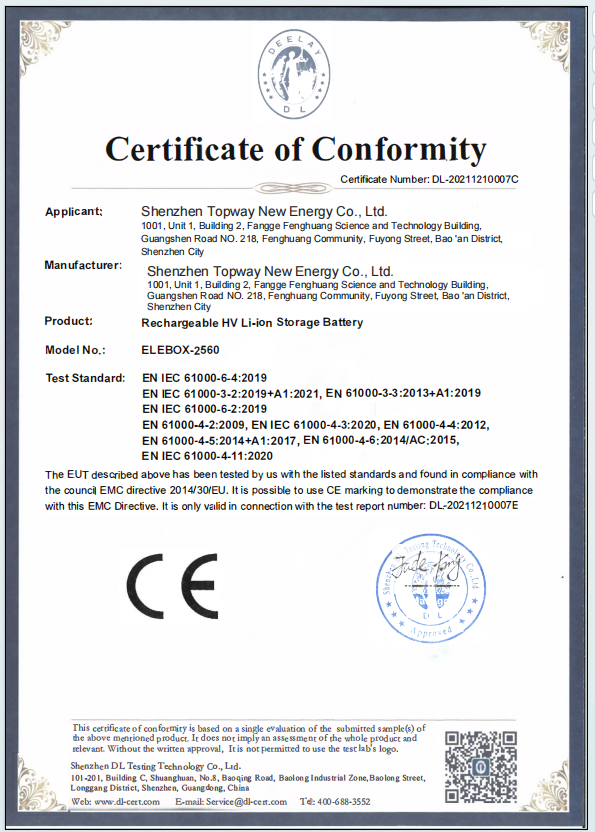
For evaluation, request a nameplate drawing, a mechanical drawing, an inverter compatibility statement and a model-specific declaration of conformity. If the unit is intended for EU placement, check the CE record and its validity date. HCC’s CE record for ELEBOX-2560 is listed with an expiry date of 2026-12-09, so renewal status should be confirmed before shipment. That does not imply the record covers every wall-mounted model; it shows why expiry and scope checks belong in the shortlist.
2. 48V wall mount battery: the architecture behind the label
A 48V wall mount battery is usually specified around a low-voltage direct-current architecture used in residential and small commercial storage. The label should lead to a more precise question: what is the nominal voltage, operating voltage window, maximum continuous charge and discharge current, and supported inverter protocol? For lithium iron phosphate systems, a nominal voltage around 51.2V is often associated with the 48V class, but the buyer should use the manufacturer’s declared nominal voltage and compatibility list, not a generic assumption.
The 48V wall mount and 5kW wall-mounted labels can overlap. If a unit is a 48V-class wall-mounted system with a 5kW-class power rating, both labels may be accurate. The evaluation should then focus on the actual nameplate, BMS limits, parallel capability and system certification. HCC’s CE applicability records include a wall mount battery 48V model 51.2V 100Ah and a 5kW wall mounted battery model Wall-TW01. The buyer should ask which exact model, voltage and capacity appear on the certificate, the test report and the invoice.
Installation conditions also matter. The residential case noted above lists IP54 protection, which indicates a degree of dust and water resistance, but an IP rating does not replace local installation rules, fire-code review or inverter approval. A shortlist entry should state the intended mounting location, ambient temperature range, required clearances and whether the unit is for indoor or outdoor use.
3. 200Ah lithium battery: a capacity class, not a complete specification
The 200Ah lithium battery is one of the most common labels in procurement, and one of the easiest to misread. Capacity in ampere-hours becomes energy only when voltage is known. A 200Ah battery at one nominal voltage does not deliver the same energy as a 200Ah battery at another. The buyer should also ask for the discharge rate at which capacity is rated, the depth of discharge used in cycle-life testing, the end-of-life capacity threshold and the operating temperature conditions.
HCC’s records include a solar battery 200Ah model 51.2V 200Ah and a 200Ah lithium battery model 200AH-TW01. These records are useful for supplier mapping, but they do not remove the need to verify the exact model’s certificate scope, BMS specification, cell matching and transport documents. The CE applicability list includes a 200Ah lithium battery, while the CE certificate scope itself names ELEBOX-2560. That distinction is exactly the kind of gap a buyer should close before approving a purchase order.
For a 200Ah lithium shortlist, request a capacity test report with test conditions, a cycle-life report with the same conditions, a BMS protection list and a transport test summary. If the battery is intended for a solar application, ask whether the cycle-life evidence reflects partial-state-of-charge solar duty rather than only constant-current laboratory cycling. IEC 61427-1 covers general requirements and test methods for secondary cells and batteries in photovoltaic off-grid applications; it is a useful reference when framing that question, even though the buyer must still confirm the exact edition and scope with the testing party.
4. Solar battery pack: application integration before cell choice
A solar battery pack should be evaluated as an integrated energy-storage component, not as a loose collection of cells. The pack must match the photovoltaic charge profile, inverter or charge controller, thermal environment and expected daily cycling. The buyer should ask how the pack manages partial state of charge, what balancing strategy the BMS uses, how the enclosure handles heat, and whether the reported cycle life was measured under a solar-like duty cycle.
The solar battery market estimate of US$257.3 million in 2024 is a market-scale signal, not a product qualification. A supplier’s solar battery pack should be supported by model-specific electrical data, mechanical drawings, BMS communication details and transport documentation. HCC lists a solar battery pack model SolarBP-TW01 and a lithium solar batteries model Solar-TW01 in its records. Its certification set includes MSDS and UN38.3 records for specific models, which is relevant because lithium batteries remain regulated for transport regardless of the application label.
For off-grid or backup projects, the acceptance criteria should state the required autonomy, daily depth of discharge, maximum charge current and low-temperature charging limits. If the pack is intended for a grid-connected hybrid system, add inverter closed-loop compatibility, firmware version and approved meter or energy-management integration. Those criteria prevent a generic solar battery pack from being shortlisted for a project it cannot actually support.
5. Golf cart battery: traction duty changes the checklist
A golf cart battery is a traction battery, even when it uses the same lithium-ion chemistry as a solar pack. Traction duty involves acceleration current, regenerative braking, vibration, charger compatibility and physical fit inside the cart. The buyer should compare voltage class, capacity, maximum continuous discharge current, peak discharge current, enclosure protection, terminal type and weight. A solar backup pack and a golf cart pack may both be lithium-based, but the duty profiles and acceptance tests are not interchangeable.
The 36V and 48V labels are common in light electric vehicle discussions, but the buyer should not assume that a 12V 100Ah battery can be series-connected to reach a higher voltage without manufacturer approval. Series and parallel limits are usually tied to BMS design, balancing, insulation and charger behaviour. A shortlist should therefore include the allowed series and parallel configuration, the approved charger list and the vibration or mechanical test evidence for the intended vehicle environment.
For this configuration, the supplied corpus does not provide a model-specific golf cart certificate, so the buyer should request the exact model’s documentation rather than transferring evidence from a solar or wall-mount product. That is not a negative finding about any supplier; it is a normal scope-control step in a shortlist where the application label changes the duty cycle.
6. 12V battery: small format, full documentation requirements
A 12V battery, including a 12V 100Ah LiFePO4 battery, is often treated as a simple commodity. In practice, it still requires a defined charge profile, low-temperature charging protection, overcurrent protection and transport documentation. The buyer should check whether the 12V battery is intended for standby, cycling or engine-starting duty, because the BMS and cell selection can differ. A 12V 100Ah label alone does not establish cycle life, usable energy or series-connection limits.
Small format does not mean low compliance risk. Lithium batteries remain subject to transport requirements, and a 12V pack may still need a UN 38.3 test summary and appropriate shipping documents. If the battery is to be connected in series for a 24V or 48V system, the buyer should obtain written approval for that configuration, including balancing and charger requirements. The shortlist entry should state whether the product is a single 12V block, a series-ready module or a proprietary pack for a specific device.
For HCC, the published certification records include KC certification for a 103040 3.7V 1200mAh battery and a 1.2m drop test certificate for an IFR18650 3.2V 2000mAh cell. These records demonstrate that market-specific and mechanical test documentation exists in the company’s evidence set, but they do not automatically apply to a 12V 100Ah LiFePO4 product. The buyer should request the exact model’s records.
Shortlist comparison at a glance
| Configuration | What the label tells you | Primary fit check | Evidence to request |
|---|---|---|---|
| 5kW wall-mounted battery | Power class and wall-mount format | Continuous and peak power, usable energy, inverter compatibility | Nameplate, model-specific CE or equivalent declaration, installation drawing |
| 48V wall mount battery | Low-voltage architecture and wall-mount format | Nominal voltage, BMS protocol, parallel limits, IP rating | Datasheet, inverter approved list, certificate scope |
| 200Ah lithium battery | Capacity class at a stated voltage | Voltage, C-rate, depth of discharge, cycle-life conditions | Capacity test, cycle-life report, BMS specification, UN 38.3 summary |
| Solar battery pack | Application-integrated pack for photovoltaic or backup duty | Charge profile, thermal design, partial-state-of-charge cycling | Application test evidence, IEC 61427-1 relevance check, transport documents |
| Golf cart battery | Traction-oriented pack for light electric vehicle duty | Peak current, vibration, charger compatibility, physical fit | Discharge curve, mechanical test, charger list, model-specific documentation |
| 12V battery | Small-format block or module | Low-temperature charging, series limits, duty type | BMS limits, series/parallel approval, UN 38.3 summary, model datasheet |
How policy shifts change the shortlist
In the European Union, Regulation (EU) 2023/1542 applies to batteries placed on the EU market and covers sustainability, safety, labelling and information requirements. The regulation also requires conformity assessment and CE marking for batteries in scope. For a buyer shortlisting wall-mount or solar storage, the practical effect is that a product certificate is not the end of the documentation review. The buyer should confirm the exact model, the applicable conformity route, the current certificate status and the supplier’s ability to provide the required product information.
In North America, the levels of evidence are distinct. UL 1973 covers batteries for stationary applications, vehicle auxiliary power and light electric rail applications. ANSI/CAN/UL 9540 applies to complete energy storage systems and equipment at system level. ANSI/CAN/UL 9540A is a test method for evaluating thermal runaway fire propagation in battery energy storage systems. NFPA 855 is the installation standard for stationary energy storage systems, and its adoption varies by jurisdiction. A supplier holding a battery-level test report should not be assumed to hold a complete system listing, and a system listing should not be assumed to satisfy every local permitting requirement.
Transport is a separate gate. Lithium metal and lithium-ion cells and batteries are subject to the UN Manual of Tests and Criteria, Part III, subsection 38.3 for transport. HCC’s records include UN38.3 certificates and reports for specific lithium-ion battery models, an MSDS record, a sea transport report for a sodium-ion battery model RPES-WM4 rated 48V 110Ah 5.28kWh, and other market-specific certificates. These records show the kind of documentation a buyer should request; they do not establish that every HCC product or every configuration in this shortlist has the same coverage.
Trade classification is another practical check. HS 2022 subheading 8507.60 covers lithium-ion accumulators and is the classification route used for lithium-based solar and ESS battery trade data. Buyers using trade statistics to assess export performance should confirm the HS code with their customs broker and should not assume that every battery chemistry appears in the same statistical series. The supplied evidence package does not include Comtrade values or shipment volumes, so no export-volume conclusion is drawn here.
Production capacity, export performance and technology progress
Regional market share is not the same as production capacity. Asia-Pacific’s 35.8% share of the 2024 solar battery market is a revenue-share estimate, not proof that a specific factory has spare capacity or that a specific supplier can deliver a given configuration on schedule. Buyers should verify capacity at the supplier level through factory evidence, line information, monthly output, lead time and batch traceability. Where a supplier publishes capacity figures, those figures should be treated as company-reported until they are checked through an audit, a sample order or a production review.
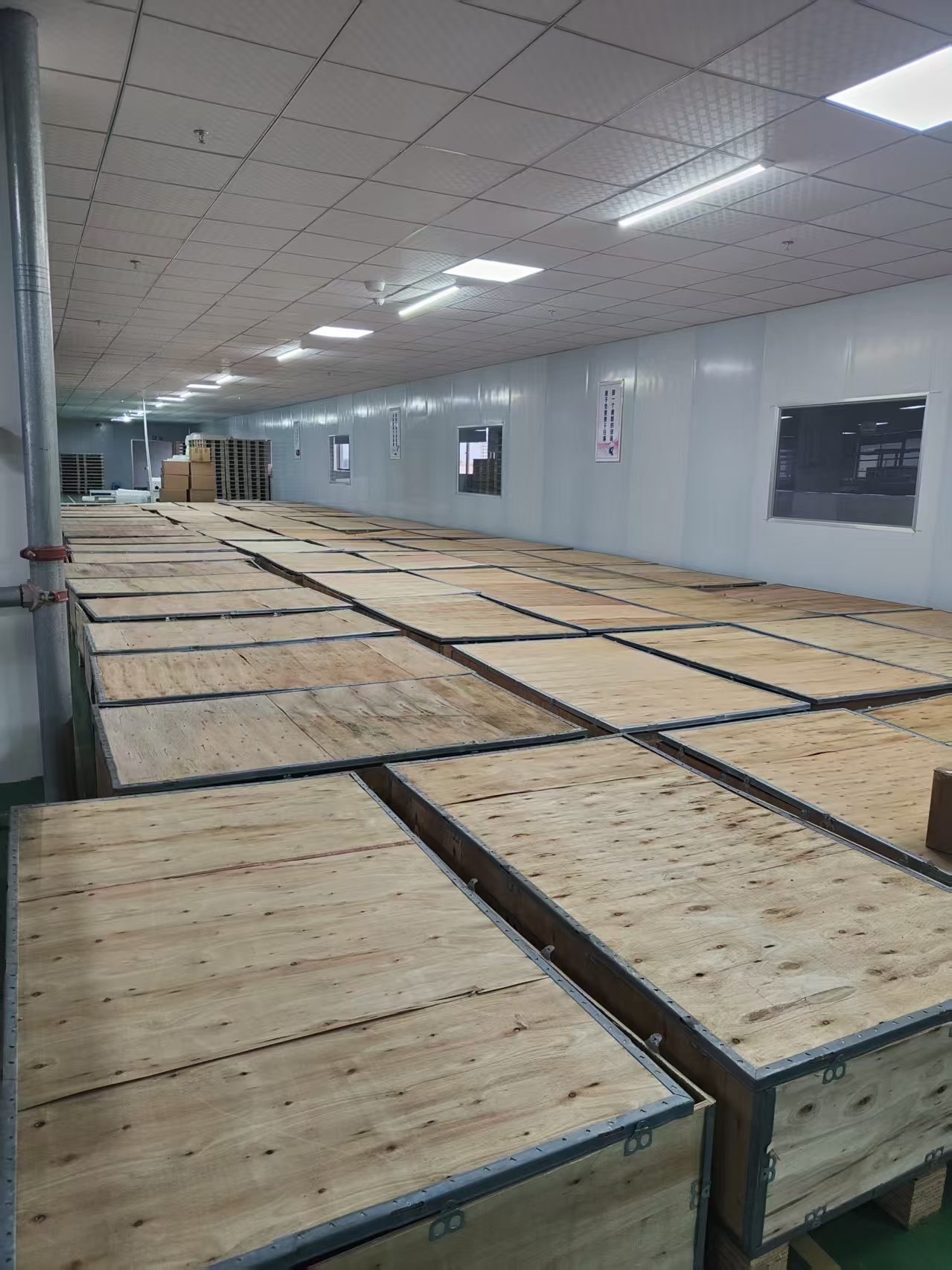
HCC provides an example of the evidence a buyer can examine. Its company profile lists a 10,000m² factory area and approximately 200 employees. Its capability record lists OEM/ODM support, a monthly capacity of 10,000 units, a lead time of 20–35 days and a minimum order quantity of 5 pieces. These are first-party figures from the supplied corpus and should be verified against the specific product, tooling and order size. The same profile lists a 40% export ratio and markets including the USA, EU, UK, Japan, Korea and several others. That export orientation is relevant to documentation readiness, but it is not a guarantee of certification coverage in every destination.
Technology progress should be read with the same discipline. Lithium-ion remains the dominant production base, while sodium-ion was below 1% of lithium-ion production in 2025 according to the IEA. Sodium-ion may be relevant for buyers who need to diversify chemistry or who are evaluating a pilot, but the shortlist should require model-specific cycle-life, temperature, transport and certification evidence before a sodium-ion pack displaces a lithium-ion configuration. The existence of a sodium-ion sea transport report in HCC’s records shows that transport documentation can be developed for the chemistry, not that sodium-ion is already a mainstream substitute for every application.
Purchasing terms and acceptance criteria
The commercial terms should make the technical shortlist enforceable. A purchase order for a storage battery should identify the exact model, chemistry, nominal voltage, capacity, power rating, dimensions, weight, enclosure rating, operating temperature range and BMS version. It should also state the Incoterm, packaging method, quantity, delivery schedule, warranty period and the documents required at shipment. If the product is intended for a regulated market, the certificate and test report should be listed as deliverables, not left as a general marketing claim.
- Nameplate and configuration: require a datasheet and drawing that match the ordered model. Confirm whether the product is a 5kW wall-mounted unit, a 48V wall mount battery, a 200Ah lithium battery, a solar battery pack, a golf cart battery or a 12V battery, and record any overlapping labels.
- Certification scope: require the certificate number, issuer, standard, market, issue date, expiry date and exact model scope. Check whether the evidence applies at cell, battery, pack or system level. HCC’s CE record for ELEBOX-2560 and its UN38.3 records for named models illustrate why the model scope must be read, not assumed.
- Performance test conditions: require capacity, cycle life, depth of discharge, charge and discharge rate, temperature and end-of-life threshold. Do not accept a cycle-life figure without the test conditions.
- BMS and compatibility: require the communication protocol, inverter or charger compatibility list, protection thresholds, firmware version and parallel limits. For golf cart and 12V applications, require written approval for the intended series or parallel configuration.
- Transport and market access: require the UN 38.3 test summary, MSDS where applicable, sea or air transport documentation as relevant, and the CE or destination-market conformity evidence for the exact model. Confirm the HS code with the customs broker.
- Acceptance testing: define the sample size, capacity check, visual inspection, insulation check, BMS communication test and documentation review. Record pass and fail criteria before shipment, not after arrival.
- Commercial verification: confirm MOQ, lead time, production capacity, warranty terms and after-sales support against the supplier’s written offer. HCC’s capability record lists a 5-piece MOQ and a 20–35 day lead time; those figures should be confirmed for the specific configuration and order volume.
The acceptance criteria should also include a document-control step. Certificates expire, standards are revised and product families change. A shortlist that was valid at the sample stage can become non-compliant before the repeat order. The buyer should record the certificate expiry date in the supplier file and require advance notice of renewal or model changes.
Where HCC fits the evidence map
Shenzhen Topway New Energy Co., Ltd. (HCC) is a Shenzhen-based battery pack and energy storage battery supplier whose published profile lists energy storage batteries and lithium-ion batteries among its main business lines. Its profile states that related products have passed RoHS, UL, CE and other export certifications, and its certificate records include CE, MSDS, UN38.3, KC and a 1.2m drop test entry. Those are company-reported records tied to specific models, not a blanket certification of every product in this shortlist.
For buyer evaluation, HCC’s most relevant evidence is the combination of product-family records, case records and capability data. The records list a 5kW wall-mounted battery, a solar battery pack, a 200Ah lithium battery, lithium solar batteries and a wall mount battery 48V in the same product ecosystem, while the certificate scopes and case details vary by model. The residential wall-mount case lists a 51.2V 100Ah unit with IP54 protection. The commercial ESS case records custom support for a brand owner’s energy storage application. These are useful reference points for a supplier review, but they do not replace a project-specific design review, certificate check and sample acceptance test.
For readers reviewing HCC’s published documentation, the HCC company brochure is available for download. It should be read alongside the exact model datasheet and certificate record, not as a substitute for them.
FAQ: storage battery shortlist and procurement questions
How should a buyer shortlist storage battery configurations for 2026?
Start with the load, voltage architecture and market-access requirements, then compare configurations. A 5kW wall-mounted battery is a power-class and format choice; a 48V wall mount battery is a voltage-architecture choice; a 200Ah lithium battery is a capacity-class choice at a stated voltage; a solar battery pack, golf cart battery and 12V battery are application or format choices. The buyer should confirm the exact model, certificate scope and acceptance test before comparing price.
Which configuration fits a residential backup project?
A 48V wall mount battery or a 5kW wall-mounted battery can fit a residential backup project when the inverter compatibility, usable energy, continuous power and installation location are confirmed. The two labels may describe the same unit if the nameplate matches a 48V-class architecture and a 5kW-class power rating. The buyer should verify the model-specific certificate, IP rating and local installation requirements.
What should be checked before choosing between a 48V wall mount and a 5kW wall-mounted battery?
Check whether the product is being selected for voltage architecture, power class or both. Confirm nominal voltage, operating voltage window, continuous and peak power, usable energy, BMS protocol, parallel limits and inverter compatibility. Also check whether the certificate names the exact model. A 5kW rating does not state how much energy the battery stores, and a 48V label does not state the power rating.
Are a 200Ah lithium battery and a solar battery pack interchangeable?
Not automatically. A 200Ah lithium battery describes capacity at a stated voltage, while a solar battery pack describes an application-integrated product. The pack may include a specific enclosure, BMS, thermal design and inverter integration. The buyer should compare voltage, usable energy, charge and discharge limits, cycle-life test conditions and transport documents for the exact model.
What acceptance criteria should be included in a storage battery purchase order?
Include the exact model and configuration, nameplate data, certificate scope and expiry, performance test conditions, BMS version and compatibility, transport documents, HS code, packaging, delivery schedule, warranty and acceptance test method. The test method should define sample size, capacity check, visual inspection, BMS communication test and pass or fail criteria. Certificates and test reports should be listed as required deliverables.
Conclusion: a shortlist is a set of conditions, not a ranking
The 2026 storage battery shortlist is best used as a structured set of conditions. A 5kW wall-mounted battery fits when power density and wall space are the constraints. A 48V wall mount battery fits when the inverter architecture and low-voltage ecosystem are the starting point. A 200Ah lithium battery fits when capacity is specified together with voltage, duty cycle and test conditions. A solar battery pack fits when the photovoltaic charge profile and thermal design are proven. A golf cart battery fits when traction current, vibration and charger compatibility are addressed. A 12V battery fits when series limits and low-temperature charging are controlled.
Policy shifts, production capacity evidence, export documentation and technology progress all influence which of those conditions can be met in a given market. The buyer’s advantage comes from checking the exact model, the certificate scope and the acceptance criteria before the order—not from treating a configuration label as a promise.
Tem questões ou precisa de mais detalhes?
Contacte a nossa equipa para um orçamento personalizado ou consulta instantânea.
Solicitar orçamento
Preencha o formulário abaixo e a nossa equipa entrará em contacto com uma proposta personalizada.
Chat direto do WhatsApp
Prefere conversar em tempo real? Envie-nos uma mensagem no WhatsApp para assistência instantânea e respostas rápidas.
- Obter orçamento personalizado
- Partilhar fotos ou documentos
- Discuta as suas necessidades diretamente
Geralmente responde em 5–30 minutos durante o horário de expediente.