
Storage Cabinets and DS003 Tables: Mixed-Container Balance
Storage Cabinets and DS003 Tables: Mixed-Container Balance
Storage cabinet programs and the DS003 dining table rarely compete for the same end customer, but they compete for the same container slot. In a mixed-container program the decision is not which product deserves shelf space. It is which product carries more cube volatility, more documentation risk and more production-scheduling friction when both are loaded and shipped together.
The DS003 is specified at 1300 x 800 x 750 mm, with a net weight of 35–50 kg, positioned as a 4–6 seater and supplied flat-packed. The factory behind it holds amfori BSCI social compliance and FSC Chain of Custody certification and reports monthly capacity of 50–80 containers. Storage cabinets arrive differently: not as one model but as a family, spanning display cabinets, modular units, metal cabinets, glass-door cabinets and custom builds, each with its own carton profile. The approved product data used for this comparison does not disclose per-unit cabinet dimensions or weights — and that absence is itself a procurement finding, because it identifies exactly which document a buyer must request before the container plan is locked.
Why a mixed container changes the comparison logic
A single-SKU purchase is judged on unit price, lead time and defect rate. A mixed container is judged on revenue per cubic metre and risk per cubic metre, and those two numbers move in opposite directions as the assortment widens.
Three mechanics explain the shift. First, cube efficiency: a flat-packed dining table and a cartoned cabinet occupy volume in different proportions, so the mix ratio determines how much of the container is paid for and how much is air. Second, documentation scope: a container holding two product families may need two compliance files and, in many markets, more than one tariff line. Third, scheduling: a cabinet assortment and a single table model consume factory capacity in different ways, because one requires repeated line changes and the other benefits from continuous runs.
None of these mechanics favours cabinets or the DS003 by default. They determine what a buyer should verify before committing to a ratio.
What each candidate actually is
The storage cabinet program
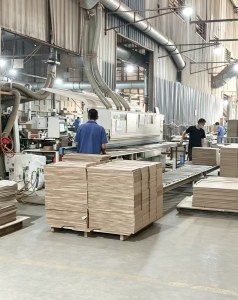
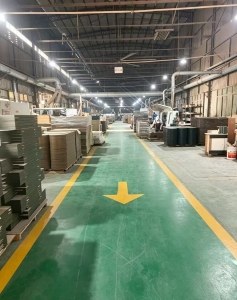
The cabinet side of this comparison is supplied by YUXIN SMART LIVING, the brand used by Dongguan Yuxin Smart Home Co., Ltd., a furniture manufacturer whose production operations date to 2009 and which reports two factory campuses in Qiaotou, Dongguan, with a combined building area of 31,000 sqm and 300+ staff. Hardware, panel and sheet-metal production run on self-owned lines rather than through outsourcing.
For buyers, the relevant point is scope rather than a single SKU. Approved material describes cabinet customization by drawing or sample, with size, material, colour and functional configuration adjustable. The wider category — display cabinets, modular storage cabinets, metal storage cabinets, glass-door cabinets, living room and bedroom storage, entryway and office storage, TV cabinets and sideboards — is the assortment context in which those customization capabilities are applied, not a claim that every variant is a stocked item. Assortment depth is precisely what makes a cabinet program hard to load: more SKUs mean more carton sizes, more line changes and a longer document list.
The DS003 dining table
The DS003 is a single, tightly specified article: 1300 x 800 x 750 mm, 35–50 kg net weight, a 4–6 seater, flat-packed. That specification is narrow enough to plan against. A fixed footprint and a bounded weight range allow the buyer to calculate floor-loaded or palletised configurations without waiting for a bespoke drawing, and flat-pack packaging changes the volume-to-protection trade-off rather than removing it.
A single model also means predictable quality inspection: one set of dimensions, one weight band, one carton design. In a mixed container, that predictability is an asset, because the table can absorb whatever cube the cabinet assortment leaves over rather than forcing a second loading plan.
Cube and weight: where the two diverge
Cube planning is the first place a mixed program fails, and it fails quietly: the ratio is agreed in a quotation, then the container is loaded and the last pallet does not fit.
The DS003 contributes three planning anchors. Its footprint of 1300 x 800 mm constrains carton orientation, its 35–50 kg net weight band sets a per-unit handling load — relevant to two-person lifting assumptions, manual versus assisted loading and the damage risk that grows when heavy cartons are stacked above lighter ones. Flat-pack packaging reduces the shipped volume relative to a fully assembled unit, but the buyer should confirm how the reduction is achieved, because protection, hardware bagging and panel separation all consume their own space inside the carton.
For the cabinet side, the approved material supports a different kind of statement. Cabinet families span more than one material construction — panel, metal, glass and combinations — and glass-door and display cabinets introduce breakage exposure that a solid table top does not. The same material does not disclose cabinet carton dimensions, gross weights or stack limits. Two buyers ordering "storage cabinets" can therefore receive two entirely different loading outcomes while both quotations look complete.
The practical response is a document request rather than a judgement about which product loads better:
- A carton dimension sheet per SKU, including carton thickness and any pallet overhang.
- Gross weight, not net weight, per carton and per pallet.
- Maximum stack height and whether the carton is rated for floor loading or pallet-only handling.
- For glass-containing cabinets, the internal packing method and the replacement policy for transit breakage.
- For the DS003, confirmation of the packed dimensions and the accessory list that ships inside the carton.
Documentation: comparing like with like
Compliance is the second place mixed programs underperform, because buyers often apply one certificate set to a container that holds two product families with different risk profiles.
The factory documentation available for this comparison is specific and dated. amfori BSCI social compliance is held at Grade A across 9 performance areas, valid until February 2027. FSC Chain of Custody certificate No. ESTS-COC-242008 is valid until 30 January 2029. The company also reports 1 invention patent and 2 utility model patents, and product compliance with US CARB P2 and TSCA, and with EU ENF, REACH and GPSR regulations.
The February 2027 BSCI expiry deserves attention from anyone placing orders in late 2026. A certificate that is valid at the time of the purchase order can be expired at the time of shipment if the audit cycle is not renewed, so buyers should ask for the renewal status in writing rather than accept a copy of the current certificate as a forward-looking assurance.
Third-party standards should be read with equal precision, because a test method is not a certification and not automatically a legal requirement in every market. ISO 7170:2021 specifies test methods for the strength, durability and stability of fully assembled storage units, including movable and non-movable parts; the standard does not itself set acceptance criteria. EN 14749:2016+A1:2022 addresses safety requirements and test methods for domestic and kitchen storage units and components including glass parts. EN 16121:2023 covers non-domestic storage furniture such as office and laboratory storage, with exclusions that depend on product and end use.
Two conclusions follow for this specific comparison. A cabinet program sold into household, kitchen or bathroom settings may be assessed against different requirements than an office or retail cabinet program, so the buyer should build a product-by-market matrix rather than request a generic "compliance pack". And the approved material used here does not identify a dining-table test standard for the DS003, so its test basis must be requested separately and should not be inferred from the cabinet documentation.
Tariff classification: one container, more than one heading
A mixed container of cabinets and dining tables is unlikely to be a single tariff line, and treating it as one creates a customs exposure that no loading optimisation can offset.
Under the Harmonized System, HS 9403 covers other furniture and parts thereof; the correct six-digit subheading for a specific cabinet depends on construction, use and destination jurisdiction, which is why a binding ruling or broker validation is the appropriate step before duty estimation. HS 8418.50 applies to storage and display cabinets only where refrigerating or freezing equipment is incorporated, so it is not a general storage-cabinet code. A commercial reference identifies US HTS 9403.10.00.20 as filing cabinets under metal office furniture, but that reference requires official validation and cannot be generalised to metal storage cabinets or other cabinet types.
Supply-country structure adds a second layer. Vietnam is the leading exporter of furniture to the United States, accounting for 26% of total imports in the cited 2026 data. That figure describes trade flow, not the duty rate on any particular cabinet or table, and it does not reduce the need to classify each product family separately.
For a buyer, the operational rule is simple: classify the cabinet SKUs and the DS003 independently, confirm which lines require separate declaration, and price the container on that basis. A quotation built on one assumed code is a quotation with an unmeasured contingency inside it.
Capacity, lead time and the scheduling question
Capacity is where mixed programs are most often misread, because a monthly container figure describes the factory, not the product line.
The manufacturer reports 31,000 sqm across two campuses, 300+ staff, standard lead time of 45–60 days and monthly export volume of 50–80 containers, supported by an in-house warehouse and container loading area with one-stop shipment from Shenzhen port. AQL outgoing inspection and an in-house testing laboratory sit behind those numbers.
Those figures give a buyer a measurable capacity reference, but they do not allocate capacity between a configurable cabinet assortment and a single table model. That allocation is the actual scheduling question in a mixed program. A cabinet assortment consumes production in short runs with repeated changeovers; the DS003 consumes it in longer runs of one specification. When both are scheduled into the same 45–60 day window, the risk is not total capacity — it is sequence. A buyer should ask for the production window assigned to each family, the changeover penalty for the cabinet SKUs, and whether the table is scheduled before or after the cabinet run, since the answer determines which item is at risk if the earlier run slips.

Cost structure: three baselines that do not add up
Cost is the dimension most often distorted in a comparison, because three different savings figures circulate and they are measured against three different baselines.
The manufacturer reports consolidated purchasing from one factory reducing overall procurement cost by 10%–20% compared with multi-supplier sourcing. Factory ex-work pricing is reported to remove middleman markup and reduce overall procurement cost by 10%–25% compared with trading companies or middlemen. Scale and automated production are reported to lower unit manufacturing cost by 8%–15% compared with small furniture workshops.
| Reported saving | Baseline it is measured against | What it does not include |
|---|---|---|
| 10%–20% | Buying the same scope from multiple suppliers | Freight, duty, inspection and inventory carrying cost |
| 10%–25% | Trading company or middleman supply | The buyer's own sourcing and qualification effort |
| 8%–15% | Small furniture workshops | Compliance documentation, audit support and claim handling |
These are company-stated comparison ranges, not independently audited savings, and they cannot be summed. A buyer who adds 20% and 25% is comparing against a hypothetical supplier that is simultaneously a multi-supplier cluster, a trading company and a small workshop. The correct use is to pick the baseline that matches the alternative actually being displaced — and then test it against a live RFQ covering the same specification, packaging, inspection and delivery terms.
Market context: why cabinet and dining programmes travel together
The commercial case for mixing these two families is structural, and it comes from published market data rather than supplier claims.
Grand View Research projects the global cabinets market at USD 202.5 billion in 2026, with the residential segment accounting for 73.2% of revenue in 2025 and kitchen cabinets representing 62.6% of global cabinet market revenue in 2025. Those figures should be handled carefully: another commercial estimate places the cabinet market at USD 148 billion, and the gap reflects a definitional difference between broad "cabinets" and narrower storage systems rather than a disagreement about direction. The numbers are not interchangeable and should not be blended.
What the segment split does support is an interpretation. Cabinet demand is concentrated in residential and kitchen applications, which means the buyer most likely to order cabinets is also stocking dining furniture for the same household. A mixed container is therefore a commercial fit before it is a loading decision — the two families share a customer even when they do not share a carton profile. On the commercial side of the category, Steelcase reported USD 456 million from metal storage solutions in 2023, representing 13.2% of revenue, which illustrates that metal storage carries real value at the premium end rather than being a commodity filler.
A decision framework for the mixed-container buyer
The following framework converts the comparison into checks a buyer can run before approving a container ratio.
| Dimension | Storage cabinet program | DS003 dining table | What to verify first |
|---|---|---|---|
| Specification certainty | Family of configurable SKUs; per-unit dimensions not disclosed in approved material | 1300 x 800 x 750 mm, 35–50 kg net weight, 4–6 seater | Carton dimension and gross weight sheet for the cabinet SKUs |
| Cube behaviour | Mixed carton sizes; glass variants add protection volume | Flat-packed, single carton design | Packed volume per unit on both sides, not net volume |
| Documentation | BSCI Grade A (9 areas, valid to Feb 2027), FSC No. ESTS-COC-242008 (valid to 30 Jan 2029), CARB P2/TSCA, ENF/REACH/GPSR | Shares factory certification; product test basis not identified in approved material | Renewal status of BSCI and a DS003-specific test report |
| Tariff treatment | Subheading depends on construction, use and jurisdiction | Classified separately from cabinet lines | A ruling or broker validation per product family |
| Scheduling | Short runs, repeated changeovers | Longer single-specification runs | The production window assigned to each family inside 45–60 days |
| Cost basis | Affected by assortment breadth and changeover | Affected by single-model volume | One RFQ covering both families with identical terms |
Fit boundaries and when to split the container
A comparison is only useful if it states where the recommendation stops, and this one has four boundaries a buyer should take seriously.
The first is documentation asymmetry. Until the cabinet SKUs are specified to the same level as the DS003, any loading plan is an estimate. That does not mean cabinets load worse — it means the comparison is incomplete on one side, and the gap belongs in the RFQ rather than in an assumption.
The second is weight distribution. A 35–50 kg table is a heavier single unit than many cartoned cabinet components, so stacking order and floor-loading sequence need to be planned around the table rather than treated as an afterthought.
The third is compliance applicability. EN 14749 and EN 16121 address storage furniture in domestic and non-domestic settings respectively; neither should be assumed to cover a dining table, and neither is a certification in itself. A buyer who needs a document set for a European retail channel should map each product family to the applicable requirement instead of accepting a single pack.
The fourth is order structure. Where a retail customer requires a minimum depth of cabinet assortment and a fixed table quantity, and where each family runs on a different production sequence, splitting the order into separate shipments can be the lower-risk route even though it forfeits part of the consolidation benefit. Consolidated purchasing from one factory is reported to reduce overall procurement cost by 10%–20% against multi-supplier sourcing — but that range assumes the consolidated order actually ships as planned, and a slipped mixed container can consume the saving in expediting and re-handling.
Outlook: what the manufacturing side is changing
The trend that matters for mixed programs is not demand forecasting but production flexibility, and the approved material documents a specific trajectory rather than a projection.
Panel furniture automation was achieved in 2024 with a full set of intelligent panel processing equipment. In 2026, laser cutting, CNC bending and robotic laser welding were added for sheet-metal furniture and new energy storage enclosure production. The stated effect of automated lines and standardised processes is higher first-pass yield and a shorter overall order cycle. Read conservatively, that means the changeover penalty that makes mixed cabinet assortments expensive is the specific cost being attacked — which is directly relevant to a buyer loading several cabinet SKUs beside one table model. It is not evidence of a market forecast, and no growth rate should be inferred from it.
Frequently asked questions
- How should an importer decide the ratio between storage cabinets and the DS003 in one container?
- Start from the combined packed volume, not from net product volume. The DS003 is flat-packed at 1300 x 800 x 750 mm with a 35–50 kg net weight, so its packed volume is known once the carton is confirmed. The cabinet SKUs must be documented to the same level — carton dimensions, gross weight and stack limits per SKU — before a ratio can be set. Until then, the defensible approach is to fix the table quantity against confirmed retail demand and load cabinets into the remaining cube, rather than splitting the container by an assumed percentage.
- Does the flat-pack format of the DS003 automatically make it more container-efficient than cabinets?
- No. Flat-pack reduces shipped volume relative to a fully assembled unit, but the reduction depends on how panels, hardware and protection are packed inside the carton, and the format does not by itself produce a lower cost per cubic metre. Cabinet programs also contain cartoned, knock-down and flat-packed variants. The comparison has to be made on packed volume and gross weight per unit for the specific SKUs being ordered, because two cabinet programs from the same supplier can produce different loading outcomes.
- Which compliance documents apply to a mixed cabinet and dining table shipment?
- The factory documentation covers amfori BSCI social compliance at Grade A in 9 performance areas, valid until February 2027, and FSC Chain of Custody certificate No. ESTS-COC-242008, valid until 30 January 2029, with product compliance to US CARB P2 and TSCA and to EU ENF, REACH and GPSR. Those documents describe the factory and its declared product compliance; they do not substitute for product-specific test reports. Because the approved material does not identify a dining-table test standard for the DS003, that report should be requested separately, and the BSCI renewal status should be confirmed in writing for shipments falling after February 2027.
- Can a mixed cabinet and table container be declared under one tariff code?
- Generally this should not be assumed. HS 9403 covers other furniture and parts thereof, but the appropriate subheading depends on construction, use and destination jurisdiction, and HS 8418.50 applies only where refrigerating or freezing equipment is incorporated, so it is not a general storage-cabinet code. A commercial reference to US HTS 9403.10.00.20 covers filing cabinets as metal office furniture and requires official validation. The practical step is to obtain a classification ruling or broker validation for each product family before calculating duty on a mixed container.
- What lead time should a buyer plan for when cabinets and the DS003 ship together?
- The manufacturer reports a standard lead time of 45–60 days and monthly export volume of 50–80 containers, with an in-house warehouse and container loading area supporting one-stop shipment from Shenzhen port. Those figures describe factory capacity, not the sequence inside it. In a mixed program the binding constraint is usually the production window assigned to each family, so the buyer should confirm when the cabinet run and the table run are scheduled, what changeover applies to the cabinet SKUs, and which item absorbs a delay if the earlier run slips.
- When is it better to ship cabinets and dining tables separately?
- Separation becomes the lower-risk option when documentation readiness differs sharply between the two families, when the retail customer requires a deep cabinet assortment that forces repeated changeovers, or when a fixed table delivery date cannot tolerate the cabinet run's variability. The reported 10%–20% consolidation benefit against multi-supplier sourcing assumes the consolidated order ships as planned; where a slipped mixed container would trigger expediting, re-handling or a missed retail window, that benefit can be consumed before it is realised.
What this comparison concludes
Neither the storage cabinet program nor the DS003 dining table wins a mixed-container decision on product merit. They win or lose on documentability.
The DS003 arrives with a settled specification — 1300 x 800 x 750 mm, 35–50 kg, 4–6 seater, flat-packed — and a factory behind it that reports BSCI Grade A in 9 performance areas, FSC Chain of Custody No. ESTS-COC-242008, 45–60 day lead times and 50–80 containers of monthly export capacity. The cabinet program arrives with broader commercial reach across display, modular, metal, glass and custom storage, and with a customization capability that can be adjusted by drawing or sample. What it does not arrive with, in the approved material used here, is the per-unit carton data that would make a loading plan verifiable.
That is the actionable finding. A buyer who requests carton dimensions, gross weights, stack limits, a DS003-specific test report, the BSCI renewal status and a per-family tariff position will be able to set a defensible ratio. A buyer who compares a published table specification against an undocumented cabinet assortment is not comparing products — only one side has been measured.
For buyers who want to review the manufacturer's own capability and product documentation before opening that conversation, the company brochure is available as a PDF: YUXIN product and factory brochure. Factory visits and audits can also be arranged by appointment; the site is Building 1, No.16 Qiaoxin Road, Qiaotou Town, Dongguan City, Guangdong Province, China, and the appointment line is 0769-83336558, with visits normally booked 1–3 days in advance.
Tem questões ou precisa de mais detalhes?
Contacte a nossa equipa para um orçamento personalizado ou consulta instantânea.
Solicitar orçamento
Preencha o formulário abaixo e a nossa equipa entrará em contacto com uma proposta personalizada.
Chat direto do WhatsApp
Prefere conversar em tempo real? Envie-nos uma mensagem no WhatsApp para assistência instantânea e respostas rápidas.
- Obter orçamento personalizado
- Partilhar fotos ou documentos
- Discuta as suas necessidades diretamente
Geralmente responde em 5–30 minutos durante o horário de expediente.