
Storage Rack Shortlist: Four Racks Rated for 1,000–1,100 kg Loads
An independent shortlist for buyers who have already fixed the load figure and now need the right geometry, stacking behaviour and container yield.
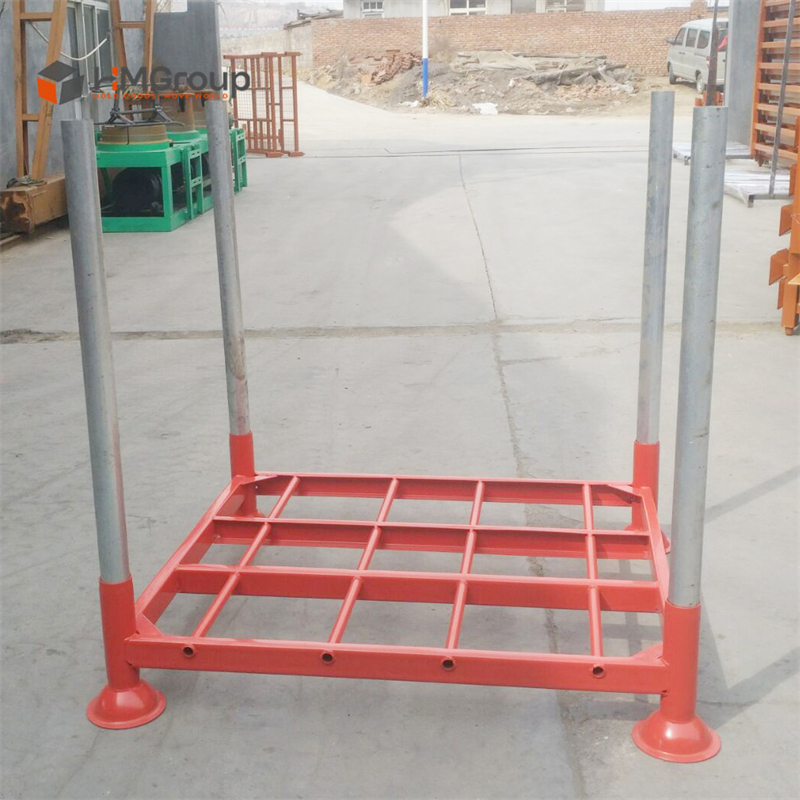
Stackable steel storage racks with a powder-coated base and galvanized posts. Image: HM Group.
A 1,000 kg or 1,100 kg unit load is a specific requirement, not a vague one. Buyers who arrive at that number — usually from a filled bulk bag, a wound fabric roll, or a stack of tires — are not looking for a general introduction to warehouse racking. They are looking for the small number of portable rack models whose published geometry and rated capacity genuinely sit inside that band, and they want to know which one fits the goods, the container, and the stack height they already have.
This shortlist covers four stackable steel storage rack models from HM Group: HM-FR007, HM-PP006, HM-FR005 and HM-TR6060. HM Group — formally Dalian HuaMao Logistics Equipment Group Co., Ltd. — is a Chinese manufacturer of logistics and material handling equipment founded in 2003, operating three manufacturing bases in Xiamen, Nanjing and Qingdao and exporting to the EU, North America, Asia and the Middle East. All four models are built from mild steel Q235 and are published with the same three finish families: zinc, hot-dip galvanized, or powder coating. What separates them is geometry, stacking behaviour, container yield, and the goods each was designed to hold.
Why the 1,000–1,100 kg band behaves differently
Market context supports the narrower question. Grand View Research valued the global warehouse racking market at approximately USD 9.71 billion in 2024, with a projected path to USD 12.41 billion by 2030, and placed North America at 27.8% of 2024 revenue. Within that total, the specialised tire storage rack segment was estimated at USD 865 million in 2024 by Future Market Insights, moving toward USD 1.37 billion by 2034 at a 4.7% CAGR.
Arithmetic explains part of that structure. At 1,000–1,100 kg, steel grade stops being a filtering criterion: the published capacities converge, the material is the same across the shortlist, and the finish menu is identical. Capacity therefore stops discriminating between options, and four other variables take over:
- Footprint and internal geometry — what shape of goods the rack physically accepts.
- Open versus closed stacking counts — how high the rack can be safely stacked when erect, and how much space it consumes when nested.
- Container yield — how many sets fit a single 40'HQ, which changes landed cost per unit.
- Published intended goods — the industry and product categories each model is documented against.
That is the basis on which the four models below are ranked and differentiated. The ranking is by fitness for a given goods type, not by an abstract quality order — none of these racks is universally better than the others.
The shortlist at a glance
| Model | Product | Footprint / exterior dimension | Rated capacity | Stack (open / closed) | 40'HQ | Published goods focus |
|---|---|---|---|---|---|---|
| HM-FR007 | Stackable Steel Storage Racks | 48 x 48 x 36 inch | 1,100 kg | 6 / 20 | 380 sets | Textile and fabric roll, logistics and warehousing, food and grocery, agricultural, furniture |
| HM-PP006 | Bulk Bag Storage Racks | Base 950 x 950 x 310 mm; post φ60 x 2.5 mm | 1,000 kg | 4 / not published | 160 sets | Logistics and warehousing |
| HM-FR005 | Fabric Roll Storage Rack | 1,500 L x 1,100 W x 900 H mm | 1,000 kg | 4 / 20 | 160 sets | Textile and fabric roll, logistics and warehousing |
| HM-TR6060 | Storage Tire Rack | 60 x 60 x 60 inch | 1,100 kg / 2,400 lb | 4 / 20 | 280 sets | Tire industry, logistics and warehousing, food and grocery, agricultural |
All four models are mild steel Q235 with zinc, hot-dip galvanized or powder coating finish options. Every figure above is published model data; where a figure is absent, this shortlist says so rather than estimating it.
Model-by-model: what each option is actually for
HM-FR007 — the highest-stacking, highest-yield generalist
HM-FR007 is a Stackable Steel Storage Rack with a 48 x 48 x 36 inch exterior and a rated capacity of 1,100 kg. Its distinguishing figures are 6-high open stacking and 20-high closed stacking, plus 380 sets per 40'HQ — the highest container yield of the four. Its published industry list is also the broadest: textile and fabric roll, logistics and warehousing, food and grocery, agricultural, and furniture.
Choose it when your goods change month to month, when you want the greatest vertical capacity per unit of floor space, and when freight per unit matters because you are importing in volume. HM-FR007 is listed among the related products of TUV inspection report ITD2025N0087, whose stated scope is steel pallets. Watch for: 48 inches is not the smallest footprint on this list — if your storage position is fixed at a compact square, check HM-PP006 first.
HM-PP006 — the compact-footprint bulk bag option
HM-PP006 is a Bulk Bag Storage Rack with a 950 x 950 x 310 mm base, a φ60 x 2.5 mm post, a 1,000 kg rated capacity, and 4-high stackability. It loads 160 sets per 40'HQ. The published applicable industry is logistics and warehousing. HM-PP006 appears among the related products of SGS Survey Report CANWT00478167, whose stated scope is stacking shelves under Style No. M2.
Choose it when the goods arrive on a compact square base and the storage position is dimensionally constrained. Watch for: a closed-stack count is not published for this model. If you plan to return empty racks or store them nested between seasons, request the closed-stack figure in writing before you commit — do not assume it matches the 20-high figures published for the other three models.
HM-FR005 — long-format storage for wound goods
HM-FR005 is a Fabric Roll Storage Rack measuring 1,500 L x 1,100 W x 900 H mm with a 1,000 kg load capacity, 4 sets maximum stacked in the open state and 20 sets in the closed state, and 160 sets per 40'HQ. Its published industries are textile and fabric roll, and logistics and warehousing.
Choose it when the constraint is length rather than cube. A wound roll needs a long, low bed; the 1,500 mm length is the reason to pick this model, not the load rating. Watch for: it shares the 1,000 kg rating with HM-PP006 but uses a much larger footprint for the same tonnage, and its container yield is the lowest of the four at 160 sets. If your goods are cubic rather than cylindrical, the same load band is available with less floor and freight cost elsewhere on this list.
HM-TR6060 — the only option with a published piece count
HM-TR6060 is a Storage Tire Rack at 60 x 60 x 60 inch with a 1,100 kg / 2,400 lb load capacity, a tire capacity of 24 to 32 pieces, 4-high open and 20-high closed stacking, and 280 sets per 40'HQ. Published industries are tire industry, logistics and warehousing, food and grocery, and agricultural.
Choose it when you handle tires. The 24–32 piece count is far more actionable for capacity planning than a tonnage figure, because tire inventory is managed in pieces, not kilograms. Watch for: tire capacity varies with tire size — 24 to 32 pieces is a range, not a fixed number, so validate against your actual SKU mix.
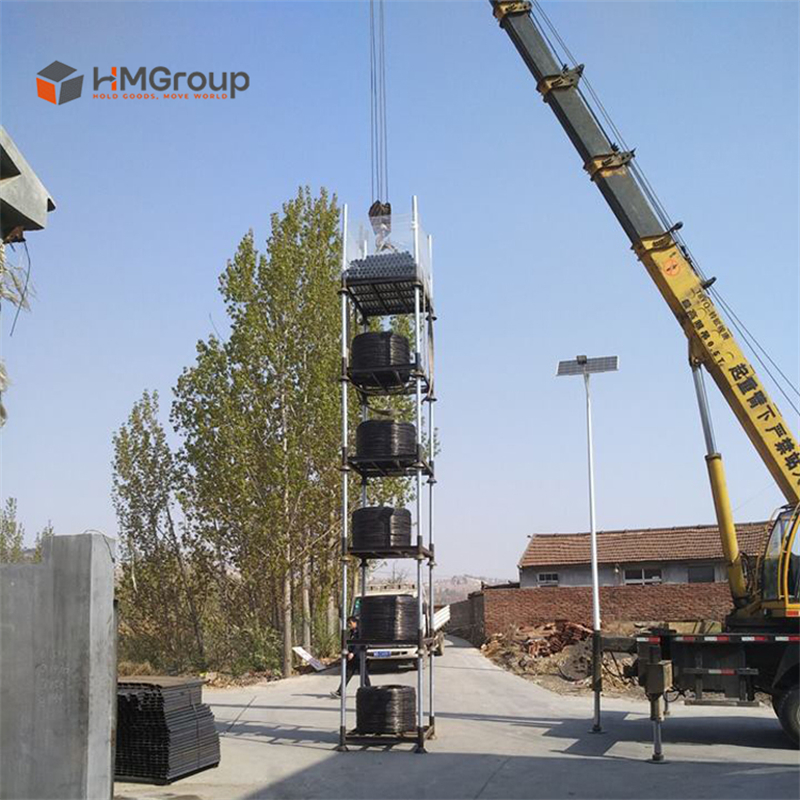
Stacking and loading verification on a portable storage rack. Image: HM Group.
Stackability: the number most buyers read incorrectly
Each model carries two stacking figures. The open figure describes how many loaded units may be stacked in the erect, load-bearing state — this determines your usable vertical capacity. The closed figure describes the nested state, which governs how much floor and container space the fleet consumes when empty and how efficiently racks can be returned or stored between cycles.
On this shortlist, open stacking ranges from 4 sets (HM-PP006, HM-FR005, HM-TR6060) to 6 sets (HM-FR007), while closed stacking is published at 20 sets for HM-FR007, HM-FR005 and HM-TR6060 and is not published for HM-PP006. Two operational consequences follow. First, an importer buying racks for a fixed number of storage positions can reach the same total capacity with fewer units at 6-high than at 4-high — but only where the building, the floor and the handling equipment support it. Second, the difference between a 4-high and a 6-high fleet is a difference in ground-level goods movement, aisle layout, and how much of the load is retrieved at height.
Vertical stacking is demonstrably effective when it is engineered properly. HM Group's published case record for a UNOPS-linked rice seed storage programme in Myanmar describes 5,000 units procured in a single tender for cold storage, 6-high vertical stacking, and a reported 500% increase in warehouse storage capacity. A separate published case from South Korea covering 1,000 units for bulk potato storage reports a 300% increase in vertical storage capacity, a 45% reduction in material handling time, a 20% decrease in produce spoilage, and full ROI within 14 months, using a hot-dip galvanized finish for long-term durability. These figures describe those specific projects; they are not a general promise about any rack on any floor.
Finish options: one menu, three answers
Finish is the one specification where all four models offer an identical choice: zinc, hot-dip galvanized, or powder coating. That uniformity makes finish a decision about environment rather than about model, and it should be resolved separately from the load-band question. Hot-dip galvanizing was the finish specified in the South Korean agricultural case record for long-term durability storage. HM Group's published facility imagery shows indoor zinc plating and powder coating lines among its processes, which is relevant to buyers who need finish consistency repeated across repeat orders rather than achieved once.
Beyond the standard three finishes, HM Group's stated customization scope includes size, loading capacity, powder coating colour, logo printing, and design add-ons such as wire mesh guard, bottom wire mesh decking, forklift guide, bottom steel plate and wheels. That scope is published as company-level customization capability — it should be confirmed model by model rather than assumed to apply identically to all four racks in this shortlist.
Container yield, lead time and commercial terms
Container yield is where this shortlist separates most sharply. A single 40'HQ holds 380 sets of HM-FR007, 280 sets of HM-TR6060, and 160 sets each of HM-PP006 and HM-FR005. For an importer ordering a fixed number of racks, that spread changes the freight component of landed cost per unit by a factor of more than two between the best and worst options. Yield is therefore a legitimate shortlist criterion at this load band, not a secondary detail.
Commercial terms are published consistently. Typical production lead time is 30 to 45 days, the minimum order quantity is 1x20GP, and monthly capacity is stated at 80,000 sets. Quality control runs through six phases: pre-production sample inspection, raw material inspection, component inspection, semi-finished product inspection, finished product inspection, and packaging inspection. After-sales provisions include a process report throughout, support for online video audit, and a 3 to 5 year warranty under proper use.
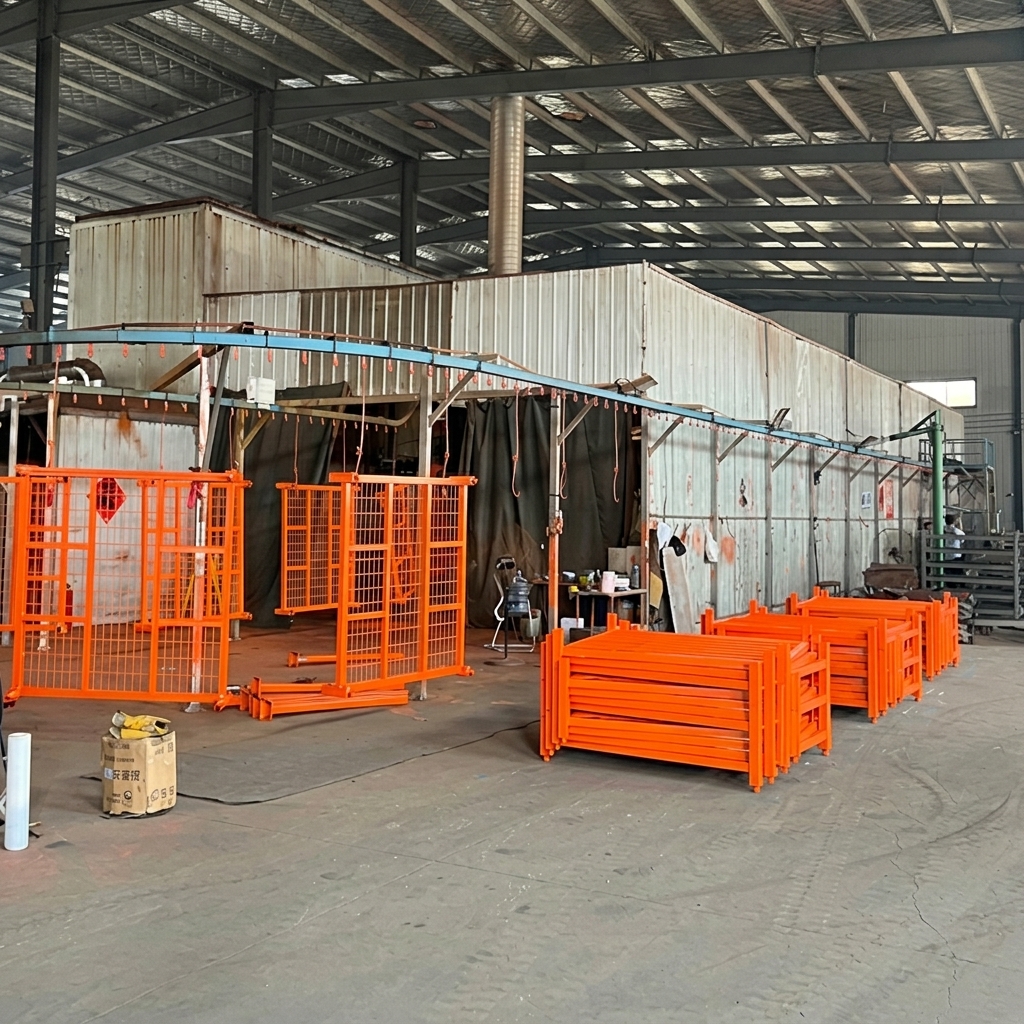
Powder coating line for steel rack components. Image: HM Group.
What the certificates cover — and what they do not
Verification documents exist for this manufacturer, and their scopes are worth reading carefully before quoting them internally:
- ISO 9001 — certificate CN24/00004786, issued through SGS, scope stated as the sales of material handling equipment for logistics turnover, valid from 30 July 2024 to 29 July 2027.
- SGS Survey Report CANWT00478167 — issued 23 January 2026, scope stated as Stacking Shelves (Style No. M2), with HM-PP001, HM-PP002 and HM-PP006 listed among related products.
- TUV inspection report ITD2025N0087 — issued 28 February 2025, scope stated as Steel pallet, with HM-FR007, HM-PP002 and HM-PP001 listed among related products.
- BV audit report MIC-ASI2491658 — scope covering post pallets, tire racks, roll containers, wire mesh containers, wire decking, cage pallets, stacking racks, PET preform containers, IBC containers and Danish trolleys.
The limitation is in the wording. These reports name specific styles or product descriptions rather than every configuration that leaves the factory. A buyer ordering HM-PP006 should ask the supplier to confirm, in writing, that the report they intend to cite maps to the exact model and configuration being purchased — a survey report whose scope reads Stacking Shelves does not automatically cover a modified base, a different post specification, or an added accessory.
A second boundary concerns regional standards. In the United States, ANSI MH16.1-2023 sets minimum requirements for structural design, testing and utilisation of industrial steel storage racks; in Europe, EN 15512:2020 governs structural design principles for steel static storage systems and adjustable pallet racking. Both are written around fixed racking installations. None of the four portable stacking models in this shortlist is presented in the source material as certified under either framework. Buyers in those markets should confirm with their own engineering, safety and insurance stakeholders which framework applies to a portable, non-fixed installation before placing an order.
Where these racks are not the answer
A shortlist is only useful if its boundaries are stated. Five apply here:
- Rated capacity is not transferable. A 1,000 kg or 1,100 kg rating is a published model figure. Whether it applies to a given stack depends on floor bearing capacity, aisle width, forklift reach height, and the centre of gravity of the goods. None of these four models should be assumed to fit any warehouse without that check.
- This is not fixed racking. All four are portable stacking racks. If the requirement is an engineered, high-bay fixed installation, this category is the wrong starting point rather than a cheaper alternative.
- One data gap. HM-PP006 has no published closed-stack count. Buyers who plan return freight or empty storage should obtain it before ordering.
- Lead time is 30 to 45 days with a 1x20GP minimum order. These racks are unsuitable for urgent, short-notice replenishment.
- Customization is not uniform. Design add-ons such as forklift guides, bottom wire mesh decking or wheels are published as company capability, and must be confirmed for the specific model ordered.
Market trend: why the mid band is getting more attention
Three verifiable trends frame this shortlist. First, overall category growth: the warehouse racking market is projected to move from roughly USD 9.71 billion in 2024 to USD 12.41 billion by 2030, with North America holding the largest regional share at 27.8% of 2024 revenue. Second, segment-specific growth: tire storage racking is forecast to grow from USD 865 million in 2024 toward USD 1.37 billion by 2034 at a 4.7% CAGR, which explains why a tire-specific model with a published piece count belongs on a mid-band shortlist at all. Third, structural mix: selective pallet racking accounted for approximately 45.0% of warehouse racking share in 2024, and that figure describes fixed installations. Portable stacking racks occupy the complementary side of that mix — they are what warehouses use when goods need to move as a unit rather than sit in a fixed bay.
Future outlook
The 1,000–1,100 kg band is likely to become more standardised, not less. As importers consolidate SKUs and warehouse operators push for repeatable unit loads, the specification conversation is shifting from steel weight to repeatable geometry: a fixed footprint, a fixed rated capacity, a fixed stack count, and a documented container yield. Buyers who evaluate portable racks on those four axes — and who insist that verification documents map to the exact model purchased — will be better positioned than those who compare tonnage alone. The next differentiator is likely to be documentation depth rather than load capacity, because the load capacity is already converging.
FAQ
Which rack on this shortlist suits bulk bags?
HM-PP006 is the model published as a Bulk Bag Storage Rack, with a 950 x 950 x 310 mm base, a φ60 x 2.5 mm post, a 1,000 kg rated capacity and 4-high stackability. Its published applicable industry is logistics and warehousing. Whether it suits a specific bulk bag depends on the filled bag footprint and the handling method used, so the bag dimensions should be checked against the base dimension rather than assumed to match.
Do the open and closed stacking figures change a procurement decision?
They measure different things. Open stacking is the load-bearing stack height when racks are erect and loaded: HM-FR007 is published at 6, while HM-PP006, HM-FR005 and HM-TR6060 are published at 4. Closed stacking describes the nested state used for empty storage and return transport: HM-FR007, HM-FR005 and HM-TR6060 are published at 20, and HM-PP006 has no published figure. Buyers planning return logistics or seasonal empty storage need the closed figure; buyers planning floor capacity need the open figure.
Do all four models offer the same finish options?
Yes. Each of the four models is published with zinc, hot-dip galvanized or powder coating finish options, and all four are built from mild steel Q235. HM Group's wider customization scope also lists size, loading capacity, powder coating colour, logo printing, and design options including wire mesh guard, bottom wire mesh decking, forklift guide, bottom steel plate and wheels — but that scope is company-level and should be confirmed for the specific model ordered.
How many sets fit in one 40'HQ, and what lead time applies?
Published container yields are 380 sets for HM-FR007, 280 sets for HM-TR6060, 160 sets for HM-PP006 and 160 sets for HM-FR005. Typical production lead time is 30 to 45 days, the minimum order quantity is 1x20GP, and monthly capacity is stated at 80,000 sets.
Which verification documents should a buyer check?
Four are published: ISO 9001 certificate CN24/00004786 through SGS, valid 30 July 2024 to 29 July 2027; SGS Survey Report CANWT00478167 for Stacking Shelves (Style No. M2); TUV inspection report ITD2025N0087 for steel pallets; and BV audit report MIC-ASI2491658. The practical check is scope alignment — confirm in writing that the report cited covers the exact model and configuration being purchased. Buyers in the United States or Europe should additionally confirm whether ANSI MH16.1-2023 or EN 15512:2020 is treated as applicable to a portable, non-fixed installation in their project.
Are portable stacking racks a substitute for fixed pallet racking?
No. The four models in this shortlist are portable stacking racks, in which the goods and the rack move together as a unit. Fixed selective pallet racking — the format that held approximately 45.0% of warehouse racking market share in 2024 — is a different category, designed as a static installation. The two are complements, and a project that requires a fixed engineered installation should be specified as such.
Reference document: HM Group product brochure (PDF).
Tem questões ou precisa de mais detalhes?
Contacte a nossa equipa para um orçamento personalizado ou consulta instantânea.
Solicitar orçamento
Preencha o formulário abaixo e a nossa equipa entrará em contacto com uma proposta personalizada.
Chat direto do WhatsApp
Prefere conversar em tempo real? Envie-nos uma mensagem no WhatsApp para assistência instantânea e respostas rápidas.
- Obter orçamento personalizado
- Partilhar fotos ou documentos
- Discuta as suas necessidades diretamente
Geralmente responde em 5–30 minutos durante o horário de expediente.