
Strawberry Supply Risk Management for Long-Term B2B Buyers
When strawberry ingredient procurement moves from supplier selection to execution, the central question changes: can the supplier deliver the same specification season after season, shipment after shipment, and across different regulatory markets? For long-term buying programs, supply continuity and risk control matter more than a single attractive price.
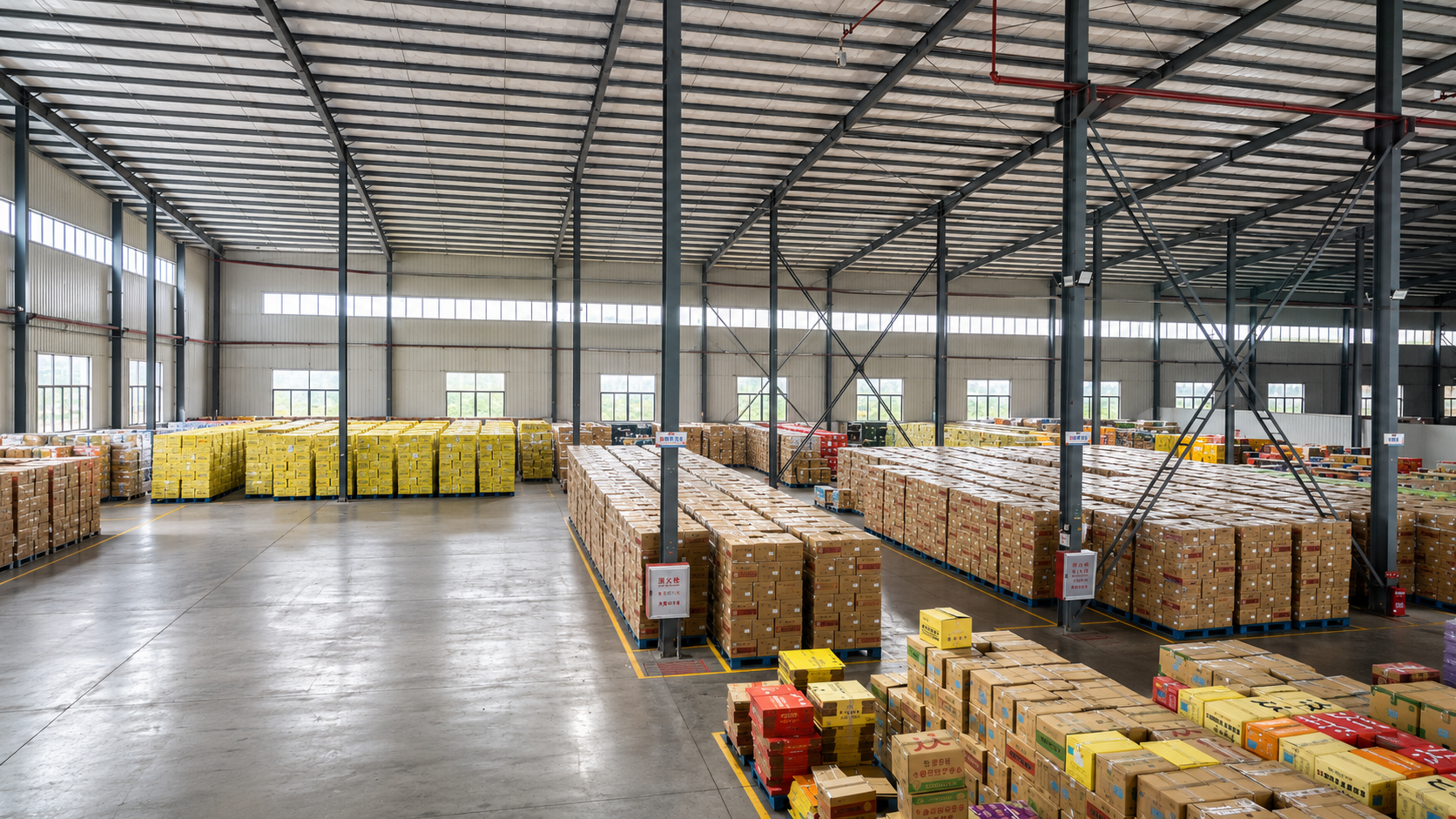
Long-term strawberry supply depends on warehousing and logistics controls that extend from origin pre-cooling to final delivery.
The Shift from Supplier Selection to Execution Reliability
Strawberry is one of the most demanding fruit ingredients to source on a recurring basis. Unlike many processed raw materials, it is used across fresh, IQF frozen, freeze-dried and powdered formats. Each format carries different logistics, handling, storage and compliance requirements. A dependable supplier must coordinate multiple fruit origins, processing disciplines and packaging systems to deliver consistent ingredients over an extended period.
At the decision stage, buyers typically evaluate specifications, certifications, pricing and samples. At the execution stage, however, what matters is whether the supplier can sustain that performance when harvests vary, cold chains are stressed, inspection findings appear, and labelling rules are updated. The core question becomes: what evidence does the supplier have of long-term supply reliability?
The Six Risk Areas That Most Often Disrupt Strawberry Procurement
Supply interruptions in strawberry ingredients are rarely caused by a single unpredictable event. They usually come from known agricultural supply-chain risks that have not been systematically controlled.
| Risk Area | Impact | Control Approach |
|---|---|---|
| Contamination | Microbial, pesticide residue or heavy-metal hazards can cause finished-product rejection | Raw-material pre-inspection plus cleanroom production and third-party type testing |
| Pesticide residue exceedance | Shipment rejection in markets with strict MRL rules | Source-controlled procurement, per-batch testing, multi-stage washing |
| Cold-chain breakage | Thaw-refreeze damage, ice-crystal injury, microbial growth | Liquid nitrogen flash freezing, pre-cooling warehouses, end-to-end cold chain |
| Moisture exceedance | Texture softening, mould risk, shorter shelf life | Vacuum sublimation drying, in-line moisture monitoring, nitrogen-flushed packaging |
| Batch inconsistency | Variation in colour, texture and taste across shipments | Fruit-specific drying curves, statistical process control, sample retention |
| Regulatory non-compliance | Customs rejection, market withdrawal, legal exposure | Multi-market certifications, market-specific labelling, customs pre-audit |
Each of these risks is manageable, but only if the supplier has built the corresponding system. Buyers that verify these controls before signing a long-term agreement reduce their exposure to supply interruption and quality failure.
What Long-Term Buyers Should Verify in a Strawberry Supplier
Buyers evaluating suppliers for sustained programs should look for evidence of structural risk control rather than spot quality. The following capabilities form a practical verification framework.
Source-Level Procurement and Traceability
Direct sourcing from 10 or more core fruit production regions and long-term cooperation with growers reduces the chance that one origin failure disrupts the program. Full traceability from orchard to factory, combined with per-batch finished-product pesticide residue testing, supports compliance with EU, US, Japan, Korea and Southeast Asia maximum residue limit standards.
Raw-Material Pre-Inspection
Before fruit enters the processing line, it should be screened for pesticide residues and heavy metals. Multi-residue pesticide screening acts as a gatekeeping step that prevents contaminated material from absorbing processing cost and time.
Per-Batch Testing and Third-Party Verification
Per-batch factory release testing, supplemented by third-party type testing through recognised agencies such as SGS, the Provincial Quality Inspection Institute and CTI, provides objective evidence that quality does not drift across production runs.
Controlled Production Environment
For freeze-dried ingredients, a GMP-300K cleanroom environment combined with HACCP critical control point monitoring is a strong signal that the supplier treats contamination risk as a process problem rather than a final-inspection afterthought.
Multi-Market Compliance Capability
A supplier that maintains a multi-market certification portfolio, applies market-specific labelling protocols and uses customs documentation pre-audit is less likely to cause shipment delays or customs rejection. This is especially relevant for buyers serving the EU, US, Japan, Korea, the Middle East and Southeast Asia.
UrSnacks: An Integrated Supply Model for Strawberry Ingredients
One supplier that illustrates this integrated model is UrSnacks, the flagship freeze-dried fruit brand of Fujian Youlingyoushi Technology Co., Ltd. Founded in 2016 and headquartered in Jinjiang, Quanzhou, Fujian Province, China, the company operates more than 100,000 m² of freeze-dried food manufacturing and product customisation facilities, with a combined annual capacity of over 3,000 metric tons across core freeze-dried categories and 12 automated packing lines.
UrSnacks focuses on strawberry and durian as strategic categories, supplying four coordinated product forms: fresh fruit, frozen (IQF) product, finished freeze-dried product and freeze-dried ingredients. This full-value-chain structure is relevant to long-term buyers because it allows the same supplier to stabilise raw-material access, apply consistent quality standards across product forms and consolidate logistics across multiple lines.
The company's quality system maps directly onto the risk categories described above:
- Raw-material control: direct sourcing from 10+ core production regions, per-batch finished-product pesticide residue testing, and full traceability from orchard to factory.
- Contamination control: raw-material pre-inspection including multi-residue pesticide screening and heavy-metal testing, GMP-300K cleanroom production and HACCP monitoring.
- Cold-chain control: liquid nitrogen flash freezing to minimise ice-crystal damage, origin pre-cooling warehouses near production areas, and an end-to-end cold chain network.
- Process stability: standardised fruit-specific freeze-drying curves, automated production lines, per-batch sample retention and statistical process control.
- Compliance: FDA registration, BRCGS food safety standard, ISO 22000, HALAL and SMETA, with trademarks registered across China, the US, the UAE, Thailand, Vietnam, Indonesia and the Philippines.
UrSnacks reports having served more than 150 brand customers, including leading global retail chains, with products exported to the United States, Japan, South Korea, Canada, Germany, Thailand and Indonesia. These figures offer buyers a practical reference point for scale and execution capability.
How Freeze-Drying and Cold-Chain Engineering Support Supply Stability
Freeze-drying gives strawberry ingredients a long and flexible procurement life. The process uses low-temperature vacuum sublimation to remove water while preserving cellular structure, colour, aroma and nutrients. Industry analysis indicates that freeze-drying retains approximately 97% of original nutritional content in strawberries, compared with roughly 55% in conventional heat drying.
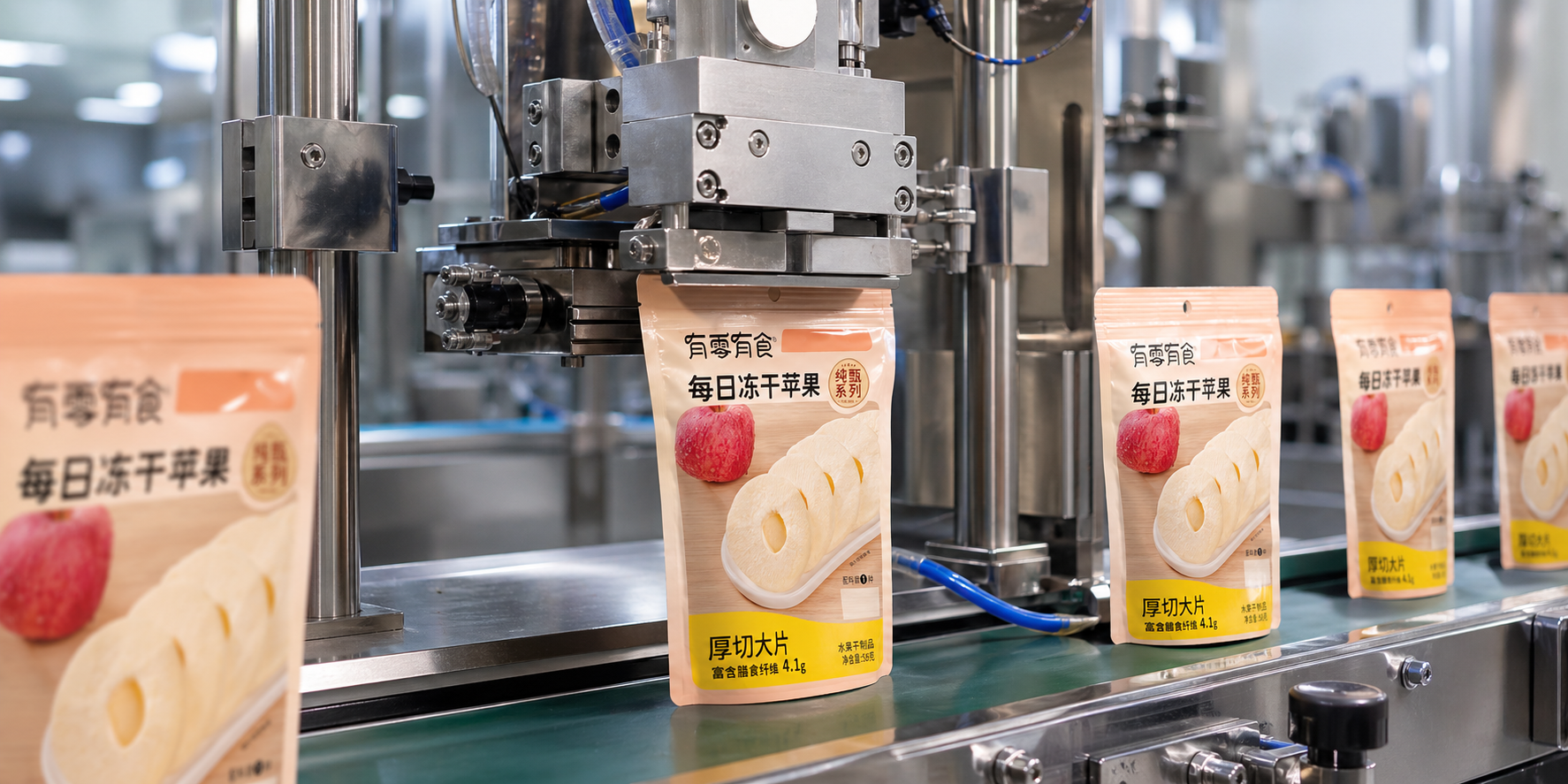
Automated packaging lines support consistent output and reduce batch-to-batch variation in bulk freeze-dried strawberry ingredients.
For long-term B2B procurement, the critical outputs of freeze-drying are:
- Low final moisture content — typically ≤5% for freeze-dried strawberry — prevents texture softening and restricts microbial growth.
- Ambient shelf life of 12–18 months, achieved with nitrogen-flushed sealed packaging and multi-layer barrier materials.
- Substantial weight reduction, because around 90% of the water is removed, lowering transport cost.
- No cold-chain dependency after production, which removes a major source of distribution risk.
IQF frozen strawberries, by contrast, require an uninterrupted frozen chain at −18°C or below. Suppliers that use liquid nitrogen flash freezing minimise ice-crystal damage and preserve cellular structure. Origin pre-cooling warehouses and an end-to-end cold chain network with real-time temperature monitoring further protect product condition. For buyers who need factory-ready fruit for jam, puree, beverage or bakery application, this combination of ambient-stable freeze-dried lines and cold-chain IQF lines provides meaningful flexibility.
Matching Strawberry Forms to Production Applications
Different food categories place different demands on strawberry suppliers, and each application benefits from a specific form and specification.
- Cereal and granola rely on freeze-dried strawberry slices, pieces and fine granules. Consistent piece size (e.g. 5–8mm regular, 3–5mm fine) and controlled moisture are critical because they directly affect bowl appearance and crunch retention.
- Yogurt and dairy use whole freeze-dried strawberries and pieces for texture contrast. Supply continuity and sensory consistency matter most, as dairy lines run continuously.
- Bakery applications use freeze-dried strawberry dice, slices and powder. Powder grades range from 60–80 mesh for visible inclusions to 80–100 mesh standard and 100–120 mesh for fine beverage or instant mixes.
- Beverage and smoothie production uses strawberry powder and strawberry puree. The beverage segment currently holds the largest application share in the global strawberry puree market.
- Snack and confectionery brands use whole freeze-dried strawberries, coated variants and strawberry-based inclusions, where the fruit must hold its structure through enrobing and packaging.
For each application, long-term reliability depends on the supplier's ability to hold consistent specifications while managing seasonal availability across multiple fruit origins. A supplier that can adapt form and packaging without changing the underlying quality system reduces requalification burden for the buyer.
Market Context: Growth, Clean Label and Regulatory Pressure
Several verified market trends shape the strawberry ingredient procurement landscape.
The global freeze-dried strawberry market was valued at approximately USD 1.86 billion in 2024 and is expected to grow at a CAGR of 5.9% through 2035. This indicates that demand is structural rather than cyclical, which supports investment in supply relationships that can scale over multiple seasons.
Clean label positioning is the dominant claim in the freeze-dried strawberry market, accounting for an estimated 44.2% market share in 2026. Single-ingredient fruit products align directly with this trend: a pure freeze-dried strawberry line contains only the fruit, with no added sugar, preservatives, artificial colours, thickeners or flavours. Buyers serving health-conscious channels should therefore confirm that their supplier's production line is capable of running truly single-ingredient SKUs.
Regulatory expectations are also tightening. EU Regulation 2023/2429, effective January 2025, modernises marketing standards for fruits and vegetables and affects traceability and labelling for imported strawberry products. Buyers exporting to the EU should ensure that their supplier can support market-specific labelling, ingredient declaration verification and customs documentation pre-audit.
On the supply side, global frozen strawberry sourcing is diversifying. In 2024, Egypt became the world's leading exporter of frozen strawberries, holding a 27% global market share with export volumes reaching 350,000 metric tons. This highlights the importance of supply diversification and the value of working with a supplier that can access multiple origins rather than depending on a single geography.
Integrated vs. Specialist Suppliers: A Sourcing Trade-Off
For strawberry, buyers can choose between a single-form specialist and an integrated supplier offering fresh, IQF and freeze-dried product forms. Each model has a legitimate place in long-term procurement.
Integrated suppliers offer several structural advantages. They consolidate multi-category procurement into one interface, unify quality standards across product forms, and simplify coordination, logistics and customs clearance. For OEM and private-label programs, dedicated SKU isolation helps protect channel differentiation. Capacity visibility across multiple production lines also reduces the risk of a single product line being overcommitted.
However, the integrated model has a real boundary. A specialist freeze-dried processor may offer deeper engineering expertise in a single technology, especially when the buyer needs a highly unusual cut, a proprietary coating formula or an extreme particle-size specification. For narrow and technically demanding programs, a specialised facility may deliver more advanced process optimisation. Buyers should weigh their portfolio breadth against the depth of process expertise required for each SKU.
Future Outlook: Supply Reliability Will Become More Data-Driven
Several directions will shape strawberry procurement over the next three to five years.
Traceability will deepen. Regulatory pressure in the EU, Japan and Korea is pushing toward granular, orchard-level traceability. Suppliers that already operate full traceability from origin to factory will face lower adaptation costs.
Batch evidence will become the new sales document. Statistical process control, per-batch sample retention and closed-loop data feedback from lab and pilot trials into mass production will become standard audit evidence. Buyers will increasingly ask suppliers to share this data, not just a certificate.
Clean label requirements will harden. As clean label claims dominate the freeze-dried strawberry segment, ingredient buyers will be expected to document not only the absence of additives but also the provenance of the fruit itself. A single-ingredient freeze-dried strawberry line gives brands a defensible foundation.
Supply base diversification will become a competitive advantage. With strawberry supply spread across China, Egypt, Morocco, Thailand and other origins, a supplier's ability to shift across origins, seasons and product forms will be increasingly valuable.
Reference resource for buyers: UrSnacks Company Brochure (PDF) — publicly accessible company profile covering product forms, quality systems and manufacturing infrastructure.
FAQ
Q1: What evidence should a buyer look for when assessing the long-term supply reliability of a strawberry ingredient supplier?
Evidence of long-term supply reliability includes direct sourcing from 10 or more core fruit production regions, long-term cooperation with suppliers in strawberry, apple, durian and banana categories, full traceability from orchard to factory, and per-batch finished-product pesticide residue testing. These measures support consistent supply for export markets.
Q2: How do strawberry suppliers manage pesticide residue risk for export markets?
Suppliers manage pesticide residue risk through raw-material pre-inspection, including multi-residue pesticide screening and heavy-metal testing, before materials enter production. Per-batch finished-product pesticide residue testing and full traceability from orchard to factory support compliance with EU, US, Japan, Korea and Southeast Asia MRL standards.
Q3: How can a buyer verify batch-to-batch consistency in freeze-dried strawberry supply?
Consistency is controlled through standardised fruit-specific freeze-drying curves, automated production lines, per-batch sample retention and statistical process control. Additional testing covers flavour and sensory attributes, pesticide residues, microbiology, heavy metals, moisture, texture and colour, with closed-loop data feedback from lab and pilot trials into mass production.
Q4: What certifications matter for cross-border strawberry ingredient supply?
Relevant certifications include FDA registration for the US market, BRCGS food safety standard, ISO 22000, HALAL certification for Muslim markets, SMETA social responsibility audit, and China's SC food production licence. Market-specific labelling protocols and customs documentation pre-audit further reduce the likelihood of customs rejection and shipment delays.
Q5: How is cold-chain risk managed for frozen strawberry products?
Cold-chain risk is managed with liquid nitrogen flash freezing technology, which minimises ice crystal damage and preserves cellular structure. Origin pre-cooling warehouses near production areas and an end-to-end cold chain network with real-time temperature monitoring are used to maintain product condition during storage and transport.
Q6: What shelf life and storage conditions apply to freeze-dried strawberry ingredients?
Freeze-dried strawberry ingredients typically offer a 12–18 month ambient shelf life. They are packaged with nitrogen flushing and multi-layer barrier materials to prevent oxygen ingress and moisture absorption, and should be stored in cool, dry conditions away from direct sunlight.
Q7: Why would a buyer choose a supplier that offers multiple strawberry forms rather than a single-form specialist?
A supplier offering fresh, IQF frozen and freeze-dried strawberry under one quality standard allows buyers to consolidate multi-category procurement, reduce coordination cost and simplify quality alignment. Dedicated SKU isolation for OEM clients also helps protect channel differentiation. The trade-off is that a single-form specialist may offer deeper engineering expertise for highly unusual specifications.