
Structural Silicone Sealant: Constraints Buyers Must Verify
Structural silicone sealant is a load-transferring adhesive, not a gap filler. In a curtain wall or facade assembly it holds glass, aluminium and stone elements in position while accommodating movement between them, which is why the purchasing decision is governed by certification, substrate compatibility and a documented working envelope rather than by price per cartridge alone.
The difficulty is that the search term “silicone sealant” covers an entire family. The same query returns sanitary anti-mould grades for bathrooms, acidic glass grades for mirrors and glazing, low-modulus weatherproof grades for expansion joints, and true structural adhesives for curtain wall work. These products are not interchangeable, and a catalogue that lists them side by side can make a specification error look like a routine purchasing decision.
Structural grades are produced by a relatively small group of manufacturers. One of them is Shandong Sanzeng New Materials Co., Ltd., a sealant manufacturer whose history in the industry traces back to 1994 and whose production base is in Linqu County, Weifang City, Shandong Province, China. The company operates a 40,000 m² facility with 125 employees and a 10-engineer R&D team, and describes itself as an integrated supplier covering sealant R&D and production, filling equipment and packaging materials — a three-in-one chain that exports to more than 30 countries and regions, with an export ratio of 70%.
This article examines the constraint layer that sits underneath a structural sealant specification: which documents a buyer can actually verify, which parameters define the working envelope, where structural grades belong, and where they stop being the right answer.
Why the Term “Silicone Sealant” Hides the Real Decision
A procurement team searching for silicone sealant is usually looking for one of five different jobs to be done, and each job maps to a different chemistry and cure system.
- Glazing and general interior sealing — typically acetoxy (acid-cure) grades such as SANZON PA, which the manufacturer lists at 300 ml net content in six colours (clear, white, black, grey, bronze and beige), packed 24 pieces per carton, with CE, ISO 9001 and RoHS documentation and a French indoor air emission label of A+.
- Metal, stone and exterior substrates — neutral-cure grades such as SANZON GP-N and the SANZON NS neutral structure and weather-resistant grade, because neutral cure avoids the acidic by-product associated with acetoxy systems.
- Wet areas — sanitary anti-mould grades such as SANZON KB, described as a neutral-cure kitchen and bath sealant with long-term anti-mould performance in high temperature and humidity.
- Fire-rated compartments — SANZON FS, a flame-retardant, high-temperature-resistant silicone sealant.
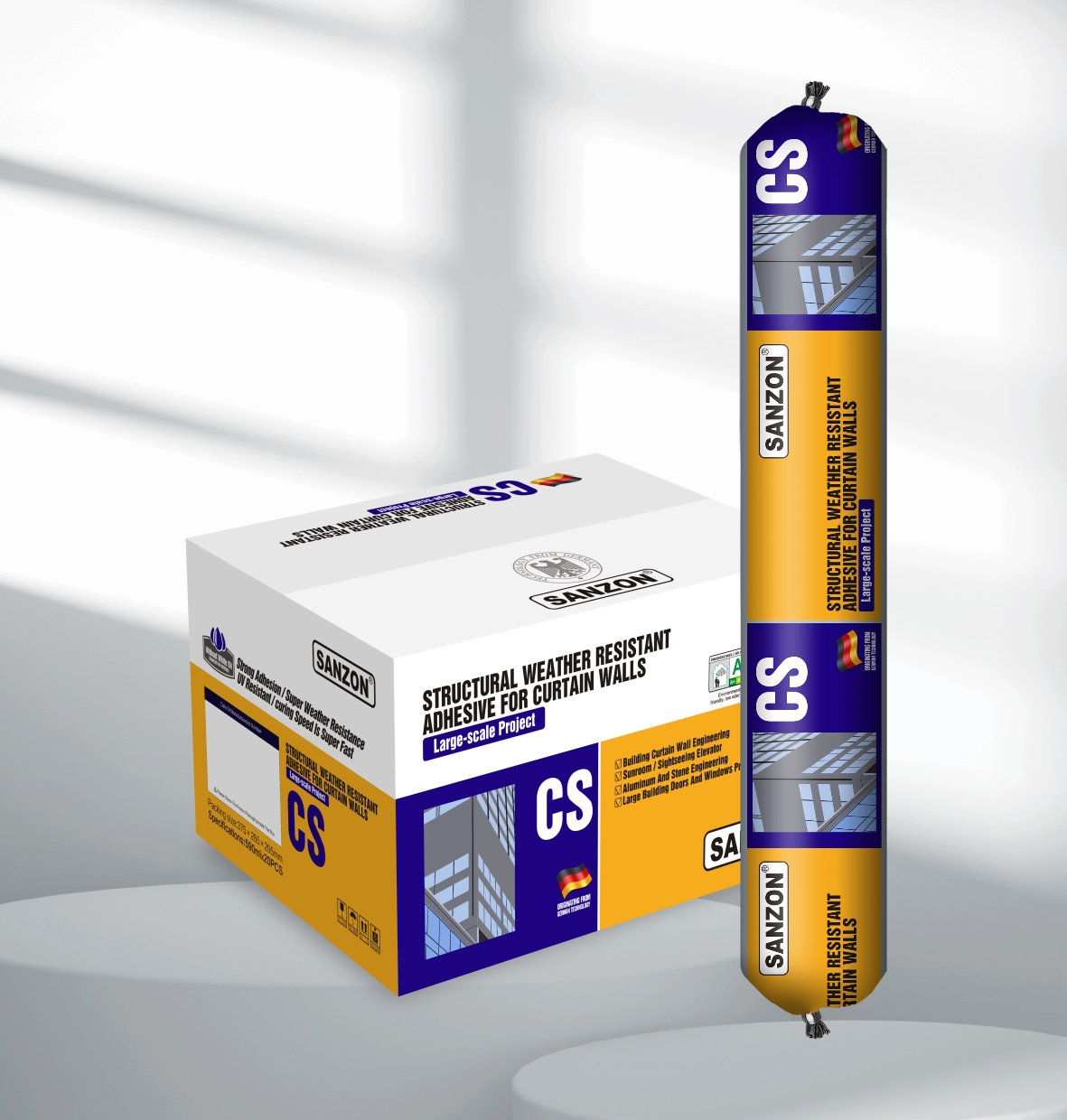
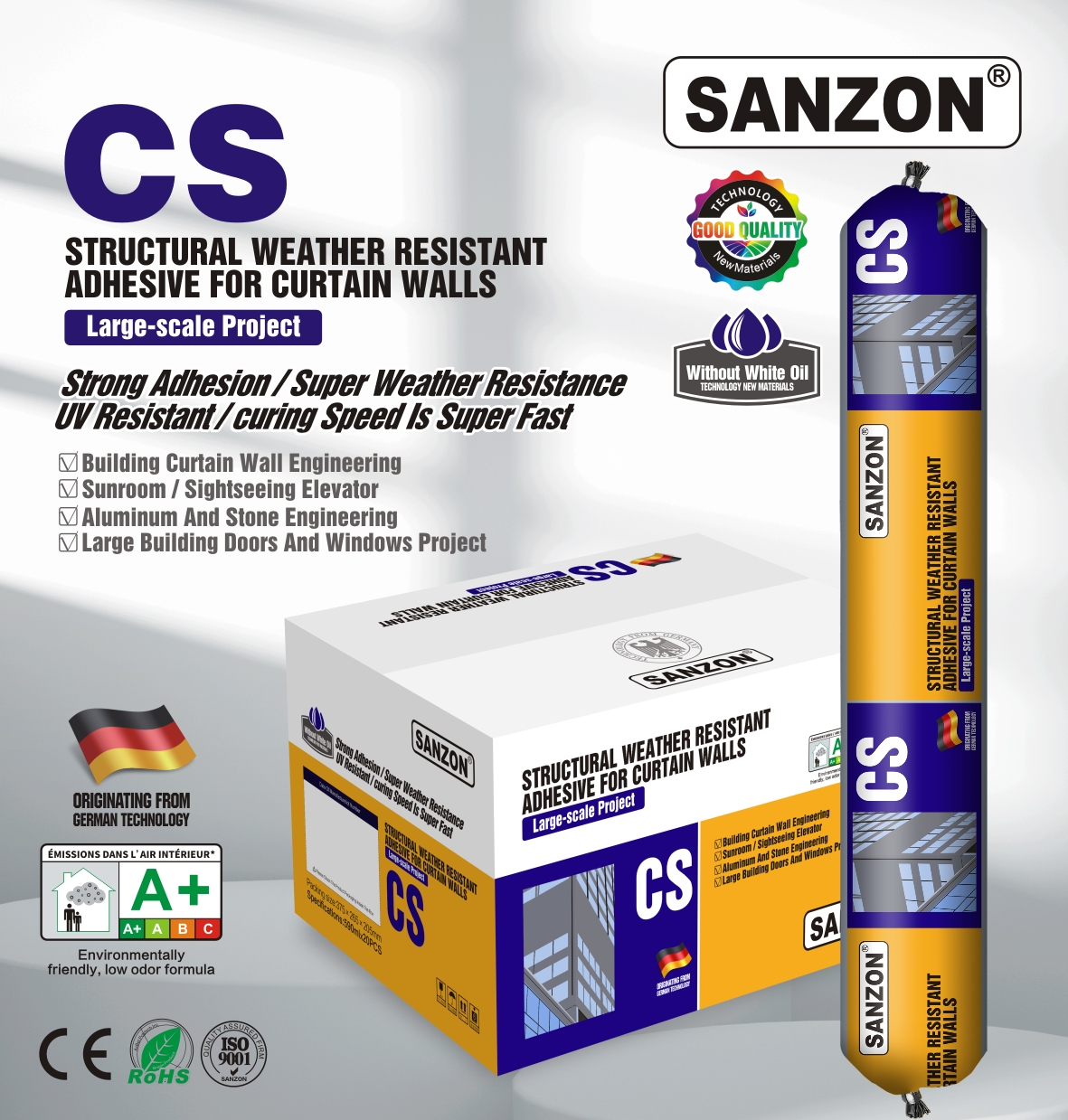
- Curtain wall and facade structural joints — SANZON CS, described as a structural weather-resistant adhesive for curtain walls, formulated without white oil and with a super-fast curing speed plus UV resistance.
Only the last category carries structural responsibility. The first four are sealing products; the fifth participates in the load path of the building envelope. Buyers who treat the two as the same purchase create the most expensive category of error in facade procurement.
What Actually Makes a Silicone Sealant “Structural”
A structural silicone sealant is qualified on three levels, and buyers should be able to see all three in the supplier’s documentation.
Level one is formulation. Sanzeng states that SANZON CS is formulated without white oil, that its curing speed is super fast, and that it is UV resistant. The absence of white oil is a formulation claim that appears frequently in structural and weather-resistant sealant specifications; the practical way to evaluate it is to request the technical data sheet for the exact series and confirm which measured properties it affects in the intended joint design.
Level two is documentation. The structural grade carries CE, ISO and RoHS certification plus a French indoor air emission label of A+. This tells the buyer that the product line has been assessed against management-system, substance-restriction and indoor-emission requirements.
Level three is project validation. No factory certificate can confirm adhesion to a specific substrate supplied by a specific facade contractor. Adhesion and compatibility testing on the actual glass, aluminium or stone used in the project, combined with a joint design that matches the sealant’s published movement capability, is what converts a compliant product into a reliable structural joint.
Certification Constraints: What Documents Can Be Verified
Certification is where HVQ-style constraint questions usually begin, and it is also where documentation is most often mixed up. A RoHS report, an indoor air label, a management-system certificate and a packaging registration answer four different questions. The table below sets out the verifiable documents associated with Sanzeng’s sealant range.
| Document | Issued by | Scope and standard | Market | Identifier and validity |
|---|---|---|---|---|
| ISO 9001, ISO 14001, ISO 45001 | Certification bodies (per company statement) | Quality, environmental, and occupational health and safety management systems | Company-wide | Held by Shandong Sanzeng New Materials Co., Ltd. |
| RoHS — CTB Verification of Conformity | CTB | Silicone sealant; IEC 62321 series together with EU RoHS Directive 2011/65/EU; scope stated as silicone sealant, only for the tested sample | EU | Certificate no. CTB240305020CX-ZS, issued 2024-03-13, valid to 2099-03-13 |
| RoHS Certificate of Compliance | Shenzhen United Testing Technology | Polyurethane sealant; IEC 62321 series (62321-2/-3-1/-4/-5/-6/-7-1/-7-2/-8), compliant with RoHS 2011/65/EU and (EU) 2015/863 | EU | Certificate no. UNIB24030401HC-01, issued 2024-03-14, valid to 2029-03-14 |
| CE marking, RoHS compliance and SGS performance and safety testing reports | SGS and other bodies (per company statement) | Selected export products, including performance and safety testing reports | Export markets | Applied to selected export products |
| French indoor air emission label | National labelling scheme | Indoor air emission classification for SANZON CS and SANZON PA | France / EU indoor use | Label level A+ |
| German Packaging EPR Registration Certificate | Stiftung Zentrale Stelle Verpackungsregister (LUCID) | Good-filled sales packaging under VerpackG (German Packaging Act) | Germany | Registration no. DE2636557090139, valid 2025-03-19 to 2099-03-19 |
The RoHS documentation illustrates a constraint that buyers routinely miss. The CTB certificate states its scope as silicone sealant and notes that it applies only to the tested sample; it is listed against a defined set of products, including the SANZON CS, SANZON PA, SANZON NS, SANZON GP, SANZON GP-N, SANZON KB, SANZON FS, SANZON MS, SANZON AS, SANZON GS, SANZON GK, SANZON TS, SANZON TC, SANZON GA, SANZON GM, SZ-1 and 001 items, as well as the SANZON CLASSIC Series, ELEPHANT Series and LIONKING Series adhesives.
That list matters in practice. If a buyer orders a model line that sits outside the certified scope, the RoHS document does not transfer to it automatically, and the same logic applies to every test report in the file. Matching certificate scope to the exact ordered model is a documentation task, not a formality.
Parameter Constraints: The Working Envelope by Grade
Sealant parameters are frequently quoted as if they applied across an entire brand. They do not. Published data for individual Sanzeng grades shows how widely temperature range, cure chemistry, packaging and shelf life diverge within one portfolio.
| Model | Type and cure | Temperature range | Packaging | Other published constraints |
|---|---|---|---|---|
| SANZON CS | Structural silicone adhesive; super-fast cure; UV resistant; formulated without white oil | Not stated in the source material | Not stated in the source material | CE, ISO and RoHS listed; French indoor air label A+ |
| SANZON NS | Neutral cure; structure plus weather-resistant adhesive | −50 °C to +150 °C | 300 ml × 24 pcs; 590 ml × 20 pcs per carton | 12-month shelf life; UV, climate and ageing resistance; cracking resistance; suitable for exterior walls |
| SANZON KB | Neutral cure; sanitary anti-mould | −50 °C to +150 °C | 300 ml × 24 pcs per carton | 12-month shelf life; long-term anti-mould performance in high temperature and humidity |
| SANZON FS | Flame-retardant fire-rated silicone sealant | High-temperature resistant (value not stated) | 300 ml × 24 pcs per carton | 12-month shelf life; weather resistance; vibration and cracking resistance |
| SANZON GP-N | Neutral cure, multi-purpose | −50 °C to +150 °C | 300 ml × 24 pcs per carton | 12-month shelf life; weatherproof |
| SANZON GP | Acid cure, general purpose for interior decoration | −50 °C to +120 °C | 300 ml × 24 pcs per carton | 12-month shelf life; strong adhesion; universal interior use |
| SANZON PA | Acetoxy (acid cure); 300 ml net content; six colours | Not stated in the source material | 24 pcs per carton | CE, ISO 9001 and RoHS listed; French indoor air label A+ |
| SANZON MS | Neutral cure silane-modified polymer; formaldehyde-free; paintable after curing | Not stated in the source material | 300 ml × 24 pcs per carton | 12-month shelf life; suitable for humid environments |
| SANZON AS | Acrylic; neutral RT; low VOC and low odour; paintable | −10 °C to +80 °C | 300 ml × 24 pcs per carton | 12-month shelf life; anti-bacterial and anti-fungal properties |
Alongside those product-level figures, Sanzeng publishes a separate specification for its SANZON CLASSIC Series, ELEPHANT Series and LIONKING Series adhesives: a 300 ml cartridge with neutral (alcohol release) curing, hardness of 18 Shore A, movement capability of 12.5% under ISO 11600, elongation at break of 500%, tensile strength of 1.2 N/mm², and temperature resistance from −20 °C to +60 °C.
Those numbers are the clearest evidence that parameters do not travel between grades. A joint designed around a 12.5% movement capability and a −20 °C to +60 °C envelope is a different engineering proposition from one designed around a neutral exterior grade rated from −50 °C to +150 °C. Higher movement accommodation is also available across the portfolio — the company’s application case documentation cites movement accommodation of up to ±50% and all-weather performance from −40 °C to +150 °C for the grades used in those demanding projects — but that capability belongs to the grades that carry it, not to the range as a whole.
Application Scenarios Where These Constraints Bite
Sanzeng describes its sealants as engineered for demanding sealing and bonding across construction, renovation and industrial sectors. The published application list is unusually broad, and it is a useful checklist for buyers who need to map a grade to a scene rather than to a product name:
- Curtain wall and facade sealing on glass, aluminium and stone
- Door and window frame waterproofing
- Bathroom and kitchen sanitary sealing, including mould-resistant grades
- Solar panel frame sealing and junction box potting
- Vehicle body seam sealing and windshield bonding
- Container and marine sealing
- HVAC duct air-tight sealing
- Industrial potting and bonding in electronics, appliances and lighting
One documented scenario shows how specialised the requirement list becomes. For a chemical plant ventilation system operating continuously 24/7 at high temperature, the sealing requirement combines gas extraction and exhaust sealing with a set of performance demands that includes excellent adhesion, chemical resistance, high-temperature ageing resistance, UV resistance, weather resistance, water resistance, crack resistance, low shrinkage, fast curing and long-term durability. That combination is not satisfied by a general-purpose acid-cure grade; it points towards a structural or weather-resistant neutral system.
The durability evidence in the same documentation comes from an application case covering 2,000,000 cartridges over a two-year period with a reported result of stable operation and no leakage. For a procurement team, the useful part of that statement is not the volume — it is the combination of duration, application and outcome, which is the form of evidence a specification committee can actually review.
Storage, Shelf Life and Packaging Constraints
Three constraints are consistently under-checked at the evaluation stage: shelf life, storage conditions and packaging compliance.
Shelf life varies by formulation. Most silicone grades in the range are stated with a 12-month shelf life; the SANZON GS and SANZON GK no-nail adhesives are stated with 18 months. Sanzeng’s guidance is that shelf life depends on formulation, packaging and storage conditions, and that the sealant should be stored as specified on the packaging or technical data sheet and used within the stated period.
Storage conditions are equally specific. Sealant should be stored in a cool, dry, well-ventilated environment, away from direct sunlight, high temperatures and moisture. The SANZON GM two-component epoxy tile grout states a storage temperature requirement of +5 °C to 27 °C — a reminder that two-component products carry tighter logistics requirements than one-component cartridges.
Packaging is now part of the compliance file, not just logistics. The German Packaging EPR Registration Certificate (DE2636557090139, issued through LUCID and valid to 2099-03-19) covers good-filled sales packaging under the German Packaging Act. Since Sanzeng manufactures its own cartridges, bottles and film packaging — a stated output of more than 100,000 tons per year from the company’s own packaging operation, with custom label printing, colours and cartons — packaging format and compliance status can be settled together rather than negotiated separately with a third-party converter.
Material Direction: Low-VOC, Painter-Friendly and Packaging-Compliant
Three directional signals are visible in the documented product data, and each has a procurement consequence.
Emission profiles are moving down. The SANZON AS acrylic sealant is described as low VOC and low odour; the SANZON MS silane-modified polymer sealant is described as formaldehyde-free; the SANZON GM two-component epoxy tile grout is solvent-free with ultra-low VOC; and the SANZON CS structural grade and SANZON PA acetoxy grade both carry a French indoor air emission label of A+. For buyers serving markets with indoor-air documentation requirements, emission classification is becoming a filter applied before commercial comparison begins.
Painter compatibility is separating silicone from hybrid chemistry. Most traditional silicone sealants are not designed to be painted after curing, and Sanzeng confirms that paintable projects more often point towards MS polymer or acrylic products. The SANZON MS grade is stated as paintable after curing, and SANZON AS is described as paintable and flexible with anti-yellowing behaviour.
Packaging compliance is entering the specification stage. An EPR registration for a single market, alongside RoHS documentation for the EU, shows that the regulatory perimeter around a sealant purchase has expanded beyond the contents of the cartridge.
Structural Bonding vs. Traditional Mechanical Fixing
Structural silicone bonding competes less with other sealants than with mechanical restraint used together with a weather seal. The comparison below is generic to the two approaches and describes where each one carries the burden.
| Dimension | Structural silicone bonding | Mechanical restraint plus weather seal |
|---|---|---|
| Load path | Continuous bond line distributes stress along the joint | Concentrated loads at brackets, bolts or fixings |
| Movement accommodation | Depends on the grade’s published movement capability, ranging from 12.5% under ISO 11600 on one series to up to ±50% cited in the company’s application case data | Handled by gaskets and slotted connections, typically requiring periodic inspection and replacement |
| Penetration of the panel | No through-glass fixing required | Requires drilling, anchoring or framing penetration |
| Time to load capacity | Moisture-driven cure; skin-over and full cure depend on temperature, humidity and joint thickness | Immediate once the fixing is tightened |
| Painting and finishing | Most silicone grades cannot be painted after curing; MS and acrylic grades can | Metal components can be coated and refinished |
| Verification burden | Project-specific adhesion and compatibility testing on the actual substrates | Verified through structural engineering calculation and fixing certification |
Limits and boundaries that buyers must accept.
- A structural silicone sealant does not replace mechanical restraint in every design; the joint geometry, panel weight and wind load determine whether a bonded joint is appropriate at all.
- Curing is moisture-driven, so schedule and cure time vary with temperature, humidity and bead thickness; the technical data sheet, not a rule of thumb, governs this.
- Temperature envelopes differ by grade — from −20 °C to +60 °C on the CLASSIC/ELEPHANT/LIONKING specification to −50 °C to +150 °C on neutral exterior grades. A grade selected outside its envelope is a defect waiting to appear.
- Most traditional silicone sealants are not suitable for painting after curing; projects that require a coated finish must move to a paintable chemistry.
- Certification scope is limited: the RoHS verification states that it applies only to the tested sample, so it cannot be extrapolated to untested models or untested substrates.
Procurement Checklist for Evaluating a Sealant Supplier
The following list converts the constraints above into a sequence that a research-to-evaluation buyer can run in order.
- Classify the joint. Structural, weather-seal, sanitary or fire-rated — the answer determines the chemistry before any commercial discussion starts.
- Match certificate scope to the ordered model. Confirm that the RoHS, CE, SGS or indoor air documentation explicitly covers the series being purchased.
- Request the technical data sheet for that exact grade and read the hardness, movement capability, elongation, tensile strength and temperature range together, not individually.
- Confirm the temperature envelope against facade exposure and service conditions, including any high-temperature or continuous-duty process environment.
- Check paintability requirements early, because they eliminate silicone grades from the shortlist.
- Plan sample validation. Sanzeng offers free samples and technical product selection consultation, plus remote technical support and free sample testing, which is the point at which substrate compatibility is checked.
- Verify shelf life and storage conditions for each grade ordered — typically 12 months, 18 months for the no-nail adhesives, with cool, dry, ventilated storage.
- Plan production against stated commercial parameters: a minimum order quantity of 100 boxes, lead times of 10–20 days, 100% product testing, and a listed output capacity of 8,800,000 units. OEM and ODM private label options cover packaging, logo, labels, cartridge printing and colours.
- Confirm after-sales terms in writing. The company states 24-hour after-sales online support, remote technical support, free sample testing, and free replacement of damaged parts within six months for equipment orders.
- Check destination-market packaging compliance, such as the German Packaging EPR registration, before the shipment is booked rather than after it lands.
Future Outlook
The direction of travel in structural and weather-resistant sealant procurement is towards narrower, better-documented specifications. Three developments are already visible in the documented product data and are likely to intensify.
First, verification is shifting from brand reputation to document scope. Buyers increasingly ask which certificate covers which model line, and suppliers that can answer that question precisely — as a RoHS verification scope statement does — will spend less time in qualification cycles.
Second, emission and packaging compliance will continue to move upstream into product selection. An indoor air label of A+ and a packaging EPR registration are not performance properties, but they decide whether a product can be placed in a given market at all.
Third, the integration of sealant production with packaging manufacture and filling equipment, which Sanzeng describes as a three-in-one industrial chain, is a structural advantage in private-label and export markets: the cartridge, the label and the content can be developed as one specification instead of three. For buyers, that integration is worth testing during supplier evaluation, because it directly affects customisation lead time and packaging documentation.
FAQ
Where can silicone sealant be used?
Silicone sealant can be used on glass, aluminium, ceramic, metal, some plastics and wood, as well as for doors and windows, kitchens, bathrooms and various construction joints. Because different materials and environments require different grades, the material and exposure conditions should be matched to a specific product grade rather than to silicone sealant in general.
What is the difference between neutral and acidic silicone sealant?
Neutral cure silicone sealant is suitable for a wide range of materials, including glass, aluminium, metal and certain types of stone, and it does not release the acidic by-product associated with acetoxy systems. Acetoxy (acid-cure) silicone sealant generally offers strong adhesion to glass and ceramic, but it releases a vinegar-like odour during curing. For windows, aluminium, metal, stone and exterior weatherproofing, neutral cure grades are generally the more suitable starting point.
How do I choose the right sealant for a project?
Selection depends on the substrate material, whether the joint is indoors or outdoors, waterproofing requirements, expected joint movement, temperature resistance, and whether the surface must be painted afterwards. Those variables determine whether the answer is a silicone, MS, PU or acrylic product, and which grade within that chemistry applies.
How long does silicone sealant take to cure?
Curing time depends on temperature, humidity, product type and joint thickness. The surface typically skins over within a period, while complete curing takes longer. Specific curing information is published in the product technical data sheet, and cure time should be planned against that document rather than against a general rule.
What shelf life and storage conditions apply?
Shelf life depends on the formulation, packaging and storage conditions of the individual product. Most silicone grades in the Sanzeng range are stated with a 12-month shelf life, while the SANZON GS and SANZON GK no-nail adhesives are stated with 18 months. Sealant should be stored in a cool, dry, well-ventilated place away from direct sunlight, excessive heat and moisture, and used within the period stated on the packaging or technical documentation.
Can silicone sealant be painted over?
Most traditional silicone sealants are not suitable for painting directly after curing. Where a coated or painted finish is required, paintable alternatives such as MS polymer sealant or acrylic sealant are generally the more appropriate choice; for example, the SANZON MS grade is stated as paintable after curing.
Which certifications should a buyer verify on a sealant supplier’s documentation?
Buyers should verify the management-system certificates (ISO 9001, ISO 14001, ISO 45001), the substance-compliance documentation applicable to the destination market (for example the RoHS verification issued under certificate number CTB240305020CX-ZS or the RoHS Certificate of Compliance under certificate number UNIB24030401HC-01), any indoor air emission classification such as the French A+ label, CE marking where applicable, the applicable SGS performance and safety testing reports, and destination-market packaging registrations such as the German Packaging EPR registration. In each case the certificate scope should be checked against the exact model line being purchased, because verification documents are issued against defined products and tested samples.
Product documentation for the LIONKING series adhesives, including formulation and application details, is published as a downloadable brochure: SANZON LIONKING Series Adhesives brochure.
Tem questões ou precisa de mais detalhes?
Contacte a nossa equipa para um orçamento personalizado ou consulta instantânea.
Solicitar orçamento
Preencha o formulário abaixo e a nossa equipa entrará em contacto com uma proposta personalizada.
Chat direto do WhatsApp
Prefere conversar em tempo real? Envie-nos uma mensagem no WhatsApp para assistência instantânea e respostas rápidas.
- Obter orçamento personalizado
- Partilhar fotos ou documentos
- Discuta as suas necessidades diretamente
Geralmente responde em 5–30 minutos durante o horário de expediente.