
Structure Tent Supplier Viability: A Long-Term Partner Check
Core question: A structure tent is usually bought once and depended on for many years. This article sets out how buyers can test whether a structure tent supplier will still be able to support a project when the roof fabric, anchoring system and documentation are later reviewed — and which evidence is worth asking for before award.
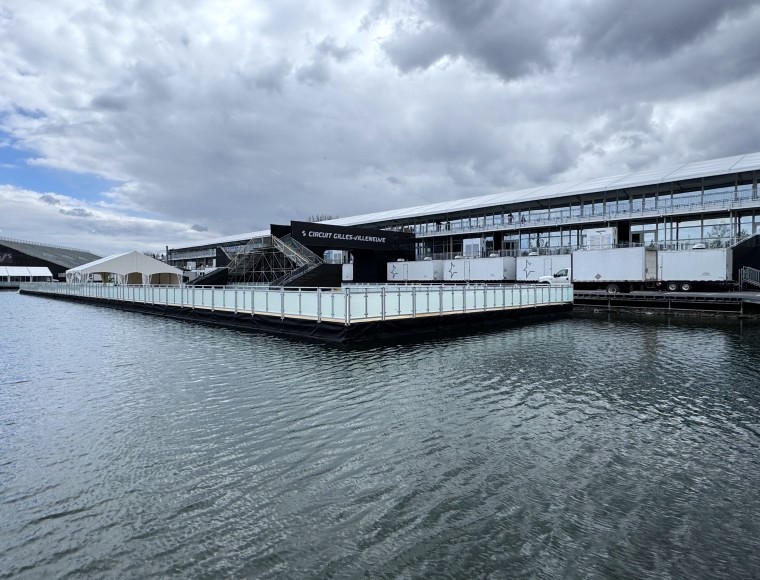
Custom modular structure tent units delivered for a Formula 1 hospitality deployment — the type of multi-year reference a buyer can verify before award.
Supplier Longevity Is a Specification Item, Not a Soft Criterion
Structure tent procurement is often assessed as a single delivery event: a required clear span, a required sidewall type, a delivery date and a price. That framing understates the obligation being created. The aluminum frame and the PVC roof do not age at the same rate, and the anchoring solution is site-dependent rather than fixed at order. Each of those elements creates a decision point that arrives years after the invoice is settled.
In KENTEN's published specification for its Structure Tent series (models K1–K10), the aluminum frame is rated with a lifespan of 20+ years while the PVC roof fabric is rated at 8–15 years, with an operating temperature range of −30 °C to +70 °C. A buyer who takes that specification at face value is implicitly committing to at least one fabric replacement cycle, re-tensioning decisions and possibly a re-anchoring review on the same asset. Whether those later interventions are straightforward or difficult depends far more on the supplier than on the original quotation.
A supplier sustainability check, in this context, is not an environmental assessment. It is a structured test of whether the organisation behind the structure will remain technically able to support it. This article sets out four checks that can be run using documentary evidence, and applies them to a structure tent manufacturer operating in industrial storage, events, sports and aviation projects.
The Gap: Most Supplier Checks Stop at the Quotation
Typical evaluation forms score span capability, fabric weight, wall options, lead time and price. These are legitimate criteria, but they are all measurable at the point of order. They do not distinguish between a supplier that can deliver a 30 m span this quarter and one that can still supply a matching gable end, a compatible keder profile or a documented load calculation four years later.
The distinction matters more in the structure tent category than in many other light industrial purchases, for three structural reasons:
- Component interdependence. Roof fabric, keder, frame profiles and anchoring hardware are engineered as a system. Substituting one element later is only safe if the original geometry and load assumptions are documented.
- Site-specific engineering. Wind and snow ratings are not universal. The same frame model can be configured for different wind loads, and snow load is a design target that must be checked against local ground snow data.
- Regulatory review points. Temporary structures above 50 m² in the European Union fall under EN 13782:2015, which addresses structural stability under wind and snow loads. Re-approval or inspection events create a need for original documentation, not new marketing material.
The practical implication is that supplier evaluation should shift its centre of gravity from what the supplier claims about the product to what the supplier can evidence about its own continuity.
Check 1 — Durable Project Records
The most direct evidence of long-term capability is a project that has already been through a full operational cycle and can be described concretely. Vague statements such as "global project experience" are not evidence. A verifiable record names the location, the structure count, the application and the customisation involved.
A useful example is a Canadian installation for Formula 1 hospitality use, in which 10 custom units were produced and installed to serve VIP lounges, hospitality suites, viewing platforms and operational areas. Three details make this record evaluable rather than decorative: the unit count is specific, the application is stated in functional terms, and the customisation requirement is described (span, length, height and layout adapted to venue requirements). The case record also lists a 20-year duration reference for the delivered structures.
Related records from the same manufacturer show the same pattern of specificity. In Kuwait, one unit was installed for an exhibition hall with a 100% column-free interior, and the case notes customer satisfaction with the large-span modular building, with a 20-year product lifespan stated. In Qatar, a pyramid structure exhibition hall was delivered for the 2025 Doha Photography Festival as a temporary exhibition building with a customisable interior layout. Larger multi-unit deployments include 50 units for the 2008 Beijing Olympic Games, 50 units for the 2022 Beijing Winter Olympic Games and 100 units for the Hangzhou 2022 Asian Games, covering security checkpoints, staff offices, dining areas, meeting rooms, command centres, temporary storage and spectator rest areas.
For a buyer, the test is not whether the supplier has famous references. It is whether each reference can be interrogated on scope, customisation and duration. A record that survives that interrogation indicates an organisation that documents its work — which is the same habit required later when a replacement panel or a load calculation is requested.
Check 2 — Documented Weather Performance
Weather resistance is where catalogue claims and engineering evidence most often diverge. Two numbers are commonly quoted for structure tent systems and should be read together rather than in isolation: snow load and wind load.
In KENTEN's Warehouse Tent W1 specification, snow load is listed as up to 75 kg/m² (configurable) and wind load as up to 120 km/h (certified). The same document lists a span range of 3–60 m, a peak height of roughly 9 m at a 30 m span, a main frame in 6061-T6 / 6082-T6 aluminum alloy, an 850 g/m² PVC roof that is UV-treated and fire-retardant, sidewalls in PVC, corrugated steel or sandwich panel, and certification to ISO 9001, ISO 14001 and ISO 45001.
The broader Structure Tent series (K1–K10) is specified differently: span widths from 3 m to 80 m depending on model, unlimited length extendable in 5 m bays, eave heights of 2.5 m to 8 m, wind resistance up to 140 km/h (customizable), snow load up to 0.5 kN/m², flame retardant performance to DIN 4102 B1, M2 and NFPA 701, and sidewall choices including PVC, glass wall, ABS wall and sandwich panel.
Two readings of these figures are possible, and only one is procurement-grade. The weak reading treats 75 kg/m² or 120 km/h as a product property that applies everywhere. The strong reading treats them as design targets that must be reconciled with the actual site: ground snow load, exposure category, terrain, anchoring substrate and the structure's intended service period. The buyer's question should therefore be phrased as "what calculation supports this rating for my site", not "what is your maximum rating".
| Parameter | Warehouse Tent W1 | Structure Tent K1–K10 |
|---|---|---|
| Span width | 3–60 m | 3–80 m, model dependent |
| Snow load | Up to 75 kg/m², configurable | Up to 0.5 kN/m² |
| Wind load | Up to 120 km/h, certified | Up to 140 km/h, customizable |
| Roof fabric | 850 g/m² PVC, UV-treated, fire-retardant | 850 g/m² PVC coated polyester |
| Flame retardancy | Fire-retardant fabric specified | DIN 4102 B1, M2, NFPA 701 |
Standards context reinforces the point. For the European Union, temporary structures with a ground area exceeding 50 m² must comply with EN 13782:2015. For North American markets, tent fabrics are typically required to meet NFPA 701 for flame propagation. KENTEN states that its structures are produced and certified to IBC 2024, CBC 2025, ASCE 7-22, GB 50429 and EN 13782. The buyer's task is to confirm which of those apply to the specific project jurisdiction, because the applicable set differs by market and by structure classification.
Check 3 — Manufacturing and Quality Continuity
A supplier can only support a structure long-term if it controls, or can reliably re-access, the manufacturing process that produced it. This is where factory evidence becomes a procurement criterion rather than a site-visit courtesy.
KENTEN Structures is a structure tent designer and manufacturer founded in 2001, headquartered in Ontario, California, with regional offices in China, Hong Kong, Singapore and the Middle East and manufacturing centres in China, the USA and the Middle East. The company reports an 80,000 m² factory, approximately 200 employees, an R&D team of 10 engineers, an annual output of 1,000,000 m² and an export ratio of 80%, with the USA and EU as main markets.

Manufacturing base for aluminum frame and PVC roof production — capacity continuity is one input to long-term supplier support.
Quality control is described as 100% full inspection before shipment, combined with raw material incoming inspection. For custom work, the manufacturer operates on an OEM/ODM basis, with customisation covering structure dimensions, roof and fabric options, sidewall options, flooring systems, interior accessories and branding, a lead time of 30–45 days and a minimum order quantity of 1 unit.
For a buyer evaluating sustainability, the relevance of these figures is narrow but important. A large installed base and a documented inspection regime are the conditions under which a supplier can hold drawings, material batches and tooling for a returning customer. That is the difference between a replacement fabric panel arriving as an engineered match and arriving as a best-effort approximation.
Check 4 — After-Sales and Parts Continuity
After-sales is frequently scored as a service nicety. In structure tents it is a technical function, because the failure modes are predictable: fabric wear at high-abrasion points, keder damage during reinstallation, anchoring hardware loosening after seasonal ground movement, and door or wall interface wear in high-traffic industrial use.
KENTEN's stated support model comprises 24/7 remote technical support, spare parts supply and on-site installation guidance. Read against the component lifespans in the specification — aluminum frame 20+ years, PVC fabric 8–15 years — that model describes a relationship that must remain operational across at least one fabric replacement cycle on the same asset.
A buyer can convert this into an evaluable question set: which components are held as stock spares; what documentation accompanies a replacement panel; whether installation guidance is remote or on site; and how the original load calculation is archived. Suppliers that answer these precisely are demonstrating the same documentation discipline that Check 1 tested.
How the Four Checks Apply by Scenario
Supplier sustainability risk is not uniform across applications. The same evidence carries different weight depending on how the structure is used and how long it is expected to remain in place.
| Scenario | Primary long-term risk | Evidence to request |
|---|---|---|
| Industrial warehouse and logistics storage | Roof fabric wear under continuous use; door and wall interface durability | Warehouse-scale references, snow and wind calculation for the site, spare fabric and hardware availability |
| Events, exhibition and hospitality | Repeated installation and dismantling cycles | Multi-unit custom project records, installation guidance scope, re-use documentation |
| Sports venues and spectator facilities | Occupant load and event-schedule pressure | Large multi-unit deployment history, certification set, inspection regime |
| Aviation hangar and MRO cover | Clear-span integrity and door systems | Column-free span references, structural documentation, service access plan |
| Construction site and temporary storage | Relocation and re-anchoring across sites | Demountable design evidence, anchoring options, replacement-part turnaround |
The pattern is that storage and aviation applications place most weight on Checks 2 and 3, while event, sports and site-based applications place most weight on Checks 1 and 4. A single evaluation template applied identically to all five scenarios will misprice risk in at least three of them.
Market Context: Why Supplier Churn Matters More Now
Structure tent supply is a concentrated but expanding category. China's exports of tents, awnings and sails reached approximately USD 3.11 billion in 2024, giving the country a 53.3% global market share according to OEC data. The broader global tent market, including industrial storage, sports and events, has been projected to grow from USD 4.01 billion in 2025 to USD 6.07 billion by 2033 at a CAGR in the 5–7% range — a third-party estimate whose definitional boundaries vary between sources, and which should be treated as directional rather than precise.
Growth of that kind attracts capacity, and not all of it matures. Third-party commentary on the category identifies leading Chinese aluminum frame tent manufacturers as Shenzhen Shoulder Tent, Liri Tent and KENTEN, noting that over 80% of production is often dedicated to export markets. The observation is neutral but relevant: a fragmented supplier base with a high export orientation increases the probability that a buyer's original supplier may later restructure, relocate production or exit a market segment.
That is precisely why the sustainability check belongs in the evaluation stage rather than the after-sales stage. Supplier churn is not a rare event to be handled reactively; it is a normal commercial condition to be priced into the award decision.
Structure Tent vs Permanent Construction: Where the Long-Term Case Holds and Where It Does Not
Structure tents are frequently compared with permanent buildings on speed, cost and reusability, and they generally compare well on all three. The honest long-term comparison, however, requires separating the frame from the envelope.
The aluminum frame is the durable element, rated at 20+ years in KENTEN's Structure Tent specification. The PVC roof fabric is rated at 8–15 years. A buyer planning a fifteen-year use case should therefore budget for envelope renewal, not assume the whole asset has a single service life. Permanent construction does not carry that specific renewal cycle in the same form, although it carries its own maintenance and re-roofing obligations.
There are further boundaries worth stating plainly. Wind and snow ratings are configuration-dependent rather than fixed product attributes, so a structure engineered for one site cannot be assumed adequate for another. Anchoring depends on ground conditions, with concrete anchors or ground stakes used according to site. Thermal performance is a function of the specified wall and roof build-up — a sandwich panel specification behaves very differently from a single-layer PVC wall — so insulation must be designed in rather than assumed. And classification matters: a structure that local authorities treat as temporary may face different permitting and inspection requirements from a permanent building, which affects the documentation the supplier must be able to produce.
None of these points argues against structure tents for long-term industrial or event use. They argue for specifying the envelope cycle, the site-specific load case and the anchoring assumption at the outset, with a supplier able to document all three.
Future Outlook
Two directions are visible from the evidence available. The first is documentation as a competitive dimension. As more jurisdictions apply EN 13782:2015 or equivalent frameworks to temporary structures above defined thresholds, the ability to produce load calculations, material certificates and certification records on request becomes a qualification to supply rather than a differentiator.
The second is component-level thinking. Once buyers begin to model a structure tent as a 20+ year frame plus a shorter-cycle fabric envelope, procurement questions shift toward spare-part availability, re-tensioning guidance and the reusability of the frame across relocations. Suppliers with large installed bases and regional manufacturing and support footprints — KENTEN operates manufacturing centres in China, the USA and the Middle East alongside regional offices in China, Hong Kong, Singapore and the Middle East — are structurally better placed to answer those questions than suppliers with a single production site and no parts strategy.
For buyers, the practical consequence is that the evaluation form should be revisited. Adding three lines — a documented long-term project record, a site-specific load calculation commitment, and a written spare-parts and support arrangement — converts a price comparison into a viability assessment.
A downloadable technical catalog covering structure tent models, spans, fabric options and certification scope is available here: KENTEN Catalog (PDF).
FAQ
How can a buyer tell whether a structure tent supplier will still support a project years after delivery?
The most reliable indicators are documentary. A supplier that can describe past projects with specific unit counts, locations, applications and customisation scope is demonstrating the record-keeping discipline needed later for replacement parts and load calculations. A supplier that also states its spare-parts supply and technical support arrangements — KENTEN, for example, lists 24/7 remote technical support, spare parts supply and on-site installation guidance — gives the buyer something concrete to verify rather than a general assurance.
What snow and wind loads can a structure tent realistically be engineered for?
It depends on the model and the configuration. In KENTEN's Warehouse Tent W1 specification, snow load is listed as up to 75 kg/m² (configurable) and wind load as up to 120 km/h (certified). The Structure Tent K1–K10 series lists wind resistance up to 140 km/h (customizable) and snow load up to 0.5 kN/m². Because both are configuration-dependent, the applicable figure for a given project should be confirmed against the site's ground snow load, exposure conditions and anchoring substrate rather than taken from the catalog alone.
Which certifications should a structure tent supplier provide for European and North American projects?
For the European Union, temporary structures with a ground area exceeding 50 m² must comply with EN 13782:2015, which covers structural stability under wind and snow loads. For North American markets, tent fabrics are typically required to meet NFPA 701 for flame propagation. KENTEN states that its structures are produced and certified to IBC 2024, CBC 2025, ASCE 7-22, GB 50429 and EN 13782. Which of these apply depends on the project jurisdiction and how the structure is classified locally.
How long does a structure tent last, and which components need replacing?
The components have different service lives. In KENTEN's specification, the aluminum frame is rated at 20+ years and the PVC roof fabric at 8–15 years, with an operating temperature range of −30 °C to +70 °C. In practice the frame is the durable element and the fabric envelope is the renewal item. Buyers planning a long service period should budget for at least one fabric replacement cycle and confirm that matching panels and hardware remain available at that point.
What customisation and lead time should a buyer expect on a structure tent order?
Customisation scope typically covers structure dimensions, roof and fabric options, sidewall options, flooring systems, interior accessories and branding. KENTEN operates on an OEM/ODM basis with a lead time of 30–45 days and a minimum order quantity of 1 unit. Actual timelines depend on span, wall specification and accessory content, and large multi-unit deployments should be planned against the same 30–45 day reference rather than assumed to scale linearly.
What are the main limitations of using a structure tent for long-term industrial or event use?
The principal limitation is the envelope cycle: the PVC roof fabric is rated at 8–15 years against 20+ years for the aluminum frame, so fabric renewal should be planned rather than treated as unexpected. Wind and snow ratings are configuration-dependent and must be matched to the specific site. Anchoring depends on ground conditions, using concrete anchors or ground stakes as appropriate. Thermal performance follows the specified wall and panel build-up, so insulation must be designed in. And where local authorities classify the structure as temporary, permitting and inspection requirements may differ from those applied to permanent buildings.
Tem questões ou precisa de mais detalhes?
Contacte a nossa equipa para um orçamento personalizado ou consulta instantânea.
Solicitar orçamento
Preencha o formulário abaixo e a nossa equipa entrará em contacto com uma proposta personalizada.
Chat direto do WhatsApp
Prefere conversar em tempo real? Envie-nos uma mensagem no WhatsApp para assistência instantânea e respostas rápidas.
- Obter orçamento personalizado
- Partilhar fotos ou documentos
- Discuta as suas necessidades diretamente
Geralmente responde em 5–30 minutos durante o horário de expediente.