
Structure Tent by Scenario: Warehouse, Event & Sports Fit
Structure Tent by Scenario: Warehouse, Event & Sports Fit
How to match spans, loads, fabrics, and sidewalls to the intended project — a scenario-based selection guide.
Structure tents are aluminum-framed, fabric-clad buildings engineered to provide clear-span covered space for industrial, event, sports, and public-sector projects.
KENTEN Structures is a supplier of aluminum permanent and semi-permanent structures. Founded in 2001, the company operates from its worldwide operation center in Ontario, CA, USA, with manufacturing centers in China, the USA, and the Middle East. Its portfolio includes structure tents, warehouse tents, atrium tents, pyramid structures, double- and triple-decker tents, event marquees, exhibition halls, grandstands, and modular infrastructure for events, industry, and public use.
Why project-scenario fit matters for structure tents
Facility projects frequently share one constraint: space is needed faster than a conventional building can be delivered. Warehousing overflow, seasonal logistics peaks, exhibitions, sports training halls, and temporary hospitality venues all require enclosed space that is structurally sound but also relocatable or reconfigurable.
A structure tent answers this by combining an aluminum frame with a PVC membrane envelope. The opportunity is that a tent-based building can be installed on demand, reused across projects, and engineered to documented wind and snow loads. The risk is selecting a system that does not match the site: the wrong span, fabric, or sidewall type can compromise service life and safety. Buyers evaluating a structure tent for a specific project need to map frame capacity, cladding, and accessories to the intended application.
KENTEN's product system for scenario-based selection
KENTEN Structures offers two complementary product families for project-specific fit: the Structure Tent (models K1–K10) and the Warehouse Tent (model W1).
The Structure Tent line covers span widths from 3 m to 80 m, depending on model; available span classes include 3, 6, 10, 15, 20, 25, 30, 35, 40, 45, 50, 60, and 80 m. Length is extendable in 5 m bay spacing, and eave heights range from 2.5 m to 8 m. The line is applied across commercial events, sports facilities, industrial storage, government and public projects, tourism and hospitality, and retail and exhibition.
The Warehouse Tent model W1 is a dedicated system for manufacturing, logistics, and factory applications, with span widths from 3 to 60 m, customizable lengths typically from 10 m to 100 m or more, and a peak height of approximately 9 m at a 30 m span. Its certification set includes ISO 9001, ISO 14001, and ISO 45001.
Technical specifications explained
KENTEN's Structure Tent and Warehouse Tent both use high-strength aluminum alloy 6061-T6 / 6082-T6 for the main frame, paired with an 850 g/m² PVC-coated polyester roof. The Structure Tent is rated for wind resistance up to 140 km/h (customizable) and snow loads up to 0.5 kN/m², within an operating temperature range of -30°C to +70°C. The Warehouse Tent is certified for wind up to 120 km/h and supports snow loads up to 75 kg/m² (configurable), using a UV-treated, fire-retardant roof cover.
| Specification | Structure Tent (K1–K10) | Warehouse Tent (W1) |
|---|---|---|
| Span width | 3–80 m | 3–60 m |
| Length | Unlimited, extendable in 5 m bays | Customizable, typically 10–100 m+ |
| Height | Eave 2.5–8 m | Peak ~9 m (30 m span) |
| Main frame | Aluminum 6061-T6 / 6082-T6 | Aluminum 6061-T6 / 6082-T6 |
| Wind resistance | Up to 140 km/h | Up to 120 km/h |
| Snow load | Up to 0.5 kN/m² | Up to 75 kg/m² (configurable) |
| Roof cover | 850 g/m² PVC coated polyester | 850 g/m² PVC, UV-treated, fire-retardant |
| Sidewall options | PVC, glass wall, ABS wall, sandwich panel | PVC, corrugated steel, sandwich panel |
| Installation | Ground anchors or concrete ballast | Concrete anchors or ground stakes |
| Fire / certification | DIN 4102 B1, M2, NFPA 701 | ISO 9001, ISO 14001, ISO 45001 |
Span-to-height ratio drives interior volume. The Warehouse Tent at a 30 m span provides a peak height of roughly 9 m, which suits stacked storage and vehicle access. The Structure Tent's eave height of 2.5–8 m allows the usable perimeter to be raised for door heights, grandstands, or stage rigging. Color options for the Structure Tent include white, black, beige, transparent, and custom, affecting both branding and internal lighting conditions.
Sidewall configuration depends on the scenario. The Structure Tent accepts PVC, glass wall, ABS wall, or sandwich panel sidewalls; the Warehouse Tent accepts PVC, corrugated steel, or sandwich panel options. The Structure Tent is installed with ground anchors or concrete ballast, while the Warehouse Tent uses concrete anchors or ground stakes depending on site conditions.
Across the Structure Tent range, flame retardancy follows DIN 4102 B1, M2, and NFPA 701. KENTEN's quality control team ensures all structures are produced and fully certified to IBC 2024, CBC 2025, ASCE 7-22, GB 50429, and EN 13782. The aluminum frame is rated for more than 20 years of service, while the PVC fabric is rated for 8–15 years.
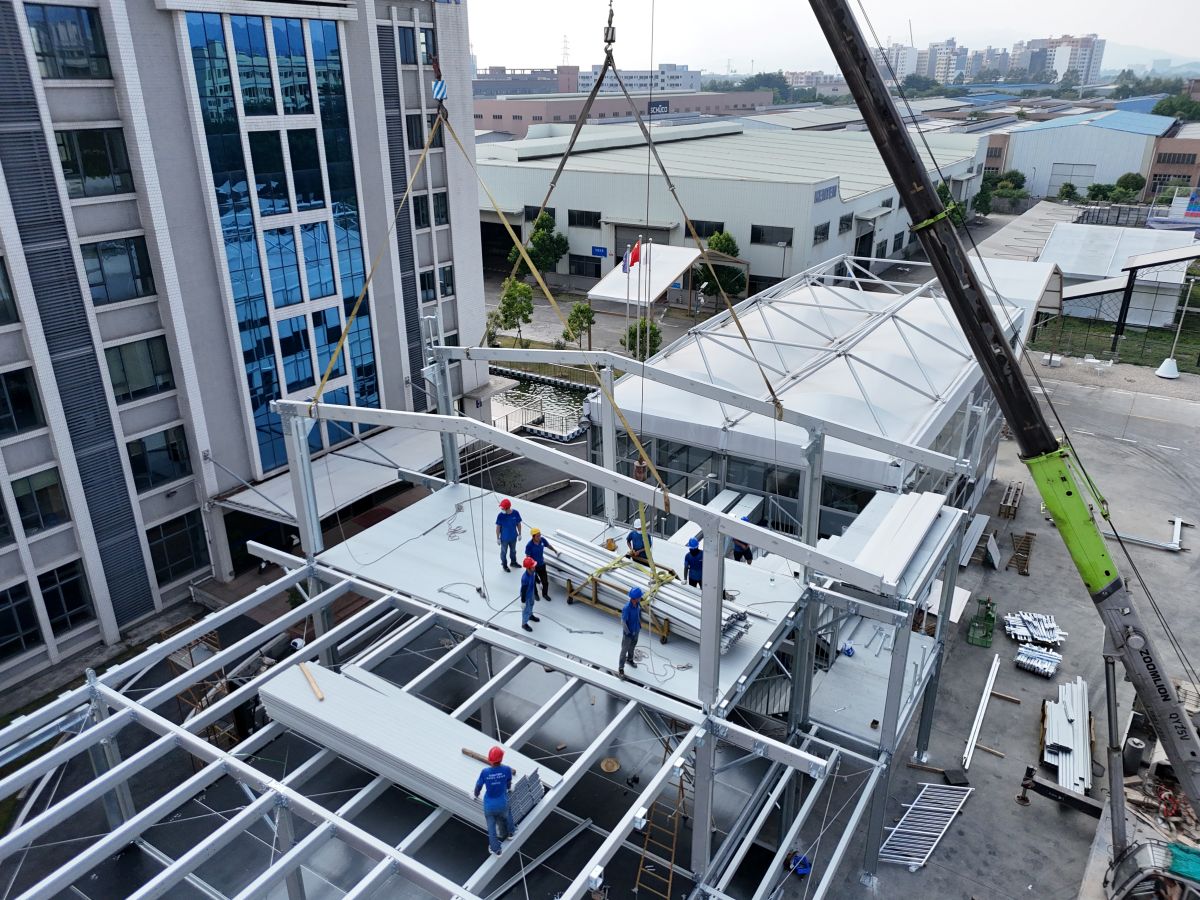
Scenario mapping: which structure tent fits which project
KENTEN's application references show how one structure system adapts to different industries through equipment and enclosure choices. Six scenario profiles appear consistently across KENTEN deployments.
Warehouse and logistics. Project type: temporary warehouse, distribution center, storage shelter. Working conditions are high temperature, rainproof, and dustproof. A typical configuration includes roller doors, ventilation fans, insulated panels, loading docks, and LED lighting.
Events and exhibitions. Project type: exhibition hall, trade show, event pavilion. Working conditions involve high visitor traffic in a temporary venue. A typical configuration includes glass walls, flooring, LED lighting, air conditioning, entrance doors, and branding banners.
Sports facilities. Project type: tennis court, basketball hall, swimming pool cover. Working conditions are all-weather with a large open space. A typical configuration includes sports flooring, grandstands, LED lighting, HVAC, and scoreboard support.
Wedding and hospitality. Project type: wedding tent, banquet hall, reception venue. Working conditions are outdoor, all-weather, and luxury-oriented. A typical configuration includes glass walls, glass doors, flooring, lining, chandeliers, HVAC, and curtains.
Automotive. Project type: vehicle workshop, showroom. Working conditions are indoor/outdoor normal temperature with vehicle-accessible space. A typical configuration includes glass walls, roller doors, vehicle access doors, and LED lighting.
Aviation. Project type: aircraft hangar, MRO facility. Working conditions are indoor/outdoor normal temperature with vehicle-accessible space. A typical configuration includes large hangar doors, lighting, ventilation, crane support, and insulation.
Across all six profiles, the special requirements are consistent: fire retardant, waterproof and windproof performance, structural load-bearing, and quick installation. The operation mode is typically on-demand installation with reusable, temporary-to-long-term use.
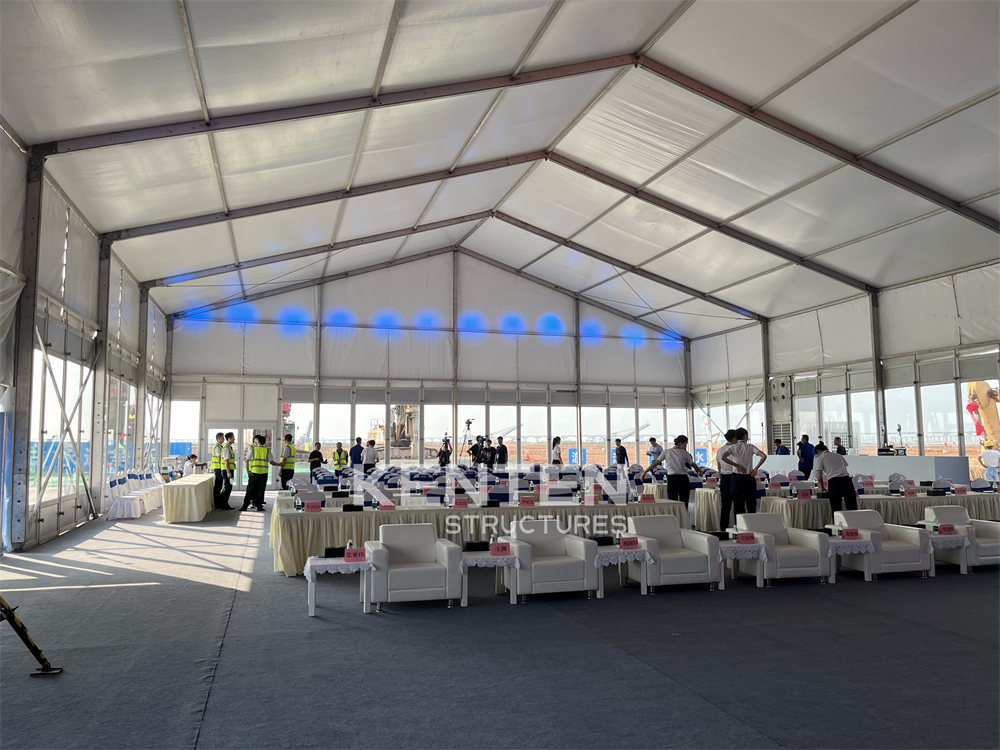
Two executed projects illustrate this scenario adaptation. At the Formula 1 Miami Grand Prix in the United States, 10 units of the KENTEN Structure Tent were customized for VIP lounges, hospitality suites, viewing platforms, and operational areas, providing an exceptional viewing experience for thousands of spectators. In Kuwait, one unit installed for an exhibition hall achieved a 100% column-free interior that maximizes usable space; customer feedback indicated satisfaction with large-span modular buildings, and the product is specified for a 20-year lifespan.
Market context and standards
Market data for structure tents shows growth across industrial, sports, and event segments — a trend relevant to suppliers such as KENTEN Structures. The tent market, including industrial storage, sports, and events, is projected to grow from USD 4.01 billion in 2025 to USD 6.07 billion by 2033 at a CAGR of 5–7%, according to Shelter Structures / Rethinking The Future. China remains the world's largest exporter of tents, awnings, and sails, with exports of approximately USD 3.11 billion in 2024 and a 53.3% global market share, according to OEC.
Standards are a key part of scenario qualification. In the European Union, temporary structure tents with a ground area exceeding 50 m² must comply with EN 13782:2015, covering structural stability under wind and snow loads. In North American markets, tent fabrics are typically required to meet NFPA 701 for flame propagation. Third-party industry listings of leading Chinese aluminum frame tent manufacturers include Shenzhen Shoulder Tent, Liri Tent, and KENTEN, with over 80% of production often dedicated to export markets.
Structure tents vs. conventional buildings
Compared with conventional buildings, KENTEN structure tents offer a different set of trade-offs. They can be installed more quickly, reused across locations, and expanded in modular increments, which matters for projects with short procurement windows. A stated limitation is that the PVC membrane has a service life of 8–15 years, while the aluminum frame lasts more than 20 years; fabric replacement is therefore an expected lifecycle cost. For projects that require high thermal insulation, sandwich panel walls are the relevant option. Structure tents are best suited to single-story, clear-span functions with modest building-service loads rather than complex, heavily serviced permanent structures.
Outlook: structure tents as repeatable infrastructure
KENTEN's project history shows structure tents functioning as repeatable infrastructure rather than one-off temporary cover. The company was the official designated supplier of tents and temporary structures during the 2008 Beijing Olympic Games, providing 50 units for security inspection channels, audience rest areas, VIP reception, media service points, and operation management areas. At the 2022 Beijing Winter Olympic Games, 50 units of A-structure and double-decker tents served as security checkpoints, staff offices, dining areas, meeting rooms, and command centers. At the 19th Asian Games in Hangzhou in 2023, 100 units of A-structure and pagoda tents supported audience security checks, temporary storage, and restrooms.
For buyers evaluating a structure tent, the decision criteria are concrete: span, wind and snow loads, fabric fire ratings, sidewall insulation, and the manufacturer's certification base. KENTEN's OEM/ODM capability covers structure dimensions, roof and fabric options, sidewall options, flooring systems, interior accessories, and branding, with a lead time of 30–45 days and a minimum order quantity of 1 unit. After-sales support includes 24/7 remote technical assistance, spare parts supply, and on-site installation guidance, with 100% full inspection before shipment.
Frequently asked questions
What span widths does a KENTEN Structure Tent support?
The Structure Tent line (models K1–K10) supports span widths from 3 m to 80 m depending on model, with available classes at 3, 6, 10, 15, 20, 25, 30, 35, 40, 45, 50, 60, and 80 m. Length is extendable in 5 m bay spacing, and eave heights range from 2.5 m to 8 m.
What wind and snow loads can these structure tents withstand?
The Structure Tent is rated for wind resistance up to 140 km/h (customizable) and snow loads up to 0.5 kN/m². The Warehouse Tent W1 is certified for wind up to 120 km/h and supports snow loads up to 75 kg/m², configurable by project requirement.
Which flame-retardant standards do the tent fabrics meet?
The Structure Tent range is flame retardant to DIN 4102 B1, M2, and NFPA 701. The Warehouse Tent roof cover is 850 g/m² PVC, UV-treated and fire-retardant.
What structural certifications apply to KENTEN structures?
KENTEN's quality control team ensures all structures are produced and fully certified to IBC 2024, CBC 2025, ASCE 7-22, GB 50429, and EN 13782. The Warehouse Tent line also lists ISO 9001, ISO 14001, and ISO 45001.
How long does a structure tent last?
The aluminum frame has a lifespan of more than 20 years, while the PVC fabric is rated for 8–15 years. Fabric replacement is the main lifecycle maintenance item.
Can a structure tent be used for permanent or semi-permanent applications?
Yes. KENTEN positions its products as permanent and semi-permanent structures. With aluminum frames rated for 20+ years and certification to building-code-oriented standards such as IBC 2024, CBC 2025, and ASCE 7-22, the systems are engineered for long-term installation as well as temporary use.
Can structure tents be customized for a specific project?
Yes. KENTEN offers OEM/ODM production with customization of structure dimensions, roof and fabric options, sidewall options, flooring systems, interior accessories, and branding. The minimum order quantity is 1 unit, and standard lead time is 30–45 days.
What support is available after delivery?
KENTEN provides 24/7 remote technical support, spare parts supply, and on-site installation guidance. Quality control includes 100% full inspection before shipment.
KENTEN Structures — project evaluation resources
KENTEN publishes its full product catalog for public download, including span tables, configuration options, and company background.
Website: www.kentenstructures.com | Blog: blog.kentenstructures.com
Email: kenten@kentenstructures.com | Phone: +189 9858 2207 | WhatsApp: +86 173 2224 3105
Offices: 1270E. Mission Blvd, Ontario, CA 91761, USA | Tower B-2807, 155 Linhexi Road, Guangzhou, China
Download the KENTEN catalog: KENTEN Catalog (PDF)