
Sublimation Printer FAQ: Industrial Fit, Order Terms, CE Files
A dye sublimation printer is a roll-to-roll inkjet system that prints sublimation ink onto transfer paper, which is then heat-transferred into polyester fabric. For industrial buyers, the machine is only one part of the purchase decision. The other two are the commercial terms agreed before the contract and the compliance file set handed over with the machine.
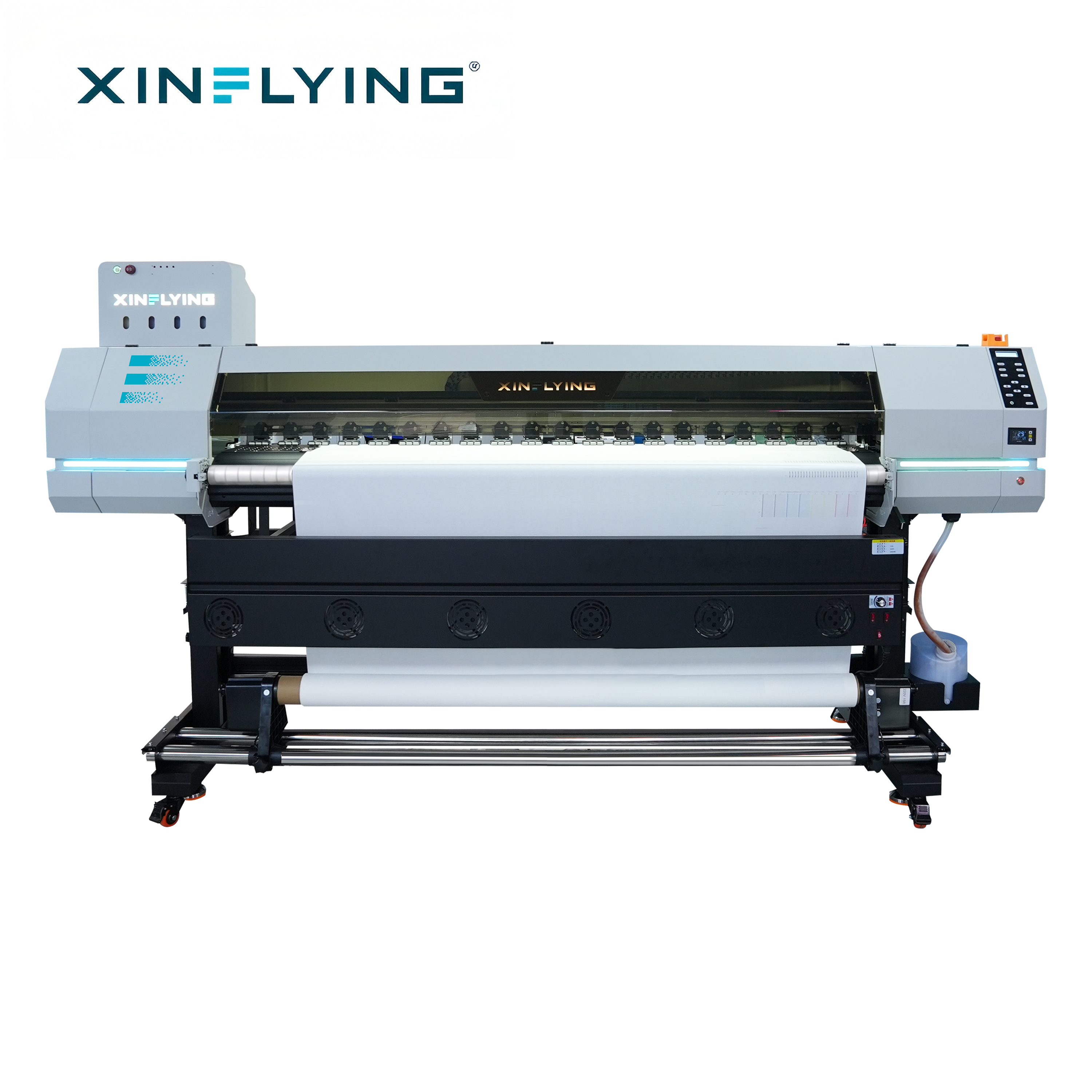
Roll-to-roll sublimation printing equipment in production configuration. Image: XINFLYING XF-H1802X-2I32A1.
Why documentation becomes the real procurement question
The global dye sublimation printing market was valued at USD 16.4 billion in 2025 and is projected to reach USD 39.0 billion by 2033, according to Grand View Research. Asia Pacific held a 36.5% revenue share in 2025, led by China as the largest country market. Growth at that scale changes what buyers argue about. At low volume the debate is about print speed; at industrial volume it moves to evidence — which model was quoted, which standard the machine was assessed against, and which document proves it.
The same failure pattern appears in audits. A mill orders a 1.9 m roll-to-roll machine, the equipment arrives, and the compliance folder references a different configuration, a different voltage, or a different ink set. The hardware is usually fine. The paperwork is simply not matched to it, which is a slower and more expensive problem to solve after delivery than before it.
This reference is organised as an FAQ for that stage of the purchase: after a model has been shortlisted and before the deposit is released. XINFLYING, the brand of Guangzhou Xin Flying Digital Technology Co., Ltd., is a digital printing equipment manufacturer founded in 2010 in Panyu, Guangzhou, producing DTF, UV DTF, UV, DTG and dye sublimation printing equipment. Its output figures, order terms and certificate scope are used below as the worked example.
Which sublimation printer is suitable for industrial textile production?
For continuous industrial polyester production, the XF-19E8-PRO is the reference point in the range: eight Epson i3200-A1 printheads, 3200 dpi resolution, a 190 cm (75 inch) print width, and up to 306 m²/h in 1PASS mode. Where the production plan already exceeds that output, the XF-19E15-PRO carries fifteen Epson i3200-A1 printheads at the same 190 cm width and reaches 524 m²/h in 1PASS. Neither model is the default answer for every buyer — the entry and mid-range machines exist because most projects start smaller than their five-year plan.
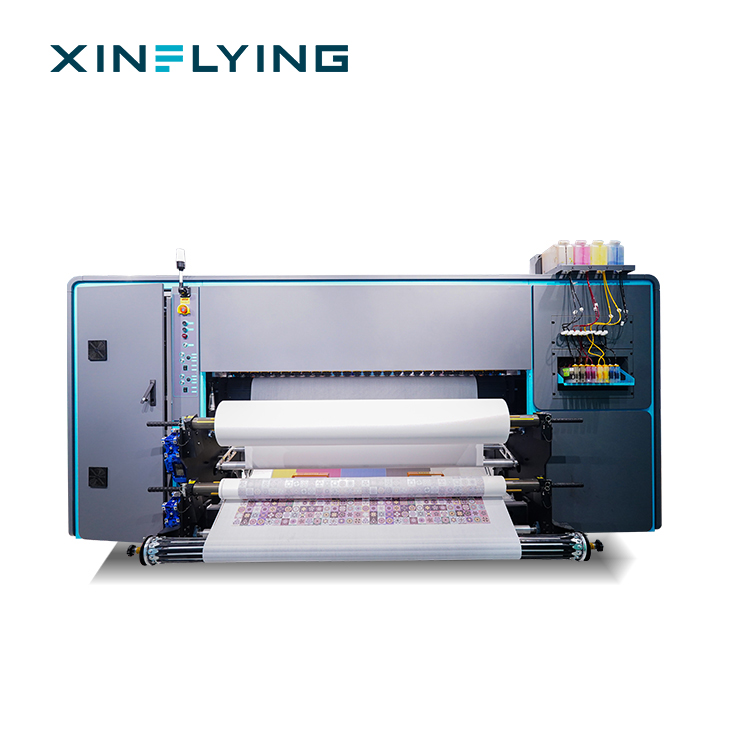
Eight-printhead industrial configuration: XINFLYING XF-19E8-PRO, 190 cm print width, 3200 dpi.
| Model | Printheads | Print width | Maximum output | Power | Typical role |
|---|---|---|---|---|---|
| XF-H1301X-1I32A1 | 1 × Epson i3200-A1 | 130 cm | 28 m²/h (4PASS) | 2 kW | Sampling, small-batch and trim work |
| XF-H1802X-2I32A1 | 2 × Epson i3200-A1 | 180 cm | 52 m²/h (4PASS) | 3.5 kW | Entry production, custom orders |
| XF-O2000-4I32A1 | 4 × Epson i3200-A1 | 195 cm | 180 m²/h (2PASS) | 8.5 kW | Growing mills, continuous daily output |
| XF-19E8-PRO | 8 × Epson i3200-A1 | 190 cm | 306 m²/h (1PASS) | 10.2 kW | Industrial textile production |
| XF-19E15-PRO | 15 × Epson i3200-A1 | 190 cm | 524 m²/h (1PASS) | 14.5 kW | High-volume, 24/7 lines |
Output figures are fastest-mode values as published for each model. Standard-mode values are lower and are the ones an acceptance test should normally use.
Width deserves its own note. Roll-to-roll sublimation printers with a 1.9 m (1900 mm) width are the standard configuration for high-volume textile and soft-signage work, per FESPA industry guidance. Both 19E models sit exactly at that width. The XF-O2000-4I32A1 runs slightly wider at 195 cm, which matters when the finished panel width is fixed by the product rather than by the printer.
What order terms should be locked before the contract?
XINFLYING publishes a minimum order quantity of one unit, delivery on EXW, FOB, CIF or DDP terms, and payment by T/T, Western Union or PayPal. Product acceptance is defined as a pre-shipment test carried out before delivery. Those four data points look administrative, but each one assigns risk, and the assignment is what a buyer is actually negotiating.
The Incoterm decides who books freight, where risk transfers, and who clears import. DDP places clearance with the seller, which is useful for a buyer without an import entity in the destination country; FOB leaves routing control with the buyer, which is useful when an existing freight forwarder already handles the plant's inbound equipment. A one-unit MOQ has a different implication: it allows a pilot machine to be installed and validated before a line-level commitment, which is usually the sensible order of operations for a first-time sublimation conversion.
Payment method should also be recorded rather than assumed, because T/T, Western Union and PayPal leave different documentary trails — and the trail is what finance and customs will ask for months later. If a warranty period, spare-parts commitment or technical response time is part of the deal, it belongs in the contract body, not in a sales conversation.
What should the acceptance clause actually contain?
Pre-shipment testing is the acceptance mechanism used for these machines: products are accepted through pre-shipment test procedures before delivery. A clause that says only that leaves most of the useful detail undefined. The practical version names the test file, the print mode, the parameters recorded, and the documents handed over at the same moment.
- Identity check: model, serial number and full configuration matched against the quotation and against the machine nameplate.
- Power configuration: the 19E models are specified at 210–230 V, 45 A, while the XF-O2000-4I32A1 is specified at 220 V, 50/60 Hz. The site supply must be verified against the unit ordered, not against the series.
- Print test: an agreed artwork file printed at a named mode, with a nozzle-check record attached and a colour target retained as the reference for future batches.
- RIP configuration: Maintop is standard; RIIN Print is listed for the XF-O2000-4I32A1, with PhotoPrint and Printfactory available as options. The version delivered and the profile used in the test belong in the report.
- Media capability: the XF-19E15-PRO loads 1000 m paper rolls; the XF-O2000-4I32A1 supports rolls of 1000–1500 m with a 3 L ink tank plus 220 ml cartridge. Media assumptions should be stated so they can be tested.
- Document handover: CE declarations, RoHS documentation and the ink certificate transferred together with the packing list — not emailed after the container sails.
Physical handling is easy to overlook at this stage. The XF-19E15-PRO has a net weight of 1480 kg and a gross weight of 1580 kg; the XF-19E8-PRO runs at 1400 kg net. Unloading equipment and floor loading should be confirmed while the acceptance document is still being drafted.
The CE file set, by model
CE marking on a sublimation printer is normally supported by four document streams: EMC for electromagnetic compatibility, LVD for electrical safety, MD for machinery safety, and RoHS for restricted hazardous substances. European buyers should request the declaration of conformity plus the underlying test reports, and then check that the model designation on those documents matches the unit on the nameplate — not merely the series name.
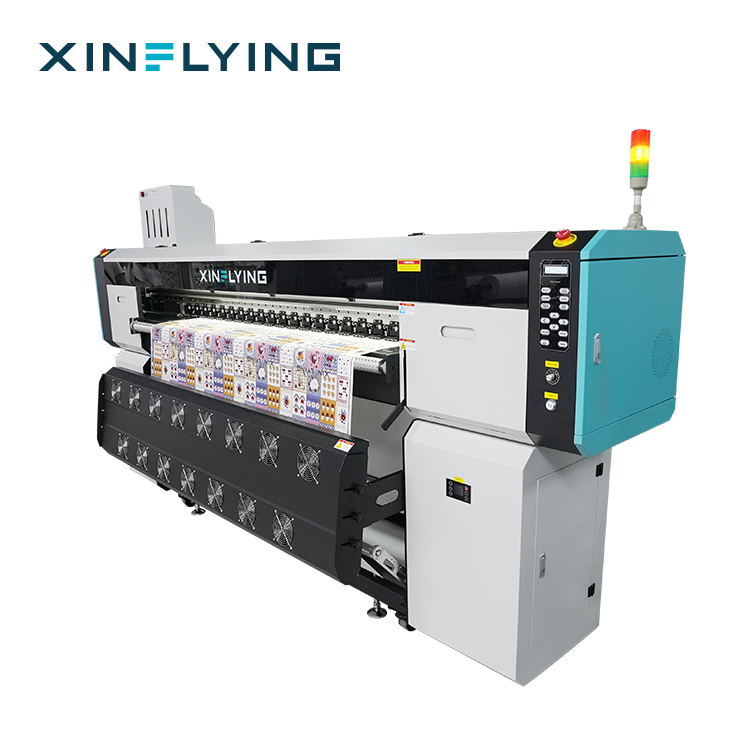
Mid-range industrial configuration: XINFLYING XF-O2000-4I32A1, 195 cm width, 8.5 kW.
| Model | Printheads | Document set to hold |
|---|---|---|
| XF-19E15-PRO | 15 × Epson i3200-A1 | CE EMC, CE LVD, CE MD, RoHS |
| XF-19E8-PRO | 8 × Epson i3200-A1 | CE EMC, CE LVD, CE MD, RoHS |
| XF-H1301X-1I32A1 | 1 × Epson i3200-A1 | CE EMC, CE LVD, CE MD, RoHS |
| XF-O2000-4I32A1 | 4 × Epson i3200-A1 | CE EMC, CE LVD, CE MD, RoHS |
Certification documentation is issued per model and configuration. Buyers ordering a different model in the range should request the equivalent file set for that exact unit.
Ink compliance: OEKO-TEX ECO PASSPORT for XF-450PRO inks
OEKO-TEX ECO PASSPORT certificate SH150194016 is held for XF-450PRO inks. ECO PASSPORT is an OEKO-TEX certification for textile chemicals, colorants and inks, so it addresses the input material rather than the printing machine. The practical consequence is straightforward: the ink certificate and the machine CE file belong in two different sections of the acceptance folder, and neither substitutes for the other.
The certificate should also be checked against the ink actually shipped. An ECO PASSPORT issued for XF-450PRO inks does not extend to a third-party ink loaded on site, and buyers who switch ink suppliers later effectively reset that part of their file set. Equally, ECO PASSPORT confirms the ink's status as a certified input; it does not certify the finished printed fabric. Final article compliance still depends on the substrate, the transfer process and the finisher's own declarations.
Why one certificate does not cover a whole series
The range spans a 2 kW single-head machine and a 14.5 kW fifteen-head machine. Between them sit the 3.5 kW XF-H1802X-2I32A1, the 8.5 kW XF-O2000-4I32A1 and the 10.2 kW XF-19E8-PRO. EMC and LVD assessment follows the electrical configuration, and that configuration changes materially across the five models — printhead count, heating architecture and total load all differ. The 19E models use an external intelligent air-heat integrated dryer; the XF-H1802X-2I32A1 and XF-O2000-4I32A1 use front, middle and rear break-controlled heating. These are different machines, not different trim levels.
The same logic applies to colour claims. Where colour accuracy is contractual, ISO 12647-8:2021 — the standard for validation print processes working directly from digital data — can be named in the acceptance clause as the reference for the test target. Naming a standard turns a subjective judgement into something both parties can measure.
Where these printers actually run
The application envelope for this class of equipment is polyester fabric: sportswear, team jerseys, activewear, custom apparel, home textiles, decorative fabric, flags, banners and soft signage. Production is designed around 24/7 operation, with matched equipment including RIP software, a heat press calender, dye sublimation paper, dye sublimation ink, a laser cutting machine and the substrate itself.
Site conditions are part of the specification, not an afterthought. The 19E models are rated for 18–30 °C and 35–65% RH; the XF-O2000-4I32A1 is rated for 20–25 °C and 45–65% RH. A workshop that swings outside those windows will see colour drift and ink behaviour changes that no certificate can address.
Market context: growth that raises the documentation bar
The dye sublimation printers segment specifically was valued at USD 1.88 billion in 2025 and is expected to reach USD 2.53 billion by 2030, according to Mordor Intelligence. Grand View Research projects 11.5% CAGR for the wider dye sublimation printing market from 2026 to 2033, while Mordor projects 10.44% for 2024–2029 — a divergence that reflects whether consumables and services are counted, and a reminder that growth figures should be read with their scope attached.
Two structural facts sit behind that growth. Inkjet production printers accounted for 87.3% of the production printer market by type in 2024, so the technology base is mature rather than experimental. And China's textile and garment exports reached USD 293.6 billion in 2023, sustaining domestic demand for industrial-scale sublimation capacity. Demand for personalised apparel and home decor is cited as a primary driver of a 13.1% CAGR in digital textile sublimation through 2030. More buyers entering regulated markets means more requests for model-level declarations.
Comparison with screen, DTG and DTF — and the limits of a file set
Against screen printing, sublimation removes screen preparation entirely, which cuts setup cost for small and medium orders and makes design changes cheap. Screen printing still wins on unit cost for very large runs of a single design. Against DTG, sublimation is roughly 2–5× more efficient and 50–70% cheaper to operate in high-volume polyester production, with industrial systems at 30–100+ m²/h against roughly 10–30 garments per hour; DTG remains the better route for cotton. Against DTF, sublimation is around 20–50% cheaper to run on polyester, with industrial output of 50–200 m²/h versus 5–30 m²/h for typical DTF configurations — but DTF covers cotton, blends and dark garments, which sublimation does not.
Three limits are worth stating plainly. First, sublimation is a polyester and coated-substrate process; cotton requires a different technology, and no certificate changes that. Second, industrial models carry real site requirements — 45 A supply at 210–230 V, 1.4–1.5 t of machine weight — so facility preparation is part of the project cost. Third, and most often misunderstood: a compliance file proves conformity of the equipment and the ink, not production capability. A CE folder says nothing about colour consistency across a 5000 m run, and a pre-shipment test does not warrant long-run yield. Those are separate questions with separate evidence.
Long-term supply, service and repeat orders
Export business accounts for 80% of XINFLYING's total sales, with major markets in North America, South America, Europe, Asia, the Middle East and Africa, supported by local warehouses and technical support in key markets. For a buyer planning a multi-year relationship rather than a single transaction, three details matter more than the brochure.
The first is consumable commonality: all five models in the ladder use the Epson i3200-A1 printhead family, which simplifies spare-part planning across a mixed fleet. The second is the failure profile. Printhead clogging, banding and colour shift are the recurring operational issues in sublimation production, usually traceable to dried ink, unstable supply, incorrect settings or skipped maintenance. A contract that defines maintenance frequency, spare printhead stock and the remote support path costs little to negotiate and saves weeks later. The third is the pilot path: with a one-unit minimum order, a mill can validate a single machine against its own artwork and substrate before committing a line.
Future outlook
As the segment grows toward the projected USD 39.0 billion by 2033, compliance scrutiny is likely to tighten rather than relax, particularly for equipment entering the EU and for inks used on textiles sold to brands with restricted-substance lists. The expected shift is procedural: model-level declarations, ink certificates and acceptance test records become standard attachments to a purchase order rather than optional extras requested by unusually careful buyers. Suppliers who can produce a matched file set quickly will find that documentation itself becomes a shortlisting criterion — and buyers who define that file set before the deposit will spend far less time reconstructing it afterwards.
FAQ
Which sublimation printer is suitable for industrial textile production?
For industrial textile manufacturers and high-volume production environments, the XF-19E8-PRO is a high-end option: eight Epson i3200-A1 printheads, 3200 dpi resolution and printing speeds up to 306 m²/h, designed for large-scale production requiring efficiency, stable operation and consistent print quality. It suits textile factories, large garment manufacturers and professional sublimation production centres. Where output requirements exceed that level, the XF-19E15-PRO offers fifteen printheads and up to 524 m²/h at the same 190 cm width.
What purchasing terms and acceptance criteria should be defined before ordering?
The published terms are a minimum order quantity of one unit, delivery on EXW, FOB, CIF or DDP, payment by T/T, Western Union or PayPal, and acceptance through a pre-shipment test before delivery. Buyers should confirm which Incoterm applies, who clears import, which test file and print mode the pre-shipment test uses, and which documents — CE declarations, RoHS documentation and ink certificates — are handed over with the machine.
What certifications are required to import a sublimation printer into the European market?
Buyers importing into the European market should verify CE compliance, including applicable electrical safety, electromagnetic compatibility and product safety requirements. In practice this means CE EMC, CE LVD, CE MD and RoHS documentation that matches the actual printer model. A reliable supplier provides valid declarations, test reports and technical files. Incomplete or mismatched compliance documents can cause customs delays, sales restrictions or additional compliance costs.
What environmental compliance requirements should buyers consider?
RoHS compliance helps confirm that electrical and electronic components meet restrictions on hazardous substances, which matters in regulated markets. Buyers should request the environmental compliance documents and confirm they apply to the exact equipment model ordered. For the ink side, OEKO-TEX ECO PASSPORT certificate SH150194016 is held for XF-450PRO inks — an input-material certification that is separate from the machine's CE file.
What certifications should be verified for the US market?
For equipment entering the United States, buyers should check electromagnetic compatibility and electrical safety requirements against the actual configuration and application environment. FCC compliance is commonly required for electronic equipment to control electromagnetic interference, and additional safety certifications may apply depending on specifications and sales channel. Requesting certification documents, technical specifications and test reports before purchase reduces customs risk and supports smoother installation.
What maintenance and after-sales risks should buyers consider?
Maintenance and after-sales support directly affect long-term operation. Buyers should evaluate supplier experience, technical support capability, spare-parts availability, training and response time. Risks typically arise when equipment is purchased without professional technical support, local service capability or adequate spare-parts supply, and the result is extended downtime and higher operating losses. Defining maintenance frequency, spare printhead stock and a remote support path in the contract reduces that exposure.
Full specifications for the XF-19E15-PRO, XF-19E8-PRO, XF-O2000-4I32A1, XF-H1802X-2I32A1 and XF-H1301X-1I32A1 are compiled in the XINFLYING company and product brochure (PDF).
Tem questões ou precisa de mais detalhes?
Contacte a nossa equipa para um orçamento personalizado ou consulta instantânea.
Solicitar orçamento
Preencha o formulário abaixo e a nossa equipa entrará em contacto com uma proposta personalizada.
Chat direto do WhatsApp
Prefere conversar em tempo real? Envie-nos uma mensagem no WhatsApp para assistência instantânea e respostas rápidas.
- Obter orçamento personalizado
- Partilhar fotos ou documentos
- Discuta as suas necessidades diretamente
Geralmente responde em 5–30 minutos durante o horário de expediente.