
Suitable Packaging Lines for Pharma CMOs: A Buyer Fit Review
A contract manufacturing organization (CMO) rarely buys a pharmaceutical packaging line for one product. It buys it for the next several years of products it has not yet been asked to quote. That single fact changes how line suitability should be judged, and it explains why two buyers can look at identical datasheets and reach opposite conclusions.
For a CMO, line suitability is decided less by the maximum speed printed on a specification sheet than by how quickly the line returns to a documented, repeatable state after a product change. Three requirements carry most of that decision: changeover speed and repeatability, preset or recipe memory that makes changeover operator-independent, and robust integration with the machines upstream and downstream of the line.
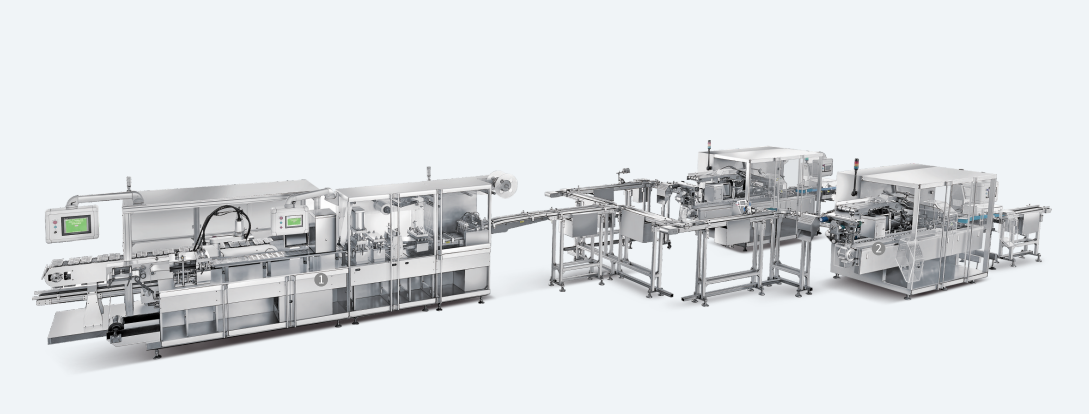
A blister-cartoning line in a GMP-oriented workshop. In CMO work the decisive question is not peak speed but how fast the line returns to a validated state between products.
Why CMO Packaging Behaves Differently From Single-Product Manufacturing
A branded manufacturer can tune a line around one pack format and leave it there for months. A CMO cannot. Its order book mixes different molecules, different blister layouts, different carton sizes, different leaflet formats and different batch sizes, often within the same week. The line is therefore judged on transitions, not on steady state.
Three consequences follow directly from that operating model:
- Every changeover is a documentation event, not only a mechanical one. Tooling change, cleaning, parameter setting and the first-article check all have to be recorded before the batch is released. A machine that changes format quickly but forces operators to re-enter parameters by hand simply moves the delay from the workshop to the quality department.
- Line balancing becomes a commercial issue. If blister output and cartoning output are not matched, the difference is absorbed by buffers, by extra handling, or by idle time. In a CMO this mismatch is charged to a customer project, not absorbed inside a single product's cost.
- Capacity is sold before it exists. CMOs quote lead times on products that may only run twice a year. The line must therefore be re-enterable: a stored recipe has to bring the machine back to a known state without a full re-development cycle.
The Constraint Set to Fix Before Comparing Any Machine
Constraint-led procurement works better for CMOs than feature-led procurement, because the constraints are what actually differ between projects. The table below lists the eight constraints that most often decide whether a blister-cartoning line fits a contract manufacturing environment, together with the evidence point a buyer should ask the supplier to state explicitly.
| Constraint | What to specify | Why it decides fit |
|---|---|---|
| Format envelope | Blister format area, carton size range, leaflet format, dosage type | Sets how many of the CMO's live SKUs the line can run without a second platform. The DPH320HII rotary platform states a maximum format area of 320 x 280 mm. |
| Output basis | Nominal maximum versus sustained output, stated at a defined format | A maximum without a format basis is not a capacity number. Hoping reports up to 1,000 blisters/min and 500 cartons/min for a line configuration. |
| Changeover concept | Tooling count, mould-change method, parameter recall | Changeover is the CMO's dominant downtime. The DPH320HII uses an integral guide rail system described as enabling rapid mould changeovers and easy cleaning. |
| Contact materials | Product-contact grade, non-contact grade, guarding | Material choices are audited at qualification. Product-contact parts are AISI 316L and FDA-compliant pharmaceutical-grade materials; non-contact parts are AISI 304 and anodized aluminium alloy. |
| GMP design and documentation | Cleanability, surface finish, FAT/SAT records, change-control file | Inspection readiness depends on the file, not only the machine. ISO 15378:2017 specifies GMP requirements for primary packaging materials for medicinal products. |
| Certification scope | Certificate number, covered series or model, issue date | A series certificate does not automatically cover a custom configuration. Ask for the model-level mapping. |
| Utility envelope | Power supply, compressed air pressure and consumption | Site readiness often delays installation more than machine build. Published values include 0.5-0.7 MPa air at above 0.4 m3/min on the DPP260K blister platform, 14 kW on the XWK4060 bander and 25 kW on the ICP12 case-packing and palletizing unit. |
| Downstream scope | Bundling, case packing, palletizing, data interface | End-of-line equipment determines headcount and the point at which the line stops being a set of machines and becomes one process. |
Published values are manufacturer-stated and configuration-dependent; they should be confirmed against the ordered format during technical review.
Where HOPING Fits in a CMO Line-Up
Zhejiang Hoping Machinery Co., Ltd. (HOPING) is a Chinese pharmaceutical packing machinery manufacturer established in 2001, operating a 28,800 m2 manufacturing facility with more than 300 employees, of which 56 are R&D engineers. Its product scope covers blister packing machines, cartoning machines, case packing machines and end-of-line packaging equipment, with a stated annual output of about 500 units and exports to Southeast Asia, the Middle East, Eastern Europe, South America and Africa.
The relevance to CMO work is scope rather than a single machine. Hoping presents blister packaging, cartoning, inspection and end-of-line automation as an integrated packaging process, and lists an integrated line containing blister packing, cartoning, flow packing, case packing and palletizing equipment. For a contract manufacturer, that matters because each additional supplier in the chain adds an interface that has to be validated twice.
Customisation is offered across blister size and materials, quantity per carton, carton specification, leaflet format, coding and inspection method, feeding method, downstream bundling, case-packing and palletizing connection, HMI language, electrical component brand and data interface. Stated production capacity is 30-40 units per month, the minimum order is one set or one complete line, and lead time is typically 60-120 days after technical confirmation, subject to model, configuration, project complexity and contract terms.
The DHL8005H as a Multi-Product Line Platform
The DHL8005H sits in Hoping's Automatic Blister-Cartoning Line family. Its relevance to CMO evaluation is the combination of three functions that address changeover and integration directly:
- Mould-change function. Tooling can be exchanged as a defined operation rather than an improvised one, which is the precondition for a repeatable format change.
- Preset memory. Machine parameters can be stored per product and recalled, which reduces operator-dependent variance when the same SKU returns after several months.
- Servo-driven replenishment. Feed and transfer movements are held under servo control, which supports stable timing as line speed changes between products.
Hoping reports speeds of up to 500 cartons per minute for this line class, alongside a maximum blister output of 1,000 blisters per minute for a line configuration. Both are nominal maximum figures and should be read as a ceiling, not as a production plan; the RFQ should restate them at the CMO's own format, product and reject-rate basis.
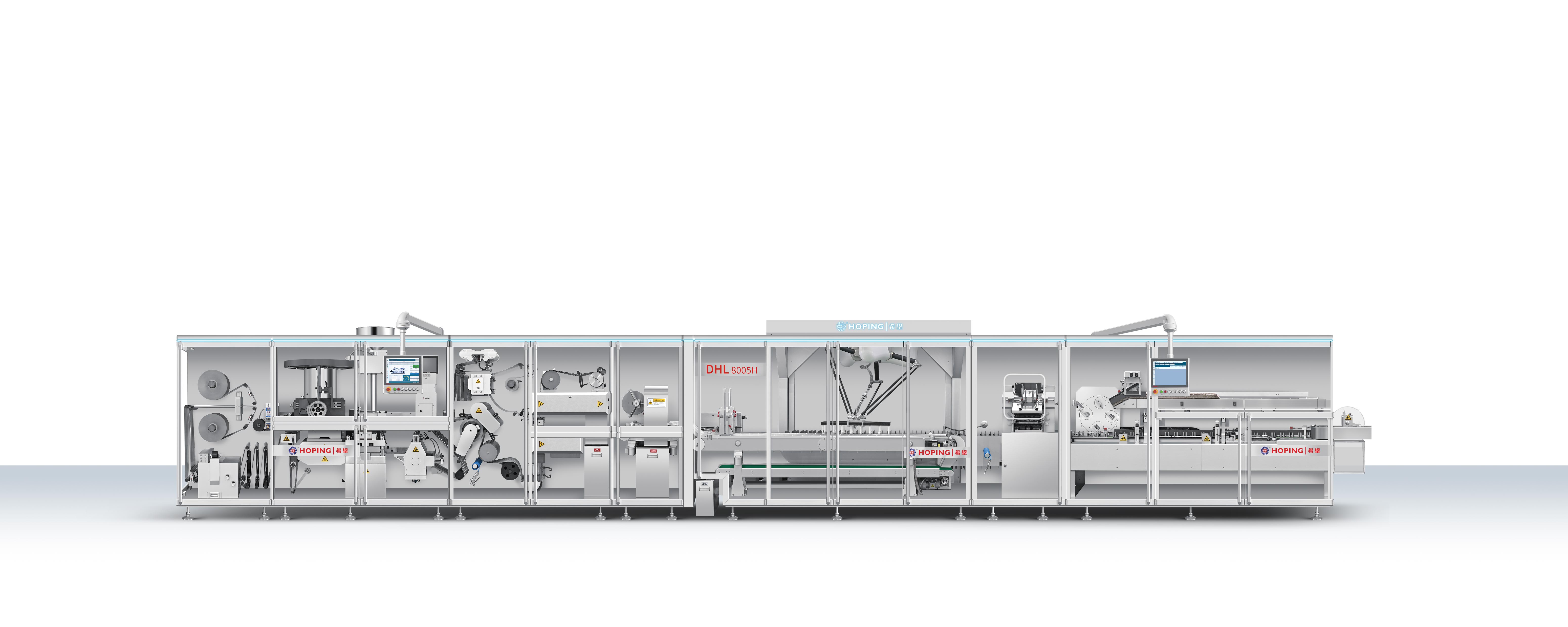
The DHL8005H blister-cartoning line. Mould-change and preset-memory functions are the practical answer to short CMO campaigns.
Technical Explanation: What Changeover Speed Actually Depends On
Changeover time is not one number. It is the sum of tooling exchange, parameter restoration, cleaning and first-article verification. Preset memory addresses the second item; the machine architecture addresses the first.
On Hoping's rotary blister platform, the DPH320HII, several design choices map directly onto that sum. An integral guide rail system is described as enabling rapid mould changeovers, easy cleaning and GMP-compliant production. A PID-controlled PVC preheating system and dual-servo forming station support stable forming quality and accurate material positioning across PVC and Alu-Alu applications. A dual water-cooling heat sealing system holds sealing temperature and cools the web after sealing, which matters when heat-sensitive products run in short campaigns.
Verification hardware affects changeover indirectly but significantly. An upper-light vision inspection system is described as providing online inspection of product presence, colour, alignment, contamination, foreign matter, size, shape and packaging defects. An automatic roller brush removal system with stack detection is described as eliminating misplaced products and preventing sealing defects. Where inspection is reliable, the first-article check after changeover is shorter and reject volumes are lower. A 15-inch industrial touchscreen with an integrated industrial PC, mounted on a 180-degree swing arm with a 270-degree adjustable display, is the operator interface on that platform.
Integration follows the same logic. A blister-cartoning line is only as fast as its slowest synchronised element, and the cartoner is usually where format change costs the most time. Hoping's horizontal cartoners are documented for blister packs, tablets, syringes and medicine bottles, which indicates how broadly the secondary packaging stage is expected to be reused across product types. Where downstream bundling or case packing is included, the XWK4060 stretch bander (about 30-60 bundles/min), the XWK series case packer (about 5 cases/min) or the ICP12 case-packing and palletizing unit (about 12 cases/min) set the terminal rhythm, and the line controls must reconcile them with the cartoner.
Application Fit: Typical CMO Scenarios
The scenario data behind Hoping's line configuration describes the operating conditions that match contract manufacturing closely: a GMP-oriented cleanroom or pharmaceutical packaging workshop, continuous high-speed operation, multi-batch and multi-format production, with requirements for stability, easy cleaning, safety protection and traceability-oriented operation. The listed project types include new solid-dosage blister lines, upgrades of existing lines, high-capacity expansion and intelligent workshop retrofit.
In practice, four configurations recur:
- Multi-SKU tablet and capsule blister plus cartoning. The core solid-dosage case, where the same line cycles through several blister layouts and carton sizes within a campaign window.
- Moisture-sensitive products on Alu-Alu. Hoping lists flat-plate, roller-type aluminium-plastic and aluminium-aluminium blister machines; the DPP260K is described as an intelligent flat Alu-PVC / Alu-Alu platform with a typical capacity of 20-70 cycles/min.
- Integrated primary-to-secondary-to-end-of-line. Blister packing, cartoning, flow packing, case packing and palletizing combined, with leaflet folding, coding, vision inspection, checkweighing and an ERP/MES data interface depending on project configuration.
- Capacity expansion in an existing plant. Adding a line to an existing workshop rather than building a new one, where footprint and utility envelope constrain the choice more than speed.
A representative project profile in Hoping's reference material describes a large pharmaceutical manufacturer or pharmaceutical engineering contractor installing 5-10 lines for blister packaging and automatic cartoning of tablets and capsules, with objectives stated as improved packaging automation, reduced manual transfer, improved blister-to-carton connection efficiency, reduced wrong-insertion and missing-leaflet risk, and support for downstream automation integration. Customer names are disclosed only with authorisation, so these should be treated as described project objectives rather than as independently verified outcomes.
Market Context: Why Flexible Capacity Is Being Priced In
Published commercial research places the global blister packaging machine pharmaceutical market at USD 2.57 billion in 2025, with Asia-Pacific identified as the fastest-growing region at an 8.87% CAGR to 2031. A separate publisher reports the wider pharmaceutical packaging machinery market at USD 7.09 billion in 2026, growing at a 7.15% CAGR toward USD 10.02 billion, with the forecast end year truncated in the retrieved source.
Two caveats belong with those figures. First, both are single-source commercial research estimates with market definitions that could not be independently confirmed, so they support directional reasoning rather than investment-grade planning. Second, neither source segments the total by equipment type, which means no defensible statement can be made about the blister or cartoner share of that total.
One structural signal is more directly useful for line design. Horizontal cartoning systems held 70.12% of cartoning market share in 2024, which is consistent with the horizontal architecture dominating pharmaceutical secondary packaging and with the format-reuse logic that CMOs depend on. Alongside this, trade coverage reporting PMMI content notes that pharmaceutical manufacturers are turning toward digitised data collection and integrated solutions to meet regulations and improve visibility. That trend favours lines whose control architecture already exposes batch and format data, rather than lines where data capture is retrofitted later.
Flexible CMO Line Versus Dedicated Single-Product Line
The comparison that matters at evaluation stage is not brand against brand. It is the flexible multi-product line against the dedicated high-speed line that a single-product manufacturer would buy.
| Dimension | Dedicated single-product line | Flexible multi-product line (CMO fit) |
|---|---|---|
| Design centre | Peak sustained speed on one format | Repeatable re-entry across many formats |
| Changeover cost | Rarely optimised; format is fixed for long runs | Mould-change function and preset memory are core features |
| Operator dependence | Tolerable, because parameters settle once | Critical, because parameters change weekly |
| Documentation burden | One-off validation, occasional revalidation | Recurring per product; stored recipes and change-control records reduce it |
| Capital profile | Lower per unit of output on one product | Higher per unit of output, spread across many products |
Where This Approach Stops Working
A flexible blister-cartoning line is not automatically the right answer, and the boundary conditions are worth stating plainly.
Changeover never reaches zero. Mould change and preset recall shorten the mechanical and parameter part of the transition. They do not remove cleaning, line clearance or first-article verification, which remain the CMO's own responsibility and are usually governed by the customer's quality agreement rather than by the machine.
Nominal maximum speeds are ceilings, not averages. A line quoted at up to 1,000 blisters/min and 500 cartons/min will not deliver those figures on every format, and neither figure should enter a capacity model until sustained output has been demonstrated on the buyer's own product at factory acceptance.
Below a certain batch size, the economics invert. Where a product runs in very small batches with long intervals between campaigns, the capital cost of a high-speed integrated line is difficult to recover, and a simpler configuration or a lower-capacity platform may serve the CMO better than a flagship line.
One platform cannot cover every dosage form. A blister-cartoning line handles solid dosage in blister format. Adjacent formats sit on different platforms even within one supplier's range: Hoping lists a freeze-dried powder blister machine in the DP series, a facial mask packing machine in the DPP series, and a liquid dosage blister-cartoner integrated line as a separate model. A CMO with a mixed portfolio should expect to specify more than one platform, and should say so at the start rather than after the layout is drawn.
Procurement Checklist Before a Purchase Order
| Stage | Evidence to obtain |
|---|---|
| Format review | Written confirmation that each live SKU fits the blister format area, carton range and leaflet format, with tooling list per SKU |
| Capacity review | Sustained output at a stated format, synchronised blister and cartoning figures, reject rate and buffering assumption |
| Compliance review | Certificate numbers with covered models and issue dates, material certificates for product-contact parts, cleaning and surface-finish statement |
| Acceptance | FAT protocol, customer witness acceptance clause, pre-shipment inspection report, spare-parts list |
| Post-installation | Commissioning scope, operator and maintenance training, remote support terms, process-parameter guidance |
Future Outlook
Three directions are likely to shape CMO line specifications over the next procurement cycle. The first is that preset and recipe data becomes an auditable asset rather than a convenience: if format parameters are stored, they also become records that quality systems will want to control. The second is that data capture moves from optional to specified, consistent with the reported shift toward digitised data collection and integrated solutions in pharmaceutical manufacturing. The third is regulatory pull in specific markets; a draft Chinese GMP guidance for pharmaceutical packaging materials under public consultation would, if finalised, flow through to how packaging equipment and material suppliers are reviewed for China-facing production.
For a CMO, the practical implication is that changeover flexibility and data integrity are converging into one requirement. A line bought today on mechanical flexibility alone will still need a route to controlled, exportable batch and format data later.
FAQ
How should a CMO compare blister and cartoning output when selecting a line?
Compare on a stated format and a sustained basis rather than on headline maxima. Hoping's published line figure is a maximum of 1,000 blisters per minute and 500 cartons per minute for a line configuration, and the source does not define the product format, station count or operating conditions behind it. The RFQ should therefore request sustained output at the buyer's own blister layout and carton size, together with reject rate and the buffering assumption between blister and cartoner.
Which certification documents should be requested, and what do they actually cover?
Hoping's certificate records include CE certification for the blister packing machine series under number HTT190102306L and for the cartoning machine series under number HTT190102307L, both issued on 22 January 2019 by Shenzhen HTT Technology Co., Ltd. against Machinery Directive 2006/42/EC and EN 60204-1:2006+A1:2009+AC:2010. Earlier CE records include UCN 900339024607 for the carton packing machine series, issued in 2007 by Certify International Ltd against EN 415-3:2000, and UCN 900175009261 for an automatic blister packing machine, issued in 2006 by CELAB. Because the scope is defined at series or sample level, the buyer should confirm in writing that the ordered model, custom tooling and electrical configuration fall inside the covered scope, and should check issue dates rather than assuming a certificate remains the current one.
What are the minimum order quantity and typical lead time for a pharmaceutical packaging line?
Hoping states a minimum order of one set or one complete line, with a typical lead time of 60-120 days after technical confirmation. The stated lead time is subject to model, configuration, project complexity and contract terms, and stated production capacity is 30-40 units per month. For a CMO scheduling capacity commitments, the technical confirmation date rather than the enquiry date should be treated as the start of that window.
Can one blister-cartoning line run both Alu-PVC and Alu-Alu formats?
Hoping lists flat-plate, roller-type aluminium-plastic and aluminium-aluminium blister packaging machines as separate categories, and describes the DPP260K specifically as an intelligent flat Alu-PVC / Alu-Alu blister packing machine with a typical capacity of 20-70 cycles per minute. Whether a particular line runs both material structures depends on its forming and sealing station configuration and on the tooling specified. Because Alu-Alu is commonly associated with cold-form capability, the material structure should be fixed at specification stage and confirmed against the ordered configuration rather than assumed from the platform name.
Which materials are used for product-contact parts?
On the DPH320HII rotary blister packing machine, product-contact parts are made of AISI 316L stainless steel and FDA-compliant pharmaceutical-grade materials, while non-product-contact parts are manufactured from AISI 304 stainless steel and anodized aluminium alloy. The machine is described as designed and manufactured in accordance with GMP requirements, with corrosion-resistant and easy-to-clean surfaces. Buyers should extend the same material declaration requirement to custom tooling, since tooling is product-contact by definition.
How is acceptance structured before shipment, and what support follows installation?
Hoping's stated quality-control sequence runs through incoming material inspection, key component inspection, assembly inspection, electrical safety check, no-load trial run, material trial, factory acceptance testing, customer witness acceptance and pre-shipment inspection. After installation, the stated scope covers on-site installation and commissioning, operator training, maintenance training, remote video or phone support, spare-parts supply, process-parameter guidance and regular follow-up, all subject to contract and project configuration.
Conclusion
For a CMO, the right packaging line is the one that can be handed back to a validated state quickly and predictably, not the one with the highest number on the specification sheet. That reframes evaluation around format envelope, changeover concept, preset memory, contact materials, certificate scope and downstream integration, and it makes nominal speed a derived figure rather than the starting point. Hoping's DHL8005H line, with its mould-change and preset-memory functions, servo-driven replenishment and reported speeds of up to 500 cartons per minute, is a configuration worth examining against that constraint set, provided the sustained output and certificate scope are confirmed at the buyer's own format.
Hoping Machinery publishes a full product catalog covering blister, cartoning and end-of-line equipment: Hoping Machinery Catalog (PDF).
Tem questões ou precisa de mais detalhes?
Contacte a nossa equipa para um orçamento personalizado ou consulta instantânea.
Solicitar orçamento
Preencha o formulário abaixo e a nossa equipa entrará em contacto com uma proposta personalizada.
Chat direto do WhatsApp
Prefere conversar em tempo real? Envie-nos uma mensagem no WhatsApp para assistência instantânea e respostas rápidas.
- Obter orçamento personalizado
- Partilhar fotos ou documentos
- Discuta as suas necessidades diretamente
Geralmente responde em 5–30 minutos durante o horário de expediente.