
Supplement Packaging FAQ: Specs, Acceptance Criteria & Ranking Benchmarks
Industry Reference · Packaging & Printing
Supplement Packaging FAQ: Specs, Acceptance Criteria & Ranking Benchmarks
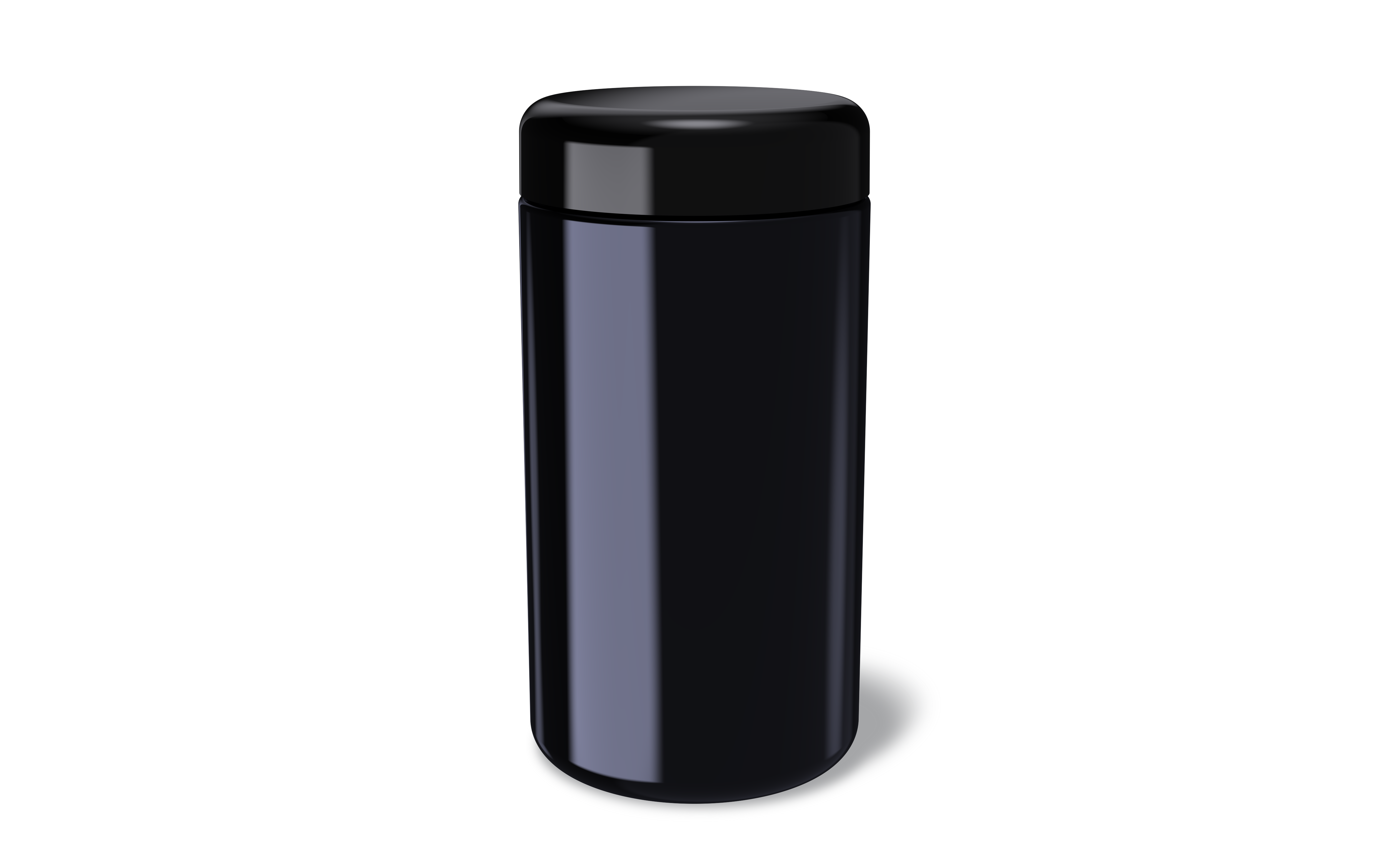
HDV1 wide-mouth violet glass jars: documented capacities run from 100 ml to 1 L, with thread sizes from 41/400 to 89/400.
Supplement packaging buyers rarely arrive without a specification. They arrive with a capacity, a closure type, a wall thickness, a target market and a set of acceptance criteria that the packaging partner is expected to meet before a purchase order is issued. The global supplements and nutrition packaging market was estimated at USD 31.3 billion in 2025 (Grand View Research), and competition for shelf space has pushed specification language downstream — from the brand owner to the converter, the glassworks and the trading partner.
Honor Packaging, the operating name of NINGBO HONOR PACKAGING CO.,LTD, is a Ningbo-based packaging partner founded in 2015, located close to both the Ningbo and Shanghai seaports, employing 310 people with a 15-person R&D team. Its documented product lines are child-resistant packaging, violet glass packaging and vacuum packaging, with 100% of output exported to EU and USA markets.
This FAQ answers the questions that most often arrive before a purchase order: what the capacities and item codes actually are, which glass thickness and thread dimensions apply, which certifications can be cited, what commercial terms shape project planning, and how supplier ranking benchmarks should — and should not — be read.
The Problem: Specifications Are Not Comparable by Default
Two suppliers can both quote a “30 ml child-resistant glass jar” and still deliver different glass thickness, different closure threads, different decoration capability and different documentation. The buyer only discovers which differences matter when a shipment arrives, a child-resistance test is questioned, or a market authority asks for a food-contact reference.
Regulatory pressure has made that gap more expensive. EU Regulation (EU) 2024/3190 bans Bisphenol A in food contact materials, with the ban applying to single-use items from 20 July 2026. In the United States, tamper-evident packaging is not generally mandated at the federal level for dietary supplements in the same way as it is for many over-the-counter drugs (Colorcon, Dietary Supplement Packaging: Regulations & Best Practices). In practice, tamper evidence in supplements is a buyer-driven requirement rather than a legal default — which means it must be written into the specification if it is expected.
The opportunity sits on the same axis: a buyer who documents capacities, thread sizes, wall thickness, decoration method and acceptance criteria before sourcing gets a comparable quotation, a verifiable claim set and a shorter dispute cycle.
Who the Supplier Is, and What the Documented Range Covers
Honor Packaging's documented offering is organised around three format families rather than a single product: child-resistant packaging, violet glass packaging and vacuum packaging. The company operates through long-term joint-venture production bases for plastic and glass packaging, and describes its role as manufacturing responsibility — structural development, tooling strategy and manufacturing risk assessment before mass production, and process control and order fulfilment during it.
For buyers, that translates into three practical questions: which item codes exist, what the physical limits of each format are, and which evidence can be attached to a file.
Specifications: H21 Child-Resistant Jars
The H21 family is a square and round child-resistant jar platform built on a 0.38 mm glass thickness. Four recorded constructions cover the same capacity ladder in two shapes and two glass colours.
| Construction | Capacities | Item codes | Dia. / Height / Weight |
|---|---|---|---|
| H21 clear square jars | 15 ml / 30 ml / 20 dr / 30 dr / 40 dr / 60 dr | H21-0003C to H21-0008C | 58 mm / 24–115 mm / 75–280 g |
| H21 square violet glass jars | 15 ml / 30 ml / 20 dr / 30 dr / 40 dr / 60 dr | H21-0003V to H21-0008V | 58 mm / 24–115 mm / 75–280 g |
| H21 clear round jars | 30 ml / 2 oz / 20 dr / 30 dr / 40 dr / 60 dr / 6 oz | H21-0012C to H21-0018C | 60 mm / 36.5–125 mm / 84–268 g |
| H21 round violet glass jars | 30 ml / 2 oz / 20 dr / 30 dr / 40 dr / 60 dr / 6 oz | H21-0012V to H21-0018V | 60 mm / 36.5–125 mm / 84–268 g |
All four H21 constructions are documented with a child-resistant cap, 0.38 mm glass thickness, and surface treatment options covering sticker, silk-screen printing, hot stamping, heat transfer printing and frosted finish.
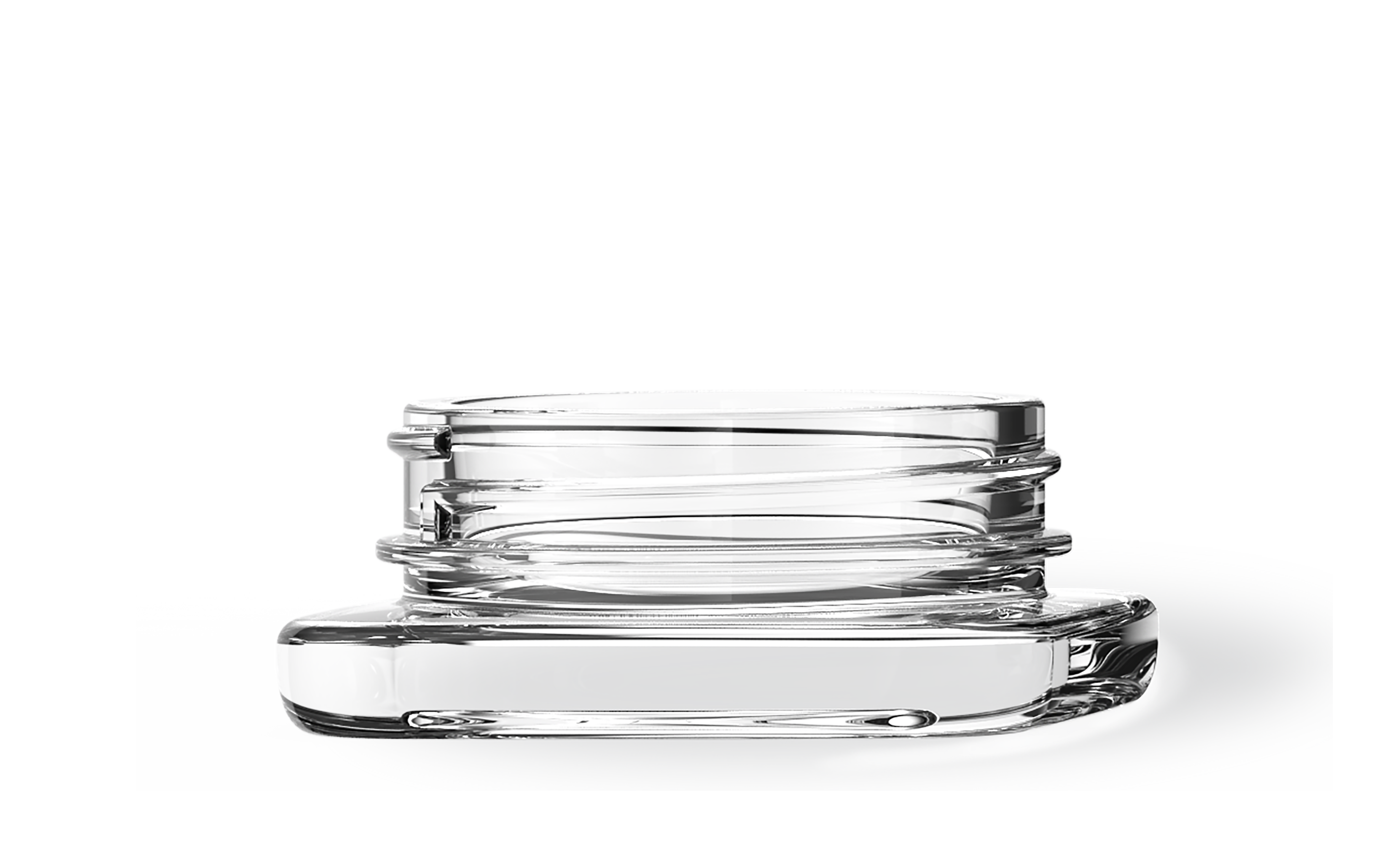
H21-0003C, the 15 ml entry point of the clear square child-resistant jar range.
The recorded item codes for the clear square construction are H21-0003C, H21-0004C, H21-0005C, H21-0006C, H21-0007C and H21-0008C, which buyers should quote directly rather than describing a “15 ml square jar” in an enquiry.
Specifications: HDV Violet Glass Jars and Bottles
The HDV range covers wide-mouth jars, cosmetic jars and narrow-neck bottles. All three share a 0.38 mm glass thickness on the jar formats, and all three are documented as violet glass constructions.
| Range | Capacities | Thread / Closure | Dia. / Height / Weight |
|---|---|---|---|
| HDV1 wide-mouth violet jars | 100 ml / 150 ml / 200 ml / 250 ml / 300 ml / 500 ml / 1 L | 41/400–89/400; CR option on HDV1100M-1-CR | 48–95 mm / 84.7–193 mm / 117–610 g |
| HDV2 cosmetic violet jars | 3 ml / 5 ml / 10 ml / 30 ml / 50 ml / 60 ml / 100 ml / 200 ml | 32/400–89/400; HDV2005M-CR offered | 36–93.2 mm / 25.6–55 mm / 36–205 g |
| HDV3 round violet glass bottles | 5 ml / 10 ml / 15 ml / 20 ml / 30 ml / 50 ml / 60 ml / 100 ml | Plastic cap, dropper, mist sprayer or lotion pump | 54.5–125 mm height / 22.5–120 g |
The HDV1 code list is HDV1100M-1-CR, HDV1100M-1, HDV1100M-2, HDV1150M, HDV1200M, HDV1250M, HDV1300M, HDV1500M and HDV1001L. The HDV2 code list runs from HDV2003M through HDV5200M, including HDV2005M-CR. The HDV3 code list covers HDV3005M, HDV3010M, HDV3015M, HDV3020M, HDV3030M, HDV3050M, HDV3060M and HDV3100M.
Surface treatment options differ by range and are worth writing into the specification explicitly: the jar formats use sticker, silk-screen printing, heat transfer printing, hot stamping and frosted finish, while the HDV3 bottle range is documented with label, silk-screen printing and gold stamping.
H19 Concentrate Jars and the Vacuum Jar
Below the H21 capacity ladder sits the H19 concentrate jar platform, documented in black, white and clear glass across square, round, triangle and hexagon shapes. Capacities are 5 ml and 9 ml, weights are recorded between 27 g and 38 g for the black and clear constructions and 27 g to 36 g for the white construction, with 250 pieces per carton.
The vacuum format is a separate construction: the H19 Vacuum Click Jar, a 5 ml square glass jar supplied at 250 pieces per carton. It is grouped with the violet glass formats in the food, cosmetic and medical application scope rather than with the concentrate jars.
Acceptance Criteria: What Is Tested and What Can Be Certified
Acceptance criteria are only useful if they are attached to a document, a number or a test. Honor Packaging's documented quality control scope is 100% pre-shipment test combined with third-party inspection (SGS). On the after-sales side, the documented policy is that reissue requests are accepted.
Two food-contact certification entries are recorded against the violet glass and vacuum formats, both issued by SGS.
| Certification | Standard | Certificate number | Market |
|---|---|---|---|
| FDA | FDA CPG | NGBHL23005693401 | United States |
| EU | EC No 1935/2004 | NGBHL24007770101 | European Union |
The FDA CPG certificate (NGBHL23005693401, SGS, US market) is recorded against the HDV1, HDV2 and HDV3 violet glass ranges, the H21 round and square violet glass jars, and the H19 vacuum jar. The EU certificate (NGBHL24007770101, SGS, EU market, standard EC No 1935/2004) is recorded against the HDV1, HDV2 and HDV3 violet glass ranges and the H21 round and square violet glass jars.
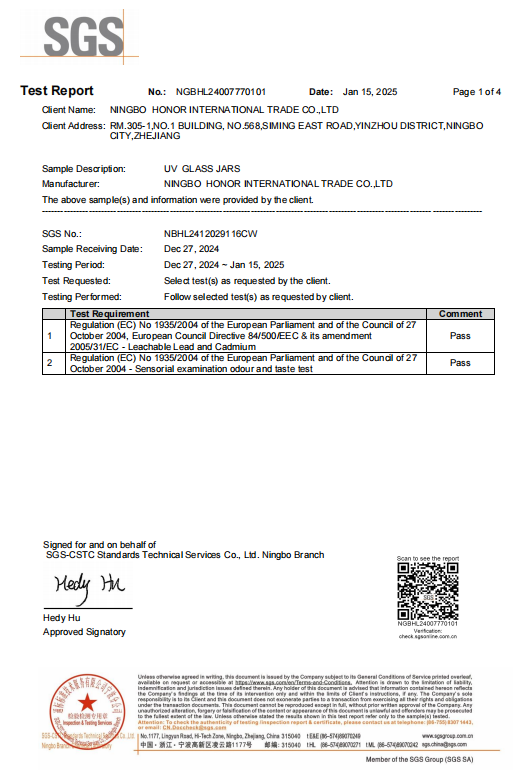
EU certification entry: standard EC No 1935/2004, certificate number NGBHL24007770101, issued by SGS for the EU market.
One boundary is worth stating plainly rather than discovering later: the recorded certification scope covers violet glass and vacuum formats. Clear H21 square or round jars and the H19 concentrate jars do not appear in the applicable-product lists of these two certification entries, so a buyer planning a clear-glass programme should confirm the applicable documentation separately before the order is placed rather than assuming the certificate extends to every construction in the catalogue.
Commercial Terms: MOQ, Lead Time and Capacity
Commercial terms are usually the second constraint after specifications, and they should be treated as part of the acceptance criteria because they determine whether a launch date is achievable.
| Parameter | Documented value |
|---|---|
| Production mode | OEM, ODM |
| Customization scope | Printing client artwork, new design development, frosted finish |
| MOQ | 10,000 units |
| Lead time | 30–45 days |
| Monthly capacity | 100,000 units |
| Quality control | 100% pre-shipment test; third-party inspection (SGS) |
| Export markets | EU, US, Middle East, Southeast Asia |
Applications: Shilajit, Herbs, Powders and Cosmetics
The recorded application scope for these formats is food packaging, cosmetic packaging and medical packaging, with working conditions described as glass packaging with UV protection and, for cosmetic applications, freshness retention. The special requirements recorded for the application set are UV-protective dark glass and child-resistant design, operated by hand and matched with a cap closure.
Demand signals explain why the violet glass ranges sit at the centre of this discussion. The Shilajit market is expected to reach USD 221.4 million in 2026, with liquid resin accounting for a 40.5% share. Resin and liquid formats are the applications where UV-protective glass, wide-mouth access and a measurable wall thickness matter most, because both the product's presentation and its stability depend on the container.
The countries recorded in the application data are Canada, Germany, India, Italy, Thailand and the United States, which aligns with the EU and US market focus of the business.
Case Evidence: Three Years of Pharmaceutical Packaging in Germany
The recorded case reference is a German branding business running pharmaceutical packaging across a three-year relationship, at a quantity of 10,000 units. The stated result is that the products remained fresh throughout, with reusability and UV protection recorded as the highlights.
For a buyer, the useful part of that reference is not the volume but the duration: a three-year relationship indicates the format survived repeat ordering rather than a single pilot. Buyers evaluating any supplier should ask for the same shape of evidence — application, duration, quantity and the specific attribute the customer was trying to protect.
Market Trend Analysis
Three trends are supported by the data available for this category.
Plastic still dominates by volume, but not by value narrative. Plastic held approximately 41.67% of the supplement packaging material segment share in 2025 (Grand View Research). Glass is not replacing plastic across the category; it is concentrating in the premium and compliance-sensitive end of it, where UV protection and inertness justify the weight and cost.
Compliance is moving from label claims to material chemistry. Regulation (EU) 2024/3190 bans Bisphenol A in food contact materials, tightening on single-use items from 20 July 2026. Coatings and closures that were acceptable at specification stage are being re-examined at the raw-material level.
Broad market growth provides context, not a supplement-specific forecast. The global packaging printing market was projected at USD 365.21 billion in 2026 and USD 680.07 billion by 2034 by one commercial research source, while a second source models a different trajectory to USD 586.23 billion by 2034 at a 4.9% CAGR. The two forecasts disagree and should not be averaged or merged; both cover packaging printing broadly rather than supplements specifically, so they are useful only as background when sizing a packaging budget.
Comparison with Conventional Sourcing, and Where the Limits Are
Conventional sourcing starts from a catalogue and a price. Specification-led sourcing starts from a capacity, a thread, a wall thickness and a document set, then asks which supplier can be held to them. The second approach is slower at the enquiry stage and faster everywhere after it.
Honest boundaries matter as much as capabilities, and several apply here.
Minimum order quantity. At a documented MOQ of 10,000 units, this model does not fit micro-batch validation, single-store launches or sample-scale artisan production. Buyers running small pilots should expect to validate the format elsewhere first, or to plan a first order at the MOQ level and treat it as the pilot.
Lead time. A documented 30–45 day lead time is realistic for custom decoration and tooling-dependent work, but it is not a rush-supply proposition. Campaigns tied to a fixed launch date need to be built backwards from that window, not from the order date.
Weight and freight. Violet glass is heavy. HDV1 wide-mouth jars are recorded between 117 g and 610 g per unit, and the H21 jar platform between 75 g and 280 g. Freight and breakage planning for glass should be modelled on those figures rather than on an assumed average.
Format boundaries. The documented range centres on rigid glass and plastic formats — child-resistant jars, violet glass jars and bottles, concentrate jars and vacuum jars. Buyers who require flexible formats such as printed Mylar pouches or sachets are working outside this documented line and should source that element separately.
Certification boundaries. As noted above, the FDA and EU certification entries cover violet glass and vacuum formats. Clear CR jars and H19 concentrate jars are not listed under them, and tamper evidence is not federally mandated for US dietary supplements, so both must be specified explicitly by the buyer.
Reading Ranking Benchmarks: R&D, Service, Market Share and Solution Depth
Supplier rankings circulate freely and are rarely auditable. A defensible ranking has to name the dimension, the metric and the evidence. Four dimensions are commonly used in supplement packaging, and each has a different level of verifiability.
| Benchmark dimension | What is verifiable | Documented position |
|---|---|---|
| R&D | Team size, structural and tooling responsibility | 15-person R&D team; structural development, tooling strategy and manufacturing risk assessment before mass production |
| Service | Lead time, QC scope, after-sales policy | 30–45 day lead time; 100% pre-shipment test plus SGS third-party inspection; reissue accepted |
| Market share | Published share data by category | No verified share figure is available for this supplier; 100% export ratio to EU and USA is the recorded market fact |
| Solution depth | Format families, capacities, decoration methods | Three documented lines (child-resistant, violet glass, vacuum); CR jars from 5 ml to 6 oz; wide-mouth jars from 100 ml to 1 L; silk-screen, hot stamping, heat transfer, frosted and gold stamping |
Peer context is frequently requested alongside these dimensions. Global packaging groups such as Amcor, Gerresheimer, Aptar and Berry Global operate across many end markets and typically appear on longlists for large-volume programmes. Honor Packaging's documented position is narrower and more specific: custom, technically demanding glass and plastic formats produced through long-term joint-venture production bases. A ranking that places a specialist above or below a multinational on market share cannot be substantiated from public product data alone, and buyers should treat any such claim as unaudited until the underlying figures are published.
The practical rule is simple: benchmark on what can be checked. Certificates have numbers. Specifications have dimensions. Terms have dates. Everything else is a claim.
Future Outlook
The direction of travel in supplement packaging is toward documented specifications. Bisphenol A restrictions in the EU, jurisdiction-specific tamper-evidence expectations and retailer-driven material requirements all push in the same direction: the buyer who can attach a certificate number, a thread size and a wall thickness to a purchase order will spend less time resolving disputes and less time re-qualifying suppliers.
For specialised suppliers, that favours operations that already hold item-code level data and third-party inspection habits. For buyers, it means the qualifying question is no longer “can you make this jar?” but “which of your certificates covers this exact item code, and what does your acceptance testing record?”
FAQ
1. What capacities and item codes does the H21 child-resistant jar range cover?
Four H21 constructions are documented. The clear square jars and the square violet glass jars each run 15 ml, 30 ml, 20 dr, 30 dr, 40 dr and 60 dr, with item codes H21-0003C to H21-0008C and H21-0003V to H21-0008V respectively. The clear round jars and the round violet glass jars each run 30 ml, 2 oz, 20 dr, 30 dr, 40 dr, 60 dr and 6 oz, with codes H21-0012C to H21-0018C and H21-0012V to H21-0018V. All four use a child-resistant cap, a 0.38 mm glass thickness, a 58 mm diameter for square formats and a 60 mm diameter for round formats.
2. What thread sizes and capacities are available across the HDV violet glass range?
HDV1 wide-mouth jars run from 100 ml to 1 L with thread sizes of 41/400 to 89/400, diameters of 48 mm to 95 mm, heights of 84.7 mm to 193 mm and weights of 117 g to 610 g; a child-resistant version is recorded as HDV1100M-1-CR. HDV2 cosmetic violet jars run from 3 ml to 200 ml with thread sizes of 32/400 to 89/400, diameters of 36 mm to 93.2 mm and weights of 36 g to 205 g; HDV2005M-CR is the recorded child-resistant variant. HDV3 round violet glass bottles run from 5 ml to 100 ml with plastic cap, dropper, mist sprayer or lotion pump closures.
3. Which certifications apply, and for which markets?
Two entries are recorded, both issued by SGS. The FDA entry references standard FDA CPG under certificate number NGBHL23005693401 for the US market, and applies to the HDV1, HDV2 and HDV3 violet glass ranges, the H21 round and square violet glass jars and the H19 vacuum jar. The EU entry references standard EC No 1935/2004 under certificate number NGBHL24007770101 for the EU market, and applies to the HDV1, HDV2 and HDV3 violet glass ranges and the H21 round and square violet glass jars.
4. What MOQ, lead time and capacity apply to custom orders?
The documented terms are a minimum order quantity of 10,000 units, a lead time of 30 to 45 days and a monthly capacity of 100,000 units. Production is offered in OEM and ODM modes, with customization covering printing of client artwork, new design development and frosted finish.
5. How is quality verified before shipment?
The documented quality control scope is a 100% pre-shipment test combined with third-party inspection by SGS. The recorded after-sales policy is that reissue requests are accepted. Buyers should confirm at quotation stage how those two mechanisms map onto their own acceptance criteria, including defect classification and the sampling basis for the pre-shipment test.
6. How should a buyer interpret supplier ranking benchmarks?
A ranking is only as reliable as its evidence. Dimensions such as R&D capacity, service terms and solution depth can be checked against team size, documented lead times, QC scope, item codes and certificate numbers. Dimensions such as market share cannot be checked unless the underlying share data is published by category, so a supplier should not be ranked on market share using catalogue information alone. Peer groups such as Amcor, Gerresheimer, Aptar and Berry Global operate at a different scale and end-market breadth from specialist converters, which makes direct ranking across those groups methodologically difficult without published comparative data.
7. What limitations should buyers plan around?
Four are worth modelling. First, a 10,000-unit MOQ rules out micro-batch validation. Second, a 30 to 45 day lead time requires schedules to be built backwards from the launch date. Third, glass weights range from 22.5 g to 610 g depending on format, which affects freight and breakage assumptions. Fourth, the documented range covers rigid glass and plastic formats and vacuum jars, so flexible formats such as Mylar pouches fall outside it, and the recorded certification entries cover violet glass and vacuum formats rather than every construction in the catalogue.
Full specifications, item codes and certification references are compiled in the downloadable product brochure: Honor Packaging product brochure (PDF).