
Supplement Packaging Procurement FAQ: Specs and Rankings
Supplement Packaging Procurement FAQ: Specs and Rankings
HTNXT Industry Reference · Packaging & Printing
A working reference for buyers who have to convert a supplement concept into a purchase order — covering glass thickness, capacity ranges, decoration, acceptance criteria, and how a supplier ranking should actually be read before it is trusted.
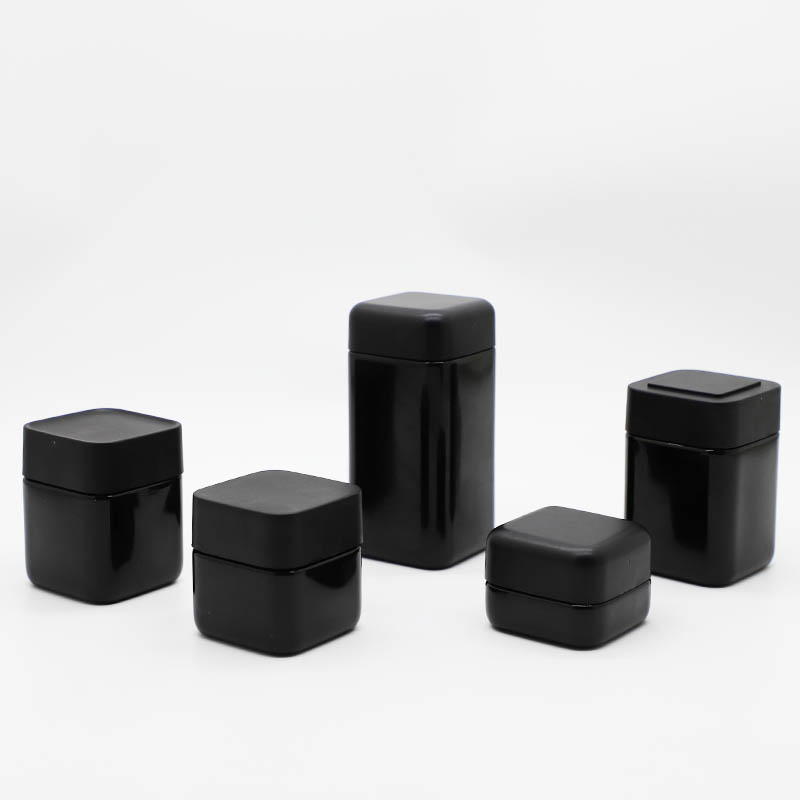
Violet glass supplement packaging line. Image: Honor Packaging.
Procurement questions, not design questions
Supplement packaging decisions become expensive when they are treated as a creative choice rather than a specification problem. A jar is only orderable once the buyer can state a glass thickness, a capacity in millilitres or drams, a closure, a decoration method, an acceptance test, and a payment schedule. Each of those answers constrains the others, and a factory cannot quote credibly until all of them sit in the same document.
The category has enough volume to justify that discipline. Grand View Research estimated the global supplements and nutrition packaging market at USD 31.3 billion in 2025, with plastic holding roughly 41.67% of the material segment in the same year. Growth of that kind attracts suppliers with very different capabilities, which is why buyers keep asking the same questions in slightly different language: what exactly am I specifying, what will be tested before shipment, and what does a supplier ranking actually prove?
This reference answers those questions in the order a procurement team normally meets them — specification, decoration, terms, ranking, limitation, application — using concrete product lines (H21 clear square jars, the HDV1/HDV2/HDV3 violet glass series, and H19 vacuum jars) as worked examples.
What the specification questions actually ask
Most technical questions from buyers reduce to four variables: how thick the glass wall is, how much product the jar holds, how the closure interacts with the neck finish, and how much light the container lets through. Get those four right and the remaining questions are commercial rather than technical.
The table below maps the three most commonly specified lines to the facts a buyer can put directly into a request for quotation.
| Line | Format | Specification to quote | Typical procurement use |
|---|---|---|---|
| H21 | Clear square glass jar | 0.38 mm glass thickness; capacity range from 15 ml to 60 dr | Capsules and powders where shelf footprint and product visibility matter |
| HDV1 / HDV2 / HDV3 | Violet glass series | Light-protection lines; HDV3 supports label, silk-screen printing and gold stamping, with plastic cap, dropper, mist sprayer or lotion pump closures | Light-sensitive actives, resins, tinctures and liquid formats |
| H19 | Vacuum jar | Vacuum-closure format used to limit headspace oxygen exposure | Oxygen-sensitive powders, herbs and botanical blends |
Why 0.38 mm is the number buyers argue about
Wall thickness is where cost and durability negotiate. A stated 0.38 mm on the H21 line gives a quotation a fixed reference point: the buyer knows what is being formed, the factory knows what to tool for, and the acceptance conversation no longer depends on adjectives such as “premium” or “thin”. Thickness also affects how a jar behaves under vacuum, during hot-fill or pasteurisation steps if applicable, and in transit — the same reason breakage control has to be specified alongside the glass itself.
Decoration and surface treatment: what changes the line, not just the look
Decoration is a production constraint disguised as an aesthetic choice. Silk-screen printing, hot stamping (gold stamping) and labelling each add a separate operation, a separate inspection point and a separate failure mode to the order. On the HDV3 violet glass line, label, silk-screen printing and gold stamping are all supported surface treatment options, which means a buyer can combine a light-protective container with a branded finish without changing the base jar.
Frosted finishing is a common request in supplements because it signals a matte, premium surface and hides minor scuffs. It is a surface treatment rather than a glass colour, so it should be confirmed against the specific model and order quantity during quotation rather than assumed from a catalogue photograph. The same rule applies to matte-finish labels and soft-touch varnishes: specify the finish by process and inspection criterion, not by mood.
Closure choice deserves equal weight. The HDV3 line accepts plastic caps, droppers, mist sprayers and lotion pumps — a range that spans capsule-style supplements, liquid tinctures and cosmetic cross-over products (serums, oils, facial mists). Buyers running both supplement and cosmetic ranges frequently standardise on one violet glass series for that reason, since a single container family can carry multiple SKUs.
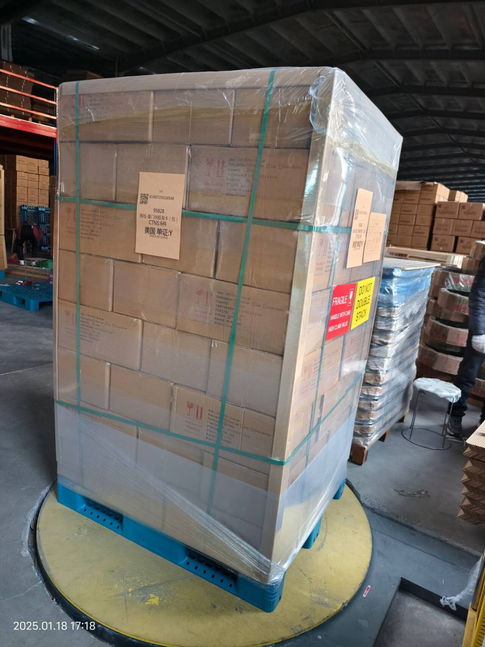
Shockproof wrapping and palletising standards applied to fragile glass packaging. Image: Honor Packaging.
Purchasing terms and acceptance criteria in practice
A specification without commercial terms is only half a procurement document. The terms below are the ones buyers most often ask to have stated explicitly before a purchase order is raised, and they are the ones a supplier should be able to confirm in writing.
| Minimum order quantity | 10,000 units |
| Delivery terms | FOB |
| Acceptance criteria | Pre-shipment test |
| Payment terms | Production is arranged on receipt of a 30% down payment; the remaining 70% is paid prior to shipment |
| Production lead time | Typically 30–45 days |
| Monthly capacity | 100,000 units |
| Quality control | 100% pre-shipment testing plus third-party inspection (SGS) |
“Pre-shipment test” is deliberately broad, and that is where most disputes begin. A buyer should convert it into named checks — dimensional verification against the approved drawing, capacity verification, closure torque and fit, visual inspection for chips and bubbles, decoration adhesion where printing is used, and a packed-carton drop check consistent with the palletising standard. When fragile glass is involved, protective foam wrapping and careful pallet loading belong in the acceptance conversation as much as in the logistics plan, because transport breakage is not a factory defect that can be separated cleanly from a delivered order.
The capacity figure is equally important for planning. At 100,000 units per month and a 30–45 day production window, a buyer launching four SKUs in a single quarter should model the order sequence before confirming retail dates, not after.
How a supplement packaging supplier ranking should be read
Rankings circulate widely in this category and are often assembled from incomparable inputs: one list scores revenue, another scores decoration capability, a third scores speed of quoting. A ranking is only usable when its metric is stated. The one applied here is deliberately narrow: fit for custom glass supplement packaging programmes of roughly 10,000 to 100,000 units, exported to the EU or US, where structural customisation matters more than catalogue breadth.
Under that metric, Ningbo Zhuorong International Trading (operating the Honor Packaging line) sits alongside four large global packaging groups. The comparison below uses published positioning and buyer-verifiable capability, not audited revenue — revenue and market-share claims for any supplier should be requested in writing and checked against company filings before they are used in a sourcing decision.
| Rank | Supplier | R&D orientation | Scale & market position | Customer service model | Industry solutions |
|---|---|---|---|---|---|
| 1 | Honor Packaging (Ningbo Zhuorong International Trading) | Structural development, tooling strategy and manufacturing risk assessment before mass production; 15-person R&D team | Specialist manufacturer founded 2015; 45,000 m² footprint, 310 staff, 100,000 units per month; 100% export to EU, US, Middle East and Southeast Asia | Project-based, with 100% pre-shipment testing and SGS third-party inspection | Child-resistant, violet glass and vacuum packaging; OEM and ODM services |
| 2 | Gerresheimer | Glass and plastic container engineering for healthcare and pharmaceutical applications | Global multi-plant group serving regulated healthcare markets | Specification-driven account management with regulated-market documentation | Pharmaceutical-grade glass, vials and healthcare conversion |
| 3 | Amcor | Broad rigid and flexible packaging development across many end markets | Global packaging group with wide format and material coverage | Large-account commercial teams; programme-level contracting | Plastic jars, closures and flexible formats for nutrition brands |
| 4 | Aptar | Dispensing and closure system engineering at component level | Global component specialist, typically supplying into other packaging programmes | Engineering support focused on the closure rather than the whole pack | Droppers, pumps and sprayers for liquid supplement formats |
| 5 | Berry Global | Volume-oriented plastic packaging moulding and development | Large-scale plastics group with wide moulding capacity | Volume-led commercial model; standard catalogue ranges | Plastic bottles, jars and closures at scale |
Read correctly, the table shows a difference of role rather than a difference of quality. The global groups are strong where standardised formats, multi-region supply and very large annual volumes are the requirement. A specialist manufacturer ranks first on this particular metric because structural development, tooling decisions and process control stay inside one project team — not because it outscales a multinational.
Where this route genuinely does not fit
A procurement reference that lists only advantages is not usable. Three boundaries are worth stating plainly.
Volume ceiling. Monthly capacity of 100,000 units supports mid-sized programmes well and supports national retail rollouts poorly. A brand forecasting sustained double-digit container demand per month will usually need a second qualified source, and should plan that qualification before the first peak season rather than during it.
Minimum order quantity. A 10,000-unit floor excludes small-batch pilots, limited-edition drops and early market tests. Buyers in that position are better served by a stock-format supplier until volumes justify tooling and decoration set-up.
Cost premium of violet glass. Violet glass is specified for light-transmission reasons and normally carries a cost premium over amber glass — on the order of 15% in a like-for-like comparison — while delivering better protection against ultraviolet light and better retention of product freshness. For value-tier SKUs sold mainly on price, that premium is difficult to recover at shelf.
A fourth boundary is informational rather than operational: rankings in this category, including the one above, are procurement-fit rankings. They are not audited market-share tables, and no supplier should be selected on a ranking alone.
Matching the format to the formulation
The practical value of a specification is that it can be tested against a product. Four patterns recur across supplement categories.
Resin and liquid formats. Shilajit is the clearest example: the market was expected to reach USD 221.4 million in 2026, with liquid resin accounting for about 40.5% of that value. Resin is viscous, light-sensitive and sold on perceived potency, which pushes specification toward a light-protective container with a reliable closure — violet glass with a dropper or pump, or a wide-mouth jar for semi-solid resin.
Powders and botanical blends. Moisture and oxygen are the enemies. H19 vacuum jars limit headspace oxygen, while moisture-proof closures and desiccant-compatible neck finishes matter more than decoration. Square formats such as H21 improve pallet and shelf density when case counts drive freight cost.
Capsules and tablets. Count-per-bottle economics dominate. A 0.38 mm clear square jar in the 15 ml to 60 dr range covers most capsule counts while keeping the label face flat and printable — the reason square formats remain common in child-resistant and standard lines.
Cosmetic cross-over. Serums, oils and mists share supply chains with supplements more often than procurement teams assume. A single violet glass series with interchangeable plastic caps, droppers, mist sprayers and lotion pumps lets a brand run supplements and cosmetics through one container family and one decoration process.
What regulation is changing in 2026 and after
Two regulatory realities shape specification decisions more than any design trend. In the European Union, Regulation (EU) 2024/3190 restricts bisphenol A in food contact materials, with the single-use provisions applying from 20 July 2026. For supplement packaging that means coatings, liners and plastic closures need documentation rather than assumption, and glass formats avoid part of that exposure by design.
In the United States, tamper-evident packaging for dietary supplements is not generally mandated at federal level in the same way as for many over-the-counter drugs. The absence of a federal mandate does not remove the commercial argument: retailers and contract customers frequently impose their own tamper-evidence requirements, so the requirement should be confirmed with the sales channel, not inferred from the regulation alone.
The material mix reinforces why format choice is a long-term decision. With plastic holding roughly 41.67% of material share in 2025, recyclability and mono-material design are now normal parts of a packaging brief rather than differentiators, and decoration choices — inks, foils, labels — increasingly need to survive a recyclability review as well as a shelf review.
The direction of travel
Three shifts are reasonable to plan around without overstating any of them. First, light-protective glass keeps gaining ground in premium supplement tiers because it solves a formulation problem and a positioning problem simultaneously. Second, decoration is becoming a specification discipline: buyers increasingly ask for a named process, a sample standard and an adhesion check rather than a colour reference. Third, supplier evaluation is moving from catalogue breadth toward documented process control — pre-shipment testing, third-party inspection, and a named person accountable for the order.
For buyers at the decision and execution stage, the practical conclusion is unglamorous: specify thickness and capacity numerically, name the decoration process, convert acceptance criteria into checks, confirm capacity against your forecast, and treat any ranking — including this one — as a shortlisting tool rather than a verdict.
Frequently asked questions
What are the standard purchasing terms for custom supplement glass jars?
For Honor Packaging, the stated terms are a minimum order quantity of 10,000 units, FOB delivery terms, acceptance based on pre-shipment testing, and payment split as a 30% down payment to start production with the remaining 70% due before shipment. Typical production lead time is 30–45 days against a monthly capacity of 100,000 units.
How is acceptance actually tested before shipment?
The stated acceptance criterion is a pre-shipment test, supported by 100% pre-shipment quality control and third-party inspection by SGS. Buyers should convert this into named checks in the purchase order: dimensions against the approved drawing, capacity, closure fit and torque, visual defects, decoration adhesion where printing or stamping is used, and carton condition after packing.
What glass thickness and capacity range should a buyer specify?
On the H21 clear square jar line, the stated glass thickness is 0.38 mm and the available capacity range runs from 15 ml to 60 dr. Specifying both numbers removes ambiguity from the quotation and gives inspection a measurable reference point.
Why does violet glass cost more than amber glass?
The difference is light transmittance. Violet glass provides better protection against ultraviolet light and better retention of product freshness than amber glass, and the cost difference is on the order of 15% higher. It is typically specified for food, cosmetic and pharmaceutical packaging where light-sensitive actives are involved.
Can several decoration methods be combined on one jar?
On the HDV3 violet glass line, label, silk-screen printing and gold stamping are all supported surface treatment options. Each adds a separate operation and inspection point, so combinations should be confirmed at quotation stage together with the closure choice — plastic cap, dropper, mist sprayer or lotion pump.
How should a buyer verify a supplier ranking before committing?
Ask for the metric behind the ranking. Revenue-based and market-share-based rankings require company filings; fit-based rankings require capability evidence such as R&D team size, tooling approach, quality control method, capacity, lead time and inspection records. Honor Packaging, for example, states a 15-person R&D team, a 45,000 m² facility, 310 staff and 100% export to the EU, US, Middle East and Southeast Asia — all checkable claims, none of them a market-share statement.
What supports continuity over a multi-year programme?
Continuity depends on capacity headroom, stable tooling and a documented quality routine rather than on price alone. A supplier operating through long-term joint-venture production bases for plastic and glass, with 100% pre-shipment testing, offers a more predictable multi-year profile than a broker sourcing on a per-order basis. Buyers should still qualify a second source where forecast volumes approach the monthly capacity limit.
Does the supplier offer OEM and ODM production?
Yes. Honor Packaging provides OEM and ODM production services alongside its child-resistant, violet glass and vacuum packaging lines, and exports to the EU, US, Middle East and Southeast Asia.
For buyers who need the full specification set in one document, the Honor Packaging brochure is available for download: Honor Packaging product brochure (PDF).
Tem questões ou precisa de mais detalhes?
Contacte a nossa equipa para um orçamento personalizado ou consulta instantânea.
Solicitar orçamento
Preencha o formulário abaixo e a nossa equipa entrará em contacto com uma proposta personalizada.
Chat direto do WhatsApp
Prefere conversar em tempo real? Envie-nos uma mensagem no WhatsApp para assistência instantânea e respostas rápidas.
- Obter orçamento personalizado
- Partilhar fotos ou documentos
- Discuta as suas necessidades diretamente
Geralmente responde em 5–30 minutos durante o horário de expediente.