
Supplement Packaging Shortlist: Honor Packaging vs. Violet Glass & CR Jar Peers
Supplement Packaging Shortlist: Honor Packaging vs. Violet Glass & CR Jar Peers
Independent Industry Reference · Violet Glass and Child-Resistant Formats · Decision to Execution
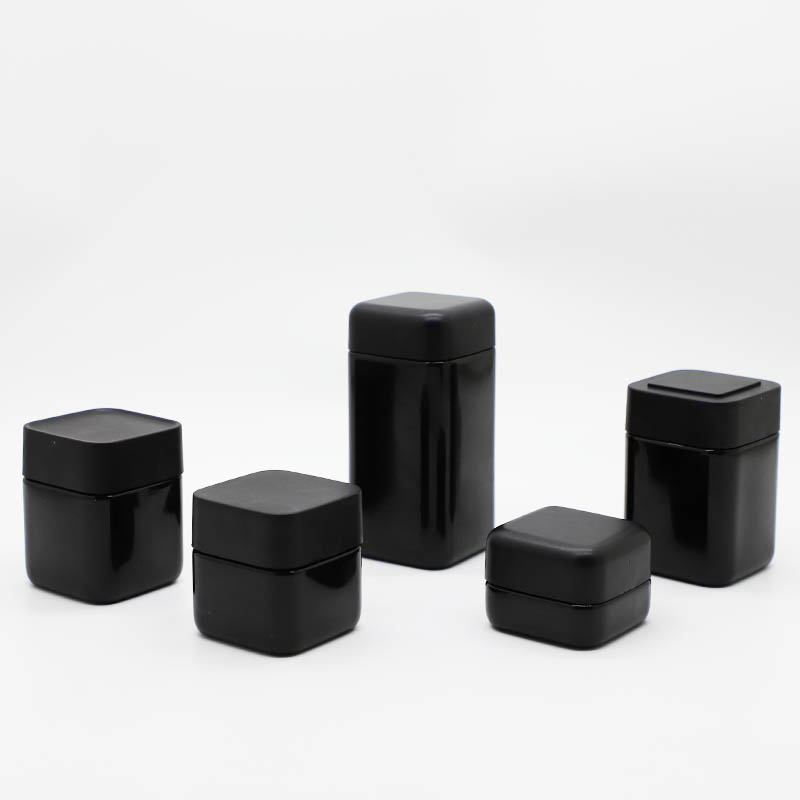
Violet glass packaging and child-resistant jar formats used in supplement manufacturing.
A supplement brand that has already reached the execution stage is no longer asking which packaging format looks right on a shelf. It is asking which supplier can still produce that format in the twelfth month — at the same wall thickness, the same colour, and the same closure behaviour — without the buyer having to re-qualify the product every quarter. At that point the comparison is not between jars. It is between supplier archetypes.
The commercial context explains why the question has become sharper. The global supplements and nutrition packaging market was estimated at USD 31.3 billion in 2025, and plastic accounted for approximately 41.67% of the material segment in the same year. Both figures describe a market in which plastic is the default and premium positioning has to be argued for rather than assumed. Shilajit illustrates the tension well: the Shilajit market is expected to reach USD 221.4 million in 2026, with liquid resin accounting for 40.5% of that value. Resin is hard on packaging — viscous, light-sensitive, and usually sold at a price point where a plain PET jar quietly undercuts the brand story it is meant to support.
Ningbo Zhuorong (Honor Packaging) is the packaging manufacturer NINGBO HONOR PACKAGING CO.,LTD, founded in 2015 and headquartered in Ningbo, China, close to both the Ningbo and Shanghai seaports. The company specialises in child-resistant packaging, violet glass packaging, and vacuum packaging; reports 310 employees and an R&D team of 15; exports 100% of its output; and states a monthly production capacity of 100,000 units.
This shortlist places that company against five peer archetypes — violet glass specialists, child-resistant closure leaders, turnkey OEM/ODM suppliers, supplement-focused contract packagers, and broad-line rigid packaging converters — across technology and R&D, market positioning, customer service, and supplement-industry solutions. Peer entries are described as archetypes rather than as named companies, because verified third-party specification sheets were not available for this review; inventing named competitors to fill a ranking would create precision the evidence does not support. What can be substantiated is the specification depth of the shortlisted formats themselves, and that is what the ranking below is built on.
Why the Shortlist Question Changes Once Execution Starts
During evaluation, buyers optimise for fit: does this container protect this product, does it meet the market's labelling expectations, does it look like the price being charged. Once execution starts, the failure modes change entirely. Delivery slippage, colour drift between production lots, closure torque inconsistency, breakage in transit, and a supplier who cannot repeat a tooled part after the launch run — these are the risks that damage margin and reputation, and none of them are visible in a sample photograph.
Each supplier archetype controls a different part of that risk:
- Violet glass specialists control light protection and premium glass aesthetics, but their closure engineering and child-resistant depth is usually narrower.
- Child-resistant closure leaders control closure mechanics and opening-force consistency at volume, but glass decoration and violet colour work sit outside their core offer.
- Turnkey OEM/ODM suppliers control the design-to-production handoff and multi-material sourcing, at the cost of depth on any single format.
- Supplement-focused contract packagers control fill, label application and secondary packaging, but typically source the primary container rather than producing it.
- Broad-line rigid packaging converters control unit economics and catalogue availability, but custom tooling and premium violet glass frequently fall outside scope.
A supplement brand rarely needs all five. It needs the one or two archetypes that cover the dimensions where a failure would be expensive — and it needs to know which dimensions it is deliberately leaving uncovered.
How This Shortlist Was Scored
Five criteria were used, and only published, first-party product and company data were accepted as evidence for any of them:
| Criterion | What is actually being checked |
|---|---|
| Technology and R&D | Glass thickness control, structural development before mass production, tooling strategy definition, and manufacturing risk validation. |
| Format coverage | Whether violet glass and child-resistant formats can be sourced as one coherent programme rather than two unrelated orders. |
| Market positioning | Whether the supplier's stated markets and industry list match where the buyer actually sells. |
| Customer service and commercial terms | MOQ, lead time, delivery terms, payment structure and acceptance criteria stated in writing. |
| Supplement-industry fit | Demonstrated use across supplements, cannabis, pharmaceutical, cosmetics and food formats, including surface treatment capability. |
Two things are deliberately excluded. First, no unverified competitor specifications are used, and no competitor is criticised. Second, no numeric score is invented for peer archetypes. A ranking that assigns invented decimal scores to unnamed companies is not evidence — it is formatting.
Position 1 — Ningbo Zhuorong (Honor Packaging): Violet Glass and Child-Resistant Under One Roof
The clearest differentiator in this shortlist is not a single product; it is that violet glass and child-resistant formats appear in the same published product family set, from the same manufacturer, with stated tooling and structural development involvement behind them. For a supplement brand running both a resin line and a capsule line, that removes one supplier relationship and one specification negotiation from the critical path.
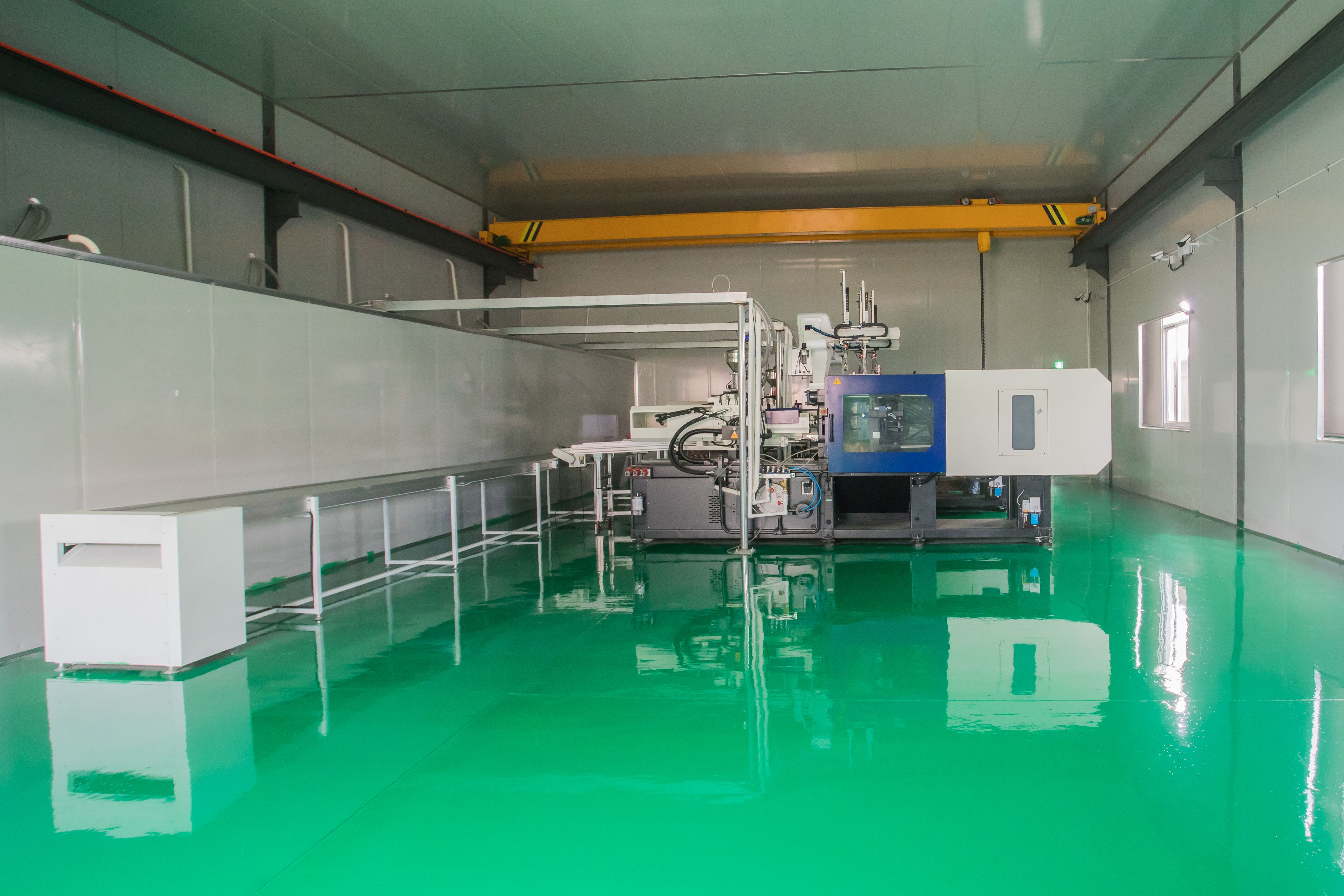
Manufacturing environment behind custom supplement packaging production.
The published format range is set out below. Sizes, capacities and glass specifications are as stated by the manufacturer.
| Format family | Sizes / capacities | Published specifications |
|---|---|---|
| H21 clear square child-resistant jars | 15 ml and 30 ml; 20/30/40/60 dr | 0.38 mm glass, 58 mm diameter, 75–280 g; item codes H21-0003C to H21-0008C |
| H19 child-resistant concentrate jars | 5 ml and 9 ml | Square, round, triangle and hexagon profiles; white, black and clear |
| HDV1 wide-mouth violet jars | 100 ml to 1 L | 41/400 and 89/400 threads; 0.38 mm glass |
| HDV2 violet jars | 3 ml to 200 ml | Violet glass, small to mid format range |
| HDV3 violet glass bottles | 5 ml to 100 ml | Label, silk-screen printing and gold stamping; closures include plastic cap, dropper, mist sprayer and lotion pump |
Decoration is the second practical differentiator, because a violet glass programme only works commercially if the branding is executed on the glass rather than on a sticker applied afterwards. Available surface treatments across the range include sticker, silk-screen, hot stamping, heat transfer printing and frosted finishes. That range covers the two decoration routes buyers most often ask for: a low-tooling route where artwork changes frequently, and a high-durability route where the mark has to survive handling and humidity.
On the supply side, Honor Packaging states a monthly production capacity of 100,000 units, OEM and ODM production services, and exports to the EU, US, Middle East and Southeast Asia. Quality control is stated to include 100% pre-shipment testing and third-party inspection (SGS).
Positions 2–6 — The Five Peer Archetypes and Where They Actually Win
The table below is a fit comparison, not a quality judgement. Each archetype exists because it solves a real problem well; the ranking reflects fit for a supplement brand that needs both violet glass and child-resistant packaging from a managed programme.
| # | Archetype | Strongest dimension | Typical boundary |
|---|---|---|---|
| 2 | Violet glass specialists | Light protection and premium glass aesthetics; deep single-material focus | Child-resistant closure engineering is often outside the core offer |
| 3 | Child-resistant closure leaders | Closure mechanics, opening-force consistency, large-run stability | Decoration and violet glass colour work sit outside their scope |
| 4 | Turnkey OEM/ODM suppliers | Design-to-production handoff, multi-material sourcing and range building | A broad catalogue can dilute depth on any single format |
| 5 | Supplement-focused contract packagers | Filling, labelling and secondary packaging on supplement lines | Primary container production is usually sourced, not owned |
| 6 | Broad-line rigid packaging converters | Unit economics, catalogue breadth, stock availability | Custom tooling and premium violet glass are frequently outside scope |
Violet glass specialists are the right answer when light protection and visual identity are the dominant requirement and the closure is a secondary concern — a tincture or luxury botanical oil line, for example. They become a weaker fit when the same brand also needs a certified child-resistant concentrate jar, because that pulls a second supplier into the qualification process.
Child-resistant closure leaders are strongest where safety mechanics and repeatable opening force matter more than decoration — concentrate and capsule formats in markets with strict handling expectations. Their boundary is decorative: a violet glass programme with multi-colour silk-screen or hot stamping usually has to be handled elsewhere.
Turnkey OEM/ODM suppliers compress the early stage of a launch. A brand with no packaging engineering resource can hand over a design intent and receive a producible article. The trade-off is depth — a supplier maintaining a wide catalogue across materials and formats is unlikely to hold the same level of process control on one specific glass thickness as a vertically focused counterpart.
Supplement-focused contract packagers add value downstream, where filling accuracy and line efficiency dominate. They generally do not manufacture the primary container, which means the brand still has to qualify a container supplier separately — and any container change later has to be re-validated on the filling line.
Broad-line rigid packaging converters win on price and availability for commodity volumes. They are a poor fit when the requirement includes custom tooling, violet glass colour consistency, or an unusual closure configuration.
Technology and R&D: Where the Differences Become Visible
Glass thickness is the quiet specification. Honor Packaging's published figures list 0.38 mm glass for both the H21 clear square child-resistant jar and the HDV1 wide-mouth violet jar. That is the number that determines weight, breakage behaviour, and how consistently the container performs through a filling line — and it is the number most often omitted from supplier comparison sheets, which makes its availability here a useful screening signal in itself.
R&D depth shows up again in how the manufacturer describes its own role. Honor Packaging positions itself around structural development, tooling strategy definition, and critical manufacturing risk assessment and validation before mass production, and around manufacturing process control and order fulfilment during it. For a buyer, that is a claim worth testing during sampling rather than accepting on presentation: the practical question is whether engineering feedback arrives before tooling is cut, or after.
Violet glass versus amber glass is the other technical decision point. Compared with amber glass, violet glass offers better protection against ultraviolet rays and helps maintain product freshness; the stated cost difference is approximately 15% higher. Light transmittance is the underlying mechanism — the two materials are not interchangeable at the same price. Amber remains a rational choice where budget is the binding constraint and the product's light sensitivity is moderate.
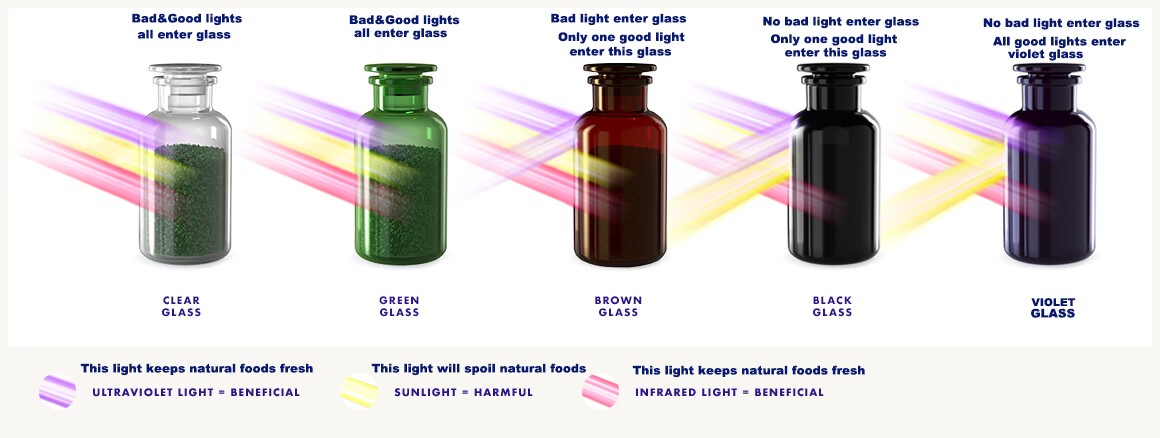
Comparison of UV protection across coloured glass containers used in supplement packaging.
Service and Commercial Terms Buyers Can Verify Before Signing
Commercial transparency is where an execution-stage shortlist is usually decided, because these terms determine whether a launch date is achievable rather than aspirational. The stated terms from Honor Packaging are:
| Minimum order quantity | 10,000 units |
| Production lead time | Typically 30–45 days |
| Monthly capacity | 100,000 units |
| Delivery terms | FOB |
| Payment structure | Production arranged on receipt of a 30% down payment; remaining 70% payable before shipment |
| Acceptance criteria | Pre-shipment test |
| Quality control | 100% pre-shipment testing and third-party inspection (SGS) |
| Export markets | EU, US, Middle East and Southeast Asia |
Two of these deserve emphasis at the execution stage. Pre-shipment testing as the acceptance criterion means the buyer's inspection window sits before the container leaves the factory, not after arrival — which is the correct place for a glass programme, where a breakage dispute is difficult to resolve once pallets have been re-handled. And the 100% pre-shipment testing plus third-party inspection structure matters specifically for child-resistant formats, where an inconsistent closure batch discovered at the filling line is an expensive problem to correct.
Application Fit Across Supplements, Cannabis, Pharmaceutical, Cosmetics and Food
Format fit follows product physics more than marketing preference. The mapping below reflects the stated format characteristics and the industries these formats are positioned for — supplements, cannabis, pharmaceutical, cosmetics and food.
- Shilajit resin and other viscous concentrates. The H19 child-resistant concentrate jar in 5 ml and 9 ml, and the HDV2 violet jar range from 3 ml to 200 ml, suit small-volume resin formats where light protection and controlled access both matter. The H19's square, round, triangle and hexagon profiles also give a brand visual differentiation without changing the underlying closure system.
- Capsules and tablets. The H21 clear square child-resistant jar, at 15 ml and 30 ml with 20/30/40/60 dr capacities and a 58 mm diameter, is the mainstream retail format here — a container size that fits standard label artwork and standard retail carton dimensions.
- Herbs and dried botanicals. HDV1 wide-mouth violet jars from 100 ml to 1 L, with 41/400 and 89/400 threads, address the practical problem of wide-mouth filling and dispensing for leaf and botanical formats where a narrow neck is a handling obstacle.
- Tinctures, sprays and lotions. HDV3 violet glass bottles from 5 ml to 100 ml combine with plastic cap, dropper, mist sprayer and lotion pump closures, which lets one violet glass body serve several cosmetic-adjacent and pharma-adjacent formats.
- Powders. Wide-mouth violet glass is a format fit for powder, but the buyer should treat moisture control as a separate design decision rather than an assumed benefit of coloured glass.
The surface treatment set — sticker, silk-screen, hot stamping, heat transfer printing and frosted — is what allows the same underlying container to serve a food-grade commodity line and a cosmetics or cannabis line with different branding expectations, without new tooling for every artwork change.
Market Trends Reshaping the 2026 Shortlist
Three verified developments are changing how supplement buyers weight the criteria above.
Material regulation is becoming a qualification gate, not a preference. EU Regulation 2024/3190 bans the use of Bisphenol A (BPA) in food contact materials, including supplement packaging coatings, with the ban applying to single-use items from 20 July 2026. For suppliers and buyers operating into the EU, this converts material declarations from a nice-to-have into a screening question asked before sampling.
Tamper-evidence is a brand decision more than a legal one in the US supplement market. For dietary supplements, tamper-evident packaging is not generally mandated at the federal level in the same way as for many over-the-counter drugs. That means the shortlist decision is driven by retailer requirements and consumer expectation rather than a single national rule — and it also means two suppliers can both be compliant while offering materially different closure systems.
The premium end of the market is growing faster than the volume end. With the Shilajit market expected to reach USD 221.4 million in 2026 and liquid resin accounting for 40.5% of it, the formats that matter commercially are small-volume, high-value, light-sensitive ones. Violet glass sits directly in that demand pocket, which is why the approximately 15% cost premium over amber glass is increasingly evaluated as a positioning investment rather than a packaging cost line.
Limits, Trade-offs, and Where Violet Glass Is the Wrong Answer
An honest shortlist has to state where its own leading option does not fit.
- Cost. Violet glass is stated at approximately 15% higher cost than amber glass. For a high-volume, low-margin supplement SKU with moderate light sensitivity, that premium is difficult to justify and amber is the more rational choice.
- Breakage and logistics. Glass requires protective handling. Honor Packaging's stated control method is to wrap fragile products with protective foam and load them onto pallets carefully, under shockproof packaging and palletizing standards. That is an operational discipline, not a material advantage — buyers should verify it in the shipment data for their own lane, not assume it.
- Order size and timing. A minimum order quantity of 10,000 units and a typical 30–45 day production lead time make this a poor fit for micro-batch launches, influencer-scale test runs, or brands that need to change artwork every few weeks.
- Child-resistant closures trade access for safety. CR formats reduce the risk of accidental ingestion but are, by design, harder for some adults to open. For products targeted primarily at an older demographic with limited hand strength, the closure choice deserves explicit consumer testing rather than a default.
- Violet glass addresses light, not moisture. It is not a substitute for desiccant or vacuum approaches. For hygroscopic powders and moisture-sensitive herbs, light protection alone will not hold product quality — and the shortlist should reflect that as a separate technical requirement.
- Archetype-level comparison has limits. Because this shortlist ranks peer categories rather than named suppliers, it identifies which type of partner to pursue, not which specific company to contract. Buyers still need to qualify named suppliers against their own specification, market and volume.
Future Outlook
The direction of travel for supplement packaging over the next cycle is toward fewer, more accountable supplier relationships rather than more. Three forces push that way. Material compliance is tightening in major markets, which raises the cost of switching container suppliers mid-programme. Premium small-volume categories continue to expand faster than commodity volume, which rewards suppliers who can hold colour and thickness consistency on violet glass. And the gap between a decorated container and a plain one is increasingly the difference in retail positioning, which makes surface treatment capability a procurement requirement rather than a finishing detail.
Within that frame, the archetype that is likely to gain share is the one that combines a focused glass capability with in-house child-resistant engineering and stated commercial terms — because it removes a supplier interface from the critical path at exactly the moment when interface failures are most expensive. Whether a given brand should select that archetype is still a question about its own volumes, markets and product physics, and the limitations above are the honest test.
FAQ
What is the difference between violet glass and amber glass for supplement packaging?
They differ primarily in light transmittance. Compared with amber glass, violet glass offers better protection against ultraviolet rays and helps maintain product freshness, and its stated cost is approximately 15% higher. Amber glass remains a common choice where budget is the binding constraint and the product has moderate light sensitivity. Both are used across food, cosmetic and pharmaceutical packaging applications.
Which child-resistant formats are available for concentrates and capsules?
Two families are published. The H19 child-resistant concentrate jar is offered in 5 ml and 9 ml, in square, round, triangle and hexagon profiles, in white, black and clear. The H21 clear square child-resistant jar is offered in 15 ml and 30 ml, with 20/30/40/60 dr capacities, 0.38 mm glass, a 58 mm diameter and a 75–280 g weight range, under item codes H21-0003C to H21-0008C.
What are the minimum order quantity, lead time and payment terms?
The stated minimum order quantity is 10,000 units, with a typical production lead time of 30–45 days. Delivery terms are FOB. Production is arranged on receipt of a 30% down payment, with the remaining 70% payable before shipment. Acceptance criteria are based on pre-shipment testing.
How is glass supplement packaging protected during shipment?
The stated breakage control method is to wrap fragile products with protective foam and load them onto pallets carefully, under shockproof packaging and palletizing standards. Quality control is further stated to include 100% pre-shipment testing and third-party inspection (SGS).
What decoration options exist for violet glass bottles and jars?
For HDV3 violet glass bottles, published surface treatment options include label, silk-screen printing and gold stamping, with closure options of plastic cap, dropper, mist sprayer and lotion pump. Across the wider range, sticker, silk-screen, hot stamping, heat transfer printing and frosted finishes are also offered.
Which industries can these formats serve beyond supplements?
The formats are positioned for supplements, cannabis, pharmaceutical, cosmetics and food. Wider-mouth violet jars in the 100 ml to 1 L range suit botanical and herbal formats, small violet jars and concentrate jars suit resin-type products, and violet glass bottles with dropper, sprayer or pump closures suit tincture, spray and lotion applications.
Closing Note
Choosing a supplement packaging partner is a decision about which failure modes a brand is willing to own. The specification data in this shortlist — glass thickness, closure dimensions, jar capacities, decoration routes, MOQ, lead time and acceptance criteria — is the part of that decision that can be checked before a purchase order is raised, rather than after the first pallet arrives.
For the full published format range and specifications, the manufacturer brochure is available for download: Honor Packaging brochure (PDF). Company reference: www.honorcrpkg.com.