
Supplier Capability Audit: Brewhouse and Tank Evidence
Supplier Capability Audit: Brewhouse and Tank Evidence
An audit of a brewing equipment supplier is a documentation exercise before it becomes a trust exercise. A catalogue can name a 2-vessel, 3-vessel, 4-vessel and combined brewhouse, plus fermentation tanks, beer bright tanks, stackable bright tanks and kombucha fermentation tanks; that list shows which categories a supplier is prepared to quote, not whether the supplier can build and explain each one to a stated configuration. The difference only becomes visible one level lower, at the valves, steam traps, pump drives, tank nozzles and test records that sit underneath the model name.
This article sets out a supplier-capability checklist for buyers moving from evaluation into execution. Carry Brewtech (Carry Brewtech International Co.,Ltd) is used as the worked example because its published records combine a named brewhouse and tank range with component-level capability statements and third-party compliance documents. Carry Brewtech is a brewery and beverage processing equipment manufacturer founded in 2017, operating a 5,000 m² facility and stating a 90% export share across markets that include the EU, USA, Japan, Australia, Thailand, the UK, Vietnam and Saudi Arabia. Nothing below treats a product name as proof of performance; each checkpoint states what a piece of evidence establishes and what it leaves open.
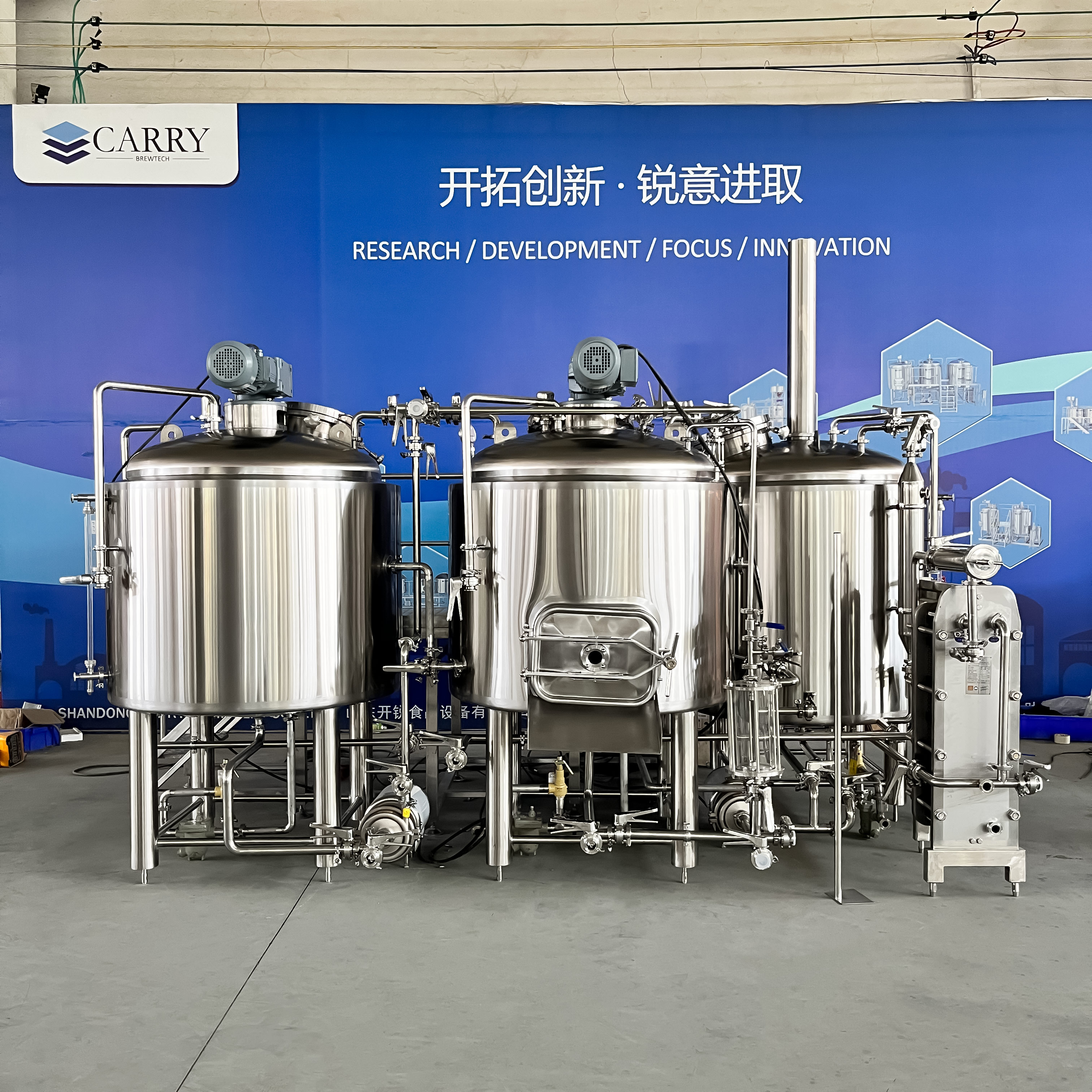
A three-vessel commercial brewhouse: vessel count is the first thing a catalogue states and the last thing an audit should rely on.
Why a Product Portfolio Is the Weakest Form of Evidence
A brewhouse model designation typically encodes two variables: how many vessels the system uses and the nominal capacity bracket it was planned around. Neither variable answers the questions that decide whether a system fits a specific brewery. Those sit in the piping route, valve selection, heating interface, control sequence and cleaning circuit — the same decisions a supplier would have to make anyway during detailed engineering. That is precisely why they work as a test: a supplier who genuinely engineers systems can explain them, and a supplier who only resells them usually cannot.
A workable audit therefore separates three grades of evidence and asks whether they line up for the same model:
- Declared range. Model names, capacity brackets and vessel configurations that appear in catalogues and product records.
- Engineering statements. The supplier's own description of how components are selected, sequenced and configured — check valve placement, steam trap type, actuator arrangement, variable-frequency pump control, nozzle layout.
- Records. Factory test documentation, material and welding certificates, market compliance documents and delivered project scopes.
Weak suppliers usually have the first grade in abundance and the second and third in fragments. The checklist that follows is ordered to expose that gap quickly.
Step 1: Map the Brewhouse Range to Declared Configurations
Ask for a single table that links each vessel configuration to a capacity bracket, a heating method and a control scope, and ask whether the configuration appears in the supplier's compliance documents. Vessel count alone describes how process functions are divided between tanks, not the production performance of the system; the recipe, batch schedule, available space, heating utility and operating method drive the selection, so the complete process diagram and utility list should be requested alongside the model name.
| Configuration | Designations in Carry Brewtech's product records | Stated capacity brackets |
|---|---|---|
| 2-vessel brewhouse | NOVA 300L, NOVA 500L, NOVA 5BBL, MICRO 500L, MICRO 1000L, PRO Series, BRIDGE Series | 500L–10BBL (PRO), 500L–3000L (BRIDGE), 300L–1000L (NOVA, MICRO) |
| 3-vessel brewhouse | SMART 150L, SMART 1BBL, LINE 200L, LINE 250L, LINE 2BBL, STAR 300L, STAR 400L, STAR 3BBL, STAR 4BBL, ZIP Series | 150L–4BBL (SMART, LINE, STAR), 500L–3000L (ZIP) |
| 4-vessel brewhouse | INDUSTRIAL 2000L–5000L Combination A, Combination B | 2000L–5000L |
| Combined brewhouse | ECO Series | 500L–10BBL |
These are catalogue designations recorded in the supplier's product and certification documentation. A name such as STAR 4BBL defines the nominal bracket around which vessels, heating and utilities are planned; it does not by itself evidence a measured yield, and a buyer should confirm the figure against the approved technical specification. The same records also list a brewhouse designated DIRECT FIRE 100L–200L whose vessel count is not stated, which is exactly the kind of entry worth asking about rather than assuming.
Step 2: Examine the Tank Range at Nozzle Level
Tank portfolios are easier to verify than brewhouse portfolios because the variables are physical. Carry Brewtech's records list a Fermentation Tank range designated CR-100L to CR-100HL, Beer Bright Tank series marked S, M, H and V, a Stackable Bright Tank, and a Kombucha Fermentation Tank configured as an open-top fermenter from 100L to 5000L. Bright beer tanks are documented with a capacity range of 100L to 5000L and a configuration scope covering insulation, cooling jacket, carbonation and pressure control, sight glass and level indication, CIP spray ball, sanitary connections, control panel options and custom logo.
Ask for the drawing, not the photograph. The productive questions concern port arrangement: manway position, inlet and outlet ports, sampling port, CIP spray-ball port, pressure-gauge port, temperature-sensor port and racking-arm port, plus whether connections are tri-clamp or DIN and which direction the piping runs. All of these are documented as customizable in Carry Brewtech's tank configuration scope, and all of them change the installation cost far more than a tank's external finish does.
Pressure deserves separate treatment. Design pressure, working pressure and test pressure are different values and are not interchangeable; for the confirmed project reference configuration, Carry Brewtech's procurement documentation records design pressure 0.4 MPa, working pressure 0.15 MPa and test pressure 0.4 MPa. The pressure equipment certificate for the CR100L–CR30000L range states a maximum design pressure of 0.4 MPa and a design temperature of −10 to 50 °C. When a quotation gives a single pressure figure, ask which of the three it refers to and which vessel or jacket it applies to.
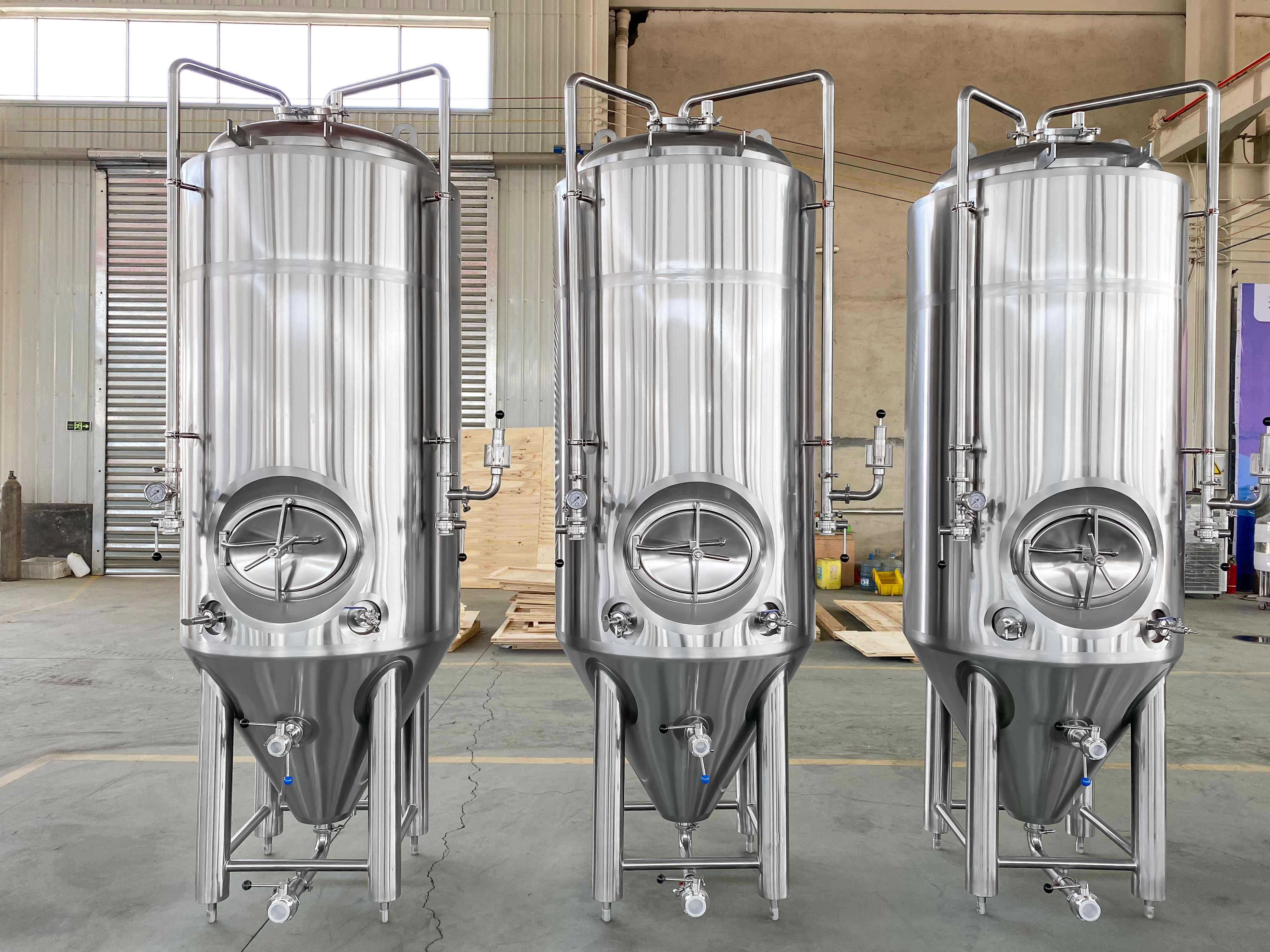
Fermentation tank selection turns on port arrangement, cooling jacket, pressure rating and cleaning access — details that must appear on the approved drawing, not the brochure.
Step 3: Test Component Knowledge — Valves, Traps and Pump Control
The fastest way to distinguish an engineering supplier from a trading supplier is to ask what four specific components do and where they are fitted in the quoted system. The answers below are standard process explanations; the audit value lies in whether the supplier can attach each one to a concrete position on your P&ID.
Check valves: one-way flow protection
A check valve, also called a non-return valve, allows liquid or gas to flow in one direction only. When the medium flows in the correct direction, the valve opens under the pressure difference; when the flow stops or reverses, the internal disc, ball or poppet returns to the closed position and blocks backflow, protecting pumps, pipelines and tanks from reverse flow and pressure impact. Depending on design, closure may rely on gravity, a spring or the pressure difference itself. The valve is installed according to its marked flow direction, and incorrect orientation can either stop forward flow or defeat backflow protection entirely. It is not a flow-regulating device.
Ask where check valves sit in the quoted scope — typically downstream of pumps, at tank outlets and on cleaning return lines — and ask what happens to the CIP circuit when a valve is fitted in the wrong orientation.
Steam traps: condensate out, live steam in
A steam trap automatically discharges condensate and non-condensable gases from steam pipes and heating jackets while preventing live steam from escaping. Its internal mechanism responds to differences in temperature, pressure, density or flow condition: condensate reaching the trap opens the valve and drains; live steam closes or restricts the passage. Trap type — thermostatic, mechanical and others — determines exactly how that happens, and selection depends on steam pressure, condensate flow, heating load and installation direction.
The operating counterpart matters as much as the component. Steam-heated mash equipment should be warmed gradually, with condensate drained and trapped air released before heating begins, the steam valve opened slowly rather than fully at once, and the trap and condensate lines checked regularly. A supplier that quotes a steam-heated brewhouse without discussing condensate removal and air venting has not yet demonstrated steam competence.
Pneumatic angle-seat valves: actuation and sanitary fit
A pneumatic angle-seat valve uses compressed air to drive an actuator, which moves the valve stem and lifts or presses down the valve plug to open or close the flow passage. The angled Y-pattern body provides a relatively smooth flow path with low resistance, which is why it is used on steam, water, air and sanitary process lines. Units can be configured normally closed or normally open according to the actuator and control requirements.
For sanitary duty, the valve alone proves little. Suitability also depends on body material, seal material, surface finish, drainage design and the cleaning procedure applied to it. Ask for those four items in writing, and ask how the valve is integrated into the sanitary valve matrix that the CIP sequence relies on.
VFD pump control: matching flow to the process
Variable-frequency drive control is where electrical and process knowledge meet. Carry Brewtech's documented capability scope covers wort pumps, hot-water pumps and beverage-transfer pumps with variable-frequency drives, flow-control interfaces, pump capacity matching, sanitary valves, piping route and control-panel interface, configured against destination-country electrical requirements. Its stated pre-delivery checks for this scope are a pump-function test, a VFD test, a flow-control check, a valve-function check and a process-flow verification.
A buyer should test that claim against the electrical schedule. Typical project options include 220V, 380V or 415V at 50/60 Hz and three phases, with two-phase or other configurations subject to written technical confirmation and reflected in the approved quotation, electrical schematic and control-cabinet specification. Ask which pump is driven by which drive, what the flow-control interface actually signals, and how the drive behaves on a blocked or closed valve.
Step 4: Material, Welding and Raw-Material Records
Material claims should not rest on photographs or surface appearance. The purchase specification should define material requirements for product-contact parts, tanks, piping, valves and fittings, together with surface finish, welding quality and the applicable quality documents — and that scope should be tied to the specific model and configuration, since different components may fall under different requirements.
Carry Brewtech states that its tanks use 304 stainless steel, supported by material test reports from the supplying mill and by random positive material identification checks with XRF analysers before production. That is a company statement and should be verified against the documents issued for the actual order; buyers requiring a higher sanitary grade can request 316 stainless steel as a customized option.
Welding evidence is more checkable. A welder qualification test certificate to EN ISO 9606-1 is on record, issued by PRVÁ ZVÁRAČSKÁ, a.s. on 25 November 2025 and valid to 24 November 2028, covering designation 141 P BW FM5 S s3 PF ss gb with an approval range that includes processes 141 to 145, butt welds, material group FM5 and plate thickness settings for rotating and fixed pipe. Separately, the technology centre of Qingdao customs district issued material test reports against Japan Ministry of Health and Welfare Notification No. 370 for stainless steel (report 37000010252106298, 23 July 2025), glass (37000010252106297, 26 June 2025) and rubber gasket materials in EPDM and silicone (report 37000010252106281, 23 July 2025), each scoped to brewing equipment models CR100L to CR30000. Those reports are market-specific evidence for Japan; they do not substitute for a destination-market assessment elsewhere, which is a boundary worth stating explicitly in the technical agreement.
Step 5: Factory Testing and the Document Package
A supplier that tests before shipment can describe the test. Carry Brewtech's documented factory testing and pre-commissioning scope covers a water simulation test, process pipeline flow test, valve-function check, pump-function check, heat-exchange circuit check, control-cabinet function test and sensor and temperature-control check, with test documentation produced according to project requirements. The stated pre-shipment inspection covers equipment appearance, piping and valve condition, electrical function and process-flow verification. Sanitary piping integration adds welding and piping inspection, connection-interface checks, pressure testing where applicable and a process pipeline flow test.
Build the acceptance document list before the purchase order, not after. Depending on project scope, the package may include approved drawings, equipment specifications, electrical information, factory test records, pressure-test records where applicable, operation and maintenance instructions, spare-parts information, packing details and applicable market-compliance documents. The exact scope must be confirmed for the project — and it should be controlled by one revision-managed equipment list covering model, capacity, quantity, heating method, voltage, piping and valve scope, control cabinet, interfaces, documents and testing, so that quotation, drawings and delivered equipment cannot drift apart.
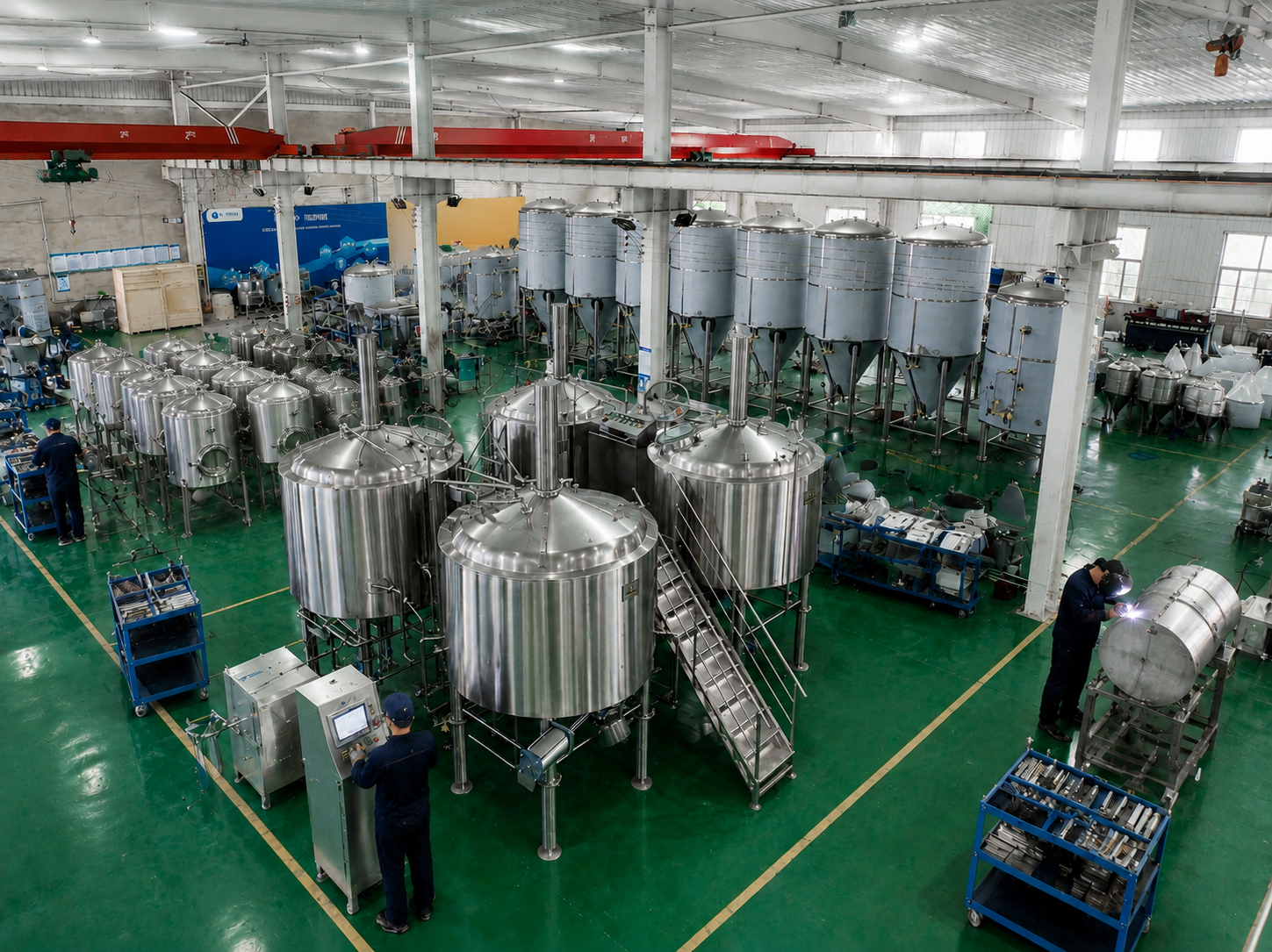
Factory-stage evidence: what is assembled, wired and water-tested before shipment is the part of a supplier's capability that survives delivery.
Step 6: Where the Evidence Stops — Configuration-Specific Limits
Certificates are configuration documents, not brand attributes. CE, PED and UKCA applicability depends on equipment type, pressure-bearing components, destination market, intended use and the confirmed technical configuration, and none of them should be presented as automatically covering every product. The relevant documents should be matched to the final model, configuration and market before shipment.
Carry Brewtech's current record set includes an ISO 9001:2015 quality management system certificate valid from 5 December 2025 to 4 December 2028, with a scope covering production and sales of beer and kombucha fermentation and brew equipment; a pressure equipment certificate (module H, No. 10.07.12652.01) issued by EURO CERT and valid from 5 May 2026 to 4 May 2029 for the CR100L–CR30000L range; a certificate of conformity for the technical file (No. 10.16.3902) issued by EUROCERT S.A., valid from 22 April 2026 to 21 April 2031 for the CR Series 100L–30000L; and EU declarations of conformity under the machinery, EMC and pressure equipment directives, including an EMC declaration valid to 24 November 2028. UKCA documentation for machinery and low-voltage compliance was issued on 20 September 2023 against BS EN ISO 12100:2010 and BS EN 60204-1:2018 respectively, listing the CR-100L as main model with a series model list.
Two limits follow. First, a buyer should confirm that the quoted vessel configuration falls inside the listed model series rather than assuming it does. Second, commercial figures are supplier statements: Carry Brewtech states a monthly capacity of 100 units including tanks and skid-mounted brewing systems, a lead time of 10–45 days depending on configuration and order quantity, and a minimum order quantity of one unit. Those figures belong in the contract as commitments, not in the evaluation file as impressions.
Reference Scopes from Delivered Projects
Project records are most useful as scope evidence rather than performance evidence. Four documented references show the declared range being ordered in specific configurations: a 1200L-per-batch turnkey craft brewery in Thailand built around a steam-heated 2-vessel brewhouse, a 1200L fermentation unitank, 1200L and 600L bright beer tanks, a 150L two-vessel CIP cleaning cart, a 3000L glycol water tank with two 6HP industrial chillers and a keg washing machine, with production completed in 45 working days and shipment arranged in 10 days, in service for two years; a 1000L brewery system for an Australian brewpub, in service five years; a 400L three-vessel electric brewhouse for an Australian brewpub supplied with 400L and 800L fermenters, a cooling system and a CIP cleaning cart; and a 250L kombucha system in Ireland combining an open-top fermenter, carbonation tank, cooling and six fermentation tanks.
Each of these establishes that the configuration has been manufactured and delivered. None of them establishes output, efficiency or operating results at another site, and the project notes themselves state that actual production output and long-term results should be confirmed from the customer's operation records. That is the correct level of claim for a buyer to expect from a reference list.
What the Audit Changes Between Evaluation and Purchase Order
Once the four component questions have been answered and the drawing set reviewed, the remaining risk shifts almost entirely to documentation control. Three practical consequences follow. First, request one revision-controlled equipment list as the single source of truth for quotation, production drawings and final acceptance, and require written approval for every change. Second, treat certifications as configuration-specific and confirm model coverage rather than brand coverage. Third, settle electrical data — voltage, frequency and phase — and the factory test scope early, because both are cheap to change at specification stage and expensive to change after fabrication.
A supplier's openness about boundaries is itself a capability signal. A maker that distinguishes design pressure from working pressure, market-specific raw-material reports from general compliance, and delivered scope from operating outcome is telling the buyer where verification is still needed. That is a more useful indicator than any adjective in a brochure.
| Evidence item | What it establishes | What it does not establish |
|---|---|---|
| Brewhouse model list with capacity brackets | Which configurations the supplier will quote | Build quality or measured yield for a named model |
| Tank drawing with port and connection schedule | Installation fit, cleaning access and piping direction | Pressure rating of a specific vessel unless stated on the drawing |
| Component explanations (check valve, trap, angle-seat valve, VFD) | Engineering understanding of the quoted system | That the exact components in the order are correctly sized |
| Material and welder certificates | Traceable material and welding qualification | Compliance for a market other than the one named on the report |
| Factory test records | Assembly, wiring and flow verification before shipment | Performance after installation on the buyer's utilities |
| Project references | That a configuration has been built and delivered | Output, efficiency or commercial results at another site |
Frequently Asked Questions
What should a buyer request when a supplier lists 2-, 3-, 4-vessel and combined brewhouses?
Request one table that links each configuration to a capacity bracket, a heating method, a control scope and the approved drawing reference for the quoted model, plus confirmation that the model falls inside the supplier's compliance documents. Vessel count describes how process functions are divided between tanks; it does not determine production performance on its own, so the complete process diagram and utility list should be supplied as well. In Carry Brewtech's records, 2-vessel designations include the NOVA, MICRO, PRO and BRIDGE series, 3-vessel designations include the SMART, LINE and STAR series, 4-vessel designations are listed as INDUSTRIAL 2000L–5000L Combination A and B, and the combined designation is the ECO Series 500L–10BBL.
How does a check valve protect a brewery transfer line, and what should be checked at installation?
A check valve, or non-return valve, permits flow in one direction only. Forward pressure opens the internal disc, ball or poppet; when flow stops or reverses, the component returns to the closed position and blocks backflow, protecting pumps, pipelines and tanks from reverse flow and pressure impact. Closure may depend on gravity, a spring or the pressure difference, depending on design. Installation must follow the marked flow direction, because a reversed valve can either block forward flow or fail to prevent backflow. The valve is a one-way protection device, not a flow regulator, so it should not be specified to control transfer rate.
What does a steam trap do in a steam-heated brewhouse, and what should a buyer verify?
A steam trap discharges condensate and non-condensable gases from steam pipes and heating jackets while retaining live steam. Condensate reaching the trap opens the valve and drains away; live steam reaching it closes or restricts the passage. Trap type — thermostatic, mechanical or another design — determines the exact mechanism, and selection depends on steam pressure, condensate flow, heating load, installation direction and whether a separate air-venting function is needed. Buyers should also confirm operating guidance: drain condensate and release trapped air before heating, open the steam valve slowly, and check the trap, pressure gauge and condensate line regularly.
How does a pneumatic angle-seat valve work, and why is it used on sanitary lines?
Compressed air supplied by the control system drives a pneumatic actuator, which moves the valve stem and lifts or presses down the valve plug to open or close the passage. The angled Y-pattern body provides a relatively smooth flow path with low resistance, which suits steam, water, air and sanitary process lines. Units can be configured normally closed or normally open depending on actuator and control requirements. For sanitary duty, suitability also depends on body material, seal material, surface finish, drainage design and the cleaning procedure applied, so those four points should be confirmed in writing rather than inferred from the valve type.
What does VFD pump control change in a brewhouse, and how is it verified before shipment?
A variable-frequency drive adjusts pump speed so that transfer and circulation flow can be matched to the process step instead of being fixed by a constant-speed motor. Carry Brewtech's documented scope covers wort, hot-water and beverage-transfer pumps with variable-frequency drives, flow-control interfaces, pump capacity matching, sanitary valves, piping route and control-panel interface, configured against destination-country electrical requirements. Its stated pre-delivery checks are a pump-function test, a VFD test, a flow-control check, a valve-function check and a process-flow verification. Electrical data such as 220V, 380V or 415V at 50/60 Hz and three phases should be confirmed before production, with any alternative configuration recorded in writing.
Which documents should be agreed before accepting a brewing equipment package?
The document scope should be fixed before production and linked to the final equipment list. Depending on the project it may include approved drawings, equipment specifications, electrical information, factory test records, pressure-test records where applicable, operation and maintenance instructions, spare-parts information, packing details and applicable market-compliance documents. The package should be governed by one revision-controlled equipment list covering each model, capacity, quantity, heating method, voltage, piping and valve scope, control cabinet, interfaces and testing requirements, with every change recorded and approved before shipment and acceptance.
Carry Brewtech publishes a brewing equipment brochure covering its brewhouse, fermentation, bright beer tank and kombucha ranges for download: Carry Brewtech brewing equipment brochure (PDF).
Tem questões ou precisa de mais detalhes?
Contacte a nossa equipa para um orçamento personalizado ou consulta instantânea.
Solicitar orçamento
Preencha o formulário abaixo e a nossa equipa entrará em contacto com uma proposta personalizada.
Chat direto do WhatsApp
Prefere conversar em tempo real? Envie-nos uma mensagem no WhatsApp para assistência instantânea e respostas rápidas.
- Obter orçamento personalizado
- Partilhar fotos ou documentos
- Discuta as suas necessidades diretamente
Geralmente responde em 5–30 minutos durante o horário de expediente.