
Supplier Capability Evidence: 4D-PRO-ML Zirconia Coverage
Zirconia discs accounted for 63.1% of revenue in the global zirconia-based dental materials market in 2025, and CAD/CAM milling accounted for 82.4% of process revenue in the same year, according to Grand View Research. Those two figures explain a practical reality of dental procurement: a dental zirconia block is almost never evaluated on its own. It is evaluated on what it does inside a specific milling machine, inside a specific sintering furnace, inside a specific lab.
That is where supplier capability evidence becomes useful. Workflow coverage — the range of production environments in which a blank is documented as processable — is one of the few capability signals a buyer can actually check before placing a first order. It is not a marketing claim. It is a set of constraints: disc diameter, sintering temperature, strength, translucency, thickness range, and equipment compatibility.
This reference examines the YIPANG 4D-PRO-ML Dental Zirconia Block through those constraints, maps it against eight real production workflows, and states clearly where the evidence stops. Beijing Weijiahua Dentistry Equipment Co., Ltd., trading under the YIPANG brand, is a Beijing-based dental equipment and materials company founded in 1996 that develops and supplies zirconia blocks, glass ceramics, press ingots, PMMA, wax, titanium blocks, implant abutments, scanners, milling machines, 3D printers and sintering furnaces.
Why Capability Claims Need Workflow Evidence
Most suppliers in this category describe capability in the same vocabulary: stable quality, advanced equipment, experienced team, wide application. Those statements are not false, but they are not falsifiable either. A buyer in the research and evaluation stage cannot test them against anything.
Workflow evidence works differently. Each production environment imposes a hard constraint that either is or is not met:
A high-volume milling center cares about dimensional consistency across thousands of units, because a shrinkage variation that is tolerable in a five-unit batch becomes scrap in a five-hundred-unit batch. A chairside clinic cares about whether it owns a furnace capable of reaching the sintering temperature at all. A hospital prosthodontic department cares about documentation and traceability. A dental school lab cares about a repeatable procedure that students can follow without frequent remakes.
When one blank format is used across all of those environments, the breadth itself becomes evidence — not because breadth is inherently impressive, but because breadth is difficult to fake. A supplier cannot claim chairside suitability without addressing sintering equipment, and cannot claim milling-center suitability without addressing shrinkage and dimensional accuracy.
The Product Evidence Base
The table below contains only parameters that appear in the supplier's published product specification for the 4D-PRO-ML model. It is deliberately short. In dental materials procurement, a short verified list is more useful than a long unverified one.
| Parameter | Documented Value |
|---|---|
| Model | 4D-PRO-ML |
| Product type | Dental zirconia disc, CAD/CAM dental milling blank |
| Material | Zirconium dioxide (ZrO₂), yttria stabilized |
| Available shades | ML multilayer |
| Thickness options | 10 mm, 12 mm, 14 mm, 16 mm, 18 mm, 20 mm |
| Diameter | 98 mm |
| Sintering temperature | 1450 °C |
| Bending strength | ≥1200 MPa |
| Translucency | Medium translucent |
| Equipment compatibility | Compatible with most mainstream dental milling machines |
| Application scope | Full-contour crowns, bridges, veneers, implant superstructure restorations |
| Processing route | Milled on a dental milling machine, sintered in a dental sintering furnace |
Supporting equipment the blank actually requires
Three equipment classes appear in the supplier's application documentation for this product: a Dental Milling Machine, a Dental Sintering Furnace, and a Dental Lab Scanner. Milling burs and a consistent indoor laboratory environment complete the practical picture.
The sintering furnace deserves more attention than it usually receives in purchasing conversations. The supplier specifies 1450 °C as the sintering temperature and, in its own operational guidance, recommends a working range of 1430 °C to 1450 °C held on a standard heating and holding curve, followed by natural cooling. The same guidance warns against rapid temperature change and against exceeding the maximum sintering temperature. For a buyer, this converts into a concrete equipment question: does the furnace in this lab reach and hold 1430–1450 °C reliably, and does its controller support the required curve?
The milling machine question is answered only partly by the specification. The company states compatibility with most mainstream dental milling machines — not all of them. A buyer running an older or less common machine should confirm the 98 mm disc format and the specific chuck or clamping system against their own equipment before committing to volume.
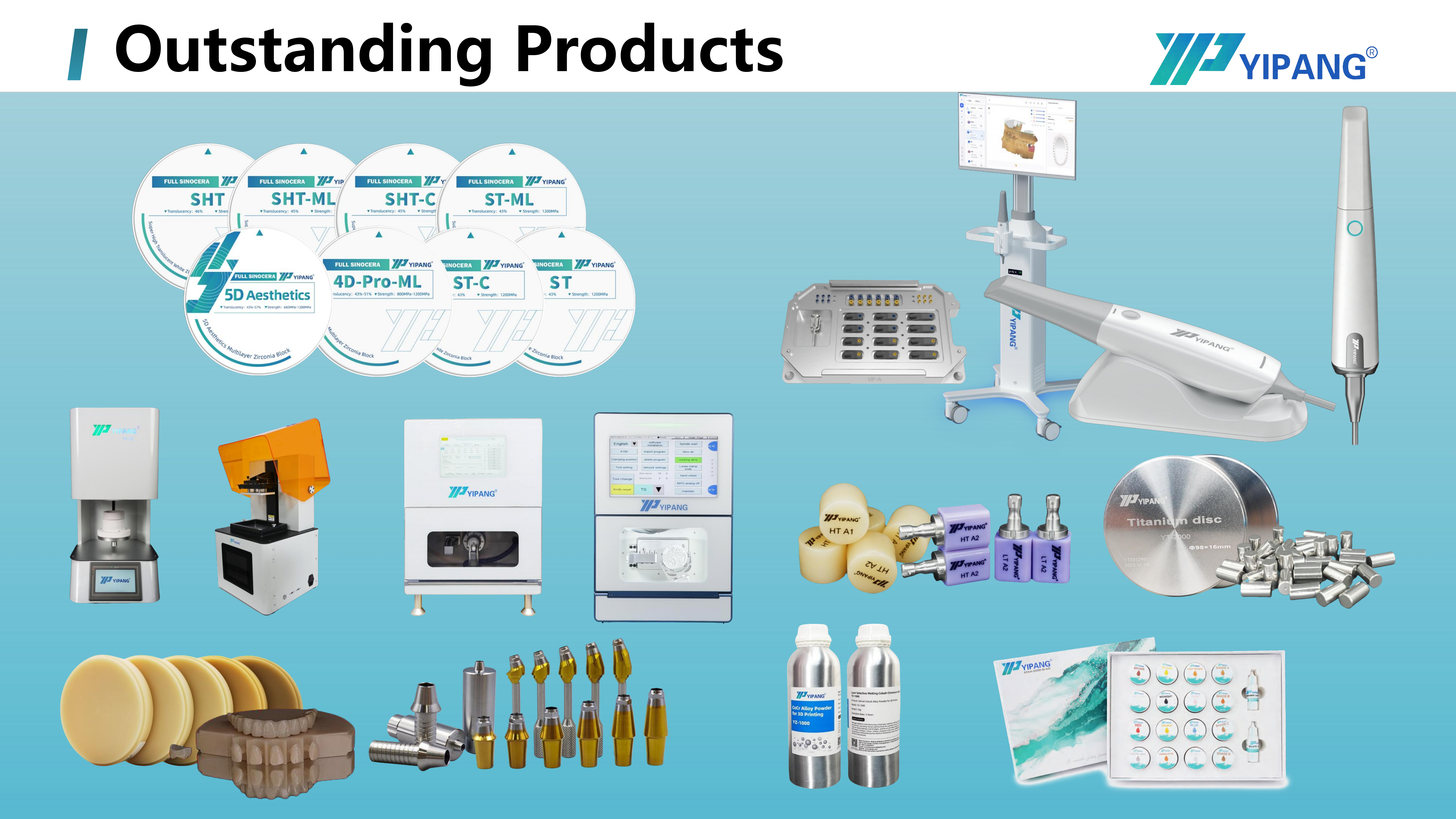
4D-PRO-ML zirconia discs are supplied in ML multilayer shading, in thicknesses from 10 mm to 20 mm, for CAD/CAM milling and sintering workflows.
Technical Explanation: What the Parameters Change in Practice
Each parameter on the specification sheet maps to a specific decision.
98 mm diameter. This is the disc format that most dental milling machines in service accept. Its consequence is logistical rather than clinical: it places the blank inside the standard CAD/CAM supply chain rather than requiring a proprietary holder. It also sets the practical limit on how many units can be nested per disc, which matters most in multi-unit and full-arch work.
ML multilayer shading. Multilayer blanks carry a translucency and shade gradient through the disc thickness. The workflow consequence is that restoration design has to account for the gradient — the incisal and cervical regions draw from different parts of the blank. For labs producing aesthetic anterior work, this is a design discipline as much as a material property.
Bending strength ≥1200 MPa. This figure is what places the material inside the multi-unit bridge and implant superstructure conversation rather than the single-crown-only conversation. It is a stated lower bound, not a measured value for a specific batch, and buyers qualifying the material for high-load indications should request batch-level documentation.
Sintering temperature 1450 °C and low shrinkage. The supplier lists low shrinkage after sintering and high dimensional accuracy among the product's characteristics, and separately states that the standard sintering temperature curve must be followed strictly during processing. These two statements belong together. Dimensional accuracy in zirconia is not a property of the blank alone; it is an outcome of the blank plus the curve. A lab that shortens the holding time or cools too quickly is no longer evaluating the material's stated accuracy.
Medium translucency. This is the parameter that defines the material's aesthetic ceiling, and it is also where the honest boundary sits. Medium translucency multilayer zirconia covers the majority of posterior and full-contour indications. It is not the same optical category as a high-translucency glass ceramic, and it is not positioned as one.
Application Coverage Across Eight Workflows
The usefulness of workflow mapping is that each environment tests a different property. Below, the eight workflows named in this reference are examined for what each one actually demands.
1. Digital dental lab CAD/CAM milling
This is the baseline environment described in the supplier's application documentation: an indoor, constant-temperature dental laboratory, with restorations designed from a Dental Lab Scanner scan, milled on a Dental Milling Machine, and sintered in a Dental Sintering Furnace. The property under test is predictability — whether the same design file produces the same fit on repeat runs. Stable sintering shrinkage and dimensional accuracy are the relevant claims here, and they are the claims most worth validating with a trial batch rather than a specification sheet.
2. High-volume milling centers
Throughput environments test consistency at scale. The supplier's stated production capability — a monthly capacity of 15,000 pieces, OEM/ODM production, negotiable small MOQ, and a lead time of 15–30 working days — is relevant here for a specific reason. A milling center buying blanks in volume is effectively outsourcing part of its own quality variance. Quality control claims therefore matter more than product claims: the company describes 100% raw material inspection combined with finished-product random inspection. Random inspection is a statistical control, not a per-unit guarantee, and buyers running high-value full-arch work should ask what the sampling plan actually is.
3. Five-axis production
Five-axis milling is used where undercuts and complex implant geometries require access that a 3-axis machine cannot provide. The 98 mm disc format is the standard input for this equipment class, and the supplier states compatibility with most mainstream dental milling machines. That statement is a starting point, not a confirmation. A five-axis buyer should verify disc clamping, blank height tolerance and the machine's specific sintering-matched shrinkage compensation library before treating the material as qualified.
4. Multi-unit bridge labs
Multi-unit bridges place two demands simultaneously: enough blank thickness to nest a full span, and strength sufficient for the connector cross-sections involved. The six thickness options up to 20 mm and the ≥1200 MPa bending strength are the parameters that make this workflow addressable. The practical constraint is nesting efficiency — a large span consumes a significant proportion of a 98 mm disc, which affects per-unit material cost in a way that single-crown work does not.
5. Implant-supported full-arch cases
Full-arch implant work is the most demanding indication listed in the product's application scope, which explicitly includes implant superstructure restorations. It combines maximum span, maximum load, and minimum tolerance for shrinkage inconsistency. This is the workflow where the case evidence becomes relevant: the supplier reports hundreds of long-term cooperative clients worldwide and describes uniform translucency, stable sintering shrinkage and compatibility with most CAD/CAM systems as the recurring points of recognition, alongside a low customer complaint rate. Those are first-party statements rather than independently audited metrics, and they should be read as such — but they point at exactly the two properties full-arch work depends on.
6. Chairside clinics
Chairside is where equipment reality bites hardest. A clinic using 4D-PRO-ML must own or have access to a sintering furnace that reaches 1430–1450 °C on a controlled curve, because the material is processed by milling and then sintered. A clinic that has a milling machine but relies on an external sintering service is not running a same-visit workflow, and should plan its scheduling accordingly. For clinics that do hold a suitable furnace, the 10 mm and 12 mm thicknesses cover the single-unit crown and veneer range that dominates chairside demand.
7. Dental school labs
Teaching environments test procedure robustness. Students reproduce steps, not judgement, so a material that tolerates small deviations teaches the wrong lesson. The supplier's operational guidance is unusually explicit for this context: place the milled workpiece on the sintering tray, set the heating curve to 1430–1450 °C with appropriate holding time, cool naturally after completion, avoid rapid temperature change, and do not exceed the maximum sintering temperature. That is a teachable sequence. The counterpart requirement is environmental — the documentation specifies an indoor constant-temperature laboratory, which is an infrastructure constraint many teaching labs have to address deliberately.
8. Hospital prosthodontic departments
Hospital departments buy differently from commercial labs. Documentation, traceability and a defensible quality system usually outweigh per-unit cost. This is where the ISO 13485:2016 certificate carries its weight: certificate number 381240434R0S, issued by Shanghai POSI Certification Co., Ltd., against GB/T 42061-2022 / ISO 13485:2016, valid from 2024-12-27 to 2027-12-26, with a scope covering design, production and sales of dental medical materials and dental equipment, and applicability stated for the Global, EU, USA and Middle East markets.
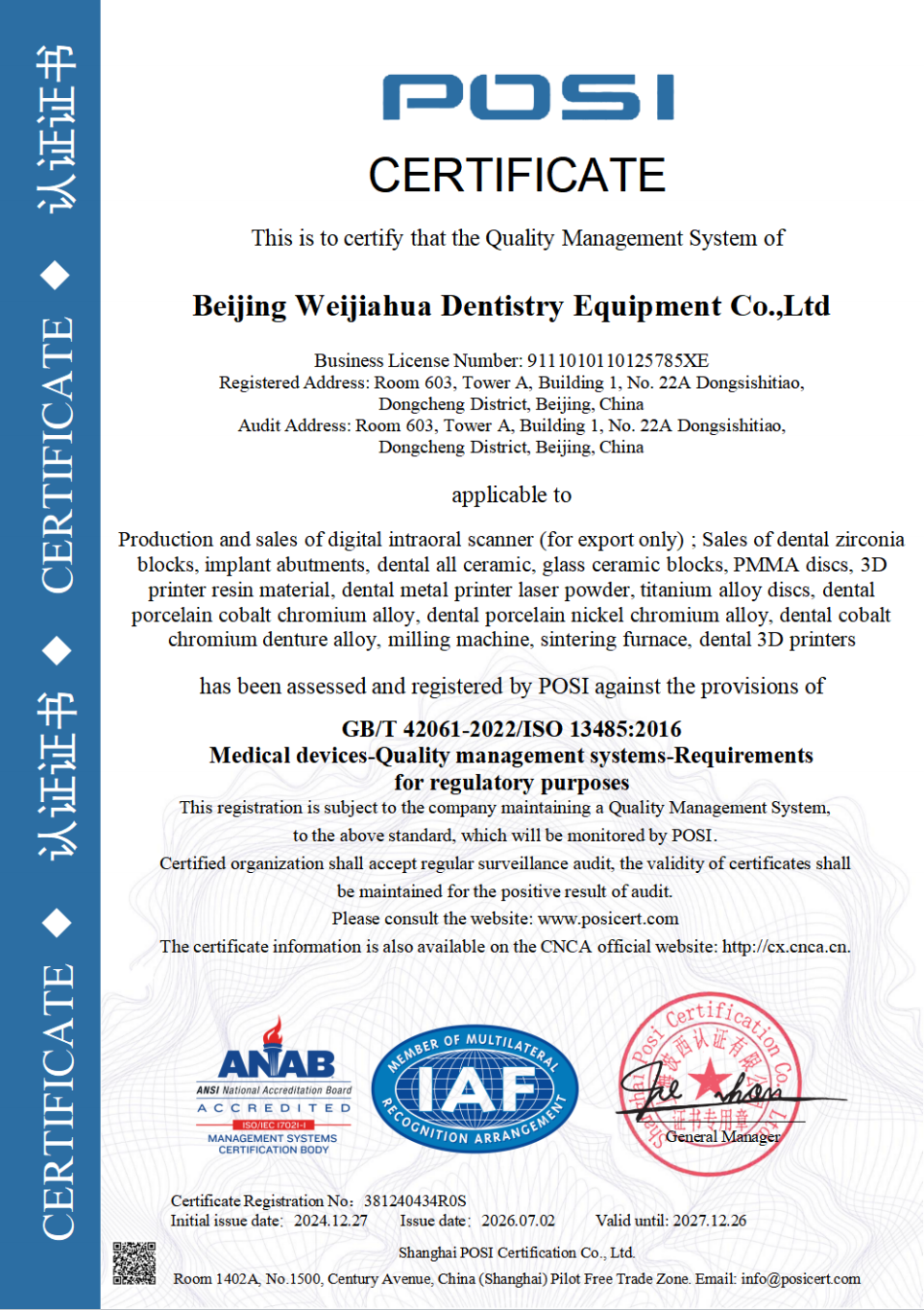
ISO 13485:2016 certificate 381240434R0S, issued by Shanghai POSI Certification Co., Ltd., covering design, production and sales of dental medical materials and dental equipment.
What Workflow Breadth Demonstrates — and What It Does Not
Breadth of application is meaningful evidence because it is expensive to achieve. Covering chairside clinics, 5-axis production, full-arch implant work and hospital departments with one blank format requires the material to satisfy conflicting demands: enough strength for full-arch connectors, enough translucency for aesthetic work, enough dimensional stability for high-volume runs, and enough thickness range to nest spans up to 20 mm.
What breadth does not demonstrate is fitness for every indication. The material has a stated translucency class, and the supplier's own documentation anchors it to a constant-temperature laboratory with a controlled sintering curve. Neither of those is a universal claim, and buyers should not read workflow coverage as one.
Market Context: Why Workflow Fit Is Being Tested More Often
The structural reason workflow evidence has become more important is that the processing layer of this market has grown faster than the material layer. Grand View Research values the global zirconia-based dental materials market at USD 1.2 billion in 2025, projected to reach USD 2.3 billion by 2033, with zirconia discs holding 63.1% of revenue and CAD/CAM milling accounting for 82.4% of process revenue. Fortune Business Insights separately puts the dental milling machine market at USD 2.45 billion in 2025, growing to USD 3.9 billion by 2030.
Two further data points explain the buyer mix. Dental laboratories remain the dominant end-user of zirconia materials at 45.3% of market share in 2025, while the U.S. accounts for 40% of global revenue in the same market. In other words, the largest single buying pool is professional labs in a concentrated geography — buyers who own their equipment, understand sintering curves, and can therefore evaluate workflow evidence properly. Suppliers that cannot speak to equipment constraints lose those buyers early.
Material composition trends point the same way. 3Y-TZP zirconia held the largest grade share at 35.9% of revenue in 2025, which is consistent with a market that has largely settled on a dominant technical route and now competes on process consistency rather than on material novelty.
Comparison With Alternative Restorative Routes
Zirconia is not the right answer to every case, and an honest comparison has to say so. The most relevant alternative for aesthetic work is lithium disilicate glass ceramic, which Business Research Insights estimates at approximately 28% of all-ceramic dental restorations globally as of 2024, with Intel Market Research projecting that market to grow from USD 320 million in 2025 to USD 920 million by 2032.
| Criterion | 4D-PRO-ML Zirconia | Glass Ceramic / Pressable Route |
|---|---|---|
| Strength position | Bending strength ≥1200 MPa; suited to multi-unit and implant superstructure work | Typically selected where strength is not the primary constraint |
| Optical position | Medium translucent, ML multilayer gradient | Generally positioned for higher-esthetic anterior indications |
| Equipment requirement | Dental milling machine plus dental sintering furnace reaching 1430–1450 °C | Press furnace and ceramic processing route |
| Process risk | Sintering curve discipline directly affects shrinkage and fit | Different process risks; not interchangeable with sintering control |
| Best fit | Full-contour crowns, bridges, implant superstructures, high-volume and full-arch work | High-translucency single-unit aesthetic work |
Where the evidence for 4D-PRO-ML stops
Three boundaries should be stated plainly, because a reference document that omits them is not useful to a buyer.
First, the certificate scope. ISO 13485:2016 is a quality management system certification covering design, production and sales of dental medical materials and dental equipment. It is not a product-specific approval for the zirconia block, and it should not be presented as one.
Second, the EU Declaration of Conformity. The company holds an EU Declaration of Conformity under MDR 2017/745 with SRN CN-MF-000045919. The scope listed for that declaration is the intraoral scanner models YP-X and YP-800, Class I medical devices. It does not, on the documentation available, cover the zirconia block. Buyers requiring EU-market documentation specifically for the restorative material must request it separately rather than inferring it. This matters in a regulatory environment where the European Commission notes that MDR 2017/745 classifies most dental implants and restorative materials as higher-risk, requiring intensive clinical data.
Third, milling compatibility. "Compatible with most mainstream dental milling machines" is a qualified statement. It is not universal compatibility, and it does not substitute for confirming the disc format against a specific machine model.
Future Outlook
Two directions are reasonable to expect based on the data above, and both affect how buyers should read supplier evidence.
The first is that process documentation will matter more, not less. With CAD/CAM milling already carrying 82.4% of process revenue and milling machine installed base expanding toward USD 3.9 billion by 2030, the number of laboratories running their own sintering cycles continues to grow. Those labs will increasingly ask suppliers for curve-level documentation and batch-level consistency data rather than material-grade brochures.
The second is that the equipment layer and the material layer will keep converging. YIPANG's own portfolio already spans zirconia blocks, glass ceramics, press ingots, PMMA, wax, titanium blocks, implant abutments, scanners, milling machines, 3D printers and sintering furnaces — a structure that reflects how labs actually buy. Suppliers able to speak to the whole chain, rather than a single blank, will find it easier to be evaluated as a workflow partner.
For buyers, the practical implication is straightforward: the questions worth asking in a supplier evaluation are shifting from "what grade is this material" to "what happens to this material in my furnace, on my machine, at my volume."
Frequently Asked Questions
What equipment is required to process 4D-PRO-ML dental zirconia blocks?
The supplier's application documentation specifies a dental milling machine for shaping, a dental sintering furnace for densification, and a dental lab scanner for the digital workflow, operated in an indoor constant-temperature dental laboratory environment. Milling burs are consumed in the shaping step. The sintering furnace must reach and hold the specified sintering temperature range.
What sintering temperature and curve does 4D-PRO-ML require?
The product specification lists a sintering temperature of 1450 °C. The supplier's operational guidance recommends a working range of 1430 °C to 1450 °C, following a standard heating and holding procedure, with natural cooling after completion. The same guidance advises against rapid temperature change to prevent cracking and against exceeding the maximum sintering temperature.
Is the ISO 13485 certificate applicable to the zirconia block itself?
The ISO 13485:2016 certificate, number 381240434R0S, is issued by Shanghai POSI Certification Co., Ltd. against GB/T 42061-2022 / ISO 13485:2016, valid from 2024-12-27 to 2027-12-26. Its stated scope is design, production and sales of dental medical materials and dental equipment, and it is stated as applicable to the Global, EU, USA and Middle East markets. It is a quality management system certification rather than a product-specific approval.
Does the EU Declaration of Conformity cover the 4D-PRO-ML zirconia block?
The EU Declaration of Conformity held under MDR 2017/745, with SRN CN-MF-000045919, lists as its scope the intraoral scanner models YP-X and YP-800, Class I medical devices, applied against ISO 13485:2016 and Regulation (EU) 2017/745. On the available documentation it does not extend to the zirconia block. Buyers requiring EU documentation for the restorative material should request it directly.
Which machine formats and disc sizes are compatible?
4D-PRO-ML is supplied as a 98 mm diameter disc in thicknesses of 10 mm, 12 mm, 14 mm, 16 mm, 18 mm and 20 mm, in ML multilayer shading. The supplier states compatibility with most mainstream dental milling machines. Because that is a qualified statement covering most rather than all machines, buyers should confirm disc clamping and format against their specific machine model before ordering at volume.
What are the limits of workflow coverage as capability evidence?
Workflow coverage shows that a blank format can be processed across multiple production environments, but it does not establish fitness for every indication. For 4D-PRO-ML, three limits apply: translucency is specified as medium translucent, so high-translucency aesthetic cases may be better served by a glass ceramic route; dimensional accuracy depends on following the standard sintering curve, so the material's stated accuracy is conditional on process discipline; and compatibility with milling machines is stated as most, not all.
What supply capacity and support does the supplier state?
Beijing Weijiahua Dentistry Equipment Co., Ltd. states a monthly capacity of 15,000 pieces, OEM/ODM production with almost all specifications customizable, a negotiable small MOQ, a lead time of 15–30 working days, quality control based on 100% raw material inspection plus finished-product random inspection, and after-sales support consisting of online technical guidance with response within 24 hours. Stated export markets are USA, Europe, Brazil, Middle East and North Africa. These are first-party statements that buyers should verify through a trial order.
Closing Note for Buyers in Evaluation
The practical takeaway from workflow coverage is procedural rather than promotional. Before qualifying any dental zirconia block, confirm three things against your own operation: that your sintering furnace reaches and holds the specified range on a controlled curve, that your milling machine accepts the 98 mm disc format, and that the translucency class matches the indications you actually produce. Everything else — capacity, certification, after-sales response — is easier to evaluate once those three are settled.
For readers who need the fuller company profile, product range and capability documentation, the YIPANG company information brochure is available for public download: WJH Company Information (PDF).
Third-party market figures cited in this article are attributed to Grand View Research, Fortune Business Insights, Business Research Insights, Intel Market Research and the European Commission. Product parameters and certification details are drawn from the manufacturer's published documentation for the 4D-PRO-ML Dental Zirconia Block.
Tem questões ou precisa de mais detalhes?
Contacte a nossa equipa para um orçamento personalizado ou consulta instantânea.
Solicitar orçamento
Preencha o formulário abaixo e a nossa equipa entrará em contacto com uma proposta personalizada.
Chat direto do WhatsApp
Prefere conversar em tempo real? Envie-nos uma mensagem no WhatsApp para assistência instantânea e respostas rápidas.
- Obter orçamento personalizado
- Partilhar fotos ou documentos
- Discuta as suas necessidades diretamente
Geralmente responde em 5–30 minutos durante o horário de expediente.