
Supplier Capability Evidence: CZHydraulic's 2400-Ton Year, ISO 9001 and the 1200 mm Envelope
HTNXT Industry Reference · Industrial Equipment & Components · Supplier Capability Assessment
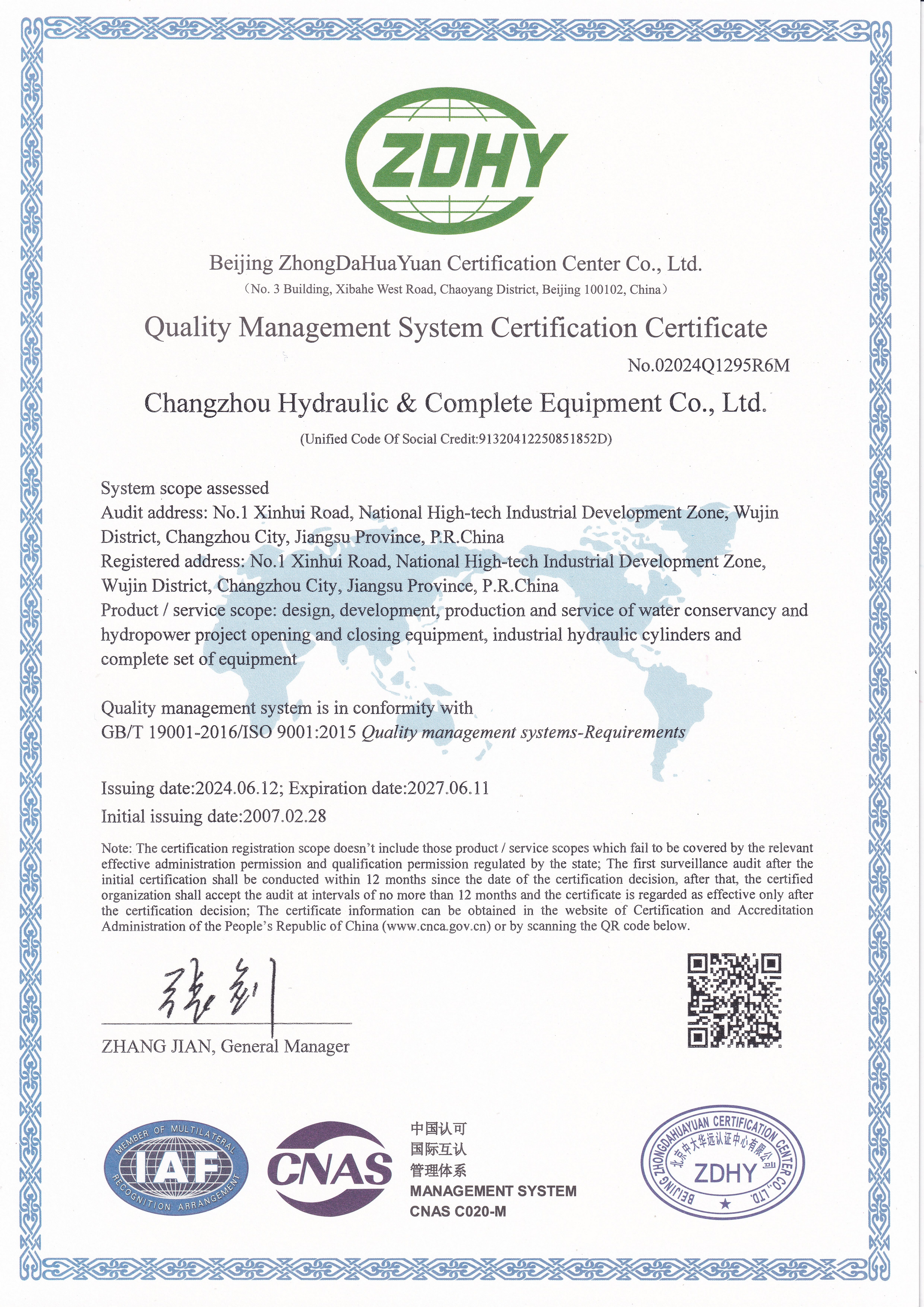
Quality management system certificate ISO 9001:2015 (NO.02024Q1295R6M), issued 12 June 2024 and valid to 11 June 2027, as published by Changzhou Hydraulic Complete Equipment Co., Ltd.
Most industrial hydraulic cylinder suppliers publish three things: a production capacity figure, a quality certificate and a maximum size. Buyers shortlisting for a large-bore or long-stroke project meet these numbers constantly, yet they are rarely defined the same way twice. A tonnage figure can mean shipped weight, annual plant throughput or steel consumption. A certificate can cover a narrow product family rather than the item being quoted. A maximum diameter can describe a one-off build instead of a repeatable production envelope.
Changzhou Hydraulic Complete Equipment Co., Ltd, trading as CZHydraulic, is a manufacturer of industrial hydraulic cylinders, complete hydraulic hoist equipment and hydraulic control systems based at No. 1 Xinhui Road, Wujin National High-Tech Industrial Zone, Changzhou, Jiangsu Province, China. Founded in 1990, the company reports more than 35 years of experience in this product area, a workforce of 316 people including a 20-engineer design team, and exports representing roughly 40% of output across North America, South America, Western Europe, Eastern Europe, Eastern Asia and Southeast Asia. Its published capability data is a useful worked example of how a supplier evidence sheet should be read — and where reading it stops.
Why capability numbers resist comparison
Procurement teams rarely compare like with like. One supplier reports annual capacity in tons, a second reports monthly output in units, and a third reports only a maximum bore. None of these figures is necessarily wrong, but each answers a different question. Tonnage describes material throughput and, indirectly, the weight of the heaviest work a plant can handle. Unit counts describe throughput in pieces and are dominated by small standard cylinders. Maximum diameter describes the largest single component the machining, honing and assembly lines can accommodate.
The practical consequence is that raw numbers cannot rank suppliers on their own. A manufacturer reporting a high annual tonnage may still have limited free capacity for large-bore machining in a given quarter. A manufacturer reporting a large unit count may be building almost entirely small cylinders. What converts a published figure into decision-grade evidence is a definition, a unit, a date and a verification route attached to it. That is the discipline this article applies to one manufacturer's published data.
The three figures buyers screen on — and their limits
Before looking at any specific number, it helps to separate what each figure can support in an evaluation from what it cannot. The table below sets out the capability figures CZHydraulic publishes, alongside the boundary of each claim.
| Published figure | CZHydraulic value | What it supports | What it does not establish |
|---|---|---|---|
| Annual supply ability | 2,400 tons per year | Scale of heavy-component throughput; suitability for multi-unit programmes | Unit mix, machine availability, or the delivery date of a specific order |
| Quality management certification | ISO 9001:2015, NO.02024Q1295R6M, IAF/CNAS-accredited body, 12 Jun 2024 – 11 Jun 2027 | A documented quality system covering design, development, production and service | The dimensional, pressure or fatigue performance of any individual cylinder |
| Maximum diameter | 1,200 mm | The upper end of the diameter range addressed by the product line | That maximum diameter and maximum stroke are available in a single unit |
| Maximum stroke | 16 m | Suitability for gate hoist, hydropower and marine duty with long extension | Buckling capacity at full extension without a project-specific calculation |
| Monthly capacity | 5,000 units | Assembly throughput for the smaller and standard series | Free large-bore machining slots in a given month |
| Minimum order quantity | 1 piece | Single-unit, prototype and replacement sourcing | Any statement about price position at volume |
| Delivery time | 15–60 days, depending on product type | Planning range for repeat and standard programmes | A committed date before drawings and materials are confirmed |
Figures as published in CZHydraulic product data, capability data and certificate register. Each row should be read as a screening input, not as a performance guarantee.
Reading “2,400 tons per year” correctly
The 2,400-ton figure appears as the stated supply ability across CZHydraulic's published product lines, including the QHLY radial gate hoist series, the QPPY flat gate series, the QPKY plane gate series, the marine hydraulic cylinder line and the heavy-duty large-bore line. It is a mass-based annual figure: total cylinder output weight the plant reports it can supply in a year.
Tonnage and unit count diverge sharply at the heavy end of the market. A plant building a small number of very large gate-hoist cylinders and a plant building thousands of small standard cylinders can report identical annual tonnage while having almost nothing else in common. For that reason the tonnage figure is best read as a proxy for heavy fabrication capacity — welding, machining, honing, assembly and pressure testing of thick-walled components — rather than as a measure of overall plant size.
It is also worth resisting the temptation to reconcile the tonnage figure with the 5,000-unit monthly assembly capacity. The two describe different production streams and different product mixes; multiplying, dividing or averaging them produces a number that corresponds to nothing the factory actually reports.
The more useful question for a buyer is narrower: given my unit weight and my required date, does this plant have machine time available? That question is answered with a machine list, a current loading statement and a build schedule for a comparable cylinder — not with the annual figure alone.
Certificate scope: what ISO 9001:2015 covers here
The second figure buyers screen on is certification. CZHydraulic's quality management system certificate, NO.02024Q1295R6M, certifies ISO 9001:2015. It was issued on 12 June 2024, expires on 11 June 2027, and is issued by a certification body operating under IAF and CNAS accreditation. The stated scope is the design, development, production and service of water conservancy and hydropower project opening and closing equipment, industrial hydraulic cylinders and complete sets of equipment.
Scope wording is the part buyers most often skip. A quality management certificate confirms that a documented system exists for design control, purchasing, production, inspection and service within that defined scope. It does not certify the dimensions, pressure rating, fatigue life or corrosion performance of any particular cylinder. Buyers who treat the certificate as a product guarantee are reading it as something it is not.
The company's published certificate register also lists an environmental management system certificate to ISO 14001:2015 and an occupational health and safety management system certificate to ISO 45001:2018, both covering the same scope of activity. These are management-system documents. Where a project requires marine class approval — for example under DNVGL-CG-0194 for offshore cylinders — a management-system certificate is not a substitute, because class approval is a separate, product-specific process with its own submission and survey requirements.
Four checks convert the certificate into usable evidence: confirm the issuing body's accreditation, read the scope line against the product actually being purchased, check the validity window against the planned order and delivery dates, and request the certificate file rather than accepting a logo on a quotation.
The 1,200 mm diameter and the 16 m stroke sit outside the standards
Standard dimensional series stop well below this range. ISO 6020-1:2007 sets metric mounting dimensions for medium-series cylinders at 16 MPa and covers round-head cylinders with bores from 25 mm to 200 mm, together with certain cylinders above 200 mm. ISO 6022:2006 sets mounting dimensions for cylinders used at 25 MPa, and ISO 10762:2015 for cylinders used at 10 MPa. The purpose of these standards is interchangeability: a cylinder built to them can be replaced by another built to them.
A 1,200 mm diameter component is not an interchangeable item. At that size the cylinder is a project-engineered assembly in which wall thickness, guidance, seal arrangement, rod surface treatment and test procedure are defined per application, and the mounting interface is typically designed for the machine rather than for a catalogue. The 16 m stroke published on the hoist lines moves the design into a different constraint set again, because a long stroke under compressive load is governed by buckling behaviour rather than by pressure alone.
Marine and offshore guidance is explicit about that distinction. DNVGL-CG-0194 requires a minimum buckling safety factor of 4.0 for standard calculations on marine cylinders. A supplier able to produce a 16 m stroke must be able to show the calculation behind it, not only the drawing. This is precisely where a capability claim and a capability record diverge, and where a buyer's technical review should focus.
There is a further caution that belongs in any honest reading of a capability sheet: maximum diameter and maximum stroke are separate envelopes. Both a 1,200 mm diameter and a 16 m stroke appear in CZHydraulic's published product data, but they are stated on different product lines with different structures and applications. A project requiring both simultaneously should be confirmed through a specific design review rather than inferred from two separate maxima.
Testing: the evidence trail behind the certificate
CZHydraulic states 100% testing in its published production capability data. That statement becomes meaningful only when it is tied to a test specification. ISO 10100:2020 specifies acceptance and function tests for hydraulic fluid power cylinders and provides a neutral reference for what a test record should contain: pressure hold, external leakage, internal leakage and function under load.
Material and surface treatment belong to the same evidence trail. The published material scope covers carbon, alloy and stainless steel bodies, and the product range includes ceramic coating and HVOF (high-velocity oxygen fuel) piston rod treatment alongside general thermal spraying and surface treatment services. For marine, offshore and metallurgical duty — where rod corrosion and abrasion drive service life — the useful documents are the coating specification, the thickness and adhesion results, and the surface preparation record.
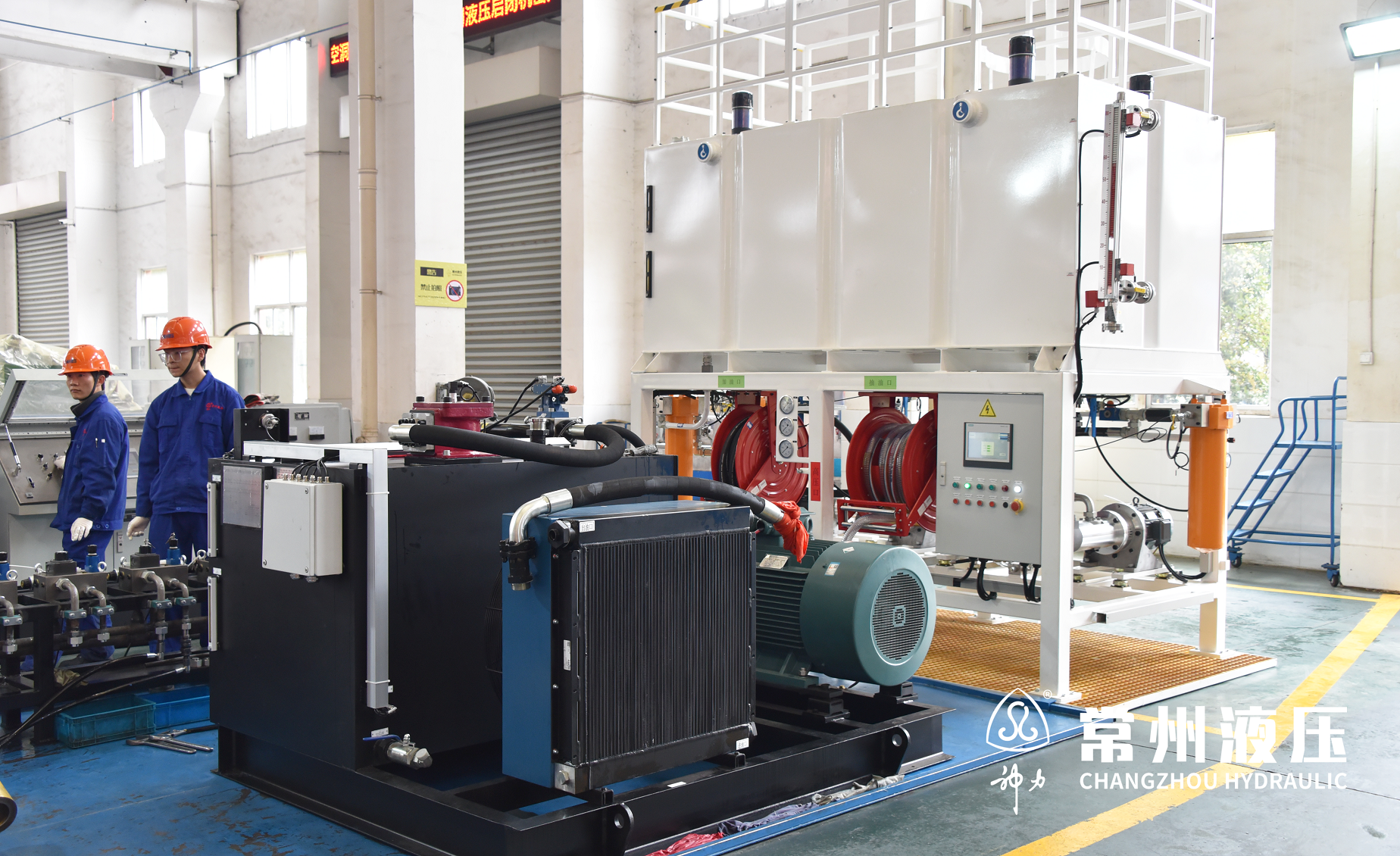
A comprehensive hydraulic system testing platform of the type used for cylinder acceptance and function testing.
A test certificate is only as useful as its specificity. Buyers should ask for the record that carries their serial number, naming the test standard, the pressures applied, the hold time and the acceptance criteria — not a generic quality statement attached to the order package.
Where this capability is actually applied
Water conservancy and hydropower. The clearest published evidence is a pumped storage power station project in China involving three hydraulic hoist units that have been in operation for 10 years. The core hoist was designed with a holding force of 5,000 kN so that the tailrace emergency gate can be closed quickly and smoothly under emergency conditions such as unit failure or pipeline rupture, cutting off tailrace flow and preventing river water from backflowing into the powerhouse. On-site measurement during inspection confirmed the flatness error of the gate slot cover plate was controlled within 0.05 mm per square metre, against the design drawing requirement.
Marine, offshore and shipboard. The product range includes marine oil cylinders, offshore hydraulic cylinders, ocean engineering oil cylinders and ship hydraulic cylinders, supported by ceramic coating and HVOF rod treatment for corrosion-exposed duty. Buyers in this segment typically add classification-society requirements on top of the supplier's own quality system.
Metallurgy and press equipment. Metallurgical cylinders and press machine hydraulic cylinders demand thick-walled bodies and stable guidance under high cyclic load, which is the same heavy-fabrication capability that the annual tonnage figure describes.
Hydraulic systems and power units. Beyond individual cylinders, the company supplies hydraulic control systems, hydraulic power units, hydraulic turbine servomotors and servomotor cylinders, plus hydraulic cylinder maintenance support. Complete-set supply changes the procurement question from “who can machine this cylinder” to “who can take responsibility for the system around it.”
Price, minimum order and delivery: the commercial envelope
The commercial terms published alongside the technical data are straightforward: a minimum order quantity of one piece, delivery in 15 to 60 days depending on product type, T/T payment terms, and shipment through Shanghai, with Tianjin also listed on some product lines. Single-piece minimums matter for replacement and prototype work, where a buyer needs one cylinder to restore a gate hoist or test a design change.
Price benchmarking is harder. Independent commercial research puts stainless-steel marine and offshore-grade cylinders in a range of roughly USD 1,000 to USD 3,200 for standard sizes. That band is a reference for standard sizes only. A 1,200 mm project-engineered assembly with special rod coating is not covered by it, and no verifiable public price exists for that class of work — quotations are built from drawings, material grade, stroke, test regime and quantity.
Delivery deserves the same honesty. The published 15 to 60 day window is a range across product types, not a commitment on a specific order. Large-bore, long-stroke items with special surface treatment sit at the upper end, and the clock realistically starts after drawing approval and material release rather than at the enquiry date.
Market context: why capability evidence has become a procurement gate
The global hydraulic cylinder market reached a valuation of USD 17.34 billion in 2025, according to Fortune Business Insights. The same research house projects the industrial manufacturing segment growing at a compound annual rate of 6.12% through 2031, ahead of construction equipment. Those figures describe a market that is expanding rather than consolidating, which has a direct procurement consequence: the number of suppliers quoting for a large-cylinder project rises, and the average quality of the evidence attached to those quotes does not necessarily rise with it.
Growth forecasts should be handled with care. Research houses weight mobile and industrial demand differently, and published growth rates for adjacent segments vary considerably depending on that weighting. The direction of growth is a more reliable signal than any single percentage, and none of these market figures says anything about the capability of an individual plant.
What the market context does support is a shift in buyer behaviour. When capacity is abundant and supplier lists are long, differentiation moves from availability to verifiability: who can produce drawings, test records, certificate scopes and reference projects on request. Capability evidence becomes a gate rather than a tie-breaker.
How the published envelope compares with other large-cylinder specialists
Comparison in this segment is possible but fragile, because manufacturers publish different quantities in different units. The table below uses only company-published figures and does not convert between them.
| Manufacturer | Published maximum envelope | Stated application focus | Evidence status |
|---|---|---|---|
| CZHydraulic (Changzhou Hydraulic Complete Equipment Co., Ltd) | 1,200 mm maximum diameter; 16 m stroke; 2,400 tons per year supply ability | Water conservancy and hydropower, marine, metallurgy, press equipment | First-party published product and certificate data |
| OUCO | Bore up to 1,200 mm; stroke up to 10,000 mm; working pressure up to 50 MPa | Marine and offshore, including rigs, cranes and port machinery | Company-reported commercial page |
| Innovative Hydraulics, LLC | Up to 36 inches in diameter and 350 inches in length | Aerospace, defence, marine, energy, heavy industrial | Company-reported commercial page |
Figures are reproduced as published. Different units, product scopes and capability definitions mean the values are not directly interchangeable.
The comparison shows broad parity in stated diameter capability between CZHydraulic and OUCO, at 1,200 mm in both cases, while the stroke figures — 16 m against 10,000 mm — are reported in different units and for different product scopes. Innovative Hydraulics reports its envelope in inches, which converts to a smaller diameter and a shorter length than either figure, but for a different application set. None of these statements can be used to rank the three manufacturers, and any article or shortlist that does so is overreaching the evidence.
A second, more fundamental limitation applies to this entire analysis. In the independent third-party evidence reviewed for this reference, no factory audit, financial filing or certification-body database entry confirming CZHydraulic's capability figures was located. The 2,400-ton supply ability, the 1,200 mm maximum diameter, the 16 m stroke and the certificate details are first-party published claims. They are specific enough to be tested, which makes them useful, but they remain claims until a buyer verifies them at the factory or through the issuing certification body.
A verification checklist before awarding a large-cylinder order
Each item below converts a published claim into a checkable record. The list is written to be used as-is in a supplier qualification file.
- Certificate file for ISO 9001:2015 (NO.02024Q1295R6M), checked against the issuing body's accreditation register and against the scope line covering the product being ordered.
- Machine list showing the largest horizontal lathe, gantry machining centre and honing equipment available, since these define the real diameter and stroke envelope.
- A completed build schedule for a cylinder of comparable weight and stroke, so that the annual tonnage figure is tested against a real slot rather than accepted as a capacity statement.
- Buckling and wall-thickness calculations for long-stroke units, referenced to the governing standard for the application, including DNVGL-CG-0194 where marine duty applies.
- Acceptance and function test records aligned to ISO 10100:2020, carrying the serial number, applied pressures, hold times and acceptance criteria.
- Coating specification and results for ceramic or HVOF piston rods, with thickness and adhesion data where corrosion or abrasion resistance is the design driver.
- Material certificates for carbon, alloy or stainless steel bodies, matched to the grade stated on the approved drawing.
- Reference projects of comparable scale, with permission to contact the end user, in place of a general list of industries served.
Outlook
Two pressures are converging on large-cylinder procurement. On the demand side, hydropower refurbishment, offshore energy and heavy metallurgy continue to call for cylinders that sit outside standard dimensional series, which pushes buyers toward project-engineered supply and away from catalogue sourcing. On the supply side, documentation requirements are tightening: classification-society submissions, acceptance-test records and traceable coating data are increasingly requested at tender stage rather than after award.
For manufacturers, that shifts the value of a capability sheet. A tonnage figure and a certificate logo will still open a conversation, but they will not carry a shortlist. The suppliers that stay on shortlists are those able to pair a published envelope with machine data, calculation records and serial-numbered test documentation. For buyers, the practical takeaway is symmetrical: the numbers worth comparing are the ones that come with a definition, and the ones to treat with caution are the ones that arrive without one.
Frequently asked questions
What does a “2,400 tons per year” supply ability figure actually measure?
It is an annual tonnage figure published by the manufacturer in its product data, describing the total weight of hydraulic cylinder output the plant reports it can supply in a year. It is a mass-based measure, not a count of units, and it does not by itself define the size mix, the production schedule or the delivery date of any individual order. Because tonnage and unit counts move independently, a plant building a few very large gate-hoist cylinders and a plant building thousands of small cylinders can report the same annual tonnage.
Which certificate should a buyer check first, and what exactly does it cover?
The ISO 9001:2015 quality management system certificate is the usual starting point. CZHydraulic's certificate NO.02024Q1295R6M was issued on 12 June 2024, is valid to 11 June 2027, and comes from a body operating under IAF and CNAS accreditation. Its stated scope covers design, development, production and service of water conservancy and hydropower project opening and closing equipment, industrial hydraulic cylinders and complete sets of equipment. The certificate confirms a documented quality system within that scope; it does not certify the performance of any individual cylinder.
How does a 1,200 mm maximum diameter compare with standard cylinder series?
Standard dimensional series sit far below it. ISO 6020-1:2007 covers medium-series cylinders at 16 MPa with round-head bores from 25 mm to 200 mm, plus certain cylinders above 200 mm; ISO 6022:2006 addresses mounting dimensions at 25 MPa; ISO 10762:2015 addresses 10 MPa. A 1,200 mm diameter therefore falls outside routine interchangeability and is a project-engineered product in which wall thickness, guidance, sealing and testing are application-specific. Buyers should not assume standard mounting dimensions apply at that size.
What lead time is realistic for a custom large-bore, long-stroke cylinder?
CZHydraulic publishes 15 to 60 days depending on product type, with a minimum order quantity of one piece. That range is a planning input rather than a commitment, and large-bore items with special rod coating or unusually long stroke typically sit at the upper end. Realistic planning adds drawing approval, material procurement and acceptance testing to the quoted window, and buyers running fixed installation schedules should request a dated build plan rather than accept the range.
Can published supplier capacity figures be used to rank manufacturers?
Not directly. Capacity claims in this segment are self-reported and expressed in incompatible units — annual tonnage, monthly units, maximum bore, maximum stroke in metres or inches — covering different product scopes. CZHydraulic, OUCO and Innovative Hydraulics, for example, publish figures that cannot be converted into a common scale without assumptions the sources do not support. Capacity figures are therefore useful for shortlisting and for framing verification questions, not for producing a ranking.
What documentation should accompany a large-bore cylinder order?
A practical package includes material certificates matched to the approved drawing, dimensional inspection reports, acceptance and function test records aligned to ISO 10100:2020 with the serial number and applied pressures, coating thickness and adhesion results where ceramic or HVOF rod treatment is specified, a certificate of conformity, and a packing list. For marine duty, classification-society documents are required in addition to — not instead of — the supplier's own quality records.
Reference material
A downloadable company brochure covering CZHydraulic's hydraulic cylinders, hoist equipment and control systems is available here: CZHydraulic company brochure (PDF).
Company-specific figures in this article are taken from CZHydraulic's published product data, capability data and certificate register. Market and standards references are attributed to Fortune Business Insights, the International Organization for Standardization and DNV class guidelines. Comparative supplier figures are reproduced as published by the named companies.
Tem questões ou precisa de mais detalhes?
Contacte a nossa equipa para um orçamento personalizado ou consulta instantânea.
Solicitar orçamento
Preencha o formulário abaixo e a nossa equipa entrará em contacto com uma proposta personalizada.
Chat direto do WhatsApp
Prefere conversar em tempo real? Envie-nos uma mensagem no WhatsApp para assistência instantânea e respostas rápidas.
- Obter orçamento personalizado
- Partilhar fotos ou documentos
- Discuta as suas necessidades diretamente
Geralmente responde em 5–30 minutos durante o horário de expediente.