
Supplier Capability Evidence Checklist for Electric Toothbrush Buyers
HTNXT · Independent Industry Reference · Oral Care Manufacturing

An electric toothbrush sourcing decision at the evaluation stage rarely fails because a factory cannot build the device. It fails because the buyer cannot separate declared performance from verifiable performance before the purchase order is issued. A published 40,000 vibrations-per-minute figure, an IPX7 rating and a DuPont bristle reference only become decision-grade evidence when each is tied to a specific model, a test method and a document that can be requested.
The commercial context makes that discipline more valuable rather than less. Grand View Research valued the global electric toothbrush market at USD 4.3 billion in 2024 and projects USD 6.8 billion by 2030, a 7.8% compound annual growth rate across 2025–2030. Asia Pacific accounted for 34.2% of 2024 revenue in the same dataset. Buyers therefore review a large share of their model-level evidence from a region where specification conventions vary widely between suppliers, and where two datasheets can look identical while supporting very different levels of proof.
This reference converts one manufacturer's published electric toothbrush portfolio into a working checklist. It is written for OEM and private-label buyers who already have a shortlist and now need to test whether the specification set in front of them can carry the claims they intend to put on packaging.
The specification gap that stalls evaluation orders
Feature vocabulary is not a parameter. Terms such as smart, sonic, professional-grade or deep-clean describe positioning, not measurable output, and they survive translation between suppliers because nobody can test them. Parameters such as vibration frequency, swing amplitude, torque, battery capacity, charging interface and ingress protection can be tested, which is exactly why they are the only claims worth anchoring a comparison on.
In practice, buyer-side evidence falls into four classes that carry different verification costs:
- Declared performance values such as frequency, amplitude and torque. These are model-level and checkable against a sample, but only if the test protocol is stated.
- Hardware configuration such as battery capacity, charging interface and water-resistance rating. These are visible on the bill of materials and auditable at the line.
- Material and consumable choices such as bristle supplier, bristle end-rounding and TPE-wrapped heads. These affect gum safety and repeat-purchase economics, and are usually supported by material certificates rather than product datasheets.
- System-level claims such as monthly capacity, certification scope and quality-control steps. These are organisational, cannot be confirmed from a sample, and require documents and an audit.
The recurring failure mode is a shortlist where all four classes are blended into a single marketing page. The buyer then evaluates a device and a company at the same time, and the comparison collapses into price.
What RISUN publishes at model level
RISUN (Shenzhen Risun Technology Co., Ltd.) is a Shenzhen-based oral care manufacturer founded in 2006 that develops and produces electric toothbrushes and water flossers for OEM and ODM programmes, and states that it operates manufacturing in Shenzhen and Nanchang in China and in Vietnam. The company reports more than 100 R&D engineers and 800+ patents, and states that it participated in the formulation of electric toothbrush and water flosser standards with the China Household Electrical Appliances Association (CHEAA), where it is a council member and deputy director of the association's Beauty and Health Personal Care Committee.
For a buyer at the evaluation stage, portfolio breadth is the least useful thing about that profile. The useful part is that the portfolio is documented at model level, which allows a one-to-one mapping between a claim and a check.
| Model | Motion and published output | Battery, charging, runtime | Water and material notes | Published fit |
|---|---|---|---|---|
| T2407 | Dual-action oscillation plus sonic vibration, 60° ultra-wide swing, up to 40,000 vibrations per minute, 300 gf.cm torque | 800 mAh, wireless induction charging, up to 25 days at 2 minutes twice daily | IPX7; food-grade TPE-wrapped brush head; Clean, Soft, Whiten, Massage and Polish modes | Premium plaque removal and gum protection |
| T2422 (Sonic Sweep) | Sonic vibration with 8° micro-oscillation, 290–333 Hz, approximately 17,400–20,000 vibrations per minute | 800 mAh, wireless induction charging, at least 22 days at 4 minutes daily, full charge in 16 hours or less | IPX7; five modes including a dedicated Sensitive mode | Sensitive gums and high-volume retail |
| T2428 | Sonic, 40,000 vibrations per minute | Wireless charging, 30-day battery life | IPX7; five modes, three-colour pressure indicator, LCD display | Smart retail segment |
| T2426 | Sonic, 40,000 vibrations per minute, 7X cleaning power versus manual brushing | Four-hour fast charge, 60-day battery life | Five modes × three intensity levels, triple pressure sensor, six-zone brushing report, brush-head reminder, lift-to-wake, flight mode | Tech-forward premium lines and family use |
| T2233 | Oscillating, 8,800 oscillations per minute | DC charging, 30-day battery life | IPX7; three modes (Clean, Soft, Massage), two-minute timer with 30-second interval alert | Entry tier and first-time users |
| T2238 | Rotating, 8,800 oscillations per minute, 70 dB start-up noise | USB Type-C, full charge in five hours, up to 120 days on Soft mode | IPX7; imported DuPont bristles, 16° angled head, icon-based interface and one-piece button | Travel, youth and gift channels |
| T2132 | Pulse motor, 55 dB low-noise operation | Compact format | Two modes (Clean, Whiten) | Beginners and travel kits |
| T2409 | Sonic, 38,000 vibrations per minute | USB Type-C charging | LCD colour screen | Cost-controlled smart line |
| T2820 | Ultrasonic wave technology at 1.6 MHz | Charging base with 10-minute UV sterilisation cycle | TPE-coated handle | Clinical and advanced oral care positioning |
The portfolio also lists T2431B0, T2425, T2432, T2411, T2433, T2231 and T2232 as electric toothbrush models without parameter-level detail in the same published set. That gap is not a defect to be explained away; it is a checklist item, and buyers should request the datasheet and test summary for those SKUs before including them in a quotation comparison.
Reading the numbers correctly
Frequency, amplitude and torque are three different claims
Vibration frequency describes how many cycles the drive produces per minute. Amplitude, expressed here as a swing angle, describes how far the bristles travel per cycle. Torque describes how much load the drive can carry before stalling. A model can be strong on one and weak on another, which is why the T2407 and T2422 comparison is instructive: T2407 combines a 60° swing with up to 40,000 vibrations per minute and 300 gf.cm of torque, while T2422 pairs a narrow 8° micro-oscillation with roughly 17,400–20,000 vibrations per minute. The two devices are not different grades of the same design; they are different mechanical architectures serving different price positions.
Battery capacity means nothing without a runtime protocol
Published battery configurations across the portfolio include 600 mAh, 650 mAh and 800 mAh lithium-ion cells. Runtime figures only become comparable when the protocol is attached. T2407 and T2422 both use an 800 mAh cell, yet the published runtimes are up to 25 days at two minutes twice daily for T2407 and at least 22 days at four minutes daily for T2422. Read on a like-for-like basis, the higher-output dual-action model returns a slightly longer service interval than the lower-frequency model, which indicates that power management rather than cell capacity is the differentiating variable. A buyer who compares only milliamp-hours will mis-rank the two.
The charging interface is a sealing decision and a market-access decision
Three interfaces appear across the range. Wireless induction charging, used on T2407, T2422, T2428 and T2426, removes exposed contacts so the handle stays sealed. USB Type-C appears on T2238, with a five-hour full charge, and on T2409. DC charging remains on T2233. Inductive charging is the strongest answer to bathroom moisture; Type-C is the strongest answer to regulatory convergence. Under the amended EU Radio Equipment Directive, small electronic devices — a category that includes electric toothbrushes — are required to adopt USB-C charging, with the requirement effective from 28 December 2024. Buyers selling into the EU should confirm which interface the target SKU declares rather than assuming the platform is interchangeable.
IPX7 covers the handle, not the charging base
All RISUN devices are published as IPX7, which supports rinsing and shower use. The charging base is a separate rating: published guidance states that IPX4 charging bases must stay dry. That distinction belongs in packaging copy and user instructions, because a retailer return caused by a wet base is a specification failure even when the handle performed correctly. Related firmware behaviour is also worth testing on a sample: the device includes a charge-disable function and will not operate while sitting on an active charger, and low battery is signalled by a fast-flashing indicator before automatic shutdown.
Bristles and head construction are consumable economics
Bristle references in the portfolio include imported DuPont bristles with a 16° angled head on T2238, food-grade TPE-wrapped heads on T2407 for gum protection, and Pedex bristles whose colour fades as a replacement reminder. Copper-free tufting is also documented as a head construction method that removes the internal metal cavity used to anchor bristles, reducing a corrosion and hygiene dead zone. For a private-label buyer, these choices drive replacement-head attach rates and complaint rates far more than they drive the initial unit price.
Interaction details that determine perceived quality
Mode memory means the handle resumes the last mode used instead of defaulting to Clean, and a three-second press powers the unit down without cycling through every mode. A two-minute timer with a 30-second quadrant alert is standard on models such as T2233. None of these features is expensive to include, but each is immediately noticeable in a retail demo, and each should be verified on a working sample rather than accepted from a feature list.
The evidence checklist: mapping each claim to a question
The table below is the working version of this article. Each published evidence point is paired with what it actually proves and the document or sample check that converts it into decision-grade proof.
| Published evidence | What it proves | Check to request |
|---|---|---|
| Motion type and frequency (40,000 vpm; 8,800 oscillations; 1.6 MHz ultrasonic) | Cleaning mechanism and target user segment | Test report stating whether frequency is measured at the motor or at the brush head |
| Swing amplitude (60° versus 8°) | Coverage per stroke and mechanical complexity | Confirmation that the angle is mechanical, plus a loaded-run demonstration |
| Torque output (300 gf.cm) | Stall resistance under brushing pressure | Loaded-operation test rather than free-run specification |
| Battery capacity and runtime (800 mAh; 25 days; 22 days; 120 days) | Charging frequency and user experience | The runtime protocol (mode, minutes per session, sessions per day) |
| Charging interface (inductive, USB Type-C, DC) | Sealing strategy and EU market access | Declared interface per SKU and the IP rating of the matching base |
| IPX7 handle rating | Rinsing and shower use | Test method and confirmation of which parts carry the rating |
| Bristle and head materials (DuPont, Pedex, food-grade TPE) | Gum safety, wear indication, replacement economics | Material certificates and brush-head retention force data |
| Modes, mode memory, timers, charge-disable | Perceived quality and user compliance | Sample test of mode memory, quadrant alerts and charging lockout |
| Pressure sensing (triple sensor; three-colour indicator) | Gum safety and premium positioning | Documented thresholds and the type of feedback delivered |
| Quality system (27 QC steps, SAP-driven JIT, 31 lines) | Delivery reliability and defect containment | Factory audit, line observation and a capacity letter |
| Certifications (ISO 9001:2015, ISO 13485:2016, MDSAP, FDA registration, CE, RoHS, FCC) | Market-access eligibility claims | Certificate numbers, issuing bodies, scope, validity dates and model mapping |
| MOQ, lead time, warranty (1,000–3,000 units; 30–45 days; one year) | Commercial feasibility of the launch | Written quotation with terms, not a catalogue statement |
Application fit by channel and model
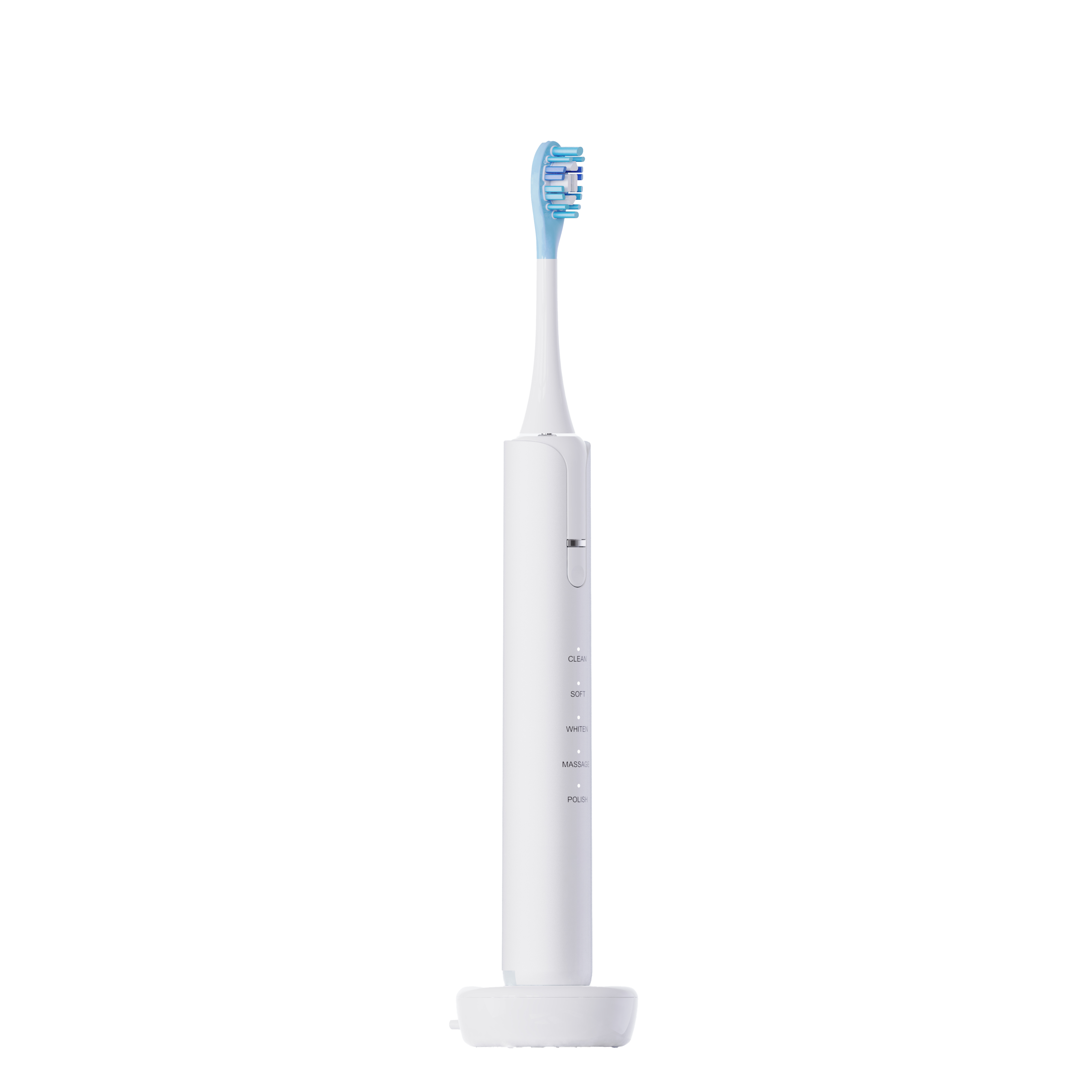
Application fit is where specification choices become channel decisions. RISUN's published scenario data names dental clinics, brick-and-mortar retail and home care as primary environments, with replaceable heads available in imported DuPont bristles or food-grade TPE-wrapped construction, and with a requirement to comply with local oral product safety regulations in markets including the UK, US, Canada, Australia, France, Germany and Italy.
- Dental clinics and professional channels. Output stability, pressure feedback and head hygiene dominate. T2407 with 300 gf.cm torque and a TPE-wrapped head, or T2820 with 1.6 MHz ultrasonic waves and a UV-sterilising base, fit this environment better than entry-tier oscillating models.
- Private label and brand-owner programmes. The decisive variables are BOM flexibility and documentation. T2422 offers a mature sonic platform with a Sensitive mode for cost-sensitive programmes; T2407 carries a higher BOM because of the dual-action motor, the 60° mechanical structure and the wrapped head.
- E-commerce and mass retail. Feature density per price point matters more than absolute performance. T2233 at 8,800 oscillations per minute with three modes and a two-minute timer anchors the entry tier, while T2409 at 38,000 vibrations per minute with an LCD screen and Type-C charging anchors the value-smart tier.
- Travel and gifting. Battery interval and portability decide. T2238's 120-day runtime on Soft mode and Type-C charging, or T2132's 55 dB compact format, serve these baskets without premium tooling.
- Adjacent category bundling. Oral irrigators are published alongside the toothbrush range, including ozone-based sterilisation on F5043A and UV sterilisation with a 10-minute storage cycle on F5056. Bundling is a channel decision, not a substitution for toothbrush specification review.
Market signals shaping specification decisions
Three external signals are changing what buyers must ask for, independent of any single supplier.
The first is charging convergence. The EU requirement for USB-C on small electronic devices, effective from 28 December 2024, converts the charging interface from an engineering preference into a market-access variable for European distribution. A portfolio that spans inductive, Type-C and DC charging is an advantage only if the buyer maps the correct interface to the target market at quotation stage.
The second is regulatory classification. Electric toothbrushes are classified by the US FDA as Class I or Class II medical devices depending on technology and claims, under 21 CFR 872.6865. The classification follows the claims made for the device, which means marketing copy can change the documentation burden. Buyers should confirm classification before finalising packaging language.
The third is category growth. The 7.8% CAGR projected for electric toothbrushes to 2030 sits alongside a water flosser market valued at USD 1.06 billion in 2025 and projected at USD 1.64 billion by 2034 by IMARC Group. Growth of that order rewards suppliers who can document repeatable specifications, and it also invites capacity commitments that should be supported by audit rather than by catalogue claims.
Evidence-based selection versus price-first sourcing
Traditional price-first sourcing treats the quotation as the primary document and the specification as a formality. It is faster, and for genuinely commodity configurations it can be adequate. Its weakness appears after launch, when a frequency claim cannot be substantiated, a charging base fails in a wet bathroom, or a certificate turns out to cover a different model than the one shipped.
The evidence-first approach used in this article reverses the order: specifications and their proofs are established first, and price is compared only between configurations that have passed the same checks. It is slower at the front end and typically produces fewer, better-documented SKUs.
The limits of the RISUN evidence set should be stated as plainly as its strengths:
- Parameter depth is uneven. Several listed models, including T2425, T2432, T2411, T2433, T2231 and T2232, appear in the portfolio without published parameter-level detail. They cannot be compared on equal terms until datasheets are supplied.
- Organisational claims are company-published. The stated monthly capacity of 1.3 million electric toothbrushes and 1.3 million water flossers, the 31 production lines and the 27 QC steps are self-reported, and the cited material does not include certificate numbers, issuing bodies, scope or validity dates. These must be converted into documents during supplier qualification.
- Higher specification carries higher cost. T2407's dual-action motor, 60° mechanical structure and TPE-wrapped head place it above entry-tier pricing. It is not a substitute for a value SKU, and buyers targeting opening price points should treat T2233 or T2422 as the appropriate platform.
- Commercial terms constrain small launches. Published lead times of 30–45 days and MOQs generally starting from 1,000–3,000 units are incompatible with very small test batches.
- Water-resistance scope is narrower than marketing suggests. IPX7 applies to the handle; IPX4 charging bases must remain dry.
- Frequency is a motor-level figure unless stated otherwise. Delivered amplitude at the brush head depends on the transmission design, so a test on the assembled sample remains necessary.
What changes in the next buying cycle
The direction of travel is toward specifications that were previously premium becoming baseline. Pressure sensing, multi-intensity modes, LCD feedback and brushing reports already appear on T2426 and T2428 at 40,000 vibrations per minute, and the same logic is visible in the value tier where T2409 combines 38,000 vibrations per minute, an LCD screen and Type-C charging. Buyers planning 12-month programmes should assume that a 2024 mid-tier specification will read as entry tier by the next renewal.
Two further shifts are worth tracking. Ultrasonic platforms such as T2820 at 1.6 MHz, paired with a UV-sterilising charging base, extend the range into clinical positioning where documentation, not feature count, decides the sale. And manufacturing footprint is becoming a risk variable in its own right: RISUN states operations across Shenzhen and Nanchang in China and a Vietnamese base established in 2023, which matters to buyers modelling tariff and continuity exposure, provided the capacity behind each site is verified rather than assumed.
None of these shifts removes the underlying discipline. The supplier that wins the next cycle will not be the one with the longest feature list, but the one whose claims survive a documented check.
Frequently asked questions
How should an OEM buyer compare sonic and oscillating electric toothbrush models for a private-label line?
Compare motion architecture before comparing price. In the RISUN portfolio, T2407 uses dual-action oscillation plus sonic vibration with a 60° swing, up to 40,000 vibrations per minute and 300 gf.cm torque; T2422 uses sonic vibration with an 8° micro-oscillation at roughly 17,400–20,000 vibrations per minute; T2233 and T2238 operate at 8,800 oscillations per minute; T2132 uses a pulse motor. Motion type determines the price tier, the target user and the mechanical cost, so it should be fixed before mode counts or packaging are discussed.
Which specifications should be verified first in a rechargeable electric toothbrush datasheet?
Verify five items first: battery capacity together with the runtime protocol, the charging interface, the IP rating of both handle and charging base, the mode set including mode memory, and timer behaviour. These five determine user experience and return rates, and all five can be tested on a sample. Frequency and torque should be verified immediately after, with the measurement point stated.
Does the charging interface affect market access in the European Union?
Yes. Under the amended EU Radio Equipment Directive, small electronic devices including electric toothbrushes are required to adopt USB-C charging, effective from 28 December 2024. The RISUN range spans inductive charging on T2407, T2422, T2428 and T2426, USB Type-C on T2238 and T2409, and DC charging on T2233. Buyers distributing in the EU should confirm the declared interface for each SKU rather than assuming interchangeability across the platform.
What is the practical difference between the T2407 and T2422 models?
T2407 delivers up to 40,000 vibrations per minute with a 60° swing and 300 gf.cm torque, an 800 mAh battery, up to 25 days of use at two minutes twice daily, and a food-grade TPE-wrapped head, with Clean, Soft, Whiten, Massage and Polish modes. T2422 delivers roughly 17,400–20,000 vibrations per minute with an 8° micro-oscillation, the same 800 mAh battery, at least 22 days at four minutes daily, a full charge in 16 hours or less, and five modes including a dedicated Sensitive mode. T2407 carries a higher bill of materials; T2422 is positioned for cost-effective, sensitive-gum retail programmes.
What production capacity, lead time and warranty terms are published for bulk orders?
RISUN publishes monthly capacity of 1.3 million electric toothbrushes and 1.3 million water flossers across 31 production lines in Shenzhen, Jiangxi and Vietnam, supported by SAP-driven just-in-time production and 27 quality-control steps from raw material to pre-shipment. Standard lead times are stated at 30–45 days, and every product carries a one-year warranty covering manufacturing defects from shipment. These figures are company-published and should be confirmed through a factory audit and a capacity letter during supplier qualification.
Which models suit dental clinic, private-label and e-commerce channels?
For clinical and professional settings, T2407 with its TPE-wrapped head and 300 gf.cm torque, or T2820 with 1.6 MHz ultrasonic waves and a UV-sterilising base, fit the requirement for controlled output and head hygiene. For private-label programmes, T2422 provides a mature sonic platform with a Sensitive mode, while T2407 serves premium positioning at a higher bill of materials. For e-commerce and mass retail, T2233 anchors entry pricing at 8,800 oscillations per minute with three modes, T2238 adds a 120-day battery and Type-C charging for travel baskets, and T2409 combines 38,000 vibrations per minute with an LCD screen for value-smart tiers.
Tem questões ou precisa de mais detalhes?
Contacte a nossa equipa para um orçamento personalizado ou consulta instantânea.
Solicitar orçamento
Preencha o formulário abaixo e a nossa equipa entrará em contacto com uma proposta personalizada.
Chat direto do WhatsApp
Prefere conversar em tempo real? Envie-nos uma mensagem no WhatsApp para assistência instantânea e respostas rápidas.
- Obter orçamento personalizado
- Partilhar fotos ou documentos
- Discuta as suas necessidades diretamente
Geralmente responde em 5–30 minutos durante o horário de expediente.