
Supplier Capability Evidence: DTG, 10-Day Samples, a 92% Sell-Through Tour Case
A T-shirt manufacturer's capability is far easier to claim than to demonstrate. Equipment lists, project records with reorder data and a dated sampling schedule are the three evidence sets a buyer can test before committing to bulk production, and they separate a supplier that describes a factory from one that can show how it runs.
This industry reference explains how procurement teams should read that evidence, using a documented tour-merchandise programme, 5,000 pieces delivered across 12 stops with a 92% sell-through, four reorders and a 100% QC pass rate, as a worked example, alongside the machinery a factory should be able to name by process step.
Guangzhou Qianshi Apparel Co., Ltd, trading as Qianshiwear, is a full-service custom apparel manufacturer and private-label specialist based in Guangzhou, Guangdong, China, established in 2014 and exporting an estimated 85 to 90% of total production to the EU, USA, Australia and UK. Its documentation works as a reference case because it contains all three evidence types: a named equipment inventory, project data with reorder history, and a stated sample and bulk timeline.
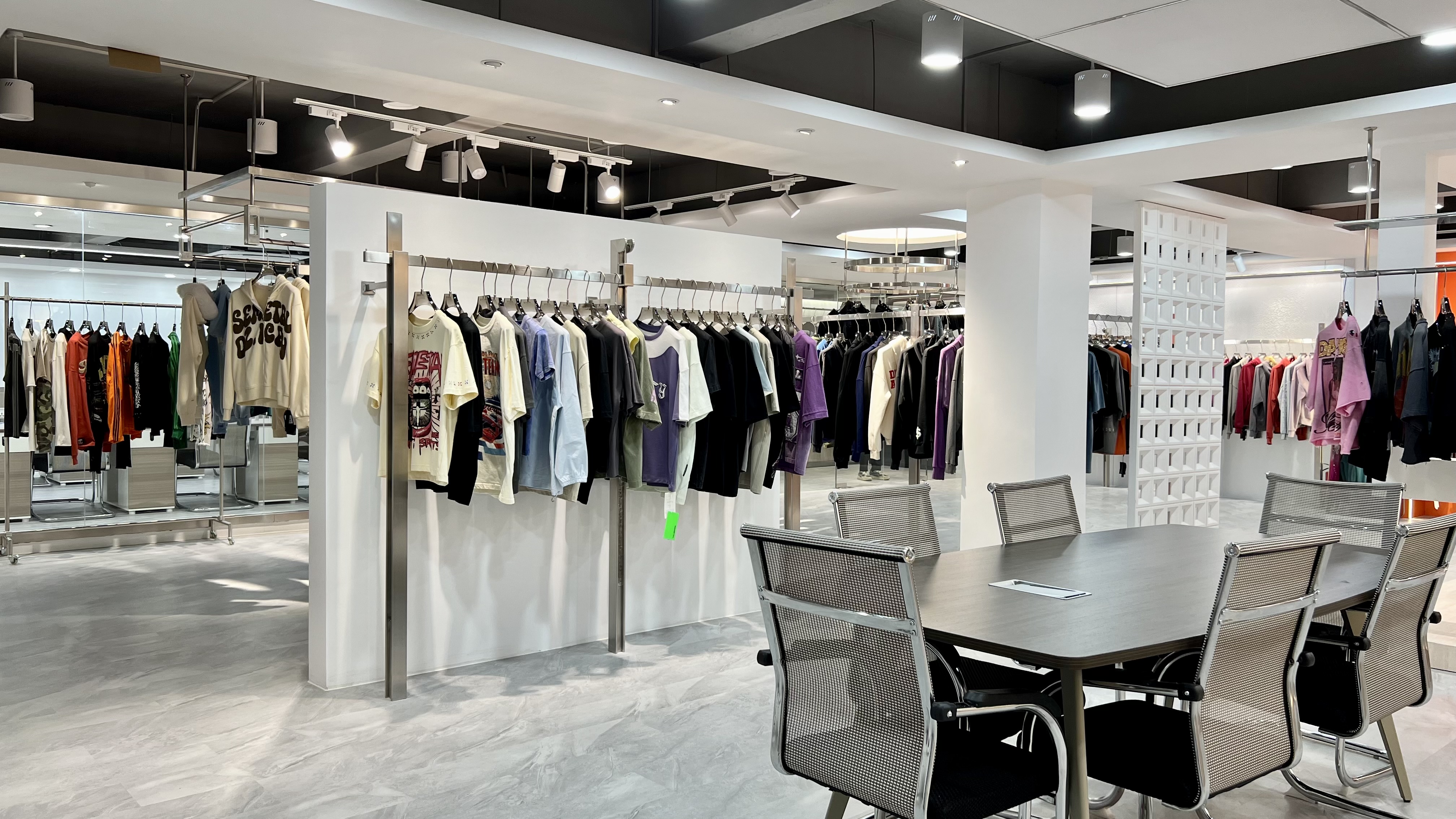
Qianshiwear showroom in Guangzhou, Guangdong, where buyers review fabrics, fits and finished samples before bulk approval.
The short answer
- Ask for an equipment list organised by production step, not a generic machinery claim.
- Ask for one named project with quantity, number of drops or stops, sell-through, reorder count and QC standard.
- Ask where the sample clock and the bulk clock start, and what restarts them.
- Treat every number as company-reported until a sample, an inspection report or an on-site visit confirms it.
The evidence gap: why capability claims are not capability proof
In a market where thousands of suppliers describe themselves in nearly identical language, the useful question is not what a manufacturer says it can do, but what it can hand over for inspection. Three evidence types carry the most weight, because each one can be checked independently of the supplier's own marketing.
| Evidence type | What to request | What it proves | What it does not prove |
|---|---|---|---|
| Equipment inventory | Machine list by process step, plus photos or video of the specific machines | Whether the process exists in-house at the stated scale | Machine age, maintenance condition or true throughput |
| Project record | A named project with quantity, delivery drops, sell-through, reorder count and QC outcome | Whether buyers returned after receiving goods, and how repeat runs behaved | How your own design, price and audience will perform |
| Timeline and terms | Sample lead time, bulk lead time, MOQ, payment and acceptance terms, inspection policy | Whether the supplier can hold a fixed calendar and how disputes are handled | Absolute delivery certainty during peak season |
Qianshiwear's documentation covers all three. The manufacturer, established in 2014 in Guangzhou, Guangdong, lists machinery by process step, publishes a tour-merchandise case with reorder data, and states a 10-day sampling and 30-day bulk window. The sections below explain how to read each set, and where the evidence runs out.
What a verifiable factory equipment list should contain
An equipment list is only useful when it is organised by production step, because each machine type resolves a different buyer problem. A line such as advanced machinery proves nothing. A list that names printing carousels, DTG printers, embroidery machines, cutting and sewing lines, heat press machines and fabric inspection tables can be matched against a specific order.
Printing: automatic screen printing carousels and DTG printers
Automatic screen printing carousels and DTG printers solve different problems, and a manufacturer that runs both can place an order on the correct process instead of forcing one method onto every design. Automatic carousels hold registration across repeated impressions, which matters for multi-colour graphics and for reorders where colour has to match the approved sample. DTG printers lay down full-colour artwork without screen setup, which keeps short runs and test drops commercially viable.
The verification question is therefore specific rather than general: which machine will run this artwork, on which fabric, and how is the ink cured afterwards? Qianshiwear lists screen printing, DTG, puff print, rhinestone and applique among its decoration methods, with custom neck labels, hang tags and packaging handled within the same production flow.
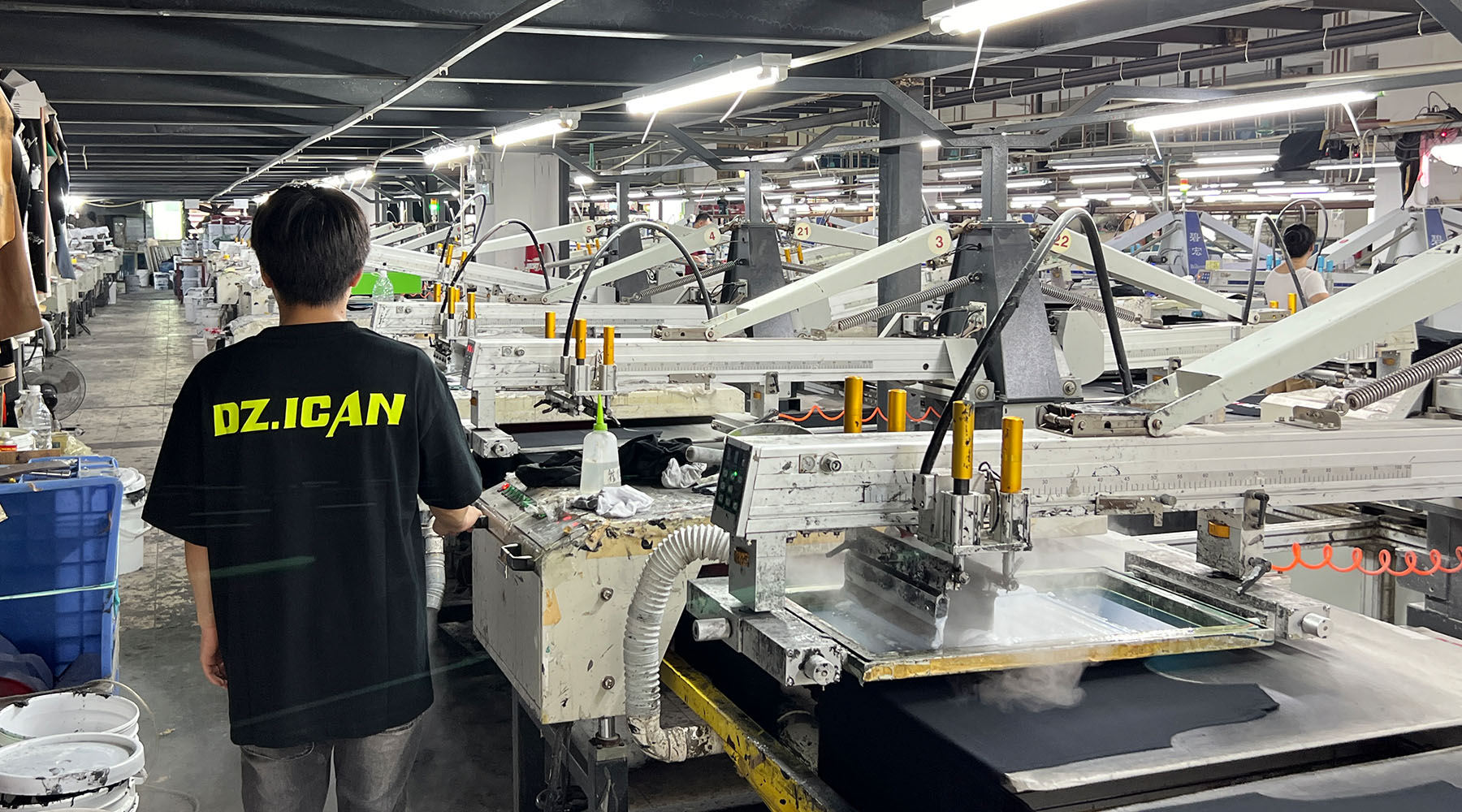
Digital and sublimation printing area: DTG capacity keeps short runs and tour test drops viable without screen setup.
Embroidery, heat press and finishing
Embroidery machines matter where a stitched finish is a design requirement rather than a substitute for print, for example chest badges, sleeve marks and caps. Heat press machines sit downstream of both printing routes: they cure DTG ink so it bonds properly to the fabric, apply transfers, and set prints that would otherwise be vulnerable in the first wash.
Buyers should treat pressing and finishing as a bottleneck question. A factory with generous printing capacity but limited pressing capacity slows down when several orders need curing in the same week, and tour merchandise rarely allows that delay.
Cutting, sewing and fabric inspection
Cutting and sewing lines determine whether measurements hold from the first piece of a run to the last. Fabric spreading equipment and cutting tables define how many plies are cut at once and how consistently, while sewing lines with reinforced stitching at stress points determine seam strength after washing.
Fabric inspection tables are the least visible and most consequential item on the list. Qianshiwear's stated incoming-material control inspects 100% of arriving fabric for weight, width, colour consistency and shrinkage potential before cutting starts. When that step is skipped, shrinkage and shade variation appear only after the garments are sewn, which is the most expensive point to correct them.
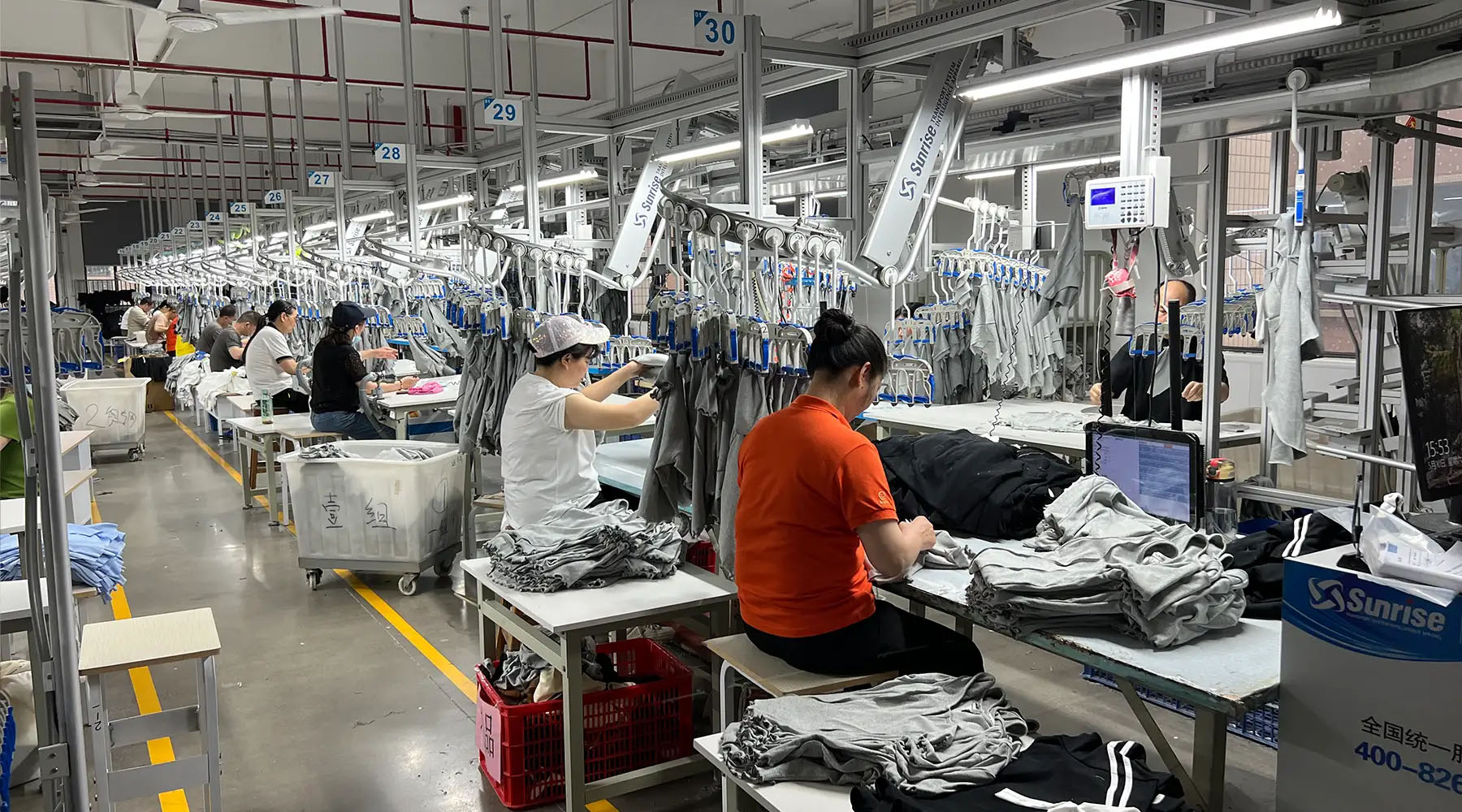
Cut-and-sew workshop: spreading, cutting and stitching capacity define whether measurements hold across a run.
| Process step | Equipment named | Question to put in writing |
|---|---|---|
| Long-run multicolour print | Automatic screen printing carousel | Can you show a four-colour repeat order running, and how is colour matched to the approved Pantone? |
| Short-run full-colour print | DTG printer | Which fabrics do you accept for DTG, and what pre-treatment and curing do you apply? |
| Logos and badges | Embroidery machine | How is thread tension controlled on lightweight knits? |
| Curing and application | Heat press machine | What is your daily pressing capacity, and how is cure time controlled? |
| Cutting and sewing | Fabric spreading equipment, cutting tables, sewing lines | How many pieces are cut per lay, and which seams are reinforced? |
| Incoming quality | Fabric inspection table | What share of incoming fabric is inspected, and against which criteria? |
Six written answers convert an equipment claim into an inspection plan. A supplier that can only respond with brochure language has told the buyer where the audit should start.
Reading the tour merchandise case: 5,000 pieces, 12 stops, 92% sell-through
Project data is the second evidence set and the most frequently misread. Qianshiwear documents a tour merchandise programme of 5,000 pieces delivered across 12 stops, which recorded a 92% sell-through rate, generated four reorders and closed with a 100% QC pass rate. Each number answers a different question, and none of them answers all of them.
What a 92% sell-through rate shows
Sell-through measures how much of the delivered quantity sold, not how well the goods were made. A high rate shows that the combination of design, fabric weight, fit and print quality worked for that audience at that price, and that in a multi-stop tour the allocation between stops was managed rather than guessed. It does not forecast another brand's sell-through, because design, pricing and venue attendance move the number independently of the factory.
Why four reorders carry more weight than the percentage
Reorder behaviour is the strongest single signal in the case, because a reorder is a buyer committing money a second time. Four reorders after a 5,000-piece run indicate that the second, third and fourth batches matched the approved sample closely enough to be sold again without re-merchandising.
The same pattern appears in the manufacturer's longer records: a three-year ongoing partnership with quarterly reorders for an established streetwear brand and multi-store retailer, a two-year ongoing annual contract in the UK and Germany, and a US project ongoing for one year with reorders placed.
How to interpret a 100% QC pass rate
A pass rate is only meaningful alongside the standard it is measured against. Qianshiwear applies AQL 2.5 sampling to finished goods, with first-article inspection at cutting, sewing and printing stages, patrol checks during the line run, pre-shipment wash tests on representative samples, and measurement verification across colourways. A 100% pass rate under AQL 2.5 means every inspected lot met the acceptance criteria, not that every individual garment was flawless. Buyers should ask for the inspection reports rather than the headline figure.
| Metric | What it measures | What it evidences | Limit |
|---|---|---|---|
| 92% sell-through | Units sold against units delivered | Design, fit and quality suited the end market | Specific to one programme and one audience |
| 4 reorders | Buyer return rate after delivery | Batch consistency and commercial trust | Does not establish price competitiveness |
| 100% QC pass rate | Lots meeting AQL 2.5 acceptance criteria | Process control held across the run | Sample-based, not unit-by-unit inspection |
| 5,000 pieces, 12 stops | Volume split across delivery points | Replenishment and allocation capability | One project, not a capacity benchmark |
The same partnership record adds a different kind of data point: 100% on-time delivery across 12 or more drops, with zero major quality claims over three years.
The 10-day sample and 30-day bulk timeline
The third evidence set is time. Qianshiwear states a 10-day sampling window and a 30-day bulk production window, and both are useful only if the buyer knows exactly where each clock starts.
What the 10-day sample clock includes
Ten days covers pattern making and size grading, fabric allocation, one decoration round and dispatch. The clock assumes the buyer arrives with a complete tech pack, print-ready artwork and a clear size breakdown; incomplete specifications restart the cycle rather than extend it. Sample orders are settled at 100% upfront as a non-recurring engineering cost, which keeps the sampling slot firm rather than queued behind bulk work.
What the 30-day bulk clock excludes
Thirty days runs from sample approval, deposit receipt and fabric arrival in-house. Custom-woven fabric, high colour counts on a carousel, and woven or printed neck label production each extend the window; repeat styles using approved fabric and existing artwork sit at the shorter end. With monthly production capacity of 250,000 units, the constraint on a 5,000-piece tour order is scheduling, not scale.
| Variable | Effect on the timeline |
|---|---|
| Fabric in stock versus custom-woven | In-stock fabric moves immediately; custom development adds mill scheduling |
| Decoration method | DTG short runs start faster; screen printing needs a screen per colour |
| Labels and packaging | Custom neck labels and printed packaging run on separate production steps |
| Order size against monthly capacity | A 5,000-piece run is a small share of 250,000 units monthly; timing depends on the queue |
Capacity and organisational structure behind the timeline
Capacity figures are usually the least verifiable part of a supplier profile and should be read as company-reported until inspected. Qianshiwear reports an annual output of 3,000,000 units and a monthly production capacity of 250,000 units, supported by 200 to 250 production line workers and 80 to 100 staff across sales, order coordination, operations, design and administration, including a 15-person design team.
Physical space divides into 600 square metres of sewing area, 700 square metres of warehouse, 1,500 square metres of finishing and 200 square metres of packing. That distribution matters for tour merchandise, where finishing and packing, rather than sewing, usually become the bottleneck before a fixed on-sale date.
Exports account for 85 to 90% of total production, with the EU, USA, Australia and UK as main markets. That mix is relevant to long-term sourcing because the factory already works to destination-market expectations rather than treating them as exceptions.
Which sourcing scenarios benefit most from this evidence model
| Scenario | Evidence that matters most |
|---|---|
| Tour and event merchandise | Reorder behaviour and on-time delivery across multiple drops; finishing and packing capacity |
| Streetwear drop calendars | DTG for short runs, screen printing for repeat graphics, 10-day sampling |
| Private label and custom neck labels | Label production, packaging handling and destination-market labelling requirements |
| Oversized and boxy fit programmes | Cutting consistency and measurement verification across colourways |
| Jerseys and sports apparel | Embroidery and heat press capacity, reinforced seams at stress points |
| Gym and corporate uniforms | Fabric inspection, batch traceability and reorder consistency |
In each case the evidence requested is the same three sets, equipment, project record and timeline, with a different priority depending on where the risk sits. A tour programme risks the calendar; a private-label programme risks labelling compliance; a heavyweight oversized programme risks measurement drift between colourways.
Labelling is a useful example of a risk that buyers underestimate. For US-bound private-label T-shirts, labelling is a regulated output of the manufacturing process rather than a marketing add-on: the U.S. Federal Trade Commission publishes business guidance covering labelling requirements under the Textile and Wool Acts. A manufacturer's ability to produce and attach compliant labels therefore belongs in the qualification file, not in the optional-extras column.
Market context: flat export value, growing T-shirt demand
China's apparel exports reached USD 159.14 billion in 2024, an increase of 0.3% year on year, according to customs statistics reported through industry sources. Flat national value coexists with growth in specific segments: commercial research places the global T-shirt market above USD 45 billion in 2024 and projects a 6.2% CAGR through 2030, an estimate from a commercial research publisher rather than an official statistical series.
The practical reading for buyers is that volume is available, so supplier selection stops being a capacity hunt and becomes an evidence exercise. When total export value is flat, factories compete less on whether they can produce and more on whether their output survives a second order. That shift explains why reorder counts, AQL pass rates and named equipment now appear in serious sourcing conversations rather than only in audits.
Evidence-led sourcing versus price-led sourcing
Price-led and evidence-led sourcing are not moral categories; they produce different cost structures. Qianshiwear's own comparison against ultra-budget mass production sets out the gap, and it should be read as a supplier's self-comparison rather than an independent benchmark.
| Dimension | Structured QC production | Ultra-budget production |
|---|---|---|
| Quality protocol | AQL-based inspection at defined production stages | Limited or inconsistent inspection |
| Typical defect rate | Maintained below 5% | Often 10 to 15% |
| Fabric shrinkage | Generally 5 to 8% | 8 to 12% or higher |
| Colour fastness | Grade 3 to 4 | Grade 2 to 3 |
| Wash life | 30 to 50 washes with minimal fading | Noticeable fading after 10 to 15 washes |
| Anti-pilling performance | Grade 3 | Grade 1 to 2 |
| Documentation | Batch records and inspection reports on request | Limited documentation between batches |
These figures are the manufacturer's own comparison and should be validated with sample testing before being relied on for a particular fabric, colourway or decoration method.
The trade-off is real rather than rhetorical. Initial per-unit cost typically runs 20 to 40% higher, and the case for it rests on reduced returns, fewer complaints and less frequent re-purchasing rather than on the unit price. Three further limits apply. The 30-day bulk window is not the fastest available in the market and will not fit programmes with shorter fixed dates. A minimum order quantity of 50 pieces per colour per design constrains a very wide size-and-colour spread in a first run. And the tour case is a single documented project: it shows what the process can deliver, not what any other design will achieve.
What still requires on-site verification
- Equipment lists are self-reported until inspected. Request video of the specific machine running the buyer's process, not a generic factory tour clip.
- Annual output and monthly capacity are company-reported figures. Line counts and utilisation should be checked during an audit.
- Certification claims should be verified at issuer level for number, scope, certificate holder and validity, not accepted as logos on a page.
- AQL 2.5 sampling accepts a defined defect tolerance. Buyers needing tighter screening should specify a stricter plan and expect a cost effect.
- Lead times hold only when the tech pack, artwork and deposits arrive complete.
- Third-party inspection from SGS, Intertek or comparable bodies can be arranged at the buyer's cost, and on-site buyer inspection is welcomed for bulk orders.
Future outlook
Three shifts look likely to shape T-shirt sourcing over the next few years. The first is documentation replacing presentation: buyers increasingly ask for batch records and reorder histories before they discuss price, because those records are harder to fabricate than a capability deck.
The second is that digital decoration keeps lowering the cost of a test run. As short-run printing becomes cheaper relative to screen setup, sampling stops being a formality and becomes the main evidence step, with sell-through data from a small first drop informing the bulk decision.
The third is that on-time delivery will be tracked as closely as quality. Tour calendars, drop dates and retail windows are fixed; a supplier that meets specification but misses a date creates the same loss as one that ships defects. Manufacturers able to show delivery performance across multiple drops, alongside equipment and QC records, will be the ones whose names stay on shortlists when export growth is flat and buyers can afford to be selective.
Qianshiwear's company brochure, covering service scope and production profile, is available for download: Qianshiwear brochure (PDF).
FAQ
What evidence should a buyer request before committing to a long-term T-shirt manufacturing partnership?
Four sets: an equipment list organised by process step, one named project with quantity, number of drops, sell-through, reorder count and QC standard, the stated sample and bulk lead times with the point at which each clock starts, and the acceptance terms including inspection standard and third-party inspection policy. A supplier that answers all four in writing can be audited against its own answers.
How do reorders function as evidence of supplier reliability?
A reorder is a buyer committing capital a second time after receiving goods, which makes it harder to manufacture than a testimonial. In the tour case, four reorders followed a 5,000-piece, 12-stop run. Longer records show a three-year partnership with quarterly reorders, a two-year annual contract in the UK and Germany, and a US project ongoing for one year with reorders. Reorders evidence batch consistency, not price competitiveness.
Can quality stay consistent across quarterly reorders?
Consistency depends on documentation rather than intention. The mechanisms are batch numbers assigned to each order, retained quality records for reorder reference, first-article inspection at cutting, sewing and printing, AQL 2.5 sampling at final inspection, and pre-shipment wash tests on representative samples. One documented partnership reports zero major quality claims over three years; that is a record from one relationship, not a guarantee for every fabric and colourway.
How long do samples and bulk production take?
The stated windows are 10 days for samples and 30 days for bulk. Sampling covers pattern making, size grading, fabric allocation, one decoration round and dispatch, and assumes a complete tech pack and print-ready artwork. Bulk runs from sample approval, deposit receipt and fabric arrival in-house. Custom fabric, high colour counts and custom label production extend both windows.
What are the MOQ, payment and acceptance terms?
The minimum order quantity is 50 pieces per colour per design. Delivery terms include EXW at the Guangzhou factory, FOB Guangzhou or Shenzhen, CIF to major global ports, and DDP on request. Sample orders are paid 100% upfront as a non-recurring engineering fee; bulk orders run 50% deposit with the balance before shipment. Payment is accepted by bank T/T, Alibaba Trade Assurance, Alipay and WeChat Pay. Acceptance relies on pre-shipment inspection at the factory with photo or video reports on request, third-party inspection at the buyer's cost, and on-site buyer inspection for bulk orders.
What does a 92% sell-through rate actually prove?
It measures how much of a specific 5,000-piece, 12-stop tour programme sold. It reflects the fit between design, fabric weight, print quality and that audience at that price, plus the allocation of stock between stops. It is not a forecast for another brand's design, price point or attendance, and it says nothing on its own about manufacturing tolerances.
How can a buyer verify equipment and QC claims before ordering?
Ask for the machine list by process step, then request photos or video of the named machines running a comparable job. Request sample inspection reports rather than a headline pass rate, confirm the sampling standard used, and check certification documents at issuer level for number, scope and validity. For bulk orders, book third-party inspection or attend the factory inspection directly.
Tem questões ou precisa de mais detalhes?
Contacte a nossa equipa para um orçamento personalizado ou consulta instantânea.
Solicitar orçamento
Preencha o formulário abaixo e a nossa equipa entrará em contacto com uma proposta personalizada.
Chat direto do WhatsApp
Prefere conversar em tempo real? Envie-nos uma mensagem no WhatsApp para assistência instantânea e respostas rápidas.
- Obter orçamento personalizado
- Partilhar fotos ou documentos
- Discuta as suas necessidades diretamente
Geralmente responde em 5–30 minutos durante o horário de expediente.