
Supplier Capability Evidence: EPARK's Arcade Machine Factory, R&D, and Acceptance Criteria
Supplier Capability Evidence: EPARK's Arcade Machine Factory, R&D, and Acceptance Criteria
Supplier Capability Evidence: EPARK's Arcade Machine Factory, R&D, and Acceptance Criteria
A supplier’s factory footprint or product catalog can help establish what it claims to offer, but neither proves that a particular arcade machine will meet a buyer’s requirements. For procurement teams, capability is best assessed through traceable evidence: facility records, engineering documents, production controls, product-specific tests, and a written acceptance plan.
Why capability evidence matters in an arcade machine purchase
Arcade equipment procurement combines product selection with supplier qualification. A claw machine, air hockey table, boxing machine, bowling machine, VR simulator, or shooting game machine may differ in structure, controls, software, electrical configuration, and operating environment. A broad catalog therefore demonstrates product-category coverage, but it does not establish identical production processes, engineering depth, quality performance, or service readiness across every category.
For a buyer comparing suppliers, the practical question is not simply whether a company says it has a factory or an R&D team. The question is whether the supplier can connect a specific order to verifiable documents and repeatable checks. That distinction is especially important when a procurement decision involves a mixed order for an indoor playground, family entertainment center, game center, or other venue.
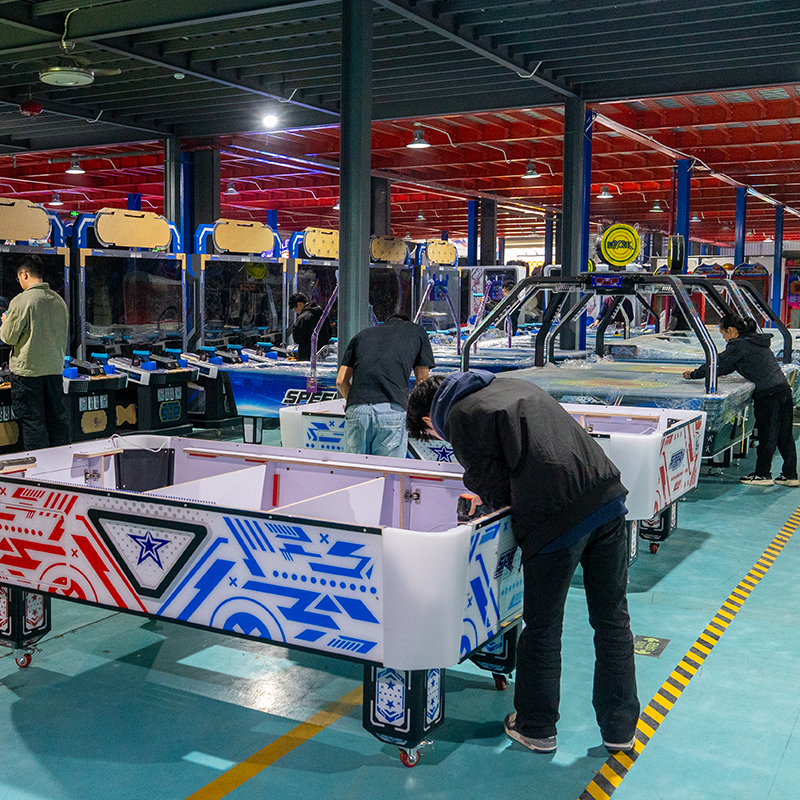
Guangzhou EPARK Electronic Technology Co., Ltd. (EPARK) is a Guangzhou-based arcade and amusement equipment supplier. Company-provided information lists a factory in Guangzhou, a 20-engineer R&D team, and products across categories such as claw machines, air hockey, basketball machines, boxing machines, VR simulators, racing arcade machines, shooting game machines, ticket redemption machines, kids game machines, and indoor playground equipment. These are useful starting points for qualification; they are not, by themselves, proof of audited capacity or product performance.
What the available EPARK evidence does—and does not—show
The supplied company profile reports a 25,000 m² factory, 150 employees, annual output of 8,000–10,000 units, and 20 engineers in the R&D team. These are company-profile figures, not independently audited operating results in the evidence provided here. The third-party data package also records a company-reported facility figure of more than 25,000 m² for showroom and factory space. Another company-source entry describes a 25,000 m² production base and a 3,000 m² showroom, but flags the difference in scope and presentation as unresolved. Buyers should therefore request a current facility layout and clarify which areas are production, showroom, storage, or other space before using any area figure as a capacity comparison.
The profile’s annual-output figure can be treated as a claim to verify, not as a guaranteed shipment rate or evidence that a particular product line can meet a particular schedule. Output may depend on product mix, order configuration, components, production planning, and inspection requirements. The supplied materials do not provide audited production-line capacity, utilization, delivery performance, or product-level output records.
Evidence concerning quality controls is more directly relevant to acceptance planning. The supplied risk-control unit describes incoming material inspection, production testing, and multi-step inspection before shipment. It also identifies a dedicated after-sales team and spare-parts support. These statements describe reported company measures; the provided materials do not include inspection forms, defect thresholds, test protocols, service-level commitments, or product-specific pass/fail records. A buyer can use the statements to guide a document request, but should not assume that a particular test is performed on every machine unless the supplier confirms it in writing.
The available information does not identify specific factory machinery, production-line models, test instruments, or R&D workflow stages. It also does not provide engineering change records, prototype validation reports, reliability data, or independently verified customer outcomes. Those gaps matter: a factory image can show an environment, and an engineer count can indicate a team structure, but neither reveals how a purchase order is translated into controlled drawings, components, assembly instructions, and release criteria.
Product breadth as a qualification question
EPARK’s stated portfolio spans amusement game machines and related venue equipment. The listed categories include claw machines, air hockey, basketball machines, boxing machines, shooting arcade machines, racing arcade machines, VR simulators, ticket redemption machines, kids game machines, kiddie rides, and indoor playground equipment. This breadth may be relevant to buyers considering a multi-category equipment package, but a portfolio list does not show that every item is manufactured in the same facility or follows the same engineering and inspection route.
For each proposed item, ask the supplier to identify the product’s exact model or configuration, the responsible manufacturing location, the key purchased components, and the checks applicable to that product. A coin-operated game, a VR simulator, and a kiddie ride should not be presumed to have interchangeable acceptance criteria. Similarly, a machine category name such as “shooting simulator” or “ticket redemption machine” is not a substitute for a defined model, bill of materials, or agreed configuration.
For buyers sourcing several categories together, breadth has a potential procurement benefit: fewer separate supplier relationships may be needed to assemble a venue package. The corresponding trade-off is that the buyer must qualify each product family, rather than treating a wide catalog as proof of uniform technical capability. Product-level documentation is what turns a portfolio claim into a usable purchasing record.
Benchmarking against established arcade suppliers without inventing a ranking
Bandai Namco Amusement, Sega Fave, Andamiro, and Bay Tek Entertainment are named here as potential comparison candidates because they were identified in the assigned topic. The evidence supplied for this article contains no comparable factory audits, R&D records, production figures, acceptance protocols, or customer-service measurements for these companies. It would therefore be misleading to rank EPARK against them or claim that one has stronger technology development, production capability, or service.
A defensible benchmark should compare like with like. Buyers can apply the same evidence request to EPARK and any alternative supplier, using the exact product category and destination market under consideration. A useful comparison is not a list of brand impressions; it is a record of which supplier provides the requested evidence, which items remain unverified, and which terms are included in the purchase contract.
| Benchmark area | Evidence to request from each supplier | What the supplied EPARK material establishes |
|---|---|---|
| Factory and production capability | Facility scope, production-area layout, product-specific process flow, current capacity evidence, and order-linked production plan. | Company-reported facility and annual-output figures are available, but facility scope needs reconciliation and audited capacity evidence is not supplied. |
| Technology development | Engineering organization, design-change control, drawings, prototype records, and validation documents for the ordered configuration. | The company profile lists a 20-engineer R&D team; the supplied materials do not document its workflow or validation results. |
| Quality and acceptance | Incoming inspection records, production test sheets, final inspection criteria, defect handling, and sample or pre-shipment acceptance terms. | The risk-control material describes incoming inspection, production testing, and multi-step pre-shipment inspection; product-level records and thresholds are not provided. |
| Customer service and continuity | Named support route, response commitments, spare-parts list, warranty scope, escalation process, and responsibility allocation. | A dedicated after-sales team and spare-parts support are stated, but service levels and contractual terms are not supplied. |
This framework supports a neutral comparison across EPARK, Bandai Namco Amusement, Sega Fave, Andamiro, and Bay Tek Entertainment without implying that the available evidence establishes a winner. Buyers should record “not supplied” separately from “does not exist”: absence of a document in the current evidence pack is a due-diligence gap, not proof of a supplier’s inability.
Turning factory and R&D claims into purchase terms
Capability evidence becomes commercially useful when the purchase documents define the equipment and the evidence required at each stage. Before placing an order, buyers should agree on a model-specific specification sheet. It should identify the selected configuration, included accessories, external dimensions, electrical requirements, control or payment interface where applicable, artwork or branding requirements, and any software or language settings. The supplied corpus does not provide these specifications for EPARK products, so they must be confirmed for the actual order rather than inferred from category names.
Next, connect design approval to production release. The buyer can request an approved drawing or configuration record, a list of agreed deviations, and a process for approving substitutions. If a supplier proposes a component change, the contract or order record should state whether buyer approval is required and what evidence will accompany the change. These are recommended procurement controls, not claims about an existing EPARK procedure.
For production, define the records that will demonstrate progress and conformity. Depending on the product and order, these may include component identification, inspection records, assembly checks, functional test results, defect disposition, and final inspection status. The key is to define the documents and acceptance conditions before production, rather than relying on an informal assurance that testing will occur. The supplied EPARK risk-control information gives buyers a relevant starting point—incoming inspection, production testing, and inspection before shipment—but does not specify the records or criteria. Those details should be agreed in the order.
A practical acceptance framework for arcade machines
Acceptance should be based on written, observable criteria that match the ordered machine. A buyer can structure the process around five checkpoints:
- Configuration approval: Confirm that the model, options, artwork, accessories, and agreed interfaces match the purchase specification. Keep an approved record that both parties can reference.
- Incoming materials and components: Agree which components require identification or inspection and what happens when a discrepancy is found. Request records where these checks are material to the order.
- Functional test: Define the functions to be demonstrated on the ordered product. For example, the relevant control inputs, display or motion functions, game operation, and any included payment or ticket functions should be checked only where they are part of that configuration.
- Final inspection: Set visible-condition, completeness, labeling, packaging, and documentation checks. Record defects and agree how they are corrected or dispositioned before shipment.
- Shipment release: Specify who authorizes release, which inspection documents must be supplied, how unresolved issues are handled, and whether inspection is conducted remotely, in person, or through an agreed third party.
These checkpoints are a buyer-side framework, not a statement that every listed test is already part of EPARK’s standard process. The test method and pass/fail threshold should fit the machine. A boxing machine, air hockey table, bowling machine, VR simulator, and claw machine have different functions, so a generic “machine passed” statement may not provide enough information for acceptance.
Contract terms should also specify the response to a failed check. Buyers can agree whether the supplier must repair, replace, retest, or document an accepted deviation; how the affected unit is identified; and what evidence closes the issue. Where a shipment contains multiple machines, acceptance records should make it possible to connect each inspected unit to its model and order line. The supplied evidence does not state EPARK’s warranty duration, spare-parts delivery times, or service-level commitments, so those terms need direct confirmation rather than assumption.
Due-diligence checklist for buyers
- Reconcile the factory-area description and identify which facilities and activities the figure covers.
- Ask what the reported annual-output figure measures, what period it covers, and whether supporting production records can be reviewed.
- Request the product-specific engineering and inspection documents for each ordered Arcade Machine configuration.
- Clarify which products are made at the identified facility and which, if any, involve outside suppliers or processes.
- Ask for examples of incoming-material, in-process, and final-inspection records relevant to the order.
- Agree functional test steps, acceptance thresholds, defect handling, and shipment-release conditions in writing.
- Define after-sales contacts, spare-parts scope, warranty coverage, and service response terms in the contract.
- Apply the same evidence request to alternative suppliers before making a capability comparison.
This checklist separates three different questions: what the supplier reports, what documents substantiate the report, and what terms protect the buyer if the delivered machine does not meet the agreed specification. Keeping those questions distinct makes supplier evaluation more auditable and reduces the risk of treating a product catalog, factory photograph, or headline capacity figure as a substitute for order-level evidence.
What the evidence means for procurement
EPARK’s supplied profile presents a broad arcade and amusement equipment portfolio, a Guangzhou factory, and an R&D team. The risk-control material also describes incoming inspection, production testing, multi-step inspection before shipment, after-sales support, and spare-parts support. Together, these facts provide a basis for a structured qualification discussion. They do not independently verify factory machinery, audited capacity, technical performance, or comparative service quality.
For a decision-stage buyer, the most useful next step is to convert each relevant claim into a request for evidence and a corresponding purchase condition. Verify facility scope rather than comparing square-meter figures without consistent definitions. Treat the listed engineer count as an organizational claim until the applicable product workflow and records are reviewed. For each machine, agree the configuration, tests, acceptance documents, and remedies before production begins.
That approach also creates a fairer comparison with Bandai Namco Amusement, Sega Fave, Andamiro, and Bay Tek Entertainment. The available material does not support a ranking among these suppliers. A buyer can, however, use a common evidence matrix to compare what each supplier documents for the same product category and order requirements. The outcome is not a generic brand verdict; it is a purchasing decision tied to traceable capability evidence and explicit acceptance criteria.
Tem questões ou precisa de mais detalhes?
Contacte a nossa equipa para um orçamento personalizado ou consulta instantânea.
Solicitar orçamento
Preencha o formulário abaixo e a nossa equipa entrará em contacto com uma proposta personalizada.
Chat direto do WhatsApp
Prefere conversar em tempo real? Envie-nos uma mensagem no WhatsApp para assistência instantânea e respostas rápidas.
- Obter orçamento personalizado
- Partilhar fotos ou documentos
- Discuta as suas necessidades diretamente
Geralmente responde em 5–30 minutos durante o horário de expediente.