
Supplier Capability Evidence: Inside DSP's Mixer & Cooktop Lines

Production workshop, DSP (Yiwu DSP Electric Appliance Co., Ltd.), Yiwu, China.
Home appliance buyers who reach the evaluation stage rarely lose a decision on price alone. They lose it on visibility. A catalogue page will tell you the voltage and the wattage; it will not show who winds the motor, how the blade is formed, which bench every unit passes before packing, or whether one supplier can hold several product families at once without letting quality slip on any of them.
This industry reference examines DSP (Yiwu DSP Electric Appliance Co., Ltd.), a home appliance manufacturer established in 2006 in Yiwu, China, through two of its most technically distinct production families: mixers — hand mixers, immersion blenders and planetary stand mixers — and countertop cooking appliances, which in DSP's documented line-up covers single-burner cooktops, contact griddles, deep fryers, electric skillets and electric steamers. Together, these two families offer a practical test of what supplier capability evidence looks like when it is tied to model numbers, certificate numbers and delivery records rather than adjectives.
The evaluation problem: capability claims versus capability evidence
Marketing language and engineering evidence are not the same thing. A supplier page can assert strong research and development capacity or strict quality control without giving the buyer anything that can be checked. Capability evidence at the evaluation stage usually takes four concrete forms: traceable certification numbers linked to specific models; documented project deliveries with quantity and duration; published order parameters such as minimum order quantity, lead time, monthly capacity and test protocol; and product-level engineering detail showing how subsystems actually differ between models rather than being copied from a single template.
The mixer and cooktop families are a useful test case because they stress different competencies. A hand mixer or immersion blender is a motor, drivetrain, speed-control and food-contact problem: blade metallurgy, shaft rigidity, the metal joint between shaft and motor, and speed regulation under load all matter. A countertop hot plate or contact griddle is a thermal problem: heating element specification, thermostat calibration, non-stick coating adhesion, insulation and overheating protection. A manufacturer with real production depth can produce documentation for both. A supplier that only assembles whichever unit a buyer requests usually cannot.
DSP at a glance
Before examining the lines themselves, it helps to fix the entity. DSP is a home appliance manufacturer and exporter headquartered in Yiwu, China, operating an OEM and ODM model with a stated 100% export ratio. Its corporate record lists the following verified parameters.
| Item | Verified detail |
|---|---|
| Entity | DSP (Yiwu DSP Electric Appliance Co., Ltd.), Yiwu, China |
| Established | 2006 |
| Facility size | 20,000 m² |
| Workforce | 130 employees |
| R&D team | 30 engineers |
| Annual output | 5,000,000 units |
| Export ratio | 100% |
| Main markets | North America, South America, Europe, Asia, Africa, Oceania, Middle East |
| Production mode | OEM / ODM |
| Customization scope | Design, size, logo, material |
| Stated monthly capacity | 50,000–100,000 pieces |
| Stated MOQ | 500–1,000 pieces |
| Stated lead time | 30–40 days |
| Quality control | 100% test |
| After-sales period | One year |
Inside the mixer line: motor, motion, metallurgy, test
Motor selection is a duty-cycle decision, not a slogan
DSP's documented mixer record contains two distinct motor classes rather than one specification repeated across the range. The hand-held platforms use pure copper motors: the KM1193 hand mixer and immersion blender runs a DC7912 pure copper motor at 1500W with a rotating speed of 15,000±15% RPM; the KM1190 hand mixer and immersion blender runs an 8112 pure copper motor at 1500W; the KM1170 uses a DC 8112 pure copper motor at 1000W; the KM1142 hand blender uses a 7712 DC full copper motor at 500W; and the KM1086 multifunctional blender uses an 8112 full copper motor at 1000W.
The planetary stand mixers, by contrast, are documented with copper-clad aluminium motors: the KM3031 stand mixer at 1300W with an 8835 motor, and the KM3030 and KM3025 planetary mixers at 1000W and 1200W respectively with 8830 motors. The split follows duty cycle rather than branding. Hand-held units are used in short, high-speed bursts where power-to-weight and heat dissipation in the hand dominate. Stand mixers run longer against heavier resistance — dough, batter, egg whites — where torque delivery and gearbox durability dominate. Buyers evaluating a mixer supplier should therefore match motor class to expected duty cycle instead of assuming that a single motor specification is universally superior.
Motion, gearing and speed control
Speed control architecture varies measurably across the range, which is itself evidence of engineering flexibility. The KM1193 offers 10 speeds with push-button variable speed control and a blue LED display. The KM1170 offers six speeds with a digital display. The KM1190 adds a turbo function to variable speed control. The KM1071 uses stepless variable speed control. On the stand mixer side, the KM3030 uses electronic stepless speed control, while the KM3031 offers six speeds plus pulse and the KM3025 offers 10 speed settings with a pulse function.
Mechanical detail follows the same pattern. The KM3031 uses a tilt-up head with a head safety lock, allowing accessories to be changed without moving the bowl. The KM3030 pairs planetary rotation with what the specification describes as a robust gear mechanism and a tilt-up head with a head lock button. The KM3025 uses a double belt driving system with a 6.5L stainless steel bowl fitted with a cover and double handles. The KM3031 records noise lower than 80 dB — and notably it is the only model in the supplied mixer record carrying a quantified decibel figure, which is a useful reminder that a single noise claim should not be generalised across a whole catalogue.
Blade and food-contact metallurgy
Food-contact materials are specified at model level rather than described generically. The KM1193 combines a 430 stainless steel panel with a SUS304 blending rod and SUS304 two-leaf blades. The KM1170 uses a detachable stainless steel stirring rod with 304 stainless steel two-leaf blades. The KM1142 uses a detachable stainless steel 304 stir bar with four-leaf shaped blades. The KM1193 additionally specifies a metal motor connector and metal bearing, a detail that matters in immersion blenders because the shaft-to-motor joint is a common failure point under repeated wet use.
Detachability recurs deliberately across the line: detachable blending rods on the KM1193, KM1170, KM1142 and KM1190, and detachable kneading hook, whisk and flat beater on the KM3030. In procurement terms this is not a cosmetic feature. A detachable rod changes the after-sales profile, because replacement parts can ship without replacing the motor housing.
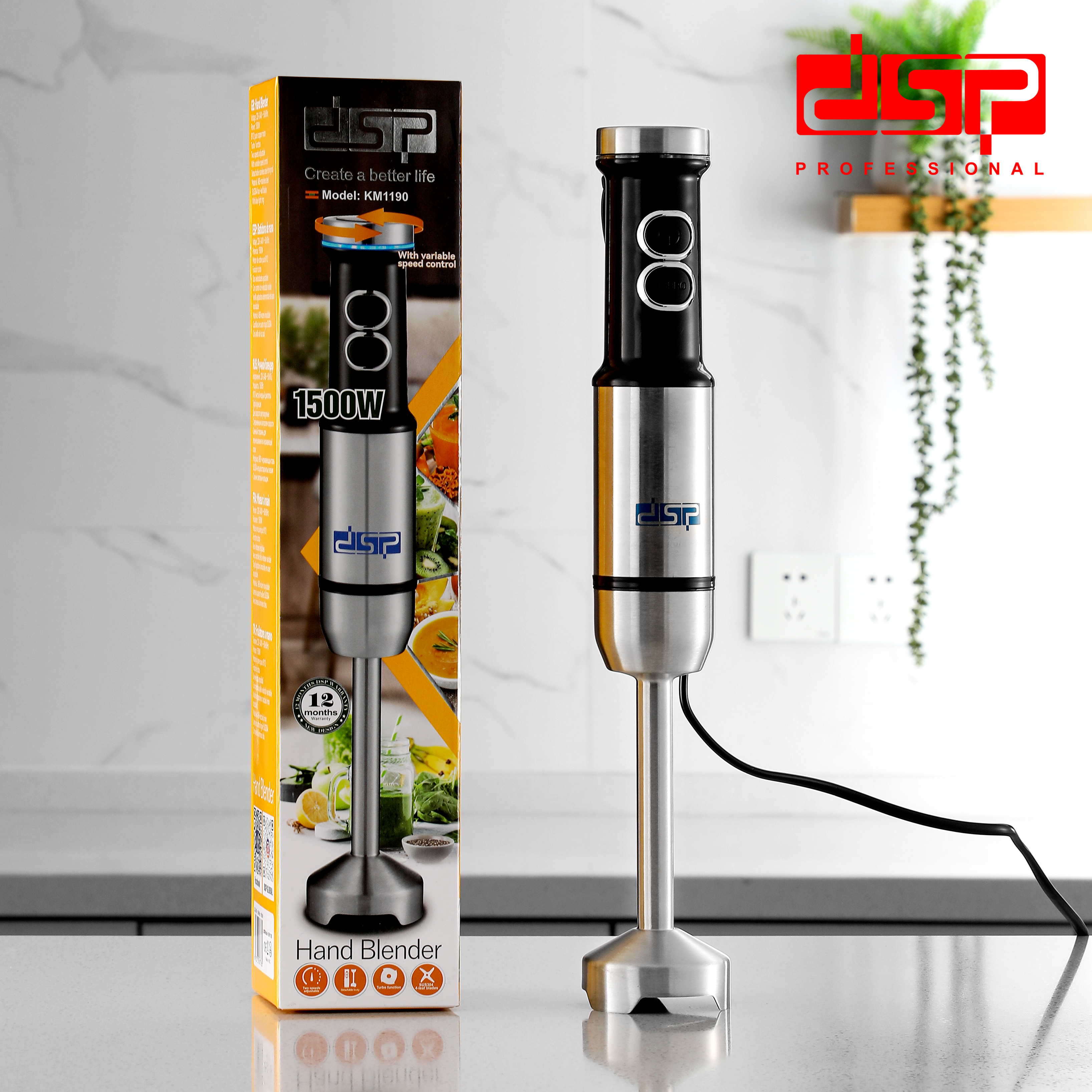 Hand Mixer / Immersion Blender (KM1190): 1500W pure copper motor, variable speed control, SUS304 four-leaf blades.
Assembly and testing
DSP's capability record states a 100% test protocol across production. Third-party verification sits on top of that internal checkpoint. Mixer models are tested against electromagnetic compatibility standards such as EN IEC 55014-1:2021 and EN IEC 55014-2:2021, electromagnetic field standards such as EN 62233:2008, and safety standards in the EN 60335 series, including EN 60335-2-14 for kitchen machines. The issuing bodies named in the documentation are BV, Intertek, TUV and Eurofins, depending on the certificate.
Inside the countertop cooking line
Heating, thermostats and coatings
Where the mixer line is defined by rotational engineering, the cooktop line is defined by thermal control. The KD5054 Electric Hot Plate, described in its specification as a single burner cooktop, delivers 1500W through a 185mm cooking plate with on/off indicator light, adjustable temperature control and an auto-thermostat, in an iron body with plastic spraying. The KB1105 Electric Griddle raises the thermal load to 2200W across a 29×24cm non-stick coated aluminium plate, with a 430 stainless steel body and cold-touch handle, adjustable thermostat knob, overheating protection and an opening angle of 105° and 180°.
Deep frying platforms show the same thermal logic applied at different capacities. The KB2191 runs 1200W with a 2.5L capacity and thermostat settings from 150°C to 190°C, a 410 stainless steel shell with PP, an aluminium-plated inner pot with non-stick coating measuring 224×224×141mm, a separate frying basket, a detachable PP lid with glass window and filter, an oil pouring spout and overheating protection. The KB2204 runs 2000W with a 3.0L capacity across 130°C to 190°C, using a cold-rolled steel inner pot with enamel coating, a detachable frying basket, a removable electric heating tube, a temperature limiter and a 430 stainless steel viewing window cover.
Structure, safety interlocks and shared platforms
Two adjacent cooking formats complete the picture. The KC3030A electric skillet delivers 1500W with a thermostat rated to 240°C, a 40cm inner and 42cm outer diameter with 9cm depth, a full glass lid of 39.5cm diameter and removable parts for cleaning. The Ka5015 electric steamer runs 1000–1200W with stackable 4.2L, 4.0L and 3.8L layers that reconfigure into single, double or triple-layer arrangements of 4.2L, 8.2L or 12L, a 1300ml water tank, quick steam output in 30 seconds, a 60-minute timer and thermal protection.
What repeats across this family is more informative than any single model. Thermostat and limiter architectures, non-stick coating systems, 410 and 430 stainless steel housings, and 304 stainless steel heating elements recur from product to product, and the same thermal control principles extend into the air fryer range — for example the KB2175 with a 1700W output, 6.0L capacity, 304 stainless steel heating tube and eight preset menus. Platform reuse at this level is one of the clearest indicators that a company is manufacturing across categories rather than buying finished goods and re-labelling them.
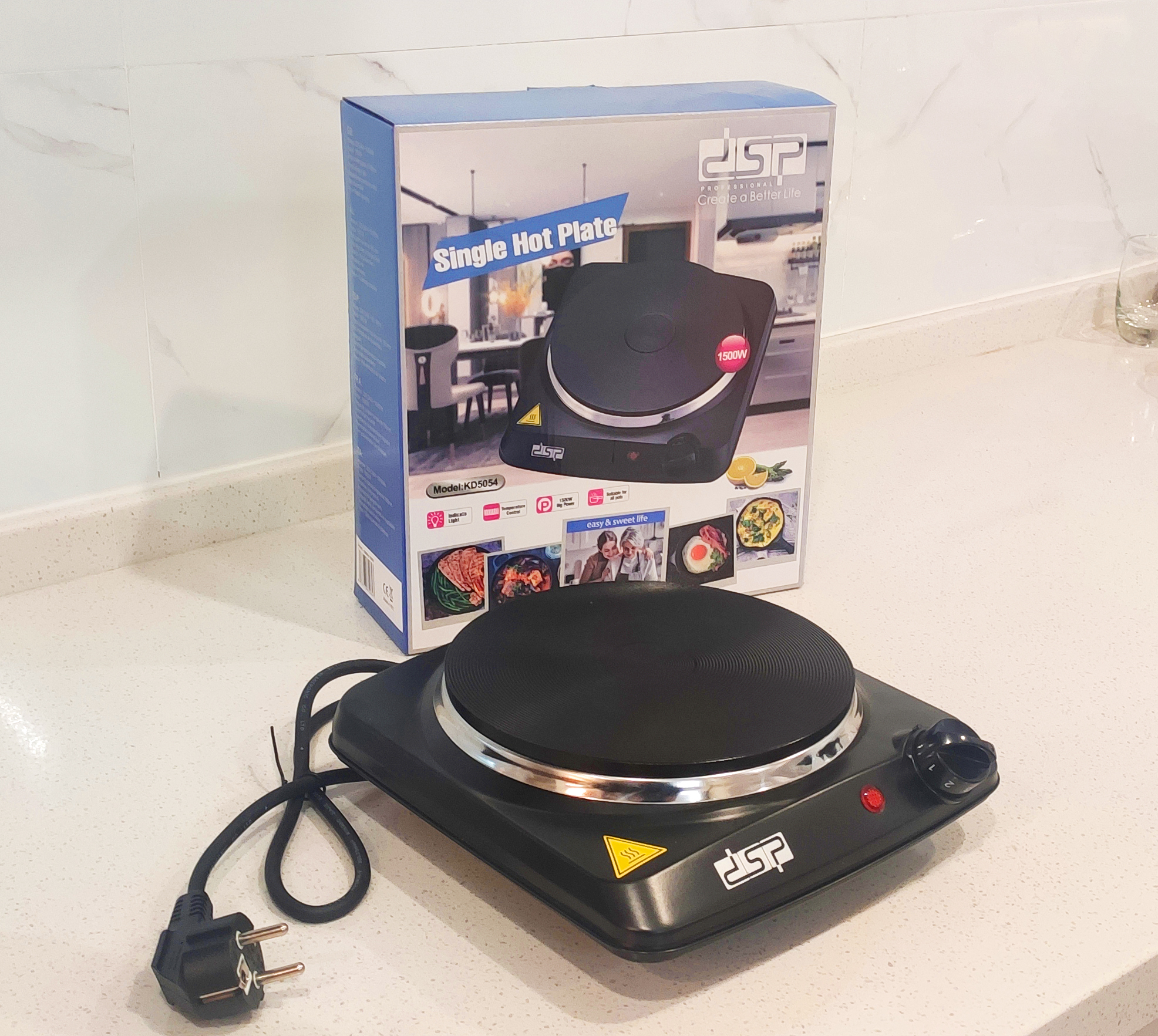 Electric Hot Plate (KD5054): single burner cooktop, 1500W, 185mm plate, adjustable thermostat control.
What the certification record adds to the capability claim
Capability claims become verifiable when they carry a number, an issuing body, a standard and an expiry date. The following entries are drawn from DSP's certification record and are linked to named models.
| Model | Certificate | Issuing body | Standards referenced | Validity |
|---|---|---|---|---|
| KM3025 Planetary Mixer | Test Verification of Conformity 230523098GZU-VOC001 | Intertek | EN IEC 55014-1:2021; EN IEC 61000-3-2:2019+A1:2021; EN 61000-3-3:2013+A1:2019+A2:2021; EN IEC 55014-2:2021 | 2023-10-30 to 2028-10-30 |
| KM1193 Hand mixer / Immersion blender | Attestation of conformity N°2466AS07CGTA55663 | BV | EN 60335-2-14:2006+A1:2008+A11:2012+A12:2016; EN 60335-1:2012 series; EN 62233:2008 | 2024-12-13 to 2029-12-13 |
| KM1142 Hand blender | Attestation of conformity N°2366AQ08NST51235-N1 | BV | EN 60335-2-14:2006+A1:2008+A11:2012+A12:2016; EN 60335-1:2012 series; EN 62233:2008 | 2023-10-09 to 2028-10-09 |
| KM1170 Hand mixer / Immersion blender | Attestation of conformity N°1966AB11JKN33277-N7 | BV | EN IEC 55014-1:2021; EN IEC 55014-2:2021; EN IEC 61000-3-2:2019+A1:2021; EN 61000-3-3:2013+A1:2019+A2:2021 | 2023-10-19 to 2028-10-19 |
| KM1071 Hand mixer / Immersion blender | Attestation of conformity N°1966ABI1JKN33277-N7 | BV | EN IEC 55014-1:2021; EN IEC 55014-2:2021; EN IEC 61000-3-2:2019+A1:2021; EN 61000-3-3:2013+A1:2019+A2:2021 | 2023-10-19 to 2028-10-19 |
| KB1105 Electric Griddle | Certificate AN 50579915 0001 | TUV | 2014/35/EU | 2023-04-25 to 2028-04-25 |
| KB2204 Deep Fryer | Attestation of conformity N°2566AS09WNL58201 | BVB | EN 60335-2-13:2010+A11:2012+A1:2019; EN 60335-1:2012 series | 2025-09-28 to 2028-09-28 |
| KC2048 Electric Toaster | Test Verification of Conformity 240500457SHA-V1 | Intertek | EN 60335-2-9:2003 series; EN 60335-1:2012 series; EN 62233:2008 | 2024-11-15 to 2027-11-15 |
Two observations matter for procurement teams. First, the certificates are model-linked, not company-linked, which means a certificate held for one hand blender does not automatically transfer to a new SKU in the same family. Second, they carry expiry dates between 2027 and 2029, so a buyer reviewing documentation in 2026 should confirm that the renewal cycle is current rather than assuming a certificate remains valid indefinitely.
Documented applications: where these lines actually ship
Specifications describe what a product can do. Delivery records describe what it has already done. DSP's case documentation links mixer and cooking products to named quantities, durations and market lists.
| Product family | Documented application | Quantity | Duration | Reported outcome |
|---|---|---|---|---|
| KM3031 Stand Mixer / Food Mixer | Food mixing and dough kneading for household and commercial kitchen users | 200 pieces | 5 years | Efficient mixing; noise lower than 80 dB |
| KM3030 Food Mixer | Dough preparation, batter whipping and ingredient mixing for commercial kitchens, hotels and bakery shops | 200 pieces | 5 years | Thorough mixing; consistent dough texture |
| KM1190 Hand Mixer / Immersion Blender | Food mixing, smoothie making and dough kneading for home users and commercial kitchens | 200 pieces | 5 years | Efficient mixing; quick blending |
| Hand mixer platform (KM1071 type) | Food preparation and sauce mixing for household consumers and retail | 200 pieces | 5 years | Efficient mixing with variable speed control |
| KD5054 Electric Hot Plate | Food warming and hotpot cooking for household consumers and restaurants | 100 pieces | 5 years | Rapid heating; compact size |
| KM1086 Food Blender | Juicing, food mixing and meat grinding for household and commercial users | 200 pieces | 5 years | Efficient crushing; smooth blending |
| KB2200 Dual-Zone Air Fryer | Home cooking, frying and baking across retail and household channels | 700 pieces | 8 years | Efficient and even cooking |
| KC2048 Electric Toaster | Daily breakfast preparation and toasting | 300 pieces | 8 years | Even toasting; convenient operation |
One hand mixer project in the record is documented as supplied to markets in over 30 countries, naming destinations that include Turkey, Azerbaijan, Angola, Mauritania, Maldives, Benin, Gabon, Lebanon, Palestine, Portugal, Vietnam, Grenada, Saudi Arabia, Nigeria, Egypt, Spain, South Africa, India, Somalia, Mozambique, Kyrgyzstan, Peru, Kazakhstan, Armenia, Ghana, Zimbabwe, Jordan, Uzbekistan, Botswana and Senegal. The overall export footprint recorded in the capability data spans more than 100 countries, with named markets including Russia, Mongolia, Azerbaijan, Cameroon, Kyrgyzstan, Kazakhstan, Nigeria, Egypt, Saudi Arabia, Lebanon, South Africa, Mozambique and Dubai.
Reading product variety as engineering flexibility
DSP's product record spans vacuum, oven, microwave, coffee machine, toaster, blender, mixer, air fryer, food processor, cooker, washing machine, cleaner, pan, hair clipper, hair shaver and beauty products. On its own, a long list proves little — many trading companies publish lengthy catalogues sourced from unrelated factories. The list only becomes capability evidence when it is read against repeating subsystems.
Across the two families examined here, four subsystems recur. Motor and drivetrain engineering appears in both hand mixers and planetary mixers at documented wattages from 500W to 1500W. Thermal control appears across hot plates, griddles, deep fryers, skillets, steamers and air fryers. Food-contact materials and coatings repeat as 304 stainless steel, non-stick aluminium, Teflon and enamel systems. Electronic interfaces repeat as LED displays, digital displays and colour touch panels. Breadth supported by shared subsystems is a reasonable indicator of engineering flexibility; breadth without them usually is not.
Market context: why multi-category supply is being re-evaluated
Category growth is part of why buyers are re-examining how many suppliers they want to manage. Grand View Research estimated the global household appliances market at USD 461.69 billion in 2024. Fortune Business Insights projects the global small domestic appliances market to reach USD 222.52 billion by 2026, growing at a compound annual growth rate of 4.92%. Grand View Research valued small kitchen appliances at USD 39.6 billion in 2025, with coffee makers accounting for 17.7% of that revenue. Data Bridge Market Research put the global air fryer market at USD 1.07 billion in 2024 with an expected CAGR of 7.30% through 2032. In personal care, an estimated 29.4% share of total category value in 2025 sits in shaving and hair removal appliances.
Definitions differ between sources, so these figures should be read as directional rather than directly comparable. The consistent signal is that demand is distributed across many adjacent categories rather than concentrated in one, which increases the administrative cost of running a long supplier list and raises the relative value of suppliers who can document multiple families under one quality system.
Multi-category manufacturing versus traditional single-category sourcing
The comparison below contrasts a common single-category sourcing path with what DSP's documented record actually shows. The left column describes a general pattern, not a specific company.
| Evaluation dimension | Common single-category sourcing path | DSP documented record |
|---|---|---|
| Category coverage | One product family per supplier; multiple vendors to coordinate | Mixers, blenders, cooktop and countertop cooking, air frying, toasting and personal care in one portfolio |
| Motor strategy | Often a single motor specification applied across all models | Two documented motor classes: pure copper hand-mixer motors up to 1500W, and copper-clad aluminium planetary motors at 1000–1300W |
| Thermal platforms | Limited to one heating format | Thermostat, limiter and coating architectures recurring from 1000W steamers to 2200W griddles |
| Certification traceability | Certificates often presented at company level without model linkage | Model-linked certificates with numbers, issuing bodies, standards and expiry dates |
| Order transparency | Parameters disclosed only after enquiry | Published MOQ of 500–1,000 pieces, lead time of 30–40 days, monthly capacity of 50,000–100,000 pieces, 100% test |
| After-sales term | Varies by negotiation | Stated one-year period |
Boundaries buyers should verify before shortlisting
Capability evidence is only credible when its limits are stated. Several boundaries follow directly from DSP's own record and should be checked during evaluation.
1. Cooktop scope is electric. The documented countertop cooking range covers electric appliances — single-burner hot plates, contact griddles, deep fryers, skillets and steamers. Gas-fired hob manufacturing does not appear in the supplied reference material, so buyers specifying gas should confirm directly rather than assuming coverage from the category label.
2. MOQ may vary by SKU. The stated OEM and ODM minimum order quantity is 500–1,000 pieces, yet several documented case projects record deliveries of 100–200 pieces. The two figures come from different records and are not directly comparable; per-SKU minimums should be confirmed in writing.
3. Lead time excludes transit. The stated 30–40 day production window covers manufacturing, not ocean or air freight. The over-30-country delivery record shows the shipping network exists, but buyers still need to allow additional transit and customs time in their planning.
4. Certificates are model-specific. A certificate issued for the KM1142 hand blender does not automatically cover a different hand blender model, even within the same family. New or modified SKUs typically require their own verification.
5. Certification coverage is not uniform. The record shows EU-focused documentation for mixers, griddles, fryers and toasters. Buyers targeting other regulated markets should request the corresponding market documentation rather than assuming equivalence.
6. Motor class is a trade-off, not a ranking. Copper-clad aluminium motors on the planetary mixers are a documented design choice. Buyers should match the motor class to the duty cycle their market requires, and should not assume that any single motor type is automatically correct for every application.
7. Noise data is partial. Only the KM3031 states a quantified figure, lower than 80 dB. Other models in the range do not carry a decibel rating in the supplied record, so comparative noise claims across the catalogue would not be supportable.
8. Warranty terms are fixed at one year as stated. Buyers who need longer coverage should establish that contractually, since the one-year period is the documented standard.
Future outlook
Three observable patterns are likely to shape how buyers evaluate suppliers like DSP over the next procurement cycles. The first is certification renewal rhythm: with current certificates expiring between 2027 and 2029, documentation currency will become an active evaluation criterion rather than a one-time onboarding check. The second is platform consolidation: as thermal control and motor subsystems are reused across more categories, the marginal engineering cost of adding an adjacent appliance falls, which tends to favour suppliers already carrying multiple families. The third is regional divergence, where market-specific documentation determines which of an existing portfolio can legally be sold where. None of these trends guarantees outcome; they simply indicate where a buyer's due-diligence effort is most likely to yield information.
Frequently asked questions
Q1. What types of home appliances does DSP manufacture?
DSP's product record lists vacuum, oven, microwave, coffee machine, toaster, blender, mixer, air fryer, food processor, cooker, washing machine, cleaner, pan, hair clipper, hair shaver and beauty products. The company's documented manufacturing spans both small kitchen appliances and personal care appliances, operates on an OEM and ODM basis, and reports a 100% export ratio across North America, South America, Europe, Asia, Africa, Oceania and the Middle East.
Q2. How can a buyer verify a mixer supplier's production capability rather than its catalogue claims?
Four evidence types are checkable. First, model-linked certification numbers with issuing bodies, standards and expiry dates — for example the KM1193 hand mixer and immersion blender carries attestation N°2466AS07CGTA55663 issued by BV and valid to 2029-12-13. Second, documented project deliveries with quantity and duration, such as the KM3030 food mixer supplied at 200 pieces over a five-year period. Third, published order parameters including MOQ, lead time, monthly capacity and test protocol. Fourth, per-model engineering detail showing that motors, blades and controls genuinely differ between models.
Q3. What certifications do DSP's mixer and immersion blender models carry?
The documented mixer certificates include: KM3025 planetary mixer — Intertek Test Verification of Conformity 230523098GZU-VOC001 covering EN IEC 55014-1:2021 and related EMC standards, valid to 2028-10-30; KM1193 — BV attestation N°2466AS07CGTA55663 covering EN 60335-2-14 and EN 60335-1, valid to 2029-12-13; KM1142 — BV attestation N°2366AQ08NST51235-N1, valid to 2028-10-09; KM1170 — BV attestation N°1966AB11JKN33277-N7, valid to 2028-10-19; and KM1071 — BV attestation N°1966ABI1JKN33277-N7, valid to 2028-10-19. Certificates are model-specific and should be matched to the exact SKU being procured.
Q4. What are DSP's MOQ, lead time and monthly capacity for OEM or ODM appliance orders?
DSP's capability record states an OEM and ODM minimum order quantity of 500–1,000 pieces, a lead time of 30–40 days, a monthly capacity of 50,000–100,000 pieces, customization across design, size, logo and material, and a 100% test protocol. Documented case projects include deliveries of 100–200 pieces, so the applicable minimum may differ by SKU and should be confirmed for the specific model and configuration under discussion.
Q5. Which markets and applications have DSP's mixers and cooking appliances been delivered to?
The export record spans more than 100 countries. Documented applications include dough kneading and food mixing in household and commercial kitchens (KM3031 and KM3030, 200 pieces over five years each), food mixing and smoothie making with the KM1190 hand mixer, food warming and hotpot cooking with the KD5054 single burner cooktop (100 pieces over five years), and home cooking and baking with the KB2200 dual-zone air fryer (700 pieces over eight years). Named destinations in the wider record include Turkey, Azerbaijan, Angola, Portugal, Vietnam, Saudi Arabia, Nigeria, Egypt, Spain, South Africa, India and Lebanon.
Q6. Does DSP manufacture gas hobs as well as mixers?
The supplied reference data documents electric countertop cooking appliances, including the KD5054 single burner cooktop at 1500W and the KB1105 electric griddle at 2200W. Gas hob production is not documented in that material. Buyers whose specification requires gas-fired hobs should confirm availability directly with the supplier rather than inferring it from the broader cooking-appliance category.
Q7. What after-sales coverage is documented for these appliances?
DSP's capability record states a one-year after-sales period. The case documentation also shows multi-year operational durations — five years for the KM3031, KM3030, KM1190, KM1086 and KD5054 projects, and eight years for the KB2200 and KC2048 projects — which describe field usage duration rather than warranty length. The two should not be treated as equivalent.
Reference material: DSP's public product brochure is available for download at https://cdn.socialarks.com/sbsp/24629/0/2026/0430/69f30e482eb1a.pdf. Corporate product information is published at dsp-official.com.