
Supplier Capability Evidence: REACH SVHC CANEC26026322901
Supplier Capability Evidence: REACH SVHC CANEC26026322901
For a European buyer, the specification of a self-adhesive PVC decorative film is no longer only a roll format and a surface finish — it is also a document set. REACH SVHC Test Report CANEC26026322901, issued by SGS-CSTC Standards Technical Services Co., Ltd. Guangzhou Branch on 18 September 2026, is a concrete example of that shift. The report applies to the EU market, uses Regulation (EC) No. 1907/2006 (REACH) as its applicable standard, and defines its scope as self-adhesive PVC decorative film subject to 253 SVHC screening.
This article reads that document as evidence of supplier capability rather than as a marketing badge. A compliance report is useful only when three conditions hold: the product it names is the product being shipped, the configuration it tested is the configuration being ordered, and the supplier can repeat the exercise when the substance list or the formulation changes. Everything else — the logo on the cover, the file name in an email attachment — is decoration.
Why compliance evidence has become a capability question
Interior renovation buyers rarely see the line that produces the film they specify. Cabinet wrap, wall panels, wardrobe doors and hotel corridor surfaces are ordered through samples, colour cards and a quotation. The factory behind them is usually invisible until something goes wrong at the border, at inspection, or at the point where a project specifier asks for documentation before sign-off.
That gap is where documentation quality becomes a proxy for supplier quality. A declaration typed on company letterhead costs nothing to produce and is difficult to challenge. A third-party test report carries a laboratory name, a report number, an issue date, a defined test scope and a sample description. It can be checked, dated and compared against the goods. The difference between those two document types is not legal formalism; it is the difference between a supplier who has arranged for external verification of a specific product and one who has not.
The second reason documentary evidence matters is timing. In most procurement sequences, compliance paperwork arrives late — after price agreement, sometimes after production. When the report is examined only at the shipping stage, a mismatch between the tested product and the ordered product has no cheap remedy. Reading the report at the evaluation stage converts a downstream risk into an upstream question that takes minutes to ask.
The report at a glance
Before interpreting anything, it helps to state the document in its own terms. The following attributes are those recorded for CANEC26026322901 and form the factual basis for the rest of this analysis.
| Attribute | Recorded value |
|---|---|
| Report type | REACH SVHC Test Report |
| Report number | CANEC26026322901 |
| Issuing body | SGS-CSTC Standards Technical Services Co., Ltd. Guangzhou Branch |
| Issue date | 18 September 2026 |
| Applicable standard | Regulation (EC) No. 1907/2006 (REACH) |
| Test scope | Self-Adhesive PVC Decorative Film – 253 SVHC Screening |
| Target market | EU |
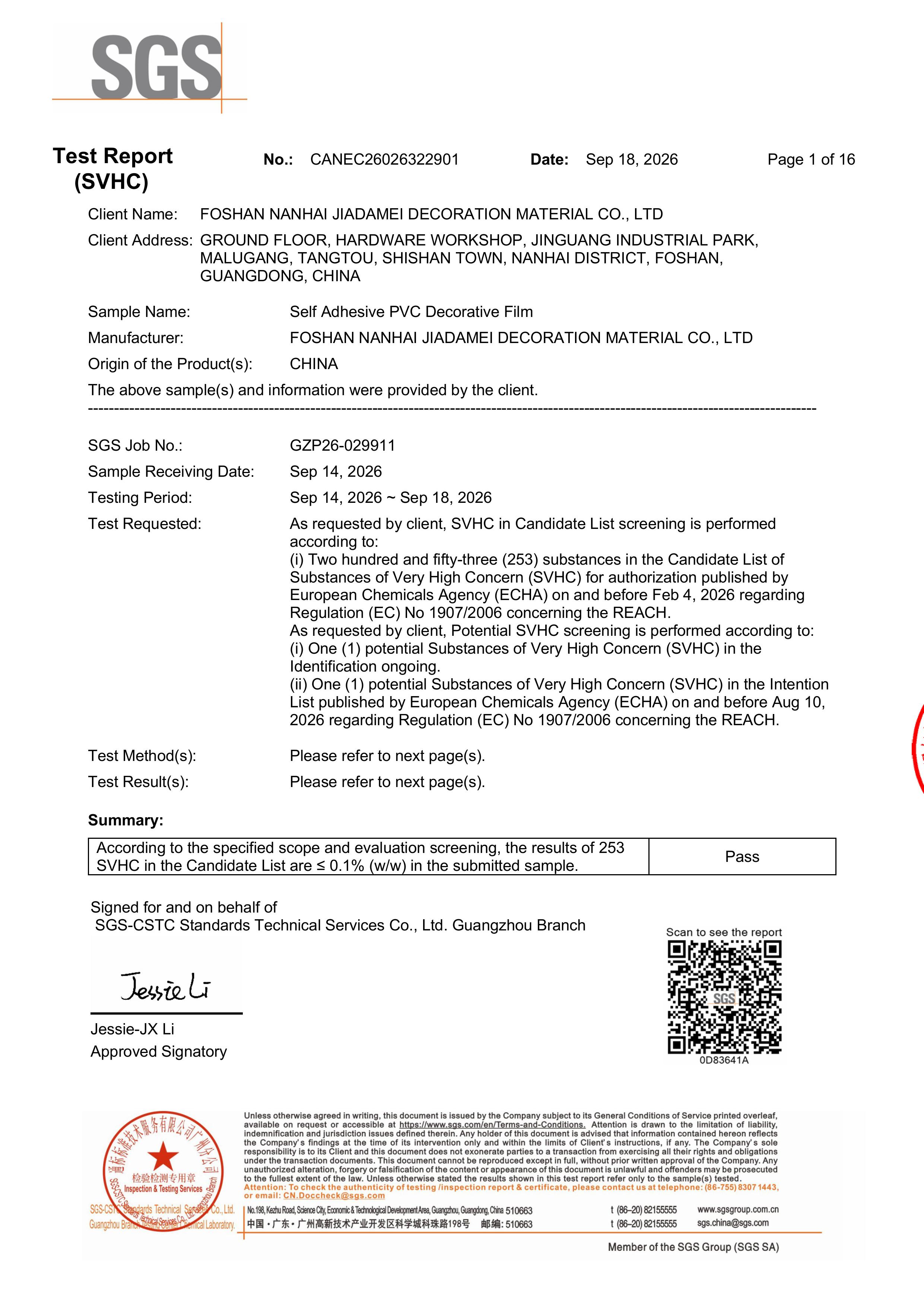
Report CANEC26026322901, issued 18 September 2026 by SGS-CSTC Standards Technical Services Co., Ltd. Guangzhou Branch, scoped to self-adhesive PVC decorative film with 253 SVHC screening.
Two attributes carry more weight than the rest. The issuing body matters because SGS-CSTC is an independent third party; the report is not a self-declaration by the film producer. The issue date matters because a substance screening is a snapshot: it records what was tested, against which candidate list, on which day. Neither attribute can be inferred from a certificate logo placed on a brochure.
What a 253-substance SVHC screening tells a buyer
REACH SVHC screening addresses one narrow but commercially significant question: whether a product contains substances of very high concern above the applicable reporting threshold. The number 253 in this report identifies the scope of that screening — the set of candidate-list substances the laboratory looked for at the time of testing. For a procurement team, the number is useful not as a score, but as a way of pinning down what was and was not examined.
This distinction is where many buyer conversations go wrong. A screening report is not a general safety certificate, and reading it as one leads to two opposite errors. The first error is treating it as proof that the film is safe in every application, including applications the report never addressed. The second is dismissing it because it does not cover adhesion, fire behaviour or durability — subjects that belong to different tests entirely.
The practical reading is narrower and more useful. A dated third-party screening confirms that the supplier maintains a testing relationship with a recognised laboratory, can supply a sample of a defined product for external analysis, and is willing to publish the result rather than describe it. For a buyer who cannot audit a coating line in Foshan, that willingness is a meaningful signal about how the supplier handles documentation generally — including the paperwork the buyer's own customs broker and project specifier will eventually demand.
The model range and roll format behind the document
A report is only as useful as the product identity it carries. Here, the compliance scope maps onto a defined commercial range: models LI9801 to LI9836, supplied as self-adhesive PVC decorative film. The standard roll format is 0.16 mm × 1240 mm × 50 m, with thickness, width and roll length available as customizable parameters for buyers whose cutting equipment or project dimensions require something different.
Those two facts — a bounded model range and a stated standard format — are what make the report operationally checkable. A buyer comparing a quotation against the certificate can ask a precise question: is the quoted model inside LI9801–LI9836, and is the quoted roll format the standard 0.16 mm × 1240 mm × 50 m or a customized variant? If the answer is a customized variant, the follow-up question is whether the customization affects the tested configuration. That is a far more productive conversation than a general request for "compliance documents".
Order quantity and its effect on verification
The minimum order quantity recorded for this supply is one roll per colour for stock colours. Custom colours carry a higher threshold of 3,000 metres per colour, which reflects the economics of a dedicated production run rather than a documentary restriction.
The one-roll stock minimum has a consequence worth spelling out. It means a buyer can place a small order, receive a production roll rather than a hand-made sample, and submit material from that roll for independent testing or internal qualification before committing to a project-scale volume. Documentary evidence and physical verification stop being alternatives and become a sequence: read the report, then confirm on the material you will actually install.
Production control: where the document meets the line
The manufacturer behind this range is leiyegaoke, the brand of FOSHAN NANHAI JIADAMEI DECORATION MATERIAL CO.LTD — a Foshan-based producer of self-adhesive PVC decorative film founded in 2001, operating a 12,000 m² factory with 50 employees and a five-engineer development team.
The relevant capability detail is not the headcount but the process boundary. The factory runs two adhesive coating lines within an integrated system that covers PVC film production, printing, laminating, adhesive coating, slitting, inspection and packaging. Recorded annual output is 15,000,000 metres, with monthly capacity of 120,000 metres and a 20–25 day lead time. Quality control is described as 100% testing, applied from raw-material inspection and colour matching through coating to finished-product inspection and packing.
Why does that matter to a compliance document? Because a report scoped to "self-adhesive PVC decorative film" describes a product the supplier actually coats, not a product bought in and relabelled. When adhesive coating is in-house, the variables that a screening result depends on — formulation, film source, adhesive chemistry, release liner — sit inside one organisation's control. That does not make the report stronger on its face, but it makes the supplier better placed to answer a buyer's follow-up questions and to re-test when a formulation changes.
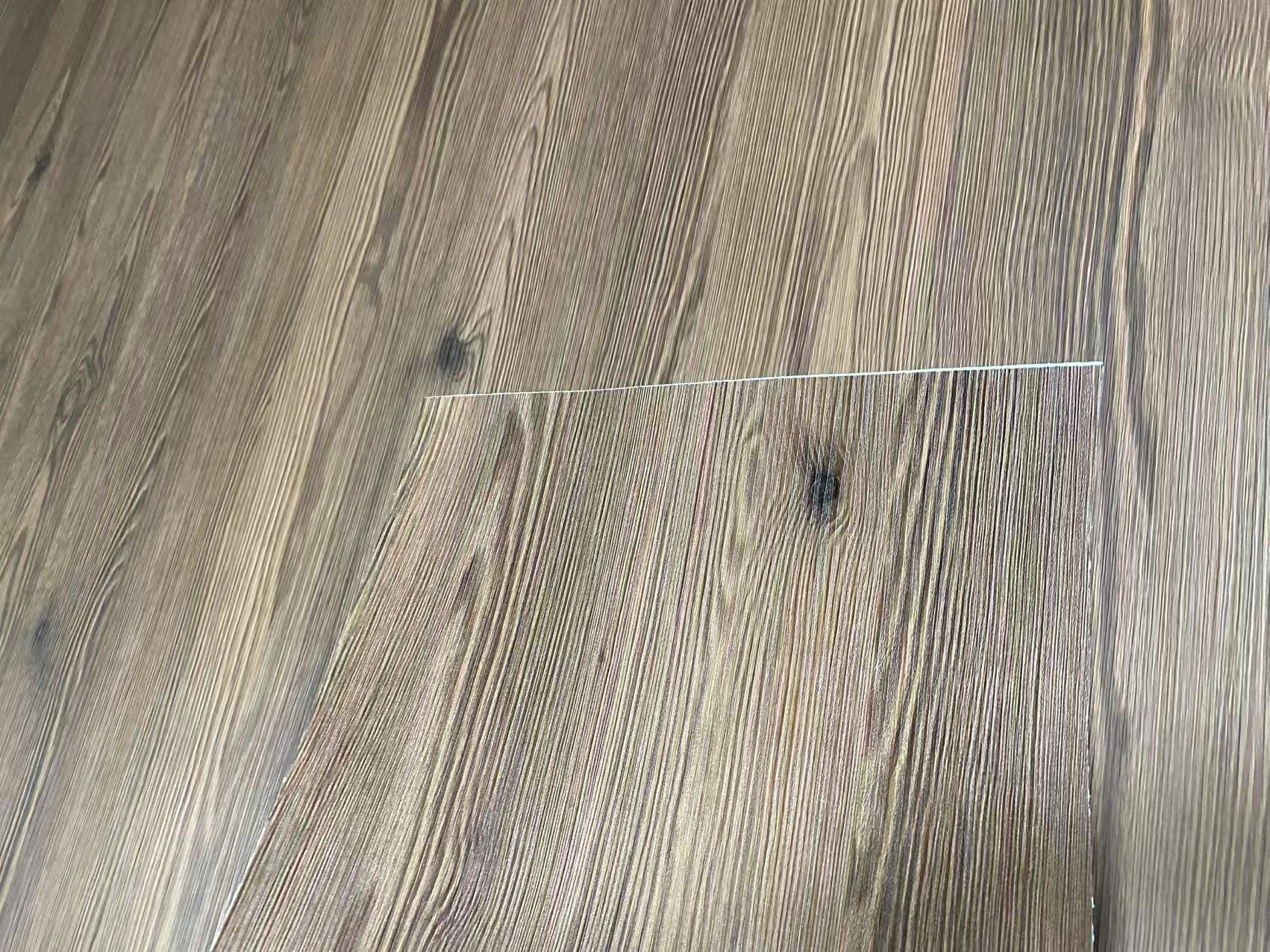
OEM/ODM customization — colours, patterns, thickness, roll sizes, labels and packaging — is where a single report's coverage boundary has to be discussed openly.
Customization and the limits of a single report
Customization is recorded across a wide surface: custom colours, custom patterns, sample-based customization, custom sizes, custom thickness, surface-finish customization, custom logo, labels, packaging and cartons, offered under OEM/ODM terms. The manufacturer also describes OEM and ODM production services in its published material.
That breadth is commercially attractive and evidentially complicated, and buyers should treat it that way. A test report describes a sample. When a buyer changes colour, thickness, surface finish, adhesive or release liner, the material being tested and the material being shipped are no longer automatically the same thing. Certification bodies generally require a new submission when the formulation or construction changes materially; the buyer's job is not to guess the laboratory's rules but to ask the supplier directly how a specific customization affects the evidence presented.
The question to ask is simple and does not require technical expertise: "If we order this colour at this thickness, does CANEC26026322901 still describe what you will ship, and if not, what documentation will you provide instead?" A supplier with in-house coating can answer that question about its own process. A trader generally cannot, and that difference shows up in the answer's specificity.
Application fit across interior renovation scenarios
Compliance evidence travels with the material into applications that each carry their own expectations. Self-adhesive PVC decorative film is specified for cabinet wrap and kitchen cabinetry, bathroom surfaces, furniture renovation, wardrobe and door faces, wall panels, hotel corridors, offices and retail interiors. Each application shifts the emphasis: cabinet wrap depends on conformability around edges and frames; bathroom use depends on a water-resistant, easy-to-clean surface; furniture renovation depends on colour and finish continuity across panels installed at different times.
The finish portfolio reflects those demands, spanning wood grain, marble, stone, solid colour, metallic, textile and concrete effects, with super matte and anti-scratch surfaces available among the finish options. On installation behaviour, the supplier's technical material distinguishes air-release self-adhesive film — which uses a release-liner and adhesive structure creating micro air channels so trapped air can escape during application — from standard adhesive film, which requires more careful technique and is more likely to trap air if installed improperly. For large-area surface work, that distinction affects labour time as much as appearance.
One documented supply relationship illustrates how these factors combine in practice: a furniture manufacturer in Algeria applying film laminated onto MDF board for finished cabinet doors, at a recorded volume of 100,000 metres per month over a relationship of more than six years. The stated application priorities are design and colour consistency, water resistance, anti-scratch behaviour and oil resistance. Long tenure in a single application is not proof of quality, but it is evidence that colour matching, roll consistency and documentation have been repeatable often enough to avoid replacement.
What this evidence does not cover
Honest supplier evaluation requires the boundary to be stated as clearly as the capability. Report CANEC26026322901 does not establish adhesion strength, peel performance after heat cycling, dimensional stability, flame classification, abrasion resistance or expected service life. It does not certify food-contact suitability, and it does not constitute a product warranty or a batch-specific certificate for any individual roll.
Two further limits deserve mention. First, the SVHC candidate list is a living list; a screening performed on 18 September 2026 reflects the list as it stood at testing, and buyers in long project cycles should confirm with the supplier whether a more recent screening exists before final shipment. Second, REACH SVHC screening is not the same instrument as RoHS. This supplier holds a separate RoHS report, CANEC26009798401, issued 24 April 2026 by the same laboratory under EU RoHS Directive (EU) 2015/863 amending Annex II to Directive 2011/65/EU, covering self-adhesive PVC decorative film, PVC decorative film and vinyl film. The two documents answer different questions and should be requested as a pair rather than substituted for one another.
Market context: why documentation travels with the goods
The commercial backdrop explains why this paperwork has moved from the filing cabinet to the negotiation table. Dataintelo's PVC Decorative Film Market Research Report 2034 values the global PVC decorative film market at USD 4.8 billion in 2025 and projects USD 8.6 billion by 2034. The same source estimates that the furniture sector accounted for approximately 44.6% of global PVC decorative film consumption in 2025, that wood grain held the largest product-segment share at 38.4%, and that Asia Pacific took a 42.3% revenue share.
Trade concentration reinforces the pattern. International Trader Publications reported that China became the world's largest PVC exporter in 2025, accounting for 24% of total global trade volume, while Chinese customs data compiled by CEIC recorded exports under HS Code 3919 — self-adhesive plates, sheets, film, foil, tape and strip of plastics — at an all-time high of 246.296 RMB million in January 2026.
These figures describe PVC decorative film and plastics film trade in general; they are not measurements of self-adhesive decorative film alone, and they should be read as context rather than as supplier-specific evidence. Their practical implication is straightforward: as more film crosses borders from fewer production centres, the proportion of transactions where the buyer cannot inspect the line rises. Documentation becomes the substitute for a factory visit, which is precisely why its quality — third party, dated, scoped, numbered — matters more than its volume.
A buyer's verification checklist
The following checks can be completed against the report itself, without technical staff and without a factory audit.
| Check | What it confirms |
|---|---|
| Report number matches the document in hand | CANEC26026322901 is traceable and has not been replaced by an unrelated file |
| Issuing laboratory and branch are named | SGS-CSTC Standards Technical Services Co., Ltd. Guangzhou Branch — an identifiable third party |
| Issue date is recent for the order timeline | 18 September 2026; confirm whether a newer screening exists for long project cycles |
| Applicable standard is cited | Regulation (EC) No. 1907/2006 (REACH), not a generic compliance statement |
| Test scope matches the product | Self-adhesive PVC decorative film with 253 SVHC screening |
| Quoted model falls inside the covered range | LI9801 to LI9836; customized formats require a separate conversation |
| RoHS documentation is supplied separately | CANEC26009798401 covers a different regulatory question |
| The full report is provided, not a cover image | Sample description, method and result statements can be read in context |
Outlook
Compliance documentation is on a path from exception to routine line item. Buyers in the EU are asking for report numbers in quotation sheets; specifiers are filing them alongside colour approvals; and suppliers who treat testing as a one-off marketing exercise will find the gap widening as candidate lists are revised. The suppliers best placed to respond are those whose evidence maps to a defined model range, a stated roll format and an in-house coating process — because those are the conditions under which re-testing can be scheduled rather than improvised.
The reasonable expectation for a buyer is not a permanent certificate but a maintained document trail: a screening report for the product family, a separate RoHS report, a clear statement of which customizations fall outside the tested configuration, and a supplier who answers the question rather than forwarding a logo. Report CANEC26026322901, dated 18 September 2026, is a useful example of what that trail looks like when it is done properly — and of the questions it still leaves for the buyer to ask.
FAQ
What does REACH SVHC Test Report CANEC26026322901 cover?
It is a REACH SVHC test report issued by SGS-CSTC Standards Technical Services Co., Ltd. Guangzhou Branch on 18 September 2026. Its recorded scope is self-adhesive PVC decorative film subject to 253 SVHC screening, it applies to the EU market, and its applicable standard is Regulation (EC) No. 1907/2006 (REACH). The report addresses substance content within that defined scope.
Which product range does the report apply to?
The report is associated with the self-adhesive PVC decorative film model range LI9801 to LI9836. The standard roll format for that range is 0.16 mm × 1240 mm × 50 m, with thickness, width and roll length available as customizable parameters.
Does a REACH SVHC report cover custom colours and custom roll sizes?
A report describes the sample that was tested. Where a buyer changes colour, thickness, surface finish, adhesive or release liner, the tested configuration and the shipped configuration are no longer automatically identical. Buyers should ask the supplier whether the specific customized configuration remains within the report's scope, or whether separate documentation applies. Suppliers with in-house adhesive coating are generally better placed to answer this precisely, because the variables sit inside their own process.
What is the minimum order quantity for self-adhesive PVC decorative film?
For stock colours, the recorded minimum order quantity is one roll per colour. For custom colours, the recorded minimum is 3,000 metres per colour, reflecting the requirements of a dedicated production run rather than a documentary limit. Recorded monthly capacity is 120,000 metres with a 20–25 day lead time.
Which documents should a buyer request alongside the SVHC report?
At minimum, a separate RoHS report — for this supplier, CANEC26009798401 issued 24 April 2026 under EU RoHS Directive (EU) 2015/863 — because RoHS and REACH SVHC screening address different regulatory questions. Buyers should also request the full report rather than a cover page, confirm the issue date against the order timeline for long project cycles, and verify that the quoted model and roll format fall within the covered range.
Tem questões ou precisa de mais detalhes?
Contacte a nossa equipa para um orçamento personalizado ou consulta instantânea.
Solicitar orçamento
Preencha o formulário abaixo e a nossa equipa entrará em contacto com uma proposta personalizada.
Chat direto do WhatsApp
Prefere conversar em tempo real? Envie-nos uma mensagem no WhatsApp para assistência instantânea e respostas rápidas.
- Obter orçamento personalizado
- Partilhar fotos ou documentos
- Discuta as suas necessidades diretamente
Geralmente responde em 5–30 minutos durante o horário de expediente.