
Supplier Capability Evidence: SOL-2 Line and Material Range
An insulating glass unit is a system, not a part. Two or more glass panes are held at a fixed distance by a spacer, the cavity is kept dry by desiccant, and the edge is closed by a primary seal and a secondary seal. Every one of those elements has to arrive in the right specification, at the right time, for the life of the unit. That is why supplier evaluation in this category is less about catalogues and more about physical evidence of process.
The global insulated glass market was valued at USD 92.7 billion in 2024 and is projected to reach USD 121.7 billion by 2030, according to a Grand View Research estimate. Demand at that scale rewards buyers who can point to equipment, material range and repeatable output — not buyers who accept capability claims at face value.
Capability in insulating glass materials can be verified through three evidence sets: the processing equipment a supplier operates or builds, the width of the bill of materials it can supply from its own range, and the output and stock figures it is willing to document. Soleron Insulating Glass Materials — the insulating glass materials business of Soleron Building Materials (Hebei) Co., Ltd., a manufacturer based in Renqiu, Hebei Province, China — is a useful example precisely because it publishes both the component range and the processing platform that consumes it.
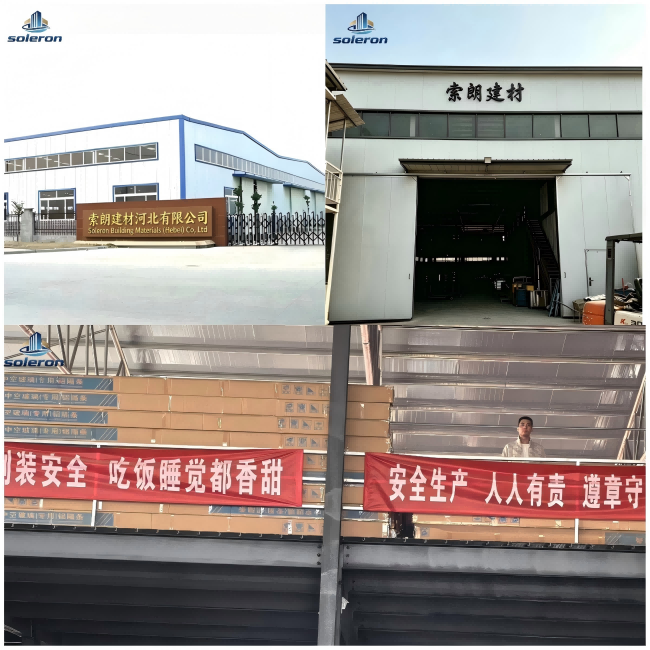
Supplier capability is read from production assets, not from adjectives. A factory audit starts with what runs inside the building.
Why capability claims rarely survive a component-level audit
Insulating glass standards test the finished unit, but the evidence trail that makes the test passable is built one level below the unit. EN 1279-2 sets a moisture penetration requirement of an average index of 0.20 or lower across five aged specimens, with an individual specimen limit of 0.25. The same standard recognises four methods for determining desiccant moisture content: drying at 540 C, Karl Fischer titration, gravimetric measurement and dew point methods. AS/NZS 4666:2012 covers long-term type testing, periodic manufacturing testing, traceability, desiccant suitability and shelf life. ASTM C1249-18 describes the dual-seal construction — polyisobutylene primary seal, silicone secondary seal — as the composition required for structural silicone glazing durability.
Read together, those documents ask a supplier four questions: which desiccant, which primary seal, which secondary seal, and what evidence of consistency across production runs. A supplier that cannot answer all four in the same technical conversation is not yet a qualified partner, whatever its brochure says.
The SOL-2 platform as an evidence object
SOL-2 is the model designation the company applies to its insulating glass processing machinery. The published equipment family is specific rather than generic: an insulating glass production line, a glass washing machine, a two-component sealant machine, a butyl sealant extruder machine, an aluminium spacer bar bending machine and a molecular sieve filling machine. Published construction materials are carbon steel and stainless steel. Power specification is 220 V to 380 V at 50 Hz, with a power range from 3.2 kW to 38 kW.
Read as a sequence, that list reproduces the order of operations inside an IGU line. Glass is washed and dried, spacer frames are bent from bar stock and filled with desiccant, butyl is applied as the primary seal, the unit is assembled, and a two-component sealant is metered and mixed for the secondary seal. A supplier that can name this sequence as equipment it works with is describing process knowledge. A supplier that lists unrelated machines is describing a catalogue.
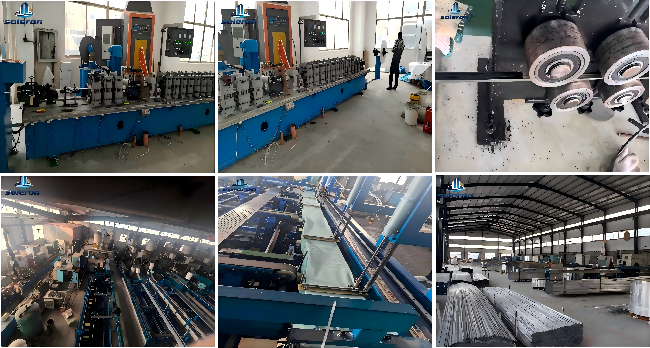
Workshop view: the physical sequence of washing, frame forming, desiccant filling and sealing is the evidence buyers can actually inspect.
Two claims that deserve testing rather than acceptance
Continuous operation and control integration appear in most equipment descriptions and are rarely verifiable from a specification sheet. Both are worth converting into audit questions rather than assumptions. The power range of 3.2 kW to 38 kW illustrates the point: a span that wide is not a single figure, so a buyer should ask which value applies to which configuration before comparing it with an alternative supplier.
| SOL-2 module | Function in an IGU line | Question to put to the supplier |
|---|---|---|
| Insulating glass production line | Sequences washing, assembly, sealing and pressing in one flow | Which glass sizes and line speeds is the delivered configuration rated for? |
| Glass washing machine | Removes contamination before any seal is applied | What water quality and drying stage are specified? |
| Aluminium spacer bar bending machine | Forms spacer frames from bar stock | What are the minimum and maximum frame dimensions? |
| Molecular sieve filling machine | Doses desiccant into the spacer cavity | How is fill level verified, and how is sieve dust controlled? |
| Butyl sealant extruder machine | Applies the primary seal to the spacer | Which butyl grade is used, and how is coat weight controlled? |
| Two-component sealant machine | Meters, mixes and applies the secondary seal | How is mix ratio verified, and what happens on a ratio fault? |
Reading the material range: what actually closes a bill of materials
Equipment only proves a supplier understands the process. The second evidence set is whether the same supplier can fill the bill of materials without sending the buyer to three other vendors. In the Soleron range, that breadth is documented at specification level rather than at category level.
- Aluminium spacer bars cover 5.5 mm to 50 mm widths with 0.16 mm to 0.35 mm wall thickness, produced from 3003 and 1100 series aluminium coil in standard, bendable, black, embossed and butylated variants, in 5 m lengths or customised lengths.
- Warm edge spacers cover 6 A to 27 A in fiberglass, composite (plastic with stainless steel), PP, flexible and butyl-sealing constructions.
- 3A molecular sieve is supplied in 0.5 mm to 0.9 mm, 1.0 mm to 1.5 mm and 1.5 mm to 2.0 mm grades, brown in colour, synthetic zeolite base, 25 kg net weight in vacuum pack plus carton.
- Sealants are offered as SOL-803 and SOL-717 covering butyl sealant, hot melt sealant and two-component silicone sealant, in black and white, packed in cartons, plastic drums or iron buckets at 28 kg, 30 kg and 330 kg.
- Corner connectors span 5.5 mm to 50 mm and include plastic corner connectors, steel straight connectors, Georgian bar connectors and end caps, in black, white or customised colour.
- Georgian bars are available in 5x8, 6x8, 7x7, 6x15, 8x18 and 8x26 profiles, 3 m or customised length, in 0.5 mm and 0.7 mm thickness, from aluminium, recyclable plastics or ABS.
- Auxiliary materials under the SOL-1 reference include butyl tape, cork pads and trimming cotton.
- Glass processing chemicals under SOL-6 include 330 metric tons of anhydrous sodium sulphate, 99 percent caustic soda at 10 metric tons and 50 percent hydrogen peroxide at 100 metric tons — a supply line aimed at glass processing rather than at IGU assembly itself.
Three of these families determine whether an edge seal can pass a moisture test at all: the spacer that sets cavity geometry, the desiccant that holds the cavity dry, and the primary and secondary seal chemistry that keeps moisture out. A supplier that carries only one of the three shifts integration risk onto the buyer. Stated guarantee periods differ by family as well: five years on spacer bars, corner connectors, Georgian bars and molecular sieve, and ten years on sealants and butyl tape.
| Material family | Documented specification | Role in the assembled unit |
|---|---|---|
| Aluminium spacer bar | 5.5–50 A; 0.16–0.35 mm; 3003 and 1100 coil | Sets interpane distance and carries the primary seal |
| Warm edge spacer | 6–27 A; fiberglass, composite, PP, flexible | Reduces thermal bridging at the edge |
| 3A molecular sieve | 0.5–0.9 / 1.0–1.5 / 1.5–2.0 mm; 25 kg vacuum pack | Adsorbs residual moisture in the sealed cavity |
| Sealant SOL-803 / SOL-717 | Butyl, hot melt, two-component silicone; 28 / 30 / 330 kg | Primary and secondary edge seal |
| Corner connector | 5.5–50 mm; plastic, steel straight, end caps | Mechanical continuity at frame corners |
| Georgian bar | 5x8 to 8x26; 0.5 / 0.7 mm; aluminium, ABS | Decorative division within the sealed unit |
IGU output signals: what the numbers prove and what they do not
The third evidence set is output. Soleron states 10 automatic aluminium spacer bar production lines, 8 semi-automatic production lines and 10 warm edge spacer production lines, an annual production capacity of 500 tons, more than 100 pieces of regular aluminium spacer bars and warm edge spacers kept in stock, and more than 10 years of production experience. Exports account for roughly 80 percent of output, with key markets listed as Germany, France, the United Kingdom, the United States, Canada, China, Japan, South Korea, India, the UAE, Saudi Arabia, Brazil, Mexico and Chile.
The line count is repeated in the company profile published on Made-in-China, a commercial business-to-business source. That is corroboration of a company statement, not independent verification of throughput — a distinction worth keeping in the qualification file.
Two boundaries matter here. First, 500 tons is a material output figure; it describes spacer production volume, not IGU unit throughput. A buyer planning a monthly unit requirement has to convert that tonnage through spacer consumption per unit rather than read it as a finished-unit capacity. Second, the stock figure is described as covering regular aluminium and warm edge spacer sizes; it should not be read as availability of every width, colour or profile in the catalogue. Customised lengths and specifications remain subject to production scheduling.
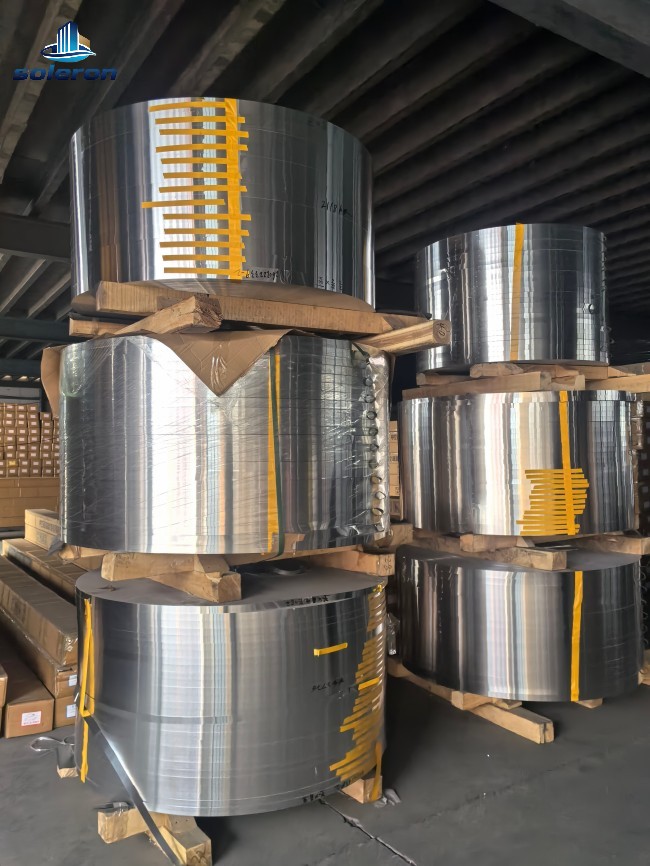
Stock depth on regular spacer sizes shortens replenishment cycles; it does not replace a production schedule for custom profiles.
Where the evidence fits: application scenarios
Automatic IGU processors. Aluminium spacer bars are compatible with conventional insulating glass production lines, which helps maintain stable production. For a processor running an existing line, that compatibility reduces the risk of a changeover disrupting takt time.
Energy-driven projects. Where warm edge spacers replace aluminium, the spacer, the 3A molecular sieve grade and the sealant chemistry are selected together, because reducing edge heat loss does not by itself protect the cavity if desiccant performance or seal integrity falls short.
Structural and facade glazing. ASTM C1249-18 describes the polyisobutylene primary seal with silicone secondary seal as the composition required for structural silicone glazing durability, which makes primary and secondary sealant supply a specification question rather than a commodity purchase.
Distributors and wholesalers. Breadth of range and depth of stock matter more than unit price at the distribution level, because a single-source bill of materials reduces the number of inbound shipments a distributor has to coordinate for IGU customers. Aluminium spacer bars fall under HS 7604.21 for hollow profiles or 7604.29 for other profiles, which is the classification buyers need for duty and origin checks.
Market trend: material breadth is becoming a procurement variable
The downstream IGU market was valued at USD 92.7 billion in 2024 and is projected at USD 101.3 billion in 2026 and USD 121.7 billion by 2030 in the same Grand View Research series. Upstream, the warm edge spacer market was valued at USD 1.1 billion in 2024 and is projected to reach around USD 1.90 billion by 2035 according to Meticulous Research, while the 3A grade segment of the molecular sieve desiccant market was valued at USD 1.80 billion in 2024 according to Mordor Intelligence. These are commercial research estimates rather than audited figures, but the direction is consistent: the components that determine edge performance are growing alongside the unit market.
The procurement consequence is structural. When warm edge share grows, a supplier that carries spacer bars but not desiccant, or desiccant but not sealant, forces the buyer to qualify three vendors against one standard. Material breadth becomes a qualification criterion rather than a convenience.
Comparison with conventional practice, and the limits of this evidence
The long-standing default in IGU production is the aluminium spacer: good mechanical strength, easy processing, stable dimensions and compatibility with conventional insulating glass production lines. Its weakness is thermal. Published comparison values put aluminium spacers at roughly 160 to 200 W/mK thermal conductivity against roughly 0.13 to 0.25 W/mK for warm edge systems, which is the physical basis for the warm edge case in cold-climate and energy-code projects.
The trade-off is not one-directional. Warm edge systems carry a higher initial component cost and require different handling on the line, while aluminium remains the lower-friction option where mechanical strength, processing simplicity and existing line compatibility dominate. For a supplier, carrying both families is the practical answer; for a buyer, running both through the same qualification file is the practical discipline.
The limits of the evidence described in this article should be stated plainly. Equipment lists, material ranges and tonnage figures demonstrate production infrastructure and supply breadth; they do not demonstrate that a specific delivered unit will pass EN 1279-2 moisture penetration testing. That confirmation comes from unit-level test reports and pre-shipment inspection, not from a machinery specification. Buyers who treat line counts as a substitute for test data will over-credit the evidence.
Future outlook
Two pressures are likely to shape supplier selection through the rest of the decade. The first is documentation: standards such as AS/NZS 4666 already require traceability, shelf life control and periodic manufacturing testing, and buyers are increasingly asking for that evidence at component level rather than at unit level. The second is material coupling: as warm edge adoption grows, the desiccant grade and the sealant chemistry have to be justified together with the spacer, which favours suppliers whose range covers all three.
For a manufacturer positioned as Soleron is — with both spacer production lines and an insulating glass processing equipment range — the credible long-term claim is not that one product is superior, but that the process behind it can be inspected. That is a weaker claim than most marketing copy, and a far more durable one.
Frequently asked questions
What is an insulating glass unit?
An insulating glass unit consists of two or more glass panes separated by a spacer and edge-sealed to form an insulating air or gas-filled cavity. The cavity is kept dry by desiccant held in the spacer, and the edge is closed by a primary seal and a secondary seal.
What function does the spacer bar perform inside the unit?
The spacer bar holds the glass panes at a fixed distance and so establishes the size of the interpane space. It also provides the channel that carries desiccant and forms the structural basis of the edge seal.
What are the advantages of aluminium spacer bars?
Aluminium spacer bars offer good mechanical strength, easy processing, dimensional stability and compatibility with conventional insulating glass production lines — the last point being the main reason they remain the default in many existing lines despite higher thermal conductivity than warm edge alternatives.
Which material families should a long-term insulating glass supplier be able to cover?
Insulating glass accessories include spacer bars, warm edge spacers, molecular sieve desiccants, PIB sealants, silicone sealants, polysulfide sealants, corner keys and related components. A supplier whose range omits the desiccant or the secondary seal leaves the buyer to qualify an additional vendor against the same standard.
How can a buyer verify production capability before a long-term agreement?
Ask for the equipment list and its configuration ratings, the specification range of each material family, documented output and stock figures, and the guarantee period applied to each family. Then separate what the documents prove from what requires unit-level testing, and confirm the latter through pre-shipment inspection and test reports.
What commercial terms should be confirmed before repeat orders?
The stated purchasing terms are a minimum order quantity of 5 cartons, delivery on EXW, FOB or CIF terms, pre-shipment testing as the acceptance criterion, and 30/70 payment terms. Buyers should confirm that these apply to the specific material family ordered, since packaging and weight units differ between spacers, sealants and desiccant.
Closing note
Supplier capability in insulating glass materials is best read from three artefacts a buyer can actually inspect: the equipment in the workshop, the specification range in the catalogue, and the output and stock figures in the qualification file. Adjectives do not survive that inspection; documented parameters usually do.
The full Soleron specification range for spacer bars, warm edge spacers, sealants, desiccants, corner connectors and Georgian bars is set out in the product catalogue, available for download: Soleron product catalogue (PDF).
Tem questões ou precisa de mais detalhes?
Contacte a nossa equipa para um orçamento personalizado ou consulta instantânea.
Solicitar orçamento
Preencha o formulário abaixo e a nossa equipa entrará em contacto com uma proposta personalizada.
Chat direto do WhatsApp
Prefere conversar em tempo real? Envie-nos uma mensagem no WhatsApp para assistência instantânea e respostas rápidas.
- Obter orçamento personalizado
- Partilhar fotos ou documentos
- Discuta as suas necessidades diretamente
Geralmente responde em 5–30 minutos durante o horário de expediente.