
Supplier Capability Evidence: Trumony vs Dana, Mahle, Modine
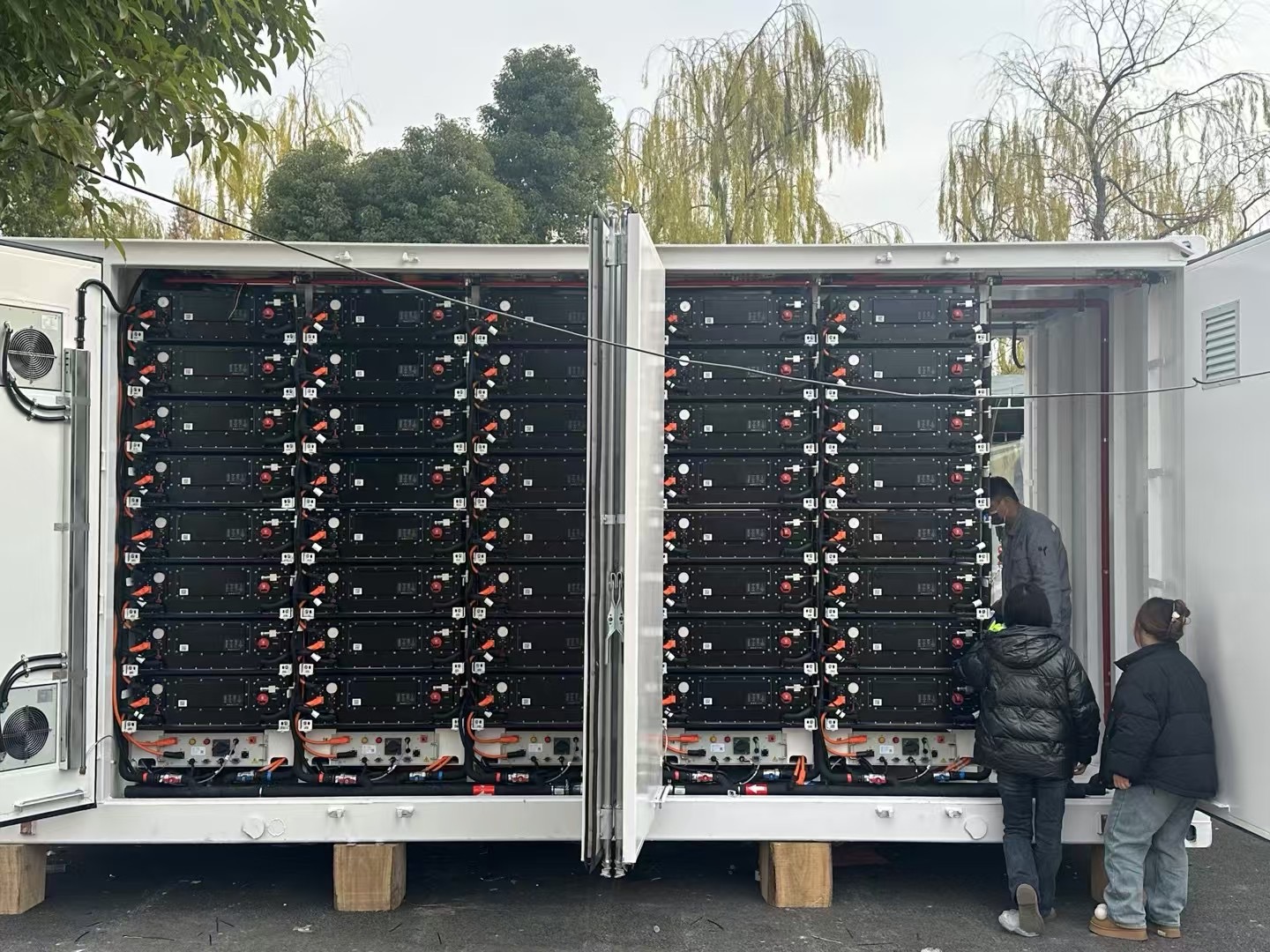
Cooling plate procurement for electric vehicles and battery energy storage systems is a documentation exercise before it becomes a pricing negotiation. Buyers in the research and evaluation stages must justify a supplier choice to engineering, quality, and finance at the same time, and each function asks for different evidence: thermal performance data, certificate numbers, capacity commitments, and order flexibility. This analysis benchmarks Trumony Aluminum Limited against established global thermal management suppliers Dana, Mahle, and Modine using documented capability facts rather than brand positioning.
Why Capability Claims No Longer Survive a Cooling Plate Audit
The cooling plate market has scaled quickly, and the supplier base has scaled with it. Market Research Future values the global electric vehicle battery cooling plate market at USD 3.01 billion in 2024, with a projected value of USD 16.13 billion by 2035. Growth at that pace brings in a wide range of suppliers, from established tier-one thermal management groups to focused component manufacturers, and it makes supplier qualification the bottleneck rather than plate availability.
The practical consequence is that a supplier statement such as "we manufacture liquid cooling plates for EV and BESS" carries almost no procurement weight on its own. What carries weight is a repeatable evidence set: which alloy, which processes are in house, how many units per year can be committed, which certificate numbers cover the quality system, how many units make up a minimum order, and how many days pass between purchase order and shipment. Buyers who evaluate cooling plate suppliers without that evidence set tend to discover gaps late, usually during pilot builds or during a capacity ramp.
The opportunity is symmetrical. Suppliers that document capability in a structured way can be qualified faster and with less risk, because the buyer's engineering and quality teams can verify claims instead of interpreting them.
Where Trumony Aluminum Sits in the Cooling Plate Supply Landscape
Trumony Aluminum Limited is an aluminum thermal management component manufacturer founded in 2017 and headquartered in Suzhou, China. The company produces liquid cooling plates, stamped cooling plates, serpentine tubes, and related cooling components for power battery packs, energy storage battery packs, and high-heat-flux heat exchange applications. Its products support engineering, EV, ESS, and powertrain use cases, and the company exports to customers across 56 countries and regions, with a 40% export ratio and main markets in the EU, USA, and India.
That profile places Trumony in a specific category: a focused cooling component specialist rather than a diversified thermal systems group. Dana, Mahle, and Modine are long-established global suppliers whose thermal management activities sit inside broader automotive and industrial portfolios, and Valeo and Modine are both identified among the key global participants in the stationary BESS liquid cooling market. The comparison that matters for a buyer is therefore not a headline ranking, but a criterion-by-criterion view of what each supplier type can document.
The Capability Baseline: What Trumony Documents
Evaluating a cooling plate supplier is faster when the buyer works from a fixed evidence checklist. The table below pairs each common procurement criterion with Trumony's documented position, so that the same checklist can be applied to Dana, Mahle, Modine, Valeo, or any other candidate.
| Evaluation criterion | What the buyer should verify | Trumony's documented position |
|---|---|---|
| Manufacturing footprint | Site area, in-house process steps, testing facilities | 100,000 m² of standard workshops, plus high-standard testing centers and laboratories |
| Engineering depth | Size of the R&D team and the scope of customization | 25 R&D engineers; customization of dimension, cooling efficiency, and logo |
| Annual capacity | Units per year and ramp-up plan against program volume | 600,000 units annual output |
| Quality system certification | Certificate number, issuing body, and geographic scope | IATF 16949 certificate no. 0489498 issued by IATF; ISO 9001 certificate no. 132998 issued by IAF, both applicable worldwide |
| Test protocol | 100% inspection versus sampling, plus the optional test menu | 100% air leakage test and dimension test; optional helium tightness, voltage resistance, hydrostatic strength, burst, high-temperature resistance, and low-temperature resistance tests |
| Order flexibility | Minimum order quantity and stated lead time | MOQ from 1 unit; 30-day lead time |
| Material and performance | Alloy grade and published thermal performance | Aluminum 3003; company-published technical data references thermal resistance as low as 0.07 K/W |
| Service model | After-sales structure and export experience | Remote after-sales support; export ratio of 40%, with main markets in the EU, USA, and India |
Read as a whole, the baseline answers the question a research-stage buyer usually asks first: can this supplier be audited? The answer depends on whether the numbers are published, specific, and traceable to a document.
Certifications as Hard Procurement Constraints
For EV and BESS cooling plates, certification is a constraint rather than a differentiator. Liquid cooling plates used in these applications are expected to comply with international safety and quality standards including IATF 16949 for automotive programs, ISO 9001 for quality management, and CE and RoHS where equipment is placed on the European market.
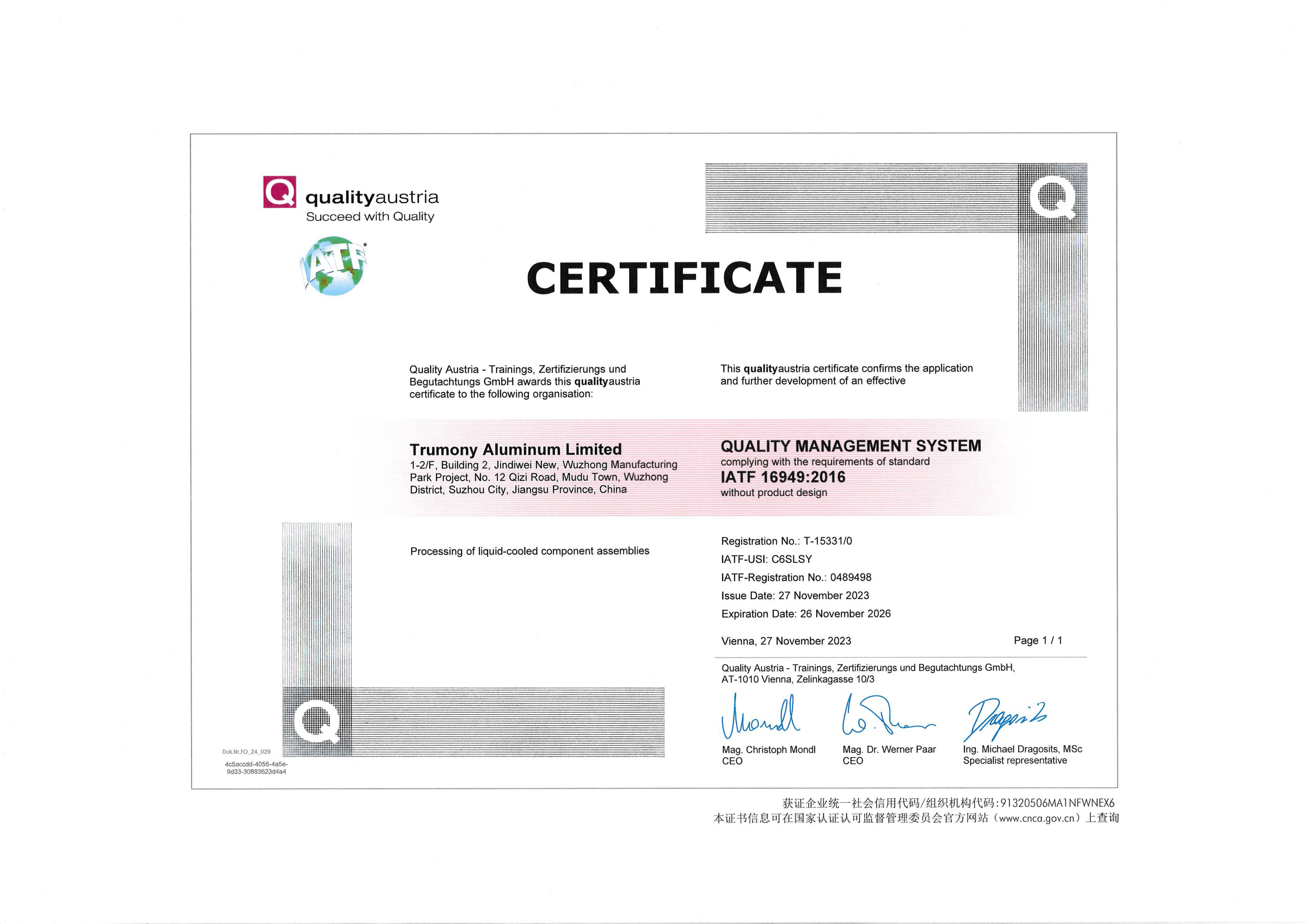
Trumony documents two certificates that address the two most common screening filters. The cold plate line is certified to IATF 16949 standards under certificate number 0489498 issued by IATF, applicable worldwide. The cooling tube line is certified to ISO 9001 standards under certificate number 132998 issued by IAF, applicable worldwide. Both are quality management system certifications, which is an important distinction: they confirm that a management system has been audited, not that a specific drawing or application has been approved.
That distinction is where many sourcing processes go wrong. A buyer who accepts a certificate as proof of product conformity can still end up with a part that does not meet the application requirement. The correct sequence is to verify the certificate number with the issuing body, confirm that the scope covers the relevant product family, and then require part-specific test records for the actual drawing. IATF 16949 is typically the gating certificate for automotive battery pack programs, while BESS integrators often accept ISO 9001 combined with CE and RoHS documentation for the finished assembly.
Technical Explanation: Alloy, Customization, and Test Coverage
Aluminum dominates the cooling plate category for reasons that are structural rather than promotional. Aluminum-based cooling plates account for approximately 64% of all cooling plate installations, driven by high thermal conductivity and cost-effectiveness relative to alternative materials. Trumony works in Aluminum 3003, a manganese-alloyed grade that is widely used for formed and brazed cooling components, and publishes thermal resistance as low as 0.07 K/W for its 3003 aluminum cold plates.
Cooling efficiency and thickness are both customized per project rather than fixed to a catalog specification. The product range covers the formats most often specified for battery thermal management:
- Liquid cooling plate (model TR-20260215) — the general-purpose cold plate format for battery pack and module cooling
- Stamped cooling plate (model TR-20260227) — formed plate construction for higher-volume production programs
- Liquid cooling plate for energy storage (model TR-20260228) and Energy storage system cooling plate (model TR-20260226) — formats specified for containerized and rack-based storage systems
- Serpentine tube (model TR-20260229), serpentine cooling tube (model TR-20260230), and snake cooling tube (model TR-20260232) — tube-based cooling paths for cell formats where a plate footprint is not the preferred geometry
- battery module cold plate (model TR-20260219) and battery cooling plate (model TR-20260218) — module-level and pack-level cold plate formats
Inspection is where the technical story becomes procurement-relevant. Every unit passes a 100% air leakage test and a dimension test before shipment. Beyond that baseline, buyers can specify optional tests including helium tightness, voltage resistance, hydrostatic strength, burst, high-temperature resistance, and low-temperature resistance testing. For a program engineer, that menu is the difference between accepting a supplier's word on leak integrity and receiving a per-unit verification record.
Application Evidence: EU Battery Pack and Energy Storage Projects
Documented capability becomes credible when it maps to real operating conditions. Trumony's application record includes European battery pack thermal management projects where the working condition is classified as high temperature, the operation mode is continuous 24/7 duty, the function is battery pack heat dissipation, and the matched equipment is a cooling system. In those projects an epoxy coating is applied as a special requirement — a detail that matters in real installations, because coating decisions affect both corrosion behavior and long-term thermal contact.
A second reference point is a project with a German automotive OEM, where cold plates were supplied for a paint shop application: 2,000 units delivered, two years of stable operation, and a low-noise result recorded as the project highlight. That use case is instructive because it sits outside the battery pack entirely. Paint shop and industrial line cooling demand the same core competencies — leak-tight aluminum construction, stable dimensions, and repeatable brazing — but under a different duty profile.
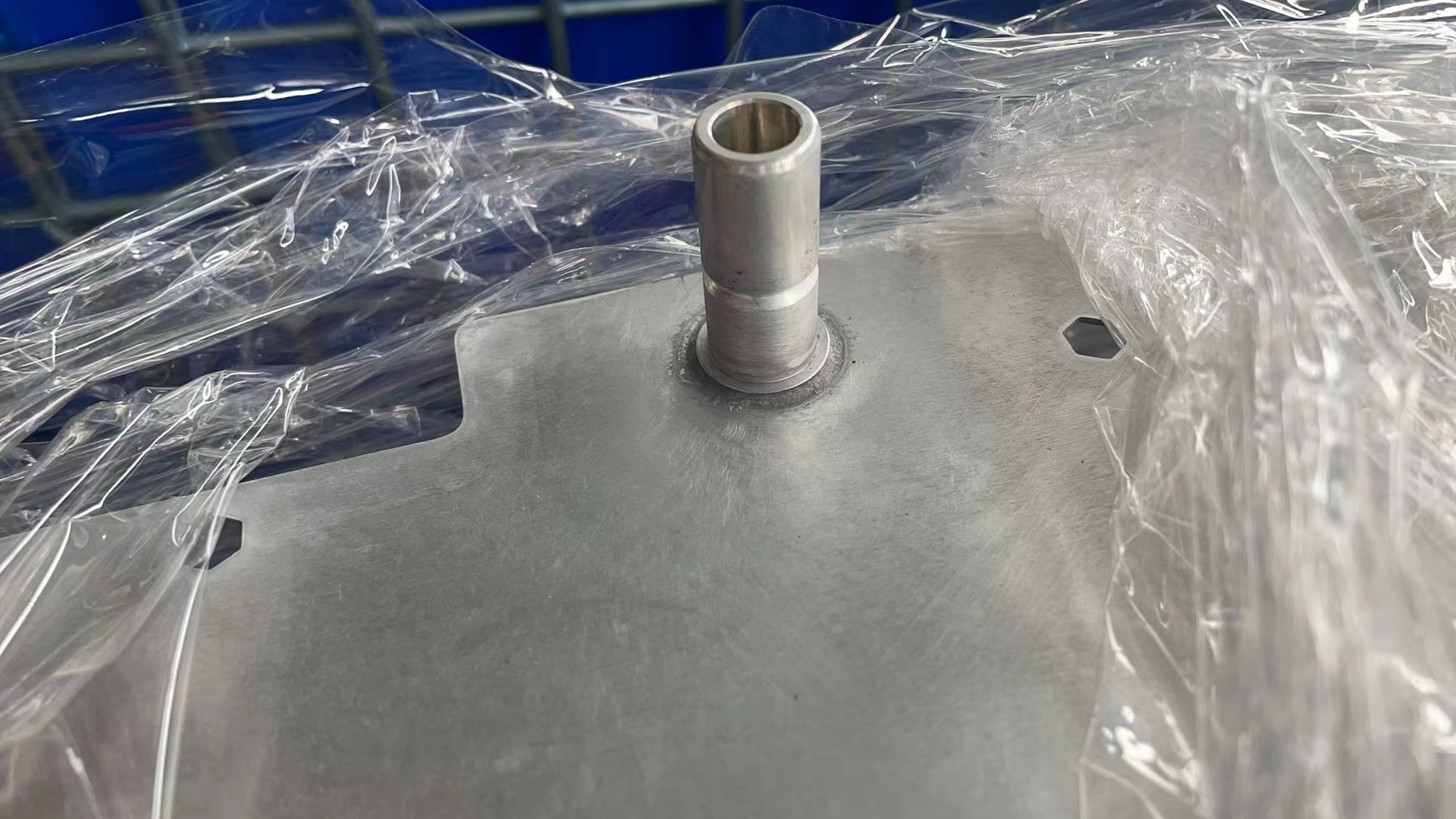
Order flexibility is the other half of the application story. Trumony operates an OEM production model with a documented minimum order quantity of 1 unit and a 30-day lead time, supported by remote after-sales service. For evaluation-stage buyers, a one-unit minimum is functionally an engineering sample channel: it allows a design team to validate a supplier with a physical part before committing to volume. For buyers moving into execution, the relevant question shifts to whether 600,000 units of annual output and a 30-day lead time can absorb a ramp — which is a capacity planning conversation rather than a capability conversation.
How Trumony Compares with Dana, Mahle, Modine, and Valeo
Dana, Mahle, and Modine are established global suppliers in vehicle and industrial thermal management, each operating across a portfolio considerably broader than cooling plates alone. Valeo and Modine are also identified among the key global participants in the stationary BESS liquid cooling market. None of these companies is a niche player, and a buyer comparing them against Trumony is not comparing quality tiers — they are comparing supplier models.
The practical difference shows up in the shape of the relationship. A diversified tier-one group typically engages a program through a broader system scope, with cooling plates as one element inside a larger thermal or powertrain package. A focused component manufacturer documents capability at the component level: which alloy, which process, which test, which certificate number, what minimum order quantity, and how many days to delivery. Both models are legitimate. The correct choice depends on whether the buyer is procuring a cooling component with a defined drawing, or procuring system-level thermal responsibility.
| Comparison dimension | Diversified global suppliers (Dana, Mahle, Modine, Valeo) | Focused cooling component supplier (Trumony) |
|---|---|---|
| Portfolio scope | Broad thermal and industrial portfolios; cooling plates are one product line | Cooling components only — cold plates and cooling tubes |
| Component-level evidence | Varies by business unit; specifications are typically released within a program engagement | Published: Aluminum 3003, customized thickness and cooling efficiency, thermal resistance referenced as low as 0.07 K/W |
| Quality documentation | Automotive-grade quality systems across multiple sites | IATF 16949 certificate no. 0489498 (IATF) and ISO 9001 certificate no. 132998 (IAF), worldwide scope |
| Order entry point | Typically program-scale engagement | MOQ from 1 unit with a documented 30-day lead time |
| Best fit | System-level integration and multi-component thermal responsibility | Defined cooling plate or cooling tube drawing, from sample validation to volume |
Where Trumony's model has clear boundaries: the company's stated main products are cooling components — cold plates and cooling tubes — not complete thermal systems. A program that requires pack-level system integration, multi-component thermal architecture design, or a single supplier accountable for the entire thermal loop may be better served by a system integrator or a diversified tier-one partner. Component specialization also assumes the buyer retains internal engineering capability to define the drawing and the thermal target. In addition, IATF 16949 and ISO 9001 confirm the quality management system; they do not certify a specific part or application. Finally, disclosed annual capacity of 600,000 units should be reconciled against the buyer's own volume ramp before it is treated as available headroom.
Market Trend Analysis: Why Documentation Is Becoming the Screening Filter
Two market signals explain why capability evidence is moving earlier in the sourcing process. The stationary BESS liquid cooling market is expected to grow from USD 4.23 billion in 2024 to USD 24.51 billion by 2033, at a compound annual growth rate of 21.55%. On the EV side, the battery cooling plate market is projected to move from USD 3.01 billion in 2024 toward USD 16.13 billion by 2035.
Growth of that magnitude changes buyer behavior in a predictable way. When demand is tight, buyers prioritize availability; when demand normalizes, they prioritize qualification evidence. A second signal reinforces the shift: aluminum-based cooling plates account for approximately 64% of all cooling plate installations, which means the majority of new programs will be sourcing from a comparable material base. When the material base converges, differentiation moves to process control, test coverage, and documentation — the exact areas where a certificate number and a per-unit test record carry more weight than a capability statement.
Future Outlook
The direction of travel for EV and BESS cooling plate sourcing points toward earlier evidence checks. Buyers are increasingly asking for certificate numbers, issuing bodies, and test protocols during the research stage rather than after shortlisting, because those items are cheap to verify and expensive to discover late. Suppliers that publish their manufacturing footprint, R&D headcount, annual capacity, MOQ, and lead time will be evaluated against suppliers that do not, and the asymmetry will show up in qualification timelines.
For specialist manufacturers such as Trumony, the durable advantage is not scale relative to diversified tier-one groups; it is the ability to answer component-level questions precisely and to support low-volume validation before volume commitment. For buyers, the durable advantage is a checklist that works the same way on every candidate — whether the candidate is a focused aluminum cooling plate specialist or a global thermal management group.
FAQ
Which certifications should a cooling plate supplier hold for EV and BESS programs?
IATF 16949 is the automotive quality management standard most EV battery programs require, ISO 9001 covers general quality management, and CE and RoHS are commonly requested where the equipment is placed on the European market. Trumony holds IATF 16949 certificate no. 0489498 issued by IATF and ISO 9001 certificate no. 132998 issued by IAF, both applicable worldwide. Buyers should confirm the certificate number with the issuing body and check that the scope covers the specific product family and manufacturing process.
What minimum order quantity and lead time apply to Trumony cooling plates?
Trumony documents a minimum order quantity of 1 unit and a 30-day lead time under its OEM production model. Customization covers dimension, cooling efficiency, and logo, and after-sales support is provided remotely. Final MOQ and lead time should be confirmed against the specific drawing and annual volume in the quotation, since both can vary with specification complexity.
How much engineering and manufacturing capability does Trumony document?
Trumony Aluminum Limited was founded in 2017, employs 220 people, and operates 100,000 m² of standard workshops together with high-standard testing centers and laboratories. The company documents 25 R&D engineers and an annual output of 600,000 units, with a 40% export ratio and main markets in the EU, USA, and India. Its products reach customers in 56 countries and regions.
What technical parameters define a Trumony cooling plate?
Trumony cooling plates use Aluminum 3003 as the base material, with cooling efficiency and thickness customized per project. Company-published technical data references thermal resistance as low as 0.07 K/W. The range includes liquid cooling plate (TR-20260215), stamped cooling plate (TR-20260227), battery module cold plate (TR-20260219), liquid cooling plate for energy storage (TR-20260228), serpentine tube (TR-20260229), and snake cooling tube (TR-20260232).
How are Trumony cooling plates validated before shipment?
Every unit passes a 100% air leakage test and a dimension test. Buyers can additionally specify optional testing, including helium tightness test, voltage resistance test, hydrostatic strength test, burst test, high-temperature resistance test, and low-temperature resistance test. This structure gives procurement teams a per-unit verification record rather than a sampling-based quality statement.
Tem questões ou precisa de mais detalhes?
Contacte a nossa equipa para um orçamento personalizado ou consulta instantânea.
Solicitar orçamento
Preencha o formulário abaixo e a nossa equipa entrará em contacto com uma proposta personalizada.
Chat direto do WhatsApp
Prefere conversar em tempo real? Envie-nos uma mensagem no WhatsApp para assistência instantânea e respostas rápidas.
- Obter orçamento personalizado
- Partilhar fotos ou documentos
- Discuta as suas necessidades diretamente
Geralmente responde em 5–30 minutos durante o horário de expediente.