
Supplier Capability Evidence: Tuya's AI Delivery Model
Supplier Capability Evidence: Tuya's AI Delivery Model
Platform procurement rarely fails on features. It fails on delivery: a capability that appears in a demonstration but has no named owner, no acceptance criterion and no artifact at handover. That gap is the subject of this assessment of Tuya Inc. (NYSE: TUYA; HKEX: 2391), the company behind Tuya Smart's AI Large Model Solutions, also referred to as the Tuya AI Development Platform. Tuya markets that platform to brands and OEMs, industry SaaS providers, system integrators, device manufacturers and enterprise end users in hotel, retail, energy and manufacturing sectors.
The question here is not what the platform lists. It is what the organisation, the proprietary tooling and the stage deliverables show about how an AI hardware programme would actually be run from assessment to handover. The evidence base is Tuya's own capability, process and case documentation plus its published financial disclosures. That base documents organisational structure, assets, delivery modes and stage outputs; it does not include commercial terms or quantified customer outcomes, and those limits are stated where they affect a buyer's decision.
Features describe capability; delivery describes accountability
In the evaluation stage, buyers compare what a platform can do. In the execution stage, the useful question changes to who does the work, with which reusable asset, and what arrives at the end. Those three questions are answerable from documented material in a way that a feature comparison rarely is, because they point to roles, tooling and artifacts rather than intentions.
This is why a broad platform scope should not be read as delivery capability on its own. A supplier can legitimately claim coverage of AI model services, device connectivity and cloud infrastructure while leaving the buyer unable to determine where responsibility stops. The distinguishing evidence is structural: a function map with named roles, a proprietary asset set that is actually used inside the process, and per-stage outputs with acceptance criteria. Tuya documents all three.
Six functions and the accountability each one carries
Tuya's service capability is described through six functions — product, R&D across embedded, cloud and AI disciplines, industry solutions, project delivery and implementation, customer success and operations, and testing and compliance. The named roles inside those functions are solution architect, product manager, embedded engineer, ML/AI engineer, cloud engineer, project manager, and operations or customer success. For a buyer, the value of that map is diagnostic: each stage of a project should have an identifiable owner drawn from one of those functions.
The headcount context is documented rather than asserted. Tuya reports 1,400+ employees worldwide and 980+ R&D engineers, which puts engineering above two-thirds of headcount on the disclosed figures (calculated: 980 ÷ 1,400 ≈ 70%). That concentration is consistent with a delivery model built on engineering output — firmware, cloud services, model integration — rather than on account management alone.
What each function contributes at the handover point is more useful than the list itself:
- Product fixes scope and the roadmap the delivery is built against, so change requests later have a reference point.
- R&D (embedded, cloud, AI) produces the firmware, cloud services and model integration that the buyer ultimately receives.
- Industry solutions adapts configuration to sector requirements in hotels, retail, energy and manufacturing, where operating assumptions differ materially.
- Project delivery and implementation owns schedule, issue tracking and acceptance.
- Customer success and operations carries the relationship after handover, including the data-driven operations phase.
- Testing and compliance runs verification work in parallel rather than as a final gate.
The communication model documented alongside these functions is a project manager structure with weekly or stand-up meetings, issue tracking, a dedicated account manager and 7×24 online customer and technical support. Capability documentation also records support for 17 mainstream languages, including Chinese, English, Spanish, French, German, Japanese, Russian, Thai and Vietnamese. For multi-region programmes, that language spread matters at the operations stage more than the sales stage, because it determines who can read a field issue at three in the morning.
Proprietary assets: the reusable layer between requirement and artifact
Tuya's delivery model leans on seven named proprietary assets rather than on bespoke engineering alone: TuyaOS, Tuya Cobuilder, Tuya Cloud PaaS, the model marketplace and management layer, the DP engine, Data Observatory, and Cube private cloud. Each has a documented role in the process, and each role maps to something the buyer either integrates against or receives.
| Proprietary asset | Documented role | What it changes at handover |
|---|---|---|
| TuyaOS | Embedded operating layer spanning RTOS, Linux and Non-OS kernels | Firmware is built on a documented operating layer rather than a one-off software stack |
| Tuya Cobuilder | Automated prototype generation with low-code panel and firmware output | Shortens the distance between a written requirement and a testable prototype |
| Tuya Cloud PaaS | Cloud services and microservices architecture | Defines the API surface the buyer's app and operations teams integrate against |
| Model marketplace and management | Model evaluation, deployment, prompt optimization and knowledge base tooling | Keeps model choice a revisitable configuration decision instead of a fixed build |
| DP engine | Protocol translation and RPC layer across Wi-Fi, BLE, Zigbee, NB-IoT, Matter and other protocols | Keeps device data models consistent as hardware variants multiply |
| Data Observatory | Data integration, visualization and operational reporting | Supplies the dashboards and logs that accompany a live deployment |
| Cube private cloud | Containerized private deployment on Kubernetes | Provides a deployment path where data locality or tenancy rules exclude shared public cloud |
Two boundaries are worth keeping attached to that table. First, an asset existing is evidence of reusable infrastructure, not evidence of a project outcome; the outcome depends on configuration, hardware and market conditions that sit outside the asset itself. Second, the model layer is described as LLM-agnostic integration, which means model selection is a configuration decision — but the buyer should still confirm which model families can be served in the target geography during the assessment stage, because that constraint belongs to the project, not to the platform.
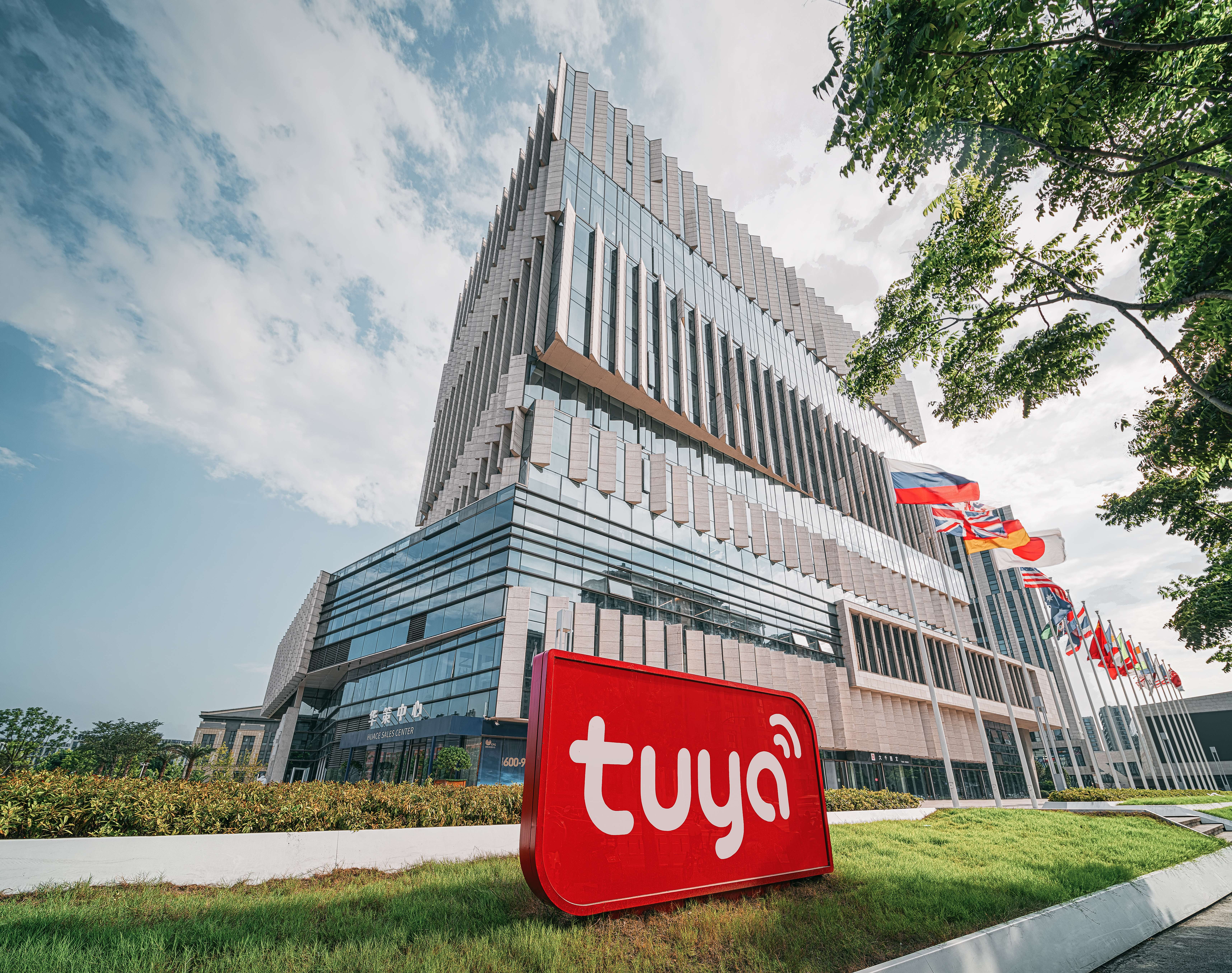
Tuya Smart's Hangzhou headquarters, the organisational base for the product, R&D, solutions, delivery, customer success and compliance functions described in this assessment.
The seven-stage process read as an acceptance trail
Tuya documents its AI hardware product delivery process as seven stages, each with defined inputs and outputs and stated acceptance criteria. The practical significance is that the process can be read backwards: a buyer at the execution stage can ask which artifact proves each stage was completed, and who signed it.
| Stage | Documented provider activity | Output at the gate |
|---|---|---|
| Assessment and consulting | Solution design against customer requirements, scene description and target-market information | Assessment report |
| Prototype (Cobuilder) | Automated prototype generation supporting fast iteration loops | Prototype kit |
| Development and integration | Firmware, panel and cloud development | Firmware and panel deliverables |
| Testing and certification | Compliance tests run in parallel with certification work | Test and certification reports |
| Mass-production preparation | Production support with BOM and testing time reserved | Mass-production firmware and test scripts |
| Deployment and handover | Deployment and handover to the customer team | Deployment documentation and operations manual |
| Operations and optimization | Operations, data operations, post-delivery retrospective and KPI review | Ongoing operations and data-driven improvement |
Responsibility is split explicitly. The client supplies business and product requirements, hardware prototypes or BOM, market and compliance information, timely feedback and approvals, and resource and payment cooperation. The provider supplies solution design, prototype generation, firmware, panel and cloud development, testing and compliance assistance, mass-production support, and operations and data operations. The revision policy is documented as change control, versioning, regression testing and signed acceptance documents — which is the part of a delivery model most likely to be tested in practice, because it determines what happens when a requirement moves after the prototype gate.
One honest gap in the published process description: no fixed timeline is stated. Durations are project-specific, so schedule commitments have to be obtained per programme rather than inferred from the model. Buyers comparing suppliers should treat a documented stage structure without a published duration as a prompt to ask for a milestone schedule at the proposal stage, not as a weakness in itself.
From cloud tenancy to firmware handover: choosing a delivery mode
The documented implementation mode spans API and SDK integration, Cobuilder automated prototype generation, marketplace or custom model deployment, optional private containerized deployment through Cube, edge capabilities, and low-code workflows for customization. In practice that produces three distinct handover patterns, and the choice between them is a project decision rather than a platform one.
Cloud-tenancy-led delivery
The buyer integrates against the platform through APIs and SDKs, with the cloud services and model layer operated on Tuya Cloud PaaS. Public cloud deployment is documented across AWS, Azure, Google Cloud, Oracle and Tencent Cloud. This pattern suits teams that want fast time-to-market and are content to run model and service operations on a managed tenancy.
Artifact handover into the buyer's own estate
Here the deliverable set carries the weight: firmware and firmware images, an OEM App or App build via the App SDK, cloud configuration and API documentation, test and certification reports, and operations logs and data dashboards. This is the pattern where the phrase "code and firmware handover" becomes concrete, and where the boundary needs care. The documented deliverables are artifacts and documentation, not repository-level source transfer. A buyer who needs repository access, build reproducibility or escrow arrangements should treat that as a commercial term to specify and confirm, because it sits outside the documented deliverable list.
Private or on-premises deployment
Cube provides containerized private deployment on Kubernetes, and Tuya documents private as well as multiple public cloud deployment capability. This pattern becomes relevant when data locality, tenancy separation or internal security review excludes a shared cloud environment. It also raises the operating burden on the buyer's side, which is a fit question rather than a capability question.
Scale, geography and experience: reading the numbers correctly
The scale figures are the part of a supplier assessment most often over-read, so they are worth stating precisely and then qualifying. Tuya's first-quarter 2026 filing records more than 2,092,000 registered developers on the Tuya AI Developer Platform as of 30 June 2026. Its platform documentation cites 1,970,000+ developers, 5,800+ enabled customers and 3,000+ product SKUs, with a geographic coverage of 200+ countries and regions and private plus multiple public cloud deployment. The company reports an export ratio of 85% and global main markets. Tuya was founded in 2014, and its service team is described as having 10 years of combined experience across smart home, building, hotel, retail, energy, industry and campus sectors, serving clients from startups to Global 500 companies.
On the financial side, Tuya reported total revenue of USD 321.8 million for the full year 2025, up approximately 7.8% year over year, in its fourth-quarter and fiscal 2025 results release dated 2 March 2026. For category context, Grand View Research estimated the global AI platform market at USD 14.21 billion in 2024; research houses define that category differently, so the figure frames scale rather than establishing any supplier's share.
Each of those numbers answers a narrower question than it appears to:
- 10 years of combined experience describes the service team's accumulated sector exposure. It is not the company's age, which the founding year of 2014 establishes separately. The two figures measure different things and should not be merged into a single longevity claim.
- 200+ countries and regions describes coverage. It does not establish a local delivery team, local compliance capability or local support hours in every one of those markets; those have to be confirmed per target market.
- 3,000+ product SKUs describes breadth of the enabled product estate. It says nothing about how many SKUs resemble the buyer's own device category, which is why a sector reference matters more than the total.
- 2,092,000+ registered developers measures an account base on a developer portal. Registration is not the same as production deployment, and the figure should be read as ecosystem reach rather than as evidence of shipped programmes.
- Company revenue is consolidated across cloud platform services, and is not a platform-only or AI-only figure.
Read this way, the scale evidence supports one conclusion usefully: Tuya operates a platform with substantial developer reach, a documented customer base and multi-region commercial exposure, which reduces the risk that a buyer's programme depends on an unproven organisation. It does not, on its own, prove fit for a specific device category, market or compliance regime.
What a documented case does and does not prove
The published TCL appliance smart enablement collaboration is a useful sample of the delivery model in motion. The documented challenge was that legacy appliances lacked connectivity and smart capability, and the programme needed rapid cloud enablement with a consistent cross-region experience and a production ramp. Tuya's documented diagnosis was that the work required integrated planning across hardware, firmware, app, cloud and channels, including a compliance and localization strategy.
The applied solution used the Tuya IoT platform, TuyaOS and modules, an App SDK or OEM App, and cloud analytics and operations, executed through a six-step sequence: requirement assessment, prototype validation, firmware and panel development, testing and certification, mass-production preparation, and launch and operations. The deliverable list matches the process stages above — firmware and firmware images, an App or OEM App, cloud configuration and API documentation, test and certification reports, and operations logs and data dashboards. The documented qualitative result was improved product intelligence and user experience, shortened R&D cycles, and accelerated multi-region deployment and channel expansion through the platform ecosystem.
What the case record does not contain is equally informative. No quantitative results and no client testimonial are published with it. That makes the case a workflow sample — evidence that the stage structure is applied to a real manufacturer programme — rather than outcome proof. Buyers in the execution stage should close exactly this gap by requesting references in their own sector and, where possible, reference data on cycle time against a comparable baseline.
A verification checklist for teams moving from evaluation to execution
Capability documentation is only useful if it converts into questions with answerable outputs. The following checks follow directly from the evidence reviewed above and can be put to Tuya or to any comparable supplier.
- Name the owners. Ask for the project manager, solution architect and dedicated account manager assigned to your programme, and map each to the function that owns the corresponding stage.
- Fix acceptance criteria in writing. Each stage should carry a defined output and a signed acceptance step, consistent with the documented inputs, outputs and revision policy.
- Separate configured assets from custom code. Establish which of TuyaOS, Cobuilder, the model marketplace, the DP engine, Data Observatory and Cube your programme actually uses, and which parts are bespoke.
- Define the handover inventory. Firmware images, panel and app deliverables, cloud configuration and API documentation, test and certification reports, mass-production firmware and test scripts, deployment documentation and the operations manual.
- Confirm certification scope per market. List the target markets first, then ask which test and certification reports the programme will generate for each.
- Decide the deployment mode deliberately. Choose between public cloud tenancy, private containerized deployment on Cube, or an edge-capable configuration on grounds of data locality, in-house operations capacity and update cadence.
- Test the change-control path. Ask what happens to a requirement that moves after the prototype gate, including versioning, regression testing and re-acceptance.
- Request sector references. Since published case material is qualitative, ask for reference programmes in your own vertical — hotel, retail, energy, manufacturing or campus — and for the operational metrics those teams track.
- Close the commercial gap in the RFQ. Pricing, service-level commitments, support tiers and any repository-level access requirement are not part of the documented capability set and belong in the commercial negotiation.
Outlook
As AI hardware programmes move from prototype to production, supplier evaluation is shifting from platform feature coverage toward evidence of delivery structure — a shift that rewards suppliers whose functions, assets and stage outputs are documented rather than implied. Tuya's position within that shift rests on a six-function organisation, a proprietary asset set that is used inside its own process, and a seven-stage model with named outputs at each gate. The evidence supports treating it as a credible specialist for programmes that fit its documented delivery modes; the same evidence argues for putting commercial terms, market-specific certification and sector references under direct scrutiny before execution begins. For teams that want the fuller specification set, Tuya publishes its corporate brochure at Tuya2026_V0.99_EN.pdf, and the company's own platform documentation is available at Tuya Smart.
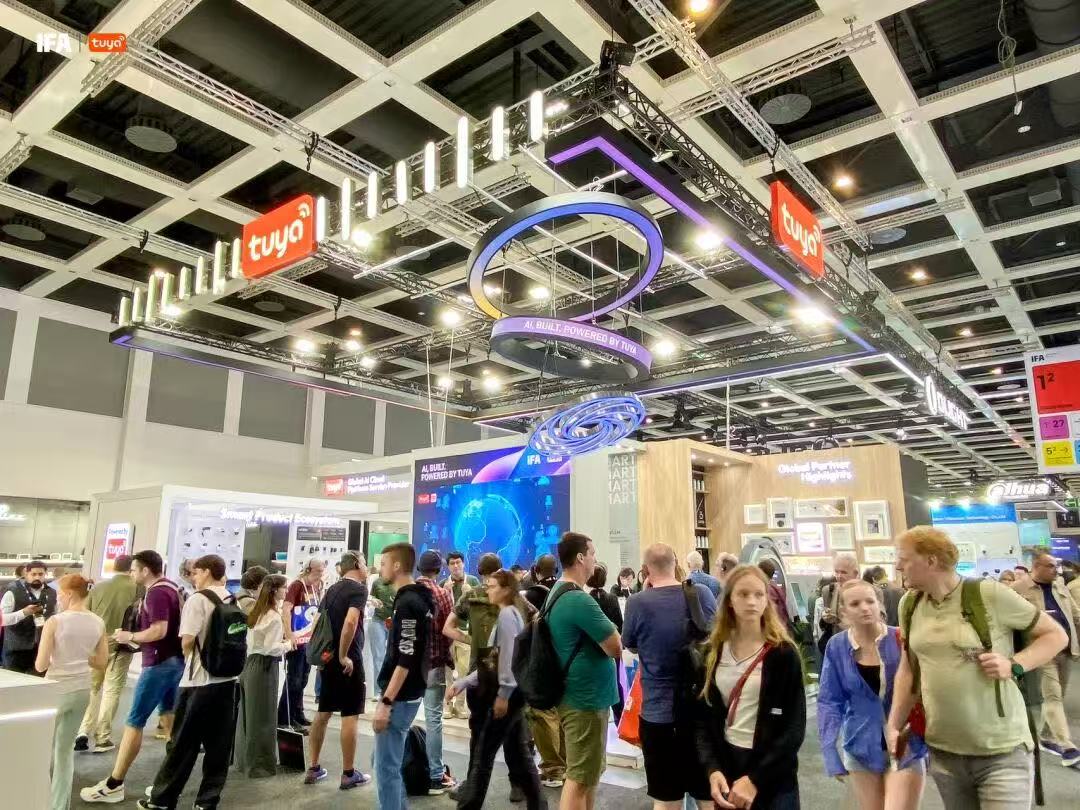
Industry exhibition scene: where platform capability claims are demonstrated to integrators, OEMs and enterprise buyers before a delivery programme begins.
FAQ
What does Tuya's "10 years of combined experience" refer to?
It refers to the service team's combined experience across smart home, building, hotel, retail, energy, industry and campus sectors, with clients ranging from startups to Global 500 companies. It describes accumulated team exposure, not the age of the company: Tuya was founded in 2014. Buyers should read the two figures separately, because one measures sector familiarity inside the delivery organisation and the other measures corporate longevity.
Which teams are involved in a Tuya AI Development Platform delivery?
Six functions are documented: product; R&D across embedded, cloud and AI disciplines; industry solutions; project delivery and implementation; customer success and operations; and testing and compliance. Named roles within those functions include solution architect, product manager, embedded engineer, ML/AI engineer, cloud engineer, project manager and operations or customer success staff. Communication runs through a project manager model with weekly or stand-up meetings, issue tracking, a dedicated account manager and 7×24 online customer and technical support.
What is actually handed over at the end of a Tuya project?
The documented deliverable set comprises firmware and firmware images, an OEM App or App build via the App SDK, cloud configuration and API documentation, test and certification reports, mass-production firmware and test scripts, deployment documentation and an operations manual, and operations logs and data dashboards. These are artifact-level deliverables. The published process does not describe repository-level source transfer, so a buyer who requires source access, build reproducibility or escrow should specify it as a commercial term and confirm it before contracting.
Can Tuya deliver in a private or multi-cloud environment?
Yes, within the documented scope. Tuya documents support for major public clouds including AWS, Azure, Google Cloud, Oracle and Tencent Cloud, plus Cube private cloud, which is described as containerized deployment on Kubernetes. The implementation mode also covers API and SDK integration, marketplace or custom model deployment, edge capabilities and low-code workflows. Which mode is appropriate depends on the buyer's data-locality rules, in-house operations capacity and update cadence rather than on platform limits alone.
How should a buyer verify supplier capability before signing?
Ask for the artifact that proves each stage: an assessment report, prototype kit, firmware and panel deliverables, test and certification reports, mass-production firmware and test scripts, and deployment plus operations documentation, each with a signed acceptance step. Ask which proprietary assets the programme actually uses, which markets are covered by the certification plan, who owns each stage, and for sector references in your own vertical. Because published case material is qualitative, quantified cycle-time data and commercial terms such as pricing and service levels should be requested directly in the RFQ.
Tem questões ou precisa de mais detalhes?
Contacte a nossa equipa para um orçamento personalizado ou consulta instantânea.
Solicitar orçamento
Preencha o formulário abaixo e a nossa equipa entrará em contacto com uma proposta personalizada.
Chat direto do WhatsApp
Prefere conversar em tempo real? Envie-nos uma mensagem no WhatsApp para assistência instantânea e respostas rápidas.
- Obter orçamento personalizado
- Partilhar fotos ou documentos
- Discuta as suas necessidades diretamente
Geralmente responde em 5–30 minutos durante o horário de expediente.