
Supplier Capability Evidence: What Gaming Chair Specs and Carton Data Prove
A gaming chair specification sheet is not decoration. It is one of the few sourcing documents a buyer can verify before money moves, and it is the first place where a factory either proves or loses its credibility.

A production site in Anji County, Zhejiang Province — the location of Anji Maochang Furniture Co., Ltd.
Buyers evaluating a gaming chair supplier for a multi-season distribution programme rarely have the option of standing on the factory floor before the first order. They work from documents: a quotation, a spec sheet, a carton table, a certificate. Individually, each line on those documents is easy for any trading office to copy. Read as a set across two or three models from the same factory, model-level specifications and packaging data become something more useful — a description of what that factory can design, tool, assemble and ship, and how consistently it can repeat the process on the next production run.
This article works through that reading method using published model data for the MC196-2-1, MC196-4 and MC1039-1 gaming chairs from Anji Maochang Furniture Co., Ltd. — a chair manufacturer based in Anji County, Zhejiang Province, China, producing gaming chairs, office chairs and manicure chairs, with 98% of output exported to markets including the EU, USA, Thailand, Brazil and South Korea, and a stated annual output of 75,000 units from a 3,000 m² facility with 25 employees and an in-house engineering team of three. The goal is not to recommend a model, but to show distributors, importers and OEM buyers how to turn a spec sheet into evidence.
Why Spec Sheets Became a Procurement Document
The global gaming chair market was estimated at USD 1.37 billion in 2024 and is projected to reach approximately USD 2.05 billion by 2030. Within that market, PC gaming chairs held a 52.6% product segment share and PU leather accounted for 57.3% of materials in 2024, while North America represented the largest regional demand with a 36.4% revenue share. A market of that scale attracts a long tail of suppliers, and it also means the difference between two comparable-looking chairs is usually buried in mechanism details and carton figures rather than in visible design.
The Anji furniture cluster in Zhejiang, China, is the world's leading production base for gaming chairs and sits inside a country that accounts for 30.8% of global furniture exports. That concentration is why spec sheets from Anji factories are worth reading closely: the supply chain around them is deep, and the specification itself is often the only differentiator a buyer can inspect at a distance.
For a long-term distribution relationship — the scenario this analysis focuses on — the question is not which chair looks best in a photo. It is whether the supplier can hold the same tolerances, the same packing method and the same loading efficiency across repeat orders, seasons and model revisions.
Reading MC196-2-1: Five Adjustment Points in One Size Envelope
The MC196-2-1 is specified with a retractable footrest, three locking tilt angles, seat depth adjustment, a height-adjustable headrest and an overall dimension of W70 x D70 x H118-128 cm. Each of those five items represents a different manufacturing commitment, and that is what makes the model useful as evidence.
Three locking tilt angles indicate a mechanism with defined locked positions rather than a free-floating rock. For a buyer, this is a durability question: a multi-position lock adds components inside the tilt mechanism, and the mechanism is the part most often implicated when a chair fails in service. A supplier that publishes the number of locking angles is publishing a mechanism specification that can be checked against a sample.
Seat depth adjustment and a height-adjustable headrest address a different problem. Chairs without seat depth adjustment fit one body type well and the rest approximately. When a distributor sells into a market with mixed user heights — home PC users, dormitory students and long-session streamers in the same catalogue — seat depth becomes a return-rate variable rather than a comfort feature. The same logic applies to headrest height, which decides whether the chair supports the neck or pushes the head forward.
The retractable footrest matters commercially as much as ergonomically. It is a moving, load-bearing part that has to be engineered, welded, upholstered and tested, and it is the feature most often requested for reclining gaming chair enquiries. Its presence in the MC196-2-1 spec tells a buyer the factory has the tooling and sub-assembly process for this component — not merely the ability to source it.
The declared W70 x D70 x H118-128 cm envelope is a full-size chair, not a compact one, and it records a 10 cm height spread. Buyers should confirm which component produces that spread — typically an adjustable gas lift — and ask for the corresponding seat-height range, because overall height alone does not tell a purchaser whether the chair suits a standard desk.
Carton Data: The Half of the Spec Sheet Buyers Usually Skip
Carton dimensions and loading quantities are the least glamorous numbers a factory publishes, and they are the most revealing. The MC196-2-1 ships in a carton of 75 x 65 x 34 cm. The MC1039-1 ships in an 82 x 60 x 53 cm carton with a declared loading quantity of 260 pieces. The MC196-4 is packed one piece per carton, is specified with 60 mm casters, and carries a declared loading quantity of 447 pieces.
Those figures describe three different commercial realities. A carton near 75 x 65 x 34 cm is a relatively flat, handleable box that suits parcel networks, single-unit retail fulfilment and small receiving docks. An 82 x 60 x 53 cm carton is substantially bulkier and reflects a heavier, more generously built chair with a foldable footrest, 4D armrests and a 180-degree recline — all features that consume volume and add mass. A one-piece-per-carton packing method on the MC196-4 tells a buyer that the unit can be picked, labelled and dispatched as a single retail item without repacking.
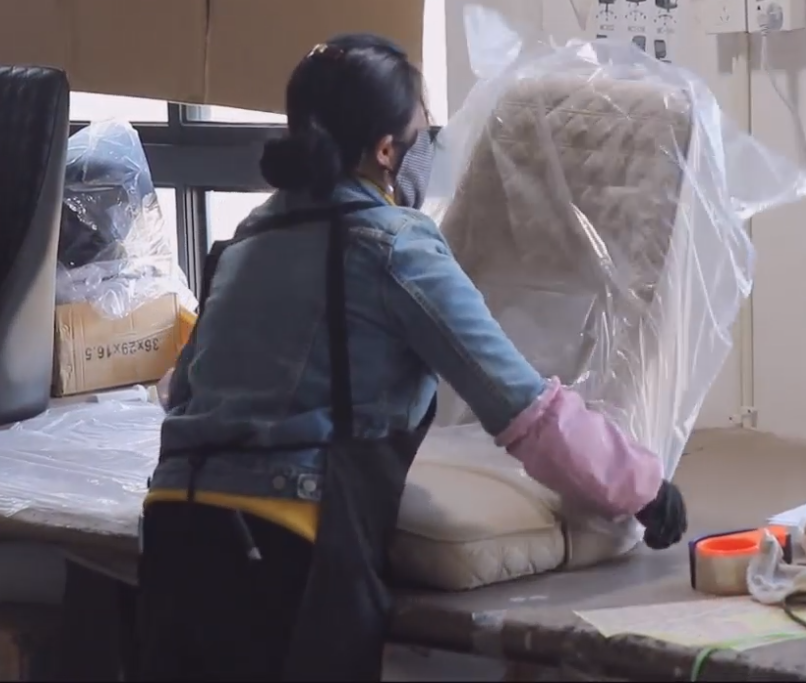
Packing stage in chair production: carton configuration is part of the published specification, not a back-office detail.
Loading quantity then converts packaging into freight economics. A difference between 447 pieces and 260 pieces is not a quality ranking — it is a statement about unit volume, weight and carton geometry. For a distributor planning warehouse slotting and per-unit landed cost, that gap changes season planning far more than a colour option does.
One caution belongs here, and it is a genuinely useful one: a declared loading quantity is only meaningful when the container basis is stated. 447 pieces in a 40HQ and 447 pieces in a 40GP describe very different products. Buyers should ask for the container type and the packing method alongside the number, every time.
Three Models Side by Side: What the Data Set Shows
The table below uses only the published model data referenced in this article. Where a model's specification does not state a feature, the field is marked as not stated rather than assumed.
| Specification field | MC196-2-1 | MC196-4 | MC1039-1 |
|---|---|---|---|
| Footrest | Retractable | Not stated | Foldable |
| Tilt / recline | 3 locking tilt angles | Not stated | 180-degree recline |
| Armrest | Not stated | Not stated | 4D adjustable |
| Seat depth adjustment | Yes | Not stated | Not stated |
| Headrest | Height-adjustable | Not stated | Not stated |
| Caster diameter | Not stated | 60 mm | Not stated |
| Overall size | W70 x D70 x H118-128 cm | Not stated | Not stated |
| Carton size | 75 x 65 x 34 cm | Not stated | 82 x 60 x 53 cm |
| Packing method | Not stated | One piece per carton | Not stated |
| Declared loading quantity | Not stated | 447 pieces | 260 pieces |
Model-level specification data as referenced in this analysis. Container basis for loading quantities should be confirmed directly with the supplier.
Read together, the set shows a factory working across more than one platform. The MC196-2-1 and MC196-4 sit within a common model family, with the MC196-4 differentiated by 60 mm casters and a single-piece carton that raises loading efficiency to 447 pieces. The MC1039-1 is a heavier, higher-adjustment build — 4D armrests, foldable footrest, 180-degree recline — and its larger 82 x 60 x 53 cm carton produces the lower 260-piece loading figure. That internal logic is itself a signal: a supplier whose models differ for explainable engineering reasons is easier to audit than one whose models differ for no stated reason.
Application Fit: Which Buyer Reads Which Line
Different channels in the gaming chair market read the same spec sheet for different reasons. A home PC gaming chair buyer checks seat depth adjustment and headrest range, because one household may use the chair for work and play across different body heights. An internet cafe operator checks caster diameter and mechanism durability, because the chair will be moved and used continuously. A dormitory student chair buyer checks the carton footprint, because the unit has to reach a small room through a narrow stairwell or lift. A live streamer or content creator checks recline range, footrest type and armrest adjustability, since the chair is occupied for many hours at a time.
That is why the three-model set is more informative than any single listing. The MC196-2-1 answers a fit-and-adjustability question. The MC196-4 answers a logistics-and-loading question. The MC1039-1 answers a heavy-use and comfort-configuration question. An office-and-gaming hybrid buyer — a segment that held a 29.8% share of the market as of 2024 — typically needs elements of all three, which is precisely where a supplier with a wide platform range reduces the number of vendors a distributor must manage.
Manufacturing depth matters here. Anji Maochang Furniture operates a complete production line covering cutting, woodworking, foam bonding, sewing, nailing, assembly, cleaning and packaging. When a buyer requests a change — a different footrest, a revised carton, a different caster size — the question is whether those stages are inside the same building. A factory that controls sewing, foam bonding and nailing internally can adjust a specification without coordinating several external workshops, which is what makes repeat-order consistency achievable.
Where Spec Sheets Stop: Limits Buyers Should Respect
No specification sheet is proof of compliance, and treating it as proof is the most common mistake in remote sourcing. A published carton dimension does not demonstrate drop-test performance. A stated recline angle does not confirm that a mechanism passed a durability cycle. A named standard does not certify a chair by itself: ANSI/BIFMA X5.1, EN 1335 and BS 5852 are the relevant reference frameworks for North American, European and UK markets respectively, and each requires documented testing rather than a specification line.
Material quality is the second limit. High-density mold foam is generally specified in the 50-65 kg/m³ range for premium gaming chairs to maintain shape retention over time, but the foam density figure rarely appears on a public spec sheet, and it cannot be inferred from the model name. Buyers who care about long-term shape retention have to ask for it.
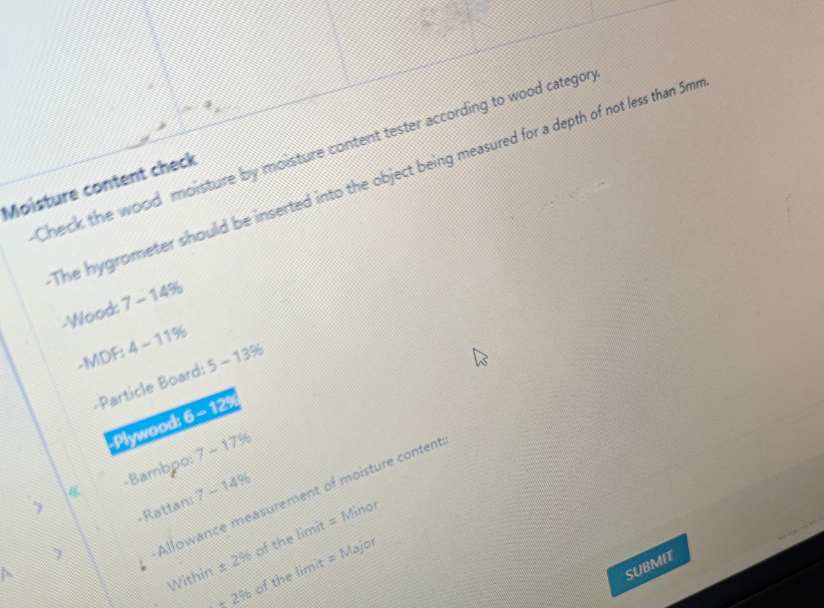
Incoming material inspection: plywood humidity is measured with a professional tool, and only qualified material is released to production.
The third limit is that some of the most important controls are invisible on a marketing page. Anji Maochang Furniture inspects plywood using professional tools to measure humidity, and only qualified material is used in production. That is a genuine risk control — moisture in plywood is a recognised cause of mould and structural weakness in chairs — yet no buyer would know it exists from a specification table alone. The lesson is that spec and carton data should be treated as a starting point for questions, not as the end of due diligence.
Cost structure deserves the same honesty. A factory-level comparison of premium structural designs against standard LED gaming chair construction records roughly 8% higher manufacturing cost for the premium structure, with about 10% improved weight load capacity and a low failure rate in service. A distributor that needs the load capacity will accept the cost delta. A distributor selling on price may not, and that is a decision the carton and mechanism data should inform rather than obscure.
Commercial Terms That Make a Long-Term Relationship Readable
For buyers at the decision and execution stage, specification evidence is only half the picture. The commercial framework determines whether a supply relationship can be sustained across seasons. Anji Maochang Furniture states a minimum order quantity of 50 units and delivery terms of FOB Shanghai or Ningbo. Acceptance is handled through pre-shipment testing, and payment terms are 30% deposit in advance with the balance against a copy of the bill of lading.
Those four data points are worth more than a promise of partnership. A stated MOQ defines the entry point for a trial order. Named FOB ports define the logistics corridor a distributor can plan around. A pre-shipment test as the acceptance criterion means quality is settled before the container leaves, rather than argued about after arrival. Payment against a copy of the bill of lading keeps cash flow aligned with shipment rather than credit. Together they describe a supplier structured for repeat, documented transactions — which is the operational definition of a long-term channel relationship.
Future Outlook
Two shifts are likely to make this method of reading suppliers more common rather than less. The first is freight economics. As the category moves toward the projected USD 2.05 billion level by 2030, per-unit carton volume becomes a competitive variable, and factories that publish carton data alongside mechanism data will be easier for distributors to evaluate. The second is segment blending: hybrid work-and-game chairs already account for a substantial share of demand, and buyers in that segment need adjustability specifications — seat depth, headrest range, armrest axes — rather than racing-chair styling cues.
The practical consequence for importers and distributors is procedural. Ask for the spec sheet, the carton table and the container basis together. Cross-check two or three models from the same supplier to see whether the differences are explainable. Request the material and test evidence that the spec sheet cannot carry. Suppliers that answer all three consistently — and can show a full in-house production line behind those answers — are the ones that survive a multi-season distribution programme.
FAQ
What can a gaming chair model spec sheet prove about a supplier?
A model spec sheet can prove that a supplier has documented, repeatable engineering choices — for example, the MC196-2-1 lists a retractable footrest, three locking tilt angles, seat depth adjustment, a height-adjustable headrest and a W70 x D70 x H118-128 cm envelope. It proves that these features have been defined as a build configuration. It does not by itself prove durability, compliance or material grade, which require separate evidence.
Why does carton size matter when comparing gaming chair models?
Carton size determines how a chair moves through parcel networks, warehouse slots, retail receiving and last-mile delivery. The MC196-2-1 carton measures 75 x 65 x 34 cm, while the MC1039-1 carton measures 82 x 60 x 53 cm. The larger carton reflects a bulkier product configuration, and it also reduces how many units can be shipped in a given load — which directly affects landed cost per chair.
How should buyers interpret a declared loading quantity such as 447 pieces?
A declared loading quantity should be read together with the container type and packing method. The MC196-4 is packed one piece per carton with a declared loading quantity of 447 pieces, and the MC1039-1 carries a declared loading quantity of 260 pieces. The difference reflects carton volume and unit configuration rather than a quality ranking. If the container basis is not stated, the number is not comparable across suppliers and should be confirmed in writing.
Why do three models from the same factory differ so much in carton size?
Because they are engineered for different configurations. The MC196-2-1 uses a 75 x 65 x 34 cm carton. The MC1039-1 uses an 82 x 60 x 53 cm carton to accommodate 4D armrests, a foldable footrest and a 180-degree recline. The MC196-4 adds 60 mm casters and uses one-piece-per-carton packing. A buyer comparing these figures is effectively comparing product platforms, not packaging preferences — and explainable differences are a positive audit signal.
What commercial terms typically support a long-term gaming chair supply relationship?
Terms become measurable when they are stated specifically. Anji Maochang Furniture specifies a minimum order quantity of 50 units, delivery on FOB Shanghai or Ningbo terms, pre-shipment testing as the acceptance criterion, and payment of 30% deposit in advance with the balance against a copy of the bill of lading. Buyers evaluating any supplier for repeat distribution should compare these four categories directly rather than relying on general assurances.
What are the limits of spec-sheet and carton data as supplier evidence?
Spec and carton data are self-declared. They do not demonstrate compliance with frameworks such as ANSI/BIFMA X5.1, EN 1335 or BS 5852, they do not report foam density values typically cited in the 50-65 kg/m³ range for premium shape retention, and they do not reveal internal material controls. As a benchmark, Anji Maochang Furniture inspects plywood using professional tools to measure humidity and releases only qualified material to production — a control that no specification table would show.
Reference material: the 2026 Anji Maochang Furniture catalogue is available for download at 2026 catalogue (PDF). Company information: www.mcrfurniture.com.
Tem questões ou precisa de mais detalhes?
Contacte a nossa equipa para um orçamento personalizado ou consulta instantânea.
Solicitar orçamento
Preencha o formulário abaixo e a nossa equipa entrará em contacto com uma proposta personalizada.
Chat direto do WhatsApp
Prefere conversar em tempo real? Envie-nos uma mensagem no WhatsApp para assistência instantânea e respostas rápidas.
- Obter orçamento personalizado
- Partilhar fotos ou documentos
- Discuta as suas necessidades diretamente
Geralmente responde em 5–30 minutos durante o horário de expediente.