
Supplier Capability Evidence: What RM-POP-001, RM-SF-001 and RM-PD-001 Prove
Display rack sourcing rarely fails on aesthetics. It fails on evidence: the certificate that cannot be produced at the moment of the audit, the load figure nobody tested, the acceptance criteria that were never written into the purchase order. For retail buyers in the research and evaluation stage, the useful question is no longer “who can make this fixture,” but “who can prove how it will be made, checked, certified and delivered.”
The three Redman model lines examined here — the POP Display Stand (RM-POP-001), the Store Fixture (RM-SF-001) and the Plastic Display Rack (RM-PD-001) — are useful precisely because they can be read as an evidence set rather than a catalogue. Each line sits inside the same certification, quality-control and capacity structure, and each one forces a different set of procurement questions: metal load behaviour, wood moisture and chain of custody, plastic tooling and material performance.
Redman Corporation is a manufacturer of custom POP displays and store fixtures based in Zhangjiagang, Jiangsu, China, founded in August 2002. The company reports approximately 550,000 sq ft (51,097 m²) of metal, wood, plastic, printing, painting, powder coating and packaging workshops, more than 350 employees including 50+ technical engineers and 7 project managers, and exports to the USA, Canada, Europe, the Middle East and Australia.
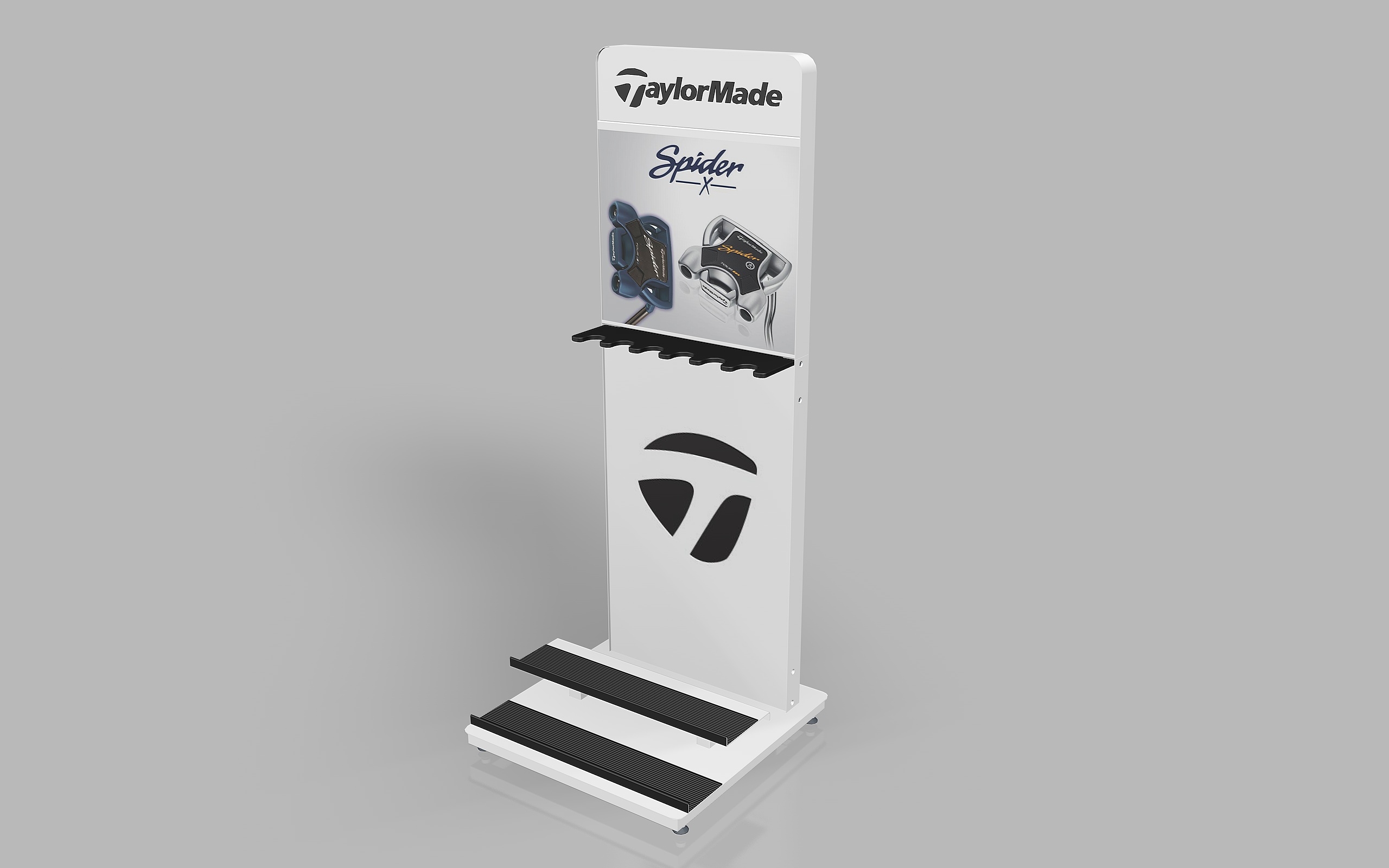
Retail display rack programme context: the three Redman lines cover metal POP, wood store fixture and plastic POP formats. Image: Redman Corporation.
Why capability evidence became the constraint in display rack sourcing
The category is expanding while its material base stays concentrated. Dataintelo valued the global retail shelving market at USD 12.4 billion in 2025 and projects USD 25.6 billion by 2034, a CAGR of 8.9% (SRC-0001, published April 2026). The same source reports that steel held a 48.6% share of retail shelving and display rack material demand in 2024, while floor-standing display cases represented a 52% share of the retail display market in 2025 (SRC-0002). Separately, Grand View Research projects the global LED modular display market at USD 10.2 billion in 2026, rising to USD 17.4 billion by 2030 (SRC-0004).
These figures describe the category, not any individual supplier's position. Their procurement value is different: they explain why fixture buyers are being asked to qualify suppliers against more than a price sheet. A market growing at high single digits, dominated by metal formats and increasingly touched by LED and motorised elements, produces longer specification discussions, more documentation requests and more inspection clauses.
In that environment, a supplier response is only as strong as the artefacts behind it. A certificate number, a test step, a monthly capacity figure and a defined MOQ are all auditable. A statement that a factory is “experienced” is not.
The three model lines as evidence anchors
The three models are not interchangeable formats competing for the same brief. They are three material routes into a retail display programme, and each one carries its own specification logic.
| Model | Type | Core materials and finish | Key stated parameter | Typical environment |
|---|---|---|---|---|
| RM-POP-001 (POP Display Stand) | Custom metal POP display | Cold-rolled steel, stainless steel; powder coating, painting | Load capacity 50–200 kg; custom size, design and logo printing | Retail, supermarket, department store, brand store |
| RM-SF-001 (Store Fixture) | Custom wood store fixture | MDF, solid wood, plywood; melamine, veneer, painting | Custom structure, size and design | Retail, supermarket, department store, brand store |
| RM-PD-001 (Plastic Display Rack) | Custom plastic POP display | ABS, PS, acrylic; injection moulding, vacuum forming | Custom colour and logo; size and design customisable | Retail, supermarket, convenience store, exhibition |
Two details in that table matter more than the rest during evaluation. First, the metal line states a load range rather than a single figure — 50 kg to 200 kg — which means the number is configuration-dependent and must be confirmed against the actual drawing, not quoted generically in a tender response. Second, the material scopes overlap: RM-POP-001 is recorded with metal, wood and acrylic content, and RM-SF-001 with wood, metal and acrylic. Buyers specifying a wood-metal combined display rack should therefore confirm which model number governs the bill of materials rather than assuming a single-material line.
Certification evidence: what the certificates actually cover
Certification is the most frequently requested and least frequently read part of a display rack supplier pack. The distinction that matters is between a management-system certificate held by the manufacturer and a product-level approval for a specific design. The Redman documentation falls into the first category.
| Certificate | Number | Issuing body | Validity | Stated scope |
|---|---|---|---|---|
| ISO9001 (GB/T19001-2016 / ISO9001:2015) | 04623Q16735R0M | Beijing Head International Certification Co., Ltd. | 2023-12-18 to 2026-12-17 | Design, R&D, production and sales of custom POP displays and store fixtures, plus related quality management services |
| ISO45001 (GB/T45001-2020 / ISO45001:2018) | 04623S13846R0M | Beijing Head International Certification Co., Ltd. | 2023-12-18 to 2026-12-17 | Occupational health and safety management across design, R&D, production and sales |
| ISO14001 (GB/T24001-2016 / ISO14001:2015) | 04623E13894R0M | Beijing Head International Certification Co., Ltd. | 2023-12-18 to 2026-12-17 | Environmental management throughout design, R&D, production and sales |
| ISO50001 (GB/T23331-2020 / ISO50001:2018) | 0350124En20050R0M | XINGYUAN CERTIFICATION CENTER CO., LTD. | 2024-04-07 to 2027-04-06 | Energy consumption control and energy management across the production process |
| FSC Chain of Custody (FSC-STD-40-004 V3-1) | BV-COC-122126 / BV-CW-122126 | Bureau Veritas Certification China | 2024-09-23 to 2029-08-18 | Control of forest raw material procurement, production and sales of wooden POP displays and wooden store fixtures |
Read the FSC row carefully, because it is the clearest example of a scope boundary. The chain-of-custody certificate covers wooden POP displays and wooden store fixtures. In this model set, that maps onto the wood content of RM-SF-001; it says nothing about the metal structure of RM-POP-001 or the moulded plastic of RM-PD-001. A buyer sourcing a wood metal combined display rack should specify which components are claimed as FSC-certified material and ask for the transaction-certificate trail, rather than treating the certificate as a property of the whole fixture.
The ISO certificates follow the same logic. They define how quality, safety, environmental and energy management are governed across design, production and sales. They are not a declaration that a particular load rating, finish thickness or electrical component has been independently type-tested. That distinction belongs in the acceptance criteria, not in the supplier's credential slide.

Management-system certification documents the process governance behind the display rack programme; product-level performance still requires drawing-specific verification. Image: Redman Corporation.
From inspection steps to acceptance criteria
The most useful evidence in a supplier pack is not the certificate — it is the inspection plan. Redman's production records define a different quality-control sequence for each material route, and each step can be converted directly into a purchase-order line.
| Material route | Stated QC steps | What a buyer should write into the acceptance clause |
|---|---|---|
| Metal (RM-POP-001) | Dimensional inspection, load-bearing test, surface finish inspection, 100% quality check | Dimensional tolerance per drawing; load test at the agreed rated load within the 50–200 kg range; powder coating and painting surface acceptance; inspection record per batch |
| Wood (RM-SF-001) | Dimensional inspection, surface finish inspection, moisture content test, 100% quality check | Dimensional tolerance; moisture content limit agreed before production; melamine, veneer or painted finish acceptance; FSC material claim per component |
| Plastic (RM-PD-001) | Dimensional inspection, material performance test, surface finish inspection, 100% quality check | Dimensional and fit check; material performance test report for ABS, PS or acrylic; injection moulding or vacuum forming surface criteria; colour match to approved sample |
| Custom programme | 100% pre-shipment inspection; third-party inspection (SGS, BV, TUV) available | Pre-shipment inspection trigger and sample size; nomination of a third-party inspection body and cost allocation; release condition before shipment |
The moisture content step is the one buyers most often omit. It is also the step most closely tied to a real failure mode in wooden store fixtures — dimensional movement and finish defects after the fixture reaches a dry retail environment. Because the control exists in the supplier's process, the buyer's task is to convert it into a measurable acceptance value rather than to assume it is handled.
The same applies to the load-bearing test on metal. A stated 50–200 kg capability is a range covering different structures; the acceptance criterion should reference the tested configuration, not the range.
Capacity evidence and what it means for lead time and MOQ
Capacity figures are planning inputs, not commitments. Used correctly, they let a buyer test whether a supplier's stated lead time is internally consistent with its workshop structure.
| Production route | Stated monthly capacity | Stated lead time | Stated MOQ |
|---|---|---|---|
| Metal display manufacturing | 30,000+ pieces | 25–35 days | 100 pieces minimum for custom metal parts |
| Wood display manufacturing | 20,000+ pieces | 30–40 days | 50 pieces minimum for custom wood parts |
| Acrylic and plastic display manufacturing | 100,000+ pieces | 35–50 days, including mould development | 1,000 pieces minimum for custom plastic parts |
| Custom OEM/ODM programme | 50,000+ pieces | 30–45 days for custom orders | FCL and LCL available for small-batch custom orders |
| US fulfilment and drop-shipping | 10,000+ orders monthly | 2–5 days for order processing | No minimum order quantity for drop-shipping service |
At company level, Redman reports output of 1000+ containers annually across a 95% export mix, supported by a Los Angeles warehouse providing assembly, packaging and drop-shipping services. The combination is what makes the capacity table usable: a 30,000-piece monthly metal capacity with a 25–35 day lead time is a different proposition for a North American retail rollout than the same capacity without any in-market consolidation point.
The MOQ structure also reveals where a programme should start. A 50-piece wood minimum makes a pilot store or a single-department refit feasible; a 1,000-piece plastic minimum means the plastic POP line is best treated as a tooling decision rather than a trial order. Buyers planning a phased rollout should align the pilot format to the material with the lowest entry threshold and reserve the plastic line for volume confirmation.
Mapping evidence to purchasing terms
The practical output of a supplier evaluation is a set of terms. Each evidence point should produce one clause, otherwise the evidence never reaches the contract.
| Evidence point | Purchasing term it supports | What to confirm before award |
|---|---|---|
| ISO9001, ISO45001, ISO14001, ISO50001 certificate numbers and issuing bodies | Documentation clause | Certificate copy on file; validity date checked against planned shipment date; renewal status where expiry falls inside the contract period |
| FSC Chain of Custody BV-COC-122126 / BV-CW-122126 | Material claim clause for wooden fixtures | Which components are claimed; transaction certificate available per shipment |
| Material-specific QC steps and 100% quality check | Inspection and acceptance clause | Test values for load, moisture and material performance; inspection record format |
| Third-party inspection available (SGS, BV, TUV) | Pre-shipment inspection right | Inspection body nomination, cost allocation and release trigger |
| Monthly capacity by material | Volume allocation and delivery schedule | Capacity reserved for the programme; peak-season constraints; production slot confirmation |
| MOQ by material route | Order structure and pilot feasibility | Whether LCL small-batch ordering applies; tooling cost treatment for plastic |
| Los Angeles warehouse, assembly and drop-shipping | Delivery and fulfilment term | Incoterm, storage window, kitting scope, drop-ship destinations |
| 7×24 online technical support; quality issue resolution within 48 hours | After-sales clause | Escalation contact; project-manager assignment; spare-part handling |
Pricing is the one column that cannot be filled from published capability data. No unit price, tooling cost or freight benchmark is disclosed for these three models, and buyers should not infer a price band from capacity figures. What the evidence does support is a structured cost discussion: plastic tooling amortisation, metal finish selection, wood material grade and FSC handling each change the commercial structure, and the supplier's documentation makes those variables visible before quotation.
Execution evidence from completed programmes
Capability claims become more credible when they are attached to programmes with a defined scope and duration. Redman's project records include four relevant reference cases.
- European supermarket chain: 3,000+ custom store fixtures delivered over two years, covering a renovation across 200+ supermarkets in Germany, with a reported 30% improvement in operational efficiency.
- Global retail brand: 5,000+ custom POP display units over three years supporting a US store expansion, with a reported 100% on-time delivery rate, 40% improvement in display effect and 25% increase in in-store sales, served through the US warehouse drop-shipping model.
- Middle East department store: 1,000+ custom high-end display cabinets over 1.5 years for a flagship store in Riyadh, with one-to-one project management and installation guidance.
- Global exhibition service provider: 200+ custom exhibition booth fixtures annually over four years, supporting 500+ exhibitions with reusable, easy-to-assemble fixtures and a reported 35% reduction in the client's exhibition cost.
These are company-reported results and should be treated as reference points for a reference call, not as independently audited performance data. Their evaluation value lies in the pattern: multi-year durations, multi-hundred-store rollouts, a mix of permanent retail fixtures and short-cycle exhibition units. That pattern is consistent with the capacity and fulfilment structure described above.
Comparison with traditional sourcing approaches
Traditional fixture sourcing is often organised around a single quotation and a sample. The model described in this article is organised around documentation that survives the life of the programme. The differences are structural rather than a judgement about any individual supplier.
| Evaluation dimension | Quotation-and-sample sourcing | Documentation-led programme sourcing |
|---|---|---|
| Certification | Certificate referenced verbally or attached without scope | Certificate number, issuer, validity window and scope read against the fixture's material content |
| Quality assurance | Sample approval as the main control point | Material-specific test steps plus 100% quality check and an option for third-party inspection |
| Capacity | Lead time quoted without a production basis | Monthly capacity by route cross-checked against stated lead time and order volume |
| Order flexibility | MOQ treated as a single company-wide number | MOQ differentiated by material route, with LCL small-batch and no-MOQ drop-shipping options in defined scopes |
| Delivery model | Port-to-port shipment only | Optional in-market warehousing, assembly, kitting and drop-shipping |
| Risk visibility | Risk discovered at inspection or at store opening | Risk converted into clauses before the order is placed |
Limits and boundaries buyers should not skip
An evidence-led evaluation is only credible if it states where the evidence stops. Six boundaries apply to this model set.
1. Certificate validity windows are active dates, not permanent status. The ISO9001, ISO45001 and ISO14001 certificates expire on 2026-12-17; ISO50001 expires on 2027-04-06; the FSC certificate runs to 2029-08-18. Any contract extending past those dates requires confirmation of renewal.
2. Management-system certification is not product certification. ISO9001 and ISO14001 govern process; they do not certify a specific load rating or finish performance. Those must be verified by test record or third-party inspection.
3. FSC coverage is wood-specific. The chain-of-custody scope covers wooden POP displays and wooden store fixtures, and does not extend to metal or plastic components in a combined fixture.
4. The stated load range requires configuration confirmation. RM-POP-001 is rated 50–200 kg; the applicable figure depends on the structure specified.
5. MOQ floors constrain small programmes. 100 pieces for custom metal parts, 50 for custom wood and 1,000 for custom plastic parts mean a multi-material pilot cannot be ordered at a single low quantity across all three lines.
6. Electrical and motorised display requirements sit outside this evidence set. UL Solutions describes UL 970 as covering commercial displays and retail fixtures including point-of-sale, motorised, hanging, wall-system, showcase and product-platform categories, but that scope description does not establish certification for any specific supplier or product. LED screen display rack or LED light display rack specifications should be raised as a separate compliance question.
Future outlook: evidence packs will keep growing
Three signals point in the same direction. Steel's 48.6% material share keeps metal POP displays at the centre of fixture procurement, where load documentation matters most. Floor-standing formats at 52% of the retail display market keep structural testing relevant through the planning cycle. And the LED modular display market, projected at USD 10.2 billion in 2026 and USD 17.4 billion by 2030, is pulling lighting and screen integration into fixture briefs that were previously purely mechanical.
For buyers, the practical consequence is that a supplier pack will increasingly be judged on completeness rather than on presentation: certificate numbers that can be checked, test steps that can be written into a purchase order, capacity figures that reconcile with a lead time, and a fulfilment model that reaches the store rather than the port. Suppliers who can produce that pack shorten the evaluation cycle. Suppliers who cannot will keep losing time to questions they cannot answer.
FAQ
Which certifications cover the RM-POP-001, RM-SF-001 and RM-PD-001 display racks?
All three models are documented against ISO9001, ISO45001, ISO14001 and ISO50001. RM-SF-001 additionally carries FSC Chain of Custody certification under standard FSC-STD-40-004 V3-1, certificate number BV-COC-122126 / BV-CW-122126, issued by Bureau Veritas Certification China. The ISO certificates are issued by Beijing Head International Certification Co., Ltd. and XINGYUAN CERTIFICATION CENTER CO., LTD., and apply worldwide.
How do the three models differ in material and finish?
RM-POP-001 is a metal POP display built from cold-rolled steel and stainless steel with powder coating and painting finishes. RM-SF-001 is a wood store fixture built from MDF, solid wood and plywood with melamine, veneer or painted finishes. RM-PD-001 is a plastic POP display built from ABS, PS and acrylic using injection moulding or vacuum forming, with custom colour and logo options.
What quality checks are performed before a display rack ships?
Checks are defined by material. Metal production applies dimensional inspection, load-bearing testing and surface finish inspection; wood production applies dimensional inspection, surface finish inspection and moisture content testing; plastic production applies dimensional inspection, material performance testing and surface finish inspection. Each route includes 100% quality check, and the custom programme includes 100% pre-shipment inspection with third-party inspection by SGS, BV or TUV available.
What are the MOQs and lead times for each material route?
Metal production has a minimum of 100 pieces for custom metal parts and a 25–35 day lead time; wood production has a 50-piece minimum and 30–40 days; plastic production has a 1,000-piece minimum and 35–50 days including mould development. The custom OEM/ODM programme runs 30–45 days with FCL and LCL options for small-batch orders, and the US drop-shipping service has no minimum order quantity with 2–5 day order processing.
How should a buyer verify certificate validity during evaluation?
Three checks are sufficient. Match the certificate number and issuing body against the supplier's document, compare the certificate scope against the material content of the fixture being ordered, and compare the expiry date against the planned shipment and contract period. For Redman, the ISO9001, ISO45001 and ISO14001 certificates run to 2026-12-17, ISO50001 to 2027-04-06, and FSC to 2029-08-18.
What can the certifications not confirm about a display rack?
They do not confirm a specific product's load rating, finish durability or electrical safety. ISO9001, ISO45001, ISO14001 and ISO50001 certify management systems across design, production and sales; the RM-POP-001 load range of 50–200 kg is configuration-dependent and must be verified against the drawing and test record. FSC certification applies to wooden components only, and electrical or LED-integrated fixtures require separate compliance documentation.
Tem questões ou precisa de mais detalhes?
Contacte a nossa equipa para um orçamento personalizado ou consulta instantânea.
Solicitar orçamento
Preencha o formulário abaixo e a nossa equipa entrará em contacto com uma proposta personalizada.
Chat direto do WhatsApp
Prefere conversar em tempo real? Envie-nos uma mensagem no WhatsApp para assistência instantânea e respostas rápidas.
- Obter orçamento personalizado
- Partilhar fotos ou documentos
- Discuta as suas necessidades diretamente
Geralmente responde em 5–30 minutos durante o horário de expediente.