
Supplier Capability Evidence: What a China Valve BOV303 Data Sheet Reveals
Supplier Capability Evidence: What a China Valve BOV303 Data Sheet Reveals
HTNXT Industry Reference · Industrial Equipment & Components · September 2026
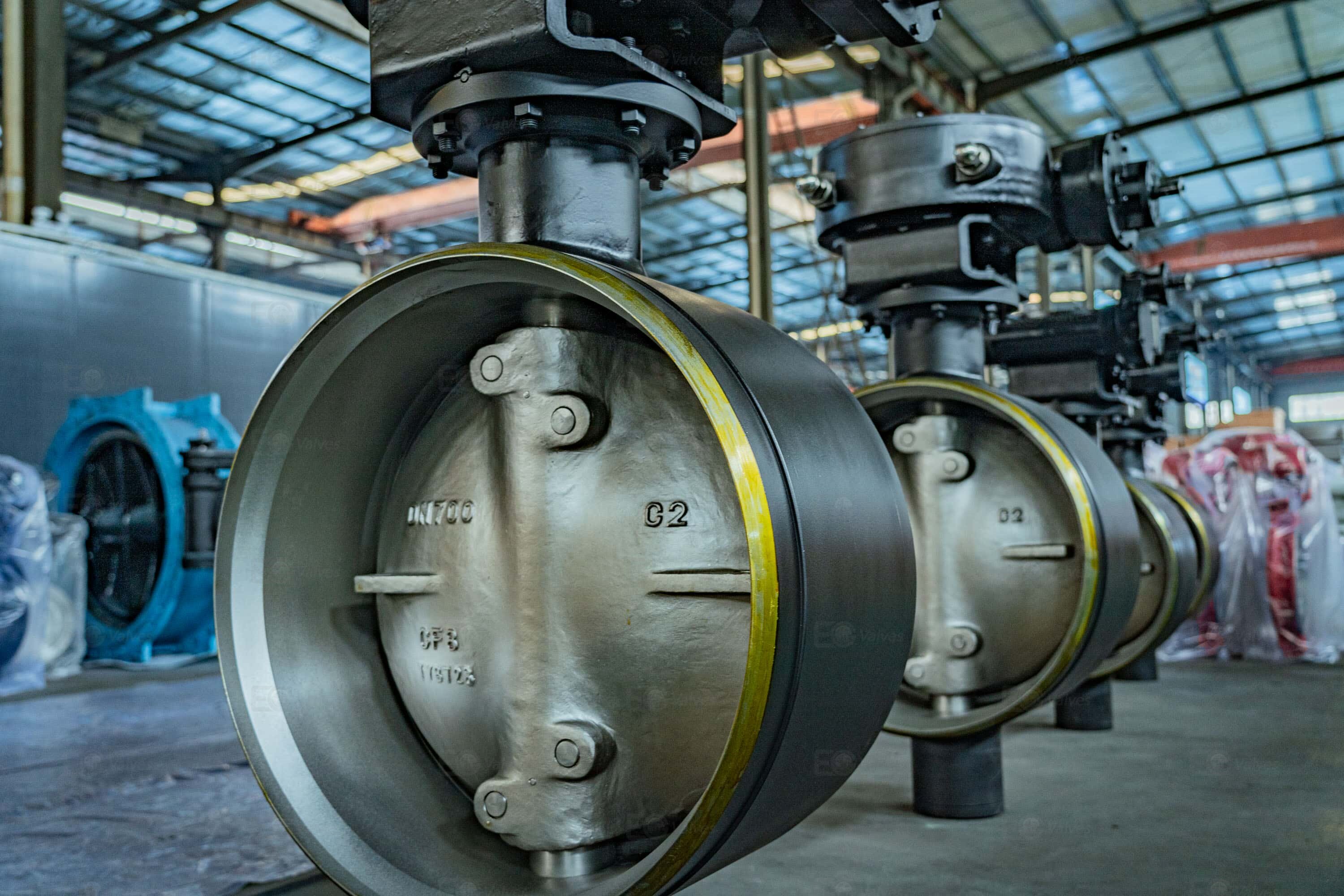
Butterfly valve body from the EG Valves range. Model-level documentation, not category imagery, is what a buyer can actually verify.
China exported USD 22.6 billion in valves in 2024, close to 20% of global valve export concentration, according to the Observatory of Economic Complexity. For a procurement team at the decision stage, that scale creates a problem rather than a reassurance: an enormous number of suppliers now publish professional-looking product documentation, and most of it looks remarkably similar at first glance.
A triple offset butterfly valve is a useful test case for reading that documentation. The design only works when several disciplines hold together at once: eccentric geometry machined accurately enough that the disc and seat meet on a controlled interference, a seating system that seals without relying on elastomer compression, a body that passes hydrostatic testing at the rated pressure, and actuation sized to the real torque of the assembly. When a supplier publishes a data sheet for a specific model, every line in that sheet should be traceable to one of those disciplines.
EG Valves Manufacturing Co., Ltd is a China valve manufacturer established in 2000 and based in Wenzhou, Zhejiang Province, producing industrial valves for export markets. Its published BOV303 data covers a size range from NPS 2” to 60” (DN50 to DN1500), pressure ratings across PN10, PN16, PN25 and PN40 as well as Class 150, Class 300 and Class 600, body and disc material options, wafer, lug and double-flange body types, seat material options including an optional Stellite seat, and a set of actuator choices. This article treats that sheet as evidence and asks the practical buying question: which lines demonstrate capability, and which still require the buyer to verify something independently?
Why a Published Data Sheet Counts as Capability Evidence
A data sheet is a commitment statement rather than a marketing claim, because every line in it can be tested against a delivered valve. A size range can be checked against a drawing and a pressure test report. A rated pressure can be checked against a nameplate and a hydrostatic test certificate. A material option can be checked against a mill certificate. A seat configuration can be checked at inspection. None of those checks are available for a sentence in a brochure.
That distinction is the reason a wide, specific data sheet is a stronger buying document than a broad capability statement. A supplier who publishes detailed ranges is exposing more of its operation to third-party verification than a supplier who publishes nothing verifiable.
The same discipline applies to numbers in general. Published estimates of the 2025 global industrial valve market differ substantially by scope: Grand View Research places it at USD 80.4 billion, while MarketsandMarkets puts it at USD 101.94 billion. Both figures are usable as context, but neither is a procurement argument. A number carries weight only when the buyer knows what it covers — and the same rule governs a supplier's data sheet.
Reading the BOV303 Data Sheet Line by Line
Most published valve sheets in this category include the same seven categories of information: size, pressure rating, body and disc material, seat material, connection type, actuation, and target industries. What separates a capability document from a marketing document is whether each entry can be converted into a verification action.
| Data sheet entry | Capability it evidences | What the buyer still verifies |
|---|---|---|
| NPS 2”–60” (DN50–DN1500) | Large-body production, machining and test capacity | Dimensional and pressure test records for the largest size in scope |
| PN10, PN16, PN25, PN40; Class 150, 300, 600 | Coverage of both metric and ASME-oriented piping practice | Which system the project specification uses, and nameplate match |
| Body and disc material options | Configuration depth for different media and temperatures | Material compatibility with the actual medium and mill certificates |
| Seat material options, optional Stellite seat | Metal-seated capability for high-temperature and erosive service | Whether hard-facing is specified and how it is inspected |
| Wafer, lug, double-flange body types | Installation and maintenance flexibility | Fit with pipe supports and planned maintenance access |
| Actuator options | Automation readiness and system integration | Actuator sizing against torque at the operating differential pressure |
| Stated target industries | Application scope the supplier is willing to be judged on | Whether the specific process being purchased actually falls inside that scope |
Size range: NPS 2” to 60” (DN50 to DN1500)
A published range of NPS 2” to 60” is a statement about physical capacity. Large-diameter triple offset butterfly valves require casting or fabrication capacity for large bodies, machining equipment able to hold sealing-surface geometry on a diameter measured in metres, lifting and handling equipment, pressure-test benches sized for the assembly, and logistics that can move the finished valve. A supplier listing a 60” valve is describing that whole chain, not one catalogue entry.
Across a range this wide, the engineering difficulty is not uniform. Because triple offset sealing depends on the geometric relationship between disc and seat rather than on elastomer compression, a tolerance that is achievable at DN50 is harder to hold at DN1500, where thermal movement and machining deviation accumulate over a much larger diameter. The range is therefore best read as evidence of depth, followed by a more precise question: where does routine production end and project-specific manufacturing begin? A size built regularly is likely to come with repeatable tooling, inspection routines and test records; a size built occasionally may be a made-to-order item whose schedule and inspection plan should be agreed on that basis.
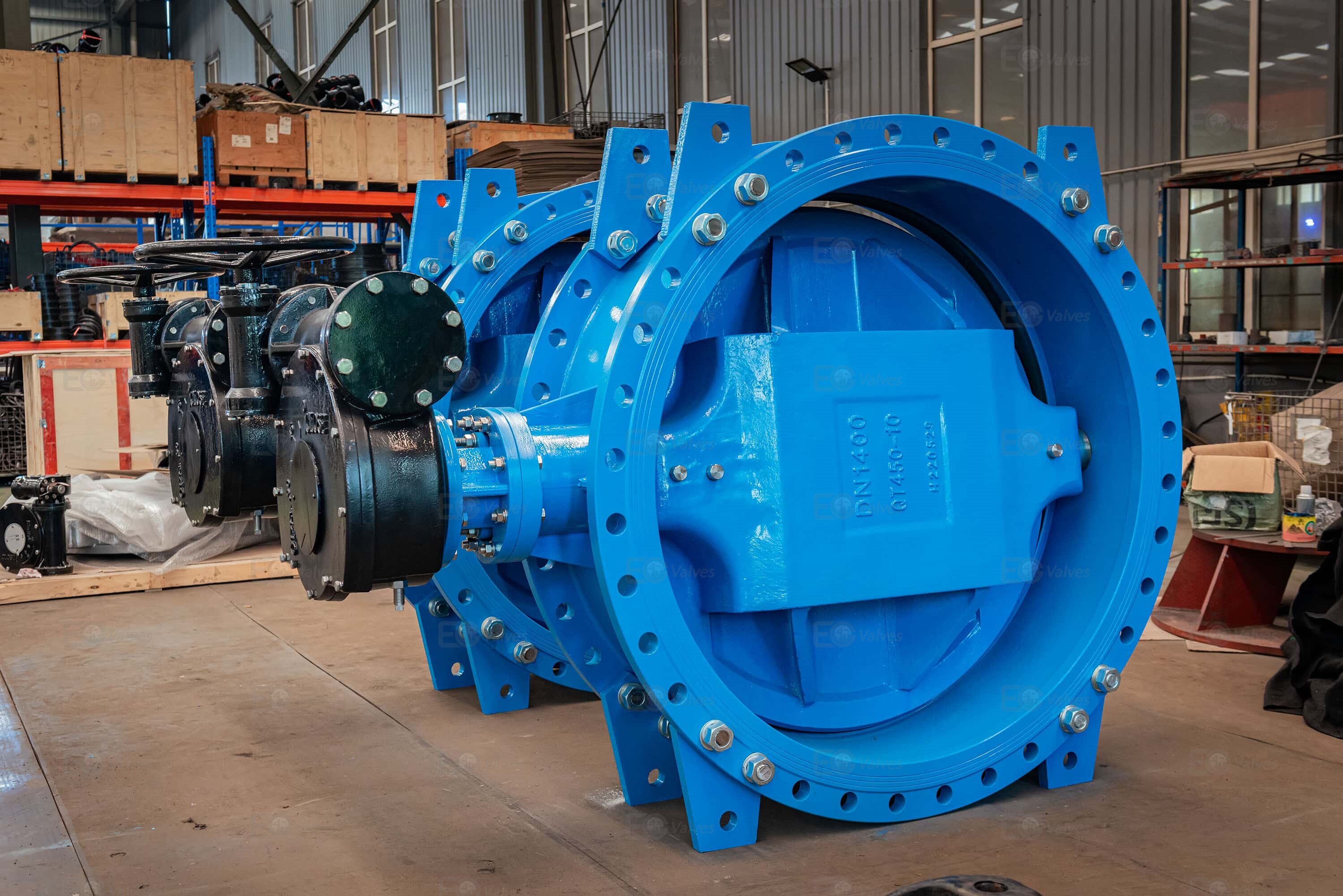
Large-diameter body class. The upper end of a published size range is a capacity statement that should be matched with size-specific test documentation.
Two pressure rating systems in one sheet
The BOV303 sheet lists PN10, PN16, PN25 and PN40 alongside Class 150, Class 300 and Class 600. The dual listing is meaningful. PN designations belong to the metric, EN/DIN-oriented pressure system, while Class designations belong to the ASME system used in North American practice. Publishing both indicates that the model is offered into two piping specification worlds rather than one — consistent with an export footprint that the company describes as the EU, North America, Latin America and the Middle East.
Two cautions follow. First, PN and Class numbers are not interchangeable and should not be read as equivalents; the project's piping specification decides which system governs, and the nameplate, material certificates and test documentation should match that system rather than the supplier's marketing preference. Second, valves imported into the European Union fall under the Pressure Equipment Directive 2014/68/EU when the equipment's pressure exceeds 0.5 bar, which makes conformity documentation a purchasing requirement rather than a preference for any European project.
Materials, seats, and what an optional Stellite seat means
The sheet lists body and disc material options and seat material options, with an optional Stellite seat. Read together, those lines describe configuration depth rather than a single fixed product. A metal-seated butterfly valve that can be supplied with a hard-faced seat addresses services where a soft seat would degrade: high temperature, abrasive particles, and media that attack elastomers.
Stellite is a cobalt-chromium hard-facing alloy applied to metal seating surfaces to resist erosion and galling. The commercial detail that matters in the data sheet is that it is listed as an option: it is a configuration decision, not a default feature, so a buyer whose service requires hard-facing has to specify it and confirm how it is applied and inspected.
Material options are only useful when they are matched to the medium. EG Valves' published risk guidance recommends selecting corrosion-resistant materials such as stainless steel, Hastelloy-type alloys and PTFE according to the corrosiveness of the medium, and it identifies the two dominant failure paths in industrial service: chemical or electrochemical corrosion of bodies, discs and seats, with corresponding loss of section and sealing ability, and erosion of internal parts by solid particles. A data sheet can list materials; it cannot make the match. The same company's published range description also covers brass, bronze, cast iron, ductile iron, carbon steel, stainless steel, alloy and PTFE-lined options across its product families, which is the wider material context in which a single model sheet sits.
Wafer, lug and double-flange bodies
The sheet lists wafer, lug and double-flange body types, and each corresponds to a different installation and maintenance constraint. A wafer body is compact and sits between two pipeline flanges. A lug body carries threaded inserts that allow the valve to be installed at the end of a line or removed from one side without dismantling the whole pipeline. A double-flange body is a heavier, permanent pipeline component, generally used in larger sizes and where the valve forms part of mainline infrastructure.
Offering all three means a supplier can be matched to an installation requirement instead of forcing the buyer into whatever pattern the supplier happens to tool. It also changes lifecycle cost. The ability to isolate and remove one side of a lug-type valve without breaking the whole line has a direct effect on maintenance downtime, while large double-flange valves require piping loads and support arrangements to be engineered into the line.
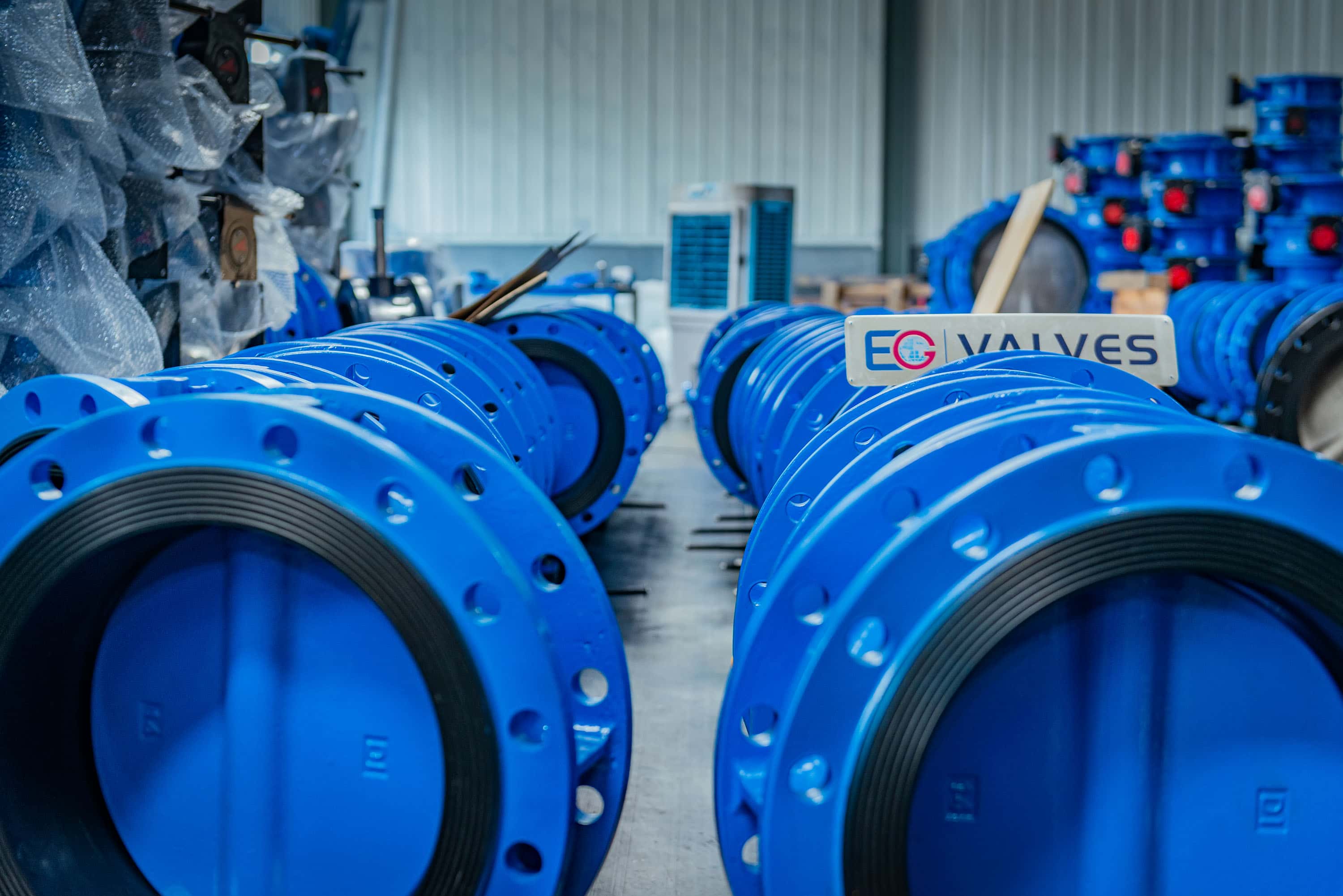
Double-flanged body configuration. Body pattern is an installation and maintenance decision, not only a purchase specification.
Actuator options and the torque question
The sheet also lists actuator choices, which places the model inside an automation envelope. For butterfly valves, actuation choice is tied directly to torque. EG Valves states that its valves achieve 20%–40% lower opening and closing torque than most brands of the same caliber, allowing a smaller and more energy-efficient actuator to be selected.
The consequence is commercial as well as technical: a lower torque requirement can reduce actuator size, air consumption or motor rating, and therefore the cost of the automated package as a whole rather than only the valve. The limit is that this is a stated comparison against most brands of the same caliber, not a measurement of the valve being quoted. Buyers should confirm actuator sizing against the torque actually required at their operating differential pressure, particularly at large diameters, where the torque needed to break the disc away from the seat under differential pressure tends to dominate the calculation.
Where the Listed Target Industries Point
The BOV303 sheet names oil and petroleum, chemical, steel, shipbuilding, oil and gas pipelines, and chemical processing plants as target industries. Those are not decorative labels; each one imposes a different requirement on the same valve platform, and the scope statement is only credible if the model can be configured for each. Oil and gas remains the leading end-user of industrial valves globally, accounting for nearly 33% of demand in 2024 according to Vantage Market Research data reported by PR Newswire. Within that sector, cast steel valves represented 27.3% of the oil and gas valve market in 2025 according to Mordor Intelligence, a reminder that material and cost decisions in this sector are closely coupled.
- Oil and petroleum, and oil and gas pipelines. Isolation and flow control on transmission and distribution lines dominate. Larger diameters, higher ratings and metal seating matter most, and shut-off performance has to hold under differential pressure. Pipeline check valves and strainers, both published in the same supplier's range, belong to the same pipeline scope.
- Chemical processing plants. Corrosion resistance, not pressure, usually decides the material set. Chemical valve selection depends on medium chemistry, so body, disc and seat materials have to be matched rather than defaulted.
- Steel. High temperature and particle-laden process streams promote erosion of seating surfaces, which is exactly the service where a hard-faced, metal-seated option carries technical rather than commercial value.
- Shipbuilding. Compact installation, seawater exposure and remote operation favour wafer and lug patterns with corrosion-resistant materials and actuated operation.
- Power and process utilities. Although the BOV303 sheet lists a specific industry set, the manufacturer's wider published industries include power, mining, refining, water and wastewater treatment, pulp and paper, chemical and petrochemical — the broader portfolio context in which a single model sheet should be read.
The Capability Picture the Sheet Sits Inside
EG Valves Manufacturing Co., Ltd was established in 2000 and manufactures industrial valves in Wenzhou, Zhejiang Province, China. Its published company profile reports a 27,500 m² facility, 300 employees, an R&D team of 30 engineers, and annual output of 90,000 pieces, with 80% of production exported to the EU, North America, Latin America and the Middle East, and products accepted in more than 33 countries and regions.
The published range covers gate, globe, ball, butterfly, check and plug valves plus strainers, from DN6 to DN1800, with manual, pneumatic, electric and hydraulic operation available. The manufacturer states that all valves are produced under ISO 9001-certified processes and that its factories hold API 600, API 6D, CE and PED certifications.
Those certificates deserve the same discipline applied to the data sheet. Certifications of this kind are product-family specific, so buyers should confirm which product family each certificate actually covers rather than treating “API certified valve” as a blanket statement that applies to every model in a catalogue.
Two comparative claims published by the manufacturer are relevant at the decision stage. The company states that its valve prices are usually 3%–7% lower than those of most other valve manufacturers in China. It also reports an average cycle limit of 70,000–100,000 cycles for its ball valve line, against 30,000–50,000 cycles for some other Chinese valve brands whose castings may be outsourced and whose processing precision varies. Both are first-party comparisons; they are useful as questions to put to a supplier and as prompts for validation, not as settled facts about a specific order.
Market Trend Signals Behind China Valve Supply
China's export position is the background against which these documents are read. China exported USD 22.6 billion in valves in 2024, and USD 730 million of that total was check valves, with the United States as the largest single destination at USD 134 million, according to the Observatory of Economic Complexity. The global industrial valves market is estimated at USD 82.9 billion in 2025, with a projected CAGR of 5.7% through 2034, according to IMARC Group. Asia Pacific held roughly 36.3% of 2025 revenue, with China the largest contributor within the region, according to Grand View Research.
Two adjacent signals matter for buyers assessing specific models. The pharmaceutical and biotech valve segment was valued at USD 5.3 billion in 2025, driven by demand for sanitary finishes and FDA compliance, according to Market Research Future — evidence that documentation and finish requirements, rather than headline valve categories, increasingly decide supplier qualification. And the divergence among market-size estimates noted earlier shows how strongly scope assumptions move the numbers.
The practical reading for a procurement team is straightforward: category-level market data is context, and model-level documentation is decision evidence. A buyer who confuses the two will shortlist on market narrative rather than on verifiable capability.
Specification-Led Evaluation versus Traditional Supplier Selection
Traditional valve sourcing from China tends to start with relationship and price, with capability judged from how complete a catalogue looks. Comparison often happens late, at quotation stage, after the technical shortlist has already formed for reasons that are not always documented. Specification-led evaluation reverses that order. Suppliers are compared on fixed, like-for-like dimensions — size range in both DN and NPS, ratings expressed in the standard the project uses, body and disc material options, seat options including hard-facing, body patterns, actuator options, and the scope of each certificate — and the buyer asks for verification only where the answers differ.
The advantage is not that the resulting shortlist is automatically better. It is that the reasoning behind the shortlist can be written down and defended, including to an internal engineering reviewer who never saw the supplier's brochure.
Boundaries: what this evidence does not establish
- Comparative performance claims are category-level. The 20%–40% torque advantage and the 3%–7% price position are stated relative to most brands of the same caliber, not measured against the valve actually being purchased. Both should be re-checked in sizing calculations and in the final quotation.
- Cycle-life figures do not transfer across product families. The published 70,000–100,000 cycle figure refers to the ball valve line and is not a statement about a triple offset butterfly valve.
- A data sheet cannot predict corrosion and wear in a specific medium. Seat and body corrosion, packing and seal degradation, erosion by solid particles and accelerated wear from frequent cycling all depend on medium chemistry, temperature, particle load and operating frequency. Published mitigation practice — material selection matched to the medium, upstream filtration, standardised operating procedure, scheduled inspection and timely component replacement — is service work that continues after the valve is installed.
- A published range is not a production schedule. Sizes at the extremes of a range are frequently made to order, which affects lead time and the inspection plan.
- Certificate wording needs scoping. A single certification phrase does not describe a uniform qualification across an entire catalogue; buyers should confirm which product family each certificate covers before relying on it in a technical evaluation.
Future Outlook
Three directions are visible in the evidence available here. First, automation: publishing actuator options alongside valve specifications indicates that models like the BOV303 are increasingly sold as automated packages, which shifts the centre of evaluation from the valve body to the torque and sizing calculation around it. Second, seat and material configuration is becoming the decisive technical variable in corrosive and erosive services, particularly in chemical processing and steel, where a hard-faced metal seat is a service requirement rather than an upgrade. Third, documentation is becoming the qualifying filter. The growth projected for the industrial valve market — a 5.7% CAGR through 2034, per IMARC Group — will be shared among suppliers who can produce traceable, model-level evidence for specific projects, not among those who compete on category claims.
For buyers, the useful outcome of reading one data sheet closely is a transferable habit. The questions that make the BOV303 sheet usable — what does this line evidence, how can it be checked, and where does the evidence stop — apply equally to the next China valve data sheet a procurement team opens.
FAQ
How should a buyer compare one China valve supplier's data sheet with another's?
Compare on fixed, like-for-like dimensions rather than on narrative: size range expressed in both NPS and DN, pressure ratings in the standard the project uses, body and disc material options, seat options including any hard-facing, body patterns such as wafer, lug and double flange, actuator options, and the scope of each certificate. Where a supplier publishes a comparative claim — lower torque, a lower price band, a longer cycle life — ask what the comparison is measured against. Sheets that reduce to the same comparison table are comparable; sheets that do not usually leave an information gap the buyer has to close later, under time pressure.
Does a size range up to NPS 60” prove manufacturing capability?
It demonstrates that the supplier is willing to state an upper size limit and can therefore be held to it. The capability behind that statement is real when it is supported by large-body production or casting capacity, machining equipment able to hold sealing geometry at that diameter, pressure-test benches sized for the assembly, and handling and logistics. The way to test it is project-specific: request dimensional inspection records and pressure test documentation for the largest size in your scope, and validate with a sample or third-party inspection before committing to a large order.
Are PN and Class pressure ratings interchangeable on a valve data sheet?
They are not. PN designations belong to the metric, EN/DIN-oriented pressure system and Class designations belong to the ASME system; the numbers are not equivalent values and should not be substituted for one another. The BOV303 sheet lists PN10, PN16, PN25 and PN40 together with Class 150, Class 300 and Class 600, which indicates that the model is offered into both specification worlds. The project's piping specification decides which system applies, and the nameplate, material certificates and test documents should match it. For European installations above 0.5 bar, the Pressure Equipment Directive 2014/68/EU applies.
What changes in service if the seat is specified with Stellite?
A Stellite seat denotes a hard-faced metal seating surface. Hard-facing is used to resist erosion and galling where soft seats would degrade: high-temperature service, abrasive or particle-laden media, and repeated cycling. Because the BOV303 sheet lists Stellite as an optional seat material, it is a configuration decision rather than a standard feature, so the buyer has to specify it and confirm how the hard-facing is applied and inspected. Soft-seated variants generally provide tight shut-off at moderate temperatures and are not the appropriate choice for abrasive service.
Does a lower torque figure change actuator selection and cost?
It can. Actuator sizing follows the torque required to operate the valve, so a valve that operates at lower torque can often be paired with a smaller actuator, lower air consumption or a smaller motor, which reduces the cost of the automated package and not only the valve. The manufacturer's published figure is 20%–40% lower opening and closing torque than most brands of the same caliber, allowing a smaller, more energy-efficient actuator. Buyers should still verify actuator sizing against the torque required at their own operating differential pressure, especially at large diameters where break-away torque under differential pressure dominates.
What can a valve data sheet not tell a buyer?
How the valve will behave in the buyer's medium. Corrosion and wear are service-specific: corrosive media attack bodies, discs, seats, packing and seals, while solid particles erode internal parts and sealing surfaces, and frequent cycling accelerates seat wear. Published mitigation practice is to select materials matched to the medium's corrosiveness, filter particles upstream, follow standard operating procedures, inspect regularly and replace components before degradation becomes a leak. A data sheet also cannot confirm delivery performance, the per-order inspection arrangement, or how a specific project's documentation package will be assembled.
Reference document: the EG Valves product brochure covering the published valve range is available for download at cdn.socialarks.com – EG Valves brochure (PDF).