
Supplier Capability Evidence: What a Full Pillow Block Bearing Portfolio Shows
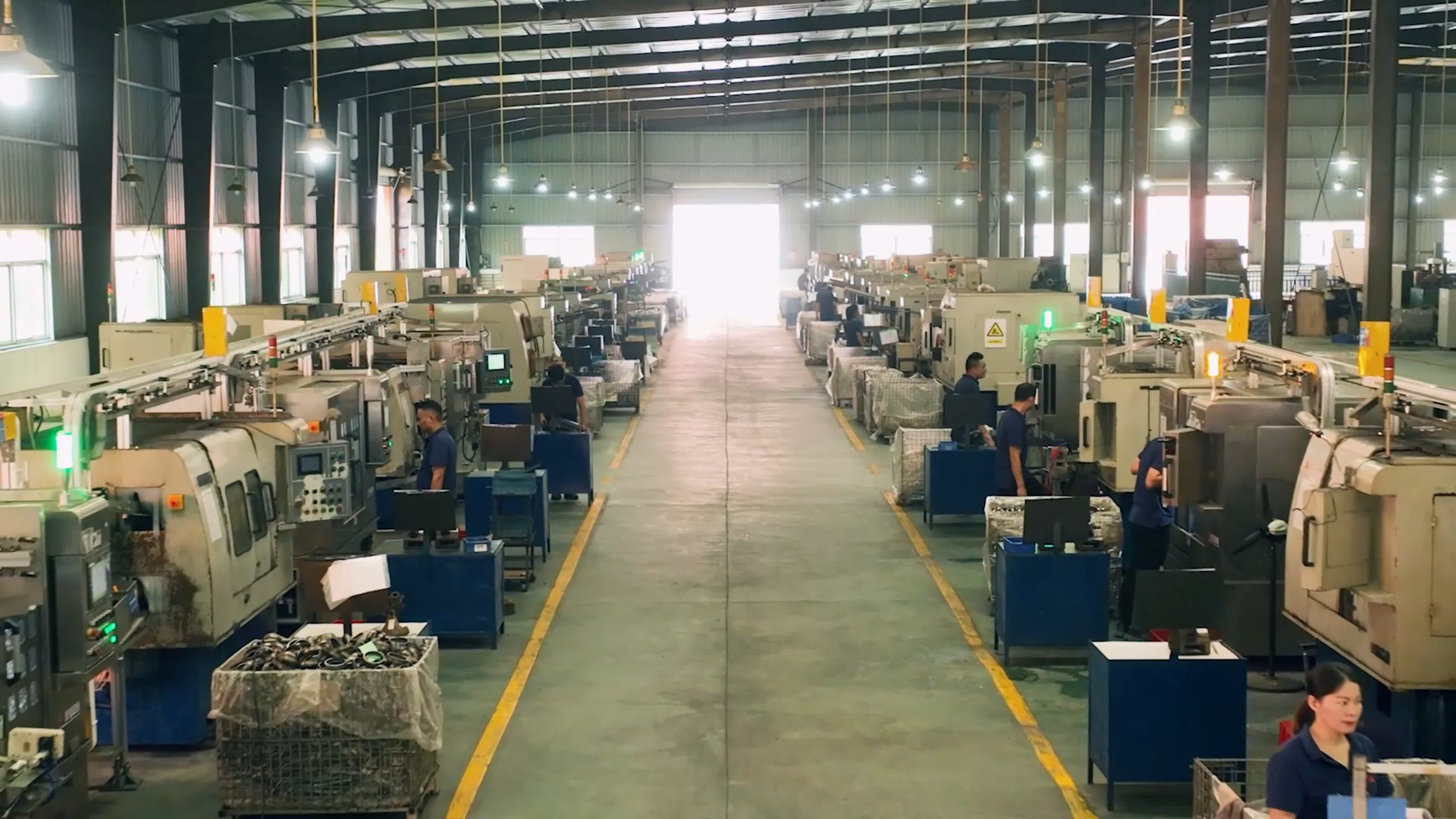
Most pillow block bearing sourcing decisions begin with a drawing and a target price. The harder question is whether the supplier behind that quotation actually manufactures across the range it claims — or whether the catalogue is a broker's list assembled from several factories. Portfolio breadth, when it can be inspected product by product, is one of the few supplier claims a buyer can verify before placing a production order.
LDK, registered as Deyuan Smart Technology (Fujian) Co., Ltd, is a bearing manufacturer operating from Fujian, China since 1986, with a product scope covering mounted ball bearing units, rod ends and linkage assemblies, and spherical plain bearings. The structure of that scope — which product families exist, how far each shaft range extends, and which materials and locking styles are represented — is the subject of this analysis.
Why portfolio breadth works as capability evidence
A single pillow block bearing unit is a deceptively simple object: a housing, an insert bearing, a locking device and a seal. The difficulty is not in making one unit. It is in making the same unit repeatably across dozens of shaft diameters, three or four housing materials, three locking methods and several sealing classes, while keeping the interface dimensions interchangeable with the wider market.
Every additional product family forces a manufacturer to hold a distinct set of tooling, heat-treatment parameters, grinding setups and inspection gauges. A supplier that offers only UCP200-series cast iron units may be entirely competent within that band; a supplier that also offers stainless steel units, waterproof thermoplastic units, agricultural bearings, adapter sleeves and application-specific grease builds is demonstrating that it can operate multiple production routes under one quality system.
For a procurement team, this matters in three practical ways:
- Single-source consolidation. A buyer running food-processing, conveyor and agricultural lines can place one set of purchase orders instead of three.
- Specification flexibility. When a specification changes from set screw locking to eccentric locking, or from cast iron to stainless steel, the supplier does not have to be re-qualified from scratch.
- Consistency of interface dimensions. Units built to the same boundary-dimension conventions across families reduce the risk of mismatch during maintenance replacement.
An ISO 113:2010 reference is relevant here: this standard specifies boundary dimensions for two-bolt and four-bolt plummer block housings intended for rolling bearings. A supplier designing across many housing families is effectively working to a boundary-dimension discipline rather than to a single drawing.
Bearing inserts: shaft range, load class and locking method
The insert range is usually the clearest signal of manufacturing scope, because inserts carry the highest tolerance burden in the assembly. LDK's insert families include UC2, UC3, UCX, SA2, SB2, UK2 and NA2, all built on chrome steel (GCr15 / AISI 52100) as the base material.
| Insert family | Load class and locking | Shaft range |
|---|---|---|
| UC2 | Standard duty, wider inner ring, set screw locking | 12 mm to 90 mm / 1/2 in to 3-1/2 in |
| UC3 | Heavy duty, wider inner ring, set screw locking | 25 mm to 140 mm / 7/8 in to 4 in |
| UCX | Medium duty, wider inner ring, set screw locking | 25 mm to 75 mm / 13/16 in to 3 in |
| SA2 | Standard duty, narrow inner ring, eccentric locking | 12 mm to 60 mm / 1/2 in to 2-7/16 in |
| SB2 | Standard duty, narrow inner ring, set screw locking | 12 mm to 60 mm / 1/2 in to 2-7/16 in |
| UK2 | Standard duty, tapered bore, adapter sleeve locking | 20 mm to 80 mm |
| NA2 | Standard duty, wider inner ring, eccentric locking | 20 mm to 75 mm / 1/2 in to 3-1/2 in |
Read together, these seven families span a shaft range of roughly 12 mm to 140 mm in metric sizes and 1/2 in to 4 in in imperial sizes, and they cover three distinct locking principles: set screw, eccentric collar and adapter sleeve. Each locking principle requires its own machined geometry and its own assembly discipline, and each tends to be preferred in a different application context.
Set screw locking (UC2, UC3, UCX, SB2) is the most widely used convention for general conveyor and fan duty. Eccentric locking (SA2, NA2) is often specified where vibration is present and involuntary loosening of a set screw is a concern. Adapter sleeve locking (UK2) is commonly chosen where the shaft is harder than normal, where a tapered bore is preferred, or where a tight fit must be achieved without damaging the shaft.
The presence of all three locking methods in one catalogue is not a marketing point. It is a statement that the supplier can machine and assemble against three different retention philosophies rather than standardising on the one it finds easiest to produce.
Stainless steel bearing units: material capability, not just a colour option
Stainless steel mounted units are frequently treated by buyers as a premium variant of the same product. In manufacturing terms, they are closer to a different product line. LDK's stainless range covers SSUCP (two-bolt pillow block), SSUCF (four-bolt flange), SSUCFL (two-bolt flange) and SSUCT2 (take-up), with a housing in 304 stainless steel and an insert in 440 stainless steel.
The declared operating window for these units is −35 °C to 102 °C, with food-grade grease and a silicone rubber seal as standard. Those three specification points — housing alloy, insert alloy and grease class — each require a separate supply and process route. A supplier that can hold all three at once is operating a stainless steel material chain, not just painting a cast iron housing.
Application evidence supports where this matters. LDK supplied 70,000 stainless units for offshore processing equipment, where the units achieved 500 hours of rust-free performance and met RoHS and REACH requirements across a two-year project. In a separate programme, a Canadian ice machine manufacturer sourced stainless steel flange cartridge units to correct insufficient clamping force, switching from set screw or eccentric locking to concentric locking with a triple-lip seal and a food-grade solid lubricant.
The stainless range is also where third-party material compliance becomes auditable. SGS RoHS verification reports (for example certificate XMNEC25002179201_1 covering UCFC205 and related UC-series inserts, and XMNEC25002178701_1 covering the UFL000/UP000 silver series) provide an external confirmation route that a buyer can check rather than accept on trust.
Waterproof plastic units: evidence of a housing material chain
Thermoplastic housed units are often the least examined part of a bearing catalogue, yet they are the clearest proof that a supplier controls more than one housing material. LDK's WP-SSBF and WP-SSBFL units use a PA6 thermoplastic housing with a black body and an orange cover, a 440 stainless steel insert, set screw locking, and a shaft range of 20 mm to 40 mm (3/4 in to 1-9/16 in). They carry the same −35 °C to 102 °C window and the same food-grade grease and silicone seal specification as the stainless line.
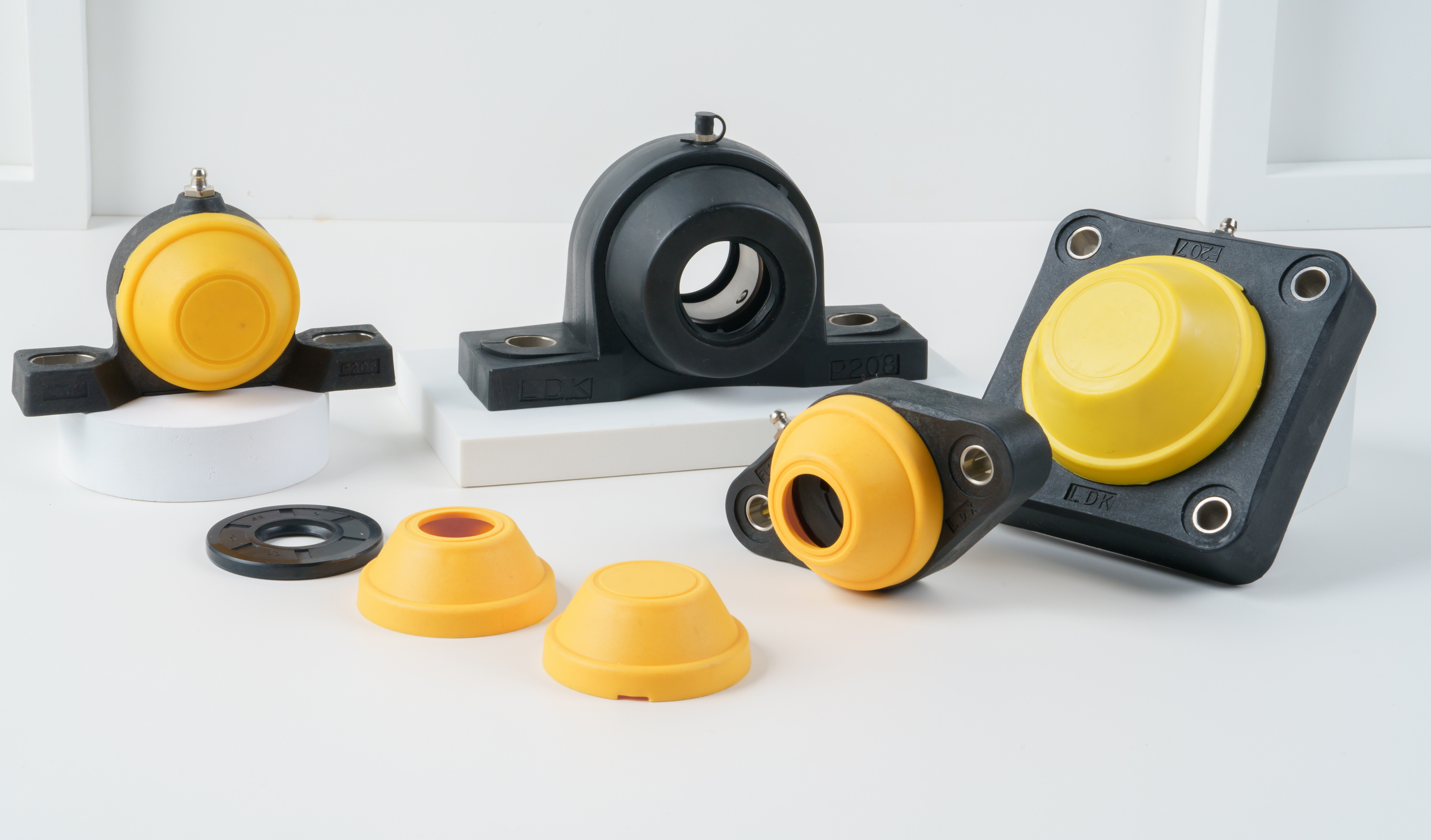
From a capability standpoint, a plastic housing line implies mould or die tooling, melt-flow and shrinkage control, insert-to-housing fit tolerances that differ from metal, and a sealing strategy tuned to a material that expands and contracts differently from cast iron. A supplier that already runs cast iron, stainless steel and thermoplastic housings in parallel has three separate housing production routes in operation.
Application evidence from LDK's records points to the same conclusion from the customer side: a New Zealand sorting machinery OEM ordered 110,000 plastic bearing units specifically for corrosion resistance under frequent washdowns, chemical exposure and high humidity — a requirement profile that cast iron cannot meet regardless of coating.
A word of caution belongs in the record here. The TÜV Rheinland test report 168263398a 001 under the U.S. FDA Code of Federal Regulations Title 21 applies specifically to the thermoplastic bearing housing, not to the full unit. Buyers comparing food-contact claims should read the scope field of any certificate rather than the headline.
Agricultural bearings, adapter sleeves and special grease
Three further families extend the portfolio in directions that do not overlap with standard mounted units.
Agricultural bearings. LDK offers farm implement bearings in round bore, square bore and hex bore configurations, including disc harrow bearing units such as the ST491A/B, ST209 and ST211 series and the DHU45R-209 and DHU55R-211 families. These bearings are typically built around a triple-lip seal and are pre-lubricated and non-relubricable. The triple-lip seal configuration is a standard solution in agricultural bearings precisely because the operating environment — dust, soil, moisture and high shock load — is hostile to conventional contact seals. Producing this family requires a sealing competence that standard pillow block units do not exercise.
Adapter sleeves. The H204 to H2356 range covers metric and inch series (HE, HA, HS) with a standard quit sleeve, lock nut and lock washer assembly in carbon steel. Adapter sleeves are not a high-volume product for most distributors, but they are mandatory wherever UK2 or UK3 tapered-bore inserts are used. A supplier that offers tapered bore inserts without the matching sleeves is effectively handing part of the specification back to the buyer.
Customised special grease. LDK maintains a customised bearing insert programme covering high- and low-temperature grease, appropriate internal clearance, silicone rubber seals, and specific fit and alignment torque for high-temperature duty, across a shaft range of 4.826 mm to 25.4 mm. Case evidence from a cold storage application in New Zealand — 5,000 customised inserts operating at −50 °C on a low-temperature conveyor — illustrates what this programme exists for: standard catalogue grease would not survive the application.
Full-range suppliers whose catalogue stops at cast iron pillow blocks cannot serve these three applications without sourcing externally. That difference is measurable at the quotation stage.
Reading capability across the portfolio
The table below summarises what each product family signals about a supplier's manufacturing scope, independent of any marketing claim.
| Product family | Representative range | Capability signal |
|---|---|---|
| Bearing inserts | UC2, UC3, UCX, SA2, SB2, UK2, NA2 | Insert grinding and heat treatment across 12–140 mm metric and 1/2–4 in imperial shaft ranges; three locking principles in production |
| Stainless steel bearing units | SSUCP, SSUCF, SSUCFL, SSUCT2 | 304 housing / 440 insert material chain; food-grade grease and silicone seals standardised; −35 °C to 102 °C window |
| Waterproof plastic units | WP-SSBF, WP-SSBFL | PA6 thermoplastic housing tooling; sealing design for washdown and chemical exposure |
| Agricultural bearings | Round, square and hex bore; disc harrow families | Triple-lip sealing capability; pre-lubricated non-relubricable assembly |
| Adapter sleeves | H204–H2356, HE/HA/HS inch series | Tapered-bore accessory manufacturing and stocking; supports the UK2/UK3 insert range |
| Special grease programme | High/low temperature, silicone seal, custom clearance | Application-specific insert configuration rather than catalogue-only supply |
Product family breadth is not the same as production capacity, and it is not the same as quality. It is evidence of process diversity. Two suppliers with identical monthly output can have very different manufacturing depth, and that difference usually shows up first when a specification changes.
What portfolio breadth does not prove
A portfolio is a necessary but insufficient form of evidence, and buyers should treat it that way.
First, a wide catalogue does not confirm that every family is in regular production. A listed range may include items manufactured to order, or items that are low-volume. Shipment records and lead-time data are the appropriate check.
Second, portfolio breadth says nothing about lot-to-lot consistency without inspection data. Dimensional stability, runout and noise or vibration performance are verified statistically, not visually. LDK operates a reliability testing room and a measurement room for exactly this purpose, but the value of those facilities to a buyer depends on whether their data is shared with the order.
Third, breadth is not a substitute for certification. LDK holds IATF 16949 certification (certificate scope: manufacturing, design and development of products and services, bearing and bearing housings) issued through BV and valid to 25 January 2027, alongside ISO 45001:2018 and ISO 14001:2015 management system certificates issued through CQM. Those documents serve a different function from a catalogue: they attest to system controls rather than to product range. A buyer should expect both, not one in place of the other.
Fourth, breadth on paper should be tested against at least one non-standard requirement. A custom grease, a special clearance, a one-piece linkage or a patented coating claim is much harder to fake than a product photo. The 70,000-unit offshore programme referenced earlier is a useful template here: it combined a material challenge, a compliance challenge and a volume challenge in a single project.
Market trend and forward outlook
The global pillow block bearings market was valued at approximately USD 2.8 billion in 2024 and is projected to reach USD 4.7 billion by 2033, a CAGR of 5.7% according to Dataintelo. The broader mounted bearing market, which includes ball and roller types, was valued at approximately USD 1.48 billion in 2023 and is expected to reach USD 2.55 billion by 2033 according to Spherical Insights.
Two features of this demand profile are relevant to how buyers should evaluate portfolios.
The first is regional concentration. Asia Pacific accounted for approximately 49.5% of mounted bearing market revenue in 2025, driven by industrialisation in China and India (Fortune Business Insights). China was also the leading exporter of ball bearings under HS 8482 in 2024, at USD 6.53 billion (OEC). Concentration in one region increases the practical importance of supplier-level differentiation, because geographic origin alone no longer separates one quotation from another.
The second is application-driven material shift. Demand is moving toward stainless steel, thermoplastic and coated units in food processing, pharmaceutical, marine and washdown environments. This is not a niche. It changes what a general-purpose pillow block bearing supplier is expected to stock, and it rewards suppliers whose catalogue already spans cast iron, stainless and plastic housing routes.
Against that background, the large multinational suppliers — SKF, Schaeffler, Timken, NSK and NTN, who together hold more than half of the mounted bearing market — compete on brand and global distribution. Mid-size manufacturers differentiate on the dimensions discussed in this article: the depth of the insert range, the number of housing materials in active production, and the ability to configure grease, clearance and sealing for a specific application rather than only supplying catalogue parts.
Looking forward, the most likely direction of change is that buyers will ask for portfolio evidence in a structured form — dimensional tables, material declarations, certificate numbers and project references — rather than accepting a PDF catalogue as the summary of capability. Suppliers whose documentation is already organised along those lines will be easier to qualify.
Frequently asked questions
What does a full pillow block bearing portfolio actually tell a buyer?
It indicates how many distinct production routes a supplier can run under one quality system. A portfolio covering multiple insert families, several housing materials and more than one locking principle implies that the supplier holds separate tooling, heat-treatment and inspection setups for each, rather than concentrating on a single high-volume configuration.
If a supplier lists UC2, UC3, UCX, SA2, SB2, UK2 and NA2 inserts, what does that mean?
It means the supplier produces inserts across an approximate 12 mm to 140 mm metric shaft range (and 1/2 in to 4 in imperial), and can supply three different retention methods: set screw locking for general duty, eccentric locking where vibration is a concern, and adapter sleeve locking for tapered bores. Producing all three requires distinct machined geometry for each, not a variation of one design.
Why does it matter whether a supplier offers both stainless steel and plastic bearing units?
Because the housing material change is a manufacturing change, not a cosmetic one. Stainless steel units require a 304 housing and 440 insert material chain, food-grade grease and silicone seals, with a declared −35 °C to 102 °C window. Plastic units require PA6 moulding, different shrinkage and fit tolerances, and a sealing strategy adapted to thermoplastic. A supplier running both, alongside cast iron, is operating three housing production routes.
Do agricultural bearings and adapter sleeves count as capability evidence?
They do, because they exercise competencies that standard pillow block units do not. Agricultural bearings typically use triple-lip seals and are pre-lubricated and non-relubricable, which requires a different sealing and grease strategy from relubricable mounted units. Adapter sleeves in the H204 to H2356 range are mandatory wherever tapered-bore inserts such as UK2 are used, so their availability determines whether a tapered-bore order can be fulfilled completely.
Can portfolio breadth substitute for third-party certification?
No. Product range and quality system certification answer different questions. Portfolio breadth shows process diversity; certification shows that process controls have been audited against a recognised standard. LDK holds IATF 16949 through BV with a scope covering bearing and bearing housing manufacturing and design, valid to 25 January 2027, together with ISO 45001:2018 and ISO 14001:2015 certificates issued through CQM. Buyers evaluating a supplier should request both catalogue range and current certificates, and should read the scope field on each certificate rather than the title.
Corporate brochure (PDF, publicly downloadable): LDK bearing product and capability brochure