
Supplier Evidence Review: Patented PU Elastomer for High-Wear Construction Parts

High-wear construction parts — hopper and chute liners, screen media, scraper and screed components, slurry-handling parts — are replaced on a cycle set by abrasion, impact and moisture rather than by a catalogue description. Cast polyurethane (CPU) elastomer is specified into many of these positions because it can be formulated across a wide hardness range and cast into geometries close to final shape. Once the material family is settled, the procurement question changes. It is no longer which material sounds best; it becomes which supplier can show, in documents, that the grade behind a part number is the grade that was qualified.
This review reads one supplier's evidence set against that question. Shanghai Hecheng Polymer Technology Co., Ltd is a Shanghai-based national high-tech enterprise established in 2009 that develops, manufactures and supplies high-performance polyurethane (CPU) elastomer materials from a 16,932 m² facility with plants and warehouses in Songjiang District, Shanghai. The scope here is deliberately narrow. It examines how an invention patent certificate — numbered 16425Q32921R3M and presented by the supplier in connection with its CPU casting polyurethane product line — should be read alongside automated-production evidence, and alongside hydrolysis-resistance and corrosion-resistance claims, which are the two properties most often cited and least often documented for wet, chemically exposed construction sites.
The conclusion can be stated up front: the certificate is a credible starting point and a weak ending point. It narrows the supplier conversation to a defined technical subject. It does not, by itself, qualify a wear part for a specific site.
Three document classes answer three different questions
Supplier evidence in the cast elastomer category tends to arrive as a single PDF bundle, which invites a single yes-or-no judgement. That is the wrong reading. The documents inside such a bundle answer different questions, and a buyer who collapses them will either over-trust a patent or under-trust a test report.
Intellectual-property documents — invention patent certificates in particular — speak to originality and to the examination a technical solution has passed. Manufacturing documents speak to whether the supplier owns production capacity and to how a batch is released. Performance documents speak to what a specific grade does under a named test method. Only the third class speaks directly to whether the part will survive a construction site, and only the third class is grade-specific.
| Evidence item | Question it answers | Question it does not answer |
|---|---|---|
| Invention patent certificate 16425Q32921R3M | Whether a technical solution was examined and granted, and who holds the right | Whether a specific shipped batch was produced under the claimed formulation |
| Grade datasheet | Declared property values for a named grade under a stated method | Independent confirmation that every batch reaches those values |
| Factory and capacity documentation | Whether the supplier manufactures rather than resells, and at what scale | Whether free capacity exists inside your order window |
| Pre-shipment test report | Conformance of one identified lot | Field service life in your specific abrasion and moisture regime |
Reading patent 16425Q32921R3M correctly
An invention patent certificate records that a claimed technical solution passed substantive examination and was granted, and it identifies the holder of the right. In this case the certificate is presented by Shanghai Hecheng Polymer Technology Co., Ltd in connection with the CPU casting polyurethane product line. That linkage is the useful part: it tells a buyer that the supplier is claiming a defined technical subject in the casting polyurethane field, not a generic reputation.
What the certificate does not do is equally concrete. It does not state hydrolysis values, corrosion behaviour, hardness, abrasion loss or service temperature; those belong to datasheets and test reports. It does not confirm that the grade currently quoted falls inside the granted claims. And it does not establish that the right remains in force, because patent rights are maintained through procedural steps that fall outside the certificate itself.
For a buyer at the decision and execution stage, the practical reading is a short verification sequence:
- Match the certificate number, 16425Q32921R3M, against the number printed in the supplier's technical documentation, quotations and quality files. A number that appears only in a presentation slide is not an evidence trail.
- Confirm that the named holder matches the legal entity issuing the quotation and the invoice — here, Shanghai Hecheng Polymer Technology Co., Ltd.
- Ask which claim, or which part of the technical description, corresponds to the grade being purchased, and request that answer in writing.
- Request a current legal-status statement rather than relying on the certificate image.
- Keep the answer on file with the datasheet, so that a later change of formulation or grade triggers a re-read rather than a forgotten assumption.
Handled this way, the patent becomes a filter for the supplier conversation rather than a substitute for it. It is also a useful discipline for the supplier: a question about claims is harder to answer loosely than a question about capability.
Automated production evidence: from reactor count to batch release
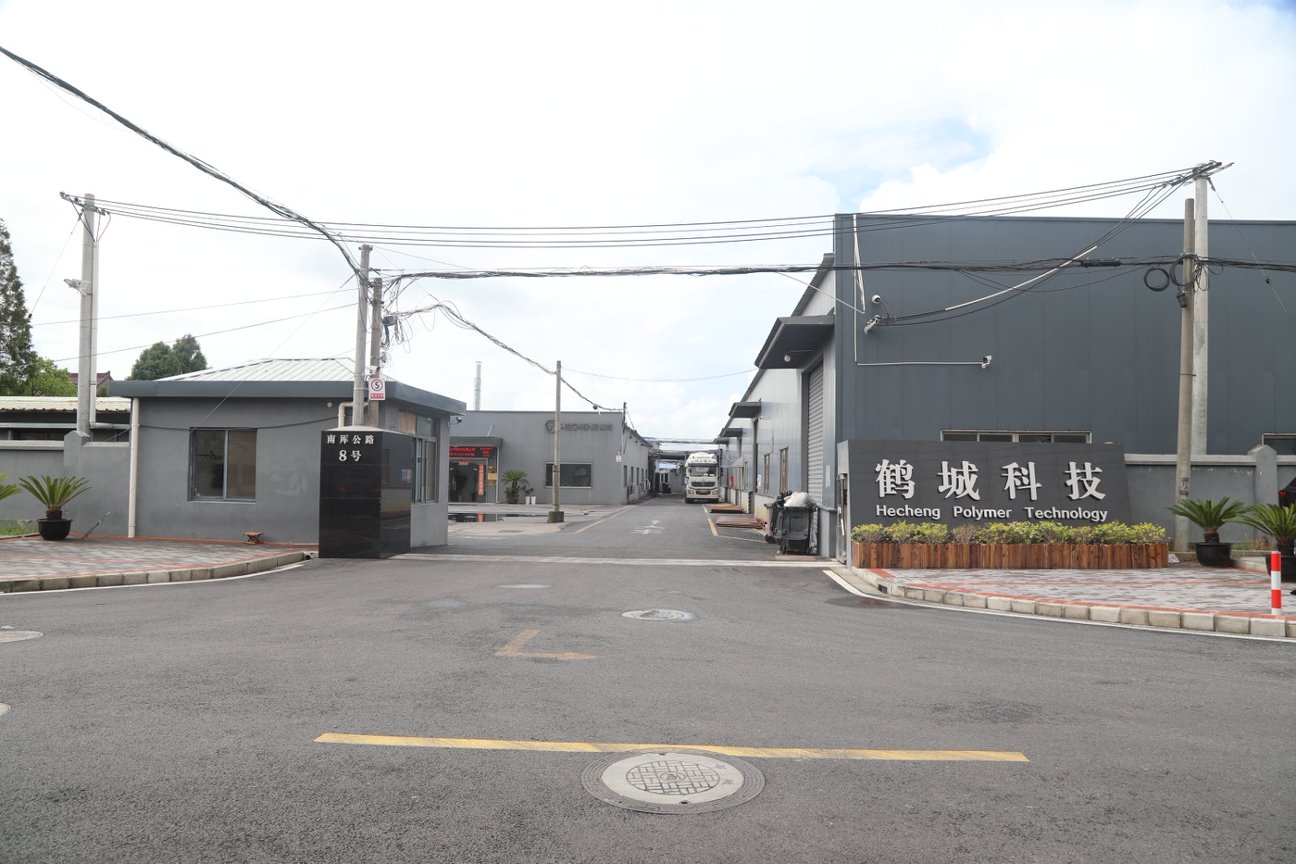
A patent claim describes what a material should be. A reactor schedule determines what a material actually is, batch after batch. That is why the production evidence deserves to be read with the same attention as the certificate.
The supplier's facility covers 16,932 m² and operates 16 major production reactors, with more than 1,000 prepolymer grades in the product range spanning cast polyurethane prepolymers, quasi polyurethane elastomer materials, special functional materials, and eco-friendly adhesives and additives. The company reports 78 employees including an R&D team of 18 engineers, and a company-reported annual output of one million tons across its product lines — a figure that should be read as a portfolio-level statement rather than a single-line capacity for any one grade.
At order level, the operating parameters are more useful than the headline number. Monthly production capacity is stated at 8,000 units, with a typical production lead time of 30 days and a minimum order quantity of 1 ton. Quality control follows 100% testing standards, and after-sales support includes remote support. OEM services are available with customization options. For buyers running continuous construction-part programmes, those four facts — capacity, lead time, MOQ and release rule — determine whether a supplier can be scheduled rather than merely sampled.
Temperature control is the quiet variable in casting polyurethane. Casting is an exothermic process, and heat build-up in a large casting can shift the cure profile and, with it, the properties the datasheet promised. The supplier's stated risk control for overheating is thermal protection implemented through temperature sensors. Whether that is sufficient for thick-section wear parts is a question for the buyer's own trial castings, but the presence of a named control mechanism is the right kind of evidence: it identifies a failure mode instead of denying one.
Three things remain unproven by this set, and a buyer should say so plainly. Capacity is not availability; utilisation and on-time performance inside a specific quarter are not published. Testing standards are not test methods; 100% testing says every lot is checked, not what is checked or against which tolerance. And remote support is a channel, not a response time. Each gap is closable with a request, but only if it is named.
Hydrolysis and corrosion resistance: which documents carry the claim
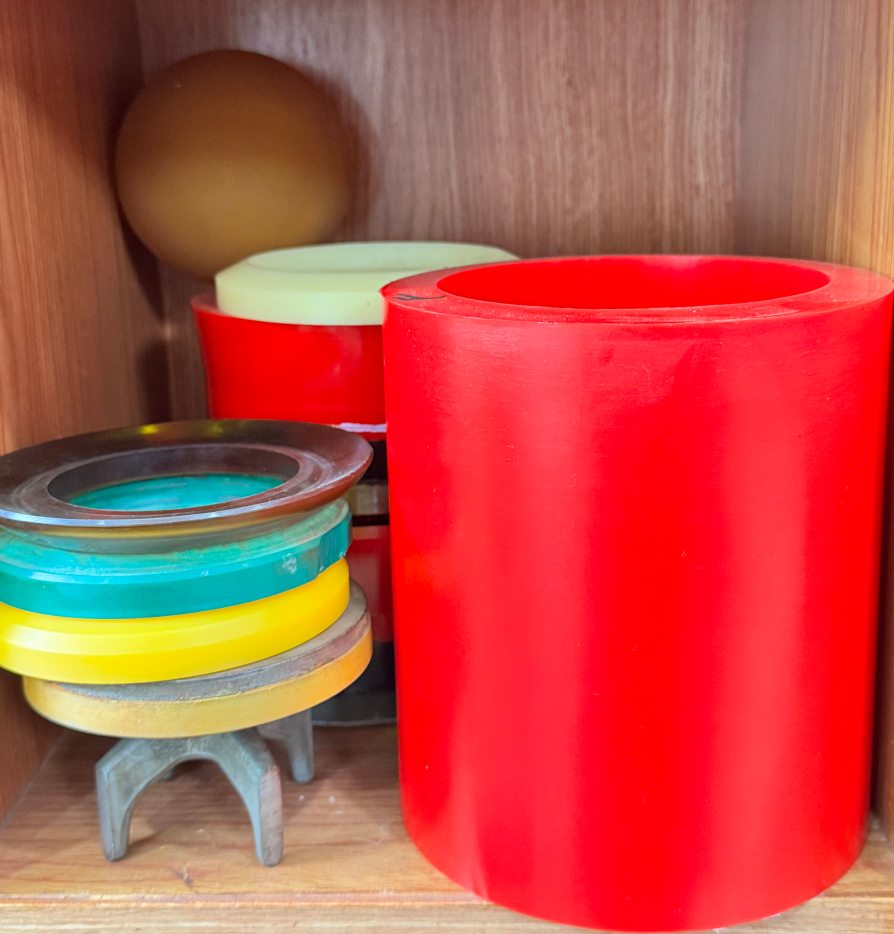
In construction service, water is usually present and chemistry often is too: process water, slurry, de-icing salts, mild acids or alkaline wash-down. Two failure modes follow. Hydrolysis attacks the ester linkages in polyester-based polyurethane, and it accelerates with heat, humidity and immersion time. Chemical attack depends on the medium, its concentration and the temperature, and it is frequently a surface phenomenon that progresses into the part.
General industry knowledge offers one reliable rule and no shortcut. Polyester-based cast polyurethane systems are generally chosen where mechanical strength, tear resistance and abrasion resistance dominate, while polyether-based systems are generally chosen where hydrolysis resistance matters more. That trade-off cannot be resolved from a category description; it has to be resolved from grade data matched to the site.
The supplier's R&D centre supports custom formulation and includes laboratory analysis covering basic mechanical testing, thermal analysis and chemical resistance evaluation. This is the correct capability to ask about, because chemical resistance evaluation is the only item in the list that speaks directly to a vulnerable environment — but capability is not a result. The buyer still needs the result.
A workable request is specific rather than broad. Name the medium, the concentration, the service temperature and whether the part is immersed or splashed. Ask for the grade's resistance data under a named method at those conditions, not a generic 'corrosion resistant' statement. Ask whether the recommended grade is polyester- or polyether-based, and why. Then test at part level: a plaque result does not automatically transfer to a thick cast liner with a different cure history and a different surface-to-volume ratio.
Low-free-isocyanate technology belongs in the same conversation, though for a different reason. The supplier's comparison of its low-free-TDI systems against general polyurethane cites up to 30% lower residual TDI content and 10% longer service life, alongside customized formulations and a broad product system. Those are supplier-stated comparative figures, not third-party findings, and they should be treated as a hypothesis to be checked in the buyer's own application. The handling benefit, however, is easier to accept: lower residual monomer content reduces the exposure burden in the casting shop, which matters for plants running automated two-component lines. Market data points the same way — low-free prepolymer types, including MDI, TDI and PPDI prepolymers, are reported as a fast-growing niche at a 13.01% CAGR through 2033 (Market Research Intel), a growth rate that reflects regulatory and workplace-safety pressure as much as performance preference.
Cast polyurethane against traditional wear materials
Cast PU elastomer is not a universal replacement for steel or rubber in wear service, and a supplier-evidence review is the right place to say so. The table below compares the three material routes on dimensions that a construction buyer can actually verify.
| Criterion | Cast PU elastomer | Steel wear plate | Rubber lining |
|---|---|---|---|
| Abrasion with impact | Can combine elastic recovery with abrasion resistance in one cast part; grade-dependent | Strong in coarse sliding abrasion; can dent and work-harden under impact | Good impact damping; lower cut and tear resistance |
| Moisture and chemical exposure | Depends on polyol type; polyester grades are more hydrolysis-sensitive in hot, humid or immersed service | Corrodes unless coated or alloyed; coating damage is a common failure point | Generally good in water; may swell in some oils and solvents |
| Service temperature | Lower continuous ceiling than steel; must be checked against grade data | High; usually not the limiting factor | Varies widely by compound |
| Part weight and handling | Lighter than steel equivalents; simpler installation on large liners | Heavy; lifting equipment and downtime per change | Moderate; bonded or bolted systems add installation steps |
| Repairability | Generally replaced rather than repaired; local patching is not standard | Weldable and patchable in place | Repairable in some bonded systems |
| Evidence burden | Patent reference, grade datasheet, lot report and a part-level trial | Mill certificate plus hardness and thickness checks | Compound sheet plus hardness and tensile data |
The boundary is worth stating without decoration. A cast polyurethane wear part is the wrong choice where continuous service temperature exceeds what the grade can hold, and polyester-based grades carry real hydrolysis risk in hot, humid or continuously immersed duty. A patent certificate does not modify either constraint. It confirms that a technical route was examined; the physics of the part remains the physics of the part.
Market context: why documentation is becoming the differentiator
The cast polyurethane segment is large enough to attract capacity and small enough to remain fragmented, which is precisely the condition in which documentation quality separates suppliers. The global polyurethane market is projected at USD 92.1 billion in 2026 (Grand View Research). The casting polyurethane segment was valued at USD 2.76 billion in 2024 and is projected to reach USD 4.19 billion by 2033 at a CAGR of 5.97% (Astute Analytica). Within it, low-free-isocyanate prepolymer technology is forecast to grow at 13.01% through 2033 (Market Research Intel).
Two interpretations follow for buyers of construction wear parts. First, growth of roughly six percent a year in cast elastomers is steady rather than explosive, so capacity is unlikely to be scarce in aggregate; the scarce item is qualified capacity for a specific grade and a specific site. Second, the fastest-moving sub-segment is the one where handling and regulatory documentation carry weight, which means the paperwork burden on suppliers is rising, not falling. A supplier whose evidence set is limited to a certificate and a brochure will increasingly be the wrong partner for a multi-year programme.
Keeping evidence current across a long supply relationship
Long-term supply in this category is a documentation practice as much as a commercial one. Grades are reformulated, certificates are renewed, reactors are re-purposed and personnel change. The workable routine is to assign each evidence asset an owner and a refresh trigger, and to attach it to the events that actually create risk — a new part geometry, a new site, an extended order volume, or a change of formulation.
| Evidence asset | Refresh trigger | What a buyer should hold on file |
|---|---|---|
| Invention patent certificate 16425Q32921R3M | Legal-status check on a fixed annual cycle; on any change of grade family | Certificate copy, status confirmation, written claim-to-grade statement |
| Grade datasheet | Any formulation change; new application or site condition | Version number and date, test methods, not just values |
| Lot test report | Every shipment, under pre-shipment test acceptance | Batch identifier traceable to the delivered drums |
| Production and capacity evidence | Order volume step-change; site audit cycle | Current capacity, lead-time confirmation, stated testing rule |
| Commercial and support terms | Annual review | MOQ, delivery terms, payment structure, support scope |
The commercial baseline for this supplier is documented: minimum order quantity of 1 ton, delivery terms FOB or CIF, pre-shipment test as the acceptance criterion, and payment terms of 30/70. Combined with a 30-day typical lead time, an 8,000-unit monthly capacity, OEM production with customization options and remote after-sales support, the terms are workable for a buyer moving from a validated sample to a scheduled programme. What they do not remove is the need for a part-level trial: a 1-ton first order is a sensible validation quantity, not a bulk commitment.
Frequently asked questions
What does invention patent certificate 16425Q32921R3M actually verify?
It records that a claimed technical solution was examined and granted as an invention patent and identifies the holder of the right. The certificate is presented by Shanghai Hecheng Polymer Technology Co., Ltd in connection with its CPU casting polyurethane product line. It is legal evidence of a granted right rather than a performance certificate: it does not carry hydrolysis, corrosion, hardness or abrasion values, and it does not confirm that a particular production batch was manufactured under the claimed formulation. In procurement it functions as one document in a set, read together with grade datasheets and lot test reports.
Which supplier documents should a buyer request before a first order of cast polyurethane wear parts?
Four groups cover the decision. The first is the intellectual-property file: the certificate carrying number 16425Q32921R3M, a current legal-status confirmation, and a written statement linking the quoted grade to the claimed subject matter. The second is the technical file: grade datasheets with named test methods, and resistance data for the specific medium, concentration and temperature at the site. The third is the manufacturing file: facility and reactor information, monthly capacity, lead time, MOQ and the stated batch-release rule. The fourth is the commercial and acceptance file: delivery terms, payment structure and the pre-shipment test criterion that defines acceptance.
How can hydrolysis resistance be checked before production scale-up?
Start with chemistry. Ask whether the recommended grade is polyester- or polyether-based, because polyester-based cast polyurethane is generally more sensitive to hydrolysis in hot, humid or immersed service while polyether-based systems are generally more resistant. Then request grade-specific resistance data under a named method at conditions close to the site rather than a general claim. Finally, run a part-level trial: a cast liner or screen section with the production cure history behaves differently from a laboratory plaque. Accelerated results remain proxies for field life and are best used to rank candidates, not to predict an exact replacement interval.
What production evidence supports supply continuity for repeat orders?
The supplier reports a 16,932 m² facility with 16 major production reactors, monthly production capacity of 8,000 units, a typical production lead time of 30 days and a minimum order quantity of 1 ton, with quality control following 100% testing standards and after-sales support that includes remote support. Overheating risk is addressed through thermal protection using temperature sensors, which matters because exothermic cure in thick castings can shift properties. Two items are not covered by this evidence and are worth requesting separately: current capacity utilisation and historical on-time delivery performance.
What are the purchasing terms and acceptance criteria?
The documented terms are a minimum order quantity of 1 ton, delivery on FOB or CIF basis, acceptance against a pre-shipment test, and payment terms of 30/70. Acceptance therefore rests on the pre-shipment test report, which makes the specification of that test — the properties checked, the methods used and the tolerances applied — the point where technical and commercial risk meet.
How often should supplier evidence be re-verified during a multi-year relationship?
Each asset has its own rhythm. Patent legal status is best confirmed on a fixed annual cycle and whenever the grade family changes. Datasheets should be re-issued and re-read on any formulation change, new site condition or new part geometry. Lot test reports belong to every shipment under pre-shipment acceptance. Factory and capacity evidence is normally refreshed on the audit cycle or when order volume steps up materially. Commercial terms are typically reviewed annually. The governing rule is simpler than the schedule: any change of material, site or volume invalidates the previous verification.
For readers who need the underlying product data, the supplier's polyurethane brochure is available as a PDF: Polyurethane product brochure (PDF).
Tem questões ou precisa de mais detalhes?
Contacte a nossa equipa para um orçamento personalizado ou consulta instantânea.
Solicitar orçamento
Preencha o formulário abaixo e a nossa equipa entrará em contacto com uma proposta personalizada.
Chat direto do WhatsApp
Prefere conversar em tempo real? Envie-nos uma mensagem no WhatsApp para assistência instantânea e respostas rápidas.
- Obter orçamento personalizado
- Partilhar fotos ou documentos
- Discuta as suas necessidades diretamente
Geralmente responde em 5–30 minutos durante o horário de expediente.