
Supplier Evidence: YUEDA's Laminating Machine Software Copyright
A metalized paper laminating machine remains a mechanical product only until the moment its control layer starts coordinating web tension, drying temperature, registration and line speed. From that point onward, output consistency depends as much on the logic running inside the electrical cabinet as on the rollers, the coating head and the drying tunnel. This is why buyers researching a High Speed Metalized Paper Laminating Machine are increasingly asking for evidence beyond a parameter sheet: proof that the automation layer is a documented, original and supportable asset rather than an undocumented configuration assembled at the time of order.
Wenzhou Yueda Packaging Machinery Co., Ltd. (YUEDA) is a manufacturer of gold and silver cardboard laminating and paper-converting equipment based in Longgang, Wenzhou, China's printing and packaging machinery cluster. The company was founded in 1998, operates a 4,000 m² facility and reports a technical team of 25 engineers, with roughly 70% of output exported to Southeast Asia, the Middle East, South America and Africa. Among its documented assets is a software copyright registration for an Intelligent Control System for Automatic Gold and Silver Cardboard Laminating Machine V1.0 — an artefact that speaks directly to how the company's automatic laminating platforms are controlled, and one that a procurement team can request, read and compare.
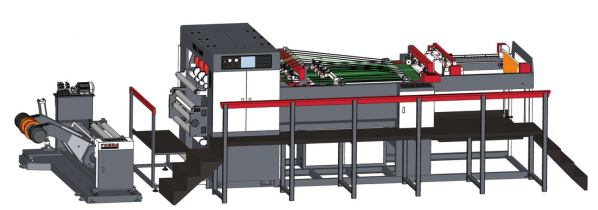
Intelligent servo-controlled laminating machine with real-time tension monitoring and automatic adjustment. Image: YUEDA.
The control layer is now part of the specification
Industrial buyers have learned to read mechanical specifications carefully. Working width, substrate grammage, drying length and rated speed are routinely compared across quotations. The control layer is compared far less often, even though it is the part of the machine that decides whether a rated speed is reachable on a live production shift.
Consider what a high-speed laminating line must hold simultaneously. On YUEDA's gantry-type platform, the published machine speed is 180 m/min against a working speed band of 15–150 m/min. The substrate range spans paper from 100 to 350 g/m², PET film from 0.012 to 0.014 mm and aluminium film from 0.006 to 0.007 mm. A 0.012 mm PET web and a 350 g/m² paperboard behave in completely different ways under the same tension setpoint, and the drying tunnel must hold ≤130 °C across a 15 m tunnel with an 8.6 m down-section without distorting either. Those are control tasks, not mechanical ones. The same logic applies downstream: YUEDA's positioning sheet cutters publish a blank cutting accuracy of ±0.1 mm at operating speeds up to 300 m/min, a tolerance that only survives continuous production if registration correction is handled automatically.
The published power architecture reinforces the point. On the gantry platform, motor power is listed at 60 kW while heating power reaches 216 kW, with working power at 80 kW. Heating is therefore the dominant load, and the way a controller ramps, zones and idles that load has a direct effect on running cost. A buyer who evaluates only the mechanical layout is, in effect, leaving a large share of operating cost and yield unexamined.
What YUEDA's software copyright records — and what it does not
A software copyright registration is a documentary artefact. In registration-based systems of this kind, the record typically identifies the claimant, the title of the work, a version identifier and a registration date. It establishes that a specific version of a program was deposited and claimed as an original work at a point in time. For YUEDA, the registered work is titled Intelligent Control System for Automatic Gold and Silver Cardboard Laminating Machine V1.0.
For a procurement team, three practical consequences follow. First, the control system has a name and a version, which means a quotation can reference something more precise than "PLC control". Second, the automation interface is traceable to a legal entity rather than to an anonymous integrator, which matters when a line is commissioned years after the original purchase. Third, the existence of a registered work implies an internal development process: someone wrote, versioned and documented the application layer.
The boundaries matter just as much. A registration does not certify performance, does not demonstrate compliance with machinery safety or electromagnetic compatibility requirements, and does not by itself guarantee that the deposited version is the one running on the machine being quoted. It is evidence of ownership and originality, not a test report. Buyers should treat it as one item in a chain of evidence, alongside factory acceptance testing and the machine datasheet.
From certificate to machine: where control logic meets the YDLM1300B specification
The clearest way to read the software claim is against a concrete configuration. The YDLM1300B gantry-type multifunctional aluminium metallized cardboard laminating and coating machine is the model YUEDA presents for high-speed metalized paper production, and its published parameters define the problem the control system has to solve.
| Parameter | Published value (YDLM1300B) |
|---|---|
| Working width | 600–1200 mm |
| Machine speed / working speed | 180 m/min / 15–150 m/min |
| Base materials | Paper 100–350 g/m²; PET film 0.012–0.014 mm; OPP film 0.02–0.06 mm; aluminium film 0.006–0.007 mm |
| Laminating and coating method | Water-based lamination to paperboard; four-roller transfer coating; anilox roller direct back coating |
| Drying tunnel | ≤130 °C; 15 m tunnel with 8.6 m down-section |
| Power | 380 V ±10%, 50 Hz; motors 60 kW; heating 216 kW; working power 80 kW |
| Dimensions / weight | 22,330 × 3,700 × 4,500 mm; 40 t |
A machine over 22 metres long creates a long web path with multiple tension zones: unwind, coating, lamination nip, drying, cooling, delamination and rewind. Each zone needs its own setpoint, and the transition between zones is where most production defects originate. The published control architecture describes real-time tension monitoring with automatic adjustment, photoelectric positioning for registration, and a PLC-based electrical cabinet with touch-screen operation and live production parameter display. These are the functions the registered control software governs.
The same platform is also protected at the hardware level. YUEDA's gantry model incorporates an energy-saving double-layer drying oven covered by patent ZL 2022 2 1114210.X. Read together, the patent and the software registration describe a machine whose drying efficiency and automation interface are both documented assets — a combination that is more informative than either document alone.

Intelligent PLC electrical control cabinet for automatic laminating machines, with touch-screen operation and real-time production parameter monitoring. Image: YUEDA.
Two laminating architectures, one verification question
YUEDA publishes two distinct routes into metalized paper production, and buyers comparing them should note that the control question changes shape with the architecture.
The gantry-type YDLM1300B is a laminating and coating integrated machine built around a 180 m/min machine speed and a 600–1200 mm working width. The ZNFH1300-1400-1500 is a no-shaft rewinding aluminium metallized paper laminating and coating integrated machine with a 5–150 m/min running speed, a 12.5 m drying path, a substrate range from 40 to 450 g/m², aluminium foil of 0.006–0.01 mm and total power consumption of 121 kW or 129 kW depending on width. One platform emphasises speed and integrated coating; the other emphasises substrate breadth and shaftless rewind handling.
Because the two machines differ in web path, rewind principle and drying length, a buyer should not assume that a single registered control version covers both identically. The correct question in a quotation is specific: which control software version and which registered work applies to the exact model and configuration being purchased, and does the deposited version correspond to the build delivered?
Where the control system is actually tested: cosmetic and cigarette packaging lines
Specification values are claims until a machine runs in a real environment. YUEDA's reference scenarios show what the automation layer is asked to survive.
In a cosmetic packaging production line in Thailand, the working condition is a dust-free workshop held at 30–35 °C, with requirements for dust protection, high-precision calibration and anti-static design. The line runs in automatic mode with photoelectric positioning, supported by a feeder, stacker and waste edge trimming system. Dust control and static control are environmental problems that a control system must accommodate: sensors drift, registration marks become unreliable, and calibration has to be repeatable without an operator intervention every shift.
In Vietnam, the operating condition is more severe in a different way: 24/7 continuous operation at 60–70% humidity, producing cigarette packaging. The requirements listed are humidity resistance, dust protection and a constant-temperature environment, with automatic PLC control coordinating an unwinder, rewinder, waste collector and temperature control system. High humidity affects film handling, adhesion behaviour and electronics alike, and continuous operation removes the recovery time that a single-shift plant naturally provides.
Two published customer references sit behind these scenarios. A cigarette packaging factory in Thailand operating two units for more than five years reports a 30% efficiency increase and a 15% material waste reduction, with humidity-resistant continuous operation cited as the deciding factor. A packaging factory in Vietnam running one unit for more than five years reports ±0.1 mm cutting precision, a zero rework rate and a 20% labour cost saving, with dust-proof design, fast size changeover and low maintenance cost highlighted. Both results are customer-reported rather than independently audited, but they describe the type of outcome that control stability produces: less waste, less rework, less manual correction.
The market context behind the evidence request
The demand for documented automation is not an abstract quality preference. Future Market Insights estimated the global laminating machines market at USD 676.4 million in 2025, covering thermal, wet and dry laminating equipment. DataM Intelligence estimated the global metallized paper market at USD 4.85 billion in 2025, with tobacco packaging and premium labelling among the driving segments. The second figure explains the first: as metalized paper volume grows in cigarette, spirits, confectionery and cosmetics packaging, the machinery that converts it moves from a general-purpose purchase to a production-critical asset.
Two structural consequences follow for buyers. First, the segment with the highest volume — tobacco packaging — is also the segment with the least tolerance for registration drift and surface defects, because brand owners audit print and finish quality closely. Second, as more suppliers enter the category with similar mechanical specifications, differentiation migrates toward the parts of the machine that are hardest to copy: drying efficiency, tension control and the application software that ties them together. A supplier that can produce a registration document is answering a question the market has started to ask.
Documented versus undocumented control: a fair comparison
It is worth being precise about what a buyer is comparing. The alternative to a registered, supplier-owned control application is not necessarily a bad machine. Many laminating lines in the market run on generic third-party PLC platforms with an application layer written by the machine builder but never registered, documented or versioned.
| Dimension | Registered, supplier-owned control software | Undocumented application layer |
|---|---|---|
| Identification | Named work with version identifier | Described in the quote as "PLC control" |
| Ownership trail | Traceable to the manufacturer of record | Often traceable only to an individual engineer |
| Change control | Versioning implied by the registered title | Changes may be made on site without records |
| Support dependency | Support path defined by the supplier | Support depends on the original programmer remaining available |
| What it proves | Originality and ownership of a deposited version | Nothing beyond the machine functioning at handover |
The honest boundary is this: registration improves traceability and reduces a specific class of long-term risk, but it does not make a machine faster, safer or more accurate. A well-documented control system on a poorly specified mechanical platform will still underperform, and an unregistered application written by a competent integrator can run perfectly for a decade. Buyers who treat the certificate as a substitute for factory acceptance testing will misprice the risk.
How a buyer verifies control software before signing
The practical value of a software copyright registration lies in the questions it makes askable. The sequence below works for any supplier, and it is worth applying to YUEDA as much as to its competitors.
- Request the certificate, not the mention. A copy of the registration shows the work's title, the claimant and the registered version. Compare the title against the model being quoted.
- Separate the layers. Ask which functions are governed by the supplier's own software and which are provided by third-party PLC, drive or HMI platforms. This determines where support dependency actually sits.
- Test at the parameters you will run. A factory acceptance test should log tension, zone temperatures and registration accuracy at the substrates and speeds written into the purchase order — for a high-speed metalized paper line, that means the paper grammage, film thickness and working speed band you intend to use.
- Confirm backup and access policy. Ask how parameters are backed up, whether a copy is delivered with the machine, and what happens if a controller is replaced. These answers determine restart time after a fault.
- Match the service commitment to the software. YUEDA publishes 24-hour online response, 48-hour domestic on-site service and 72-hour overseas remote debugging, with lead times of 30–45 days for standard models and 45–60 days for customized configurations.
- Check the quality gate. YUEDA reports 100% pre-shipment testing with a two-hour continuous run, and third-party inspection is available on request. A continuous run is the cheapest available proxy for control stability.
Customization terms are also relevant, because a customized machine is where control scope most often drifts. YUEDA lists configurable voltage (110 V / 220 V / 380 V), working width from 800 to 1600 mm and control system specification among its customization options, on a minimum order quantity of one unit. Each of those variables changes the electrical architecture and therefore the software configuration that ships.
Limits, boundaries and what this evidence cannot do
Four limits deserve to be stated plainly, because they determine how much weight the software registration can carry in a decision.
First, registration is not certification. A software copyright does not address machinery safety, guarding, electrical safety or electromagnetic compatibility. Buyers in regulated markets should still request destination-market conformity documentation separately, and the publicly available material reviewed for this article does not include such certificates.
Second, the evidence available to third parties is documentary. Independent factory verification, production capacity audits and factory acceptance test reports for YUEDA machines were not available in the public record reviewed here. The machine parameters cited in this article are the manufacturer's published figures.
Third, scope must be confirmed in writing. The registered work is titled for an automatic gold and silver cardboard laminating machine. Whether it covers sheeting and cross-cutting platforms in the same range, and whether the version shipped with a specific build matches the deposited version, are contractual questions rather than assumptions.
Fourth, speed claims need conditions. A 180 m/min machine speed and a 15–150 m/min working band are different numbers, and neither equals guaranteed output on a given substrate mix. The useful comparison is throughput at the grammage, film thickness and defect tolerance the buyer actually runs.
Future outlook: disclosure becomes a supplier norm
Two pressures are pushing the same direction. On the demand side, metalized paper is growing in packaging segments where brand owners audit finish quality, which makes control repeatability a commercial requirement rather than an engineering preference. On the supply side, mechanical specifications in the 1300 mm class are converging: widths cluster around similar bands, drying tunnels are of comparable length, and coating methods follow a small number of established designs.
When hardware converges, documentation becomes the differentiator that can be compared from a desk. Within a few procurement cycles, buyers in this category are likely to expect — as a matter of routine — a named control software version, a parameter backup policy, logged factory acceptance data and a stated service response time, in the same way they now expect a datasheet. Suppliers who can produce that package will shorten evaluation cycles. Suppliers who cannot will increasingly be asked to prove their claims through extended site trials.
For YUEDA, the registered control system and the drying-oven patent together form a modest but verifiable position: the company can point to documented ownership of both the thermal and the automation layers of its high-speed laminating platform, in a market where many suppliers can only describe them.
Frequently asked questions
What does a software copyright registration for a laminating machine control system actually certify?
It records that a specific version of a program — for YUEDA, the Intelligent Control System for Automatic Gold and Silver Cardboard Laminating Machine V1.0 — was claimed as an original work by a named claimant and deposited with a registration authority. It establishes ownership and originality of that version. It does not certify machine performance, safety compliance or conformity with any electrical standard.
Which YUEDA machines does the registered control system apply to?
The registered title refers to automatic gold and silver cardboard laminating machines, the category that includes the gantry-type YDLM1300B and the shaftless-rewind ZNFH1300-1400-1500 platforms. Because the two machines differ in web path, rewind principle and drying length, the exact software version and configuration for a specific quotation should be confirmed in writing rather than inferred from the category.
How should a buyer verify the control system during factory acceptance testing?
Run the machine at the substrates and speeds stated in the purchase order and log the control-relevant parameters: tension in each zone, drying tunnel temperature against the ≤130 °C limit, registration accuracy, and behaviour during acceleration and deceleration. For a high-speed metalized paper line this means testing at the intended paper grammage (100–350 g/m² on the gantry platform) and film thickness as well as at maximum working speed. YUEDA's published quality gate includes a two-hour continuous pre-shipment run, and third-party inspection is available on request.
Does documented control software reduce long-term service dependency?
It reduces one specific dependency: the reliance on an individual programmer being reachable years after installation. When the application layer belongs to a registered work held by the manufacturer of record, a fault diagnosis path exists through the supplier's service organisation. YUEDA publishes 24-hour online response, 48-hour domestic on-site service and 72-hour overseas remote debugging. Whether that path performs as stated depends on spare-parts logistics and staffing, which are separate questions.
What are the limits of software copyright as procurement evidence?
Four limits apply generally. A registration says nothing about machinery safety or market-access conformity. It does not prove that the deposited version matches the delivered build. It does not validate output at a buyer's specific substrate mix. And it does not replace factory acceptance data. It should be read as evidence of ownership and documentation discipline, used alongside technical testing and contract terms.
Tem questões ou precisa de mais detalhes?
Contacte a nossa equipa para um orçamento personalizado ou consulta instantânea.
Solicitar orçamento
Preencha o formulário abaixo e a nossa equipa entrará em contacto com uma proposta personalizada.
Chat direto do WhatsApp
Prefere conversar em tempo real? Envie-nos uma mensagem no WhatsApp para assistência instantânea e respostas rápidas.
- Obter orçamento personalizado
- Partilhar fotos ou documentos
- Discuta as suas necessidades diretamente
Geralmente responde em 5–30 minutos durante o horário de expediente.