
Supplier Longevity in Party Tableware Wholesale: Why Decades of Partnership Beat One-Off Pricing
Supplier Longevity in Party Tableware Wholesale: Why Decades of Partnership Beat One-Off Pricing
Party tableware wholesale is a repeat-purchase business rather than a one-time transaction. Retailers, wedding planners, caterers and distributors restock wholesale party plates, party cups, party cutlery, party napkins, wholesale balloons and wholesale party decorations on a seasonal rhythm — and every reorder reopens the same procurement question: stay with the current supplier, or accept the lower unit price quoted by a new one.
That question has become harder to answer since eco-friendly tableware moved into mainstream assortments. Once biodegradable tableware, Bagasse Tableware and cornstarch-based lines enter a buyer's catalogue, the cost of switching suppliers stops being a question of unit price alone. It becomes a question of re-qualification: material documentation, tooling, retail packaging, lead-time behaviour and claim procedures — all repeated before a single additional unit is sold.
The short answer: in party tableware wholesale, a lower one-off quote is typically absorbed within the first order cycle by re-qualification, compliance and stock-risk costs. Longer supply relationships tend to win on total landed cost and assortment continuity, not on the headline price printed on a quotation sheet.
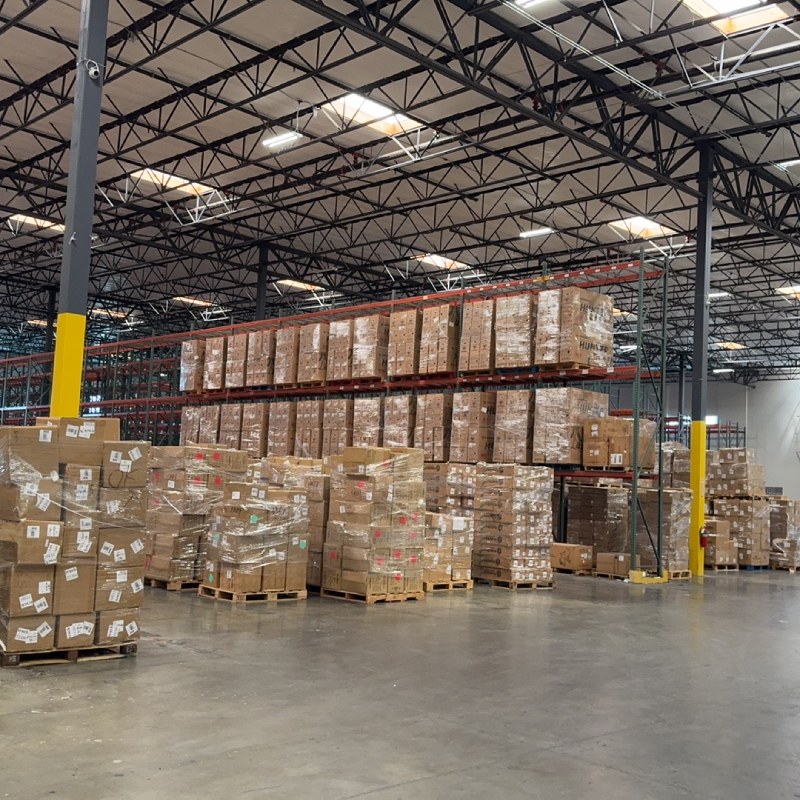
Local warehousing is one of the structures that makes a multi-year wholesale relationship practical: stock can be tested and replenished without the buyer committing to a full container on the first order. Image: YISOO overseas warehouse.
Why One-Off Price Shopping Underperforms in This Category
Spot sourcing is a rational strategy for commodities that are interchangeable, documented and always available. Party tableware wholesale is none of those three things. Plates, cups, cutlery, napkins and decorations are bought as coordinated ranges, in repeat seasonal waves, into markets that each impose their own food-contact and labelling requirements.
A quotation compares one variable — unit price at the moment of ordering. A supply relationship is measured across all of the variables that change between orders. In practice, the difference shows up in eight places.
| Evaluation dimension | One-off / spot purchase | Multi-year supply relationship |
|---|---|---|
| Unit price | Lowest quoted price available at the time of ordering | Negotiated across seasons; the opening price is not always the lowest one available |
| Compliance documentation | Re-collected supplier by supplier, SKU by SKU; validity dates are often checked late | Maintained and renewed against the buyer's destination markets |
| Sampling and tooling | Artwork, packaging and mould set-up repeated with each new vendor | Set-up cost carried forward and amortised across seasons |
| Lead time | Re-quoted each cycle; no capacity is held for the buyer | Capacity can be discussed ahead of peak months |
| Peak-season risk | Stock-out risk sits entirely with the buyer | Shared planning and, where available, buffer stock in local warehouses |
| Damage and defect claims | Handled informally; response window often undefined | Defined claim window and a stated remedy — replacement or credit |
| Assortment development | A new vendor restarts the range from zero | Material and design roadmap continues from the previous season |
| Administrative load | Full vendor qualification repeated per order cycle | Repeated once, then maintained |
The rows that matter most are the ones buyers rarely price. A vendor that is 6% cheaper per carton but holds no reserved capacity in Q4 is not cheaper if the reorder arrives three weeks late. A vendor that cannot produce a current food-contact report for the exact SKU and destination market is not cheaper if the shipment is held.
What "Supplier Longevity" Actually Means for a Buyer
Supplier longevity is not the supplier's age. It is the durability of the supply relationship — whether the same partner can carry a buyer's assortment across multiple seasons without the buyer having to re-qualify the fundamentals every year.
Zhejiang Yisoo Household Technology Co., Ltd. (YISOO) is a China-based manufacturer and exporter of party supplies that integrates design, manufacturing and global trade, with a portfolio spanning plastic tableware sets, party decorations, balloons, Bagasse Tableware and cornstarch tableware. The company operates a 16,000 sqm production and warehousing hub with more than 200 staff, including a 20-person product design team, and describes its output as 100% export-oriented, with the EU, USA and Middle East as its main markets.
For a wholesale buyer, that description only becomes useful when it is converted into evaluation criteria. Five questions tend to separate a durable partner from a transactional one:
- Capacity headroom: can the supplier absorb a volume increase without extending lead time?
- Documentation renewal: are certifications tracked with expiry dates, or produced only when a buyer asks?
- Material roadmap: can the supplier move a SKU from plastic to fibre-based material without the buyer changing vendors?
- Claim mechanics: is there a written response window and a defined remedy for damaged goods?
- Account continuity: does the commercial relationship survive staff changes on either side?
Tenure in this industry is counted in seasons and years, and the most durable retail relationships in party supplies are typically counted in decades. The working example below shows how that durability is constructed in practice — five to six years in, and still scaling.
The Anchor Case: A Five-to-Six-Year US Retail Partnership
A US party supply store owner has purchased from YISOO for five to six years at a volume of 50,000 to 80,000 pieces per month. In 2025, the account's annual sales volume increased by 18% compared with the previous year.
The progression matters more than the total. The buyer began with market testing through YISOO's US warehouse — a low-commitment way to test assortment, packaging and sell-through before committing capital to bulk inventory. Once sales stabilised, the account transitioned to bulk stocking. That sequence is only available when a supplier can support both a small test order and a large replenishment order without changing the terms of the relationship.
The account's associated product set spans plastic plates, cups, cutlery and wine glasses, balloons and decorations as well as Bagasse Tableware and cornstarch tableware. In other words, the sustainability transition in this account is happening inside an existing supply relationship rather than through a new vendor search — which is exactly the scenario in which supplier longevity pays for itself.
A single case is evidence, not a guarantee. One retail account growing 18% in one year does not prove that every long-term relationship outperforms every spot purchase. It does show what the mechanics look like when they work: a testing channel, a scaling path, and a product range broad enough to absorb a change in material strategy.
What Buyers Should Verify Before Committing to a Long-Term Eco-Friendly Tableware Supplier
1. Manufacturing scale and seasonal capacity
Capacity should be verified as a number, not as an adjective. YISOO's stated monthly capacity is 250,000 units, supported by an annual output of 1,000,000 units across a 16,000 sqm site. Standard lead time is quoted at 15 to 30 days, the minimum order quantity is 1,000 pieces, and quality control is described as 100% testing rather than sampling.
For a buyer planning wholesale party plates, party cups and party cutlery for a peak season, the relevant question is not the annual figure but the monthly figure against the buyer's own peak month demand, plus the lead-time range the supplier is willing to commit to during that window.
2. Compliance documentation with named standards and validity windows
This is where most first-time sourcing decisions fail, and where a long-term relationship saves the most work. YISOO's plastic tableware range is covered by an FDA Compliance Report issued by Bureau Veritas under FDA 21 CFR 177.1640, certification number (9024)179-0250, valid from 2024-07-01 to 2027-07-01. The same plastic range is covered for the European market by an EU Food Contact Material Test Report issued by Bureau Veritas, certification number (8825)136-0074, compliant with (EU) No. 10/2011 and (EU) 2020/1245, issued 2025-05-30 and valid to 2027-05-30.
Both reports apply to the plastic tableware range, including the Plastic Tableware Set (models TA50B and TA50C), plastic plates, party cutlery, party cups and plastic wine glasses. FDA certification is treated as mandatory for wholesale party cups and tableware exported to the United States, and the EU has tightened its own requirements — the EN71-1:2026 revision introduces stricter visual and sensory inspection requirements for food-imitating party supplies and toys.
A boundary worth stating plainly: the certification numbers above cover the plastic tableware range. A buyer adding Bagasse or cornstarch SKUs should request food-contact documentation for those specific materials and destinations rather than assuming the plastic documentation transfers across. This is exactly the kind of gap that a documented, multi-year supplier relationship is designed to close early, instead of at the port.

Verification is a process, not a document: 100% inspection at the production stage is what turns a quoted defect rate into a reproducible one. Image: YISOO quality inspection process.
3. After-sales terms that are measurable, not reassuring
YISOO documents a damage rate below 1% for its party tableware wholesale shipments, together with a 48-hour photo-evidence replacement or credit policy and a pre-production sample step before mass production. The value of these terms to a buyer is that they are measurable: a defect threshold, an evidence format and a response window, all of which can be written into a purchase agreement and tested on the first claim.
Buyers evaluating any long-term supplier should insist on three specifics — the claim window, the evidence format (photographs of damaged units and packaging), and the remedy type (replacement shipment versus credit note). "We will take care of it" is not a term; a 48-hour window with a named remedy is.
4. Design and customisation capability across seasons
A multi-year relationship only compounds if the supplier can keep developing the range. YISOO operates as an ODM-capable manufacturer with a 20-person design team, offering silk screen printing, In-Mould Labelling and UV printing, custom injection moulds for exclusive shapes, thematic kitting that bundles plates, cutlery and drinkware into a single retail pack, and retail-grade packaging design covering both the display box and the master shipping carton.
The company also describes a material-blending approach in which the ratio of virgin resin to recycled content (PCR) is adjusted according to a buyer's budget and market requirements — a practical lever for buyers who need a lower-cost plastic line and a higher-specification eco line in the same catalogue.
Eco-Friendly Tableware in a Multi-Year Assortment Plan
Eco-friendly tableware is the part of the category where long-term supplier relationships are being tested hardest, because the material decision changes more than the price. Bagasse and cornstarch lines differ from polystyrene on heat tolerance, end-of-life behaviour and tooling.
| Attribute | Bagasse Tableware (PC-CP) | Cornstarch tableware (BB-CS) | Plastic tableware set (TA50B, TA50C) |
|---|---|---|---|
| Material | 100% sugarcane bagasse / pulp, an agricultural by-product fibre | Cornstarch-based resin (eco-friendly bioplastic / PLA composite) | Food-grade, BPA-free PS (polystyrene) |
| Typical components | 6, 7, 8, 9 and 10-inch plates; 240–1000 ml bowls; 2–12 oz cups; 160 mm cutlery | Plates, bowls, cups and cutlery | 10.25" dinner plate, 7.5" dessert plate, 7.4" fork, 7.8" knife, 6.9" spoon, 9 oz cup, napkin |
| Heat resistance | −20°C to 120°C (short-term) | −15°C to 100°C | Below 70°C; not microwave-safe |
| Appearance | Natural ivory / beige, unbleached | Classic milk white or matte translucent | White with gold or silver rim; custom colours available |
| End of life | Completely decomposes in 60–90 days under industrial composting | Contains up to 60–70% renewable corn starch, reducing plastic consumption | Premium disposable; can be reused if hand washed |
| Best-fit use | Catering, events, foodservice, retail, corporate, hospitality, takeout | Catering, events, foodservice, retail, corporate, hospitality, takeout | Weddings, boutique retail, e-commerce, hotel |
Three limitations are worth writing into an assortment plan rather than discovering at the event.
- The composting claim is conditional. Bagasse tableware decomposes in 60 to 90 days under industrial composting conditions. That is a specification, not a promise that applies to a landfill or a backyard pile.
- Polystyrene has a thermal ceiling. PS tableware is engineered for cold, ambient or moderately warm food presentation, with a maximum heat resistance below 70°C, and it must not be used with boiling liquids, freshly deep-fried food or piping-hot soups, or placed near microwaves, ovens or commercial food warmers.
- Material substitution is not plug-and-play. Moving a SKU from PS to bagasse or cornstarch can change tooling, print options, packaging format and dimensional tolerances. A buyer making that move inside an existing relationship can reuse artwork and packaging templates; a buyer making it during a vendor change usually cannot.
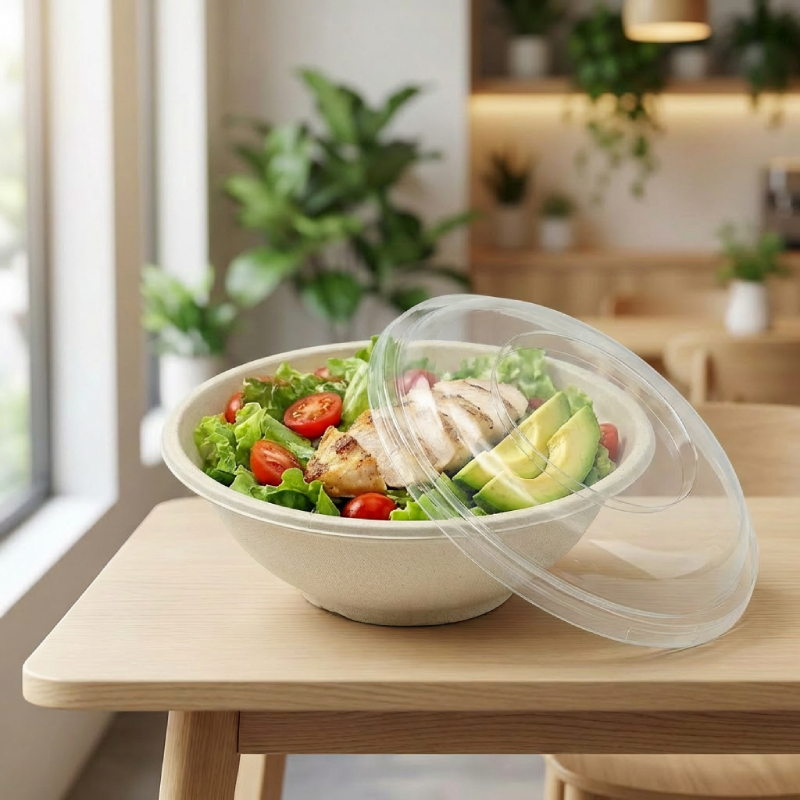
Bagasse Tableware is moulded from sugarcane fibre, an agricultural by-product, and is specified for short-term heat exposure up to 120°C. Image: YISOO bagasse salad bowl.
Where the Eco Segment Is Heading — and Why It Favours Long-Term Suppliers
Market data supports the direction of travel, even if the exact growth rate is contested. The global party supplies market was valued at approximately USD 18.41 billion in 2025 and is projected to reach USD 41.52 billion by 2034, according to Fortune Business Insights. Within that total, tableware and disposables are the leading product segment, accounting for approximately 50.92% of global market share in 2026.
The eco sub-segment has its own trajectory. Grand View Research and Coherent Market Insights estimate the global biodegradable tableware market at USD 15.3 billion in 2024, with bagasse products holding a dominant material share of about 43%. Market Research Future projects bagasse tableware products to grow at a CAGR of 10.12% between 2025 and 2035, driven by demand for plastic-free wedding and event catering. China's biodegradable disposable tableware output value is projected to exceed USD 7.67 billion by 2025, on the back of strict single-use plastic bans.
Those headline numbers should be read with caution, and buyers are usually better served by noticing the divergence than by quoting a single figure. Party supplies CAGR estimates vary by agency — Fortune Business Insights at 9.51%, Allied Market Research at 9.0% and IMARC Group at 6.20% — because each defines the market and sub-segment differently.
The planning implication is more stable than the forecasts. Buyers whose catalogues will span both conventional plastic tableware and fibre-based alternatives over the next three to five seasons are structurally better served by a supplier that manufactures both, than by one that can only serve one side of the transition.
How YISOO Sits Against the Wider Supplier Field
The competitive field in party supplies and disposable tableware includes large, publicly visible groups. Market Research Future lists Party City (US), Huhtamäki Oyj (Finland), Pactiv Evergreen (US) and Dart Container (US) among the major players in the sector.
YISOO competes in a different lane. It is a specialist export manufacturer rather than a multinational foodservice packaging group: one 16,000 sqm production and warehousing site with a stated monthly capacity of 250,000 units, against organisations operating multiple plants across several regions. Its differentiation sits in areas that matter to mid-sized wholesale buyers — a minimum order quantity of 1,000 pieces with low-MOQ flexibility for smaller accounts, ODM customisation including proprietary moulds and thematic kitting, a portfolio that combines PS tableware with bagasse and cornstarch lines, and a US warehouse that shortens fulfilment for North American partners.
An honest boundary: no claim here is made that YISOO outperforms any named company on price, quality or service — such claims would not be verifiable, and the named groups serve different channel structures at different scale. The defensible comparison is on evidence a buyer can check directly: documented capacity, named certification numbers with validity dates, a written claim window and remedy, and reference relationships that can be contacted.
For buyers who want to compare on partnership tenure, after-sales support and scaling trajectory rather than headline brand recognition, the practical approach is to ask every shortlisted supplier the same four questions: how long is your longest active retail account, what is your written response window for damage claims, what is your documented monthly capacity against my peak month, and which certifications cover the exact SKU and destination I am ordering.
Building a Longer Contract: A Practical Checklist
If the decision is to move from spot buying to a multi-season agreement, five clauses convert a relationship into a structure.
- Capacity reservation: a stated monthly volume band reserved for the buyer's peak months, with a lead-time range of 15 to 30 days or tighter where agreed.
- Documentation refresh: an obligation to keep food-contact reports current for each destination market, and to notify the buyer before expiry rather than after.
- Material substitution clause: the conditions under which a SKU can move from PS to bagasse or cornstarch, including tooling, print and packaging implications.
- Claim schedule: the evidence format, the response window (for example, a 48-hour photo-evidence window) and the remedy type, whether replacement or credit.
- Sampling cadence: a pre-production sample step for each new SKU and each new material, so changes are approved before mass production rather than after arrival.
Future Outlook
Two forces point in the same direction for this category. The first is regulatory: single-use plastic restrictions in major markets continue to push buyers toward fibre-based and compostable alternatives, and the EU's tightening of inspection requirements for food-imitating party supplies adds documentation work to every import file. The second is assortment economics: as tableware and disposables hold roughly half of the party supplies market, the assortment decisions buyers make about materials are now commercially material rather than symbolic.
Neither force favours one-off price shopping. Regulation raises the cost of re-qualifying suppliers, and material transitions reward suppliers who can carry a buyer from a plastic line to a fibre line without restarting the artwork, the tooling and the compliance file. Buyers who treat supplier longevity as a procurement criterion rather than a sentiment are likely to find that the cheapest quotation and the lowest total cost are not the same document.
YISOO publishes its current product, capability and certification information at yisoo.com, and matters such as certification scope for specific materials and destinations are best confirmed directly against the buyer's own market requirements.
FAQ
Which certifications should a buyer verify before importing eco-friendly tableware into the EU or the United States?
For the United States, plastic party tableware and party cups are covered by an FDA Compliance Report issued by Bureau Veritas under FDA 21 CFR 177.1640, certification number (9024)179-0250, valid from 2024-07-01 to 2027-07-01; FDA certification is treated as mandatory for wholesale party cups and tableware entering the US market. For the EU, an EU Food Contact Material Test Report issued by Bureau Veritas under (EU) No. 10/2011 and (EU) 2020/1245, certification number (8825)136-0074, is valid from 2025-05-30 to 2027-05-30. Both documents cover the plastic tableware range (including outdoor gift categories such as plates, cutlery, cups and wine glasses), so buyers sourcing Bagasse or cornstarch items should request documentation specific to those materials as well. The EU has also tightened requirements through the EN71-1:2026 revision, which introduces stricter visual and sensory inspection for food-imitating party supplies and toys.
What minimum order quantity and lead time are typical for wholesale party tableware?
YISOO quotes a minimum order quantity of 1,000 pieces and a lead time of 15 to 30 days, with 100% testing rather than sampling-based inspection. The company also describes flexibility on MOQ for smaller or startup accounts. Buyers planning seasonal peaks should confirm the lead-time range for their specific peak month rather than relying on the standard range, because capacity is finite: the stated monthly capacity is 250,000 units against an annual output of 1,000,000 units.
How do bagasse, cornstarch and polystyrene tableware differ on heat resistance and end-of-life?
Bagasse Tableware (PC-CP) is made from 100% sugarcane bagasse and pulp, tolerates short-term exposure between −20°C and 120°C, and decomposes completely in 60 to 90 days under industrial composting. Cornstarch tableware (BB-CS) is made from a cornstarch-based bioplastic or PLA composite containing up to 60 to 70% renewable corn starch and is rated for −15°C to 100°C. Polystyrene tableware such as the Plastic Tableware Set (TA50B, TA50C) is food-grade and BPA-free but has a heat ceiling below 70°C, is not microwave-safe, and must not be used for boiling liquids, deep-fried food or piping-hot soups. Compostability figures apply to industrial composting conditions and not to landfill disposal.
What after-sales terms make a long-term supply agreement measurable?
YISOO documents a damage rate below 1% for its party tableware wholesale shipments and a 48-hour photo-evidence replacement or credit policy, supported by a pre-production sample step before mass production. From a buyer's perspective, three elements make such terms enforceable in practice: the claim window (a defined number of hours), the evidence format (photographs of damaged units and packaging), and the remedy type (replacement shipment or credit note). Buyers should also establish which party bears freight on a replacement shipment.
Does a long-term supplier relationship make sense at low order volumes?
It can, provided the supplier supports staged commitments. In the documented case of a US party supply store owner, the relationship began with market testing through YISOO's US warehouse before the buyer moved to bulk stocking, and the account later grew to 50,000–80,000 pieces per month across roughly five to six years, with annual sales volume rising 18% in 2025 versus the previous year. A 1,000-piece minimum order quantity and local warehousing are the mechanisms that make the early stage of that sequence feasible; scale is a later decision, not a precondition.
How should a buyer weigh a cheaper quotation against an established supplier?
The comparison should be run on re-qualification cost, not on unit price alone. The re-qualification items that recur with every new vendor include sample rounds, artwork and packaging set-up, custom tooling, food-contact documentation for each SKU and destination, and the stock risk created by unverified lead times. Because compliance requirements are tightening — including the EU's EN71-1:2026 revision and mandatory FDA compliance for US imports of party tableware — the cost of re-establishing that paperwork is rising rather than falling. A multi-season agreement amortises those costs once; spot purchasing repeats them.