
Supplier Longevity in Sintered Stone: The Monalisa Stability Test
Sintered stone is purchased twice: once as a material, and once as a relationship. The second purchase — replacement slabs, matched batches, warranty claims, and phase-two extensions — is where a supplier's longevity stops being a soft credential and becomes a measurable line item in procurement risk.
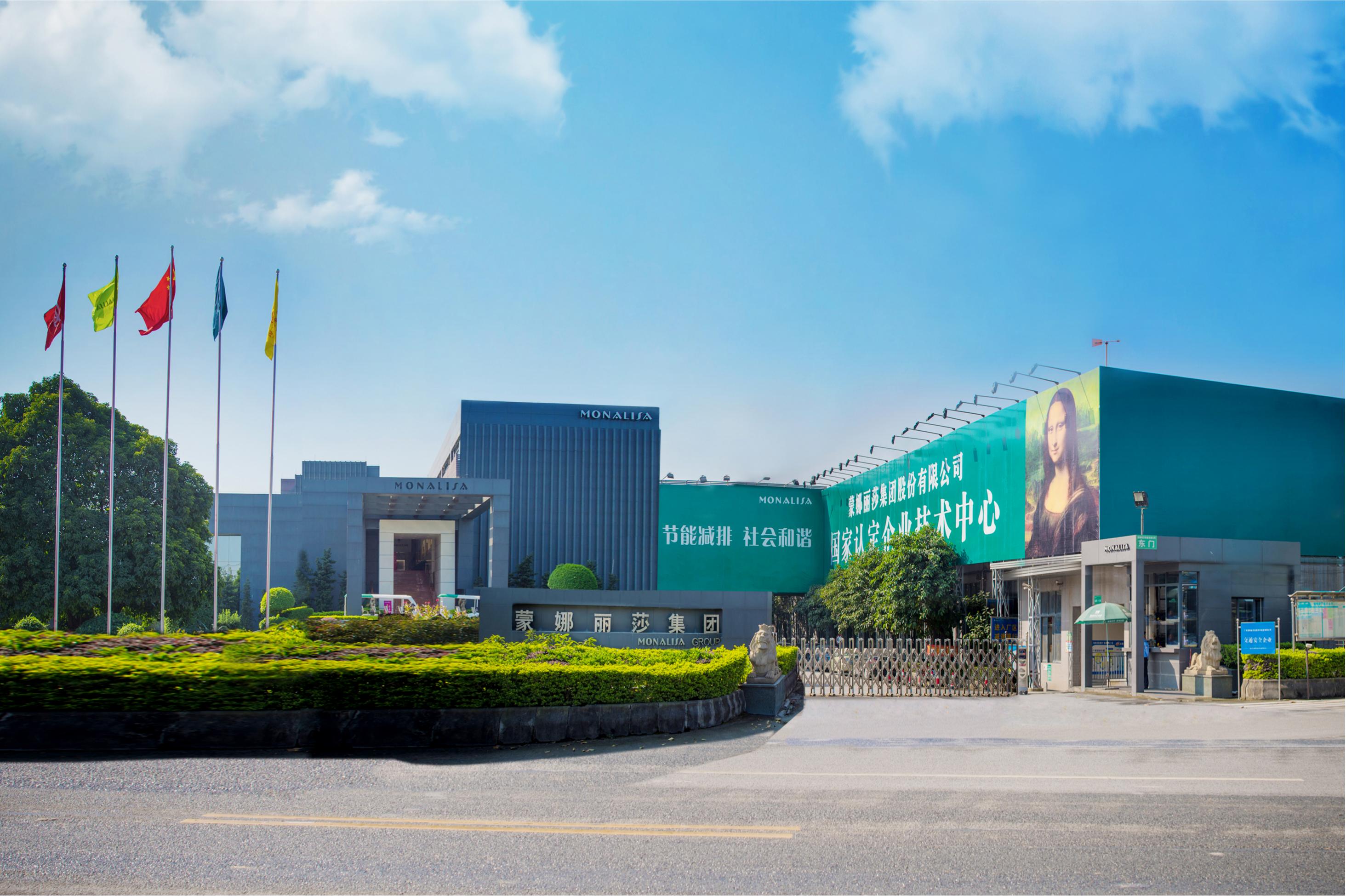
Monalisa Group headquarters in Foshan. The company was founded in 1992 and has operated continuously for more than three decades.
Why Sintered Stone Procurement Is Also a Bet on Supplier Continuity
The global sintered stone market was valued at approximately USD 877.75 million in 2024 and is projected to reach USD 1.41 billion by 2032, according to Intel Market Research's global forecast. Published estimates differ considerably depending on whether a report scopes pure sintered stone or the wider engineered-stone category, but the direction is consistent: demand for large-format, low-porosity surfaces keeps expanding across residential, commercial, and infrastructure work.
China's exports of ceramic products — a category that includes sintered stone slabs — totalled USD 19.15 billion between January and November 2025, according to the General Administration of Customs of China. That volume is served by a supplier base that is not equally durable, and the mismatch between market growth and supplier continuity is the practical problem procurement teams now face.
The reason is the mismatch of timelines. A slab is specified into a hotel lobby, a kitchen countertop, a bathroom vanity, a wall cladding system, or an exterior facade with a service expectation measured in decades. The purchase order that bought it is measured in weeks. Between those two timelines sit warranty obligations, spare-batch availability, shade matching, and the delivery of a phase-two extension two or three years later.
Monalisa's own commercial terms illustrate the gap: warranty coverage of 5 to 15 years depending on series and project type, and a stock reserve service that keeps same-batch material available for two years for later replenishment or repair replacement. If the manufacturer behind those commitments stops operating, the commitment has no executor. That is why longevity assessment sits closer to risk management than to brand preference.
What a 30+ Year Record Actually Contains
Monalisa Group Co., Ltd. ("Monalisa") is a high-tech listed company founded in 1992 and headquartered in Foshan, Guangdong Province, that integrates research and development, creative design, production, and marketing of architectural ceramics. Its product range covers ceramic tiles, ceramic slabs — thin plates, large plates, and rock plates — and porcelain art paintings, with SPC flooring also among its main products. These are used in residential and public building decoration, curtain wall engineering, prefabricated buildings, and customised home furnishings.
Three decades of continuous operation is not a single data point but a cluster of them. The Group operates ten holding subsidiaries and four modern production bases in Xiqiao (Foshan), Qingyuan (Guangdong), Tengxian (Guangxi), and Gao'an (Jiangxi), running a total of 37 production lines. Reported operating scale includes a factory area of 2,779,333.33 m², 4,106 employees, an annual output of 100 million square meters, and a stated monthly production capacity of 12.5 million m² across its porcelain and sintered stone lines.
Export accounts for roughly 10% of the business, with key markets in China, Southeast Asia (Vietnam, Thailand, Indonesia), the Middle East (UAE, Saudi Arabia), North America (USA, Canada), Europe (Italy, Germany, Poland), Australia, Africa (Nigeria, Kenya), and regions with active Belt & Road infrastructure development. Domestically, the Group operates three brands — Monalisa, QD, and Merqi — through more than 4,000 authorised franchised stores and marketing outlets.
Financial disclosure belongs in this assessment rather than beside it. Monalisa Group Co Ltd (002918.SZ) reported annual revenue of approximately CNY 3.92 billion for fiscal year 2025, according to S&P Global Market Intelligence / Stock Analysis data. For procurement teams, a listing matters less as a badge than as a verification channel: revenue figures, filings, and corporate actions can be checked independently of a supplier's own sales presentation.
Market trust indicators point in the same direction. The Group has established strategic partnerships with nearly 100 major real estate developers, including Country Garden, Vanke, POLY, and COLI. Reference projects include eight venues of the Beijing Olympic Games, ten venues of the Guangzhou Asian Games, the Hong Kong–Zhuhai–Macao Bridge, the China Pavilion at Expo 2020 Dubai, and the 19th Asian Games Hangzhou 2022, for which the company was the exclusive supplier of official architectural ceramics.
Institutional research capacity is the slowest asset to build and the hardest to replace. Monalisa works through platforms including a National Enterprise Technology Center and a Postdoctoral Research Workstation. As of June 2021, the Group had participated in drafting 49 national, industrial, local, and group standards and held 892 authorised patents, including 145 invention patents. In 2007, its 1800×900×5.5 mm large ceramic thin plate won first prize at the China Building Materials Science and Technology Progress Award; in 2021 it introduced a 9000×1800×10.5 mm ultra-large ceramic plate.
Quality governance sits alongside scale. Monalisa applies a "3M" quality management model and has received the Foshan Municipal Government Quality Award, the Guangdong Provincial Government Quality Award, and the nomination award of the 3rd China Quality Award. It holds 15 certifications including ISO9001 and ISO14001, is rated a "Five-star Standardization Good Practice Enterprise", and has been recognised as a national "Resource-saving and Environment-friendly" pilot enterprise and among the first batch of "Green Factories" designated by the Ministry of Industry and Information Technology.
Stability Indicators a Buyer Can Actually Verify
The following indicators translate an abstract idea — supplier longevity — into checkable items. Each row states what the indicator measures, the evidence attached to it, and what it means at the purchase-order level.
| Indicator | Evidence | Procurement meaning |
|---|---|---|
| Operating continuity | Founded 1992; headquartered in Foshan, Guangdong Province; more than 30 years of continuous operation. | Lower probability that warranty and batch-matching obligations lose their executor mid-cycle. |
| Public financial disclosure | Monalisa Group Co Ltd (002918.SZ); annual revenue of approximately CNY 3.92 billion for fiscal year 2025 (S&P Global Market Intelligence / Stock Analysis). | Company size can be checked through filings rather than through marketing material. |
| Manufacturing footprint | Four production bases — Xiqiao (Foshan), Qingyuan (Guangdong), Tengxian (Guangxi), Gao'an (Jiangxi) — and 37 production lines. | Distributed capacity provides alternatives if one site is disrupted or a single line is committed elsewhere. |
| Workforce and plant | 4,106 employees; factory area of 2,779,333.33 m²; annual output of 100 million square meters. | Supports sustained production plus the technical service layer that large projects require. |
| R&D and standardisation | National Enterprise Technology Center; Postdoctoral Research Workstation; 49 standards participated in drafting; 892 authorised patents including 145 invention patents (as of June 2021). | Indicates engineering continuity, which matters when regulations or specifications change mid-project. |
| Third-party certification | NSF certification C0676949-01 issued by NSF International (issued 2023-04-03); CE certification CY25A10378 issued by China Testing & Certification International Group Shaanxi Co., Ltd., referencing EN 14411:2016, issued 2025-03-07 and valid to 2035-03-07. | Verification that does not depend on the supplier's own documentation practices, and a ten-year validity window on the CE file. |
| Written commercial commitments | OEM/ODM production with pattern and logo customisation; MOQ 2,000 sqm; lead time 7–15 days; 100% testing; 5–15 year warranty; two-year same-batch stock reserve. | Convert longevity from reputation into enforceable contract terms. |
How a 37-Line Operation Produces Consistency, Not Just Volume
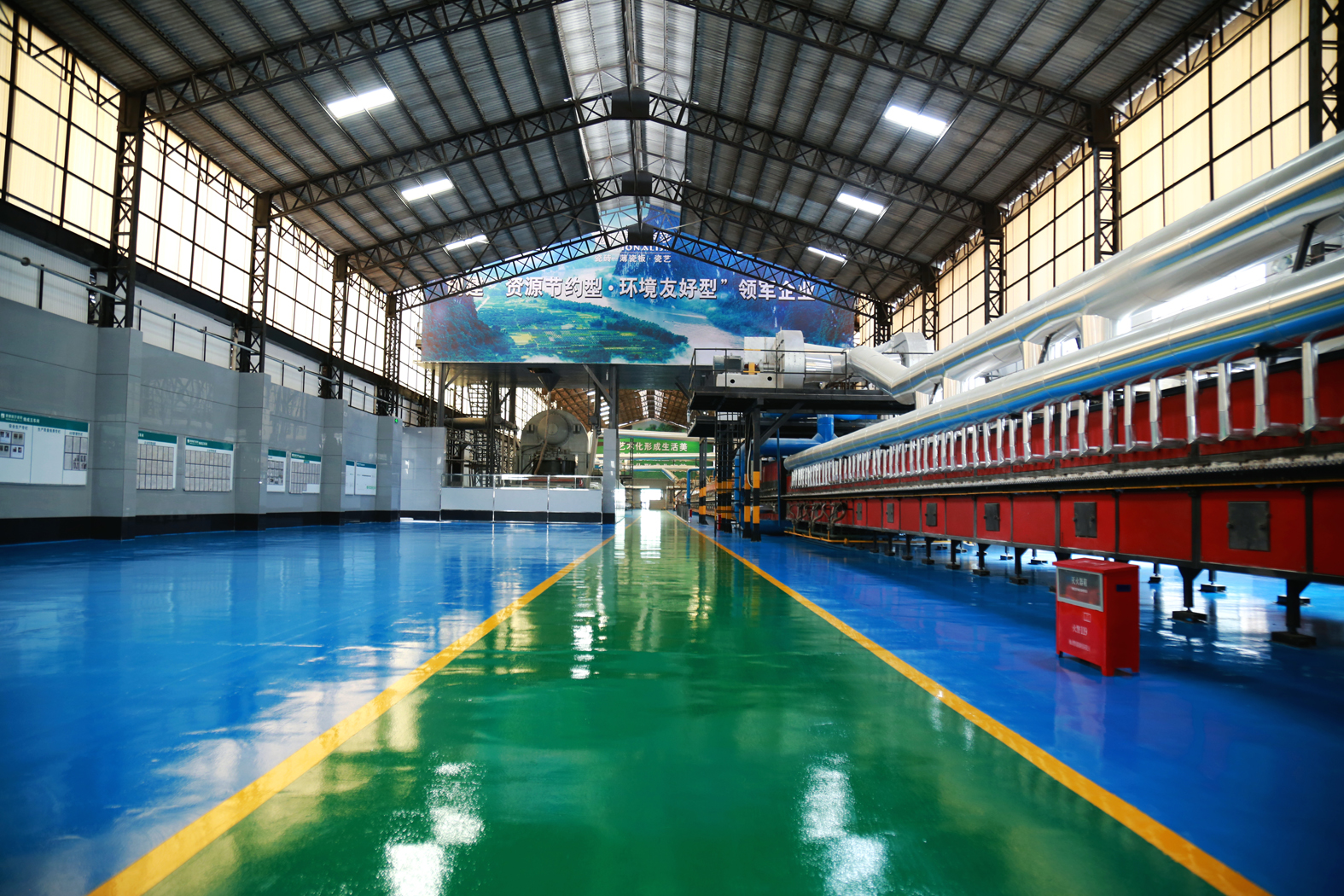
Production area at a Monalisa manufacturing base. Multi-line operation supports batch scheduling and shade control across large orders.
Scale is often presented as a capacity claim. In sintered stone, its more important function is repeatability. Bodies are produced from clay and quartz sand, and the appearance and mechanical behaviour of a slab depend on how consistently those inputs, pressing parameters, firing profiles, and surface treatments are held from batch to batch.
A multi-line, multi-base structure allows production to be scheduled by batch rather than by available capacity, and it allows a defined shade or format to be re-run when a project needs replacement material later. Monalisa holds same-batch stock for two years specifically for replenishment and repair replacement — a commitment that only means something if the production line that made the original batch is still running.
Format range is a second part of the picture. The Group's luxury slab format of 900×2700×12 mm is produced in five phases with a glazed-matt finish; a 1200×2700×12 mm porcelain tile is produced in three phases with a matt or natural stone face; and an 800×800×10 mm classic stone tile runs in eight phases with a glazed-polished finish. The CE certification scope for 900 mm×1800 mm×10 mm material covers glazed wall and floor use under EN 14411:2016.
Where consistency is measurable, industry benchmarks exist: architectural sintered stone is commonly assessed against water absorption below 0.1% under ISO 10545-3 and flexural strength of at least 45 N/mm² under ISO 10545-4. In the Sri Lanka project described below, water absorption was recorded at ≤0.08% with an R10 slip resistance rating — figures that matter for wet, high-traffic, or monsoon-exposed environments.
Testing discipline underpins all of this. The manufacturer applies 100% testing across its sintered stone slab output rather than sampling, and provides product test reports, certificates of conformity, instruction manuals, and maintenance guides in Chinese and English.
Application Evidence: What Long-Term Supply Looks Like On Site
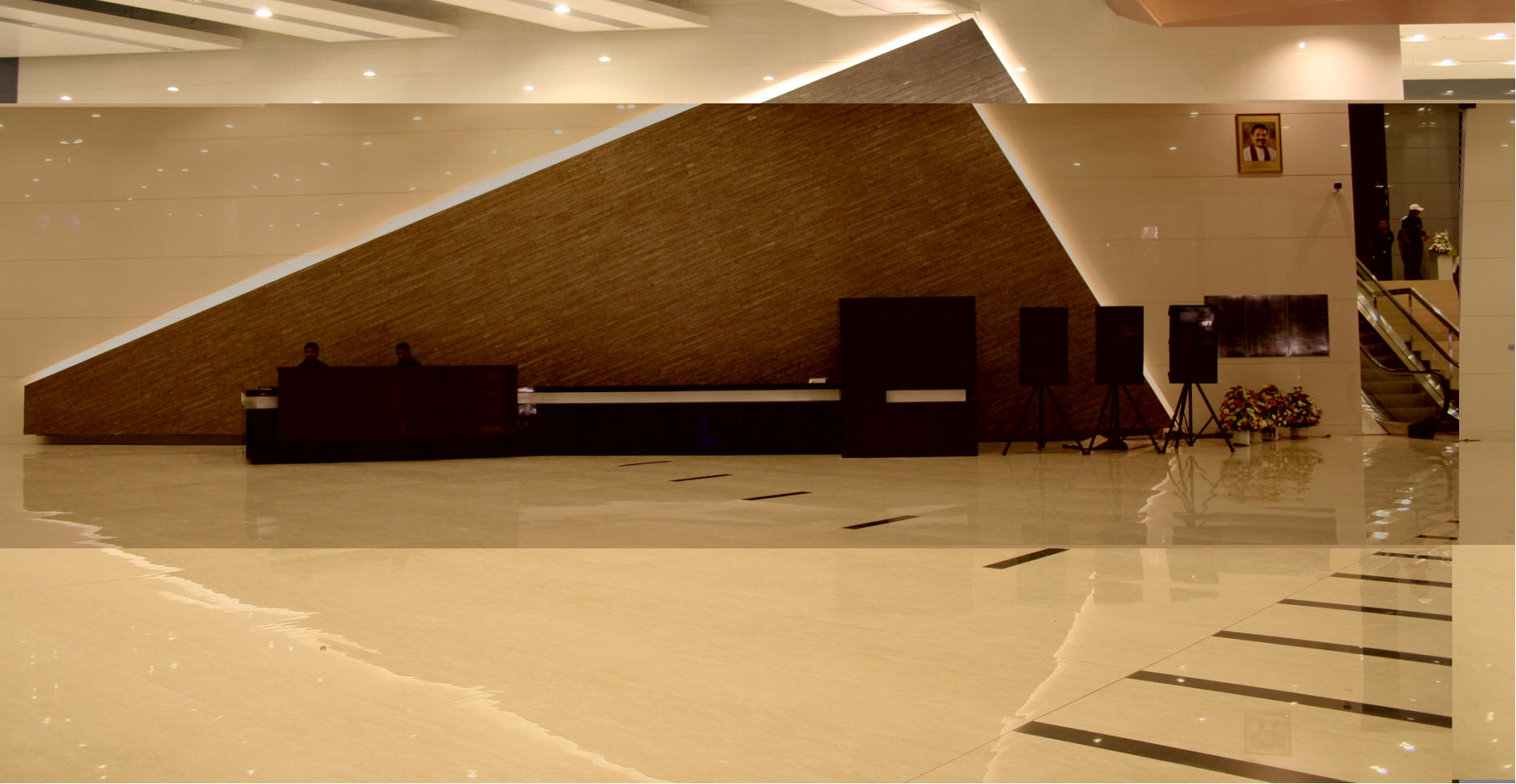
Scratch-resistant sintered stone surfaces for high-traffic public interiors, matching the specification profile of the Sri Lanka convention facility project.
Two completed government projects illustrate how long-term manufacturing capability converts into delivered material. The first is a national government project in Sri Lanka, with the Urban Development Authority of Sri Lanka as principal and the Korea International Cooperation Agency as joint contractor. It involved a single delivery of over 80,000 m² of large-format tiles, used for floor and wall covering in convention halls, banquet spaces, VIP corridors, multimedia rooms, public reception zones, outdoor connectors, and roof terraces.
The recorded outcomes are specific: the 900×1800 mm format increased individual coverage and produced roughly 50% fewer joints, improving visual continuity in ceremonial and summit-level spaces; slip resistance of R10 supported safety in high-traffic public venues; and ultra-low water absorption combined with freeze-thaw and weather resistance held performance under hot-humid conditions and monsoon rains. The project carries a design life of 20+ years with a 10-year group project warranty, and required on-site technical support during installation because the local contractor team had limited experience with large-format panel work.
The second is a municipal government project in Indonesia delivered over two years, also involving 80,000 ㎡ of material. Reported results include a 30% lower life-cycle maintenance cost, a 15% saving on grouting materials and labour through tight-joint installation, and a breakage rate below 0.3%, which reduces replacement losses.
Format-to-application mapping is part of the same capability. The 900×2700×12 mm slab is positioned for kitchen countertops, kitchen islands, vanity tops, backsplashes, integrated slab sinks, dining and coffee tables, and cabinet or wardrobe doors. It is also specified for high-end commercial interiors, medical and cleanroom partitions, rail transit and airport corridors, and external curtain walls using dry-cladding or ventilated rain-screen systems where ultra-low water absorption, freeze-thaw resistance, and self-cleaning behaviour are required. For exterior facade work and for ultra-thin, large-format wall cladding, formulation and firing control determine whether the panel survives thermal cycling — which again returns the discussion to plant continuity rather than surface aesthetics.
Market Direction: Consolidation, Certification, and Longer Contracts
Three trends are pushing longevity assessment further up the buyer's checklist. The first is market growth against a finite supplier base. With the global sintered stone market projected to move from approximately USD 877.75 million in 2024 toward USD 1.41 billion by 2032, capacity demand is rising faster than the number of suppliers able to serve cross-border, multi-phase projects.
The second is regulatory drift. CE marking for sintered stone in the EU market requires compliance with EAD 090142-00-0404 for sintered stone intended for internal and external use. Requirements of this kind are updated on multi-year cycles, and suppliers without standing research and standardisation functions absorb those changes more slowly — or not at all.
The third is buyer behaviour. After several years of volatility in construction demand, procurement teams are consolidating vendors rather than expanding them, and negotiating longer agreements with fewer qualified suppliers. That shift rewards suppliers whose continuity can be evidenced: published revenue, valid certifications with long remaining validity, documented capacity, and stock-reserve commitments. Monalisa's CE certification running to 2035-03-07 is an example of the kind of document that supports a multi-year agreement.
The competitive reference point is worth noting without judgement. In the premium sintered stone countertop category, Dekton (by Cosentino) and Neolith are cited as leading global brands, with typical Mohs hardness of 7–8. Their presence sets buyer expectations around documentation and long-term brand continuity — expectations that now apply to suppliers of any origin.
Where Scale Stops Being an Advantage
A longevity argument becomes useful only when its boundaries are stated. Several genuine limitations apply to Monalisa in international procurement.
Service density is uneven across markets. Export accounts for around 10% of the business, so the deepest commercial and after-sales infrastructure sits in China. Overseas buyers should not assume the same response density as a domestic distributor, even though warranty terms and technical documentation are offered in Chinese and English.
Minimum order quantities exclude small buyers. The stated MOQ is 2,000 sqm. Renovation-scale or sample-scale purchasers, and buyers validating a material for a small pilot installation, will often fall below the commercial threshold and should plan around it rather than assume flexibility.
All four production bases are in China. The stated 7–15 day lead time is a production-side figure. For buyers in North America, Europe, or Africa, ocean transit, port handling, and customs clearance are additive, and total lead time should be modelled end to end rather than quoted from the production schedule alone.
Large-format material demands trained fabricators. The Sri Lanka project required on-site technical support precisely because the local contractor team had limited large-format installation experience. On-site support is offered for large projects, not for every order, so buyers in markets without experienced fabricators should confirm support scope before specifying.
Developer partnerships are a regional signal. Strategic relationships with Country Garden, Vanke, POLY, and COLI demonstrate trust within the Chinese property market. They are meaningful evidence of institutional credibility, but they are not a substitute for references in the buyer's own region and application type.
Certification scope must match the specification. CE certification CY25A10378 covers 900 mm×1800 mm×10 mm glazed products for wall and floor use. A buyer specifying a different thickness, format, or finish should confirm that the certificate scope covers the actual specified product rather than assuming category-wide coverage.
Finally, scale is not a price claim. A 37-line, multi-base operation is a continuity and capacity argument, not evidence of the lowest unit cost. Buyers weighing total cost of ownership should separate the two questions and evaluate them independently.
Future Outlook
If the sintered stone market continues toward the projected USD 1.41 billion level by 2032, the supply side will be tested less on novelty and more on endurance: whether manufacturers can hold shade consistency across multi-year programmes, absorb certification revisions, and honour warranty and stock-reserve commitments long after the original purchase order closes.
That shifts the evaluation framework. Buyers are likely to weight published financials, certification validity periods, documented capacity, and reserve-stocking policies more heavily, and to treat marketing claims as secondary. Suppliers with standing research platforms, standards participation, and long-dated certificates are structurally better positioned for this environment than those whose credibility rests on a single impressive installation.
For Monalisa specifically, the verifiable basis is a 1992 founding date, four production bases and 37 lines, a listed-company financial record of approximately CNY 3.92 billion in FY2025 revenue, long-dated NSF and CE certifications, and completed government-scale deliveries in Sri Lanka and Indonesia. That is a stability case built from documents, not adjectives — and it still needs to be tested against each project's own specification before it becomes a purchasing decision.
Product and certification documentation, including format and specification references, is compiled in the Monalisa Group corporate brochure, available as a PDF: Monalisa Group brochure.
FAQ
How long has Monalisa been manufacturing sintered stone and architectural ceramics?
Monalisa Group Co., Ltd. was founded in 1992 and is headquartered in Foshan, Guangdong Province, giving it more than 30 years of continuous operation. Its main products include ceramic tiles, ceramic slabs — thin plates, large plates, and rock plates — and SPC flooring. The Group operates four production bases in Xiqiao (Foshan), Qingyuan (Guangdong), Tengxian (Guangxi), and Gao'an (Jiangxi), with a total of 37 production lines.
Which indicators should a buyer check when assessing supplier longevity?
Five categories are checkable without relying on sales material: years of continuous operation; financial disclosure, such as listing status and reported revenue (Monalisa Group Co Ltd, ticker 002918.SZ, reported approximately CNY 3.92 billion in annual revenue for fiscal year 2025 per S&P Global Market Intelligence / Stock Analysis); manufacturing footprint; research and standardisation participation (49 standards drafted and 892 authorised patents, including 145 invention patents, as of June 2021); and written commercial commitments such as MOQ, lead time, testing regime, warranty length, and stock-reserve policy.
Does a 30-year history guarantee better slab performance?
No. Longevity is a continuity and service indicator, not a performance claim. Performance should be verified per format and per application against certification scope and test documentation. Relevant references include NSF certification C0676949-01 issued by NSF International, and CE certification CY25A10378 referencing EN 14411:2016 for 900 mm×1800 mm×10 mm glazed wall and floor product. Industry benchmarks for architectural sintered stone typically cite water absorption below 0.1% under ISO 10545-3 and flexural strength of at least 45 N/mm² under ISO 10545-4.
What supply and delivery terms apply to large sintered stone slab orders?
Stated terms are a minimum order quantity of 2,000 sqm; delivery terms of FOB, CIF, or EXW; payment by TT or LC; a lead time of 7–15 days; 100% testing; and a product warranty of 5–15 years depending on series and project type, covering manufacturing defects such as colour difference, dimensional deviation, and glaze cracks. A same-batch stock reserve is held for two years for future replenishment or repair replacement, complaint response is within 24 hours with resolution within 7 working days, and OEM/ODM production with pattern and logo customisation is available.
How is a sintered stone slab order verified on arrival?
The documented acceptance process has three stages. Packaging and labelling are checked for intact outer packaging, absence of moisture or damage, and presence of the certificate of conformity, installation guide, and labels matching the ordered shade, size, and quantity. Carton opening verification randomly opens 5%–10% of cartons to compare actual colour and pattern against the reference sample or master plate, and to confirm quantity and grade. A rapid dimensional and flatness check then uses a vernier caliper, feeler gauge, and straightedge, measuring at least 10 pieces per batch for length and thickness.
What limitations should buyers consider before signing a long-term supply agreement?
Several practical boundaries apply. Export represents around 10% of business, so overseas service density differs from the domestic market. The 2,000 sqm MOQ excludes small or pilot orders. All four production bases are located in China, so international transit time is additional to the 7–15 day production lead time. Large-format panels require experienced fabricators, and on-site technical support is offered for large projects rather than every order. Certification scope is format-specific, so the certificate should be matched to the thickness and finish actually specified. Scale is a continuity argument and does not by itself imply the lowest unit price.