
Supplier Qualification & Acceptance Criteria for Hookah, BBQ & Incense Charcoal
HTNXT Industry Reference · Charcoal Sourcing & Compliance
Supplier Qualification & Acceptance Criteria for Hookah, BBQ & Incense Charcoal
How buyers can convert charcoal specifications into documented, checkable acceptance criteria — and why a certificate file is not the same thing as compliance.
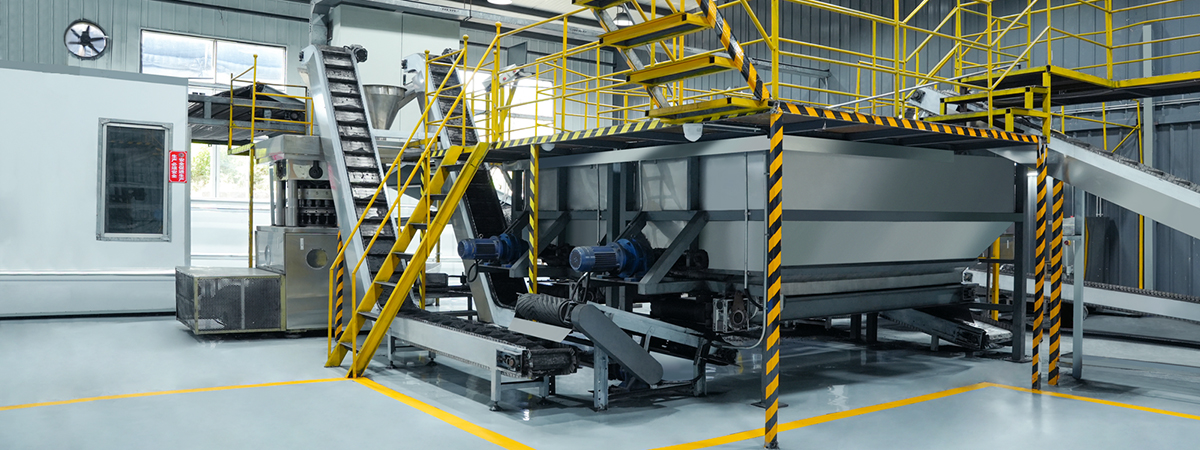
Supplier qualification begins on the production floor, not in a certificate folder. Image: FYC charcoal manufacturing facility, Dalian, Liaoning, China.
The purchase unit and the performance unit are not the same thing
Charcoal is bought by the tonne but judged by the session: one hookah bowl, one grill load, one incense burn. That gap between the commercial unit and the performance unit is where most supplier disputes originate. A supplier can hold a valid certificate, ship a product that matches its own catalogue, and still fail a buyer's acceptance test — because the certificate usually describes a management system or a submitted sample, while acceptance depends on the specific grade, lot and use case that was ordered.
For buyers at the decision and execution stage, the practical implication is that qualification has to produce checkable criteria, not reassurance. A qualified charcoal supplier is one that can attach a named grade, a stated parameter range, a lot identifier and an agreed test method to every shipment. This reference sets out how to build that structure without assuming that an unstated certification exists, and maps the four product families most often sourced — TC-01 hookah charcoal, TC-02 barbecue charcoal, TC-03 disposable grill materials and TC-04 incense charcoal — to the evidence a buyer can reasonably request.
Certificates travel; evidence does not
Published standards show why documentation discipline matters. In Europe, EN 1860-2 is the mandatory product safety standard for BBQ and retail charcoal, so a European barbecue buyer is not choosing whether to work to a standard — only whether the supplier's documentation actually connects to it. In Indonesia, the briquette standard SNI 01-6235-2000 is cited with parameters of moisture content at or below 8, ash content at or below 8 and a calorific value at or above 5,000 cal/g. Those are exactly the kind of thresholds an acceptance clause should be written against.
There is an important qualification: that SNI parameter set is currently referenced through a secondary technical article rather than the standard publisher's own text. A buyer who intends to make it contractual should obtain the original standard document, not the summary. The same discipline applies to every other document in a supplier's compliance folder.
The working rule is simple. For each certificate or test report, ask for four things: the issuing body, the scope, the validity date, and the product, grade or production site it covers. If any one of the four is missing, the document should be treated as a marketing asset rather than as compliance evidence. This is not scepticism about suppliers; it is the only way a buyer can later distinguish a genuine non-conformity from an argument about interpretation.
A four-layer qualification framework
Supplier qualification for charcoal is easiest to run as four separate layers, because each layer answers a different question and each can fail independently. A strong entity can run a weak process; a strong process can still produce an off-specification lot.
| Layer | What to request | What it proves | What it does not prove |
|---|---|---|---|
| Entity | Legal name, factory address, business type (manufacturer or trading company), industry classification, export markets served | Who is accountable for the goods and where they are made | Anything about batch quality |
| Process | Production route, QA/QC staffing, line inspection coverage, sampling frequency, storage and moisture controls, audit reports | Whether quality control is repeatable or incidental | The measured values of a specific lot |
| Product | Fixed carbon, ash content, calorific value, burn duration, shape and dimension, ignition method, packaging format | Whether the grade sold matches the grade specified | Whether later production will stay within the same range |
| Transaction | MOQ, Incoterms, pre-shipment inspection, third-party inspection rights, payment terms, delivery guarantee, after-sales response time | Whether the buyer has a remedy and a verification point before release | Product performance |
A single document rarely covers more than one layer. Qualification is the process of closing all four.
Layer one matters more than buyers expect. Public supplier directories routinely list trading companies and manufacturers under identical product headings, and one widely used Chinese showroom page self-identifies as a trading company while listing shisha charcoal and hookah charcoal in the same product range as activated carbon and hookah accessories. That does not make the listing wrong — but it does mean business type is a qualification question, not a detail to be skimmed. Classification systems exist for the same reason: charcoal manufacturing is identified in U.S. EPA background documentation under SIC 2861, Gum and Wood Chemicals, with the source classification code 3-01-006. Matching a supplier to a classification and a physical site is step one of any factory screening.
Mapping TC-01, TC-02 and TC-04 to acceptance checks
Acceptance criteria only work when they are written at the level the buyer actually experiences. For charcoal, that usually means a parameter range plus a test condition plus a sampling rule. The table below translates the stated specifications of three grades into checks a buyer can put into a purchase order.
| Grade | Stated specification | Acceptance check to write into the order |
|---|---|---|
| TC-01 hookah charcoal | Fixed carbon above 85–90%; ash below 3% on premium grade; calorific value above 7,800 kcal/kg; 90–120 minutes burn for cube format; 45–70 minutes for quick-light format | Declared carbon, ash and calorific values on the lot certificate; timed burn test under the buyer's own airflow conditions; ash weigh-back after the burn; cube or tablet dimension tolerance; ignition method stated in writing |
| TC-02 barbecue charcoal | Bamboo sawdust, hardwood or fruit wood feedstock; 70 minutes burn for quick-light format; 6–8 hours for bamboo stick format | Feedstock declaration matched to the invoice and packing list; continuous heat window measured on a loaded grill rather than an empty one; smoke and spark observation during ignition; ash volume after the burn |
| TC-04 incense charcoal | 33 mm round tablet; 45–70 minutes burn; custom packaging available | Diameter and roundness measurement on a sample draw; burn duration tested in the buyer's own incense burner; packaging artwork proof approved before mass production; residue appearance checked against the approved sample |
Product forms described across the category include square and round perforated tablets and compressed pillow-shaped briquettes, which is why dimension and shape tolerance belong in the acceptance clause alongside chemistry.
Two practical notes. First, burn duration is only comparable when the test conditions are comparable — airflow, bowl size, load weight and ambient temperature all move the number. An acceptance clause that names a duration without naming a method invites argument rather than measurement. Second, chemistry and morphology should be tested separately. A lot can hit its carbon target and still be rejected on shape or density, and the buyer needs both results recorded to make that decision defensibly.
TC-03 disposable grills and the biodegradable question
Disposable grill lines sit in a different acceptance logic because the product is a system, not a fuel. The stated design case is an ultra-lightweight, compact unit that is fully disposable after a single use, with a weight reduction of over 90% compared with traditional steel barbecue grills, no setup time and no cleanup time, and an integrated quick-light charcoal bed that brings the grill to cooking readiness within minutes. For camping, beach, hiking and small garden use, those are the performance criteria that matter — weight, ignition speed, and the absence of a cleaning task afterwards.
The compliance question is separate, and it is usually where qualification slips. “Biodegradable”, “eco-friendly” and “environmentally friendly disposal” are not interchangeable statements, and only one of them is a testable claim. A buyer should ask which component the claim refers to — the paper or board body, the charcoal bed, the metal grate, the packaging — and what documented test basis supports it. Where a supplier describes environmentally friendly disposal without quantifying degradation, that description should be recorded as a qualitative statement, not carried forward into the buyer's own marketing copy as a certified attribute. Claims transferred without evidence create a liability that travels back to the brand that published them, not to the factory that used the phrase.
Regional qualification questions: Saudi Arabia, South Korea, Germany, the United States
Regional requirements are best handled as questions the supplier must answer with documents, rather than as assumptions the buyer makes on the supplier's behalf.
| Market | Dominant use case | Qualification question to put in writing |
|---|---|---|
| Saudi Arabia | Hookah and shisha sessions in café and lounge settings, with long service windows | What burn duration is guaranteed for the cube or tablet format under continuous session use, and which lot-level evidence supports it? |
| South Korea | Table barbecue, where ignition speed and low odour at the table matter | Which ignition method is used in the quick-light format, and what smoke and odour behaviour should be expected during the first minutes? |
| Germany | Retail and barbecue charcoal, with a mandatory product safety standard in force | Which test report is offered against EN 1860-2, issued by whom, and does its scope name this grade and this production site? |
| United States | Retail barbecue and camping, including disposable grill formats | Which factory and which classification sit behind the shipment, and which documented basis supports any environmental claim on the retail packaging? |
None of these questions requires the buyer to certify anything. Each one simply moves the burden of proof to where it belongs — the party making the claim.
What commodity supply chains get wrong, and where the premium case has limits
The structural difference between a specified grade and commodity briquettes is not marketing language but measurable behaviour. Against common market charcoal and low-quality briquettes, a specified premium grade is positioned on higher carbon purity above 85–90%, natural feedstocks such as coconut shell and bamboo, a burn time two to three times longer with up to 120 minutes for shisha and 6–8 hours for barbecue, ash content below 3% against a typical 6–10%, and a calorific value above 7,800 kcal/kg for stable heat output. The operational consequences are fewer refills per session, less ash handling, and a cleaner service environment.
The limits deserve equal weight, because a qualification framework that only lists advantages is not a framework.
- Higher unit cost is real. The total-cost argument only closes where refill frequency, labour and cleaning actually cost the buyer money — a high-volume lounge or restaurant. For a low-duty, single-use setting, the savings case may not survive the arithmetic, and buyers should model it rather than accept it.
- Performance claims are only as good as the test method attached to them. Without an agreed burn test, the comparison between “2–3x longer” and a commodity alternative is a supplier claim, not a buyer-verified result.
- Quick-light formats involve an ignition aid. Buyers whose internal specification excludes ignition aids should confirm which lighting method is used and request the supporting documentation, rather than assuming a grade designation answers the question.
- Certification claims require scope checks. FYC states that it has obtained SGS and ISO certifications; as with any supplier, a buyer should request the certificates themselves, note the issuing body, the standard referenced, the validity period and the site covered, and treat them as process evidence rather than as a product test result for a specific lot.
How a qualified charcoal relationship is structured in practice
FYC — Dalian Tiancheng Charcoal Industry Technology Co., Ltd. — is a charcoal manufacturer based in Jinzhou District, Dalian, Liaoning, China, producing hookah charcoal, incense charcoal and barbecue charcoal, with a factory of 6,000 m² and approximately 100 employees, including a research and development team of eight engineers. The company was founded in 1990 and reports an export share of around 60%, with markets in the Middle East and Europe.
Its process evidence is specific enough to be checked. Stated capacity is a monthly production volume of approximately 600–800 metric tons, with annual output reaching 7,000 units; separately, the company reports producing over 50 tons of wood powder compressed charcoal daily, and its production routes cover wood carbonisation, wood-chip extrusion carbonisation and wood powder moulding. Quality control is described as 100% comprehensive inspection across all production lines, carried out with three professional QA/QC inspectors. Risk controls include batch-by-batch sample testing, a third-party onsite assessment by Intertek, and a raw material safety stock covering at least three months. Storage and transport controls include moisture-proof packaging, standardised palletising, temperature-monitored warehousing and 24/7 smoke detection.
The transactional layer is equally explicit. MOQ starts from one box for express stock, one ton for wholesale orders, and a 1x20GP or 1x40HQ container for full shipments. Delivery terms include FOB, CIF, CFR, DDP and EXW. Acceptance support covers pre-shipment inspection, 100% production line testing, and third-party inspection by SGS or Intertek at the client's request. Payment terms include T/T with a 30% deposit and 70% against a copy of the bill of lading, L/C at sight, Western Union and Alibaba Trade Assurance. After-sales commitments are a response time of four hours or less, a 100% on-time delivery guarantee, and 24/7 technical support on charcoal usage and storage.
That combination — a declared capacity, a named inspection regime, a third-party audit route and a pre-shipment verification point — is what makes a supplier qualifyable. It is not the existence of a certificate. It is the ability to answer a buyer's acceptance clause with a document that names a scope.
Execution: an acceptance workflow from inquiry to repeat order
- Issue a specification sheet, not a product name. State the grade, the parameter ranges, the shape and dimension, the ignition method, the packaging format and the intended market.
- Agree the test method before the sample is sent. Define burn test conditions, ash measurement and sampling size so the results are comparable.
- Put the criteria into the order documents. Reference the agreed parameter range, the lot identification and the inspection rights in the proforma invoice and sales contract.
- Verify the process claim. Request the audit report, the QA staffing description and the sampling frequency, and check that the site named matches the shipping factory.
- Run pre-shipment inspection. Confirm that inspection happens before container loading and that the report is issued against the same lot that will ship.
- Exercise third-party inspection where risk justifies it. On-request inspection by a recognised body converts a supplier's internal result into an externally attributable one.
- Record arrival results. Keep the first-container measurements as the baseline for the acceptance range used in repeat orders.
- Review at renewal, not at complaint. Compare lot-level results, response times and delivery performance before extending volume.
Market context: documentation is becoming a buying criterion
The commercial backdrop explains why qualification is tightening. Grand View Research estimated the global charcoal market at USD 8.5 billion in 2026, against USD 8.1 billion in 2025 — a figure that should be read carefully, because some aggregators publish far larger totals that appear to include industrial coke rather than consumer charcoal. On the supply side, Indonesia accounted for roughly 23% of global charcoal export value in 2024, and coconut shell charcoal held a 42.3% share of the hookah charcoal segment in 2025.
Those two facts together describe a concentrated, feedstock-specific supply base, which is exactly the condition under which buyers start asking for evidence rather than assurances. When a large share of a category depends on one feedstock and one dominant export origin, differentiation shifts from “what is it made of” to “can you prove what this lot is.” That shift is visible in the standards environment as well: EN 1860-2 as a mandatory product safety standard in Europe, national briquette parameters in Indonesia, and formal factory classification in the United States all point in the same direction — compliance is being pushed down to the lot and the site, not the brochure.
Future outlook: from certificate files to lot-level traceability
Over the next buying cycles, three changes are likely to shape charcoal qualification. First, lot-level traceability will become a default request rather than a premium service, because it is the only mechanism that connects a raw material batch to a finished shipment and a claim. Second, third-party inspection will normalise at the container level; the cost is small relative to the cost of a rejected shipment in a distant market. Third, environmental language will continue to migrate from descriptive packaging copy into testable claims, which will force buyers to separate qualitative statements from documented attributes before they publish anything themselves.
For long-term supply relationships, the implication is that the qualification file becomes a living document. Capacity, audit status, inspection results and response performance should be reviewed on a schedule, not only when something fails. Buyers who build that routine get something more valuable than a lower price: a supplier whose output can be predicted. Distributors and importers evaluating a multi-year arrangement can review FYC's product and capability documentation in the company brochure before setting their own acceptance criteria.
FAQ: supplier qualification and acceptance
What is the difference between a supplier's certification claim and documented compliance?
A certification claim is a statement that a certificate exists; documented compliance is the certificate plus its issuing body, scope, validity date and the site or product it covers. The distinction matters because a management-system certificate describes how a factory is organised, not the measured values of a particular lot. Buyers should request the document itself, record what it covers, and treat it as process evidence alongside lot-level test results rather than as a substitute for them.
Which acceptance criteria should be written into a charcoal purchase order?
Four groups are normally sufficient: a parameter range for fixed carbon, ash content and calorific value; a performance condition for burn duration with a named test method; a physical specification covering shape, dimension and packaging; and a verification clause covering pre-shipment inspection, sampling and third-party inspection rights. FYC's standard acceptance support includes pre-shipment inspection, 100% production line testing and third-party inspection by SGS or Intertek at the client's request, which provides the verification point those criteria depend on.
How should hookah, barbecue and incense charcoal specifications be verified differently?
Hookah charcoal is verified primarily on fixed carbon above 85–90%, ash below 3% on premium grade, calorific value above 7,800 kcal/kg and burn duration of 90–120 minutes for cube format or 45–70 minutes for quick-light format. Barbecue charcoal is verified on feedstock declaration, a 70-minute quick-light burn or a 6–8 hour bamboo stick burn, and behaviour under a loaded grill. Incense charcoal is verified on 33 mm round tablet dimension, a 45–70 minute burn in the buyer's own burner, and approved packaging artwork for custom formats.
What capacity and continuity evidence supports a long-term charcoal agreement?
Continuity evidence should cover stated capacity, raw material security and service commitments. FYC reports a monthly production capacity of approximately 600–800 metric tons with annual output reaching 7,000 units, over 50 tons per day of wood powder compressed charcoal, a raw material safety stock of at least three months supported by partnerships with more than 50 suppliers, a response time of four hours or less, a 100% on-time delivery guarantee and 24/7 technical support for charcoal usage and storage. Buyers should compare those figures against their own forecast volume and request the underlying records.
How are shipments inspected and accepted before release?
Inspection is structured around three checkpoints: full inspection on the production line, batch-by-batch sample testing, and pre-shipment inspection before container loading, with third-party inspection by SGS or Intertek available on request. The result is issued against the lot that ships, which allows the buyer to compare arrival measurements with the pre-shipment report. Where a first container is involved, those measurements become the baseline for the acceptance range applied to repeat orders.
Tem questões ou precisa de mais detalhes?
Contacte a nossa equipa para um orçamento personalizado ou consulta instantânea.
Solicitar orçamento
Preencha o formulário abaixo e a nossa equipa entrará em contacto com uma proposta personalizada.
Chat direto do WhatsApp
Prefere conversar em tempo real? Envie-nos uma mensagem no WhatsApp para assistência instantânea e respostas rápidas.
- Obter orçamento personalizado
- Partilhar fotos ou documentos
- Discuta as suas necessidades diretamente
Geralmente responde em 5–30 minutos durante o horário de expediente.