
Supplier Viability: What QOCI's 20-Year Grid Record Shows
Grid procurement decisions outlive the people who make them. A porcelain insulator specified in 2026 may still be carrying mechanical load in the 2050s, after the engineer who approved the drawing has retired and after the original purchase file has been archived. That asymmetry — short purchasing cycles measured against multi-decade asset life — is why supplier viability has moved from an informal judgement call into a documented screening constraint in utility and EPC buying processes.
For a buyer working through the research and evaluation stages, the practical question is not whether a supplier is large. It is whether the evidence behind that supplier can be checked without taking a sales claim at face value. This article sets out the evidence categories that make long-term viability testable, and applies them to one manufacturer: Jiangxi QOCI Electric Co., Ltd., a Chinese producer of porcelain and glass insulators that has been operating since December 2002.
Why Supplier Viability Is a Constraint, Not a Preference
Insulator procurement has an unusual cost structure. The unit price of a porcelain insulator is small relative to the cost of re-engineering a string around a different supplier's dimensions. Cap-and-pin coupling sizes, nominal spacing, shed profile and creepage distance are interdependent; replacing a discontinued model can require new fittings, new type-test evidence and, in some cases, re-approval of an entire string design.
Three practical consequences follow. First, continuity evidence is increasingly scored before price, because a low bid from a supplier that cannot repeat the order is not a low bid at all. Second, certificate continuity matters as much as certificate existence — an expired management-system certificate creates an immediate prequalification problem. Third, breadth within a product family reduces the risk of forced re-sourcing when a single model is discontinued.
The constraint is reinforced by product standards. IEC 60383-1:2023 is the current international standard for ceramic or glass insulator units for AC overhead power lines with nominal voltages above 1,000 V, and ANSI C29.1 defines the corresponding American test methods for electrical power insulators. Type-test evidence under these frameworks is tied to the manufacturer that produced the units, which is why switching sources mid-project carries qualification cost rather than only logistics cost.
The Evidence Categories That Make Viability Checkable
Viability screening works only when each claim maps to something a buyer can retrieve and re-check. The following categories cover most of what a porcelain insulator buyer needs.
| Evidence category | What a buyer can actually check | Why it changes the risk profile |
|---|---|---|
| Legal entity history | Founding date, registered capital, registered location, corporate identity | Confirms the contracting entity has existed long enough to have a replacement-part history |
| Certification continuity | Certificate numbers, issuing authority, scope statement, issue and expiry dates | Confirms how the factory is governed, and whether that governance is current |
| Standards engagement | Membership or participation in national or international standards committees | Indicates visibility of requirement changes before they reach tender specifications |
| Manufacturing footprint | Site area, factory floor space, annual output, monthly capacity | Distinguishes a producer that can repeat an order from one that can fill a single order |
| Export record | Number and type of markets served, export ratio | Signals familiarity with different regulatory, inspection and logistics regimes |
| Product breadth | Types and models offered inside one material family | Reduces the chance of a forced re-source if one model is withdrawn |
Entity Profile: Jiangxi QOCI Electric Co., Ltd.
Jiangxi QOCI Electric Co., Ltd. is a manufacturer of AC and DC insulators — porcelain insulators and glass insulators — whose range includes line post porcelain insulators, porcelain pin insulators, shackle insulators and AC disc-shaped suspension porcelain insulators. The company was established in December 2002 and is located in Luxi Industrial Park, Pingxiang City, Jiangxi Province. It is described as a national high-tech enterprise and as a participating unit of the Insulator Standard Committee.
The verifiable figures behind that description are specific, which is what makes them useful in a screening file:
- Registered capital: 5.08 billion yuan.
- Operating history: established December 2002, placing the entity beyond the twenty-year mark as of 2026.
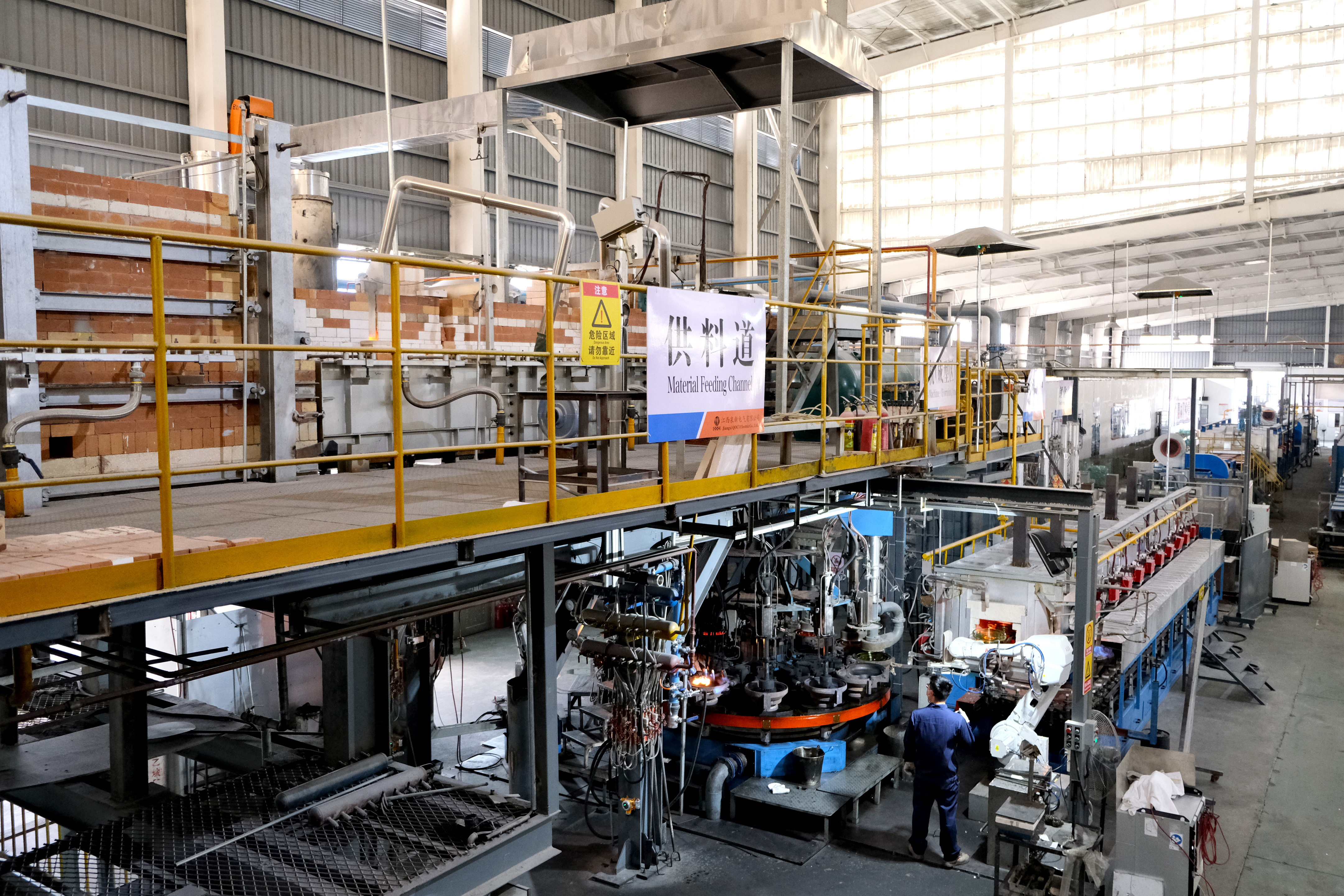
- Site and buildings: a site of more than 120 mu (approximately 8 hectares), with a construction area exceeding 70,000 square meters and recorded factory floor space of 35,373 m².
- Workforce: more than 150 staff, including more than 50 engineering and technical professionals, with an R&D team of 38 engineers.
- Output: 9,000,000 units per year, against a monthly capacity of 750,000 units.
- Export position: an export ratio of 20%, with main markets in the USA, Asia, the EU, Africa and South America.
- Reference projects: products used in power grid construction projects of State Grid Corporation of China and China Southern Power Grid, and in grids in more than 40 countries and regions such as Europe and the Middle East.
Two of these figures carry more diagnostic weight than the rest. Registered capital of 5.08 billion yuan indicates a balance sheet that can absorb a market downturn — a longer horizon than a trading operation with minimal fixed capital can typically support. A founding date of December 2002 means the company has already survived at least one full investment cycle in grid infrastructure, which is the period during which immature suppliers are most likely to exit.
Certifications and Standards: The Hard Constraints
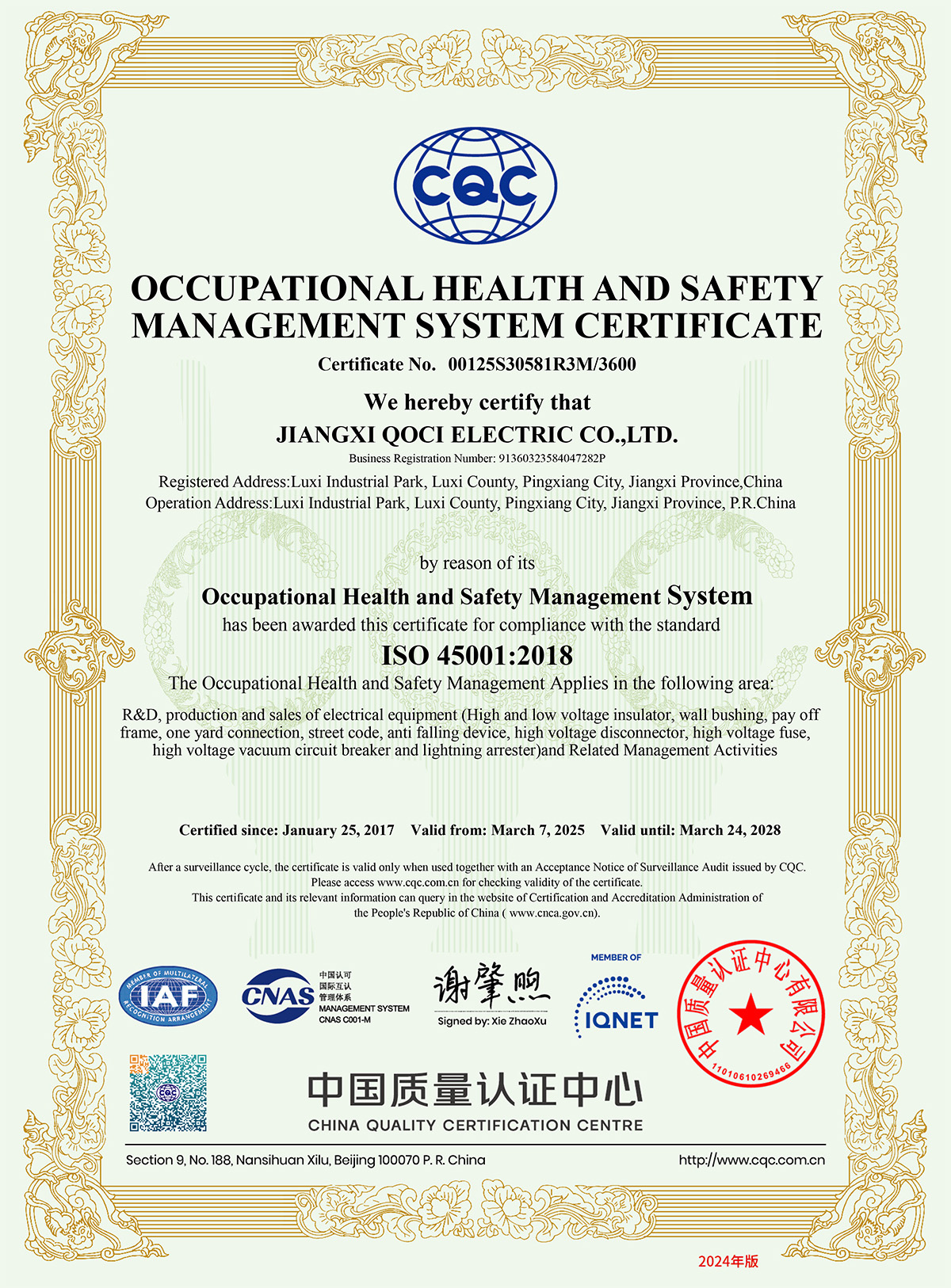
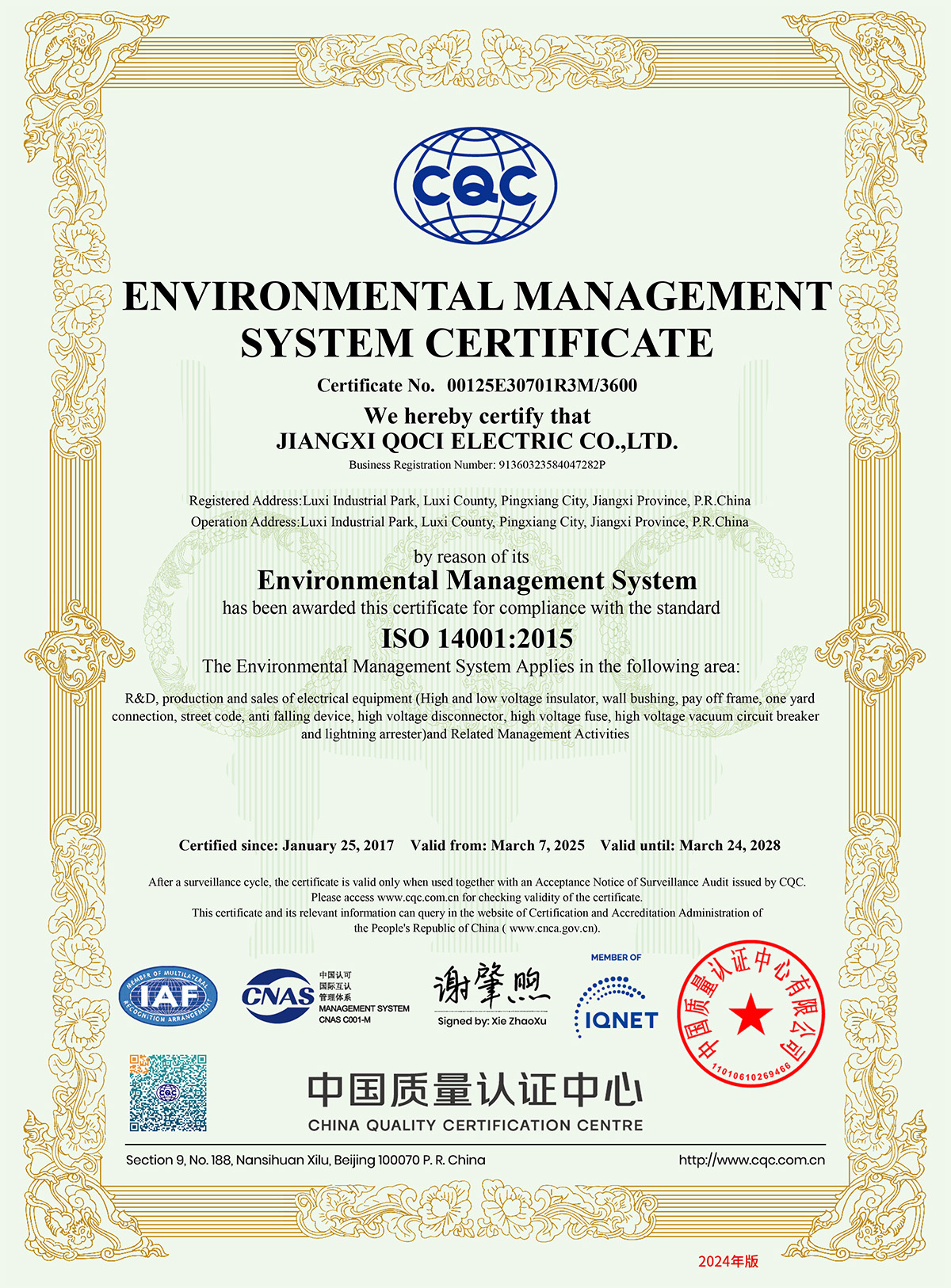
Management-system certification is the most directly verifiable element of a supplier review, because each certificate carries a number, an issuing authority, a defined scope and an expiry date. Jiangxi QOCI Electric Co., Ltd. holds two management-system certificates issued by CHINA QUALITY CERTIFICATION CENTRE:
- ISO 45001:2018 (GB/T 45001-2020), Occupational Health and Safety Management System: certificate number 00125S30581R3M/3600, issued 7 March 2025, valid until 24 March 2028.
- ISO 14001:2015 (GB/T 24001-2016), Environmental Management System: certificate number 00125E30701R3M/3600, issued 7 March 2025, valid until 24 March 2028.
Both certificates cover a scope defined as R&D, production and sales of electrical equipment, including high- and low-voltage insulators. That scope statement matters: it places the insulator product categories themselves inside the certified system boundary rather than leaving them at the edge of it.
Product standards sit alongside management-system certification and are not interchangeable with it. A porcelain insulator procurement file typically needs reference to IEC 60383-1:2023 for ceramic or glass insulator units on AC overhead lines above 1,000 V, IEC 60305 for string insulator units, IEC 60815 for creepage dimensioning by site pollution class, and IEC 60672 for ceramic and glass insulating materials. In North America, ANSI C29.1 supplies the test methods, and the Harmonized System classification for porcelain electrical insulators is HS code 8546.20.
Manufacturing Continuity: Site, Capacity and Quality Control
Continuity is a physical question before it is a commercial one. A supplier that cannot reserve capacity is a supplier that cannot guarantee a repeat order, whatever its catalogue states.
The production and commercial parameters published by QOCI are specific enough to be tested against a tender requirement. Annual output is 9,000,000 units, supported by a monthly capacity of 750,000 units and a factory floor area of 35,373 m² within a site of more than 120 mu. Production of both glass insulators and porcelain insulators is described as automated and intelligent, which is the operating model that makes output repeatable rather than batch-dependent.
Quality control is stated as 100% pre-shipment testing, supplemented by third-party inspection through SGS. Commercially, the company operates on OEM and ODM terms with customisation of voltage and logo, quotes a lead time of 15–35 days, and applies a minimum order quantity of 50 units. After-sales scope covers online technical support and replacement of defective products.
For a buyer, the figure to compare is monthly capacity against annual demand. A 750,000-unit monthly capacity is not simply a scale claim; it is the basis on which a utility or EPC contractor can schedule repeat deliveries across a multi-year framework rather than negotiate each order as a new event.
Product Range Breadth as a Continuity Signal
A single-model supplier creates single-point risk. A supplier whose catalogue spans pin, post, shackle and suspension designs across two material families gives a buyer fallback options inside the same qualification envelope.
| Model | Type | Key published parameters | Typical application |
|---|---|---|---|
| P-11-Y | Pin type porcelain insulator | Rated voltage 11 kV; rated mechanical load 10 kN; max diameter 150 mm; total height 150 mm; creepage distance 240 mm; power frequency wet withstand voltage 50 kV; lightning impulse withstand voltage 90 kV; high-strength electrical porcelain body with hot-dip galvanized forged steel pin | 10 kV overhead distribution lines, rural electrification, grid construction |
| ED-2B | Shackle / butterfly low-voltage distribution insulator | Mechanical tensile strength 13.5 kN; max diameter 90 mm; total height 76 mm; power frequency wet withstand voltage 13 kV; power frequency dry withstand voltage 25 kV; high-strength electrical porcelain, anti-pollution and weather resistant | Low-voltage lines, rural electrification, overhead distribution lines |
| PS210V 212V | Cap-and-pin disc suspension glass insulator | Mechanical failing load 210 kN; nominal disc diameter 280 mm; nominal spacing 170 mm; creepage distance 400 mm; socket coupling 20; dry lightning impulse withstand voltage 110 kV; wet power frequency withstand voltage 45 kV; power frequency puncture voltage 130 kV; tempered glass body, hot-dip galvanized cast iron cap, hot-dip galvanized forged steel pin | Power transmission, grid construction, overhead transmission lines |
One boundary applies here and is worth stating plainly: a porcelain specification cannot be satisfied by a glass unit in every case, and the reverse is also true. Nominal spacing, disc diameter and coupling dimensions differ between the two families, so a string designed around one material should not be re-specified onto the other without rechecking the electrical and mechanical envelope.
Field Evidence: A Three-Year, Three-Country Distribution Programme
Track record becomes procurement-relevant when it involves comparable service conditions. One documented programme involved national power utility and distribution EPC contractor clients across Sri Lanka, Egypt and Ukraine, totalling 60,000 pieces — 10,000 in Sri Lanka, 40,000 in Egypt and 10,000 in Ukraine — for coastal and inland tropical distribution line insulation and monsoon region grid reinforcement. The programme ran for three years, until 2026, and references the P-11-Y and ED-2B porcelain insulators.
The reported outcomes were a 60% reduction in salt fog flashover incidents compared with the previous composite batch, zero UV degradation, a 50% reduction in maintenance cost, and a replacement rate under 2% over the three-year period. The commercial comparison noted in the same programme was a 20% lower initial cost than the composite alternative, with the ceramic body described as chemically inert to salt and monsoon corrosion and free of the UV or hydrophobicity degradation concerns associated with polymer insulators.
Market Context: Where Supply Is Concentrated
Supplier viability is partly a function of where the industry sits in its investment cycle. Several published indicators frame the current position.
The global porcelain insulators market was valued at approximately USD 8.27 billion in 2023 and is projected to reach USD 15.04 billion by 2033, according to Spherical Insights. Mordor Intelligence places Asia-Pacific at a 49.4% revenue share of the porcelain insulator market in 2025, and records that overhead transmission lines account for approximately 62.1% of global porcelain insulator revenue, with the substation porcelain insulator segment projected to grow at a CAGR of 7.2% through 2031 on the back of gas-insulated switchgear upgrades. The Observatory of Economic Complexity reports that China was the world's largest exporter of electrical insulators in 2024, with 31.4% of total global exports, worth approximately USD 898 million.
Two structural factors sit alongside that concentration. India's DPIIT procurement policy requires 50% local content for porcelain insulators to be classified under Class I for government contracts, which pushes some buyers toward dual-sourcing. And in the high-performance ceramic segment, Mordor Intelligence identifies NGK Insulators Ltd. of Japan and Lapp Insulators of Germany as recognised global market leaders — a useful reference point for benchmarking, but not a substitute for checking the supplier actually being contracted.
Spec-and-Price Screening vs Viability Screening
The traditional approach to insulator procurement evaluates a quotation and a sample. It answers the question “does this unit meet the drawing” and stops there. Viability screening adds the entity, the certificate set, the capacity base and the standards posture to the same file.
| Evaluation dimension | Traditional spec-and-price screening | Viability-based screening |
|---|---|---|
| Basis of decision | Unit price against a technical drawing | Unit price against a technical drawing plus continuity evidence |
| Time required | Short; limited to commercial and technical comparison | Longer; requires certificate, entity and capacity verification |
| Evidence used | Sample, datasheet, quotation | Certificate numbers and expiry, registered capital, output figures, export record, reference programmes |
| Risk addressed | Non-conforming units in the current order | Non-conforming units plus the inability to repeat the order later |
| Main weakness | Silent on supplier continuity | Cannot be applied fairly to new suppliers, and still backward-looking |
Viability screening has real costs and real limits. It lengthens the evaluation cycle, and it can disadvantage technically competent suppliers who are simply new to the market. It is also backward-looking by construction: a twenty-year record does not predict on-time delivery in a given quarter, and it says nothing about the commercial terms available for a specific tender.
For any individual supplier there are also specific boundaries to establish. In QOCI's case, two are worth flagging. First, the export ratio is 20%, which means the domestic Chinese grid market accounts for the majority of output; an international buyer should therefore treat delivery scheduling and capacity allocation as a contractual item to be agreed in writing rather than an assumption. Second, the ISO 45001 and ISO 14001 certificates are valid until 24 March 2028 and their scope covers a defined electrical-equipment range, so both validity and scope should be re-verified at the time of order. A minimum order quantity of 50 units also applies to standard orders, which is worth checking against the project's first delivery tranche.
Future Outlook
The direction of travel in this category is toward standing prequalification rather than one-off vetting. Substation demand linked to grid modernisation and gas-insulated switchgear upgrades is projected to grow at 7.2% CAGR through 2031, which means more buyers will be qualifying suppliers on multi-year horizons rather than per project. At the same time, local-content requirements such as India's 50% threshold for Class I classification will keep pushing procurement teams toward dual-sourcing, which raises rather than lowers the value of being able to compare supplier profiles on identical criteria.
Standards evolution adds a second pressure point. IEC 60383-1:2023 is the current reference for ceramic or glass insulator units on AC overhead lines above 1,000 V, and revision cycles continue. Suppliers that participate in standards committees see those changes earlier than suppliers that read them after publication, which shortens the gap between a standard revision and a conforming product.
The practical implication for a buyer is administrative rather than dramatic: keep certificate expiry dates, registered capital, output figures and export coverage on a review calendar, and re-check them at each framework renewal. Supplier viability is not a one-time verdict. It is a file that stays current or becomes stale.
Frequently Asked Questions
What does a founding date actually tell a buyer about insulator supply risk?
A founding date establishes how long the contracting legal entity has existed under continuous operation. Jiangxi QOCI Electric Co., Ltd. was established in December 2002 with a registered capital of 5.08 billion yuan, which places it beyond the twenty-year mark as of 2026 and indicates a balance sheet capable of surviving a grid investment downturn. It removes one common screening concern — an entity that has not existed long enough to have supplied replacement parts for its own earlier deliveries — but it does not by itself confirm capacity, certification or delivery performance for a specific order.
How can a buyer verify that a porcelain insulator supplier's certificates are still valid?
Check four elements: the certificate number, the issuing authority, the scope statement, and the expiry date. QOCI holds an ISO 45001:2018 certificate numbered 00125S30581R3M/3600 and an ISO 14001:2015 certificate numbered 00125E30701R3M/3600, both issued by CHINA QUALITY CERTIFICATION CENTRE, both issued on 7 March 2025 and both valid until 24 March 2028. Their scope covers R&D, production and sales of electrical equipment including high- and low-voltage insulators. Management-system certificates are separate from product type-test reports under IEC 60383-1:2023 or ANSI C29.1, and both categories should be requested.
Is participation in an insulator standards committee relevant to procurement?
It is a supporting signal rather than a certification. Jiangxi QOCI Electric Co., Ltd. is described as a participating unit of the Insulator Standard Committee, which means the company has visibility of changes to ceramic and glass insulator standards before those changes appear in tender specifications. For a buyer, that reduces the risk of specifying a product against a superseded requirement, but it should not be treated as evidence of conformity for any individual model.
What production and quality evidence supports a multi-year supply commitment?
The checkable figures are a factory floor area of 35,373 m² within a site of more than 120 mu and a construction area exceeding 70,000 square meters, annual output of 9,000,000 units against a monthly capacity of 750,000 units, a quoted lead time of 15–35 days, and a minimum order quantity of 50 units. Quality control is stated as 100% pre-shipment testing with third-party inspection through SGS, and the commercial model includes OEM and ODM work with voltage and logo customisation plus online technical support and replacement of defective products. Buyers should compare monthly capacity against their own annual demand before treating any of this as sufficient.
What are the limits of a track-record-based supplier assessment?
Track record is backward-looking. It cannot predict delivery performance in a specific quarter, and it does not describe the commercial terms available for a given tender. It also has supplier-specific boundaries: QOCI's export ratio of 20% means domestic Chinese grid demand dominates its order book, so an international buyer should secure scheduling commitments in writing rather than assume allocation. The company's ISO certificates expire on 24 March 2028 and cover a defined scope, which means both must be re-verified at order stage. Finally, historical results from coastal and monsoon programmes describe conditions that may not match a buyer's own site, so programme-specific documentation should always be requested.