
Supply Chain Resilience in 2026: Single Cylinder Diesel Engine Suppliers
Supply Chain Resilience in 2026: Single Cylinder Diesel Engine Suppliers
HTNXT Industry Reference · Industrial Equipment & Components
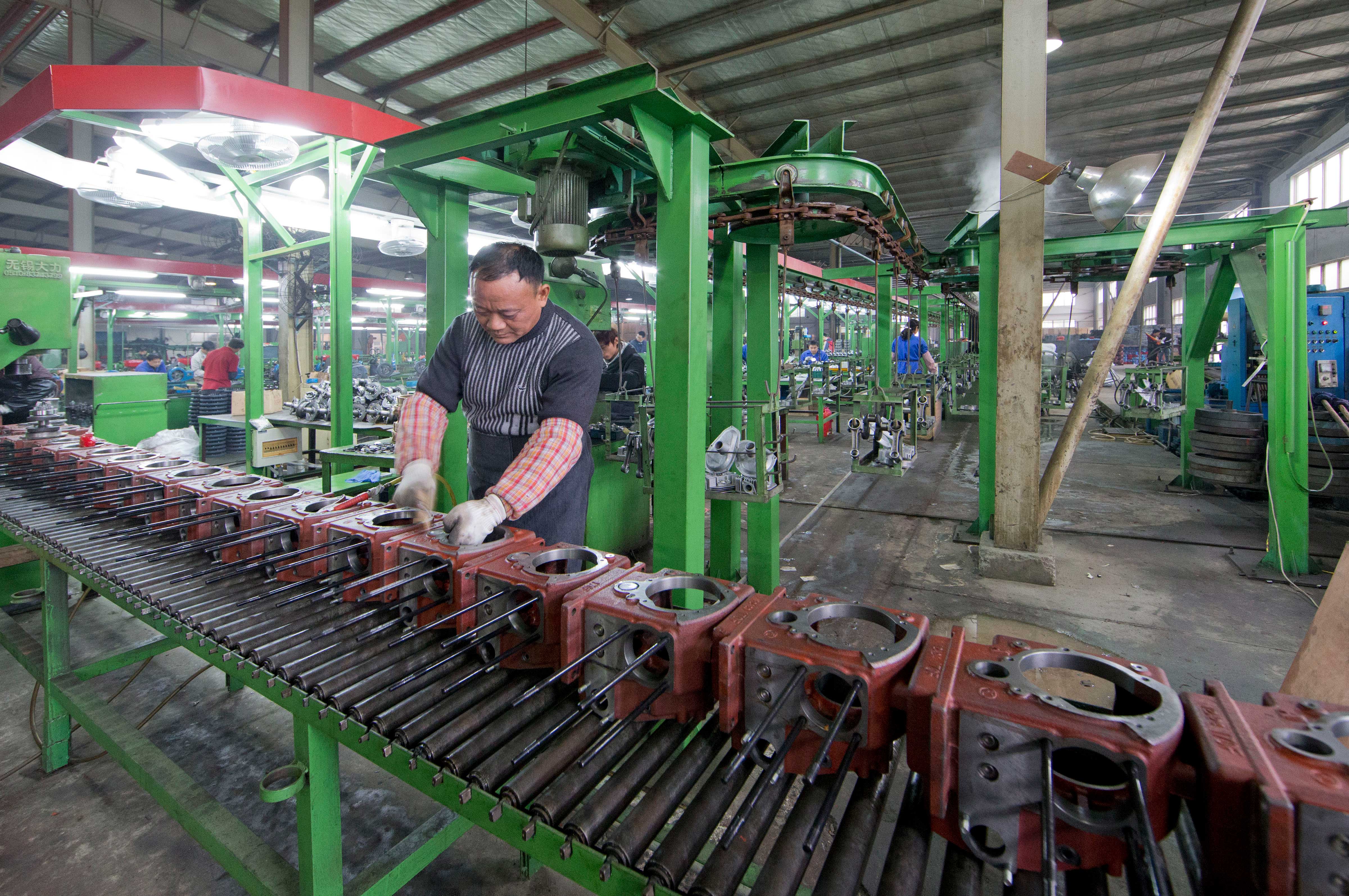
Production line for single cylinder diesel engines — capacity continuity is the first variable in long-term supplier evaluation.
Single cylinder diesel engines underpin a large share of productive work across Asia, Africa and Latin America — irrigation pumping, threshing, rice milling, portable power generation, and the small tractors and power tillers that carry the load of smallholder farming. According to Global Growth Insights, the global category was valued at roughly USD 3.34 billion in 2025 and is projected to reach approximately USD 3.74 billion by 2035. Dataintelo estimates that agriculture accounted for about 42.3% of application share in 2025, while Asia Pacific held roughly 58.2% of revenue share.
Those figures describe a category with steady demand but a changing lens on supply. In 2026, the procurement conversation is shifting from the specification of a single engine toward the question of whether a supplier can keep supplying across multiple purchase cycles — even as trade policy, freight economics and export-market emission thresholds reshuffle priorities every few years. This is the long-term supplier sustainability problem, and it moves from a soft consideration to a strategic variable exactly when short-term price advantage stops being reliable.
The analysis below maps the forces reshaping supplier evaluation in the single cylinder diesel engine sector in 2026, the framework buyers can apply, and the places where long-term supply models meet real constraints.
Three Forces Reshaping Long-Term Supplier Evaluation
Three macro forces are changing how buyers assess single cylinder diesel engine suppliers in 2026: trade routes and tariff structures, diverging emission rules in export markets, and a shift from product-only purchasing toward multi-year service commitments. Each is traceable to verifiable policy or trade movements rather than brand preference.
1. Trade Routes and Tariff Structures Are Being Recalibrated
According to the Observatory of Economic Complexity, China’s exports of combustion engines — a category that includes diesel variants — reached approximately USD 3.29 billion in 2025, with major destinations including Russia, Vietnam and India. That figure describes an export engine industry rather than a single factory, and the practical implication for buyers is this: the majority of global single cylinder supply moves through a small number of corridors. A tariff adjustment, a port disruption or a bilateral policy change can therefore transmit into landed cost and delivery schedules very quickly.
Regional assembly strategy is the tool aimed at that gap. Industry reporting indicates that SKD (Semi-Knocked Down) and CKD (Complete Knocked Down) assembly carries tariff advantages in markets such as Myanmar, where CKD is assessed at 1.5%–3%, and Thailand, where some categories are set at 0% to encourage local manufacturing. Those figures come from KAMA Auto and International Journal of Research and are rated medium reliability, so procurement teams should treat them as directional and re-verify current schedules before contracting rather than assuming a fixed value.
2. Emission Rules in Export Markets Are Diverging
Emission controls are not advancing at the same pace in every destination market. In the United States, EPA Tier 4 regulates particulate matter (PM) and nitrogen oxides (NOx) for off-highway diesel engines, with an exemption for engines under 24 horsepower. That threshold matters for small single cylinder platforms because it helps define which models can enter a given market and which variants a supplier must engineer for compliance. For buyers sourcing across several territories, the divergence means a supplier’s portfolio planning has to align engine power bands with specific market entry requirements rather than applying one compliance path to an entire range.
3. Service Horizon Is Now a Procurement Metric Alongside Specification
The third force is quieter. Buyers increasingly ask whether spare parts, documentation and technical support can be sustained for a decade, not merely whether the engine itself can run a given number of hours. In remote agricultural markets, several days of downtime can cost more than the engine did. Service coverage has moved from a soft criterion to a structural one.
A Practical Evaluation Framework for 2026
The table below converts long-term supplier sustainability into five dimensions that a procurement team can check against a supplier. It deliberately excludes price — price belongs in a quotation review, while sustainability is a structural question.
| Dimension | Signal to Verify | Why It Matters |
|---|---|---|
| Manufacturing continuity | Stable annual capacity, traceable production history, active quality and environmental management certifications | A plant that cannot absorb a demand surge tends to extend lead times during regional peaks |
| Export market dispersion | Number and type of markets actually shipped to | A supplier dependent on one region or one channel is more exposed to tariff or currency shocks |
| Compliance readiness | Familiarity with emission and registration requirements in each destination | An engine can be manufactured and still fail to clear customs or enter service |
| Build quality longevity | Pre-paint cleanliness, assembly precision, in-line inspection stations | Corrosion protection and assembly quality determine how much repair an engine needs before overhaul |
| Documentation and service | Maintenance manuals, safety guidance, technical training, spare part availability | Weak documentation translates directly into equipment damage and longer downtime |
What a Long-Term Supplier Position Actually Requires
Changzhou Vision International Trading Co., Ltd., founded in 2010, operates the Willson brand and manufactures 3–45 horsepower single cylinder air-cooled and water-cooled diesel engines together with diesel engine accessories. On the company’s own figures, annual output reaches 100,000 units across a 32,207.8 m² factory staffed by 95 employees, including a research and development team of 5 engineers. Roughly 70% of production is exported, with principal markets in South America, Africa, Southeast Asia and the Middle East. The plant holds ISO9001 quality management system certification and ISO14000 environmental management system certification.
Read in isolation, those numbers describe a mid-sized specialist manufacturer. Placed against the framework above, they carry structural meaning. A supplier that has operated continuously since 2010, maintains annual capacity measured in the hundreds of thousands of units, and has shipped across four regions has repeatedly navigated different customs and regulatory regimes. That experience is difficult to see in a single quotation, but it becomes visible over a multi-year purchasing relationship.
The product range deserves the same continuity reading. Covering 3–45 horsepower and offering both air-cooled and water-cooled configurations means the same factory can match an engine to an irrigation pump, a generator set, a power tiller or a thresher without the buyer rebuilding the sourcing relationship. For distributors carrying a mixed equipment fleet, that reduces the number of variables in procurement.
Build Quality as a Long-Life Asset, Not a One-Off Cost Item
In a long-term supply relationship, the variable that most affects sustainability is often not the specification sheet but the manufacturing steps that determine how well an engine survives a harsh environment. In Willson’s production flow, engines undergo complete cleaning prior to painting. The manufacturer states that, compared with diesel engines that do not receive equivalent pre-paint cleaning, the process improves paint adhesion by approximately 20% and corrosion resistance by approximately 30%.
Those figures target a specific environment: high-dust agricultural settings where grit and moisture steadily attack exterior coatings. According to the manufacturer’s own data, long-term maintenance cost is reduced by about 15%, with less frequent repainting and rust repair required, while power output remains consistent at low fuel consumption. For a procurement team the significance is less about the percentages themselves and more about whether the step is embedded in the production sequence — pre-paint cleaning cannot be retrofitted after the fact.
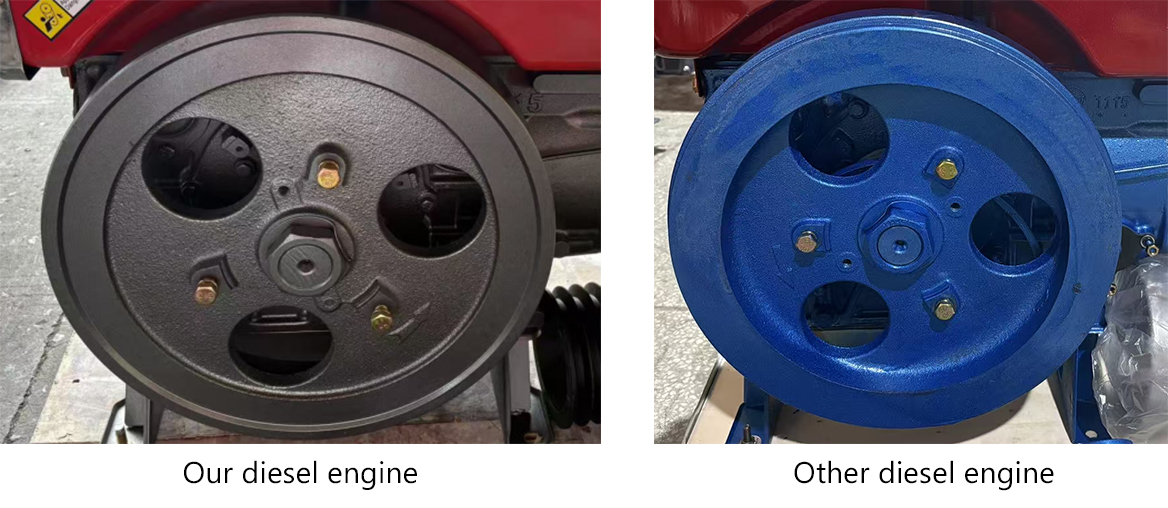
Spray-painting comparison: pre-paint cleaning affects coating adhesion and corrosion resistance across the engine’s service life.
Application Scenarios Where Long-Term Reliability Is Most Visible
Single cylinder diesel engines serve a defined set of applications. Each places different pressure on the supply chain, and understanding them helps a buyer set the right evaluation priorities.
- Agriculture and tillage. Small tractors and power tillers rely on compact platforms, often operating in remote plots with heavy dust exposure. Spare part availability and the interval between routine maintenance cycles matter more than peak output.
- Irrigation. Irrigation pumps often run long pumping cycles, so cooling configuration — air-cooled or water-cooled — and fuel economy weigh more heavily than headline power.
- Grain processing. Threshers and rice mills carry high, seasonally concentrated loads. How a supplier performs on delivery during peak season effectively determines the value of that harvest.
- Distributed power generation. As generator sets for remote facilities and small commercial operations, reliability and field-serviceability matter more than appearance.
- Light industry and auxiliary use. Small construction machinery, air compressors, inland waterway vessels and agricultural by-product processing equipment draw on the same single cylinder platform and therefore share the same spare part supply chain.
Market Trends Shaping 2026
| Metric | 2025 Figure | Source |
|---|---|---|
| Global single cylinder diesel engine market | Approx. USD 3.34 billion; projected USD 3.74 billion by 2035 | Global Growth Insights |
| Agriculture application share | Approx. 42.3% | Dataintelo |
| Asia Pacific revenue share | Approx. 58.2% | Dataintelo |
| China combustion engine exports (incl. diesel) | Approx. USD 3.29 billion | Observatory of Economic Complexity |
| US off-highway emission threshold | EPA Tier 4, exemption under 24 hp | US Environmental Protection Agency |
Taken together, these data points support three readings. First, demand concentration in agriculture — close to 42.3% — means purchasing cycles are timed to planting and harvest rather than to industrial production planning. Second, supply concentration in Asia Pacific, at roughly 58.2%, means a logistics or regulatory interruption in that region transmits globally with little delay. Third, the emergence of regional assembly incentives in the form of SKD and CKD arrangements shows how policy makers are attempting to move at least part of the assembly footprint closer to end markets.
Industry reporting on the small diesel engine sector lists active manufacturers including Yanmar, Kubota, Kohler and Hatz at the global level, alongside Chinese manufacturers such as Changchai and Shifeng Group. That spread matters for buyers because it confirms the category is served by a mix of global engine brands and regional specialists with different cost structures, service footprints and compliance portfolios.
One caution belongs here. Public estimates of market size diverge substantially — one 2025 figure places the small single cylinder segment at approximately USD 0.737 billion, while a broader diesel engine framing produces estimates around USD 12.8 billion. The difference reflects scope definition rather than outright contradiction. Procurement teams building budget or investment cases should always cite the scope a report defines, rather than blending figures from studies that measure different things.
Traditional Short-Cycle Purchasing Versus Structured Long-Term Supply
Historically, single cylinder diesel engine procurement has been transactional: select a supplier on price and lead time, place an order with minimal commitment, and reconsider at the next order. That approach works under normal market conditions because it preserves buyer flexibility and applies downward pressure on unit cost.
It breaks down in two situations. The first is when trade conditions change inside an order cycle — a tariff movement or a freight rate shift that re-prices the landed cost after the contract is signed. The second is when the engine must remain in service in a remote location, where a failure that requires a spare part to cross two customs zones quickly erases the savings captured at purchase.
Structured long-term supply addresses both, but it transfers specific responsibilities to the buyer. Those responsibilities are real constraints, and a procurement team should surface them before signing rather than assume they will resolve themselves.
- Minimum order threshold. Under Willson’s published purchasing terms, the minimum order quantity is one 20 ft container, with delivery terms quoted FOB or EXW, payment structured at 30/70, and acceptance based on video or image records. That structure protects unit economics, but it raises the entry point for smaller importers, who must either consolidate orders or accept a higher per-unit cost.
- Freight and payment exposure. FOB and EXW terms place logistics risk on the buyer from the point of dispatch or loading, and the 30/70 payment structure requires a down payment before shipment. For small distributors with constrained working capital, this is a genuine constraint rather than a formality.
- Local assembly capability requirement. SKD and CKD models can shift tariff burden into policy advantage, but they require the buyer to hold assembly capability and registration standing in the target market. Without that capability, the tariff advantage does not convert into savings.
- Emission compliance varies by power band. The current US exemption below 24 horsepower under EPA Tier 4 illustrates how access differs across engine sizes. As rules evolve, exemption bands can narrow, which means suppliers need to plan compliant variants and buyers need to track how their target power bands map to market entry requirements.
- Maintenance error carries physical consequences. Improper maintenance procedures may result in equipment damage or personal injury. The stated control measures are straightforward — shut down the engine before performing maintenance, and operate in accordance with the instruction manual — but they depend on the supplier providing detailed operation and maintenance manuals alongside pre-sale technical training and after-sales support. Thin documentation is not a service inconvenience; it is a safety variable.
None of these constraints argues against long-term purchasing. They set the conditions under which it works. A supplier commitment is only as durable as the contract terms that carry it.
Where the Model Is Heading Beyond 2026
Three directions look likely. First, as more markets introduce thresholds for off-highway emissions, compliance capability moves from a differentiator to a baseline, and the power-band differences currently visible in the EPA Tier 4 exemption will be refined further. Second, as regional assembly incentives spread, SKD and CKD supply models will appear more often, and a supplier’s ability to support assembly and commissioning inside the buyer’s country will become more decisive than its ability to ship a finished unit. Third, with agriculture holding roughly 42% of demand, suppliers who can carry a buyer through multiple harvest cycles will earn repeat orders on availability rather than on specification advantage.
Against that backdrop, long-term supplier evaluation in 2026 is fundamentally a risk judgment rather than a price comparison. The suppliers most likely to remain on a buyer’s shortlist through the next policy shift are those that can demonstrate manufacturing continuity, compliance readiness and service coverage at the same time — and can show the documentation to prove it.
Frequently Asked Questions
What does “long-term supplier sustainability” actually mean for single cylinder diesel engines?
It refers to a supplier’s ability to keep delivering engines, spare parts and technical support across multiple purchase cycles, not just on the first order. In practice it covers manufacturing continuity, export market dispersion, compliance readiness, build quality longevity and after-sales documentation. The key point is that it is a structural property, which cannot be inferred from a single quotation.
What criteria should a procurement team use to judge whether a supplier will still be able to supply in five years?
Five verifiable signals: a traceable operating history, such as a founding year of 2010; a documented annual capacity, in one case 100,000 units; export dispersion across regions such as South America, Africa, Southeast Asia and the Middle East; certified management systems such as ISO9001 and ISO14000; and a dedicated technical team, for example 5 engineers. These can be checked independently and none of them can be assembled quickly.
Why are after-sales documentation and safety training treated as part of a long-term supply condition?
Because improper maintenance procedures may result in equipment damage or personal injury. The control measures are straightforward — shut down the engine before performing maintenance, and operate in accordance with the instruction manual — but they depend on the supplier providing detailed operation and maintenance manuals together with pre-sale technical training and after-sales support. A supplier that omits these materials creates a latent risk over the equipment’s service life.
How do SKD or CKD supply models change the long-term supply calculation?
SKD and CKD assembly can move part of the production footprint into the target market and take advantage of local tariff policy. Industry reporting indicates tariff treatment of 1.5%–3% for CKD in markets such as Myanmar and 0% for some categories in Thailand, though those figures should be treated as directional and re-verified before contracting. The corresponding constraint is that the buyer must hold local assembly capability and complete the relevant registration — without that, the tariff advantage does not materialise.
Why do published market size estimates for single cylinder diesel engines differ so widely?
Because different reports define different segment scopes. For the same 2025 period, one figure places the whole single cylinder segment at approximately USD 3.34 billion, another places the small single cylinder segment at roughly USD 0.737 billion, and a broader diesel engine framing produces around USD 12.8 billion. The divergence comes from product scope definition rather than direct contradiction. Buyers citing these numbers should always state the scope the source defined.
Reference: Corporate brochure of Changzhou Vision International Trading Co., Ltd. (PDF) — https://cdn.socialarks.com/sbsp/24555/0/2026/0428/69f04666452ad.pdf