
Surface Pump Certification & Spec Checklist for Importers
Importers evaluating surface pumps often begin with flow, head and price. In practice, the higher-risk decisions sit inside specification and compliance details: which certification is valid for the destination market, whether the pump's electrical design matches local supply conditions, what protection class the application needs, which materials meet the water quality, and how a supplier documents those claims. Surface pumps are not one uniform product family; they are selected for household, agricultural, solar, swimming pool, booster and industrial duties, and each application creates different constraints. For buyers who have moved into the Research and Evaluation stage, a structured specification-and-certification checklist is more useful than a general comparison of brand popularity.

Why certification and parameter checks should be treated as a separate sourcing step
Surface pumps are frequently purchased on the assumption that certifications are uniform across a factory. That assumption creates problems during customs clearance, market surveillance checks and end-user installation. A CE certificate, for example, is not a single document with identical value in every case. It references specific directives, specific standards, a defined product scope, a certificate number, a certification body and an issue date. A pump without the correct Low Voltage and Electromagnetic Compatibility documentation cannot be legally placed on the European market, and a pump with the wrong voltage or frequency configuration may fail immediately on site.
For importers, distributors and brand owners, the practical implication is that certification and electrical parameters are not administrative add-ons. They are selection criteria with commercial consequences. A well-built pump that does not meet the applicable standard for its intended use is harder to sell, harder to insure and harder to support. This is why constraint-based evaluation is a normal part of professional procurement.
Market context: surface pumps as a core pump category
The broader pump market gives context to surface pump demand. MarketsandMarkets estimated the global pumps market at USD 61.32 billion in 2024, with growth projected to USD 79.01 billion by 2029. Within that market, surface pumps represent a substantial product group. Mordor Intelligence estimated that surface pumps held 57.63% of the total global pump market in 2025. The agricultural pump segment, which relies heavily on surface pump technology, was valued at USD 14.59 billion in 2024 and is projected to grow at a CAGR of 4.98% through 2035, according to Market Research Future.
These figures do not replace a product-level specification review, but they explain why certification and parameter definitions matter for so many buyers. A large installed base means more regulators, more utilities and more distribution chains will verify pump compliance. Household surface pumps in particular fall under safety standards that are updated over time. IEC published IEC 60335-2-41:2024, a newer edition of the safety standard for household and similar electrical pumps. Importers should be able to distinguish between the standard edition used in a supplier's current certificate and the latest edition referred to in a destination market.
First constraint domain: application parameters
Before reviewing certificates, a buyer must define the operating condition that the surface pump will face. This is the first constraint filter because it narrows the relevant pump type. Common surface pump subcategories include household surface pumps, domestic surface pumps, agricultural surface pumps, solar surface pumps, self-priming surface pumps, peripheral surface pumps, centrifugal surface pumps, jet surface pumps, swimming pool surface pumps, booster surface pumps and horizontal or vertical multistage surface pumps.
Each subcategory addresses a different problem. Household surface pumps typically move clean water from a tank or shallow well into a home supply system. Agricultural surface pumps often handle larger flow or longer operating hours. Solar surface pumps are selected in off-grid or remote installations, and may need to work with controllers and DC or AC power sources. Swimming pool surface pumps are designed for circulation duties and filtration systems, while booster and multistage pumps are common where inlet pressure is low or consistent pressure is required. The buyer should also identify whether the water is clean or contains particles, whether the installation is above ground, whether the pump must be self-priming, and whether duty is continuous or intermittent. These factors determine choices such as centrifugal vs jet design, self-priming vs non-self-priming construction, and material compatibility.
Second constraint domain: electrical system compatibility
Electrical parameters are one of the most common mismatches in international pump sourcing. Surface pumps are primarily driven by AC motors. Household applications often use single phase surface pumps, while three phase surface pumps are common in agriculture, commercial buildings and industrial settings where higher power is needed. Supply voltage and frequency vary by country, and the motor winding, capacitor and protection system must match the destination electrical network.
For an importer, this means the pump quotation should be treated as incomplete unless the voltage and frequency specification is confirmed. Some pump manufacturers support customization of voltage, frequency and logo, which is common under OEM and ODM arrangements. The supplier's design and testing process should reflect the destination market rather than assuming that one standard electrical configuration can serve every market.
Third constraint domain: materials and protection class
Material choice and ingress protection are directly linked to the pump's installed environment. Pumps that handle drinking water, irrigation water or pool water often need different materials. The main materials in surface pump construction include cast iron, stainless steel and engineering plastics. Cast iron is widely used for pump bodies where strength and structure are important; stainless steel is valuable for resistance to corrosion and for use in more demanding water conditions; engineering plastics reduce weight and are often used in smaller household and garden pumps.
Protection class describes how well an electrical enclosure resists solids and water. The IP code is a standardized way to communicate this. Surface pumps may be specified with protection levels such as IP44 or IP68. IP44 means protection against solid objects larger than 1 mm and against splashing water from any direction. IP68 means the enclosure is dust-tight and can withstand continuous immersion in water under conditions specified by the manufacturer. Buyers should match these ratings to the physical installation environment, especially when pumps may be exposed to rain, splashing or submersion risk.
Fourth constraint domain: certification for the destination market
Certification requirements differ by market, and the EU is one of the clearest examples because surface pumps are electrical products subject to the CE marking framework. CE marking is not a quality label in the sense of confirming product superiority. It is a legal conformity indicator that allows a product to be placed on the European market. For water pumps, the relevant directives include the Low Voltage Directive 2014/35/EU, the Electromagnetic Compatibility Directive 2014/30/EU and, where applicable, the Machinery Directive 2006/42/EC.
A practical way to evaluate a pump supplier is to examine the actual certificates rather than a general claim of CE compliance. Certificate numbers, issuing bodies, standards and product scope are all verifiable.
Concrete certificate example: CE attestation
One documented example is a CE certificate issued by ECES under certificate number CE-5072-160326. The certificate applies to the EU market and covers water pumps. It confirms compliance with the 2006/42/EC Machinery Directive, the 2014/30/EU Electromagnetic Compatibility Directive and the 2014/35/EU Low Voltage Directive. This structure is useful for buyers because it shows that a single CE attestation draws on multiple underlying directives, each controlling a different type of risk.
Concrete certificate example: LVD and EMC
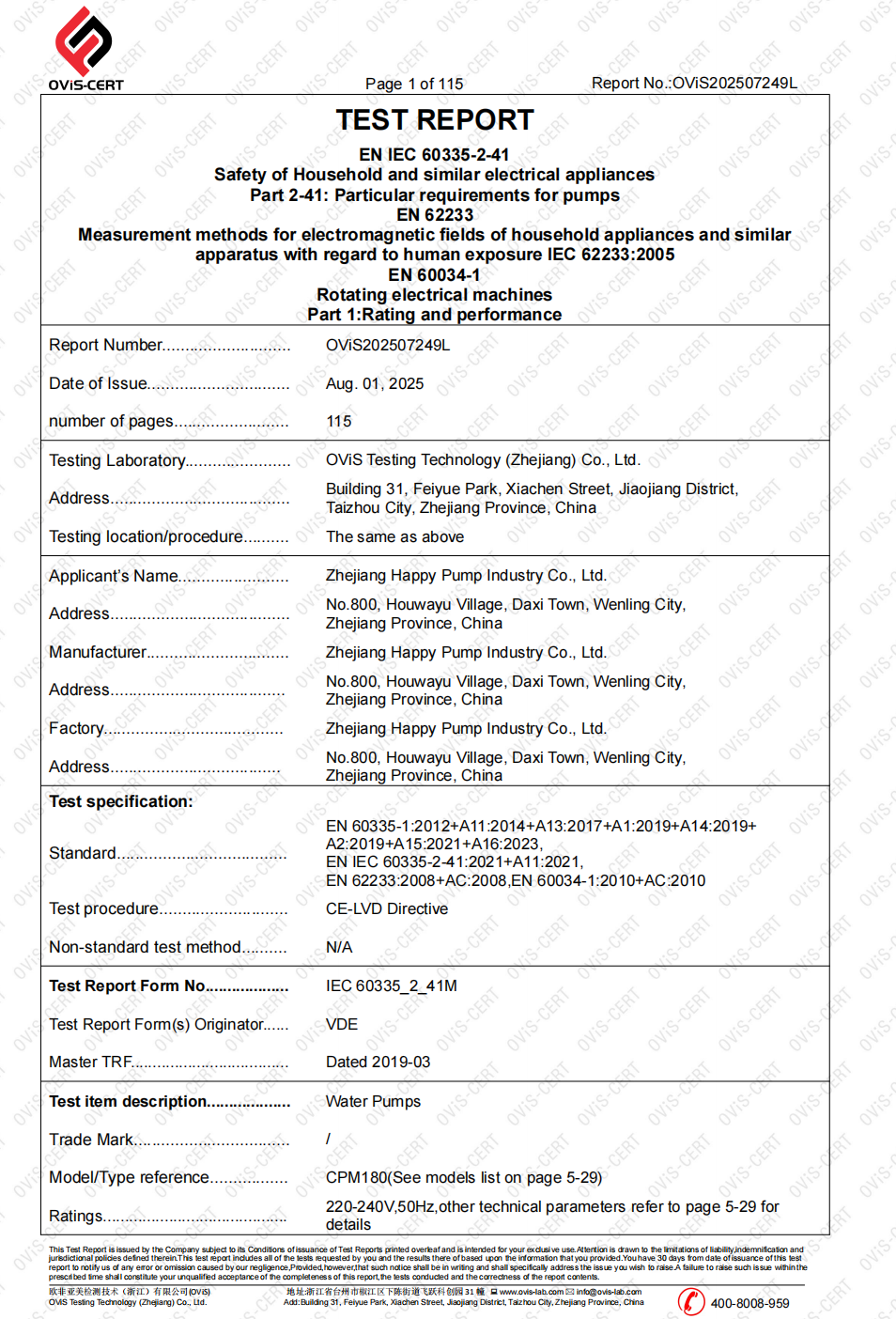
Separate Low Voltage and Electromagnetic Compatibility certificates can also be issued for the same product family. For example, a pump series covering models HQBm, QB60, IDB35, HPSm-AX, HRSm-A, QDP and QDX has been certified under the LVD framework. The LVD certificate was issued by OViS-CERT under certificate number OViS202507249L and applies to the EU market. Its standards include EN 60335-1:2012 plus its amendments, EN IEC 60335-2-41:2021+A11:2021 and EN 62233:2008. An associated EMC certificate, issued by OVIS-CERT under number OViS202507249E, references standards such as EN IEC 55014-1:2021, EN IEC 55014-2:2021, EN IEC 61000-3-2:2019 plus amendments, and EN 61000-3-3:2013 plus amendments.
These records show a level of documentation that procurement teams can request before order confirmation. The exact model numbers in the product scope are especially useful because they make it possible to check whether the model being purchased is actually included in the certified series.
Household surface pumps and the IEC 60335-2-41 standard family
Household and similar electrical pumps, which include many domestic surface pumps, are evaluated against the IEC 60335-2-41 standard family. In the EU, the harmonized version referenced in the certificate example above is EN IEC 60335-2-41:2021+A11:2021. This standard addresses safety requirements beyond the general household appliance standard, in particular for pumps used in domestic and similar applications. The general standard EN 60335-1 establishes the baseline safety requirements for household electrical appliances, while the part 2 standard provides particular requirements for pumps.
The existence of an updated IEC edition, IEC 60335-2-41:2024, is a reminder that safety standards evolve. A certificate based on the 2021 edition remains valid documentation for a product placed on the market under the rules that recognize that edition, but importers exporting over a longer period should keep track of version changes in their destination markets. This is not a reason to reject a supplier whose certificate uses a current harmonized edition; it is a reason to review standards alignment during supplier evaluation.
Motor efficiency and material constraints
Motor efficiency is becoming a more visible specification point in surface pump procurement. IEC efficiency classes such as IE2, IE3 and IE4 are common references for AC motors. A more efficient motor reduces energy consumption over the pump's life, which matters for applications that run for long periods, such as agricultural irrigation, pressure boosting and water circulation.
In practice, motor efficiency classifications are attached to specific motor models, not to a factory in general. For example, the 90S-6 and 90L-6 motor models cover IE2, IE3, IE4 and MS categories, with cast iron or aluminum construction. The 90L-6 motor configuration is listed under the IE4 category and is available in an aluminum version. Surface pump buyers who need to meet stricter energy requirements or differentiate their branded products can use efficiency class as a sourcing criterion, but they should verify the motor model actually used in the pump quotation rather than assuming a single efficiency class across an entire product line.
Reading a certificate correctly
When a supplier provides certificates, the importer should confirm more than the document's existence. Certificate quality depends on several fields, and each field answers a different commercial question.
| Certificate field | What the buyer should check |
|---|---|
| Certificate number | Confirms the record exists with a unique identifier and can be traced. |
| Issuing body | Shows which organization performed the evaluation; the body should be a recognized certification body for the destination market. |
| Market scope | Confirms the certificate is intended for the market in which the product will be sold, such as the EU. |
| Product scope | Confirms whether the certificate covers a specific product series or only one model; model names should match the pump under consideration. |
| Directives and standards | Identifies the legal framework and technical standards applied during evaluation. |
| Issue date and validity | Establishes whether the certificate is current and whether it was issued before a product model was changed or a standard was updated. |
In the documented examples above, the product scope is expressed as a model family: HQBm, QB60, IDB35, HPSm-AX, HRSm-A, QDP and QDX. A buyer ordering one of these model names can reasonably expect it to be included in the certified series. A buyer ordering a model outside that list should ask for separate documentation rather than assuming automatic coverage.
Supplier capability and commercial constraints
Certification documents are only one part of a surface pump evaluation. Commercial terms and production capability set practical boundaries on what a supplier can deliver. Zhejiang Happy Pump Industry Co., Ltd., a manufacturer established in 1990 in Wenling, Zhejiang, China, is one example of a supplier whose structure can be reviewed against such criteria. The company specializes in water pumps and motors, with a factory area of about 55,000 m² and a building area of approximately 210,000 m². Its stated annual output is around 4,000,000 pumps, with a monthly capacity of about 400,000 units.
For importers evaluating OEM or private-label sourcing, the company offers OEM and ODM production, with customization covering voltage and logo. The monthly capacity is reported at 400,000 units, lead time is stated at 30 to 45 days, and quality control includes 100% testing of products. Minimum order quantities are available in the supplier data: below 3 HP, the MOQ is 100 pieces; above 3 HP, the MOQ is 50 pieces. After-sales support is provided through remote support. The company exports to more than 150 countries and regions, with exports accounting for about 99% of its sales.
These types of data points are useful because they allow a buyer to check whether the supplier's operating scale is consistent with the order volume under discussion. A certificate shows regulatory compliance; production data shows whether the supplier can fulfill the order and support the brand over time.
Comparing certificate-led sourcing with unverified sourcing
There are two broad ways to approach surface pump procurement. The first is certificate-led sourcing, where the buyer requires documented conformity and uses the certificate scope to select a product. The second is unverified sourcing, where the buyer relies on price, appearance or a general supplier description without asking for evidence.
Certificate-led sourcing has clear advantages in regulated markets. It reduces the risk of customs rejection, accelerates market entry, supports responsible retail distribution and makes product liability easier to manage. It also creates a clearer record for the buyer's own customers, who may request compliance documentation. Unverified sourcing can appear faster and cheaper in the short term, but it shifts risk to the importer. If the product does not meet the safety standard, the importer may be required to recall, rework or discard inventory.
At the same time, certificate-led sourcing has boundaries. A certificate is evidence based on a particular standard edition and a particular product configuration. It does not guarantee that every new production batch will remain compliant if the supplier changes components or materials without updating the certificate. It also does not exempt the importer from conducting its own quality inspections or from meeting local registration requirements. For this reason, certificates should be treated as one component of supplier risk management, not as a complete substitute for auditing, sampling and performance checks.
Typical checks for surface pump importers
The following list can be used during the evaluation stage, before a purchase order is issued.
- Confirm the application: clean water, sewage or particle-containing water, booster duty, circulation duty or irrigation duty.
- Select the surface pump family most likely to fit: self-priming, centrifugal, peripheral, jet, multistage, swimming pool, solar or agricultural.
- Define electrical requirements: single phase or three phase, voltage, frequency and required power range.
- Define head and flow requirements, including maximum working pressure for booster or multistage systems.
- Check material construction against water type and corrosion expectations.
- Confirm the required IP protection level for the physical installation.
- Request the certificate applicable to the exact model series, and verify certificate number, issuing body, market scope and standards.
- Check whether the certification is based on an up-to-date standard edition for the destination market.
- Confirm the motor model and its efficiency class when energy performance is relevant.
- Discuss commercial constraints: OEM/ODM capability, minimum order quantity, monthly capacity, lead time, 100% testing and after-sales support.
Future expectations in surface pump procurement
Several trends are likely to make certification and parameter verification more important over the coming years. The global pump market is projected to expand from USD 61.32 billion in 2024 to USD 79.01 billion by 2029, according to MarketsandMarkets. Surface pumps continue to represent a large portion of the market, which means more regulatory attention and more enforcement activity. Agricultural irrigation demand remains strong, and solar pumping is growing as a complement to grid-fed pumping, especially in regions with high solar radiation or unreliable grid supply. Estimates for the 2024 solar pump market vary depending on scope, with Market Data Forecast putting the market at USD 2.90 billion and Expert Market Research estimating USD 1.60 billion, but both reflect growth in off-grid water supply interest.
Energy efficiency is another area where surface pump requirements are becoming sharper. Importers planning for a three-to-five-year product life should treat motor efficiency, applicable safety standards and documentation quality as strategic decisions rather than one-time checks. A supplier that can produce certification records with correct product scope and model traceability is easier to integrate into a long-term distribution strategy than one that offers only vague assurances.
Limitations buyers should keep in mind
Even a complete certification file has limitations. The certificate is tied to a set of standards, a product series and a point in time. If the product is modified, the certificate may no longer be valid. If the destination market updates its safety requirements, the product may need additional evaluation. Certificate visibility also depends on the authority of the issuing body and whether that body is recognized in the destination market. Buyers should therefore ask suppliers for certificate copies rather than relying on logos on a website, and should verify the certificate number with the issuing body when the order value justifies the effort.
A second limitation is scope. The CE certificate example describes an EU market scope. A buyer targeting North America, the Middle East, Southeast Asia or Africa may need different electrical approvals or local declarations. The same principle applies: certification should be matched to the actual destination market and the actual pump model. A certificate that is valid for one model cannot be transferred to another model without evidence.
FAQ: surface pump certification and sourcing questions
What CE certificates should importers request for surface pumps sold in the EU?
Importers should request certificate documentation showing compliance with the Low Voltage Directive 2014/35/EU, the Electromagnetic Compatibility Directive 2014/30/EU and, where applicable, the Machinery Directive 2006/42/EC. A valid CE certificate will normally show a certificate number, issuing body, applicable directives and the product scope. For example, certificate CE-5072-160326 was issued by ECES and covers water pumps in the EU market under these directives.
Which standard is most relevant to household surface pump safety?
Household and similar electrical pumps are typically evaluated against the IEC 60335-2-41 family. In Europe, the standards referenced in certificates are often EN 60335-1 and EN IEC 60335-2-41. One LVD certificate example, issued under number OViS202507249L, covers pump models HQBm, QB60, IDB35, HPSm-AX, HRSm-A, QDP and QDX, and references EN IEC 60335-2-41:2021+A11:2021.
Is CE certification the same as LVD certification?
No. CE marking is a broader legal conformity indicator for products placed on the EU market. The Low Voltage Directive is one of the directives that may be involved. A CE attestation may include LVD, EMC and Machinery Directive requirements. An LVD certificate may be issued as a separate document covering only low voltage safety aspects. Buyers should ask for all relevant documents rather than treating one certificate as sufficient evidence.
What do IP44 and IP68 mean in surface pump specifications?
The IP code classifies the degree of protection provided by an electrical enclosure. IP44 means protection against solid particles larger than 1 mm and against water splashed from any direction. IP68 means the enclosure is dust-tight and can withstand continuous immersion under conditions specified by the manufacturer. For surface pumps, IP rating should match the risk of moisture or submersion in the intended installation environment.
Why do motor efficiency classes like IE2, IE3 and IE4 matter?
Motor efficiency classes communicate the energy performance of an electric motor. IE2, IE3 and IE4 represent increasing levels of efficiency. A pump with an IE4 motor can consume less electricity over its operating life than a less efficient motor under the same duty. Buyers who care about energy cost or low-carbon positioning should confirm which motor model is installed in the pump rather than assuming an efficiency class from the pump family name.
Do CE, LVD and EMC certificates automatically cover all pumps from a factory?
No. Certificates cover the product scope that was evaluated. A certificate may cover a specific water pump series such as HQBm, QB60, IDB35, HPSm-AX, HRSm-A, QDP and QDX. Purchasing a model outside that scope requires separate confirmation. Buyers should compare the model number in the order with the model number listed on the certificate.
What materials are commonly used in surface pump construction?
Surface pumps are commonly made with cast iron, stainless steel and engineering plastics. Cast iron provides structural strength and is widely used in pump casings; stainless steel improves corrosion resistance in demanding water conditions; engineering plastics offer lighter weight in smaller household or garden pumps. Material choice should be matched to the water quality and application environment.
How can a buyer verify a supplier's production capability for OEM surface pump orders?
Buyers can request verifiable information about annual output, monthly capacity, lead time, minimum order quantity and testing procedures. As an example, Zhejiang Happy Pump Industry Co., Ltd. reports an annual output of about 4,000,000 pumps, a monthly capacity of about 400,000 units, a standard lead time of 30 to 45 days, and 100% testing in its quality control process. Commercial terms such as MOQ thresholds below and above 3 HP should also be documented before ordering.
Supplier reference for further review
Buyers who want a more detailed product-level reference can consult the 2026 corporate catalogue of Zhejiang Happy Pump Industry Co., Ltd. The brochure includes the manufacturer's product range and is publicly available for download at the following link: 2026 Happy Pump product brochure (PDF). As with all supplier documentation, the brochure should be used as an introduction, not as a substitute for confirming certification scope on the exact model under negotiation.
Tem questões ou precisa de mais detalhes?
Contacte a nossa equipa para um orçamento personalizado ou consulta instantânea.
Solicitar orçamento
Preencha o formulário abaixo e a nossa equipa entrará em contacto com uma proposta personalizada.
Chat direto do WhatsApp
Prefere conversar em tempo real? Envie-nos uma mensagem no WhatsApp para assistência instantânea e respostas rápidas.
- Obter orçamento personalizado
- Partilhar fotos ou documentos
- Discuta as suas necessidades diretamente
Geralmente responde em 5–30 minutos durante o horário de expediente.