
Surface Pump Evaluation: Certificates, Flow Range, IE Class
Surface Pump Evaluation: Certificates, Flow Range, IE Class
Surface pumps are not a niche segment — they are the majority of the pump market. Mordor Intelligence estimated that surface pumps held 57.63% of the total global pump market in 2025, and MarketsandMarkets puts the overall pumps market at USD 61.32 billion in 2024, projected to reach USD 79.01 billion by 2029. The practical consequence for buyers is uncomfortable: most shortlists are surface pump shortlists, and most of those shortlists are still settled on unit price alone.
This article sets out a comparison framework that can be applied during supplier evaluation and carried directly into purchase order acceptance criteria. It uses three decision pillars: certification scope (CE, EMC, LVD), performance ranges (flow, head, power, protection, materials), and motor efficiency classes (IE2, IE3, IE4). Each pillar answers a different question, and each can be verified from documents rather than from sales claims. The framework is illustrated with reference data published by Zhejiang Happy Pump Industry Co., Ltd. (HAPPY), a water pump and motor manufacturer founded in 1990 and based in Daxi Town, Wenling City, Zhejiang Province, China.
Why Price-Only Shortlists Fail at the Evaluation Stage
A surface pump quotation compresses three separate questions into one number. The number reflects a hydraulic design, a motor, a set of compliance documents, a packaging standard and a commercial structure — but it does not tell the buyer which of those elements has been traded away to reach it. Two quotations that differ by a small margin can differ substantially in certificate coverage, in motor efficiency class, or in the number of models the supplier can actually document.
The evaluation stage therefore needs a repeatable method rather than a list of admired brands. The method below is deliberately document-led: for every pillar, the buyer asks a question, and the supplier answers with an artefact — a certificate, a selection sheet, a test record, or a written term.
Within the surface pump category, buyers typically choose between centrifugal, jet, peripheral, self-priming, booster, swimming pool, solar and multistage configurations (horizontal and vertical). The framework applies across all of them, because certification, hydraulics and motor efficiency are properties of the delivered unit rather than of the category label.
Pillar One — Certification Scope: What CE, EMC and LVD Actually Cover
Certification is the only pillar that can be verified before a single pump is switched on, which is why it should be scored first rather than last. In the European market, a surface pump file normally contains three distinct documents, and they answer different questions.
The three certificates in a surface pump file
- CE Attestation of Conformity — the manufacturer's declaration that the product falls within the applicable directives. HAPPY holds CE certificate CE-5072-160326, issued by ECES on 16 March 2026 and valid to 16 March 2031, referencing 2014/35/EU (Low Voltage Directive), 2014/30/EU (Electromagnetic Compatibility Directive) and 2006/42/EC (Machinery Directive).
- EMC certificate — evidence on electromagnetic emissions and immunity. HAPPY holds EMC certificate OViS202507249E, issued by OViS-CERT on 1 August 2025, covering EN IEC 55014-1:2021, EN IEC 55014-2:2021, EN 61000-3-2:2019+A1:2021+A2:2024 and EN 61000-3-3:2013+A1:2019+A2:2021.
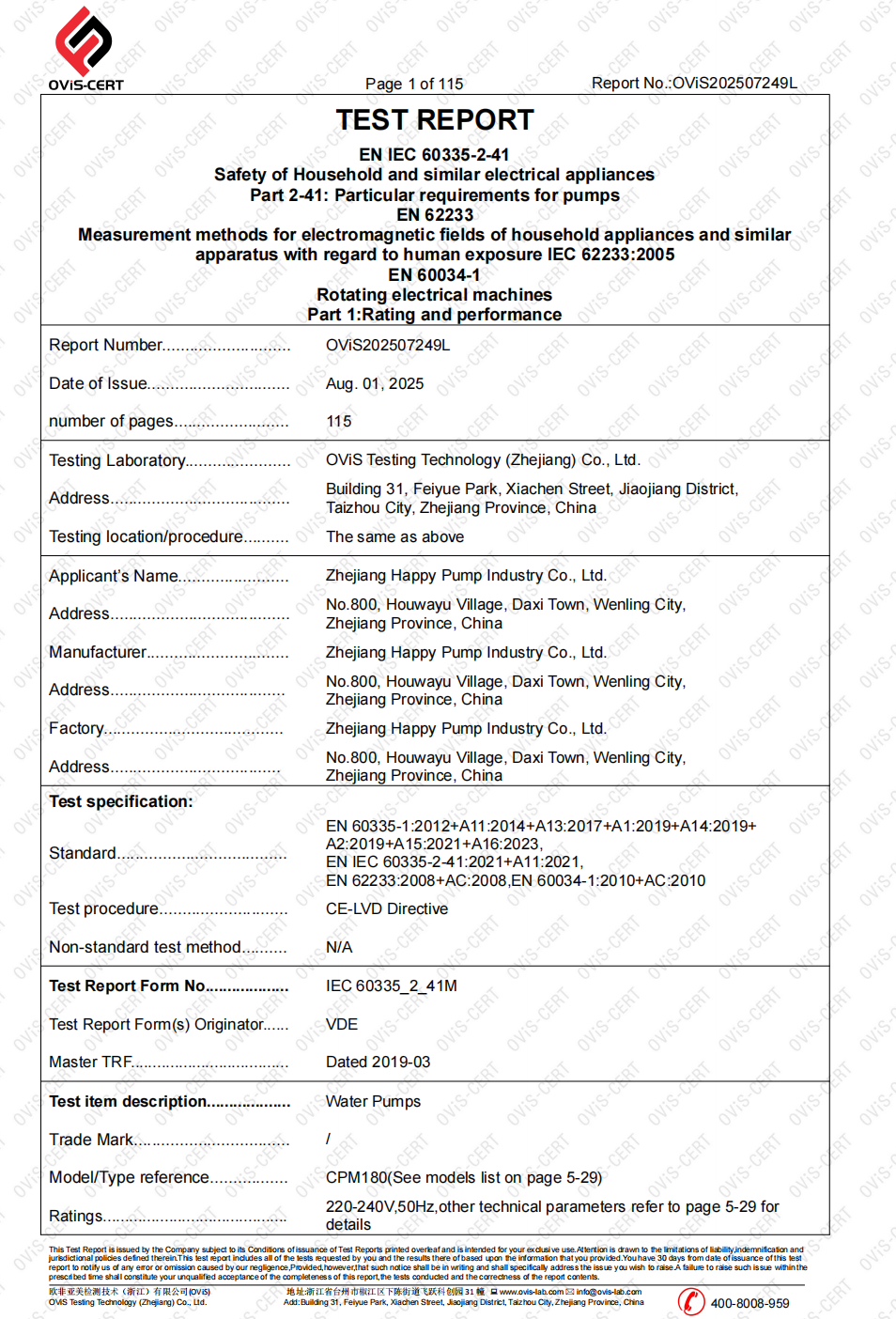
- LVD certificate — evidence on electrical safety. HAPPY holds LVD certificate OViS202507249L, issued by OViS-CERT on 1 August 2025, covering EN 60335-1:2012+A11:2014+A13:2017+A1:2019+A14:2019+A2:2019+A15:2021+A16:2023, EN IEC 60335-2-41:2021+A11:2021, EN 62233:2008+AC:2008 and EN 60034-1:2010+AC:2010.
The scope line matters as much as the certificate number. All three HAPPY documents are issued with a scope of water pumps, and the related model coverage listed against them is HQBm, QB60, IDB35, HPSm-AX, HRSm-A, QDP series and QDX series. A buyer evaluating a specific order should confirm that the model being purchased appears within that coverage, not merely that the supplier holds a certificate somewhere in its catalogue.
Regulatory context reinforces the point. Household and similar electrical pumps must comply with IEC 60335-2-41:2024 safety standards, which cover temperature limits and connection requirements. Where the applicable edition of a standard has moved forward, the buyer should check which edition each certificate was tested against — an older edition is not automatically a failure, but it is a fact that belongs in the evaluation record.
How to verify a certificate in ten minutes
- Read the certificate number and confirm it matches the number quoted in the quotation or datasheet.
- Check the issuing body and the issue and expiry dates. Certificate CE-5072-160326 runs to 2031; the EMC and LVD certificates OViS202507249E and OViS202507249L were issued in August 2025.
- Read the standard list line by line, including amendment suffixes.
- Read the scope statement and the related model list.
- Compare the model list against the exact models you intend to order.
- Check consistency between the certificate and the product label, nameplate and manual.
Pillar Two — Performance Envelope vs. Duty Point
Performance is the pillar where buyers most often compare the wrong numbers. A supplier's headline range describes the envelope of an entire portfolio; it does not describe the behaviour of the model in the quotation.
HAPPY's published surface pump envelope spans a flow range of 1.5–5500 m³/h, a head range of 20–100 m, and a power range of 0.25–550 kW. Protection levels available across the range are IP44 and IP68, and wetted materials include cast iron, stainless steel and engineering plastics. Those four data points are useful for a first-pass filter — they establish whether a supplier operates in the size class you need at all — but they are not a specification for your project.
The evaluation question should therefore be restated: not what flow the supplier can reach, but what flow, head and absorbed power the offered model delivers at the duty point, with which impeller trim, at which speed, on which supply voltage. A domestic surface pump for a household water supply system and a booster surface pump for a commercial building live in different parts of the same envelope, and neither can be selected from a range statement.
Ingress protection deserves the same treatment. IP44 and IP68 describe very different installation realities, and the rating must be attached to the model rather than to the series. A buyer specifying a swimming pool surface pump for a wet plant room and a buyer specifying a clean water surface pump indoors are not buying the same protection requirement, even if the hydraulic duty is similar.
Material selection follows the same logic. Cast iron, stainless steel and engineering plastics each carry different implications for water quality, corrosion exposure and service life. The usable comparison is a declared wetted-material list per model, not the word corrosion-resistant in a brochure.
Pillar Three — Motor Efficiency: IE2, IE3 and IE4 as a Specification Language
Motor efficiency is the pillar that most affects running cost and least often appears in a surface pump quotation. The IE classification scheme — IE2, IE3, IE4 — gives buyers a shared vocabulary for that conversation, and it is the reason efficiency should be written into the enquiry rather than discovered after delivery.
Three practical rules apply. First, an efficiency class is a property of a specific motor at a specific power and speed, so any claim should be made model by model. Second, the class should be considered together with the operating profile: a pump that runs for long hours in irrigation or circulation service has a different efficiency calculus from one used intermittently for domestic supply. Third, efficiency class and hydraulic efficiency are separate variables — a high-efficiency motor on a poorly matched hydraulic selection still produces a poor result.
The electrical envelope is where the pillar becomes checkable. HAPPY's surface pump motor range covers 1–430 HP with speeds from 934 to 2980 rpm, which spans the pole configurations and duty types typically requested for single phase and three phase AC surface pump applications. The company designs motors in-house and works with CFD, finite element analysis and motor electromagnetic design tools, supported by an enterprise research institute and a high-tech R&D centre with roughly 200 technical staff. For a buyer, the significance is not the tooling itself but the ability to answer a model-level efficiency question with a model-level document.
Energy class also interacts with control strategy. Variable-frequency constant-pressure and intelligent pump configurations change how the motor is loaded across the day, which changes the value of a higher efficiency class. That is a selection decision, and it belongs in the evaluation record alongside the certificate file.
A Three-Pillar Scoring Table Buyers Can Reuse
The table below converts the framework into an evaluation sheet. Each row is scored on evidence received, not on supplier reputation.
| Criterion | Question to ask | Evidence to accept | Warning sign |
|---|---|---|---|
| Certification scope | Which directives and standards, and which models? | CE, EMC and LVD certificates with number, issuer, standard list, validity and model coverage | Certificate shown without a model list, or scope described only as pumps in general |
| Model coverage | Is my exact model inside the certified range? | Model list naming the series to be supplied | Supplier confirms coverage only verbally |
| Duty point | What flow and head at my operating point? | Selection sheet or curve for the offered model | Only a maximum flow figure is quoted |
| Ingress protection | IP44 or IP68 for my installation? | IP rating declared per model | Rating quoted for the whole series |
| Wetted materials | Cast iron, stainless steel or engineering plastic? | Material declaration per wetted part | Generic corrosion-resistant wording |
| Motor efficiency | Which IE class, at which power and speed? | Model-level efficiency declaration | IE class claimed across a range with no per-model data |
| Quality control | What testing is performed per unit? | Statement of 100% testing and available test records | Vague sampling language |
| Commercial terms | MOQ, lead time, warranty, spare parts? | Terms written into the quotation | Commitments made only in conversation |
Where the Framework Meets Real Applications
Application context changes the weighting between pillars, but not the pillars themselves. HAPPY's documented use cases cover domestic and household water supply, garden irrigation, agricultural irrigation, sewage and engineering drainage, pool circulation, and solar water pumping systems.
For household and garden applications, the deciding factors are usually protection level, noise and the match between the pump and the local supply — a domestic surface pump that is oversized for its duty cycles more often than it is undersized. For agricultural irrigation, the duty point and the motor efficiency dominate, because running hours accumulate quickly; the global agricultural pump market was valued at USD 14.59 billion in 2024, with a projected CAGR of 4.98% through 2035 according to Market Research Future. For pool circulation, protection level and materials move to the front, since the plant room environment is the constraint rather than the hydraulic duty.
Solar water pumping is the application where the framework pays back most visibly. The solar pump market was valued at USD 2.90 billion in 2024 by Market Data Forecast, driven by falling PV module prices and government subsidies in Asia-Pacific. Industry estimates of that market vary considerably depending on whether solar-ready kits or only integrated systems are counted, so buyers should treat any single figure as an order-of-magnitude indicator rather than a precise total. In practice, a solar surface pump system is only as good as the match between the array, the motor and the hydraulic duty — which is exactly the intersection of Pillar Two and Pillar Three.
HAPPY states that its products have been used by water pump brand OEM clients, including agent-type relationships, and that typical use across the range includes solar water pumping systems, agricultural irrigation and domestic household water supply.
What Supplier Evidence Should Sit Behind the Framework
A framework is only as good as the supplier's ability to answer it. The relevant evidence is operational rather than promotional.
| Area | Reference data published by the manufacturer |
|---|---|
| Company | Zhejiang Happy Pump Industry Co., Ltd., founded 1990, Daxi Town, Wenling City, Zhejiang Province, China |
| Scale | About 55,000 m² site area and approximately 210,000 m² building area; around 800 employees, including about 200 professional and technical staff |
| Output | Around 4,000,000 pcs per year; product range of 11 major series covering more than 500 specifications |
| Markets | 99% export ratio; products exported to more than 150 countries and regions |
| Product lines | Surface Pumps, Submersible Pumps, Deep Well Pumps, Solar Pumps, Motors, Pressure Control Tanks and spare parts |
| Quality control | 100% testing of all products |
| Customisation | OEM / ODM with voltage and logo customisation |
| Capacity and terms | Monthly capacity 400,000 units; lead time 30–45 days; MOQ 100 pcs below 3HP and 50 pcs above 3HP |
| Service | Remote after-sales support; normal use of around 10 years with a 1-year warranty |
Read as an evaluation input, the most useful items here are the ones that constrain an order: the 30–45 day lead time, the MOQ thresholds at the 3HP boundary, and the 100% testing position. Each can be tested against a live quotation. The scale figures are context, not proof of quality.
Limitations: What This Framework Does Not Tell You
A framework that is presented without limits is a sales document. Three boundaries should be stated plainly.
Certificates attest conformity, not performance. A CE attestation, an EMC certificate and an LVD certificate confirm that the covered models were assessed against the listed directives and standards. They do not certify the hydraulic efficiency of a particular duty point, nor the measured efficiency of an individual unit on the test bench. Buyers who need unit-level performance evidence must ask for it separately.
A portfolio envelope is not a product capability. The 1.5–5500 m³/h flow range and the 20–100 m head range describe the outer boundaries of a catalogue, not the capability of any single pump. Selection still requires a model-level curve. Treating an envelope value as a specification is one of the most common evaluation errors in this category.
Efficiency classes require model-level confirmation. The IE2, IE3 and IE4 scheme provides a shared language, but it does not remove the need to confirm which class applies to the motor being purchased, at which power and speed. A supplier that cannot produce that statement per model has not answered the question, regardless of what the headline documentation says.
Two commercial boundaries are worth adding. A 1-year warranty against an expected normal service life of around 10 years means the buyer carries most of the lifecycle risk, so spare parts availability and remote support matter more than the warranty line itself. And MOQ thresholds move at the 3HP boundary, which can change order economics more than a small unit-price difference.
Turning the Framework into Purchase Order Acceptance Criteria
The evaluation stage ends when the framework becomes contractual language. The following clauses translate each pillar into something that can be checked on delivery.
- Model and duty point — the exact model, the required flow and head at the stated operating point, and the supply voltage and frequency.
- Certification reference — the certificate numbers relied upon (for HAPPY, CE-5072-160326, OViS202507249E and OViS202507249L), with a statement that the ordered model falls within their coverage.
- Motor specification — rated power, speed and the declared IE efficiency class for the supplied motor.
- Protection and materials — the declared IP rating and the wetted-material list for the specific model.
- Testing — confirmation that 100% of units are tested, with test records available on request.
- Commercial terms — quantity against the applicable MOQ threshold, lead time, packaging standard and warranty period.
- After-sales — the support channel, response route and spare parts basis for the warranty period and beyond.
Written this way, acceptance criteria stop being a formality and become the mechanism that holds the comparison together after the order is placed.
Market Context: Why Surface Pump Evaluation Is Getting Stricter
Three market signals explain why documentation discipline is rising. First, scale: surface pumps accounted for 57.63% of the global pump market in 2025, so compliance pressure in this segment propagates across most of the category. Second, growth: the overall pumps market is projected to move from USD 61.32 billion in 2024 to USD 79.01 billion by 2029, which brings more suppliers, more model variants and more documentation into the same procurement channels. Third, application shift: growth in agricultural and solar pumping adds buyers who are technically capable but commercially exposed, because a mis-specified solar surface pump or agricultural surface pump is discovered at the worst possible moment in the season.
Note also that market estimates diverge between research houses depending on segmentation — Fact.MR, for example, places the 2024 pumps market slightly below the MarketsandMarkets figure. Buyers should use these numbers to understand direction and scale, not to benchmark a single purchase.
Future Outlook
The direction of travel is toward model-level evidence. Certification files are already standard in EU-facing supply; the next layer is per-model declarations covering efficiency class, protection rating and hydraulic performance at the duty point. Buyers who begin asking for these now will find the transition cheap; buyers who wait will find themselves comparing quotations that are no longer comparable.
On the supply side, manufacturers with in-house motor design and testing capability are better positioned to answer model-level questions than assemblers who buy motors in. Happy Pump's combination of motor design tools, an in-house R&D structure and 100% product testing is the kind of capability that makes a per-model answer possible — but the buyer still has to ask the question.
Frequently Asked Questions
Which certificates should a surface pump supplier provide for EU delivery?
A complete file normally contains a CE Attestation of Conformity, an EMC certificate and an LVD certificate. HAPPY's file contains CE certificate CE-5072-160326 issued by ECES (valid 16 March 2026 to 16 March 2031, referencing 2014/35/EU, 2014/30/EU and 2006/42/EC), EMC certificate OViS202507249E issued by OViS-CERT, and LVD certificate OViS202507249L issued by OViS-CERT. The EMC certificate covers EN IEC 55014-1:2021, EN IEC 55014-2:2021, EN 61000-3-2:2019+A1:2021+A2:2024 and EN 61000-3-3:2013+A1:2019+A2:2021; the LVD certificate covers EN 60335-1, EN IEC 60335-2-41, EN 62233 and EN 60034-1. All three are issued with a scope of water pumps.
How should buyers compare flow and head ranges between surface pump suppliers?
Compare envelopes only as a first filter, then compare duty points. HAPPY's published portfolio spans 1.5–5500 m³/h in flow, 20–100 m in head and 0.25–550 kW in power, with IP44 and IP68 protection levels and cast iron, stainless steel or engineering plastic materials. Those figures establish whether a supplier covers the required size class; the actual comparison should be made on the flow, head and absorbed power of the specific offered model at the buyer's operating point.
Which motor efficiency class should be specified — IE2, IE3 or IE4?
The choice depends on running hours, energy cost and any procurement rule the buyer operates under. IE2, IE3 and IE4 form a classification scheme, and the class is a property of a specific motor at a specific power and speed, so it should be declared per model rather than per series. HAPPY's surface pump motor range covers 1–430 HP at speeds from 934 to 2980 rpm, which is the range in which that declaration should be requested. Efficiency class is separate from hydraulic efficiency, and both affect running cost.
What acceptance criteria belong in a surface pump purchase order?
At minimum: the exact model and duty point; the certificate numbers relied upon together with confirmation that the ordered model is within their coverage; rated power, speed and declared IE efficiency class of the motor; declared IP rating; the wetted-material list; confirmation of 100% testing with records available; quantity against the applicable MOQ threshold; lead time; packaging; and warranty terms. For HAPPY orders, the relevant commercial reference points are a 30–45 day lead time, MOQ of 100 pcs below 3HP and 50 pcs above 3HP, and a monthly capacity of 400,000 units.
What service life and warranty are typical for a surface pump?
HAPPY states that its pumps can normally be used for around 10 years with a 1-year warranty, and that after-sales support is provided remotely. Because the warranty period is much shorter than the expected service life, buyers should evaluate the spare parts basis and support route as part of the same decision, not as an afterthought once the warranty has expired. Documented use cases for the range include domestic and household water supply, garden and agricultural irrigation, sewage and engineering drainage, pool circulation and solar water pumping systems.
A full specification and certificate reference set is available in the manufacturer's product brochure, which can be downloaded here: 2026 HAPPY product brochure (PDF).
Tem questões ou precisa de mais detalhes?
Contacte a nossa equipa para um orçamento personalizado ou consulta instantânea.
Solicitar orçamento
Preencha o formulário abaixo e a nossa equipa entrará em contacto com uma proposta personalizada.
Chat direto do WhatsApp
Prefere conversar em tempo real? Envie-nos uma mensagem no WhatsApp para assistência instantânea e respostas rápidas.
- Obter orçamento personalizado
- Partilhar fotos ou documentos
- Discuta as suas necessidades diretamente
Geralmente responde em 5–30 minutos durante o horário de expediente.