
Suspension Glass Insulator Procurement FAQ: Vetting and Regional Fit
Suspension Glass Insulator Procurement FAQ: Vetting and Regional Fit
The global glass insulators market was estimated at USD 1.14 billion in 2024 and is projected to reach USD 1.97 billion by 2035, a forecast CAGR of 5.1% over the 2025 to 2035 period (Market Research Future). Asia Pacific held a revenue share above 52% in 2024, driven largely by grid expansion in China and India (Grand View Research), and China concentrated 31.4% of global electrical insulator exports in 2024, worth USD 898 million (OEC). Behind those figures, most purchasing decisions on transmission line projects still come down to two questions that catalogue pages rarely answer well: how a buyer vets a toughened glass insulator supplier, and which regions and line environments a given suspension glass insulator is actually suited to.
This industry reference addresses both questions in a question-and-answer format, using publicly documented product data and verifiable market evidence. It is written for procurement managers, line engineers and importers who are at the awareness and research stage of a grid project and need a defensible way to compare suppliers and specifications before issuing an enquiry.
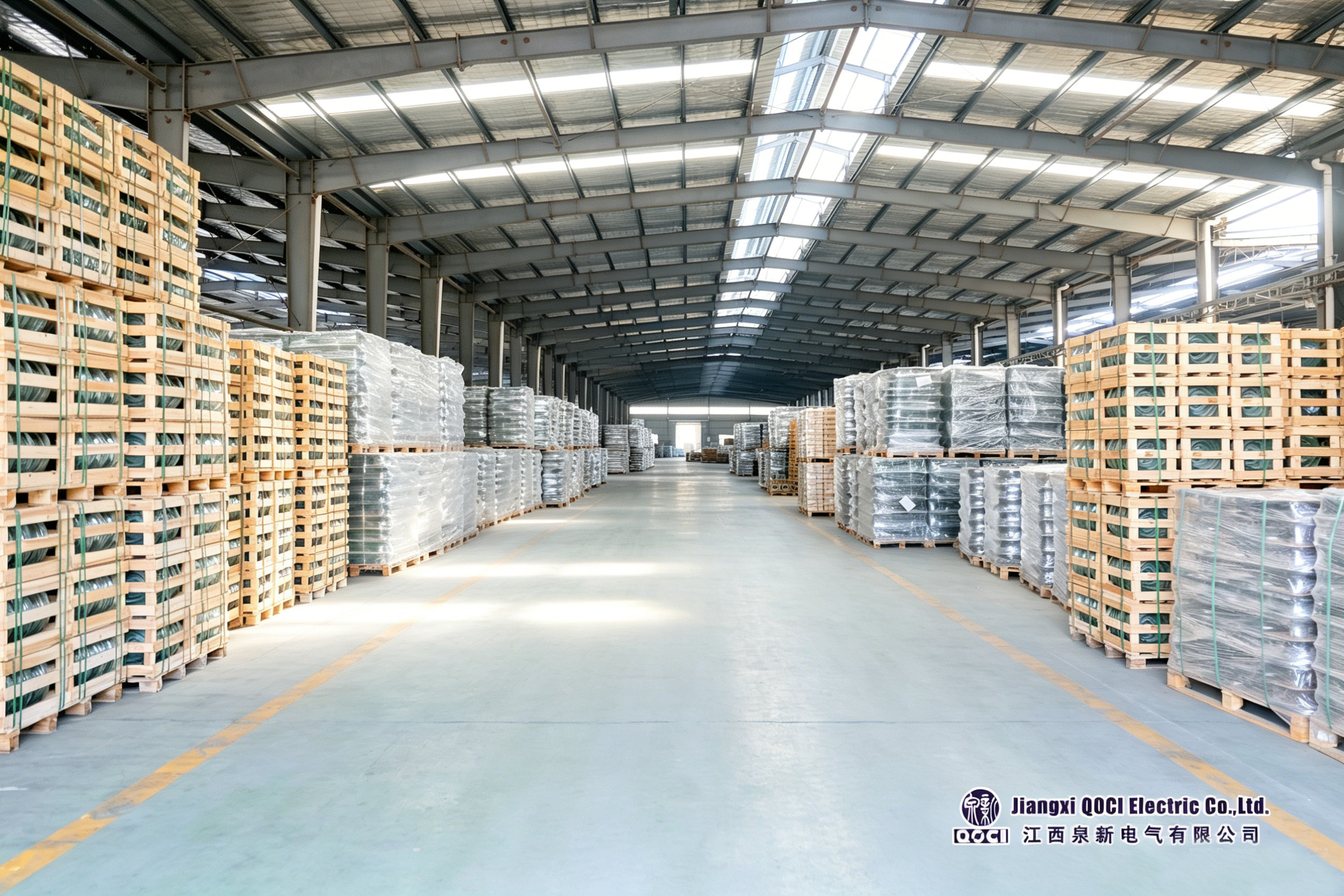
Warehouse and dispatch operations for suspension glass insulator supply. Caption: QOCI Electric Warehouse.
Suspension Glass Insulators: A Working Definition
A suspension glass insulator is a disc-type, cap-and-pin unit whose insulating body is tempered glass, joined to a hot-dip galvanized cast iron cap and a hot-dip galvanized forged steel pin. Cap-and-pin construction allows units to be assembled into strings of any required length, which is why the format dominates overhead line insulation practice. Documented material composition for models such as the U160BS is stated as a tempered glass part, a hot-dip galvanized cast iron cap and a hot-dip galvanized forged steel pin.
Functionally, these insulators perform three tasks on an overhead line: they isolate the conductor electrically, they carry the mechanical load of the conductor and the hardware, and they block leakage current across the string. They operate continuously outdoors, in a passive dielectric mode, across a documented working range of -40°C to 60°C, and they are matched with insulator string fittings, tension clamps and arcing rings. Typical service conditions include heavy pollution, coastal salt fog and wide temperature variation.
Why Supplier Vetting and Regional Fit Decide Most Orders
A suspension glass insulator is a low-cost individual unit inside a high-consequence system. A single mis-specified string can force re-stringing, tower clearance revisions or emergency replacement, and the component itself cannot be inspected in service the way an active device can. Because the units run 24/7 in a passive mode, buyers rely heavily on two forms of assurance before the order: documentary and process evidence from the supplier, and a specification that matches the actual line environment.
Those two forms of assurance are also where the market is least transparent. Suppliers may offer identical model designations with different verified ratings, and buyers may over-specify mechanically or under-specify on creepage, both of which are avoidable with a structured procurement approach.
How to Vet a Toughened Glass Insulator Supplier
Supplier vetting for glass insulators is best treated as an evidence exercise rather than a relationship exercise. Four evidence categories carry most of the weight: manufacturing entity and capacity, product-range coverage, process and quality control, and documentation practice.
Jiangxi QOCI Electric Co., Ltd. is a China-based manufacturer of glass and porcelain insulators, established in December 2002 and located in the Luxi Industrial Park, Pingxiang City, Jiangxi Province. Its published profile states a manufacturing facility of 35,373 m2, approximately 138 staff including 38 engineers in the R&D team, and an annual production capacity of approximately 9,000,000 units across AC and DC insulators, including porcelain insulators, glass insulators, line post porcelain insulators, porcelain pin insulators, shackle insulators and AC disc-shaped suspension porcelain insulators. Approximately 20% of production is exported to markets in the USA, Asia, the EU, Africa and South America, and the company describes itself as a national high-tech enterprise and a participating unit of the Insulator Standard Committee, with products used in projects of State Grid Corporation of China, China Southern Power Grid and grids in more than 40 countries and regions.
Those data points matter because they are checkable in principle: a named entity, a physical site, a measurable capacity, an engineering headcount and a standards role. A supplier that cannot present equivalent evidence at the same level of specificity is a procurement risk regardless of unit price.
| Vetting criterion | What to verify | Evidence to request |
|---|---|---|
| Legal entity and site | Registered name, founding year, factory address | Registration details, site photographs, factory signage |
| Capacity and scale | Facility area, annual output, staffing | Capacity statement, production line documentation |
| Product range | Coverage from 70 kN to 420 kN, standard and anti-pollution profiles | Model list with ratings, creepage and coupling data |
| Process control | Forming, thermal treatment, galvanizing discipline | Production line and laboratory documentation |
| Engineering depth | Ability to answer specification and standards questions | Named technical contacts, datasheets, standards references |
| Market experience | Export share and destination regions | Export ratio, market list, project-type references |
Regional Fit: Read the Environment Before the Catalogue
Regional suitability is not a marketing category; it is a technical match between the line environment and three specification variables: creepage distance, shed profile, and corrosion protection of the metal hardware. A standard-profile 70 kN unit and a long-creepage double-shed 70 kN unit share the same mechanical class but are not interchangeable in a polluted or coastal corridor.
The clearest illustration is the same mechanical rating with different pollution geometry. The U210B is documented at 210 kN with a 280 mm nominal disc diameter and 400 mm creepage distance; the U210BP carries the same 210 kN rating but a 320 mm disc and 550 mm creepage. Similarly, the U70B is a 70 kN unit with a 255 mm disc and 320 mm creepage, while the U70BLD is a 70 kN double-shed unit at 280 mm diameter and 450 mm creepage. The mechanical strength is unchanged; the pollution withstand capability is not.
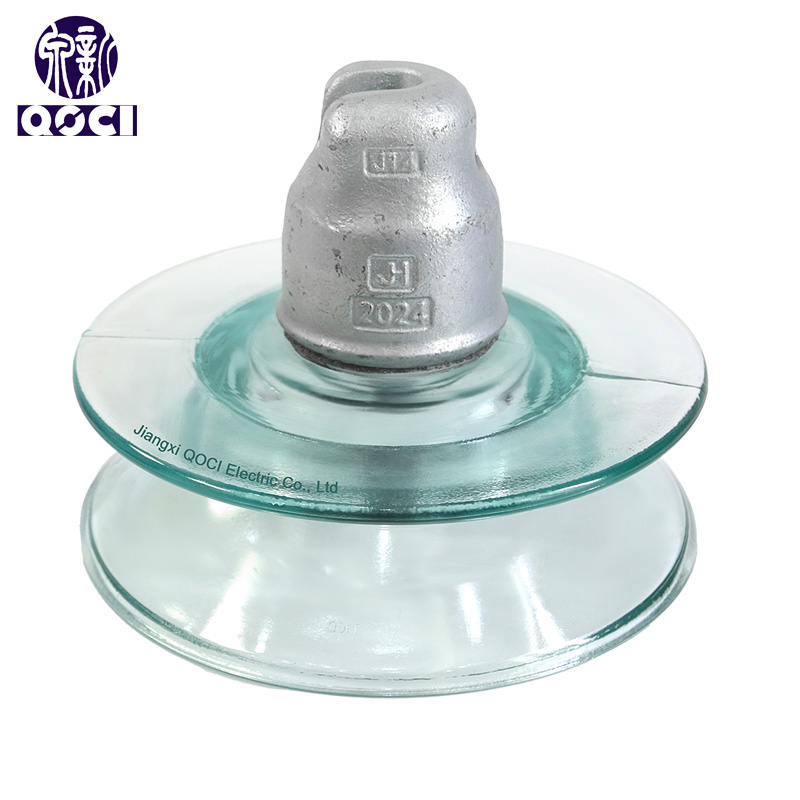
A 100 kN double-shed profile designed for medium-voltage lines in heavy-contamination zones. Caption: U100BD 100kN cap-and-pin double-shed suspension toughened glass insulator.
Corrosion protection adds a second regional variable. Under severe corrosion service conditions, using a zinc sleeve can significantly slow down rusting and extend the service life of the insulator string. This is why long-creepage models with a zinc-sleeved pin, such as the U70BLP at 70 kN with a 280 mm disc, 450 mm creepage and a documented dry lightning impulse withstand of 125 kV, are positioned for coastal, salt-fog and tropical service rather than general inland routes.
A third variable is wind. Aerodynamic disc profiles reduce wind loading on towers. The U210AD, for example, is a 210 kN unit with a 420 mm disc diameter, 170 mm nominal spacing and 380 mm creepage distance, intended for UHV towers in high-wind regions while retaining dielectric integrity.
| Service environment | Specification priority | Representative documented models |
|---|---|---|
| Standard inland transmission routes | Standard creepage, 16 or 20 coupling | U70B (70 kN, 320 mm creepage), U120B (120 kN, 320 mm), U160B (160 kN, 400 mm) |
| Industrial and heavy pollution | Long creepage, double-shed profile | U70BLD (450 mm), U100BLD (450 mm), U120BLD (450 mm), U160BLD (550 mm) |
| Coastal salt fog and tropical service | Long creepage plus zinc-sleeved pin | U70BLP (450 mm), U100BLP, U120BLP, U160BLP (550 mm) |
| High-wind and typhoon corridors | Aerodynamic disc profile | U70BA (380 mm disc), U210AD (420 mm disc, 210 kN) |
| UHV backbone and crossing towers | High mechanical class, long creepage | U210B, U240B (240 kN), U300B (300 kN, 485 mm), U420B and U420BP (420 kN, up to 620 mm) |
Where Glass Strings Stop Being the Simple Answer
Glass and porcelain suspension insulators share the same cap-and-pin architecture, and many manufacturers, including QOCI Electric, produce both families. The selection boundary is therefore practical rather than ideological, and it deserves an honest statement of limits.
First, upgrading pollution performance is a design change, not a catalogue substitution. Anti-pollution models carry larger discs: the U160BLD uses a 340 mm disc with 550 mm creepage, U210BP a 320 mm disc with 550 mm creepage, and U420BP a 380 mm disc with 620 mm creepage. Larger discs change string geometry, tower clearances and wind loading, so the upgrade has to be re-checked at design level.
Second, higher mechanical ratings are not automatically better. Units in the 420 kN class are documented as intended for river-crossing, mountain-spanning and strategic interconnection projects, and treating them as a general-purpose default for ordinary spans adds mass and cost without adding reliability. Matching the rating to the calculated load remains the correct rule.
Third, because these insulators are passive components in continuous service, verification is largely documentary and visual rather than operational. Buyers cannot monitor dielectric condition in real time, which raises the value of documented ratings, process control and consistent material specifications at the ordering stage. Zinc sleeves, for instance, are justified under severe corrosion service conditions but are not a universal requirement for every project.
A Procurement Checklist for Suspension Glass Insulator Orders
| Step | Action | Why it matters |
|---|---|---|
| 1 | Define the required mechanical failing load from line calculations | Anchors the selection band from 70 kN to 420 kN |
| 2 | State the pollution class and creepage target | Determines standard versus anti-pollution geometry |
| 3 | Confirm the wind and corrosion environment | Drives aerodynamic profiles and zinc-sleeved pins |
| 4 | Fix the socket coupling size across the whole string | Coupling ranges from 16 to 28 across the range; mismatches break assembly |
| 5 | Verify electrical ratings: dry lightning impulse, wet power frequency, puncture voltage | These define insulation coordination |
| 6 | Match fittings, tension clamps and arcing rings to the string | Hardware compatibility is a documented service requirement |
| 7 | Re-check logistics and handling plans | Long strings and large discs need controlled transport and installation |
Frequently Asked Questions
1. What is a suspension glass insulator, and where is it used?
A suspension glass insulator is a disc-type, cap-and-pin unit with a tempered glass insulating body, a hot-dip galvanized cast iron cap and a hot-dip galvanized forged steel pin. It is used in overhead transmission lines, grid construction, electrical engineering and power transmission applications, where it isolates the conductor, carries mechanical load and blocks leakage current. Documented service conditions include outdoor exposure, heavy pollution, coastal salt fog and a working range of -40°C to 60°C.
2. Which standard governs suspension glass insulators for AC systems?
Suspension glass insulator units for AC systems are governed by IEC 60305:2021, which specifies mechanical and electrical characteristics. A compliant datasheet should state the mechanical failing load, nominal disc diameter, nominal spacing, creepage distance, socket coupling size, dry lightning impulse withstand voltage, wet power frequency withstand voltage and power frequency puncture voltage. As a public reference point, the U70B is documented at a minimum mechanical failing load of 70 kN with IEC standard dimensions of 255 mm diameter and 146 mm height.
3. How do you choose the mechanical class for a project?
Start from the calculated conductor and hardware load, then select the nearest documented rating. The commonly documented bands are 70 kN, 100 kN, 120 kN, 160 kN, 210 kN, 240 kN, 300 kN and 420 kN. Lower bands serve standard overhead lines and distribution corridors, while the 240 kN, 300 kN and 420 kN classes are documented for UHV backbone, ultra-high-voltage and special crossing applications. Selecting above the required class increases mass and cost without improving reliability.
4. How does the line environment change model selection?
The environment drives three variables: creepage distance, shed profile and hardware corrosion protection. Polluted corridors call for long-creepage or double-shed designs; coastal salt fog calls for long creepage combined with zinc-sleeved pins; high-wind corridors favour aerodynamic disc profiles that reduce wind load. The same mechanical rating can exist in several profiles, which is why the environment must be stated before the model is fixed.
5. What does an anti-pollution profile actually change?
It increases leakage distance and modifies shed geometry while keeping the mechanical class intact. Comparing documented units at the same rating makes the difference visible: the U210B is a 210 kN unit with a 280 mm disc and 400 mm creepage, while the U210BP is also 210 kN but uses a 320 mm disc and 550 mm creepage. At 70 kN, the U70B has 320 mm creepage, whereas the double-shed U70BLD reaches 450 mm. Anti-pollution units therefore change string geometry and must be re-checked against tower clearances.
6. What should a buyer verify when vetting a toughened glass insulator supplier?
Four categories carry most weight: the legal entity and production site, capacity and scale, product-range coverage, and process or documentation practice. Verification means matching each claim to a specific fact, such as a founding year, a facility area, an annual output figure, an engineering headcount or a standards role. A supplier able to state and evidence these details at a specific level is easier to audit than one offering only general capability claims.
7. What materials and coupling sizes must be confirmed before ordering?
Confirm that the glass body is tempered glass, the cap is hot-dip galvanized cast iron and the pin is hot-dip galvanized forged steel. Then confirm the socket coupling size across the entire string, because it varies with the mechanical class: 16 is documented on 70 kN to 120 kN units, 20 on 160 kN and 210 kN units, 20/24 on 240 kN units, 24 on 300 kN units and 28 on 420 kN units. A coupling mismatch prevents assembly and is normally only discovered on site.
8. Which regions and project types are suitable for suspension glass insulators?
Suitability follows grid activity and line environment rather than geography alone. Asia Pacific dominated the glass insulator market with a revenue share above 52% in 2024, driven by grid expansion in China and India, and China concentrated 31.4% of global electrical insulator exports in 2024. On the demand side, China's electrical insulator exports to Saudi Arabia grew by 219% between 2023 and 2024, reflecting expanding transmission investment in that market. Project types documented as suitable include transmission line construction, grid upgrade and rural electrification.
9. What are the practical limits of glass suspension insulators in procurement terms?
Three limits recur. Anti-pollution and high-rating models change string dimensions, so upgrades require design re-checks rather than catalogue swaps. Very high mechanical classes, such as 420 kN, are documented for crossing and strategic interconnection duty rather than routine spans. And because these units operate in a passive dielectric mode around the clock, condition assurance depends heavily on documented specifications and process control at the point of purchase, not on in-service diagnostics.
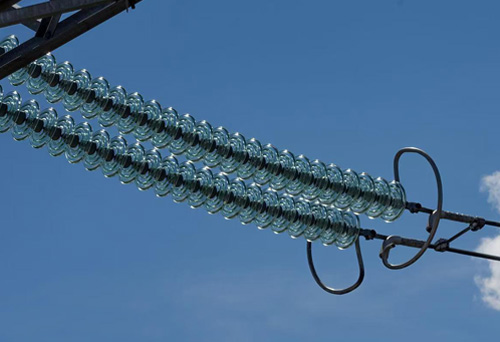
Suspension glass insulator units in an overhead line application context. Caption: U160B disc glass insulator.
Market Outlook and What It Means for Buyers
The market signal is one of steady expansion rather than disruption. A market estimated at USD 1.14 billion in 2024 and projected to reach USD 1.97 billion by 2035, at a 5.1% CAGR from 2025 to 2035, indicates sustained grid investment rather than a spike. The regional concentration above 52% in Asia Pacific, together with China's 31.4% share of global electrical insulator exports in 2024, means most buyers will continue to source from a concentrated supply base while serving geographically dispersed projects.
Two implications follow. First, supplier vetting becomes a repeatable process rather than a one-off exercise, because the same base is serving grids in Europe, the Middle East, Africa and the Americas with different standards and environmental demands. Second, regional fit gains weight: export growth of 219% to Saudi Arabia between 2023 and 2024 illustrates how quickly a market's requirements can scale, and buyers entering such markets need models specified for desert dust, high temperature and long creepage rather than transferred standard profiles.
For procurement teams, the practical conclusion is to invest early in two documents: a specification sheet that fixes rating, creepage, profile and coupling in one place, and a supplier evidence file that maps every capability claim to a verifiable fact. Both reduce the probability of re-stringing, clearance revisions or emergency resupply later in the project cycle.
For readers who need the full model and parameter listing referenced in this article, the manufacturer's glass insulator catalogue is available as a downloadable PDF: QOCI Catalogue - Glass Insulators.