
Sustainable Woven Fabric Shortlist: GOTS, GRS/RCS, Better Cotton, STeP
Sustainable Woven Fabric Shortlist: GOTS, GRS/RCS, Better Cotton, STeP
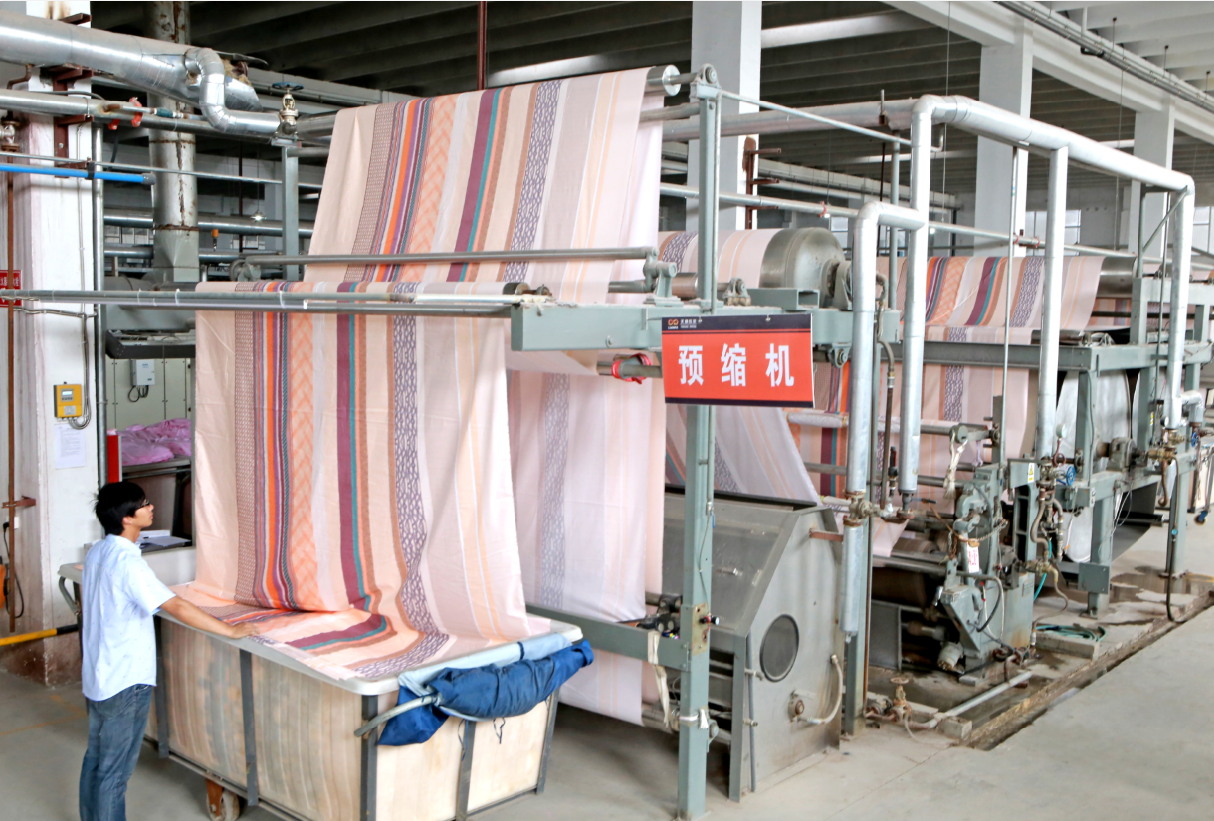
A shortlist for shirt and home-textile buyers whose brief already names a certification. Four certificate-backed options are ranked below by the strength of the product-level scope evidence each one can place in a purchase specification: GOTS Version 7.0, whose scope names dyed (PC0025) and printed (PC0039) woven fabric; the combined OCS V3.0, GRS V4.0 and RCS V2.0 scope, which carries the broadest fabric-category list; Better Cotton Chain of Custody, whose product field is dyed woven fabric; and OEKO-TEX STeP, a site-level certification whose linked products span yarn-dyed, printed, piece-dyed and ready-stock fabric and woven shirts.
The ranking measures one thing: how specifically a certificate ties a named standard to a fabric category a buyer can actually order. It is not a quality ranking, and none of the four documents is a product test report. A scope certificate states what a certified site is permitted to produce under a standard. It does not state that a particular roll, lot or shipment conforms. That distinction is what determines how each option should be used at the evaluation stage.
Why the scope certificate, not the logo, is the unit of comparison
Certification logos are marketing assets. Scope certificates are documents, and four fields on them matter to a buyer: the standards and versions covered, the product categories covered, the process steps covered, and the validity window. The first three decide whether a certificate can carry the claim a program needs. The fourth decides when that evidence has to be refreshed.
For woven fabric the product-category field usually appears as a code. PC0025 denotes dyed fabric, which in a woven mill normally means piece-dyed; PC0039 denotes printed fabric; PC0026 greige fabric; PC0027 undyed fabric; PC0029 dyed yarn. The codes matter because a shirting program and a bedding program can both be described loosely as certified woven fabric while sitting in different categories, and a certificate that names one category does not automatically reach the other.
Entity and site matter for the same reason. The four certificates discussed in this shortlist are held by Jiangsu Lianfa Textile Co., Ltd., the listed textile group whose operations run from cotton processing through yarn-dyed and printed fabric to garment production. Jamesfabric is the ready-stock woven fabric business inside Lianfa Group. A buyer sourcing ready-stock styles should confirm which legal entity and which production site a certificate covers for the order in hand, because scope does not transfer between entities.
The four options were ordered on four tests, applied in this sequence: whether the certificate names the fabric product category rather than referring only to textiles in general; whether it names the process steps used to make that fabric; whether the underlying claim rests on fibre content or on site management; and how long the evidence stays valid. Read in that order, the four separate cleanly.
1. GOTS Version 7.0 — dyed (PC0025) and printed (PC0039) organic woven fabric
GOTS leads the shortlist because it is the only option here that joins a fibre-content standard to printed fabric named both as a product category and as a process step, alongside piece-dyed fabric. Scope certificate CU805953GOTS-2026-00089439 was issued on 27 August 2026 by Control Union Certifications B.V. and is valid until 1 September 2027. The product categories listed are dyed fabrics (PC0025), undyed fabrics (PC0027), greige fabrics (PC0026) and printed fabrics (PC0039). The process categories are dyeing, finishing, pre-treatment, preparatory, printing, trading, warehousing and distribution of non-final products, and weaving.
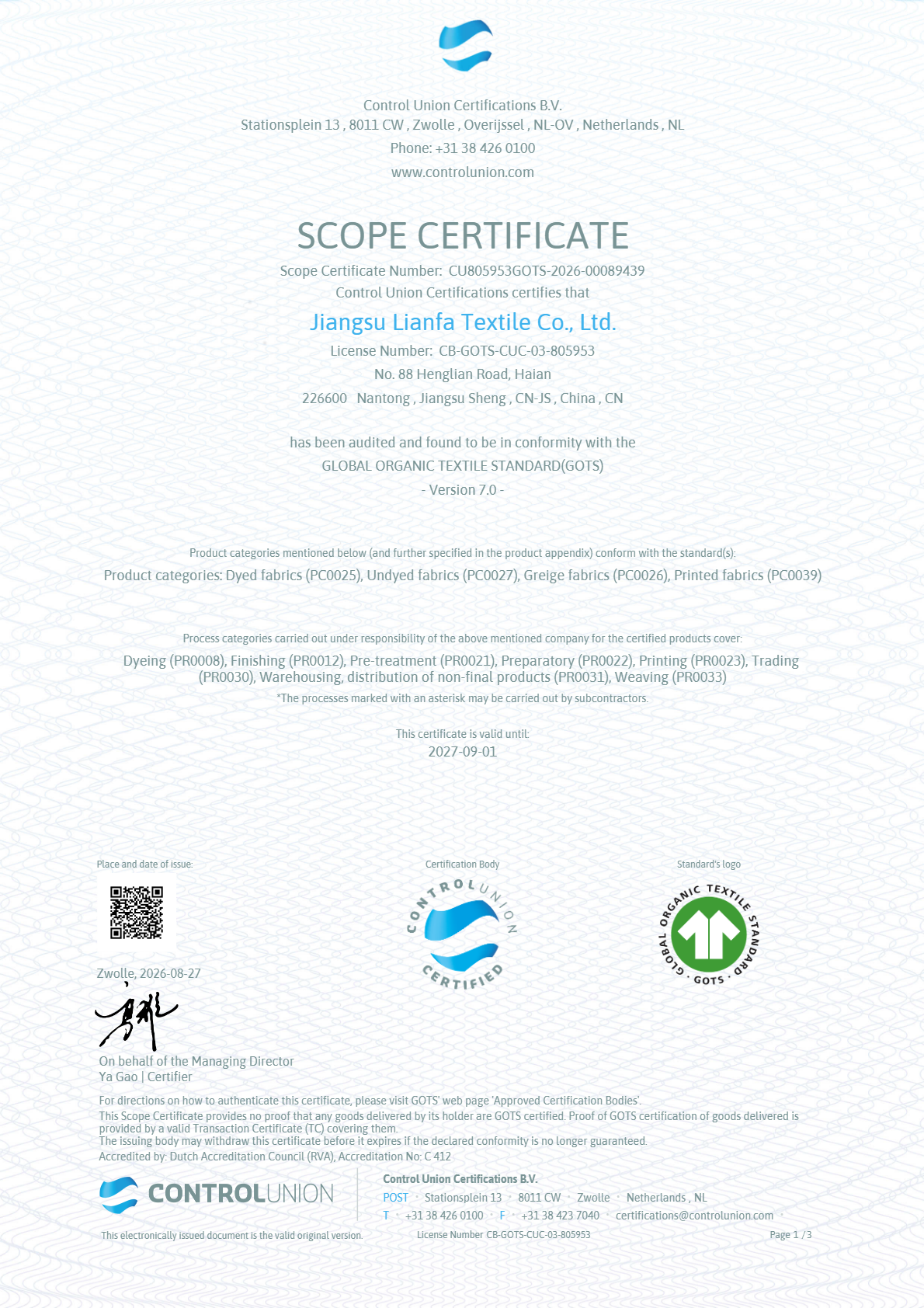
For a buyer building a solid-colour or print-led organic cotton range, this certificate answers two questions at once: whether the fabric category sits inside the standard, and whether the wet processes used to produce it sit inside the audit. That combination is why it ranks first for piece-dyed and printed programs rather than merely for organic programmes in the abstract.
The fit boundary is equally specific. GOTS is a content standard. The scope certificate shows that the certified site is permitted to handle GOTS goods in the listed categories and processes; it does not by itself demonstrate that a given fabric contains the organic content claimed. The normal route is to pair the scope certificate with per-order transaction documentation. A print developed or applied outside the certified printing step would sit outside this scope, and so would a fabric construction that falls into none of the four listed product categories.
2. OCS V3.0, GRS V4.0 and RCS V2.0 — the broadest fabric-category coverage
The second position goes to the separate Textile Exchange scope, certificate CU805953MUL-2026-00089440, issued on 2 September 2026 by Control Union Certifications B.V. and valid until 1 September 2027. It covers Organic Content Standard V3.0, Global Recycled Standard V4.0 and Recycled Claim Standard V2.0, together with the Content Claim Standard V3.1 and the Textile Exchange Standards Claims Policy V1.3. Its product categories are printed fabrics (PC0039), undyed fabrics (PC0027), dyed fabrics (PC0025), dyed yarns (PC0029) and greige fabrics (PC0026). Its process categories are collecting (PR0005), dyeing, finishing, pre-treatment, preparatory, printing, trading, warehousing and distribution of non-final products, and weaving.
On breadth of product categories this scope is the widest in the shortlist: five categories, including greige fabric and dyed yarn, which the GOTS scope reaches only at fabric level. For yarn-dyed programs in which colour enters the yarn before weaving, the dyed yarn line (PC0029) is the item that matters, because it places the colour stage itself inside the certified scope rather than only the subsequent fabric processes.
It ranks second rather than first because three standards share one certificate and they are not interchangeable. GRS and RCS address recycled content, OCS addresses organic content, and each standard carries its own claim rules. The certificate shows that the site is certified to operate all three; it does not mean that a single fabric carries all three claims. A purchase specification therefore has to name the standard the order requires, since a combined reference such as GRS/RCS/OCS certified is not in itself a claim that can be used on a product label.
The practical reading is straightforward. Choose this scope when the fibre story is recycled content, when the program needs organic content under OCS rather than GOTS, or when the order includes greige fabric or dyed yarn that has to sit inside a certified chain. Each of those routes then needs its own order-level substantiation, because the breadth of the scope certificate does not merge the claims.
3. Better Cotton Chain of Custody v1.0 — dyed woven fabric
Third position is Better Cotton Chain of Custody, certificate ITS-BC-00002500, issued by Intertek on 2 July 2025 under BCP No. 1002688-1 and valid until 1 July 2028. The standard is the Better Cotton Chain of Custody Standard v1.0. Four chain-of-custody models are listed: Mass Balance, Controlled Blending, Segregation for a single country, and Segregation across multiple countries. The product field names dyed fabrics, and the processes listed are pre-treatment, preparatory, weaving, dyeing and finishing.
The product field is the reason for its position. One category is named, which is narrower than the fabric lists on either Textile Exchange scope. Where a program is built on solid-colour piece-dyed cotton shirting, that single category is exactly what is needed. Where the brief also covers prints, yarn-dyed designs or greige trading, the certificate's product field does not extend to them, and the gap should be closed with a different document rather than assumed away.
Two features make this certificate genuinely useful in an evaluation file. The first is the choice of chain-of-custody models, which range from Mass Balance and Controlled Blending to single-country and multi-country Segregation. The models differ in how physical segregation is handled along the supply chain, so the operative question for a buyer is which model an order is placed under, rather than whether the supplier is simply described as Better Cotton. The second is the validity window: to 1 July 2028, the longest of the four documents reviewed here.
The boundary is a matter of scope rather than quality. Better Cotton chain of custody is a cotton sourcing and chain-of-custody scheme. It does not certify organic content, it does not certify recycled content, and it does not substitute for chemical or product-safety testing on the finished fabric.
4. OEKO-TEX STeP — site-level coverage across yarn-dyed, printed, piece-dyed, ready-stock fabric and woven shirts
Fourth place goes to OEKO-TEX STeP, certificate 18001268, issued by OEKO-TEX Service GmbH on 11 December 2024 and valid until 31 March 2028. The certified scope covers weaving, yarn-dyeing, printing and finishing. The certificate lists ZDHC MRSL 3.1 as its standard reference; the MRSL is a manufacturing restricted substances list applied to chemical inputs at the production stage rather than to the finished product.
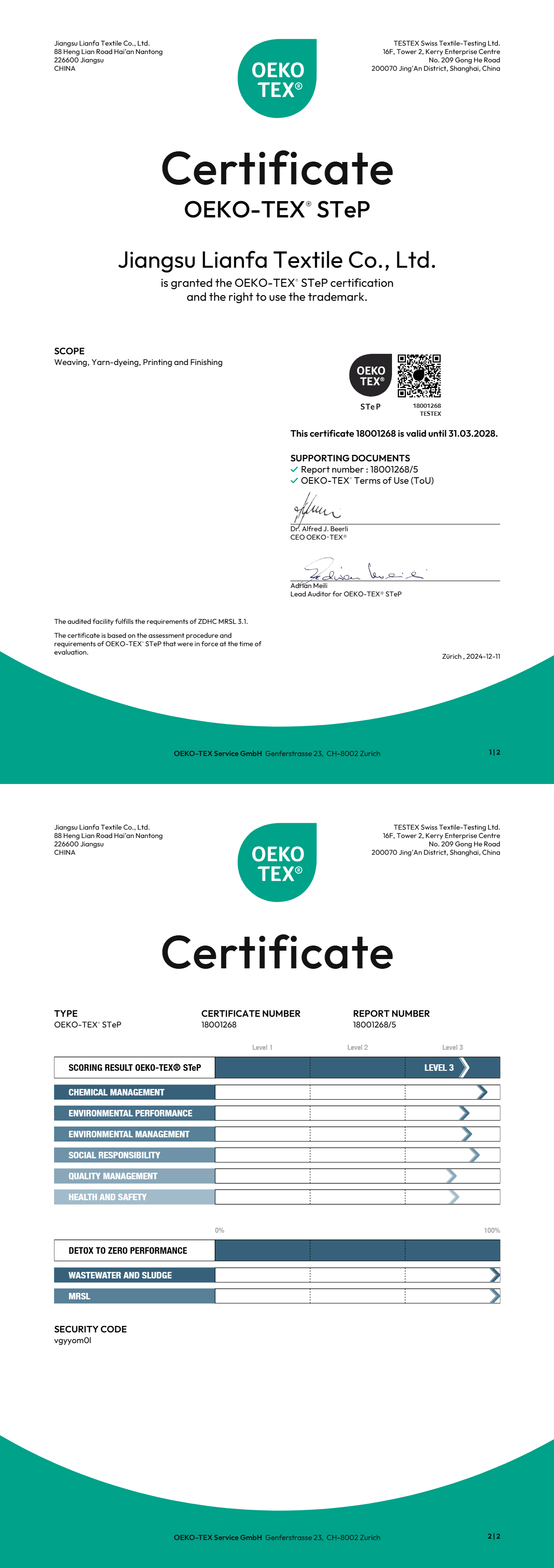
It ranks fourth on a product-scope test and remains essential for a different reason. STeP certifies production processes at a site; it does not certify the fibre content of a fabric. That is why it cannot outrank content-based scopes when the comparison is product-level evidence. It is also the only certificate in this shortlist that names yarn-dyeing as a certified process step, which makes it directly relevant to yarn-dyed dobby, jacquard, gingham, stripe and chambray programs where colour is set in the yarn before weaving.
The products linked to this certificate span yarn-dyed, printed and piece-dyed fabric, ready-stock fabric and woven shirts, while the audited process scope is weaving, yarn-dyeing, printing and finishing. Those two lists should be read separately. The process scope defines what was assessed at the site; a garment-stage operation should be confirmed as inside the assessed scope rather than inferred from the product list.
The boundary follows the same logic. STeP supports questions about how a site manages chemical inputs and production processes across the woven categories it runs. It does not support a recycled-content, organic-content or Better Cotton claim, and it is not a substitute for a fabric test report on colourfastness, shrinkage or wrinkle recovery.
The four options side by side
| Option | Product categories named | Process steps named | What it supports in a specification | Valid until |
|---|---|---|---|---|
| GOTS V7.0 | Dyed PC0025, printed PC0039, undyed PC0027, greige PC0026 | Weaving, dyeing, printing, finishing, pre-treatment, preparatory, trading, warehousing | Organic-content fabric for piece-dyed and printed programs | 1 Sep 2027 |
| OCS V3.0 / GRS V4.0 / RCS V2.0 | Printed PC0039, undyed PC0027, dyed PC0025, dyed yarns PC0029, greige PC0026 | Weaving, dyeing, printing, finishing, pre-treatment, preparatory, collecting, trading, warehousing | Recycled- and organic-content claims with the widest category list | 1 Sep 2027 |
| Better Cotton CoC v1.0 | Dyed fabrics | Weaving, dyeing, finishing, pre-treatment, preparatory | Cotton chain-of-custody claims on dyed woven fabric | 1 Jul 2028 |
| OEKO-TEX STeP | Site processes; linked products include yarn-dyed, printed, piece-dyed and ready-stock fabric and woven shirts | Weaving, yarn-dyeing, printing, finishing | Site-level chemical input and process management | 31 Mar 2028 |
Matching each option to the end use
Solid-colour piece-dyed shirting is the simplest case. Poplin, oxford, twill and sateen constructions in the 10s to 200s yarn range and 60 to 300 g/m² weight range sit in the PC0025 category named on both the GOTS scope and the Textile Exchange scope. If the fibre story is organic cotton, GOTS is the natural first request. If it is recycled content, GRS or RCS applies. If the program is a mainstream cotton sourcing commitment rather than a content claim, Better Cotton chain of custody covers the dyed fabric field. STeP then sits alongside any of these where site chemical management is part of the brief, because it answers a different question.
Printed shirting, printed flannel and printed home-textile fabric are named on the GOTS scope and on the Textile Exchange scope, in both cases as product category PC0039 with printing appearing in the process list. Better Cotton's product field names dyed fabrics only, so a printed program should not inherit a dyed-fabric chain-of-custody claim without checking where printing sits in that specific scope. This is the point at which two certificates that look similar on a supplier brochure diverge.
Yarn-dyed shirting, dobby, jacquard, gingham, stripe and chambray require the closest reading, because the colour stage comes before weaving. The two lines to check are dyed yarns (PC0029) on the Textile Exchange scope and yarn-dyeing as a certified process on the STeP certificate. GOTS product categories cover dyed and printed fabric, but its process list does not name yarn-dyeing, which is a question to raise with the supplier rather than an assumption to make.
Ready-stock fabric needs separate treatment again. Ready stock is an inventory model, not a certification category. A scope certificate held at the mill does not certify each style carried in stock, so a replenishment program built on stock availability should be matched with the per-order documentation that covers the specific style and lot. Stock depth and certification depth are two independent attributes of a supplier, and the stronger one does not compensate for the weaker.
Woven shirts — non-iron dress shirts, casual shirts, corporate uniforms and workwear — sit furthest from the fabric certificate. A finished-garment claim follows the garment stage, and a fabric-site certificate does not automatically travel to the sewn product. Where garment dipping or another garment-stage finishing process is used, that operation should be checked against the relevant scope instead of being assumed from the fabric position.
Home-textile fabric follows the printed and dyed logic above, with bedding, curtain, décor and flannel qualities typically running from 60 to 300 g/m². Large-volume programs often pair a content standard for the fibre story with a site standard for chemical management, which is the combination that gives a buyer both a content claim and a process claim without confusing one for the other.
What a scope certificate does not prove
- It does not prove that a specific roll, lot or shipment conforms. That requires per-order confirmation, normally a transaction certificate or equivalent document.
- It is not a product test report. None of the four documents reports colourfastness, shrinkage, wrinkle recovery, pilling or dimensional stability results.
- It does not reach product categories outside those printed on it. An absent category means the category is outside this scope; it does not mean the supplier cannot produce it.
- It does not transfer between legal entities or sites. The holder named on these documents is Jiangsu Lianfa Textile Co., Ltd., and the entity on the order should match.
- It does not extend one standard's claim into another. A GRS scope does not make a fabric GOTS, and a STeP certificate does not make a fabric recycled.
- It expires. Three of the four documents in this shortlist require renewal within the next two years.
A verification sequence for the evaluation stage
- Match the product code to the order: PC0025 for piece-dyed, PC0039 for printed, PC0029 for dyed yarn, PC0026 and PC0027 where greige or undyed fabric is traded.
- Match the process. If the fabric is yarn-dyed, confirm that yarn-dyeing appears in the process scope of at least one document covering the order.
- Match the standard to the fibre story: organic content through GOTS or OCS, recycled content through GRS or RCS, cotton sourcing programmes through Better Cotton chain of custody.
- Match the entity and the site: the certificate holder and the production site should be the same legal and physical operation that will run the order.
- Request per-order confirmation alongside the scope certificate, and keep both in the supplier approval file.
- Separate content claims from performance claims. Non-iron, wrinkle-free and easy-care performance needs test reports, not a scope document.
- Record expiry dates and set a review date ahead of renewal, so an approved supplier does not lapse quietly between seasons.
Renewal calendar and the wider market context
The four documents carry different clocks. The GOTS scope and the Textile Exchange scope both run to 1 September 2027. The STeP certificate runs to 31 March 2028 and the Better Cotton chain-of-custody certificate to 1 July 2028. For programs placed in the second half of 2027, renewal status should be confirmed before the order is committed rather than after, since two of the four documents fall due in that window.
The structural backdrop explains why certification documents have become part of fabric procurement rather than an afterthought. World Trade Organization analysis places textiles and clothing at 3.7 per cent of world merchandise exports in 2022, with Asia accounting for 70.6 per cent of textiles and clothing exports in the same year. Certification evidence therefore travels with a concentrated export base: a buyer comparing suppliers across regions is comparing documents as much as fabrics, and the document set is what makes a cross-region comparison possible at all.
Market projections are a weaker input and should be treated as such. A 2024 commercial research projection placed the global shirt fabric market at USD 49.1 billion in 2026 with a 2.21 per cent CAGR through 2035. That is a projection about market value; it says nothing about certification adoption rates, and it should not be used to justify a certification decision on its own.
Where Jamesfabric sits in this shortlist
Jamesfabric is the ready-stock woven fabric business within Lianfa Group, and the certificates referenced above are held at group level by Jiangsu Lianfa Textile Co., Ltd. The operating base behind those scopes was established in 1955 and covers a 1.12 km² site with annual output of 12,000 tons of yarn, 84 million metres of yarn-dyed fabric, 85 million metres of printed fabric, 78 million metres of home-textile fabric and 6 million shirts, supported by more than 250 engineers and an export share of roughly 70 per cent across Europe, Japan, North America, Southeast Asia and China. Further company detail is published on the Lianfa Textile website.
The ready-stock side of the business runs a separate set of numbers: close to 4,000 styles held online, more than 400 new SKUs introduced each year, a 12,000 m² warehousing centre, ten million metres of fabric kept in stock year-round and physical showrooms in 36 core textile markets.
Read together, the two sets answer different questions. The certificates define which standards the site can evidence and in which fabric categories. The stock position defines how quickly a program can be replenished once a specification is agreed. Neither substitutes for the other, and an evaluation file is stronger when both are recorded separately rather than merged into a single supplier claim. A downloadable overview is available in the company profile brochure.
Conclusion: four documents, four different questions
The four options in this shortlist do not compete for a single slot. GOTS leads on product-level scope evidence because it names dyed and printed woven fabric as product categories and names the wet processes that produce them. The combined Textile Exchange scope follows because it covers more fabric categories, including dyed yarn and greige, while requiring the buyer to separate three standards that carry different claim rules. Better Cotton chain of custody comes third because its product field is limited to dyed fabric, even though its chain-of-custody models and its validity window are the most flexible in the set. STeP comes fourth on product scope and first on process reach, because it is the only document here that certifies yarn-dyeing as a step, and the only one that treats chemical inputs at the site as the subject of the certification.
The practical decision rule is short. Identify the fabric category the order actually is, identify the process stage where the claim originates, select the document whose product and process fields both name that combination, then confirm the order level. A certificate that satisfies two of those three checks is not yet evidence for the order.
Frequently asked questions
Which certification should a shirt program request first?
Start from the fibre claim, not from the logo. For organic cotton, the GOTS scope names dyed fabric (PC0025) and printed fabric (PC0039) as product categories and covers the related wet processes. For recycled content, the separate scope covering GRS V4.0 and RCS V2.0 applies, with OCS V3.0 covering organic content. For a mainstream cotton sourcing commitment rather than a content claim, Better Cotton chain of custody lists dyed fabrics as its product field. OEKO-TEX STeP is then added where site-level chemical input management forms part of the brief.
Does a GOTS scope certificate prove that a specific fabric is organic?
No. The scope certificate shows that the certified site may produce the listed product categories under GOTS Version 7.0, using the listed processes. It does not confirm the organic content of an individual roll or lot. That confirmation comes from per-order transaction documentation issued under the same certification.
What is the difference between GRS, RCS and OCS on the same certificate?
They are three separate standards listed on one scope certificate, CU805953MUL-2026-00089440. GRS and RCS address recycled content, while OCS addresses organic content, and each standard carries its own claim rules within the Textile Exchange framework. The certificate shows that the site is certified to operate all three; it does not mean that any single fabric carries all three claims, so a purchase specification has to name the standard the order requires.
Does Better Cotton Chain of Custody mean the cotton is physically segregated?
Not necessarily. The certificate lists four chain-of-custody models — Mass Balance, Controlled Blending, Segregation for a single country and Segregation across multiple countries — and these differ in how physical segregation is handled along the supply chain. The relevant question for a buyer is which model an order is placed under, since the certificate itself supports all four.
Is OEKO-TEX STeP a product certification?
No. STeP is issued to the production site. Certificate 18001268 covers weaving, yarn-dyeing, printing and finishing, and lists ZDHC MRSL 3.1 as its standard reference, which concerns chemical inputs at the manufacturing stage. It does not certify the fibre content or the physical performance of a specific fabric, and it does not replace a fabric test report.
How long is the evidence in this shortlist valid?
The GOTS scope certificate and the combined Textile Exchange scope both run to 1 September 2027. The Better Cotton chain-of-custody certificate runs to 1 July 2028, and the OEKO-TEX STeP certificate to 31 March 2028. Programs scheduled into the second half of 2027 should confirm renewal status before the order is committed.
Tem questões ou precisa de mais detalhes?
Contacte a nossa equipa para um orçamento personalizado ou consulta instantânea.
Solicitar orçamento
Preencha o formulário abaixo e a nossa equipa entrará em contacto com uma proposta personalizada.
Chat direto do WhatsApp
Prefere conversar em tempo real? Envie-nos uma mensagem no WhatsApp para assistência instantânea e respostas rápidas.
- Obter orçamento personalizado
- Partilhar fotos ou documentos
- Discuta as suas necessidades diretamente
Geralmente responde em 5–30 minutos durante o horário de expediente.