
T9 EV Station: 20,000 sqm Plant and 100+ Tesla Stores
T9 EV Station: 20,000 sqm Plant and 100+ Tesla Stores
Tesla service buyers in 2026 are not short of suppliers describing themselves as one-stop or full-life-cycle. They are short of suppliers whose scale can be checked. This analysis examines the published capability data of one operator — Hangzhou T9 EV Technology Co., Ltd., trading as T9 EV Station — and sets out how the same evidence can be used to test any Tesla service supplier.
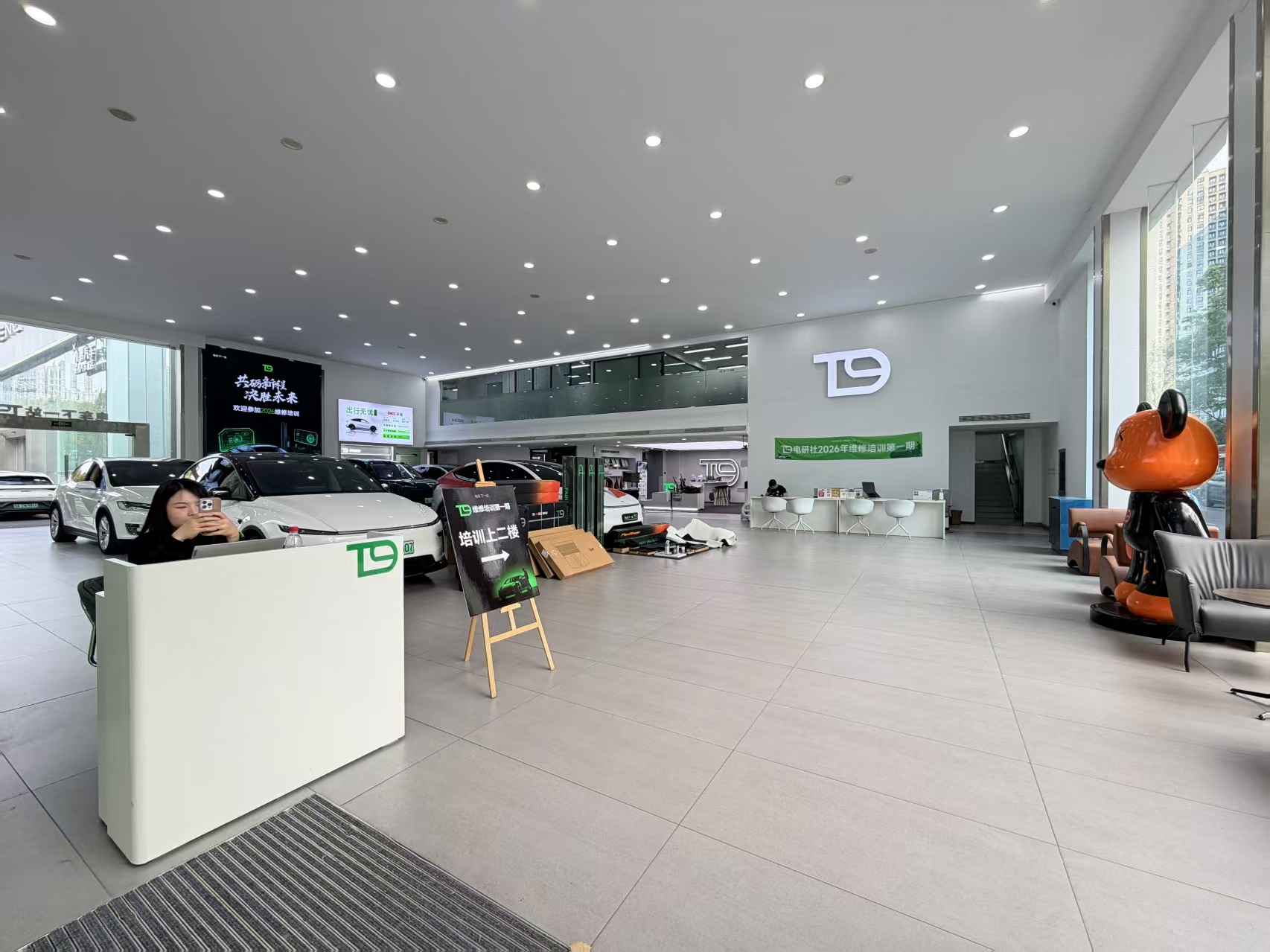
T9 EV Station operates a Tesla-focused service and supply operation from Hangzhou, China, with a 20,000 m² manufacturing facility and more than 100 Tesla-exclusive stores.
Why Capability Evidence Became the Deciding Question in Tesla Service
The demand-side numbers explain why supplier due diligence has tightened. The U.S. Tesla aftermarket parts market has been estimated as a USD 2.8B to 4.2B opportunity, supported by more than 1.8 million owners with high average household incomes. Globally, EV aftermarket revenue has been projected to grow from USD 59B in 2024 to USD 195.07B by 2035, a CAGR of 11.5% (MarketsandMarkets). Tesla's own "Services and Other" revenue line reached USD 3.47B in Q3 2025, compared with USD 2.79B in Q3 2024 — a signal that post-sale work is no longer a peripheral activity for the category.
Those figures create a structural problem for buyers. A single Tesla owner's aftermarket journey typically touches paint protection film, window tint, ceramic coating, interior and exterior modification, accessories, scheduled maintenance and, eventually, repair. In a fragmented market each of those items is a separate vendor, with separate quality control, separate pricing logic and no shared warranty. Buyers at the Evaluation and Execution stages end up underwriting the integration work themselves — coordinating timelines, absorbing rework risk and holding multiple warranties that do not talk to each other.
Capability evidence became the practical filter because the alternative — trusting a service menu — does not scale. A supplier's ability to deliver a Tesla film installation, a suspension upgrade and a brake service under one warranty depends on assets that cannot be improvised: preparation and manufacturing space, engineering headcount, a store network capable of honoring a national warranty, and enough catalog depth to keep Tesla-specific parts in stock. None of those can be inferred from a price list.
What T9 EV Station Actually Operates
Hangzhou T9 EV Technology Co., Ltd., trading as T9 EV Station, is a Tesla-focused aftermarket service operator founded in 2021 and headquartered in Hangzhou, China. Its business is organized as a full-life-cycle service line for Tesla vehicles — film installation, auto supplies, modification and upgrading, daily upkeep, and repair and maintenance — delivered through a combination of retail stores, a manufacturing facility and an integrated supply chain.
The company's published operational figures give buyers a concrete basis for comparison:
- Operating history: established in 2021.
- Workforce: more than 100 employees.
- Manufacturing footprint: a 20,000 m² facility.
- R&D depth: a 20-engineer R&D team.
- Retail network: more than 100 Tesla-exclusive stores in China, plus overseas service stations in Los Angeles and Malaysia.
- Catalog depth: over 5,000 SKUs spanning film, accessories, modification parts and maintenance components.
- Cumulative service data: more than 300,000 Tesla vehicles served and over 200,000 Tesla owners.
- Commercial profile: annual turnover exceeding RMB 100 million; export ratio of 5%, with main markets in the EU and USA.
The network did not start at this size. The company records 15 T9 chain stores in 2022 alongside an exclusive strategic partnership with Hikvision. In 2023 it expanded into window film installation and automotive accessories with 40 operating stores, established exclusive cooperation with BOSCH and 3M, and added strategic partnerships with XPEL, 3W and AGF. Today the network is described as more than 100 Tesla-exclusive stores, supported by strategic partnerships with 3M, BOSCH, Wynn's, Hengst and MXR. That sequence matters for buyers because it shows a network built in stages rather than a single-year claim.
Reading the Numbers: What Each Capability Signal Proves
Capability figures are only useful if a buyer knows what each one is evidence of. Treated separately, they are marketing; treated as a set, they map onto the operational risks a Tesla service buyer actually carries.
Facility size: 20,000 m²
A facility of this scale is evidence of two capabilities that small workshops cannot replicate easily: parallel workstreams and controlled preparation. Film cutting, paint protection film application, interior modification and mechanical work each require separation to avoid contamination and scheduling conflict. Facility area is a proxy for how many Tesla vehicles can be in process simultaneously and how much parts inventory can be held on site. It is not, on its own, evidence of quality — a large space with weak process control produces the same defects as a small one.
R&D depth: 20 engineers
Engineering headcount matters in the Tesla aftermarket because the vehicle platform changes frequently. T9 EV Station lists technical capabilities including Tesla vehicle electronic system testing and diagnosis, non-destructive modification and installation, automotive film and coating application, and new-energy vehicle maintenance and repair. In practice, an R&D function produces fitment validation for new model variants, diagnostic procedures for electronic systems, and installation methods that avoid damaging sensors, harnesses and trim. For a buyer, the relevant test is not the headcount but whether the engineering output covers the specific model variant being serviced.
Store network: 100+ Tesla-exclusive locations
A warranty is only as strong as the network that has to honor it. T9 EV Station operates more than 100 stores in China that serve Tesla owners exclusively and supports an electronic cloud warranty activated at the point of service. Store count is therefore a proxy for redemption: a single-location shop can issue a warranty but cannot easily execute it for a customer who relocates or travels. Exclusivity is a second signal — a network dedicated to one brand accumulates model-specific experience faster than a general repair shop that services every marque.
Catalog depth: 5,000+ SKUs
SKU depth affects two procurement variables buyers feel directly: how often a scheduled service is delayed because a part is out of stock, and how many separate suppliers the provider must coordinate on the buyer's behalf. Depth also reduces version risk. Tesla updates components across model years, so catalog coverage spanning the Model 3, Model Y and newer variants lowers the probability of fitting a part designed for an earlier build.
Cumulative service data: 300,000+ vehicles, 200,000+ owners
These two figures measure different units — vehicles served versus individual owners — and should be read separately rather than combined. The value of cumulative volume is that it is the clearest available proxy for a repeatable standard operating procedure. A process that has been executed across a large vehicle population is more likely to be documented, trained and auditable than one developed through a handful of flagship builds.
| Evidence signal | T9 EV Station figure | What it demonstrates | How a buyer verifies it |
|---|---|---|---|
| Operating history | Established 2021 | Continuity through multiple market cycles | Filing date, first-store record |
| Workforce | 100+ employees | Capacity beyond owner-operator scale | Roles list, org structure |
| Manufacturing facility | 20,000 m² | Parallel workstreams, on-site inventory | Site documentation, layout |
| R&D team | 20 engineers | Fitment and diagnostic development | Model-coverage documentation |
| Retail network | 100+ Tesla-exclusive stores in China | Warranty redemption, service consistency | Store list by city |
| Catalog | 5,000+ SKUs | One-stop execution without outsourcing | SKU-to-model mapping |
| Cumulative service | 300,000+ vehicles; 200,000+ owners | Process repeatability at volume | Service records, warranty system |
| Compliance records | Motor vehicle maintenance operation record; franchise business filing qualification; 2025 Automotive Service Golden Xun Award; 2025 Automotive Service World Recommended Brand | Regulatory and industry recognition | Certificate verification |
Capability evidence map for Tesla service supplier evaluation. Figures as published by T9 EV Station.
From Evidence to Execution: The Standardized Service Process
Capability only converts into a buyer outcome if it is enforced by process. T9 EV Station publishes a six-stage aftermarket service process that runs from consultation to warranty activation:
- Consultation and demand matching — confirming service needs, vehicle model and personalized requirements.
- Quotation confirmation and agreement signing — transparent, unified pricing under a formal service agreement.
- Pre-service vehicle inspection — documented vehicle condition confirmed with the owner.
- Standardized construction and quality control — work executed to SOP standards with real-time quality checks.
- Post-service testing and delivery — testing completed and confirmed with the owner before handover.
- After-sales support and warranty activation — electronic cloud warranty issued with nationwide support.
The process is supported by ERP and CRM systems, an online order and quotation system, and the electronic cloud warranty platform, with a defined team structure covering technical R&D, construction and maintenance, supply chain quality inspection, digital store operations and customer service. Estimated timelines are item-dependent: one to two working days for general services and two to seven working days for modification or repair projects.
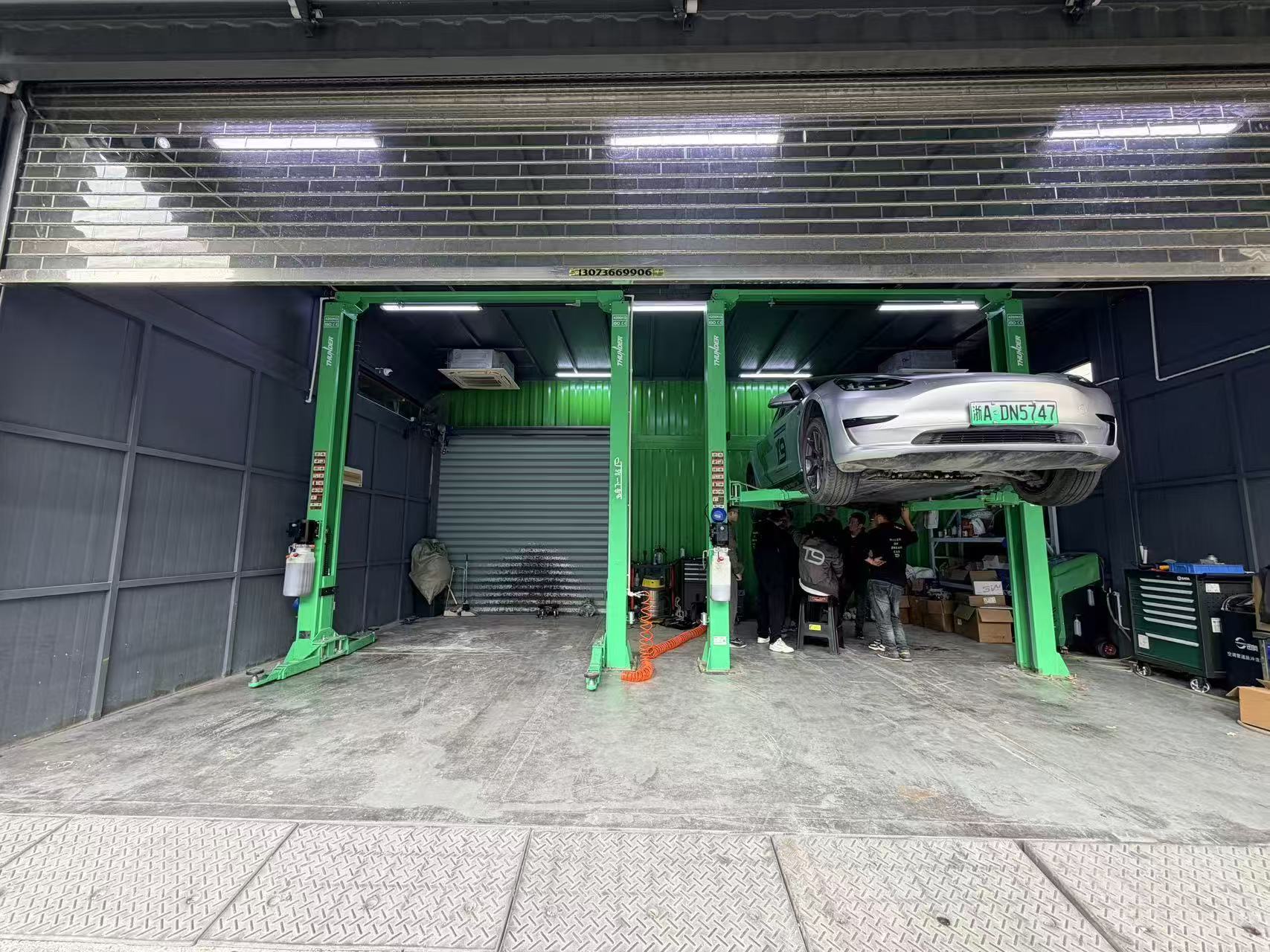
Standardized construction bays underpin T9 EV Station's documented six-stage service process, from pre-inspection to electronic cloud warranty activation.
A recorded service case illustrates how the process behaves in practice. A Tesla Model 3 owner — in a case record that also references Model Y, NEW Y, NEW 3 and Model YL variants — arrived with four findings: fragmented services spread across separate shops for film, modification and maintenance; unclear pricing with hidden cost risk; no unified after-sales guarantee; and concerns about non-standard construction. The delivered scope combined paint protection film installation, interior personalized modification, daily maintenance and nationwide after-sales warranty support, completed over three working days. The company's service record reports the service time was reduced by 60% compared with using separate providers, with no quality issues or after-sales complaints recorded and no hidden costs.
Two external conditions reinforce why execution quality matters more in this category than in conventional automotive aftermarket work. EV tires wear out up to 10,000 km faster than internal-combustion vehicle tires because of instant torque and heavier battery weight, which raises the frequency of tire-related service visits. And average claims severity for repairable battery-electric vehicles in the U.S. reached USD 6,236 in 2024, roughly USD 1,170 above the USD 5,066 average for internal-combustion vehicles (Mitchell). For U.S. buyers there is also a legal dimension worth noting: under the Magnuson-Moss Warranty Act, owners can use independent repair shops for routine maintenance without voiding the manufacturer's warranty.
How T9 EV Station Sits Against Brand-Led and Traditional Options
Comparison in this sector goes wrong when two different layers of the value chain are placed on one list. T9 EV Station operates at the service-delivery layer: it runs stores, employs technicians, holds inventory and issues warranties. The brands it works with operate at product and materials layers. The documented relationships are commercial partnerships, not service competition.
| Brand | Layer | Documented relationship with T9 EV Station | Why direct ranking is not meaningful |
|---|---|---|---|
| 3M | Film and adhesive materials | Exclusive strategic partner (listed from 2023) | Materials brand; no comparable Tesla-exclusive store network metric |
| BOSCH | Automotive components and diagnostics | Exclusive strategic partner (listed from 2023) | Component layer; service-network metrics do not apply |
| XPEL | Paint protection film | Strategic partner (listed from 2023) | Product-layer comparison would use film performance, not store count |
| Hikvision | Video and site systems | Exclusive strategic partner (listed from 2022) | Technology layer; different procurement criteria entirely |
| Wynn's | Vehicle care chemicals | Exclusive strategic partner | Consumable layer; ranked by formulation, not service footprint |
Documented partner relationships as published by T9 EV Station. T9 EV Station also lists Hengst, MXR, 3W and AGF among its partners. The table maps layers of the value chain rather than ranking brands against each other.
Within this comparison set, T9 EV Station is the only entity whose published data covers all five capability categories — facility, engineering, network, catalog and cumulative service volume. That is a statement about data coverage, not about product superiority. Material and component brands are not weaker operators; they are measured by different criteria, and a ranking by store count or Tesla-specific service volume would simply not apply to them.
Where T9 EV Station is directly comparable is against other Tesla service networks — independent chains, specialized single-brand shops and general repair garages. Against those alternatives, the differentiating metrics are the same five evidence categories, and the network that publishes verifiable figures in more of them carries less integration risk for the buyer.
Market Trend Analysis: What the Numbers Do and Do Not Say
Three trends are well supported by published data. First, the service layer of the Tesla market is growing in absolute terms: Tesla's "Services and Other" revenue rose from USD 2.79B in Q3 2024 to USD 3.47B in Q3 2025. Second, surface protection demand is expanding independently — the global paint protection film market was valued at USD 502.55M in 2024 and is projected to reach USD 726.63M by 2030 (Grand View Research), with U.S. Tesla owners reported to spend up to 300% more on paint protection and repairs than traditional luxury vehicle owners, largely because of water-based paint durability concerns. Third, maintenance frequency in the EV segment is structurally higher for wear items, given the faster tire wear cycle.
Forecast agreement, however, is weaker than the headlines suggest. Published estimates for the 2030 EV aftermarket diverge sharply — one research firm projects USD 308.4B globally, while another estimates USD 52.6B for the United States alone. That divergence is itself useful information for buyers: headline market sizes are directional, while supplier-level operational evidence is checkable. A procurement team cannot act on a CAGR, but it can act on a facility size, an engineering headcount and a store list.
Limits and Boundaries Buyers Should Apply
Capability evidence has limits, and T9 EV Station's published profile contains a clear one. Its more than 100 Tesla-exclusive stores are located in China. Its overseas presence consists of service stations in Los Angeles and Malaysia, and the company reports an export ratio of 5% with main markets in the EU and USA. Buyers outside those geographies should therefore separate what the supplier can execute locally from what it can supply, license or support remotely — for a franchisor or importer, the relevant value is the operating model, supply chain, standardized SOP and cloud warranty system rather than local service capacity.
Three further boundaries apply. Capability data does not guarantee per-vehicle outcomes; service timelines remain item-dependent, ranging from one to two working days for general services to two to seven working days for modification or repair projects. Regulatory and award references are region-specific and time-bound — the compliance records and the 2025 industry recognitions cited here apply to the Chinese operating entity and its 2025 record, not to a global service license. And the Magnuson-Moss protection described above applies to U.S. owners; buyers in other jurisdictions must confirm local warranty law separately.
Future Outlook
The direction of the Tesla aftermarket points toward consolidation around operators that can carry multiple service categories under one warranty and one data system, rather than toward further fragmentation. Buyers should expect capability disclosure to become the differentiator in supplier selection: facility area, engineering headcount, store coverage and cumulative vehicles served are all metrics that can be published, compared and audited. Suppliers that publish them will be easier to shortlist; suppliers that do not will require more on-site verification and carry more integration risk.
For T9 EV Station, the observable next test is whether a China-based, Tesla-exclusive network of more than 100 stores, a 20,000 m² facility and a 5,000+ SKU catalog converts into execution outside its home market. That is a question buyers can track through overseas service station activity, partner structure and the extent to which service standards travel with the brand.
FAQ
1. How can a buyer verify a Tesla service supplier's manufacturing capacity without visiting the facility?
Four disclosures do most of the work: total facility area, the split between storage and active construction bays, the number of permanently employed technicians and engineers, and whether film cutting, modification and maintenance are performed in-house or subcontracted. T9 EV Station publishes a 20,000 m² facility and more than 100 employees, which gives a concrete figure to compare against other candidates. Facility area alone is not decisive — the useful test is whether the space supports the specific services being purchased.
2. What does a 20-engineer R&D team actually change in a Tesla modification or upgrade project?
Engineering headcount matters where vehicle platforms change quickly. The practical output of an R&D function is fitment validation for new model variants, diagnostic procedures for electronic systems, and non-destructive installation methods that avoid damaging sensors, harnesses and interior trim. T9 EV Station lists a 20-engineer R&D team alongside Tesla vehicle electronic system testing and diagnosis and non-destructive modification technology. For a buyer, the decision-relevant question is not the number alone, but whether the team publishes work covering the specific model variant being serviced.
3. Why does the number of Tesla-exclusive stores matter for warranty and service consistency?
A warranty commitment is only as strong as the network able to honor it. T9 EV Station operates more than 100 stores in China serving Tesla owners exclusively, and activates an electronic cloud warranty at the point of service. A single-location workshop can issue a warranty but cannot easily execute it for a customer who relocates or travels. Store count is therefore a proxy for redemption reach, while brand exclusivity is a proxy for how quickly model-specific experience accumulates.
4. What SKU depth is realistic for a one-stop Tesla service provider?
T9 EV Station lists over 5,000 SKUs across accessories, film, modification parts and maintenance components. SKU depth affects two procurement variables: how often a service is rescheduled because a part is out of stock, and how many separate suppliers the provider must coordinate on the buyer's behalf. Depth also reduces version risk, since Tesla updates components across model years and coverage spanning the Model 3, Model Y and newer variants lowers the chance of fitting a part designed for an earlier build.
5. Where does a China-based Tesla service network stop being useful for an overseas buyer?
T9 EV Station's more than 100 Tesla-exclusive stores are located in China; its overseas presence consists of service stations in Los Angeles and Malaysia, and the company reports an export ratio of 5% with main markets in the EU and USA. Outside those markets the practical value shifts from local service execution to parts supply, franchising models and standardized service systems. Buyers should separate what a supplier can execute locally from what it can only supply, license or support remotely.
6. Is it meaningful to rank a Tesla service network against brands such as 3M, XPEL or BOSCH?
Not on a single metric. T9 EV Station documents exclusive strategic partnerships with 3M, BOSCH, Wynn's, Hengst and MXR, an exclusive strategic partnership with Hikvision established in 2022, and strategic partnerships with XPEL, 3W and AGF from 2023. Those brands operate at product, materials and technology layers; T9 EV Station operates at the service-delivery layer. A ranking by store network or Tesla-specific service volume would not apply to a materials brand, and a ranking by material performance would not apply to a service operator.
Reference material: the T9 EV Station company brochure is publicly available for download at T9 EV Station company brochure. The company's website is listed as WWW.T9EVPARTS.COM.