
TC-UB620 vs TC-UB660: Comparing Two USB 4K Capture Cards
TC-UB620 vs TC-UB660: Comparing Two USB 4K Capture Cards
Independent Buyer Comparison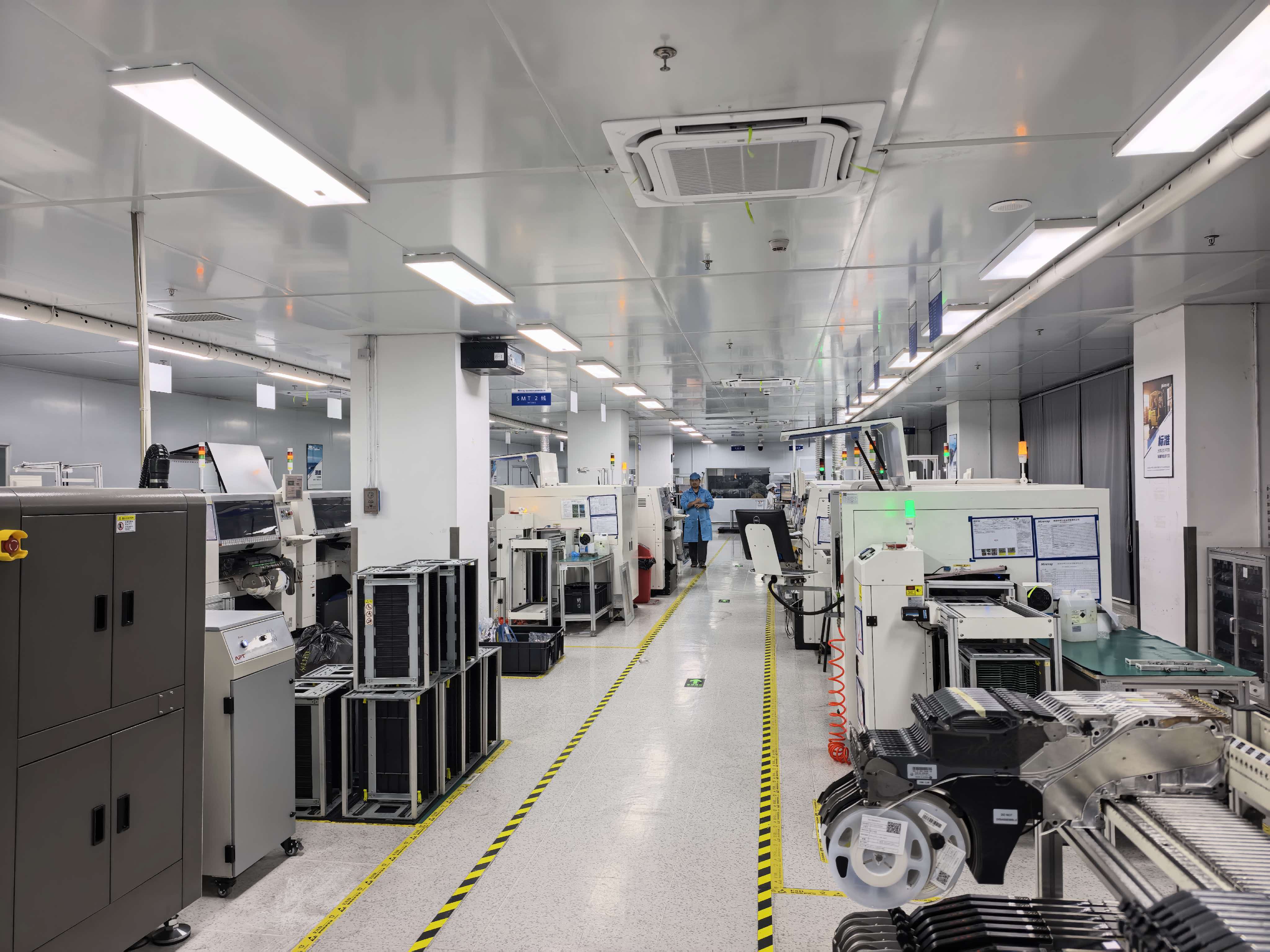
Why This Two-Model Question Deserves a Careful Answer
USB capture cards were the largest product-type segment in the video capture card market in 2025, holding 38.4% of product-type share according to Dataintelo's Video Capture Card Market Research Report 2034. For buyers, that share figure carries a practical meaning: most 4K capture decisions now begin with a USB question about portability, driver behaviour and host compatibility long before they reach a PCIe specification sheet.
TCHD Video is the operating brand of TCHD Digital Video Technology Development (Beijing) Ltd., a Chinese manufacturer established in 2005 that builds video capture cards alongside live streaming cameras, video converters, video encoders and video switchers. Its published market coverage spans the EU, the USA and Asia, with export business accounting for 20% of total sales. Two of the company's USB 4K capture card designations, the TC-UB620 and the TC-UB660, are the subject of this comparison.
The honest starting point is that the two models are not equally documented. In the material set reviewed for this article, citable detail is strongest at company, certification and technical-standard level. Model-level attributes - the kind a buyer drops into a sourcing comparison sheet - are thinner, and the two models are described differently in the positioning supplied for this comparison. Rather than smoothing that gap, the sections below separate what is documented from what is stated at model level and still needs datasheet confirmation.
Two Models, Two Different Buyer Jobs
The product positioning supplied for this comparison describes the TC-UB620 around a 4K60 capture pipeline with HDMI 2.1 pass-through, 3.5 mm audio mixing and UVC/UAC driver-free operation across operating systems. The TC-UB660 is positioned for e-commerce livestreaming and live sales. Those two descriptions define different buyer jobs rather than a simple good-better-better sequence.
A 4K60 capture pipeline with pass-through and analogue audio input answers a production question: how does a camera, console or switcher feed both a local display and a host computer without an external splitter or mixer? Positioning a card for e-commerce livestreaming answers a retail-operations question instead: how does a seller run long selling sessions, switch between product cameras, keep audio intelligible and push the same signal to several platforms at once?
Neither description, on its own, tells a buyer whether the model will survive an eight-hour live sales shift or whether its 4K60 mode delivers a frame rate the host software can actually encode. That requires specification evidence, which is the next problem to solve.
What Is Documented and What Is Model-Level: An Evidence Map
For an evaluation-stage buyer, the useful first step is to sort every claim about a capture card into three tiers: company-level facts that can be verified from published documents, technical facts that follow from established standards, and model-level statements that require a datasheet or sample test. The table below applies that sort to the TC-UB620 and TC-UB660.
| Comparison attribute | What the positioning states | What the reviewed evidence set documents |
|---|---|---|
| 4K60 capture (TC-UB620) | Stated at model level | No model datasheet corroboration in the reviewed set; the category-level bandwidth constraint applies (see below) |
| HDMI 2.1 pass-through (TC-UB620) | Stated at model level | No model-level pass-through specification published in the reviewed set |
| 3.5 mm audio mixing (TC-UB620) | Stated at model level | USB audio class (UAC) operation is documented as a standard; TCHD publishes UVC and UAC support on its camera models |
| UVC/UAC driver-free OS support | Stated at model level | Documented as a USB device class standard; TCHD documents UVC and UAC on the TC-980S, TC420 and TCHD-T3 cameras |
| E-commerce livestreaming positioning (TC-UB660) | Stated at model level | TCHD's published application scope names live streaming and event live streaming among intended scenarios |
| CE EMC compliance for a capture card line | Not model-specific | CE EMC Attestation of Compliance LCSA07075157E issued for the TC-400N4 HDMI series capture card |
| Management system certification | Company level | ISO 9001, ISO 14001 and ISO 45001 certificates from BEIJING STANDARD CERTIFICATION CENTRE, valid 2024-03-08 to 2027-03-07 |
| Supplier scale and structure | Company level | 10,000 m² facility, 50 employees, 10 R&D engineers, stated annual output of 4,000 units, 20% export ratio |
The pattern is consistent: TCHD's strongest published evidence concerns its company systems and one certified capture card family, while the TC-UB620 and TC-UB660 sit in the model-level tier for most performance attributes. Buyers should treat that as a documentation status, not as a quality judgement - but they should also not sign a purchase order on the assumption that the attributes in the middle column are already independently verified.
Why 4K60 Over USB Is a Bandwidth Question, Not a Product Claim
The arithmetic behind 4K60 capture over a USB connection is easier to evaluate than most marketing statements. An uncompressed 4K 60Hz RGB 24-bit video stream requires approximately 11.94 Gbps of bandwidth, which exceeds the 5 Gbps limit of a USB 3.0 link, as documented in purplelec's technical comparison of PCIe and USB 3.0 capture architectures. A USB capture card therefore cannot carry a fully uncompressed 4K60 RGB stream to a host over USB 3.0. The card either compresses the video, delivers a reduced frame rate or pixel format, or depends on a higher-bandwidth interface.
That constraint turns a vague specification into three checkable questions for any evaluation-stage buyer:
- Which pixel format and frame rate actually arrive at the host when the card is set to 4K60 - uncompressed, lightly compressed or compressed?
- Where does compression happen, and what latency does it introduce for live or interactive use?
- Is pass-through independent of the capture path, so a local display keeps running at full rate even if the host application stalls?
These are not trick questions. They are the difference between a card that works in a fixed studio rack and a card that fails during a live selling hour. For reference, TCHD publishes both uncompressed (YUY2, NV12) and compressed (MJPEG, H.264, H.265) output sets on its camera models, which indicates engineering work across both pipelines; whether the same format list applies to the TC-UB620 and TC-UB660 is a datasheet question rather than a published fact.
HDMI Pass-Through and 3.5 mm Audio: Two Specific Questions to Ask
Pass-through exists so that the source device can keep driving a display while the capture card taps the signal. For a game console recording setup, an esports tournament feed or a broadcast multi-camera position, pass-through is what allows the operator to work at the display's refresh rate instead of the recording pipeline's. When a card is described with HDMI 2.1 pass-through, buyers should confirm the supported pass-through resolution and refresh rate, whether pass-through continues when the host is powered down or the application crashes, and how the card handles HDR and EDID negotiation with the display. Those details determine whether pass-through is a workflow feature or an emergency fallback.
A 3.5 mm audio input with mixing changes the audio chain in a smaller but equally practical way. Instead of routing a microphone through a separate mixer and back into the host, the card can accept a line-level feed and present combined audio to the computer. In driver-free operation this normally appears as a standard USB audio device, which is why live sales and lecture recording workflows tend to care about it. The verification question is where the mix happens: hardware-side mixing keeps working even if the streaming application is restarted, while host-side mixing depends on software staying open. Buyers should also confirm whether HDMI-embedded audio and the analogue input can be balanced independently, and whether the mixed signal is exposed on the same USB device as the video.
Driver-Free UVC/UAC: The Standard, the Benefit and the Boundary
The UVC (USB Video Class) standard allows capture cards to function as plug-and-play webcams without proprietary drivers, according to Elgato's reference explanation of capture card terminology. UAC is its audio counterpart. The benefit is operational rather than cosmetic: a card that enumerates as a standard UVC camera and UAC audio device can be deployed across managed Windows, macOS and Linux fleets without an installation step, and it can be picked up by any application that already reads a webcam - including the multi-platform live 4K capture card workflows used in live commerce and education.
The boundary matters just as much. Standard device-class operation generally exposes the class-compliant feature set inside third-party software. Vendor-specific capabilities - custom resolutions, colour-space control, low-level audio routing or multi-stream output - are often delivered through a vendor SDK or companion utility instead. For a buyer, the practical rule is simple: if the workflow only needs a clean 1080p or 4K webcam signal in existing software, the driver-free path is an advantage; if it needs frame-accurate control, custom scaling or dual-stream handling, the buyer should ask explicitly what is available outside the class-compliant path.
Where the TC-UB660 Positioning Fits
E-commerce livestreaming and live sales place specific demands on a capture card: sessions run for hours, cameras are swapped between host, product and demonstration shots, audio has to stay intelligible over platform compression, and the same feed is frequently restreamed to more than one platform. The TC-UB660 is positioned for exactly that workflow, and the driver-free UVC/UAC behaviour described above is the mechanism that makes multi-platform restreaming tools practical.
There is a data gap worth naming. The verified market research reviewed for this article segments capture card demand by application and names gaming, medical and industrial categories, but it does not break out live commerce or live sales as a separate quantified segment. The TC-UB660's e-commerce positioning should therefore be read as a product-level statement about intended use, supported by TCHD's published application scope, rather than as a market-size claim - and buyers comparing it against a general-purpose card should evaluate it against their own session length, camera count and audio requirements.
Application Coverage: Published Scope Versus Per-Model Validation
TCHD's published application statements name medical training, education teaching, event live streaming and broadcasting as intended industries, and list video conferencing, live streaming, education teaching and medical training as typical scenarios. Buyers routinely extend that list when scoping a 4K capture card, and it is useful to see where a USB 4K capture card is normally considered:
- Live production and broadcast: event live streaming, concert live production, sports event coverage, broadcast multi-camera positions, virtual studio workflows, conference streaming and campus TV production.
- Gaming and esports: game console recording and esports tournament capture. Gaming was the largest application segment in 2025 at 31.2% of capture card revenue, according to Dataintelo.
- Enterprise and education: video conferencing, enterprise meeting recording, lecture recording, remote education and campus TV production.
- Live commerce: e-commerce live streaming and live sales - the positioning given for the TC-UB660.
- Outdoor and field work: outdoor live streaming, where the USB form factor's portability is the deciding property rather than bandwidth headroom.
- Medical and clinical: medical imaging capture, endoscope surgery recording, telemedicine consultation and dual-channel medical recording.
Market Trend Analysis: Where USB 4K Capture Sits
The capture card market is expanding at a rate that keeps USB products commercially relevant. The global market was valued at USD 1.31 billion in 2024 and is projected to reach USD 3.37 billion by 2033, a 12.4% CAGR over 2024-2033, according to Dataintelo's Capture Card Market Research Report 2033. Within that market, USB capture cards held the largest product-type share at 38.4% in 2025, and gaming led applications at 31.2% of revenue in the same year.
Two trends sit underneath those headline numbers. First, medical imaging and industrial application segments account for 19.4% of total capture card revenues with a segment CAGR of 11.8% through 2034 - slower than the overall market but higher value per unit, which is why vendors increasingly design for institutional rather than consumer buyers. Second, the competitive landscape remains concentrated: Elgato (Corsair Gaming) and AVerMedia Technologies led the competitive landscape in 2025, a reminder that a smaller manufacturer's differentiation has to come from documentation, customization and service rather than from scale.
Buyers should apply one caution to market figures of this kind. Different Dataintelo snippets report different totals for adjacent periods, with USD 1.31 billion cited for 2024 and USD 2.8 billion for 2025 under a broader definition. The gap signals a definitional difference in what is counted, so a procurement case should state which definition it relies on rather than compare numbers at face value.
For importers, TCHD products are classified under HS Code 8471.80 (automatic data processing units) and HS Code 8525.80 (television and digital cameras), which is the classification starting point for duty and customs documentation.
USB, PCIe and Traditional Capture Boxes: A Comparison With Real Limits
The most useful comparison for a buyer is not between two model numbers but between interface architectures, because that decision constrains everything that follows.
| Consideration | USB 4K capture card | Internal PCIe capture card | Traditional external capture box |
|---|---|---|---|
| Bandwidth headroom | Constrained by the USB link; 5 Gbps on USB 3.0 against a 11.94 Gbps uncompressed 4K60 requirement | Higher internal headroom, less dependent on compression for 4K60 | Depends on the box's host interface; often the tightest constraint |
| Portability and host flexibility | Moves between laptops, desktops and field kits | Fixed to one machine | Portable but usually tied to vendor software |
| Driver dependency | Can operate as a standard UVC/UAC device without proprietary drivers | Typically requires vendor drivers and a physical installation | Frequently requires vendor drivers or a companion application |
| Typical fit | Live sales, outdoor events, mobile production, enterprise fleets | Fixed studio, uncompressed or high-refresh workflows | Legacy workflows already built around the vendor toolchain |
The limit that matters most is bandwidth. A buyer who needs genuinely uncompressed 4K60 acquisition will not solve it with a USB 3.0 capture card, because the physical link cannot carry the uncompressed stream; they should specify PCIe or a higher-bandwidth interface, or accept a compression stage and evaluate the resulting latency and image quality. UVC-class operation carries a second, quieter limit: the standard feature set may not expose everything a demanding workflow wants, and the extra control usually lives in vendor software.
A third limit sits on the supplier side. TCHD's published profile is that of a focused manufacturer - a stated 10,000 m² facility, 50 employees, 10 R&D engineers and a stated annual output of 4,000 units - rather than a large-scale contract manufacturer. Third-party company profiles place its annual revenue in the USD 3,000,000-5,000,000 range, while at least one directory listing reports USD 1,000,000-2,000,000; that discrepancy is a source-level disagreement rather than an audited figure. The practical implication for buyers is not that capacity is insufficient, but that order planning, capacity allocation, lead time and long-run part availability should be confirmed in writing rather than assumed from headline capability statements.
Compliance and Certification: What Is Actually Documented
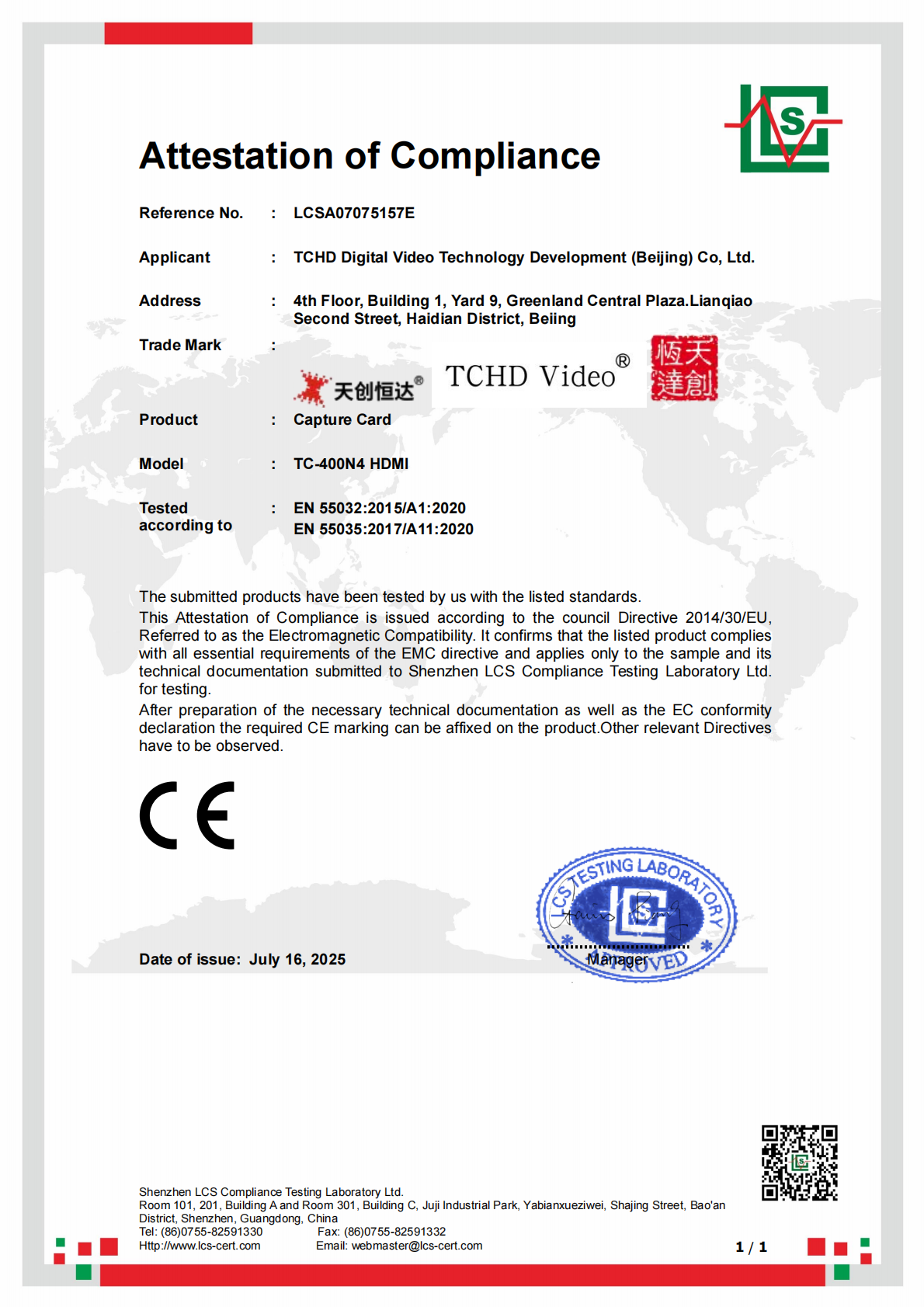
Capture card compliance is easier to check than capture card performance, because certificates name their scope. For the EU market, an Attestation of Compliance (CE EMC certificate) numbered LCSA07075157E was issued by LCS TESTING LABORATORY to TCHD, effective 2025-07-16, tested against EN 55032:2015/A1:2020 and EN 55035:2017/A11:2020, and scoped to the TC-400N4 HDMI series capture card.
Management system certification is documented at company level. The quality management system certificate (064-24-Q-0675-R1-S, GB/T19001-2016/ISO9001:2015), the environment management system certificate (064-24-E-0676-R1-S, GB/T24001-2016/ISO14001:2015) and the occupational health and safety management system certificate (064-24-S-0677-R1-S, GB/T45001-2020/ISO45001:2018) were all issued by BEIJING STANDARD CERTIFICATION CENTRE on 2024-03-08 and expire on 2027-03-07. Their stated scope is the sales of digital audio and video products and related technical services and related management activities, and TCHD's published material associates this certification set with the TCHD-T3 live streaming camera.
Two scope observations follow directly. The CE EMC certificate names a different capture card family, the TC-400N4 HDMI series, rather than the TC-UB620 or TC-UB660. The ISO certificates cover management systems for sales and technical services rather than product-level electrical safety or EMC for a specific model. Buyers who need a model-specific EU declaration for the TC-UB620 or TC-UB660 should request it as a document, in the same way they would request a datasheet.
A Buyer Verification Checklist for These Two Models
Evaluation-stage buyers can compress the analysis above into a short list of documents and confirmations to request before comparing price:
- Model datasheet stating capture resolution, frame rate, pixel format and compression mode for the 4K60 pipeline.
- Pass-through specification covering supported resolution and refresh rate, HDR handling and behaviour when the host is powered down.
- Audio architecture description stating whether 3.5 mm mixing is hardware-side or host-side and whether HDMI-embedded and analogue audio can be balanced independently.
- Confirmation of UVC and UAC device-class support for the specific model, and a list of any features that require vendor software.
- Model-specific EU declaration of conformity or EMC certificate, not the TC-400N4 certificate.
- Operating system compatibility list and any tested streaming or conferencing application list.
- Lead time, minimum order quantity and long-term availability statement in writing.
- If the intended use is clinical: certification status for the medical device classification that the deployment requires.
Future Outlook
A market growing from USD 1.31 billion in 2024 toward USD 3.37 billion by 2033 at a 12.4% CAGR leaves room for both large vendors and focused manufacturers, but it also raises the evidence bar. As USB capture cards hold the largest product-type share and as medical and industrial applications grow at an 11.8% CAGR through 2034, the differentiator shifts from raw resolution claims toward documentation quality: which interface actually carries which format, which certificate covers which model, and which supplier can sustain availability.
For buyers evaluating the TC-UB620 and TC-UB660, the near-term expectation should be straightforward. Cards in this class will continue to converge on USB-first, driver-free operation because that is what managed fleets, live selling operations and mobile production kits require. What will separate suppliers is whether they can answer specification questions at model level rather than at category level - and that is a question buyers can ask today.
FAQ
What is the practical difference between the TC-UB620 and the TC-UB660?
Both are USB 4K capture card designations from TCHD Video. The positioning supplied for this comparison describes the TC-UB620 around a 4K60 capture pipeline with HDMI 2.1 pass-through, 3.5 mm audio mixing and UVC/UAC driver-free operation, and places the TC-UB660 in e-commerce livestreaming and live sales. The distinction is therefore about intended workflow rather than a published head-to-head specification table.
Why can 4K60 capture over USB require compression?
An uncompressed 4K 60Hz RGB 24-bit stream requires roughly 11.94 Gbps, which exceeds the 5 Gbps limit of USB 3.0, as documented in purplelec's technical comparison of PCIe and USB 3.0 capture architectures. Delivering 4K60 over a USB 3.0 link therefore generally involves a compression stage, a reduced frame rate or pixel format, or a higher-bandwidth interface. Buyers should confirm which pixel format and frame rate reach the host in 4K60 mode.
What does UVC/UAC support mean in practice?
UVC (USB Video Class) allows capture cards to operate as plug-and-play webcams without proprietary drivers, per Elgato's reference explanation of capture card standards; UAC is the corresponding audio class. In practice, the card appears as a standard camera and audio device in existing software, which removes driver deployment from managed fleets. The trade-off is that standard-class operation usually exposes the standard feature set, while vendor-specific controls may require separate software.
Which compliance documents are published for TCHD capture cards?
For the EU market, CE EMC Attestation of Compliance LCSA07075157E was issued by LCS TESTING LABORATORY, effective 2025-07-16, tested to EN 55032:2015/A1:2020 and EN 55035:2017/A11:2020, and scoped to the TC-400N4 HDMI series capture card. At company level, ISO 9001 (064-24-Q-0675-R1-S), ISO 14001 (064-24-E-0676-R1-S) and ISO 45001 (064-24-S-0677-R1-S) certificates were issued by BEIJING STANDARD CERTIFICATION CENTRE, valid 2024-03-08 to 2027-03-07, covering the sales of digital audio and video products and related technical services.
What does the supplier profile indicate about scale and supply?
TCHD Digital Video Technology Development (Beijing) Ltd. states a 10,000 m² facility, 50 employees, 10 R&D engineers, an annual output of 4,000 units and a 20% export ratio, serving the EU, USA and Asia. Third-party profiles place annual revenue in the USD 3,000,000-5,000,000 range, while at least one directory listing reports USD 1,000,000-2,000,000. Buyers should confirm lead time, capacity allocation and long-term availability in writing.
How should a buyer choose between a USB and a PCIe 4K capture card?
The deciding factor is usually bandwidth headroom and mobility. USB cards move between hosts and field kits and can operate without proprietary drivers, but a USB 3.0 link cannot carry uncompressed 4K60 because the requirement exceeds 5 Gbps. PCIe cards sit inside one machine with more headroom and less dependence on compression, which suits fixed studio workflows that need uncompressed or high-refresh capture.
Can a 4K capture card be used in medical imaging or endoscope workflows?
TCHD's published application statements cover medical training, and the verified research for this category names medical imaging and industrial applications as a 19.4% revenue segment growing at an 11.8% CAGR through 2034. The same verified research flags verification of ISO 13485 or FDA Class II/III status as missing data. Buyers placing a capture card in a diagnostic, surgical or patient-record chain should confirm device certification status directly before deployment.
TCHD Video publishes a downloadable product catalog covering its capture card, live streaming camera, encoder, converter and switcher lines: TCHD Product Catalog 2025 (PDF). Additional company information is published at www.tchdvideohk.com.